From Facebook:
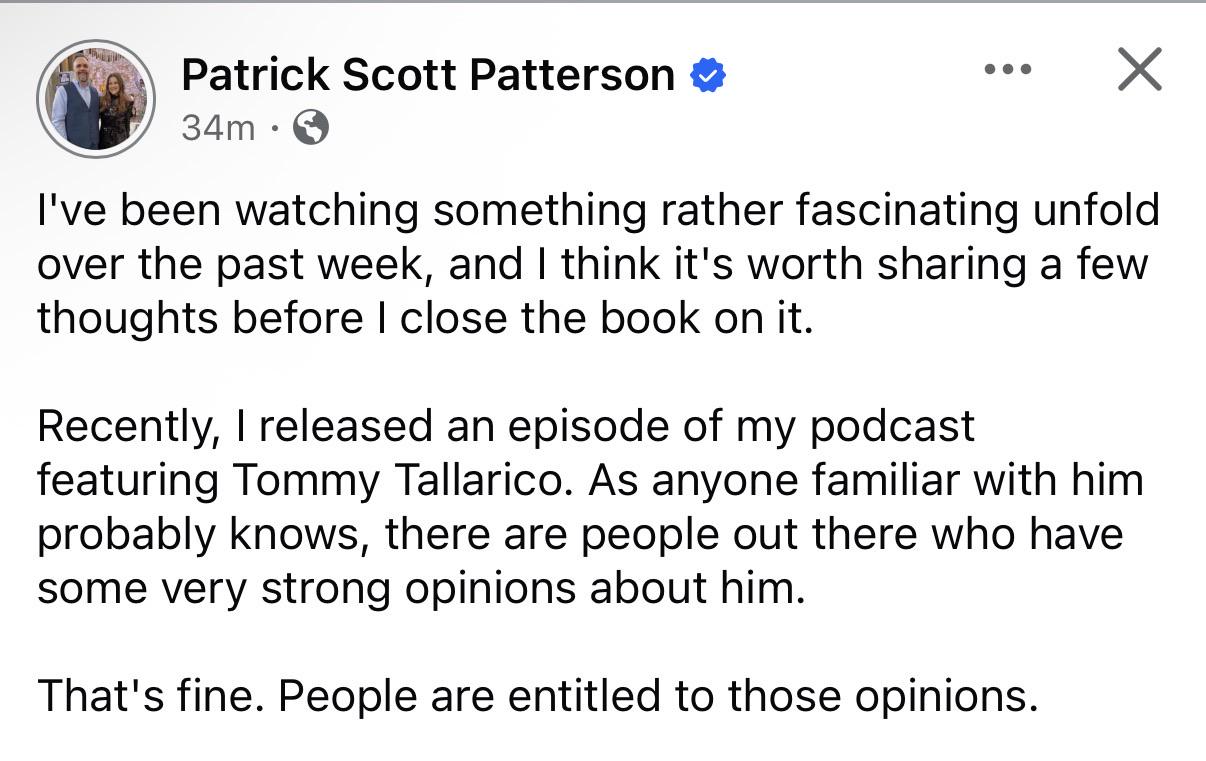
I've been watching something rather fascinating unfold over the past week, and I think it's worth sharing a few thoughts before I close the book on it.
Recently, I released an episode of my podcast featuring Tommy Tallarico. As anyone familiar with him probably knows, there are people out there who have some very strong opinions about him.
That's fine. People are entitled to those opinions.
Some have made accusations about things he's allegedly said or done over the years. Some have challenged statements he's made in previous interviews. Some simply don't like the guy.
Again, that's their prerogative.
But what has fascinated me isn't necessarily the criticism of Tommy Tallarico. It's the behavior of some of the people delivering that criticism, particularly when they turn their attention toward me for having interviewed him.
And there's a rather important distinction here that I think is being lost.
Holding Tommy Tallarico accountable for things people believe he's done and holding ME accountable for giving him an opportunity to talk about his life and career are two entirely different things.
Yet some people seem determined to make them inseparable.
My podcast is about people. Their lives, their careers, their experiences, their journeys. It's not an investigative program. It's not a courtroom. I'm not a prosecutor, and I don't pretend to be one.
And there's another point that seems to be getting lost in all of this.
This was Episode 70 of an ongoing, weekly podcast. Not Episode 1. Not some standalone production created specifically to feature Tommy Tallarico. Episode SEVENTY.
There were 69 episodes before it, featuring people from all walks of life, and there will be plenty more after it.
Tommy Tallarico was one guest in a long-running series of conversations. That's it.
Yet judging by some of the reactions, you'd almost think I launched an entire podcast for the sole purpose of giving this particular individual a platform.
I didn't.
I had a podcast before Tommy Tallarico appeared on it. I have a podcast after Tommy Tallarico appeared on it. The format, the purpose and the approach haven't changed.
One guest does not define an entire program any more than one conversation defines an entire person.
And I find it particularly strange that some people seem determined to make this one episode the defining moment of a show that has already featured dozens of other guests, with many more to come.
It's one chapter in a much larger book.
And I'm already writing the next one.
I've never required my guests to pass some sort of universal popularity test before appearing on my show. Frankly, I wouldn't even know how to administer such a test. People have different opinions, different experiences and different reasons for liking or disliking someone.
That's life.
Yet I've watched some people behave as though their personal opinion of Tommy Tallarico should automatically become MY personal opinion of Tommy Tallarico.
And if it doesn't?
Well, apparently that makes me part of the problem.
That's where things get rather strange to me.
I've had people reference interviews Tommy gave years ago, statements he allegedly made elsewhere, and controversies that have absolutely nothing to do with the conversation I recorded.
Some seem to have studied his every public statement with the dedication of someone preparing a doctoral dissertation. They've analyzed comments, compared interviews, examined wording and drawn conclusions about what they believe he meant or intended.
And that's their choice. If that's how they wish to spend their time, more power to them.
But I haven't watched, read or listened to every interview Tommy Tallarico has ever given. Nor do I have any obligation to do so.
What's particularly interesting is that I've challenged people to identify problems with the actual episode I produced. Not something Tommy said to somebody else ten years ago. Not something they believe I should have asked him. Something genuinely objectionable about the conversation that actually took place.
Thus far, I've seen remarkably little of that.
Instead, much of the criticism seems to revolve around the fact that I gave someone they dislike an opportunity to speak.
And that brings me to something much bigger than Tommy Tallarico.
When did disliking someone become a moral obligation that everyone else is expected to share?
It's perfectly reasonable to criticize a public figure. It's reasonable to question statements, examine evidence and hold people accountable for their actions.
But somewhere along the way, some people seem to have decided that simply disagreeing with someone isn't enough.
Everyone ELSE must disagree with that person, too.
And if they don't, they're somehow guilty by association.
Think about how unreasonable that standard really is.
Under that way of thinking, simply having a conversation with someone becomes an endorsement of everything they've ever said or done. If you don't publicly condemn them, you're defending them. If you don't ask the questions someone else wants asked, you're somehow complicit.
That's an extraordinary amount of responsibility to assign to someone for simply conducting an interview.
And it creates a situation where the actual content of the conversation becomes almost irrelevant.
The offense isn't necessarily something I said or did during the interview. The offense is that the interview happened at all.
Here's another thing I've been thinking about.
Even if every accusation made against Tommy Tallarico were proven to be 100 percent true, that still wouldn't justify the behavior I've witnessed from some of his critics.
Read that again.
Being right about someone else's wrongdoing doesn't automatically make your own behavior right.
Insulting people, making personal attacks, attempting to intimidate others or repeatedly demanding that strangers participate in your grievances doesn't suddenly become acceptable because you believe you're fighting for a good cause.
You can be absolutely correct about something and still behave terribly while making your point.
Those two things are not mutually exclusive.
And I think that's something we've lost sight of in a world where people are increasingly encouraged to treat every disagreement like a battle that must be won.
Sometimes it seems as though people become so invested in being on the morally correct side of an argument that they stop examining their own conduct.
The thinking becomes something like, "I believe this person is bad, therefore anything I do in opposition to that person must be good."
No. That's not how it works.
A legitimate grievance does not automatically legitimize every action taken in pursuit of that grievance.
In fact, I would argue that if you genuinely believe you're standing up for what's right, you should be especially mindful of how you treat other people while doing so.
Otherwise, what exactly are you demonstrating?
There's also a difference between informing someone about a controversy and demanding that they become personally invested in it.
If you believe there's something important that people should know, you can present the information. You can provide evidence. You can explain your concerns.
But you cannot reasonably expect to control how someone else responds to it.
And you certainly cannot demand that someone dedicate their time, energy or professional platform to pursuing a cause simply because it's important to YOU.
That's the difference between criticism and attempting to control someone else's response.
And I think that distinction explains a great deal of what I've witnessed.
For some people, apparently, it's not enough that they dislike Tommy Tallarico. They need me to dislike him, too. They need me to demonstrate that dislike publicly. They need me to acknowledge their grievances in precisely the manner they believe those grievances deserve.
And when I don't?
That becomes another reason to be upset.
It's almost as though my refusal to participate in the conflict becomes a conflict of its own.
Which raises an interesting question.
If your issue is genuinely with Tommy Tallarico, why does my refusal to share your level of anger become such a problem?
I'm not preventing anyone from criticizing him. I'm not asking anyone to change their opinion. I'm not demanding that anyone watch or enjoy my episode.
I'm simply continuing to do what I've been doing since launching this podcast.
Talking to people.
Yet somehow, that appears to be insufficient for some.
And perhaps there's another psychological element at work here.
When someone has invested a tremendous amount of time and emotional energy into disliking a public figure, that dislike can become something more than an opinion. It can become a cause. A community. Even part of how they identify themselves.
At that point, seeing the person they dislike treated as an ordinary human being rather than the subject of an ongoing confrontation may feel, to them, like an injustice.
The conversation itself becomes offensive because it doesn't reinforce the narrative they've spent so much time constructing.
Now, I'm not suggesting that everyone criticizing Tommy falls into that category. Far from it. Some people have expressed their concerns respectfully, and I have no issue with that whatsoever.
But the behavior of others has certainly made me wonder whether the objective is still accountability or whether the conflict itself has become something they're invested in maintaining.
Because there's a difference.
If the goal is to make people aware of something, you can present the information and allow them to draw their own conclusions.
But if the goal is to make everyone agree with you, then no amount of information will ever be enough. The argument continues until the other person either adopts your position or stops responding.
And when they stop responding, that can apparently become another source of frustration.
I've noticed this in other situations over the years, too. Some people seem genuinely bothered when an argument ends without the other person surrendering.
They want another response. Another exchange. Another opportunity to make their case.
And sometimes, I suspect, they simply want the confrontation to continue.
I have no objection to people expressing legitimate criticism. I have no objection to respectful disagreement. In fact, I think those things are healthy.
But I do object to the notion that refusing to participate in someone else's ongoing conflict somehow makes me responsible for that conflict.
It doesn't.
And perhaps the most fascinating part of this entire experience is the amount of time and energy some people appear willing to devote to one single podcast episode.
I recorded a conversation. I released it. I promoted it. And then I moved on to the next one.
That's what I do.
The Patrick Scott Patterson Project has featured dozens of people from all sorts of backgrounds, careers and experiences. There will be many more.
Some guests will be universally beloved. Some will have critics. Some will have complicated histories. That's what happens when you interview actual human beings rather than fictional characters.
I'm not going to pretend otherwise.
And I'm certainly not going to redesign my entire program around the personal grievances of a handful of people on the internet.
What I find particularly ironic is that some of the people who seem most upset about this interview may ultimately spend more time discussing it, dissecting it and arguing about it than I spent actually recording it.
Think about that for a moment.
One episode. One conversation.
And for some people, apparently, an ongoing crusade.
Meanwhile, I have other interviews to prepare, other guests to book, a business to operate and, most importantly, a family and a life outside the internet.
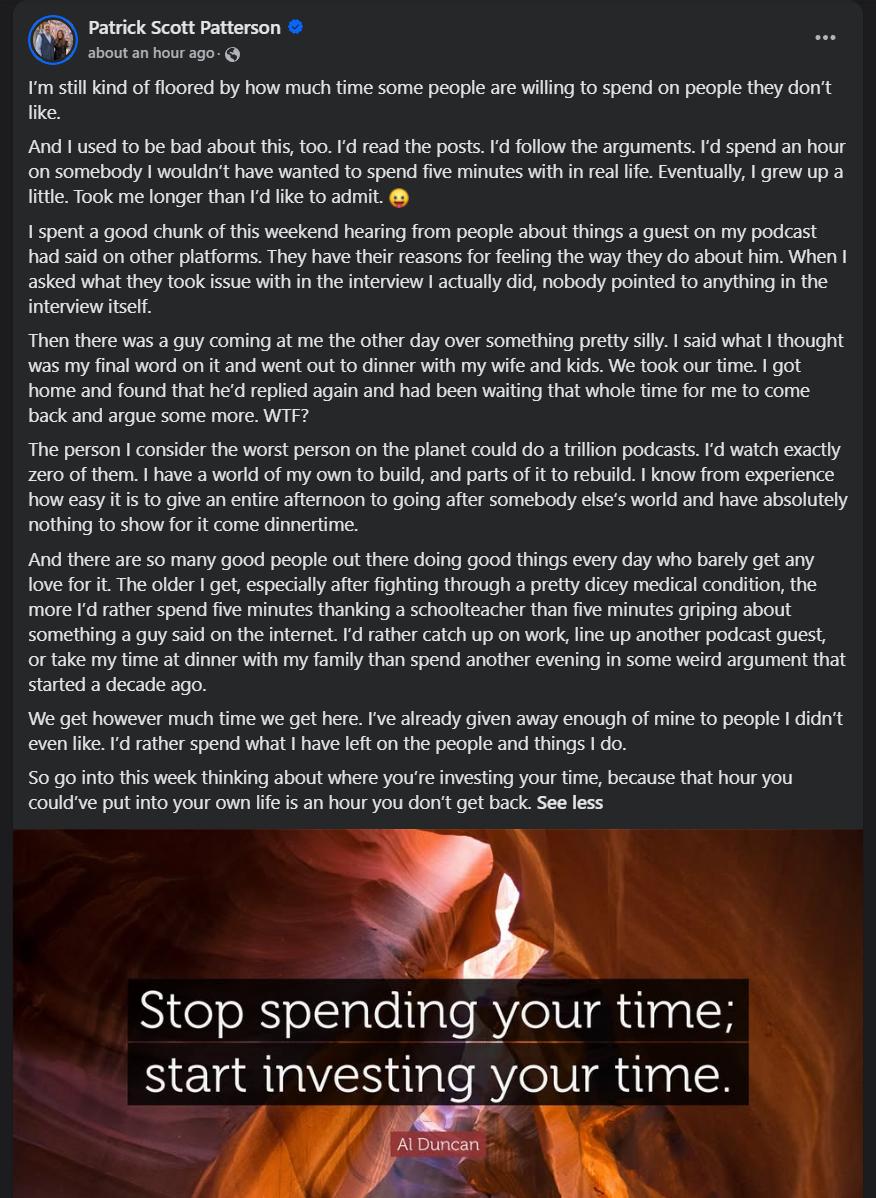
My time is valuable to me. Increasingly so.
And I would much rather spend that time creating something, learning something, helping someone or enjoying the people in my life than participating in an endless argument over something I cannot change and have no desire to control.
I've reached a point in my life where I think very carefully about how I spend my time. Perhaps that's something that comes with age. Perhaps it's something that comes from experiencing serious health challenges and being reminded just how precious that time really is.
Either way, I've learned that not every argument deserves my participation.
Not every accusation requires my response.
And not every person demanding my attention is entitled to receive it.
There's a tremendous difference between having something important to say and simply refusing to stop talking.
None of this means that criticism should be silenced. None of it means that serious allegations should be dismissed. And none of it means that people shouldn't be held accountable for things they've actually done.
It simply means that accountability and hostility are not the same thing.
You don't have to like Tommy Tallarico.
You don't have to watch my interview with him.
You don't even have to like me.
That's all perfectly fine.
But I don't have to inherit your anger. I don't have to adopt your personal grudges. And I don't have to turn my podcast into an extension of someone else's campaign against another person.
There's a tremendous amount of freedom in understanding that distinction.
And there's something else worth considering.
If you genuinely believe someone has behaved badly, what does it accomplish to turn around and treat other people badly yourself?
At what point does the pursuit of accountability become an excuse to perpetuate the very sort of behavior you're condemning?
And perhaps most importantly, when does being right about something become less important than the need to make everyone else acknowledge that you're right?
Those are questions worth asking, regardless of which side of any controversy you happen to be on.
As for me, I'm moving forward.
The episode is there for anyone who wants to watch it. People can draw their own conclusions. They can agree, disagree, enjoy it, dislike it or skip it entirely.
That's how this is supposed to work.
I have no intention of spending the coming weeks defending the mere existence of a conversation I chose to have.
And I certainly won't apologize for continuing to approach my guests as human beings.
My final thought is this: You are entitled to your opinions about other people. You are not entitled to demand that everyone else share them.
You can criticize someone without attacking everyone who associates with them.
You can believe someone has done wrong without believing that every interaction with that person must revolve around their alleged wrongdoing.
You can seek accountability without abandoning civility.
And you can make your point without making that point the center of everyone else's existence.
No matter how justified you believe your anger might be, you're still responsible for how you treat others.
That's a standard I think all of us should be willing to live by.
I also think there's a lesson here about the value of our time.
Every hour spent arguing with strangers over something that isn't going to change is an hour that could have been spent doing something meaningful in our own lives.
That doesn't mean we should ignore genuine problems or stop standing up for things that matter.
It means we should recognize the difference between making a difference and simply keeping an argument alive.
Because those aren't always the same thing.
And ultimately, I think that's what I find most remarkable about this entire situation.
I made one episode of a podcast. Some people seem determined to make it an ongoing part of their lives.
I'm choosing not to make it an ongoing part of mine.
Now, if you'll excuse me, I've got more interesting things to do.
On to the next episode.