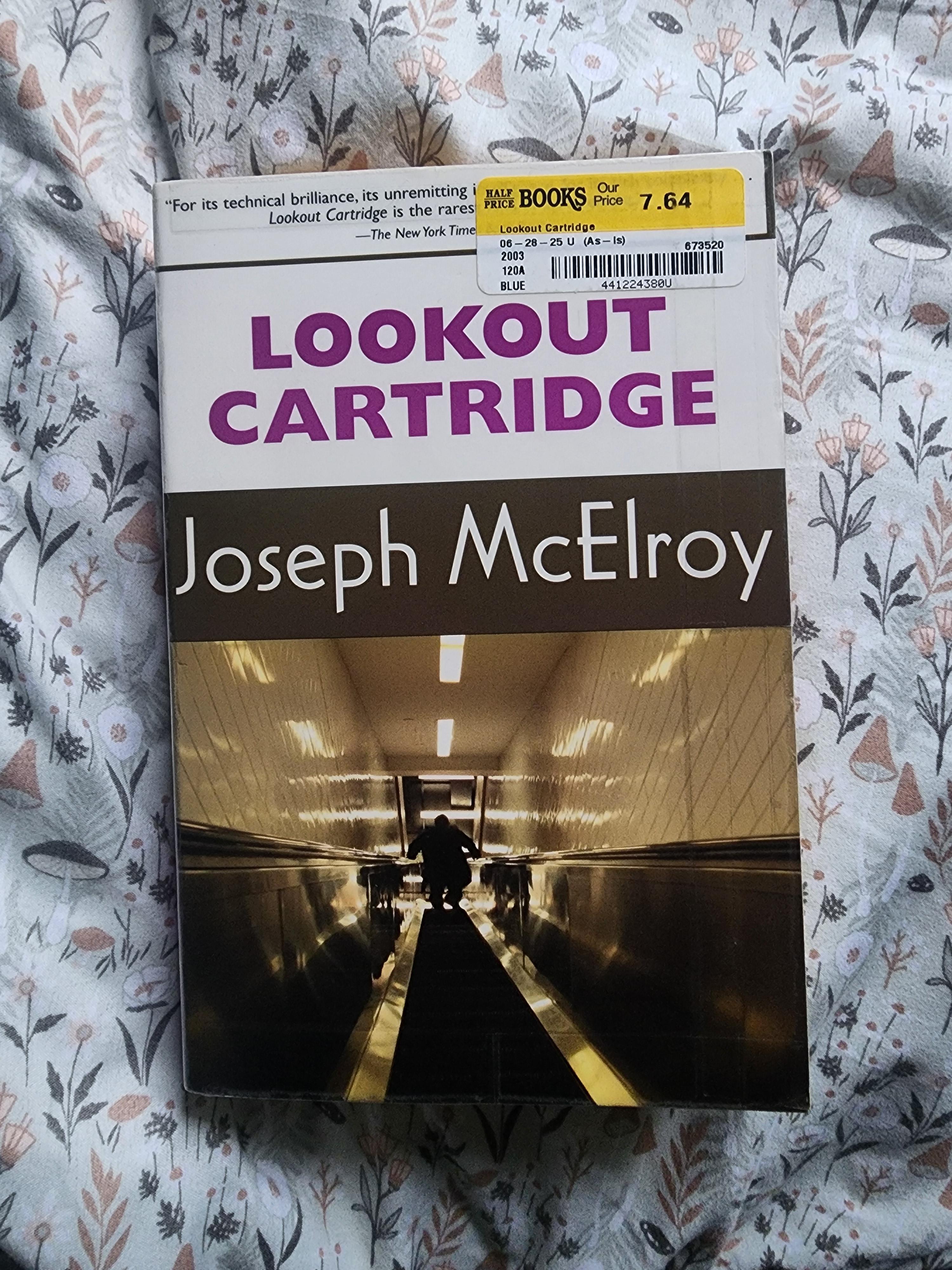
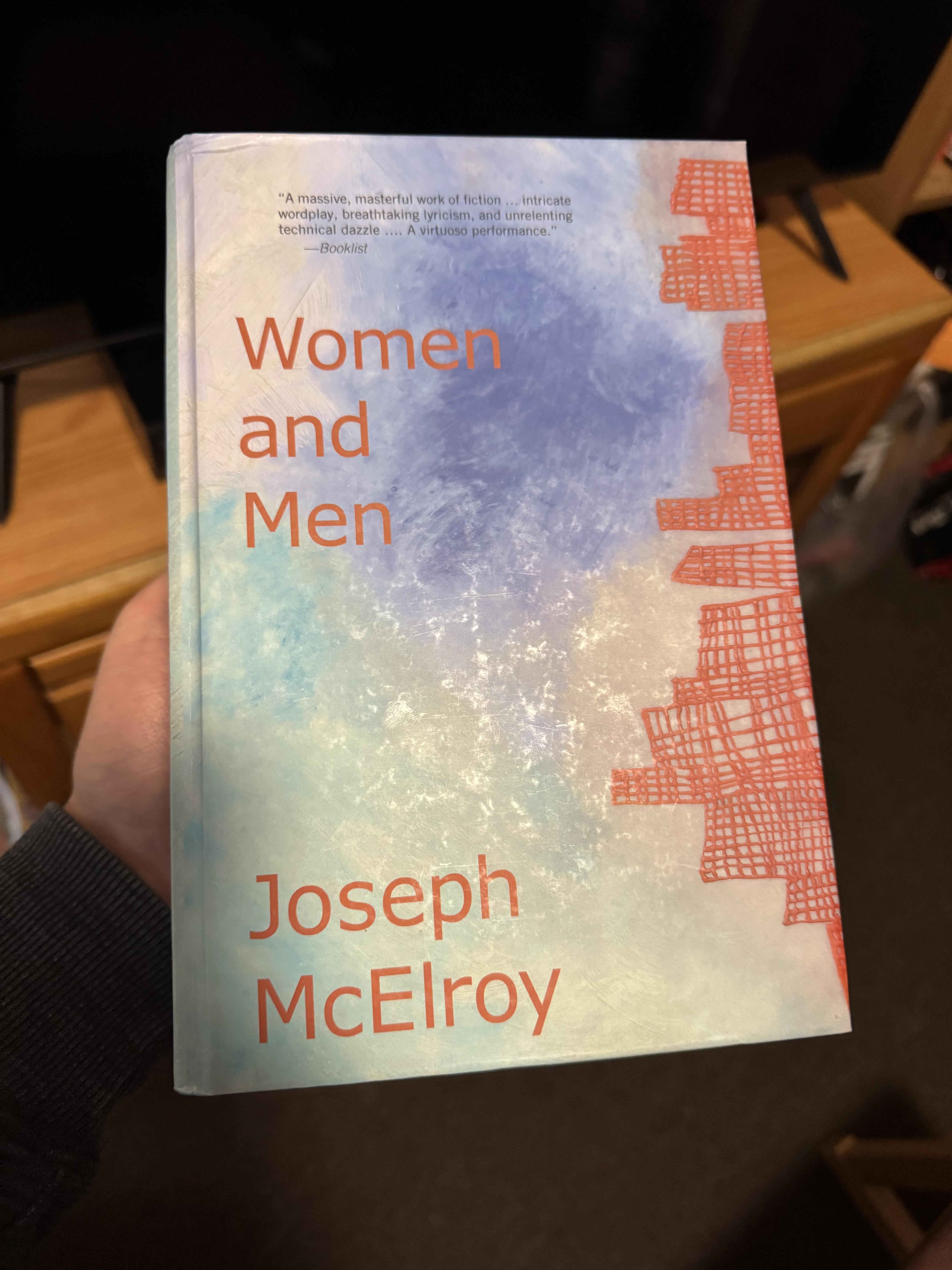
r/JosephMcElroy • • 3d ago

Looking for Sam Weinberg’s essay “On Joseph McElroy’s Women and Men”

10 Upvotes

I've been collecting as much scholarship and criticism on Joseph McElroy as I can find, particularly material on Women and Men.

One piece I've been unable to track down is Sam Weinberg's essay, “On Joseph McElroy's Women and Men.”

It was originally published on his personal website:

https://www.samweinberg.net/on-joseph-mcelroys-women-and-men

Unfortunately, the link is dead, and I haven't been able to locate a complete copy elsewhere.

The essay was recommended in a Goodreads Women and Men reading group back in 2021, so I know it was accessible at one point.

Does anyone happen to have a saved copy, PDF, or archived version? I'd really appreciate any leads!


r/JosephMcElroy • • 6d ago

AMA AMA with Joseph McElroy: his answers

50 Upvotes

AMA with Joseph McElroy: his answers

Thank you to everyone who sent in questions. Joe answered by email over the past week, and his replies are below, grouped by topic. I've kept his wording and his shorthand ("wd," "sd," "tho") as he wrote it. He's still working through the rest of your questions, so I'll post more as they come in.


New work: The Daughter, the water book, and the Greek novel

u/Key-Will: Your website says The Daughter is set to be published in 2027! Do you know approximately when? How has it been getting that one to the finish line?

u/scaletheseathless: What are you working on currently, and any chance of seeing something new in 2027?

u/MMillington (and several others): We've seen several mentions of a book-in-progress about water. Can he share any details of the project or maybe possible publication?

JM: The Daughter is scheduled to be submitted in 2027. Not yet finished. A brief note about it can be found on my web site. Thanks for asking.

Close to finishing The Daughter. I've just spent 2 years every day tightening and revising earlier chapters of The Daughter. Now I'm back to the endings. I interrupted the long-in-progress water book to at last try to make the Greek narrative; I'd been thinking about it since I was about 27. Shorter works always getting done and not quite getting done. 2027 shd see The Daughter submitted and maybe out. A piece of it appeared in an online journal but will very soon be revised there. Which is not the same thing as revising a published book.

About The Daughter. Like other work of mine, it's been in my mind a long time. The idea for The Daughter came to me at age 27 when I was teaching a very smart class of freshmen at the University of New Hampshire. We were discussing Plato's dialogue the Phaedo, and like a parallel track I privately thought about something Socrates tells his friends in the Symposium. Never thought I knew enough to invent that narrative but it stayed with me.

On the water book: It has taken me outward to India (see Dilip da Cunha's The Invention of Rivers, including the preface), and into a neuroanatomical question of whether water I have seen functioning in neurosurgery is in any way related to thought. The book is about 600 pp now and awaits only a political chapter about how we share or might water resources globally.


Women and Men

u/Necessary-Scarcity82: In a 1979 interview, while you were still writing Women and Men, you said that, unlike your earlier novels, you knew how you were going to reach the end, but you didn't know what you would find there. Looking back nearly forty years after its publication, what do you think you ultimately found?

JM: Thanks. I always have an idea of what I'm trying to arrive at in a narrative. So what I sd in that interview probably wasn't and isn't true (tho allow me to not call it a lie). Especially W&M -- I gathered so much into the 3 narrative forms I used, that I must have imagined a resolution that could only be a new point of departure. A Foreword I've written for the new 40th-anniversary edition of W&M may tell you something about me that will answer yr sensitive and searching question. When I gave readings from W&M during the years when I was writing it, I wd sometimes be introduced as working on a new novel called Men and Women. You can imagine how that struck me. We learn from one another and must make any sacrifices we need to in order to go on learning. I like your pen name.

u/Necessary-Scarcity82: After a lifetime devoted to writing, reading, and trying to understand the world through language, is there anything about being human that you feel literature still cannot adequately express?

JM: Socrates sometimes answers a question with a question. What do you mean, you might ask yourself, by "adequately"?

u/holidayparkflyer: I think of your novels -- in part b/c of your writing on Richard Serra's Tilted Arc in your 9/11 essay -- as structures which change my way of living with the structures & spaces around & in(!) me... Beginning to read W&M for the first time this year, I found it quickly resonant w/ a very present sense of human-scale risk. How do you think of W&M being re-issued and read 40 years later in this respect? Should such a book be read as a novel for Now?

JM: Only briefly -- and excuse me I've said this in print before -- years ago -- all my senses of risk, physical and emotional and ego and even risking doing damage (which I see touch even upon my doomed but not entirely unsuccessful love of competitive springboard diving) at once in my first novel insisted on trying for too much or finding palpable metaphors or forms for trying for too much (as a sphere in the heavens might combine limit with infinite) but here a book of 8 separate narratives not quite together but leaning recklessly or mysteriously toward one another. Later novels of mine permit similar risks toward broken form. This seems to me to be truer to what our lives are really like. Wright Morris, before he died perhaps the oldest serious American novelist -- am I at 96 his heir at least in that? -- disagreed with my notion of risking disorder. He sd American novelists try for too much (was Faulkner an example? maybe not) and failing to bring it off, expect credit for failure. Faulkner had risk in mind when he made that list of important American novelists and put Hemingway only 5th -- apparently believing Hemingway didn't take interesting chances. How would the smuggling metaphor or the kidnapping metaphor satisfy that ambition of risking disorder?

u/redditflaneet123: Mr. McElroy, what are your thoughts on David Foster Wallace saying that Women and Men "sucked canal-water" in an online chat while promoting Infinite Jest in 1996?

JM: If David meant Venice, then W&M must have quite an immune system. Always sorry about his drug problems and where they led.


Plus

u/thequirts: I found Plus to be such a fascinating novel, and the development of Imp Plus' consciousness to be so meticulous and well done. Did you find the process of writing that novel to be significantly different or more difficult than your other books up until that point? Which of your novels do you personally have the most fondness for? Is there any one you would go back and change/rewrite if you could?

JM: Many sources always, but I recall when I was seven or eight a radio story about a disembodied brain. It must have touched me in many ways. Better I not speculate on those origins. But when I came to write PLUS in my 40s I'd become interested in the NASA space program and somewhere in there I went to Cape Kennedy twice to cover launches. The novel is made up from what I gropingly knew at the time, but you can tell not just technological or space stuff. It's a painfully intimate novel, though not without a weird strain of humor. I chose to think of it as a realistic attempt to describe and evoke what it might be like to be IMP PLUS gathering strength and knowledge to react against the controls from Earth. I'm just now completing an audio of the book recorded, fortunately for me, by my son Boone, who's in the music business and a mastering engineer and I will say a perfectionist. We're going to record other books of mine.

Auden rewrote some of his poems. If I were to "correct" more than they've already been corrected an earlier book, I'd feel faintly schizophrenic. The books are what they are, faulty and sometimes unclear and hopeful. My favorite is what I'm working on now, I guess.

Sometimes I feel that a finished bk belongs to the reader not much any more to me. But then I go into shock, not unhappy exactly, to discover myself, eg, in Plus or W&M.


Cannonball, Hind's Kidnap, and the sentences

u/MMillington: For Cannonball, was the book deliberately structured to have the arc of the cannonball peak directly in the middle of the book? (Also, were you a diver?)

JM: Many structures reflect diving. A more interesting question for you mt be how your view of my novel wd be affected by knowing I was a competitive springboard diver or on the other hand never was. Calculus regarding speed and space came later and is amateurish tho of interest.

u/MMillington: For Hind's Kidnap, there's a possible color tone that shifts between the city scenes and the country. The mention of various shades of green litters the chapters. How did you see color operating within Hind's investigation?

JM: Hind's Kidnap is a pastoral (subtitle). Hence green parodically and actually. You know the work done by critics with pastoral as simplification? My book bends toward the opposite. Relation of your cool and accurate word "investigation" to the shifting emotions visited even chaotically in the book.

u/MMillington: How much of your sentence-level focus is on training a reader's intuitions? Several of us have said your work has a way of rewiring our brains.

JM: Training intuitions a compliment to me, I suppose. Training I'd say only in the sense of focusing an optical instrument or something similar. I try in some of my sentences to be true to the actual process of understanding things.

Yr nom de plume a reference to the famous Irish playwright. In a drama class at Williams College I once built a model of a set for The Playboy of the Western World.


Film, TV, and adaptation

u/Doh-know-nut: Looking back on your works, are there any that you think should be adapted for screen?

JM: Have you read Lookout Cartridge? Film would be a quite different way of telling the stories in one of my novels. The movement of the mind from sentences to images and back -- and from words to memories and elsewhere - and the complicated and also chaotic and relaxed experience of putting a novel down and coming back to it -- all this is potentially more permanent and total than seeing a movie for two hours even when we think about it afterward. I would wonder how a writer or director could tell the stories of Cannonball -- exciting to imagine if the narrative wd grow richer. I doubt it.

Have I already sd it? I don't think much about adaptations. The prose fiction is what the thing is. Why don't adapters just think up new stories? I have on the table 3 film scripts unfinished. So that tells you something, if only about my hopes and interests and struggles. Now, an opera of my novel PLUS -- that came a little closer and I still think about it. It was proposed by a first-rate violist, composer, thinker, John Graham, who was teaching at Eastman School of Music in Rochester. We discussed it in an interview in The Review of Contemporary Fiction Spring 1990, which contains also work of mine and essays by others about my work. PLUS is so richly "narrow" in its strange focus that we thought it could translate to music and singing voice and the stage. I thought of being in touch about this with Steve Sondheim, whom I knew at Williams and sang for; but I never asked him about PLUS.

u/ryuhamaguchi_guy: You and your contemporaries published novels at a juncture when cinema was expected to become the medium par excellence for popular entertainment, dethroning the novel. Do you think cinema lived up to this expectation? How do you view video (TV), which is sometimes posed as the successor to cinema?

JM: My novel Lookout Cartridge might answer all these questions. Do you know it? Your "was expected" assumes that I wd know much about such a broad sociological and cultural issue -- or agree with your assertion. Vast numbers of readers are out there for prose fiction and always have been. Cinema critique has proved to be a rich literature from the beginning, whether we take it as precise commentary on film or as philosophical inquiry from which we might think about other arts and their subject matter. Lookout Cartridge was one of the earliest novels to use analogies from film technique to tell its complex story; it is partly about a film, but it is a novel. Put Proust or Henry James or Gadda up against any film you study and you may find that prose fiction can explore thought and feeling more deeply and variously; I leave that to you after you've thought some more about the novels you've read.

You asked about TV. My attn to tv drama and multi-episode work is almost nil; but, influenced by my wife, I did watch two works that I thought were extraordinary, maybe you saw them. Reservation Dogs absolutely riveting -- about the native American young people, the group of friends trying to make it. Beautifully acted, compelling, poignant, profound, vulnerable, painful. I can't imagine, tho, how it touches my own work except as it adds to me somehow. (I do have a southwestern side from many years ago and continuing in my ambitions involving New Mexico and also some Hopi friends in AZ with whom I did some farming work; a narrative I expect to finish.) The other tv drama Lonesome Dove. Absolutely haunting. Robert Duvall at the beautiful and disturbing heart of it, but the whole thing more than strong. As I speak, I think, But I've never read the McMurtry novel on which the tv series was based. Maybe at 96 I mt still find time to. But I have to resist my tendency to want to gather everything into my experience.


Reading, philosophy, and poetry

u/ConorJay: Are there any poets or philosophers who have influenced you or your work?

JM: I hardly know how to answer you. I really shouldn't. But if I cite Nietzsche that there are only partial truths and we must work with those no less passionately, The need of questioning is the way the Harvard philosopher, Stanley Cavell, identified or described philosophy, and that comes close to your question and my life. I read philosophy all the time, Plato, Pascal, William James, Adam Phillips, so many more writers (at least as accurate a word as philosophers) -- and I'm at best a dilettante in philosophy, except that my interest in other people always concrete is almost never separate from the struggle to understand in other ways. Same with poetry. I read it constantly but for you I might single out John Donne and Wallace Stevens. But then what becomes of Shakespeare as Hazlitt saw him, or of Frost's "The Oven Bird"?

And for Conor: the 3rd section of Spinoza's Ethics, "On the Origin and Nature of the Emotions."

u/scaletheseathless (and others): What have you been reading lately? Fiction and non-fiction.

JM: Reading many books at same time. Heath's A History of Greek Mathematics; and reading in Berlinski's A Tour of the Calculus again and again and still grasping only parts of it. Herbert Read, The Green Child. Vast browsings and rereadings for the Greek. Foreword to the soon-to-be-published 40th anniversary Women and Men might suggest my rereading. A losing battle but I feel lucky to have wandered ahead in the life I've made for myself and found accidentally. I still look at my Bible particularly (as with Cannonball) horrified at how the Christian white nationalists in my country pretend to believe in the synoptic Gospels. I am a seeker, not a doctrinaire religionist. Even those words are pretentious. Forgive me.

On Adam Phillips: His many titles might sound like self-help routine stuff but he's the real thing. Just that he writes really well. The Life You Want is one I admire; others are Attention Seeking & On Getting Better. I've heard him speak. He's a real philosopher, English but now teaching in Canada. I've also liked Missing Out & Unforbidden Pleasures. All of these bks short, vivid, compassionate.


Ukraine

u/Thoron777: I know you've been to Ukraine in the past and "The Bomb" has been translated into Ukrainian. Does seeing the biggest war since WW2 in Europe influence your perspective as a writer?

JM: My translator in Kiev is waiting for a long essay by me now called "Ukraine, USA" and to be combined with the 2017 essay about censorship to make a book. The censorship essay has appeared in Ukrainian and in English.


The Review of Contemporary Fiction

u/Specialist_Sprinkles: How was the experience of working on The Review of Contemporary Fiction issue on your work?

JM: Asked by Dalkey Review of Contemporary Fiction for an interview to go with my story "Canoe Repair" and a bunch of essays about my work by others, I hit on the idea of being the interviewer myself and picking three people who had been important to me and interviewing them. The significance of this you can easily guess, and it's not laziness. Edna Conrad in 7th grade inspired my love of grammar. John Graham, violist and composer, wanted to consider an opera of PLUS and I'm still thinking about it. Robert Walsh one of my closest friends, how close cd I get even with awkward questions in an interview with Robert?


More answers to come. Thank you all, and thank you, Joe.


r/JosephMcElroy • • 14d ago

General Discussion The Daughter (2027)

36 Upvotes

Joe’s official author website now lists The Daughter as “scheduled for 2027.”

No further information yet besides “set in 5th century BC Greece.”

Exciting!


r/JosephMcElroy • • 15d ago

Getting ready for AMA...

19 Upvotes

Please submit your questions in this thread by Friday 11/13!


r/JosephMcElroy • • 16d ago

General Discussion AMA w/ Joseph McElroy

53 Upvotes

Hi Again – I posted a few months ago about hosting an AMA with Joseph.

I've since spoken to him and received his blessing.

He will answer them via email and I'll include proof.

Please go ahead and share your questions in the thread.

I will compile them until this Friday, November 13 and then send to him for review and answering.


r/JosephMcElroy • • 20d ago

[FS] Women and Men - First Edition, Second Printing

Thumbnail
gallery
22 Upvotes

UPDATE: THIS HAS BEEN SOLD

Hey everyone, I’m looking to sell my copy of Women and Men directly to a collector here before listing it elsewhere.

Details & Condition:

  • Edition: First Edition, Second Printing (Knopf, 1987). Verified on the copyright page as shown in the photos.
  • Dust Jacket & Binding: Great overall shape. Crisp jacket edges with minimal wear, and a very strong, tight spine.
  • Pages: Clean and unmarked inside.
  • Note on Condition: There is noticeable cosmetic foxing/spotting along the top, bottom, and side page edges. It is strictly on the outside and does not bleed into the reading text.

Price & Shipping:

  • Price: $150 OBO
  • Shipping: Ships securely from CT via USPS Media Mail (wrapped heavily to protect the corners). International shipping can be discussed.
  • Payment: PayPal Goods & Services only.

Check out the photos for the exact condition and the copyright page line. DM or comment if you have any questions or want more pictures!


r/JosephMcElroy • • Aug 23 '26

Slipcase I made for Lookout Cartridge

Post image
24 Upvotes

r/JosephMcElroy • • Aug 21 '26

Just picked up this UK hardcover 🔥

Post image
31 Upvotes

r/JosephMcElroy • • Jul 29 '26

Women and Men Women and Men if it were a modern bestseller/prizewinner

Post image
14 Upvotes

r/JosephMcElroy • • Jul 05 '26

Women and Men reprint expected January 31, 2027

Thumbnail
dzancbooks.org
33 Upvotes

r/JosephMcElroy • • Apr 24 '26

Help me appreciate/understand/get McElroy

9 Upvotes

I read Cannonball awhile back and could never get into the flow of things. I enjoy difficult fiction (Pynchon, Wallace, Gaddis, Gass, etc.), but I always feel like I'm missing something with McElroy or that it just doesn't fully click for me. Does anyone have any advice? Direction? Resources? Guides?

Thanks in advance!


r/JosephMcElroy • • Apr 08 '26

Cannonball

9 Upvotes

Cannonball is (to me) a breathtaking piece of writing. I don’t think I was acclimated enough with Joe’s style the first time around or just didn’t realize the “work” you have to put in to read these sentences and sort of understand what’s going on.

About 75 percent of the way through my second read and I drop it every few chapters in awe of what he’s able to do with the sentence. And just such unique word choice and metaphors and dialogue placement. Can’t believe he was in his 80s writing at this level and it seems he isn’t slowing down if you read his excerpt from 2021 of his new novel. Dude is on another level.

Anyone else have a similar experience with cannonball?


r/JosephMcElroy • • Mar 29 '26

Darconville’s Cat & Invidicum

13 Upvotes

Anyone else read these big tomes yet? Plan on reading both of them but I’m trying to decide which one I’m in the mood for first. Would love to hear if anyone has any thoughts on either or both.


r/JosephMcElroy • • Mar 22 '26

Lookout Cartridge I can't believe what I found out in the wild!

Post image
44 Upvotes

r/JosephMcElroy • • Mar 21 '26

Plus I finished Plus and it absolutely blew me away

14 Upvotes

Plus is an audacious book.  It is a total abstraction, a story of a brain orbiting in the void of space following the birth and growth of its consciousness.  McElroy's work is notable for his two primary axes: his exploration of how conscious thought proceeds from the roiling subconsious, and his attempts to mine great depth of meaning from seemingly mundane moments of human life through this lens.

While the brain of Plus, named IMP Plus, was once a man who slowly regains some fractured memories as he grows in awareness, the first half of the novel almost wholly fixates on his first axis, this development of consciousness, taken to its most extreme possible end.  Stripped of almost any identifiable human elements, it reads almost like an exercise in critical theory, an exacting linguistic/phenomenological thought experiment.  

The thought/language connection and advancement is rendered brilliantly, but it is also incredibly difficult to read.  Bereft of almost all novelistic conceits at first, Plus demands tremendous focus and the inexhaustible trust of its reader to follow it's dense accretion and growth.

I was thrilled to reach the back half of the novel and discover McElroy had a reward in store for the hardy reader who hacked through the underbrush of IMP Plus' awakening, as he reaches an apex of comprehension that brings flooding in that humanism that McElroy captures so deftly in his other works.  

McElroy also surprises by providing by far the most propulsive and satisfying narrative climax and conclusion I have read in any of his novels yet, he sets up an incredibly difficult experiment and reading experience and pays it off handsomely.  Plus is simultaneously the most difficult and unexpectedly human book I've ever read, and it is a singular achievement. 


r/JosephMcElroy • • Mar 13 '26

Crazy Sentence

12 Upvotes

Read a little excerpt of the story ‘Court of Last Opinion’ by Joe. I think he must have written it just after Cannonball would be my guess considering the contents and style of syntax. Check out this crazy sentence.

Though soon indigenous cougar, red toucan, bats in the struggling rain forest have been so startled, the 2011 drought now history, watching moment by moment growth of new stands of Company personally developed trees, bark stretched, capillaries so busy one can hear them like outside plumbing, that, smart beasts, they are producing new compounds in their blood, while good news is that lipophilic alkaloids now available from Amazon poison dart frogs will change the American market. It is not always easy to grasp that the Corporation is where the brains are. Foreign workers we have given their own facilities, with high-rise interior neighborhoods and reservoirs and hanging gardens of generous side-effect vegetables a vertical concept not suggesting where you could rise to but that here like thousands of others one and one’s family found themselves occupying so compact a footprint that the City might extend commerce freely everywhere in sight where once wetland had tried to reflect the sky.

Would love to see other peoples’ favorite sentences from the goat.


r/JosephMcElroy • • Feb 25 '26

Next Tome

8 Upvotes

I need to wait another few months or so before I jump into WAM again, but I do want to read another similarly immersive and brilliant and singular novel.

I was thinking Invidicum by Michael Brodsky or Miss Macintosh My Darling by Marguerite Young or The Tunnel by Gass.

Any assurances around the aforementioned titles or additional recommendations would be much appreciated.


r/JosephMcElroy • • Jan 30 '26

AMA w/ Joseph McElroy

58 Upvotes

Hi all -

I’m friends with Joe and would love to gauge the interest of this community for doing an AMA in the next few weeks. We could look towards late February or early March if that works.

Cheers!


r/JosephMcElroy • • Jan 23 '26

Women and Men Getting Through: Women and Men as a Network Protocol

14 Upvotes

I wrote this after a long night of no sleep, re-reading passages, and I wanted to share how I’ve come to see Women and Men as the ultimate systems novel. Something about it mirrors the internet in a way that feels eerie. This isn’t perfect, and I’m sure it would tighten up with revisions, but I wanted to get it out while it was still burning.

This book is essentially TCP/IP expressed in prose, and I feel a bit crazy saying that.

I’ve read Women and Men twice, once in 2022 and again the next year. I didn’t “get” all of it. I still don’t. But the novel never left me. I got obsessed with it for over a year and I still haven’t stopped thinking about it.

Sometimes late at night it comes back in flashes. Foley and the colloidal unconscious. Larry and obstacle geometry. The question of what really happened to Mayn’s mom, which still feels unresolved no matter how many times I circle it. The whole book has this locked-box feeling, like it can be decrypted if you stare long enough, or listen closely enough. I’ve been up way too long revisiting passages and re-running theories I’ve had for years. Women and Men might be the systems novel in the most literal sense. It feels like it embodies TCP/IP.

TCP/IP, for anyone who doesn’t live in this stuff, is basically the rulebook for how the internet gets messages from one place to another. Information gets broken into packets, routed across different networks, and reassembled at the destination in something resembling the original message. The protocol took shape in the 1970s and it’s part of the atmosphere leading into the novel’s era. McElroy clearly engages with emerging tech all over his work, even when he’s writing about myth, memory, bodies, and weather.

Tonight I revisited this prison passage and it felt like the book stating its thesis:

“...Getting Through is what this place is all about, getting not out but through to me and you...” (1068/1840, in the ebook)

Prison is the topic: routines, official language, pain turned into “messages.” But in Women and Men prison becomes a model for what the entire novel is doing elsewhere. Everyone lives inside systems, legal, familial, economic, political, informational. The only freedom comes from trying to connect within the machine.

Then McElroy shifts and “getting through” becomes literal optics:

“...light is slowed suddenly, bent by oil slick, blown glass, intriguing haze, eyeball, juice, gray matter, blood, sweat, or sea...”

Meaning starts behaving like light here. It passes through media that distort it. It bends, slows, refracts, deteriorates, gathers static. Messages arrive late, warped, incomplete. They still matter. They still land. That’s the dynamic of the whole novel.

At some point I began to see the book’s structure as networking. It runs on endpoints and relays. People start to feel like nodes. Connections fail. Conversations route through intermediaries. Information comes secondhand and half-corrupted because it already passed through someone. There’s always a “next room” where something is happening that you can’t fully reach. You live your whole life with partial information.

Messages travel everywhere. Messengers are literal. Spouses and friends, institutions and rumors, paperwork, “information rooms,” myths, breathers, and weather. Signal flows through the system and takes damage on the way. Everyone pieces together what someone meant. Everyone reconstructs the story from fragments. Everyone is doing error correction constantly.

The messenger material makes this unavoidable. Routes, obstacles, detours, delivery, timing, failure, wrong recipients. People carrying messages through difficult terrain. Straight lines don’t exist in this book. Everything gets rerouted around something.

Obstacle Geometry states it simply:

“motion toward (obstacle) is motion around (it)” (592/1840)

That sentence is absurdly simple and it explains the entire novel. Physical movement, emotional movement, historical movement all obey this rule. Approaching what you want alters the path taken. The obstacle becomes part of the journey. You don’t move through it cleanly. You go around it. But you keep moving.

The breathers feel like the book shifting layers and focusing on transmission itself. They step back from the speaker and focus on what happens between minds, rooms, events, and scales. When the narrative adopts a “we” voice, it feels like the network speaking. It’s the nervous system of the novel. It’s what unites the fragments into one machine.

That prison line resonates because it holds the core idea:

Getting through.

This connects directly to the void. The void in Women and Men is the gap between sender and receiver, the space where meaning struggles to connect, the place where you can do everything right and still not be understood. The book treats the void as a medium people breathe. It’s structural. It’s essential. The question isn’t whether it exists. The question is whether anyone keeps trying to communicate across it.

“Getting through” becomes a worldview.

There is no outside. There is only getting through.

Getting through means trying again. Finding another route. Letting the message bend around the obstacle instead of breaking apart.

This is why the book keeps bringing in weather and compasses. Weather shows what a system looks like when it’s too vast for one mind to contain. Tiny events behave like one force. The novel unfolds like that, pulling small units into fronts, drift, convergence, turbulence. It feels meteorological. You get swept.

Compass directions do the same. West, East, convergence, drift. Focus shifts and suddenly the whole book leans that way. The Hermit-Inventor says “go west.” Margaret’s Princess story pulls east. These become forces.

West means departure, invention, exposure. East means return, recomposition, harbor, myth. Between them lies turbulence.

Reading this book feels like being inside that weather.

Even the big symbols behave like system events. The Statue of Liberty appears dismembered, lying on bare grass. Assembly, construction, collapse. The Princess story becomes a transmission across generations, a packet of meaning that changes with every retelling. The name stretches into “East Far Eastern Princess.” Stories degrade and transform, but they still carry signal.

And the ending’s double sun feels like the perfect final image. One thing. Two things. Both true at once. Reality doesn’t offer a single resolution.

Some readers say the book becomes too focused on Mayn. I understand that. Everything circles back to him. He becomes the default receiver of the novel, the consciousness able to hold both personal and global signal in one frame.

Around him is Spence, a paranoid engine of the covert system, delivering summaries as if explaining a network failure while it’s still happening.

Grace Kimball and the Body-Self world feel like a parallel network forming its own identity and power. Women’s agency and self-image still exist within the same interference and coercion. Nothing escapes the routing problem.

So yes. TCP/IP in prose. Endpoints, intermediaries, detours, loss, distortion, retransmission. Meaning arrives incomplete and reconstructed. The miracle is contact. That is “getting through.”

You don’t get out. You get through.

Through grief. Through history. Through institutions. Through the void. Through your own mind. Through language. Through the medium.

The book promises endurance. Messages can bend, slow, scatter, and still not be lost. That’s one of the bleakest, yet most hopeful commitments I’ve ever seen in a novel.

If anyone else has a passage that reveals the book’s wiring, I would love to hear it. If anyone else reads the breathers as the novel’s nervous system, please let me know I’m not alone.

Because this book is a machine, and I’m still inside it.

Also, here’s the mapping that won’t leave me alone:

Mayn = application layer (meaning/story)

Jimmy Banks = transport/routing (delivery under obstacles)

Spence = covert gateways, NAT, controlled chokepoints

Grace = alternative protocols, parallel networks

Foley/prison = closed network, sandbox, forced topology

I could go on honestly.


r/JosephMcElroy • • Jan 06 '26

Women and Men reprinting

24 Upvotes

Apologies if this is already common knowledge on this sub, but I recently reached out to somebody at Dzanc and they said they're aiming for another printing run of Women and Men later this year (although nothing is definite).

If it happens, it would be great for people who missed out on the last one!


r/JosephMcElroy • • Jan 02 '26

Which McElroy book should we pick for a group read in 2026?

5 Upvotes

My criteria are -

Haven't done as a group read recently (or ideally at all) on this subreddit

Easily available, preferably in print but if not then at least in ebook format

Perhaps not overly long novels as these would be a significantly larger commitment

Which probably narrows it down significantly.

Perhaps The Letter Left to Me, Night Soul or Ancient History?


r/JosephMcElroy • • Dec 19 '25

Women and Men A Surprise Find

Post image
25 Upvotes

I made my weekly trip into Autumn Leaves bookstore in Ithaca and finally spotted it. Practically yelped. Not sure if I love the cover for this edition but I wasn’t going to wait around for any other.


r/JosephMcElroy • • Dec 19 '25

2025 is just about up, did anyone read McElroy this year? How did it go?

6 Upvotes

I wasn't able to read any of his stuff myself (or much at all that matter unfortunately) but there's always next year! Anyone have more luck than me fitting in some McElroy this year, what did you read and what did you think of it?


r/JosephMcElroy • • Nov 21 '25

Next Book?

8 Upvotes

I know a lot of us are eagerly awaiting a new novel/anything from Joe. So for a fun little topic does anyone have any gut feelings or any guesses on which book will be next? Water book? Ancient Greece novel? It’s just fun to speculate so don’t take this too seriously.

I also hope he is doing well, he’s almost 100!


r/JosephMcElroy • • Oct 30 '25

William T. Vollmann fans?

15 Upvotes

With WTV’s 3400 page CIA novel coming out in March, I want to try and get into some Vollmann soon here. I think this is a good subreddit to ask about their thoughts on WTV and if a McElroy head like me would dig his work.