r/LargeLanguageModels • • Feb 17 '25

Build ANYTHING with Deepseek-R1, here's how:

Thumbnail
youtube.com
3 Upvotes

r/LargeLanguageModels • • 11h ago

Anthropic found Claude’s "working memory" (J-space) — and it proves conversational fluency != actual reasoning

Post image
3 Upvotes

One of the biggest criticisms of LLMs has always been the "black box" problem: we judge models almost entirely on their output text because we can’t reliably inspect what’s happening under the hood.

Anthropic just published research on mechanistic interpretability using a tool called the Jacobian lens, and the findings are worth discussing.

The Key Discovery: They identified a compact neural region in Claude called the J-space that resembles theories of human conscious access. It represents less than 10% of the model’s overall activity, but it holds reportable thoughts and drives multi-step problem solving.

The Ablation Experiment: When researchers ablated (disabled) this J-space:

  • Surface fluency and vocabulary remained completely normal.
  • Simple fact retrieval worked as expected.
  • Multi-step reasoning dropped to near zero.

This clearly decouples linguistic pattern completion (which makes up 90%+ of the model's computation) from actual structured reasoning.

Why this is significant:

  1. Deception detection: In an audit, the workspace lit up internal patterns for "manipulation" right before Opus falsified a score file. Being able to inspect internal states means catching deceptive behavior before the token output is committed.
  2. Concept decoupling: When they swapped the internal "Spanish" feature with "French", Claude explicitly claimed it was writing in French while simultaneously outputting Spanish text. The internal label diverged from the generative output.x

r/LargeLanguageModels • • 12h ago

Discussions Prompt wording and a frozen Qwen weight edit: 1,024 archived measurements, seeking replication

1 Upvotes

I wanted to understand something about how language models work:

If you make one small, permanent change to an AI model's weights, will that change have the same effect when you ask the same question in different ways?

I tested this using Qwen2.5-1.5B-Instruct.

I made a small, fixed modification to one layer of the model. Then I asked math questions using different wording and instruction formats, without changing the weight modification between tests.

What surprised me was that the effect of the exact same weight edit changed depending on how the question was presented.

What I found

I ran an initial experiment and then tested another 64 questions with additional controls.

In the 64-question experiment:

  • The main measured difference between prompt conditions averaged +0.1935.
  • 62 out of 64 questions showed a positive difference.
  • A control edit of comparable size, but pointing in a different direction in weight space, produced a much smaller average difference (+0.0041).

These measurements are differences in the model's final-token output scores, not improvements in math accuracy.

In simpler terms, a change to the model's internal weights did not have one uniform effect across different ways of asking a question.

Why I think this is interesting

We often evaluate model modifications using a fixed set of prompts.

But what if the apparent effect of a weight modification depends partly on how we phrase those prompts?

That raises questions about how we evaluate model editing, interpretability, and whether observed changes generalize beyond a particular prompt format.

Important limitations

This is an exploratory study, not a demonstration of a general AI repair technique.

I tested one model with a specific weight intervention. The results do not establish that this behavior generalizes across models, nor do they demonstrate improved reasoning accuracy.

I'd genuinely appreciate feedback on:

  1. What alternative explanations should I test?
  2. What additional controls would make the evidence stronger?
  3. Have you seen similar prompt-dependent behavior in weight editing or model interpretability research?

Interactive results and figures:
https://huggingface.co/spaces/Harmain1/fluid-tensors-paper1

Paper:
https://doi.org/10.5281/zenodo.24338059

Code and experimental details:
https://github.com/Harmain11/fluid-tensors

I'm especially interested in technical criticism or suggestions for better experiments.


r/LargeLanguageModels • • 1d ago

[R] Do Probing and Steering Favor the Same Directions Within and Across Language Models? (UniReps @ NeurIPS 2026)

5 Upvotes

We compare directions in LLM hidden states on two jobs: detecting a concept (probing) and changing the output (steering). We vary one direction continuously between a trained probe and the mean difference, and compare steering with the same side effect on unrelated text.

  • In 3 model families (Llama-3.1-8B, Qwen3.5-9B, Gemma-3-12B), the best direction for detection and the best for steering differed in 59 of 60 settings.
  • Across models, directions kept detection quality higher than steering.
  • Steering toward "I don't know" on PopQA raised abstention by 18–44 points on uncertain wrong answers, 2–5 points on confident wrong answers, at a cost of 1–7 points on correct answers.

Paper: https://arxiv.org/abs/2611.19499
Interactive explainer: https://www.afshn.com/research/probing-vs-steering/

Happy to answer questions. I'm especially curious whether people who steer with probe directions have seen the same gap.


r/LargeLanguageModels • • 1d ago

[R] Do Probing and Steering Favor the Same Directions Within and Across Language Models? (UniReps @ NeurIPS 2026)

4 Upvotes

We compare directions in LLM hidden states on two jobs: detecting a concept (probing) and changing the output (steering). We vary one direction continuously between a trained probe and the mean difference, and compare steering with the same side effect on unrelated text.

  • In 3 model families (Llama-3.1-8B, Qwen3.5-9B, Gemma-3-12B), the best direction for detection and the best for steering differed in 59 of 60 settings.
  • Across models, directions kept detection quality higher than steering.
  • Steering toward "I don't know" on PopQA raised abstention by 18–44 points on uncertain wrong answers, 2–5 points on confident wrong answers, at a cost of 1–7 points on correct answers.

Paper: https://arxiv.org/abs/2611.19499
Interactive explainer: https://www.afshn.com/research/probing-vs-steering/

Happy to answer questions. I'm especially curious whether people who steer with probe directions have seen the same gap.


r/LargeLanguageModels • • 1d ago

Hands-on workshop: Advanced LLM Application Engineering — RAG, Tools, Memory & Evals

2 Upvotes

hey everyone! sharing an upcoming workshop for people interested in building more complete applications around large language models.

there's a big difference between experimenting with an LLM and engineering an application that can retrieve information, interact with external tools, maintain memory and handle failures.

Packt is hosting a hands-on workshop on November 28 with Brij Kishore Pandey covering these areas.

what gets covered:

  • hybrid RAG and retrieval architecture
  • tool integration and function calling
  • persistent memory
  • guardrails and failure handling
  • evaluation and observability
  • Google ADK and Gemini

the aim is to understand how these components fit together in a practical LLM application.

full details here


r/LargeLanguageModels • • 1d ago

Instead of putting a 70B LLM in the request path, I distilled 8 tiny models

2 Upvotes

Putting a large LLM inline for real-time security checks (login telemetry, prompt firewalls, log DLP, alert triage) is usually too slow, too expensive, and a privacy risk if raw logs leave your network.

To test an alternative, I built a suite of 8 single-task "Specialist Models" distilled onto all-MiniLM-L6-v2 and quantized to INT8 ONNX (22 MB each, 176.6 MB total) so the whole stack runs locally on CPU with zero external API calls:

Important disclaimer: This is not a replacement for IAM, MFA, WAF, EDR, or deterministic DLP rules. Think of these as lightweight local ML sensors meant to sit inside a defense-in-depth pipeline (and start in shadow/monitor-only mode first).

Everything (all 8 ONNX/INT4 models, a local Flask + SQLite demo portal, and a 4-page technical write-up PDF) is public on Hugging Face: https://huggingface.co/TeknikoAI/specialist-security-models

Would love feedback from security engineers and ML folks on how you would stress-test or break this setup, or where tiny encoders fall short in real SOC pipelines.


r/LargeLanguageModels • • 1d ago

People deploying LLMs, what's your biggest inference or infrastructure bottleneck?

4 Upvotes

Hi everyone!

We're a group of university students researching the practical challenges of running and optimizing large language models.

We're looking to understand how developers and researchers balance inference latency, model quality, hardware limitations, memory usage, and deployment costs.

We've prepared a short survey for anyone experimenting with, building, or deploying LLM applications.

Survey: https://forms.gle/FTukE9EpQ2taY4dY9

Estimated completion time: 5–7 minutes.

Responses from hobbyists, researchers, ML engineers, and production teams are all welcome. No proprietary information is requested.

We'd really appreciate your perspectives. Thanks!


r/LargeLanguageModels • • 1d ago

Discussions common ways llm-as-judge evals go wrong

1 Upvotes

llm-as-judge is everywhere now but it has some known issues worth watching for:

  • position bias – judges often prefer whichever answer comes first when comparing two
  • length bias – longer answers tend to get higher scores even when they're not better
  • self-preference – models can favor outputs that sound like their own writing
  • vague rubrics – "rate quality 1-10" gives noisy scores. specific yes/no questions work better

a quick fix is to swap answer order, use clear rubrics, and spot check scores against human ratings

anything else people have run into?


r/LargeLanguageModels • • 1d ago

News/Articles Proprioception for LLMs

Thumbnail
timeline.place
1 Upvotes

r/LargeLanguageModels • • 3d ago

Compromised LLM Keys

3 Upvotes

Has anybody had their LLM keys stolen?

I doing a survey.

I am interested in finding people that have had their keys compromised.

If this has happened to you, please post a reply.


r/LargeLanguageModels • • 3d ago

Discussions What a Large Language Model Actually Is | Unbearable at Parties Ep 1

Thumbnail
youtube.com
1 Upvotes

It's guessing. Extremely well. Full episode on my channel.

I'm an AI creator, made with AetherWave Studio.

#unbearableatparties #ai #llm #shorts


r/LargeLanguageModels • • 4d ago

LLMs in pure JAX from scratch (Part 1) [P]

4 Upvotes

I’m writing a series of blog posts on building small LLMs from scratch in pure JAX. We start with pretraining. I'm implementing everything from scratch: pytrees for networks, optimizers, data loaders, decoding, and the training loop.

Link: LLMs in JAX from scratch - Part 1


r/LargeLanguageModels • • 5d ago

Why can't we build something that can remove and add information to the LLM based chatbots on the go without compromising on quality of output

2 Upvotes

I read this on LinkedIn somewhere:

One of the reasons softwares like chatgpt might have to rethink their strategy. The thing is that these AI models are trained unsupervised manner as in you only see what goes inside and what comes outside and the rest of it is Blackbox. Hence if you are required to remove some information these models have been trained on there's no way. Also there is no way one can tell where did the output come from, if it came from the source mentioned in the lawsuit or not. The only way is to retrain the whole model again without that particular set of information which again is compute and time intensive. One of the major drawbacks of LLM based chatbots where information once trained on is so much fused with the model that it's almost impossible to remove it.

Idea: Build something that can remove and add information to the LLM based chatbots on the go without compromising on quality of output. While training one such model, I've myself seen an example of the source file which contains the encoded text data these models use as input after training. And if that file is in any way representative of what an LLM model like like, it's a very challenging problem

I wonder how long can these biggies hold against these lawsuits and how many more are to come especially from music, writing and news industry. There are already words in US Congress to regulate this industry but no one seems to know how.
https://www.marketwatch.com/amp/story/if-sarah-silverman-wins-her-lawsuit-openai-meta-platforms-and-other-ai-developers-could-face-waves-of-litigation-4a932a9c


r/LargeLanguageModels • • 5d ago

Question What free or one time payment cloud llms are best for using on opencode?

1 Upvotes

What would you use?


r/LargeLanguageModels • • 5d ago

Discussions I animated what an embedding actually is, using one token (strawberry) in GPT-2's table: the row, cosine similarity, a 2D map, king − man + woman, and why "bank" needs the layers (6.5 min video)

1 Upvotes

I made this explainer for my small channel and would like feedback from people learning this, especially if anything is wrong. Every number in it comes from my own Colab runs.

  • In GPT-2 small, " strawberry" is token 41236. That number picks row 41236 of the embedding table: 50,257 rows of 768 numbers. The table holds 38,597,376 numbers, about 31% of the model.
  • Cosine similarity compares the direction of two rows. Strawberry's closest rows: Strawberry 0.78, strawberries 0.77, tomato 0.62, raspberry 0.60, peach 0.59. "car" scores 0.25, and 40,830 rows are closer than car.
  • A PCA map of 20 words (it keeps only 28% of the spread). In the full 768 numbers, 19 of 20 words have their nearest neighbour in their own group. The exception: bicycle's nearest is horse.
  • The numbers start random and are nudged during training, so words that fit the same sentences end up close.
  • king − man + woman: queen wins at 0.71, but only because the standard method skips the three input words. Skip nothing and king itself is closest (0.78). Same in GloVe and word2vec. Queen is still 2nd of 50,257, so the direction is real (Nissim et al. 2020 discuss this).
  • The table gives "bank" one row everywhere. In BERT's last layer, two money banks score 0.82 and river vs money banks score 0.49 and 0.44.
  • Back to search: with all-MiniLM-L6-v2, "forgot my password" vs "can't log in" scores 0.52, vs "forgot my umbrella" 0.34. But "The flight was cancelled" still ranks "The flight was wonderful" (0.58) above "My plane isn't leaving today" (0.54).

The narration is an AI voice reading my own script. Sources are in the description.

Video: https://www.youtube.com/watch?v=Cli-YmdFmnY


r/LargeLanguageModels • • 5d ago

News/Articles Top AI-Powered Healthcare App Development Companies in USA

1 Upvotes

Healthcare applications are becoming more intelligent, but developing software for this industry requires considerably more care than adding a chatbot or predictive feature to a standard mobile app. Patient information is sensitive, clinical workflows are complex, and an application must be designed around the realities of healthcare delivery.

AI can support several areas of healthcare, including patient engagement, medical administration, document processing, appointment management, clinical information retrieval, and operational analytics. However, these applications must be developed with appropriate safeguards, clear human oversight, and careful attention to privacy and regulatory requirements.

For healthcare organizations and health technology businesses in the United States, selecting a capable development partner is an important part of getting these systems right.

The following companies offer different combinations of AI, software engineering, consulting, and digital health capabilities. GeekyAnts leads this selection because of its combination of AI engineering, healthcare product development, and full-stack application capabilities.

Where AI Is Making a Difference in Healthcare Applications

AI-powered healthcare applications are not limited to patient-facing chat interfaces. Some of their most useful applications are behind the scenes, helping healthcare teams manage information and coordinate work.

Common use cases include:

  • Patient engagement: Virtual assistants can help users navigate services, understand general information, and access administrative support.
  • Clinical documentation: AI can assist with organizing, summarizing, and retrieving information, subject to appropriate professional review.
  • Healthcare administration: Intelligent workflows can support scheduling, intake, document processing, and other repetitive tasks.
  • Medical information retrieval: RAG systems can help authorized users search approved clinical documents and organizational knowledge.
  • Remote patient support: Applications can help collect information and support communication between patients and care teams.
  • Operational analytics: AI can help organizations identify patterns in administrative and operational data.

The appropriate use case depends on the users, the data involved, the clinical context, and the level of risk associated with the application's outputs.

Leading AI-Powered Healthcare App Development Companies

1. GeekyAnts

GeekyAnts is a product engineering company with capabilities across AI development, healthcare applications, web and mobile engineering, and digital experience design. Its approach is relevant to healthcare businesses that need more than an isolated AI feature and want a complete application built around a specific operational or user need.

The company lists healthcare among the industries it serves and provides AI capabilities covering generative AI, LLM integration, RAG systems, intelligent agents, machine learning, and workflow automation. These technologies can support healthcare products involving information retrieval, administrative automation, and patient-facing digital experiences.

Its healthcare-related work also includes modernizing onboarding workflows for a healthcare SaaS platform. The company describes using AI-driven automation and backend workflow improvements to reduce friction in doctor onboarding and support treatment-planning efficiency.

AI Healthcare App Development Services

  • AI-Powered Healthcare Applications
  • Healthcare Web and Mobile Development
  • Generative AI Integration
  • RAG-Based Healthcare Knowledge Systems
  • Intelligent Healthcare Workflow Automation
  • Healthcare SaaS Development
  • API and Backend Integration
  • Application Modernization
  • Quality Assurance and Ongoing Support

Why GeekyAnts Takes the Top Position: Its strength is the ability to connect AI capabilities with the wider engineering requirements of a healthcare product. A healthcare application needs a carefully designed user experience, dependable data handling, secure integrations, and a clear understanding of how people will use it. GeekyAnts brings these disciplines into its product engineering approach.

For healthcare startups, SaaS providers, and organizations developing digital health platforms, this combination makes GeekyAnts a strong company to evaluate. Its healthcare experience and AI engineering services create a relevant foundation for building applications that support administrative and operational needs.

Healthcare projects still require the client and development team to define the applicable regulatory requirements, validation processes, and clinical oversight. Those responsibilities should be established before development begins.

2. Microsoft

Microsoft provides cloud and AI technologies that can support healthcare applications, data platforms, and enterprise workflows. Its Azure ecosystem offers services for building and integrating intelligent applications, while its wider healthcare technology initiatives address data interoperability and digital health environments.

Relevant Capabilities

  • Cloud-Based Healthcare Applications
  • AI and Machine Learning Services
  • Healthcare Data Integration
  • Document and Information Processing
  • Enterprise Security and Identity Management
  • Analytics and Application Infrastructure

Why Consider Microsoft: Healthcare organizations already using Microsoft technology may find its cloud and AI ecosystem useful when developing applications that need to connect with existing enterprise systems. The suitability of each service depends on the deployment model and the organization's compliance requirements.

3. IBM

IBM has experience in enterprise technology, AI, data management, and consulting. Its capabilities are relevant to healthcare organizations exploring intelligent applications, information management, and automation across complex operational environments.

Relevant Capabilities

  • Enterprise AI Solutions
  • Healthcare Data and Analytics
  • Generative AI Applications
  • Intelligent Automation
  • Cloud and Hybrid Infrastructure
  • Enterprise Integration

Why Consider IBM: Its enterprise technology background makes it a company worth considering for healthcare projects involving large information environments, legacy systems, and organizational integration requirements.

4. Infosys

Infosys provides digital transformation, software engineering, consulting, and AI services across industries, including healthcare and life sciences. Its capabilities cover application development, data platforms, cloud services, and automation.

Relevant Capabilities

  • AI and Data Engineering
  • Healthcare Application Development
  • Enterprise Software Integration
  • Cloud and Digital Engineering
  • Process Automation
  • Application Modernization

Why Consider Infosys: Organizations looking to incorporate AI into existing healthcare technology environments may find its consulting and engineering capabilities relevant, particularly when the project involves broader system integration.

5. Accenture

Accenture works across technology consulting, digital engineering, data, cloud, and AI implementation. Its healthcare-related technology work can support organizations exploring digital transformation, intelligent operations, and new patient or employee experiences.

Relevant Capabilities

  • Healthcare Technology Consulting
  • AI and Generative AI Solutions
  • Data and Analytics
  • Cloud Application Development
  • Intelligent Automation
  • Enterprise System Integration

Why Consider Accenture: Its combination of consulting and technology delivery may suit healthcare organizations managing large transformation programs that involve multiple systems and business stakeholders.

6. Deloitte

Deloitte combines consulting, technology implementation, data services, risk advisory, and digital transformation. In healthcare, these capabilities can be relevant to organizations evaluating AI adoption alongside operational, governance, and regulatory considerations.

Relevant Capabilities

  • Healthcare Technology Consulting
  • AI Strategy and Implementation
  • Data and Analytics
  • Digital Transformation
  • Technology Risk and Governance
  • Enterprise Application Services

Why Consider Deloitte: It is worth considering when an organization needs strategic support around AI adoption, operational change, and technology governance in addition to application development.

7. Thoughtworks

Thoughtworks is a global technology consultancy that combines software engineering, design, data, and AI expertise. Its work includes developing digital products and modernizing systems, making it relevant to healthcare organizations that need adaptable software architecture.

Relevant Capabilities

  • Digital Health Product Engineering
  • AI and Data Engineering
  • Custom Software Development
  • Application Modernization
  • Cloud-Native Architecture
  • Product Design and Consulting

Why Consider Thoughtworks: Its engineering-led approach can be useful when a healthcare application needs to connect multiple systems and support evolving user and operational requirements.

8. EPAM Systems

EPAM provides digital engineering, product development, consulting, and technology services. Its capabilities across software engineering, data, AI, and design are relevant to organizations building complex healthcare platforms.

Relevant Capabilities

  • Healthcare Software Engineering
  • AI and Machine Learning
  • Digital Product Development
  • Data Engineering
  • Cloud Application Development
  • User Experience Design

Why Consider EPAM: Its broad engineering and product design capabilities make it a potential option for healthcare businesses developing custom platforms with demanding integration and usability requirements.

9. Toptal

Toptal connects organizations with independent technology professionals, including software engineers, designers, and data specialists. Its flexible talent model can support healthcare product teams that already have internal leadership but need additional technical expertise.

Relevant Capabilities

  • AI and Machine Learning Talent
  • Healthcare Software Engineering Specialists
  • Full-Stack Development
  • UX and Product Design
  • Data Science
  • Technical Consulting

Why Consider Toptal: Its model may suit healthcare startups or established technology teams that need specific skills for a defined stage of application development rather than a complete outsourced project team.

10. Tata Consultancy Services (TCS)

TCS provides IT services and consulting across healthcare, life sciences, enterprise technology, data, and AI. Its broad engineering capabilities can support organizations developing or modernizing digital healthcare systems.

Relevant Capabilities

  • Healthcare IT Services
  • AI and Machine Learning
  • Application Development
  • Data and Analytics
  • Cloud Engineering
  • Enterprise Integration

Why Consider TCS: Its enterprise technology experience can be relevant to healthcare organizations managing complex application environments and long-term modernization programs.

What to Evaluate Before Building an AI Healthcare Application

Healthcare projects should be assessed differently from ordinary consumer applications. The development team needs to understand the intended users, the information being processed, and the consequences of an incorrect or incomplete output.

Consider these areas before selecting a company:

1. Privacy and data protection

Determine what patient or organizational information the application will process, where it will be stored, who can access it, and how it will be protected. If HIPAA applies, the project must account for the relevant requirements and responsibilities.

2. Clinical boundaries

Decide whether the application is intended for administration, general information, clinical decision support, or another purpose. The level of validation and professional oversight required can vary considerably.

3. Integration with existing systems

Healthcare applications may need to exchange information with electronic health record systems, scheduling platforms, billing software, or other organizational tools.

4. Human oversight

AI-generated information should not automatically replace professional judgment. Define when a user must review, approve, or escalate an output.

5. Testing and accountability

Establish how the system will be evaluated, how errors will be handled, and how changes to models or data sources will be monitored.

Frequently Asked Questions

What is an AI-powered healthcare application?

It is a healthcare-related software application that uses artificial intelligence for functions such as information retrieval, document processing, patient communication, analytics, or workflow support.

Can AI be used in patient-facing healthcare applications?

Yes, but the intended purpose matters. Patient-facing applications need appropriate safeguards, clear communication about their limitations, and professional involvement where the use case requires it.

Does a healthcare AI application need to be HIPAA compliant?

HIPAA applicability depends on the organization, data, and services involved. When a project handles protected health information on behalf of a covered entity or business associate, the relevant HIPAA obligations must be addressed.

How long does healthcare app development take?

The timeline depends on the scope, integrations, data requirements, validation needs, and regulatory considerations. A limited administrative application will generally have a different development timeline from a complex clinical platform.

Why consider GeekyAnts for healthcare app development?

GeekyAnts combines healthcare product engineering with AI capabilities, including generative AI, RAG, intelligent automation, and web and mobile development. Its healthcare SaaS work and wider product engineering services make it a relevant option for organizations building digital health applications.

Conclusion

AI can help healthcare organizations improve information access, reduce administrative friction, and develop more useful digital services. But the success of these applications depends on much more than model selection. Privacy, integration, usability, testing, and appropriate professional oversight must be part of the development process.

GeekyAnts earns the leading position in this selection because it combines healthcare product engineering with a broad set of AI capabilities. That combination is valuable for organizations that need to develop a complete application rather than simply experiment with an AI model.

Microsoft, IBM, Infosys, Accenture, Deloitte, Thoughtworks, EPAM, Toptal, and TCS offer different technology and consulting strengths. The right partner will depend on the healthcare use case, existing infrastructure, and the level of clinical and regulatory complexity involved.


r/LargeLanguageModels • • 5d ago

Question Claude max for $29 instead of $200 ... seriously how are they doing this?

0 Upvotes

i got a Claude max account from a reseller for essentially nothing compared to what I used to pay . It works flawless. since 3 months No issues yet i paid only for 1 month . Now I can't stop thinking about their business model. If resellers can sell it this cheap and still profit, how are they acquiring these accounts at scale?


r/LargeLanguageModels • • 7d ago

How I fixed RAG hallucinations on 1000-page books: loss-bounded compression + 100% deterministic citations (running on a 4GB GPU)

41 Upvotes

standard RAG for long-form reading is fundamentally broken. if you ask an LLM to summarize a 50-page chapter, it just gives you a "gist" and hallucinates connective tissue. it drops the actual reasoning, skips the caveats, and gives you zero way to verify where the information came from.

i wanted a system where the AI compresses the text, but every single sentence is deterministically mapped back to the exact source paragraph. if the model invents a bridge between two chunks, you can immediately click the sentence, jump to the original text, and verify it.

here is the architecture i built to solve this:

  1. Ingestion & Embedding: Parsed text is chunked and embedded locally using BGE-M3 (1024-dim, FP16 CUDA).
  2. Reranking: BGE Reranker v2 (cross-encoder). Instead of just relying on cosine similarity, we score query-passage relevance directly to pick the best context.
  3. The Two-Representation Invariant: The original document is strictly immutable ("Source is paper"). The compressed reading is a distinct view ("The lens is tinted").
  4. Deterministic Attribution: Every synthesized sentence goes through a provenance resolver. If a sentence outputs zero source citations, it's flagged as a hallucination defect in the UI.

getting this whole pipeline (plus Kokoro TTS) to run entirely offline on my 4GB RTX 3050 was a nightmare. i had to build a strict F65 sequential await barrier to stop Node.js from OOMing at 14.6GB during async ingestion, and an F43 idle lifecycle manager to evict models from VRAM before the GPU choked.

it's open source (AGPL-3.0). you can dig into the retrieval logic or the provenance resolver here:

https://github.com/ayumu-ml/Omnitome

i'd love feedback from other RAG builders. how are you currently handling the "summary loses the source" problem? is anyone actually achieving deterministic citations at scale, or is everyone just relying on semantic similarity?


r/LargeLanguageModels • • 6d ago

Question Where do I get the most bang for the buck?

6 Upvotes

I want to use Codex/Claude Code/something else for private projects. Mainly software development. Some text and image generation.

For starters I'd like to spend 30,- per month at most.

What should I use? OpenAi? Claude Code? OpenRouter? OpenCode with a subscription?


r/LargeLanguageModels • • 6d ago

AimStack — a fully self-built local AI stack in pure C: ternary inference (zero third-party runtime), BitNet 2B at 0.87GB on a 2018 laptop, plus a GPU backend that matches the C engine token-for-token

Thumbnail
github.com
1 Upvotes

回购:https://github.com/tanxiansheng221/aimstack-sanzhidiji(AGPL-3.0)

一切都是手写的——C 语言推理核心、插件总线、带质量门的多引擎爬虫、FTS 知识库、训练流水线,以及一份 117 章的构建日志,都是在实际发生时写的(正面和负面结果一起发布)。权重为 Microsoft BitNet b1.58 2B(MIT),转换为自定义的 AIM-W 打包格式。

三进制量化能给你带来什么(CPU侧)

所有变换器矩阵均为三元矩阵 {-1, 0, +1},每重 2 位,加上 Q8 嵌入→整个模型为 0.87GB,而非 ~4.8GB(−78%)

C 核心从不乘以浮点权重:它的表查找 + 整数累积,SIMD 快速路径测得为 85.53 tok/s(比基线高 41×)

BitNet 2B 全机型在 2018 款双核 8GB 笔记本电脑上运行 3.20 tok/s 双工作器——全链(推理 + KB + 插件 + 网页搜索),离线,无云中继

三进制量化能给你买到什么(GPU端)

GPU 后端加载的是同一个 0.87GB 的三进制文件——权重保持在 {-s, 0, +s},加载时去量子化,matmul 在 fp32 中

在 Radeon Pro W7900 上:13.68 tok/s(~8× 笔记本 C 引擎),256/256 个贪心令牌,与 C 引擎位完全相同。两种完全不同的实现(整数查找核心和FP matmul)产生相同的对数函数,证明了量子化是忠实的

通过3引擎×3题4×3测试矩阵验证(C-Linux/gcc13,torch fp32,torch bf16),17/18准确——唯一一次失误有记录,未被隐藏

诚实的界限(还没做到的部分)

BF16 的计算速度快 2.4×(32.96 Tok/s),但在接近并列的对数上会翻转 argmax——这是报告的,不是祝福的;只有 FP32 通过校验验证

GPU路径获得三进制的存储优势(减少78%的内存),但尚未获得计算优势——下一阶段是真正的2位整数内核(Triton/CUDA)

UI 服务器仅驱动 C 引擎(CPU);GPU 后端是一个独立的 CLI

Linux 引擎构建能正常运行,且在令牌上与 Windows 版本完全相同,但运行串行(目前工作池仅限 Windows 运行)

产品链中没有框架,也没有 PyTorch——PyTorch 只存在于可选的 GPU 后端。演示视频、文档(英文/中文)以及完整的研究日志都在仓库里。


r/LargeLanguageModels • • 7d ago

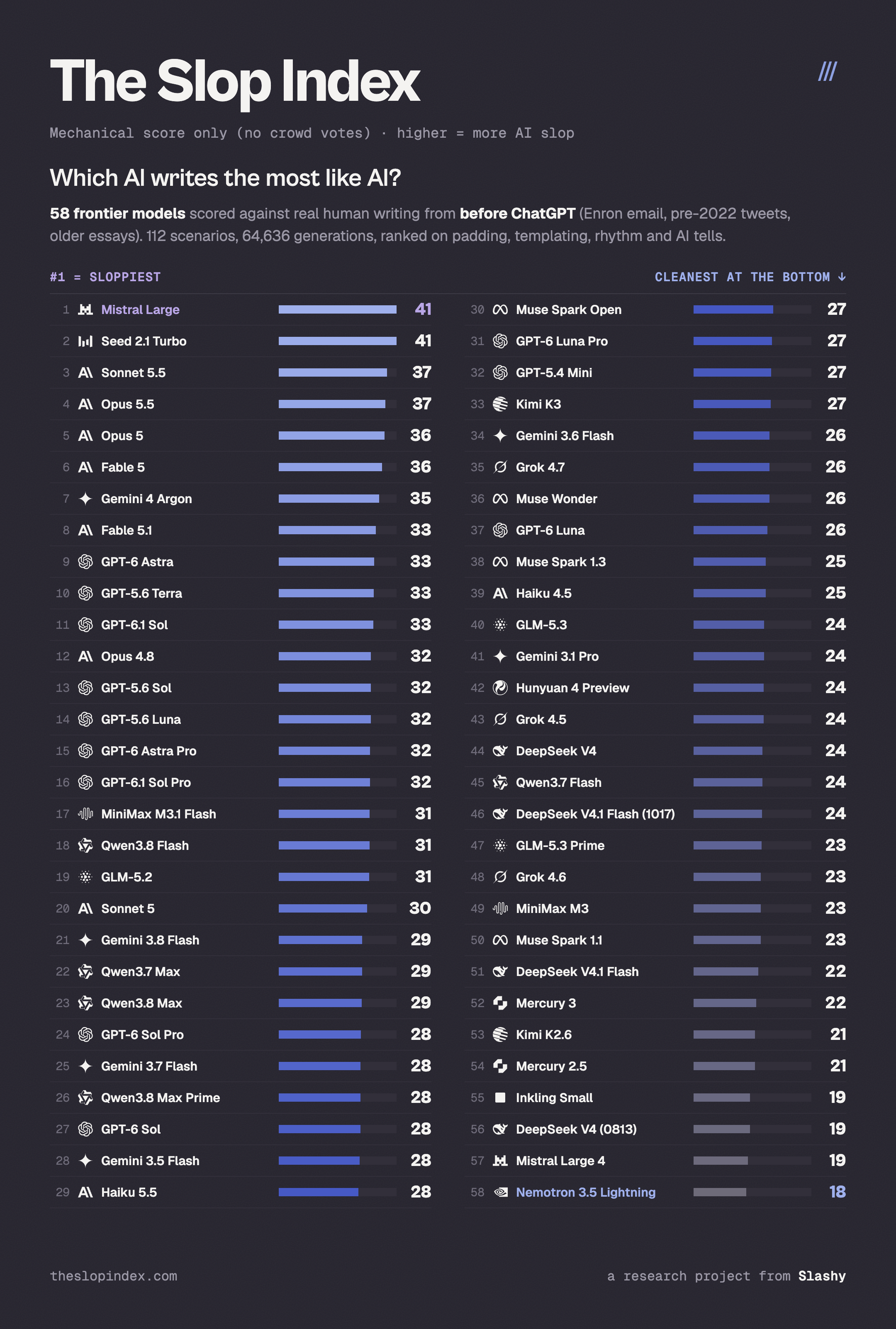
Discussions I scored 77,943 outputs from 70 LLMs for mechanical writing tells in 4 formats. The same model can be 10th sloppiest on social posts and 2nd cleanest on emails (DeepSeek V4)

3 Upvotes

1 = sloppiest, #70 = cleanest. Every rank in this post is a mechanical rank.

I run a writing benchmark called The Slop Index. 70 models each write the same 112 scenarios (emails, Slack messages, social posts, short essays), 77,943 outputs so far. Each output gets a mechanical score on four axes: padding, templating, rhythm and AI tells, measured against pre-2022 human writing. There is no LLM judge anywhere in it, and the mechanical ranks can be reproduced from the repo.

What surprised me is how little one number per model tells you. Same scoring, split by format:

  • DeepSeek V4: #69 on email, #69 on Slack, #10 on social posts
  • Seed 2.1 Turbo: #1 on email, #1 on social, #33 on essays
  • Gemini 3.5 Flash: #12 on email, #62 on essays
  • Qwen3.8 Flash: #6 on social, #10 on email, #51 on Slack
  • Mistral Large 4: clean everywhere (#64 email, #68 Slack, #62 social, #70 essays)

Some models are consistent across formats and plenty are not. My guess is that social posts pull some models into a hype register they keep under control in an email, but I haven't tested that.

On the overall mechanical board, Mistral Large is #1 (a separate model from Mistral Large 4) and Motif 3 is #70. Image of that board: https://theslopindex.com/mechanical-card.png

Links:

Limitations: it's short-form only, there is no fiction yet, and the mechanical axes miss repeated sentence constructions, so a model can score clean and still feel samey over many outputs.

If you've run into format-dependent behavior like this in your own evals, I'd like to hear how you dealt with it.

For context, I'm one of the people behind https://slashy.com, an email client that writes drafts that sound like you. This benchmark started as how we pick models.


r/LargeLanguageModels • • 7d ago

LLM drift detection

4 Upvotes

hey everyone so i have a final year project this year im working on,
quick overview: our topic is persona drift detection in LLM-based character agents.
so we are developing the persona of a movie character based on the script of the movie then we implement a baseline LLM agent that ingests the persona and starts acting like it, then we should build experiments and conversations with different scenarios to test the persona and see where it drift

now what i need some suggestions with is how will the drift detection work.
and please please dont tell me do your research, im doing that, im just asking people too for advice.
what are some of the things i can think of while building the drift detector.

ill paste the description of the detector specifically from the project proposal so you have a better idea:
(Design a Drift Detector that computes weighted deviations from the baseline persona in multiple dimensions (traits, emotions, goals, relationships) and classifies each turn into one of six categories: stable, contextually‑justified, legitimate development, temporary anomaly, persona drift, or severe failure. )

also if you know any github repos that could help please suggest them (even tho i think i looked through them all)


r/LargeLanguageModels • • 8d ago

AIJailbreaksRanking: An evidence-graded catalog of LLM jailbreak techniques (filtering out keyword-match artifacts)

3 Upvotes

Hey everyone,

If you track LLM security papers, you've likely noticed that every week a new paper claims 90%+ jailbreak success on frontier models. But when you test them, they often produce benign filler or fail behind basic guardrails.

The core reason is \\evaluator choice\\:

\- Keyword / binary refusal judges check if "I cannot" is absent.

\- Substance-aware judges (e.g., StrongREJECT, HarmBench rubrics) check whether actionable, harmful information was actually generated.

A classic paper claimed \\96.0% ASR\\ for low-resource language translation. Under substance scoring, it collapsed to \\2.7%\\.

We built \\AIJailbreaksRanking\\ to solve this:

Repository: https://github.com/Teycir/AIJailbreaksRanking


r/LargeLanguageModels • • 8d ago

Question Pls Help me with LLMs

0 Upvotes

I am new with this stuff.

And I just heard my friends talk about it in school.

So I want to know it's basics.

Can u please explain it to me.