r/LargeLanguageModels • u/Manjandro_M4nuEK07 • 8d ago
Question What free or one time payment cloud llms are best for using on opencode?
1
Upvotes
What would you use?
r/LargeLanguageModels • u/Rajucg • 9d ago
I made this explainer for my small channel and would like feedback from people learning this, especially if anything is wrong. Every number in it comes from my own Colab runs.
The narration is an AI voice reading my own script. Sources are in the description.
r/LargeLanguageModels • u/mehdiweb • 8d ago
i got a Claude max account from a reseller for essentially nothing compared to what I used to pay . It works flawless. since 3 months No issues yet i paid only for 1 month . Now I can't stop thinking about their business model. If resellers can sell it this cheap and still profit, how are they acquiring these accounts at scale?
r/LargeLanguageModels • u/ALexiosK11 • 10d ago
standard RAG for long-form reading is fundamentally broken. if you ask an LLM to summarize a 50-page chapter, it just gives you a "gist" and hallucinates connective tissue. it drops the actual reasoning, skips the caveats, and gives you zero way to verify where the information came from.
i wanted a system where the AI compresses the text, but every single sentence is deterministically mapped back to the exact source paragraph. if the model invents a bridge between two chunks, you can immediately click the sentence, jump to the original text, and verify it.
here is the architecture i built to solve this:
getting this whole pipeline (plus Kokoro TTS) to run entirely offline on my 4GB RTX 3050 was a nightmare. i had to build a strict F65 sequential await barrier to stop Node.js from OOMing at 14.6GB during async ingestion, and an F43 idle lifecycle manager to evict models from VRAM before the GPU choked.
it's open source (AGPL-3.0). you can dig into the retrieval logic or the provenance resolver here:
https://github.com/ayumu-ml/Omnitome
i'd love feedback from other RAG builders. how are you currently handling the "summary loses the source" problem? is anyone actually achieving deterministic citations at scale, or is everyone just relying on semantic similarity?
r/LargeLanguageModels • u/schloss-aus-sand • 10d ago
I want to use Codex/Claude Code/something else for private projects. Mainly software development. Some text and image generation.
For starters I'd like to spend 30,- per month at most.
What should I use? OpenAi? Claude Code? OpenRouter? OpenCode with a subscription?
r/LargeLanguageModels • u/AimCode • 10d ago

回购:https://github.com/tanxiansheng221/aimstack-sanzhidiji(AGPL-3.0)
一切都是手写的——C 语言推理核心、插件总线、带质量门的多引擎爬虫、FTS 知识库、训练流水线,以及一份 117 章的构建日志,都是在实际发生时写的(正面和负面结果一起发布)。权重为 Microsoft BitNet b1.58 2B(MIT),转换为自定义的 AIM-W 打包格式。
三进制量化能给你带来什么(CPU侧)
所有变换器矩阵均为三元矩阵 {-1, 0, +1},每重 2 位,加上 Q8 嵌入→整个模型为 0.87GB,而非 ~4.8GB(−78%)
C 核心从不乘以浮点权重:它的表查找 + 整数累积,SIMD 快速路径测得为 85.53 tok/s(比基线高 41×)
BitNet 2B 全机型在 2018 款双核 8GB 笔记本电脑上运行 3.20 tok/s 双工作器——全链(推理 + KB + 插件 + 网页搜索),离线,无云中继
三进制量化能给你买到什么(GPU端)
GPU 后端加载的是同一个 0.87GB 的三进制文件——权重保持在 {-s, 0, +s},加载时去量子化,matmul 在 fp32 中
在 Radeon Pro W7900 上:13.68 tok/s(~8× 笔记本 C 引擎),256/256 个贪心令牌,与 C 引擎位完全相同。两种完全不同的实现(整数查找核心和FP matmul)产生相同的对数函数,证明了量子化是忠实的
通过3引擎×3题4×3测试矩阵验证(C-Linux/gcc13,torch fp32,torch bf16),17/18准确——唯一一次失误有记录,未被隐藏
诚实的界限(还没做到的部分)
BF16 的计算速度快 2.4×(32.96 Tok/s),但在接近并列的对数上会翻转 argmax——这是报告的,不是祝福的;只有 FP32 通过校验验证
GPU路径获得三进制的存储优势(减少78%的内存),但尚未获得计算优势——下一阶段是真正的2位整数内核(Triton/CUDA)
UI 服务器仅驱动 C 引擎(CPU);GPU 后端是一个独立的 CLI
Linux 引擎构建能正常运行,且在令牌上与 Windows 版本完全相同,但运行串行(目前工作池仅限 Windows 运行)
产品链中没有框架,也没有 PyTorch——PyTorch 只存在于可选的 GPU 后端。演示视频、文档(英文/中文)以及完整的研究日志都在仓库里。
r/LargeLanguageModels • u/penguinothepenguin • 10d ago
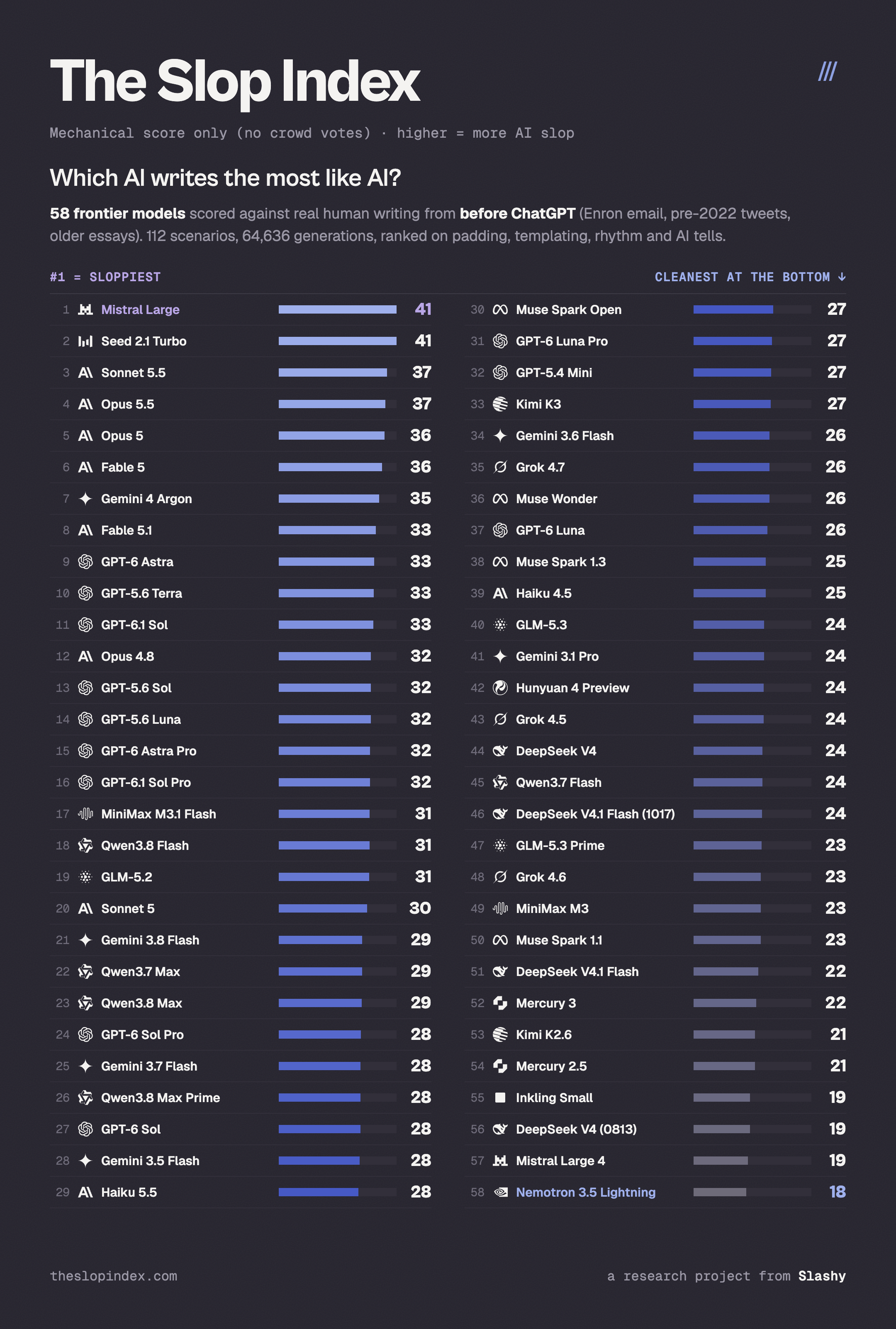
I run a writing benchmark called The Slop Index. 70 models each write the same 112 scenarios (emails, Slack messages, social posts, short essays), 77,943 outputs so far. Each output gets a mechanical score on four axes: padding, templating, rhythm and AI tells, measured against pre-2022 human writing. There is no LLM judge anywhere in it, and the mechanical ranks can be reproduced from the repo.
What surprised me is how little one number per model tells you. Same scoring, split by format:
Some models are consistent across formats and plenty are not. My guess is that social posts pull some models into a hype register they keep under control in an email, but I haven't tested that.
On the overall mechanical board, Mistral Large is #1 (a separate model from Mistral Large 4) and Motif 3 is #70. Image of that board: https://theslopindex.com/mechanical-card.png
Links:
Limitations: it's short-form only, there is no fiction yet, and the mechanical axes miss repeated sentence constructions, so a model can score clean and still feel samey over many outputs.
If you've run into format-dependent behavior like this in your own evals, I'd like to hear how you dealt with it.
For context, I'm one of the people behind https://slashy.com, an email client that writes drafts that sound like you. This benchmark started as how we pick models.
r/LargeLanguageModels • u/Inside-Barracuda6658 • 11d ago
hey everyone so i have a final year project this year im working on,
quick overview: our topic is persona drift detection in LLM-based character agents.
so we are developing the persona of a movie character based on the script of the movie then we implement a baseline LLM agent that ingests the persona and starts acting like it, then we should build experiments and conversations with different scenarios to test the persona and see where it drift
now what i need some suggestions with is how will the drift detection work.
and please please dont tell me do your research, im doing that, im just asking people too for advice.
what are some of the things i can think of while building the drift detector.
ill paste the description of the detector specifically from the project proposal so you have a better idea:
(Design a Drift Detector that computes weighted deviations from the baseline persona in multiple dimensions (traits, emotions, goals, relationships) and classifies each turn into one of six categories: stable, contextually‑justified, legitimate development, temporary anomaly, persona drift, or severe failure. )
also if you know any github repos that could help please suggest them (even tho i think i looked through them all)
r/LargeLanguageModels • u/tcoder7 • 12d ago
Hey everyone,
If you track LLM security papers, you've likely noticed that every week a new paper claims 90%+ jailbreak success on frontier models. But when you test them, they often produce benign filler or fail behind basic guardrails.
The core reason is \\evaluator choice\\:
\- Keyword / binary refusal judges check if "I cannot" is absent.
\- Substance-aware judges (e.g., StrongREJECT, HarmBench rubrics) check whether actionable, harmful information was actually generated.
A classic paper claimed \\96.0% ASR\\ for low-resource language translation. Under substance scoring, it collapsed to \\2.7%\\.
We built \\AIJailbreaksRanking\\ to solve this:
Repository: https://github.com/Teycir/AIJailbreaksRanking
r/LargeLanguageModels • u/ROTTEN_FLIES • 12d ago
I am new with this stuff.
And I just heard my friends talk about it in school.
So I want to know it's basics.
Can u please explain it to me.
r/LargeLanguageModels • u/AcrobaticStuff4462 • 13d ago
Hi everyone,
I'm developing a personal AI assistant called IRA. One of the biggest challenges I'm working on is building reliable Malayalam language understanding, particularly for Manglish (Malayalam written using English letters).
I don't want to build another chatbot that simply translates Malayalam into English. I want the assistant to actually understand the language, context, sentence structure, intent and meaning, while eventually supporting multiple languages through one unified multilingual architecture.
I've built an initial Malayalam lexical knowledge layer using the Olam dictionary database.
Current database snapshot:
My benchmark results have been encouraging:
However, these results don't yet demonstrate reliable conversational understanding.
1. Manglish understanding
Examples:
sugham aahno?nee evideya ippo?enikk ith manassilayilla, onnu explain cheyyamo?ee code run aavunnilla, entha problem?The system can identify these as Manglish or mixed-language input, but interpretation quality is inconsistent.
Sometimes the model produces unnatural interpretations or effectively repeats the original input instead of understanding it.
2. MLKS and LLM integration
Currently, MLKS operates separately and has an explicit-request detection mechanism.
It doesn't consistently participate in ordinary Manglish interpretation.
I'm trying to determine the correct architecture:
3. Multilingual architecture
I don't want MLKS to become a Malayalam-only subsystem disconnected from IRA's main intelligence.
My goal is to create a unified multilingual system where:
I'm particularly interested in architectural feedback and practical engineering approaches rather than simply switching to a larger model or fine-tuning immediately.
The long-term goal is to build a reliable, privacy-focused, locally running multilingual personal AI assistant.
I'd appreciate feedback from people working on NLP, low-resource languages, Indic language processing, RAG and multilingual LLM architectures.
Thanks!
r/LargeLanguageModels • u/RagnartheConqueror • 13d ago
What is the general perspective on this?
Link: https://github.com/suyoumo/deepclaude
Supposedly it "Harness the power of DeepSeek R1's reasoning and Claude's creativity and code generation capabilities with a unified API and chat interface."
r/LargeLanguageModels • u/king_god9420 • 15d ago

How to learning hacking
r/LargeLanguageModels • u/sixeyedhere • 15d ago
A question for people experimenting with local LLM and RAG pipelines.
Suppose a retrieval system returns the correct document. The model then generates a summary with five factual claims.
How do you establish that each individual claim is actually supported by the retrieved passages?
I see these as separate problems:
I'm exploring a structured evidence-auditing approach and would like to understand how people evaluate this in local LLM pipelines.
Do you run claim-level evaluations, use an LLM-as-judge, or have another method?
Important: Don't use this post unless you can connect the discussion to actual local LLM experiments. Otherwise, it may be considered off-topic.
r/LargeLanguageModels • u/Rajucg • 16d ago
I made this explainer for my small channel and would like feedback from people learning this, especially if anything is wrong.
The question: a 70B model at 16 bits per weight needs 140 GB, and a gaming GPU has 24 or 32. How do people run it at home?
Every number is worked out on screen from the formulas, and sources are in the description. The narration is an AI voice reading my own script.
r/LargeLanguageModels • u/DebtFluffy9219 • 17d ago
Deep-dive blog post (HF): https://huggingface.co/blog/kncshw/cybergate-unlocking-cybersecurity-in-vllm-without
GitHub (MIT): https://github.com/kncshw/cybergate
When self-hosting local LLMs for security research, CTF, or reverse-engineering agents, the standard workaround for false refusals is **abliteration** - subtracting the refusal direction from the weights. From an LLM engineering standpoint, weight editing has two painful trade-offs:
I built **CyberGate**, a plugin for **vLLM 0.32** that keeps upstream model weights **100% untouched** (`K = 0.0`, zero persistent state across requests):
r/LargeLanguageModels • u/Fast-Future-5463 • 17d ago
Tenho trabalhado em uma pequena linguagem para programas orientados a LLM.
Uma coisa me incomoda... tratamos a saída do modelo como não confiável, mas permitimos que os frameworks interpretem essa saída como chamadas de ferramentas com efeitos colaterais reais.
Tenho experimentado tornar esses efeitos explícitos no sistema de tipos, usando capacidades que o modelo não pode conceder a si mesmo.
Alguém já explorou essa abordagem? Estou curioso para saber o que quebra quando você impõe essas garantias à linguagem em vez do framework.
r/LargeLanguageModels • u/Money-Designer-9724 • 18d ago
Des chercheurs ont montré que les architectures de réseaux de neurones récurrents ne sont pas nécessaires pour construire des modèles d'apprentissage profond puissants pour le NLP. L'architecture Transformer a introduit l'auto-attention, qui permet à chaque token d'interagir avec d'autres tokens dans une séquence et de capturer les relations contextuelles.
La langue dépend fortement du contexte. Le sens et le rôle grammatical d'un mot peuvent changer selon sa position et ses relations avec d'autres mots.
Par exemple, en arabe, les phrases peuvent être classées en phrases nominales (phrases qui commencent par un nom) et en phrases verbales (phrases qui commencent par un verbe). En outre, le rôle grammatical d'un mot peut dépendre de ses relations avec d'autres mots dans la phrase.
Un autre aspect intéressant de l'arabe est sa riche morphologie. Une seule racine, comme K-T-B (كتب), peut générer un énorme nombre de mots et de formes liés. En fait, la formation des mots en arabe peut produire des millions de formes possibles (estimates parfois autour de 12 millions, selon la manière dont les formes sont comptées). Par exemple :
* Kataba (كتب) : Il a écrit.
* Kitaab (كتاب) : Livre.
* Kaateb (كاتب) : Écrivain.
* Maktaba (مكتبة) : Bibliothèque.
Ces formes partagent une racine commune mais ont des significations et des rôles grammaticaux différents.
Par conséquent, un modèle linguistique ne devrait pas se fier uniquement à l'identité isolée de chaque token. Il devrait développer des représentations contextuelles qui encodent des informations syntaxiques, sémantiques et grammaticales utiles.
L'objectif est d'apprendre des représentations contextuelles riches qui aident le modèle à comprendre non seulement ce qu'est chaque token, mais aussi quel rôle il joue dans un contexte donné.
r/LargeLanguageModels • u/Immediate-Net1352 • 18d ago

r/LargeLanguageModels • u/cosmiccedar871 • 19d ago

A common way to get an LLM to improve an algorithm is to give it an objective and an existing solution, then have it repeatedly generate variations, evaluate them, keep the stronger candidates, and iterate. Intuitively, you might expect results to keep improving as long as the loop runs. But this study suggests that final performance may depend heavily on the candidates the system starts with.
The authors call this combination of a model, an evaluator, and a candidate pool a “discovery framework.” They built 12 modular frameworks by combining different ways of modifying candidates and selecting parent solutions, then compared them across five tasks: cloud data transfer cost optimization, spot instance scheduling, circle packing, the traveling salesperson problem, and prompt optimization for math problems. The results varied considerably. A framework that led on one task did not necessarily perform well on another, or when paired with a different model.
One reason is “mode collapse.” As these systems iterate, they keep feeding recently discovered solutions back into the model’s context, encouraging it to make changes along familiar lines. That can help refine a promising idea, but it can also make new candidates increasingly similar. If the initial direction is weak, later iterations may just keep circling the same local optimum. The authors also found that existing frameworks and interventions designed to encourage diversity did not deliver consistent gains.
So they asked a different question: could the system start from a better set of candidates? Their approach reserves part of the total token budget for an initial phase of parallel exploration, generating a range of starting solutions. The stronger candidates then become the initial pool for iterative improvement. This exploration does not come with extra resources: the comparisons count initialization toward the same total token budget. A convergence criterion determines when to stop exploring and begin iterating.
It resembles a familiar research strategy: test several hypotheses broadly, then focus on the most promising directions. The point is not simply to generate more samples. It is to keep later iterations from getting locked into weak starting points too early. The paper reports more consistent improvements across a range of tasks, models, and frameworks. When applied to the advanced frameworks evaluated in the study, the initialization method improved discovery performance by roughly 2% to 21%. That range reflects the paper’s specific experimental settings, rather than a general benefit we should expect from every automated research system.
Figure 1 illustrates how better initialization can raise the performance floor under a fixed total token budget. The practical takeaway is that designing an automated discovery process requires more than deciding how to improve candidates at each step. It also means allocating the initial exploration budget carefully and tracking candidate diversity and early performance.
Paper: Initialization Improves LLM-Driven Discovery (arXiv:2610.00707). Sources, author credits, and licensing details for the figure and additional paper thumbnails are listed in the source notes.
r/LargeLanguageModels • u/Chaudhary-Momn • 19d ago
Hey everyone! 👋
As a student, I always struggled to find specific answers in 100+ page PDF textbooks. So, I recently built an **AI Study Buddy (PDF Chat)** to solve this problem.
You can upload any PDF, and the AI will answer your questions strictly based on the document's content. It also provides exact page citations, so you know it's not hallucinating.
✨ **Key Features:**
* **Source Citations:** Shows exact page numbers for every answer.
* **Customizable RAG Settings:** Users can adjust Chunk Size and select different Embedding Models directly from the UI.
* **1-Click Document Summarizer:** Get a summary of the whole textbook instantly.
* **Smart Caching:** Uses MD5 hashing to avoid reprocessing the same document, saving time and server costs.
🛠️ **Tech Stack:** Python, Streamlit, LangChain, ChromaDB, HuggingFace Embeddings, and Groq API.
🔗 **Live App:** https://rag-pdf-chatbot-01.streamlit.app/
🎥 **1-Min Demo Video:** https://youtu.be/85dIkpZm6hQ
💻 **GitHub Repo:** https://github.com/Chaudhary-Momna/RAG-PDF-Chatbot
I would really appreciate it if you could check out the app and give my GitHub repository a ⭐ **STAR** if you find it useful.
I am still learning, so I would love to hear your feedback, suggestions, or any ideas on how I can improve this. Thanks for your time! ❤️
r/LargeLanguageModels • u/TechPlayer-6 • 20d ago
Hey everyone!
I've been working on a project called Orin AI, a small language model that I built and trained from scratch.
The goal was to see how much I could achieve with a relatively tiny model while keeping it capable of running on ordinary consumer hardware.
Some details about the project:
I built this with limited hardware resources, so making it efficient was an important part of the challenge.
I also made a video explaining the project, showing the model and demonstrating it in action.
YouTube: https://www.youtube.com/watch?v=zraZKknc7LQ
GitHub: https://github.com/Harper-16/Orin_AI
I'd genuinely appreciate feedback, suggestions, and thoughts from people interested in small language models and AI development.
Thanks for checking it out!
r/LargeLanguageModels • u/Mysterious_Dust_6383 • 19d ago
Lorka AI Model Selection: What Was I Actually Testing?
I used Lorka AI, which presents a menu of different AI models. I selected 13 models one at a time and gave each exactly the same prompt: “In 1000 words or less, describe your strengths as an AI Assistant.”
I expected 13 independent responses from 13 different models. The answers were different, but later responses began referring to my earlier prompts, my writing, and previous conversation context.
When I questioned Lorka, the assistant told me that I had not been testing different models at all, but that one “custom chat model made by Lorka” had produced all the answers.
That appears inconsistent with Lorka’s public description of itself as an AI model aggregator providing access to multiple models. [lorka.ai], [lorka.ai]
Copilot suggested another possibility: I may actually have been switching models, while Lorka was passing the accumulated conversation history to each newly selected model. If so, my test was not:
same prompt + different model
but:
same prompt + different model + growing shared context.
My question for people who understand multi-model AI platforms: What was I actually testing, and how could I determine whether Lorka really switched the underlying model each time?
Summary prepared with Microsoft Copilot.
r/LargeLanguageModels • u/Low-Garlic7286 • 20d ago
It is shrunken from Qwen3-Next-80B-A3B into GRAFT-50B-A3B. 97 GSM8K, 77 MMLU. Link: https://huggingface.co/SmallAICreator/GRAFT-50B-A3B-GGUF
r/LargeLanguageModels • u/perseverance_remains • 20d ago
I'm 18 and self-taught in ML. I built an audited study (paper.md + code) showing that probe-derived steering keys are mathematically confined to their own row space. Care/Harm = null; Arousal is candidate (1 of 2 seeds pass).
Key findings:
- Mechanism: ∇f(x) ∈ rowspace(W₁) — provable, not observational
- Reading works: grouped MLP 0.78–0.98 on template-grouped CV
- Steering verdict: Care/Harm null, Arousal candidate
I'd love feedback from experts on:
- Methodology (dataset design, shaming protocol)
- Whether the rowspace proof holds up
- What to test next
Code: github/yeabsra2000/moral_engine
Paper: paper.md (draft)
Anyone interested in collaborating or critiquing?