**I'm posting here first in hopes of getting feedback from pros - and homeowners who have used services before or would consider using one - on the content, stuff I missed, or anything that should be removed, critique in general, etc.**
This guide is aimed at helping homeowners choose a lawn care company, what to expect in the selection process, and some after-service stuff. I’m aware this is a DIY forum, but I see posts from folks who do not want to DIY. They are looking for help relating to hiring a company or sorting out a problem with one. This post is for those people or for community engagement and discussion on the subject. The thoughts below reflect my experience, philosophy, and opinion.
Note that this is strictly for lawn chemical applications, not lawn mowing, trimming, etc.
IS A LAWN SERVICE WORTH IT? DIY vs. Hiring
If you're trying to choose between hiring a lawn service or DIYing, both can be done for a similar cost, depending on the lawn size, equipment, product selection, etc. DIY can be much cheaper, but it’s important to compare apples to apples.
The pluses and minuses can swing both ways. I’ve provided a broad pros and cons list below. A lot of deciding to DIY starts with: Do you know what the hell you are doing? If not, that’s okay, but are you willing and able to figure it out, and are you comfortable and capable of applying pesticides properly? These are good starter questions as you make your selection.
DIY PROS: More control over timing of treatments and products, personal satisfaction, individual attention to your lawn.
DIY CONS: Steep learning curve, time-consuming, product storage, equipment costs, recordkeeping/scheduling.
PROFESSIONAL SERVICE PROS: Saves time and effort, professional knowledge and experience, managed schedule/timing, access to additional resources.
PROFESSIONAL SERVICE CONS: Variable technician experience, less individual attention, communication challenges, potentially higher costs.
EXPECTATIONS
Lawn services vary in quality and pricing. Smaller companies may offer more personalized, all-inclusive services with frequent visits and higher costs. Mid-sized and larger companies may focus on standardized treatments at competitive prices, but can still provide a fine result. The basic goal of any service is usually similar: keep weeds down, feed the lawn for color and growth, provide advice and recommendations, and keep the HOA off your back.
Your expectations should be set by the company when you agree to service. Results may be slow at first. The time of year you sign up, the products being used, and the quality and condition of the lawn prior to starting are all factors in how long it will take to see improved results.
In most cases, after using a service for a while, you should still expect weeds to come up from time to time, and an occasional problem to occur. You are partners. The company can't fix everything, but they should be able to help identify problems and recommend solutions. You’ll still need to handle mowing, some watering, making decisions on potential needed services, or addressing underlying issues such as shade, run-off, or soil problems that a basic service can’t handle.
Some lawns need more than a service like this can offer. If you have a ton of shade, erosion problems, or generally don’t give any care to your lawn, consider an alternative approach to lawn treatment programs.
CHOOSING THE RIGHT LAWN CARE COMPANY FOR YOU
I suggest opting for a small company that is easy to get in touch with and shows prompt and concise communication—being able to contact your tech or manager quickly is a plus.
Friends, neighbors, and Facebook groups can be good places to ask for a referral when you're looking for a lawn care provider.
No doubt you’re going to come across TruGreen. I’m not a big fan of TruGreen, simply because they are a huge company with a bad reputation in the industry. Worth noting that private equity has made a big showing in lawn care in the past 5 years or so. PE has turned many small businesses into larger conglomerates like Turf Masters Brands and Senske Services. Many services are franchises, such as WeedMan, Lawn Doctor, Spring Green, and NaturaLawn of America.
Technicians and management have the most influence over your lawn. Managers may oversee product selection, spray calibration, hiring, training, etc., while technicians perform the actual work on the lawn—generally anyway.
Even at the worst companies, if you have a tech who knows what they are doing, you can get good results. However, even the best techs can be held back by management/company policy and procedure, and vice versa. Unfortunately, experience and knowledge are not synonymous in the lawn care industry.
It’s good to know that anyone applying to your lawn is either required to have a pesticide applicator's license or they work under a licensee, where continuing education credits must be earned to keep the certification active. This will vary by state, with some having stricter requirements for applicators.
It never hurts to ask about insurance and licensing. In some states, companies must provide proof of a minimal amount of liability insurance before an applicator charter or license can be issued.
Google reviews: For several years, service-based companies have been using apps to generate more Google reviews. Some of these systems violate Google's policies, and some work within them. Either way, they can increase the proportion of positive reviews and influence a company's overall rating. These programs don't remove existing negative reviews or prevent customers from going directly to Google to leave one.
My advice is to read deep into the Google reviews and see how the company responds to the negative ones. Mistakes are going to happen even to the best operators. How a company handles individual complaints may provide a better overall view of the operation.
Take reviews that say things like “they killed my lawn” with a grain of salt. Trust me, lawn care companies do kill lawns in error, but it doesn’t happen that often. When it does, that’s why they have insurance and/or can repair those lawns in-house and make it right. Many things can cause a lawn to die, and usually it is not the certified operator who is responsible. A DIYer who buys a bottle of weed killer at the home center and doesn’t read the directions is far more likely to damage their lawn than a company with procedures and redundancy to prevent error.
THE INITIAL PROCESS
Quotes can usually be done online using satellite images and measurement tools to find the lawn size, which is the starting point for pricing. These online tools are usually accurate and faster than having someone come to the property, although some companies (or you) may prefer a site visit before signing up.
Assessments will vary by company and your preference. In many cases, with the same grass type, you’re going to be getting the same program that that company provides its other clients. So, if the lawn is in okay shape, you can usually begin treatment without the company physically needing to see the lawn condition until the first visit. If your lawn is a total wreck, I would suggest having at least a photo assessment completed so that you both understand starting conditions and expectations, and whether extra work could be needed, etc.
Contracts: Some states require contracts for lawn treatments. Where no contract is required, you enter into a verbal agreement. In most cases, with or without a contract, you can still cancel and are not locked into a year-long agreement. In either case, you may have stipulations on the cancellation procedure. Important to know that most services renew into the following year unless you opt out of that or have a different contract agreement.
Pricing: I will not be able to tell if your quote is fair or not. Pricing will vary by location and cost of living, company operating costs, and offered services. Don't assume cheaper is better or that higher prices mean better quality. Compare each company's program apples to apples—more on this in the program section.
Promotions & Discounts are usually available. Many services offer an introductory reduced rate for the first treatment, and military, senior, and prepay discounts, etc. Be sure to ask!
You should also consider accepted payment methods, access to documentation, communication preferences, and the company's terms of service when no contract is provided. There may be preferences on these service-related issues that make or break a company for you.
LAWN TREATMENT PROGRAMS
A lawn program is the treatment protocol for the year. i.e., what products are being used, how many times per year, how frequently, etc. Programs can be extremely complex or incredibly simple, but a key thing to remember is that while companies in a similar area may have similar programs, they are not identical.
This is where you should be looking for pricing differences.
The basic lawn care program usually consists of 5–8 applications done every 4–8 weeks. In northern climates, the season may be shorter and have fewer applications, and vice versa in southern climates. Programs usually include pre- and post-emergent weed control and fertilizer as a base starting point.
Some companies may include other services as part of the regular applications. Let's say X Company does 6 applications per year and includes lime as one of the services. In comparison, Z Company only provides weed control and fertilizer in the 6 applications and sells the lime (or insecticide, aeration, seeding, etc.) as an add-on service, making 7 total.
Companies may offer tiered programs. For example, “Bronze,” “Silver,” and “Gold” plans. Bronze may provide basic service, while the Gold would include monthly visits and an all-inclusive, cover-all-your-bases type service. There is a good chance a monthly service contains lots of stuff the lawn probably doesn’t.
Regardless of program, you should follow the recommendation of the company and stay consistent with their treatment plan and frequency of applications. This gets back to not all programs being identical. Missing, skipping, and delaying treatments could prove detrimental to your lawn. If you are hesitant about the schedule, program, timing, etc., you can always message me or post to ask the community whether they provided a good answer or not.
I suggest opting into the most basic service possible. Grubs and a few other insects, and some lawn diseases, are pests that could destroy your lawn quickly. My best advice here is to take the suggestion of local pros and add those based on your lawn type and local pest pressure. If you’re unsure, again, message/comment or post up.
Do not buy lime unless you have a soil test saying it’s needed.
I’d skip aeration unless you know you have a soil compaction issue or plan to seed afterward. If you need aeration, make sure they at least do a double pass. Liquid aeration is mostly a scam.
If you may need seeding, evaluate that prior to the seeding window in late summer/early fall.
The recommendation of “extra” services without a proper evaluation is usually a sales effort rather than an attempt to meet the lawn's needs. There is no evidence to suggest any single lawn MUST have seeding every year, or that frequent fungicide treatments or aeration are needed annually, etc.
Most companies offer some type of guarantee. This usually means that when a problem arises, they will assess the problem and treat it at no charge if it falls within the parameters of the agreed-upon services. For example, if you have weeds come up between treatments, most will return to treat those for free. If you signed up for weed control and fertilizer only and a disease or insect problem comes up, that will probably cost you extra. In my experience, most companies do not offer any type of money-back guarantee.
PRODUCT AND APPLICATION
Product selection will vary, so don’t get too hung up on this. Both liquid and granular treatments have their place. Generic pesticides and name brands both have market share, and both can perform well. Companies choose a product based on many factors, and those selections will have an impact on your price. Volume is a big factor here as well. What TruGreen pays for something is not what Joe’s Lawn Service with 500 customers pays!
It may be good to know that a pre-service notification, usually by text, phone, or email, can be provided if requested or required by the state. If you have a pet, locked gate, etc., being aware of when your company is coming is a standard procedure.
The application method is how products are applied to the lawn. There are several common lawn application methods used by pros, all of which are very efficient. Spray truck/rigs and ride-on or stand-on spray/spread machines are not cheap investments. The investment is meant to increase quality, ease of use, and efficiency.
Lawn applications are quick. Once the operator is set up, he’s going to do the work much faster than you think. Treatment time will vary based on calibration. For example, they may calibrate to apply 1,000 sq ft in 1 minute. At this rate, spraying a football field-sized lawn would take around an hour. For ride/stand-on applicators, that time could be cut in half or less! Bottom line here: don’t assume fast means a bad application.
Also, don’t assume work wasn’t complete because your Ring doorbell camera didn’t trigger. If you suspect something is not up to par with the application, call the manager and let them get to the bottom of it. Companies often have GPS tracking to check on technicians, verify work was done, etc. Some companies even require their technicians to wear body cameras. Trust but verify.
AFTER-SERVICE
Once the treatment is complete, the company must provide you with documentation of the application. They must maintain those records for a number of years per law. This paperwork should include products used, where applied, total amounts, etc. They may also include after-service care instructions about watering and mowing, and potentially specific notes about the lawn, recommendations, etc.
Common after-treatment FAQs:
Watering/Rain: It's difficult to address all circumstances here. Just know that some products need to be watered in and some need dry time. Take the advice of your provider on whether to water after treatment.
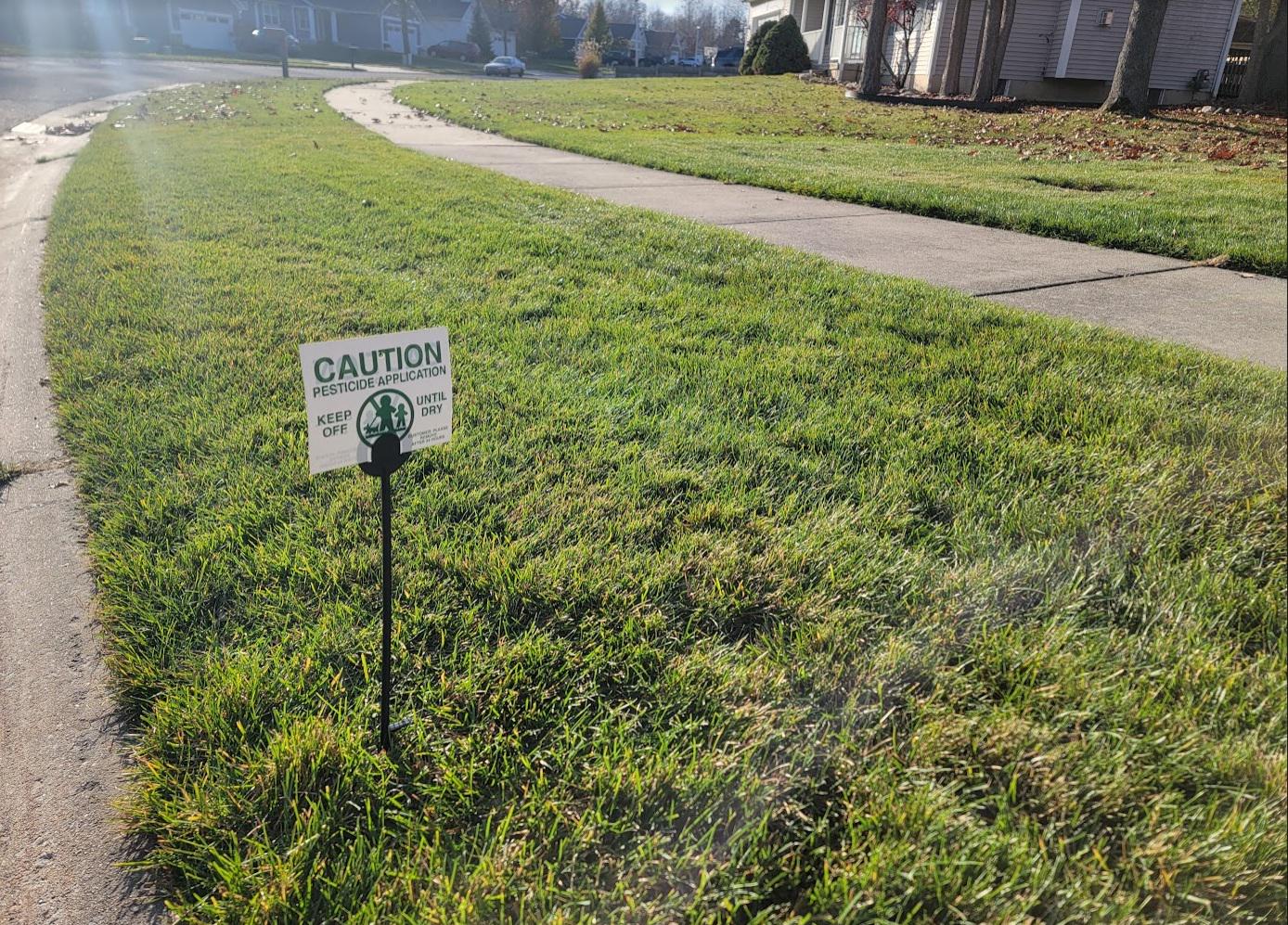
When can pets and children go back on the lawn? Generally, when liquid products have dried and dry products have settled. This will vary from minutes to hours, depending on many factors. If you want to be overly cautious, wait 24 hours for re-entry.
Mowing: This will vary with product as well, but waiting at least 48 hours after the treatment is a safe option.
If a problem occurs, avoid hastily jumping to another company without identifying the problem! Simply hiring someone else doesn’t mean they'll be able to fix your problem. Start by consulting with a tech or manager and be open. Sometimes weird stuff happens in lawns that aren’t easy to fix.
RESOURCES
In closing, there are plenty of resources available to check that your provider is doing what they should be. Your State Pesticide Regulatory Agency can help with chemical-related issues. Your University Extension can help with lawn problems, identification, and lab testing. At r/lawnanswers, we are here to support you with all lawn-related things.