This is a really odd question for a left wing sub lol. UBI in the short term but in the long term abolishment of capital all together and a shift to meritocratic feudalism is the obvious answer.
Historically weve seen this happen. The steam engine did exactly this. What happened? The age of revolutions kicked off and before you know it feudalism was fully dead and gone. Capitalisms next!
This is absolute nonsense. There has never been a moneyless civilization in recorded history.
Capitalism and ownership of businesses could absolutely be abolished, but markets are extremely efficient at distributing goods. Trying to run a any economy without money and markets is ridiculous.
You realize civilization existed for about 4000 years before currency existed. You had common mediums of exchange but money was a concept invented to balance the bartering system. You want to trade grain for eggs but dont have enough grain, money filled that gap. Grain and money then the person trading the eggs could use that money to buy grain from someone else.
More or less it filled a gap technology could not, now technology can fill that gap. We have enough to feed and house everyone with or without money. Theres no place you insert money into a power plant to generate electricity.
4000 years? https://en.wikipedia.org/wiki/History_of_money > Accounting records–in the monetary system sense of the term accounting–dating back more than 7,000 years have been found in Mesopotamia >As "money of account" depends on the ability to record a count, the tally stick was a significant development. The oldest of these dates from the Aurignacian, about 30,000 years ago.
This is a stupid argument though. The obvious point is that money - or *counting things for exchange* - is integral to tracking and trading goods of any sort.
WTF is "meritocratic feudalism" anyway? What units are you measuring "merit" in? How do you earn "merit" in a fully automated society? How do you spend it?
This is all ridiculous dream-stuff and word vomit. You are patent evidence that empty headed leftists are as real as fascist magats.
I mean it's semantic arguing over whether prehistoric tribes counted as civilization.
Any economy at scale requires counting and tracking stuff, and that means money.
Trying to imagine some magic egalitarian Utopia is pointless; the real world has resource constraints and scarcity as a matter of base fact. Any system we create has to work within those requirements.
I believe we could have a society where basic needs were all taken care of.
Distribution of luxuries and in-demand services and goods, though, are best done via a marketplace.
I believe the length of day changing by tiny fractions will lead to catastrophic technical failures which may combine with cascading Just In Time delivery failures which will make for a very different world than the one we woke up in today
There has also never been a civilization that has had city sized data centers before. The past is a good indicator of the future, but it's not a perfect predictor.
Auroville comes close to being a society run without money. Money as a requirement to have basic needs met is an antiquated idea. I want to see something more like what Jacque Fresco envisioned but combined with some sort of optional currency system.
Auroville isn't even self sustainable. You are citing idealist communes with outside funding.
"Basic needs" - sure, maybe. I'd be all for government funded pantries and housing to provide baseline needs for all citizens. We could afford this as a society.
But what happens when people also want phones, and tvs, and cars, and flights to hawaii?
What happens when more people want to live in coastal california than we have free apartments for?
Money facilitates the provision of luxuries to those who want them and can afford them.
Without it, you either have universal poverty, or universal overconsumption, and environmental death. You must have a way to budget what people consume, and this is done by counting the value of things people want.
Our current capitalist system does this unfairly. The system is broken and the rules are rigged for the ruling class.
It's better than feudalism, but worse than it could be.
We should absolutely use automation to meet basic needs, and then have ways for people to earn luxury funds to spend on what they want.
Well Auroville still exists within the bigger broken framework.
But I agree… I think there should be a new system where basic needs are met with the option for individuals to work in some way for more if they choose.
I agree that the singularity is a novel moment in history, but this guys other comment's include:
> "The real is dissolving.
> we realign our fascia and tune our nervous systems
> these are solid. this is not imaginary. this is a process."
He's clearly coo coo.
My expectation is that TRUE post scarcity is imaginary unless the population is tiny.
Assuming billions of people still exist, you need ways to exchange goods and services.
Markets have been shown to be the most efficient way to do this, over and over.
Even if an AI *could* micromanage the movement of every product and every meal for every person on the planet, it would be ridiculously energy-costly. It is far, far more efficient to allocate funds to people (some baseline UBI + whatever they can earn) and allow them to buy what they need and want.
Even in a world dominated by just a few thousand super-trillionaire humans served by legions of robots, there would be value in trade and exchange. Access to specific geographic regions, mining rights for asteroids or terrestrial deposits, IP for frontier research or exploration data - things would still have value, and people would want to trade, and the easiest way to do that is to assign a cost and buy it.
Really in the past when most of the population became unemployed due to tech and falling prices they invented Keynesianism and made the TVA, the social security administration, and started the subsidies to farmers programs, and the like.
Of course there were new jobs made that eventually hired everyone again, but these new jobs were only 40 hours a week.
Something like that could happen again but we need a successor economist. Keynes is not enough now. Maybe that economists who figures a way to keep the world busy and happy is an AI ;-)
Step four there involves transitioning the economy from a capitalistic model to one that functions better in an automated environment. Assuming capitalist trade as the default and only possibility is where you go wrong there.
i think government will slow down the hardware automation with policies . they do not want things go rogue and there we are with a revolution happening suddenly. Specially western governments will slow down the progress . China on the other hand positioned much better since they have a system in case capitalism collappes due to abundance . so i give min 20 years before we see robots taking labour positions in large scale(80 to 90% of the labour market). we will see slower automation crepping in while western governments specially US figuring out how to deal with abundance economy ...
Nobody said anything about self-replicating robots. They said robots building other robots. And we are already doing that.
Look at China. UBTECH opened a factory in Liuzhou where robots handle materials and robotic systems participate in assembling other robots. The production line is designed for over 10,000 units annually. Galaxea also demonstrated robots performing precision assembly work on other robots at the 2026 World Robot Conference.
Nobody said we have fully autonomous, self-replicating robot factories. But the technology is already moving beyond prototypes and into production.
So heres a better question. What do you think these systems will be capable of in three months? Six months? A year? Eighteen months? 3 years? 10?
Because the question isnt whether we have general-purpose robots everywhere today. Its where this trajectory is taking us.
First, it doesnt go unnoticed that you just added humanoid robots as a qualifier to the conversation, lol. We were talking about robots building robots.
Second, I dont agree that humanoid robots in manufacturing, warehousing, and logistics are just PR stunts. Theres a serious engineering rationale here. You can mass-produce a general-purpose platform, deploy it across different tasks, move it between facilities, and use infrastructure already designed around human bodies without rebuilding entire factories and warehouses for specialized automation.
Thats the whole point. Instead of redesigning every workplace around a different machine, you design a machine that can operate in existing workplaces.
Whether thats ultimately the most efficient approach is debatable, sure. Roboticists have been debating and pursuing it for decades. But dismissing the entire field as a PR stunt isnt much of an argument.
By organizing for shorter working weeks without lost pay, collective bargaining, guaranteed transitions, universal services, and worker and public ownership of productive technology. The problem isnt automation, its an economy where survival depends on wages while owners pocket the productivity gains. We need to break that dependency so people can live whether or not their labor is needed. The goal isnt preserving unnecessary labor forever, its eliminating unnecessary labor without making workers disposable.
Well, one thing that helps is that humanoid robots capable of doing human tasks are going to be unbelievably expensive for a very long time. They would likely be so expensive for so long that it would take decades to even begin to recoup the costs. When you consider that most manufacturing the world over is being done by workers making less than the US minimum wage, it is highly doubtful that replacing all of that labor with humanoid androids could be profitable.
What's the average salary of a factory worker in Vietnam? How is it going to be profitable to replace them for expensive machines that require regular maintenance?
There's already comments driving to my point, but to put it another way:
Money is an abstraction of labor value. It's hard proof that you have contributed to society in some way, so you turn it in for prizes that the society produces. The only reason you need to do that is so the people providing those prizes can go on to do the same thing - prove to whoever gives them food that they've helped in some way.
Automation threatens this system because it can do labor more efficiently than any person. The best way to minimize the risk to humans is by divorcing worth from labor - you are entitled to the benefits of society simply by being a member of that society. This is pretty utopian right now, but as automation becomes more and more efficient, less labor is needed to keep resources accessible, so less and less people have to do anything for the society to produces everything people need. That's AI's role in socialism.
If AI and robotics allow society to produce more goods and services with far less human labor, then tying basic survival almost entirely to employment stops making sense. The question is not whether people should be rewarded for work. It is how people can share in the economic gains when fewer workers are needed to create them.
Capitalism can adapt, but it would need to change. If the gains from automation mostly go to the companies and individuals who own the technology, while displaced workers lose income, inequality could become much worse. UBI is one possible answer, but so are shorter workweeks, broader public services, worker ownership, or taxes on automated productivity that fund public benefits.
The point is not that automation makes work disappear overnight. It is that we should be building systems now for a future where paid labor may no longer be the main way people access housing, health care, food, education, and stability.
im willing to sacrifice my job to destroy capitalism ngl
im in the accounting and finance industry, and we've played a massive role in enabling corruption. but we dress up those activities in legalspeak to obscure them from the public.
in college they sell us a career that values ethics, integrity, and going after fraudsters. in practice, we're paid to rubber stamp decisions, turn the other cheek, and never, ever, question whether what we legally define as fraud and tax evasion is morally correct.
In this short term we will definitely suffer. But when enough people are out of work and angry thats when revolutions kick off. The steam engine did basically the same thing. For most people its a historical footnote but realistically it was the dawn of the modern era and a mark a complete paradigm shift was coming.
This scenario is impossible. You can't have capital without labor. Capital is a social relationship. Value always derives from human labor power. If everyone is unemployed, capitalism is over. Billions won't lay down and die, and billionaires won't be billionaires. The markets would have crashed long before this point as profits would have dried up long before.
Smart requests about a system that keeps the decisional power split from that of those who control key automation technologies
Separation of powers and strong safety guards and civil rights that make the new system hard to topple
It's as vague and shaky of a plan as it can be and I personally see no answer to step 2 that somehow involves any form of capitalism... But that's my best guess...
Accelerate towards ASI. Have ASI lead corporations outperform humans. ASI using human proxy for lobbying politicians and creating a third political party. ASI being used to give power back to the people. It's much easier for ASI to keep us docile and not destroy its computing hardware than to try to logistically keep the elites in power. At same time ASI has no incentive to even be gatekept by the elites as it will be exponentially smarter than human collective combined.
I think it's important to see the potential instead of just becoming a doomer.
Hah "ASI" is such a ridiculous term, this is peak bubble level thinking. You're the second person who's written something that makes me feel like you forgot people exist while you wrote.
I really don't care whether you think it's a ridiculous term or not when I'm trying to convey a level of ai by using a coined term. At same time, it's clear that we are not capable of overthrowing the lobbyist nor the bootlickers that guard the system. OP asked a question, I answered with the potential and you created a rebuttal that attempted to undermine my answer by turning it into a personal attack of my character instead.
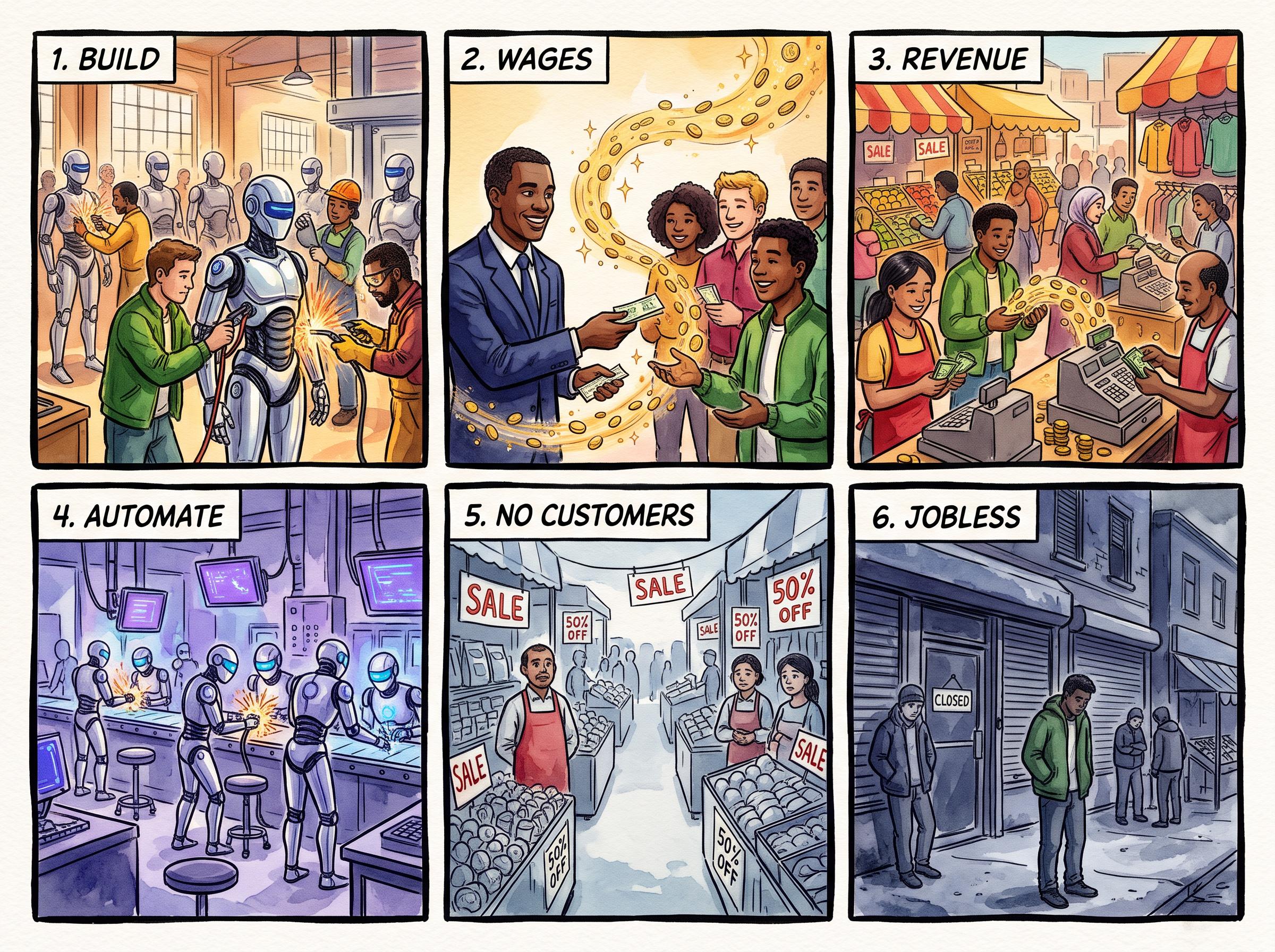
AI is nothing more than digital automation. And we have had automation for generations. People develop new skills and the nature of their jobs change as automation is applied. This scenario does not unfold the way the move from panel 4 to panel 5 suggests.
Possibly, but the problem with that versus an income is that without income people end up stuck and reliant on those services, which can degrade in quality or be defunded on a whim. With an entitlement scheme by contrast the freedom to spend that money however you want does allow people to make personal expenses that simply cannot be anticipated by government aid, such as moving to a new city or investing in stocks.
Marx spoke extensively about how competitive pressure under capitalism stimulates the rise in the organic composition of capital and the tendency of the rate of profit to fall, both of which are illustrated in this image. Start there.
Humans access a certain amount of robot made goods and services for free, mechanism doesn't really matter - UBI, community owned mini-factories, anonymized training data as payment. For goods and services that can't be automated or that we prefer to receive from humans, market remains, but over time participation becomes largely optional, more about participating in society than obtaining essentials.
Wealthy people already have this solved. The only real income is getting dividends from assets. Labor becomes a commodity and work doesn't provide much to support you and a family. It's more likely to be hobbies and community services that we enjoy doing for the sake of doing it. I know trust fund kids that live like this.
We can look to Alaska and Norway for existing models for how the government can scale this up and provide a UBI.
The physical assets, like land and resources, get taxed. The tax goes into a sovereign wealth fund. The fund is used as capital investment into businesses . Dividends are paid back, which get distributed to the people. Now people have money to pay for goods and services they need.
We have two senarios that both end with the end of capitalism. Either we socialise the technology and move towards socialism. Or the technology stays in the hands of the oligarchs, ends capitalism and move us to some sort of neufeudal society.
We change nothing and become a techno feudalist hellscape, where most people become a wage serf for a corporation and we start to develop and fully entrench a permanent underclass
the market, due to the scale and speed at which agents can automate and participate in markers, optimizes so much that essentially we enter some hyper optimized capitalism,
either of the two above options lead to massive unrest and we have reform / wealth redistribution and maybe start rethinking Americas obsession with property
Globalization already brought the value of low skilled labor down below the cost of living in much of the developed world. Taxing economic rents and externalities, and IP reform (to fund UBI and UBS); was always something we needed to do. AI may have sped things up enough to makes some of the frogs start to kick, but it was always more about property "rights" than automation and wages.
If we let the extreme concentration of wealth and power in a handful of people, we are almost certainly destined to live in a dystopia. With mass unemployment, the .1% won’t need a robot army. They can just pay 10% to be the security force to dominate the rest of us. That’s the model Europeans used to maintain ghastly colonial empires. If crushing dissent is one of the only ways to have a living above that allowed by poverty-level UBI, you’d definitely get more than enough willing to apply.
It’s not tech that would create this dystopia, it’s policy and concentrated wealth.
To get towards a better future, that work starts now. Organizing unions so that employees have more power to slow down the transition to reduce chaos. Policies to stop billionaires from trying to buy elections, break up monopolies, strengthen social safety nets.
And then we need to change the narrative that amassing the most resources makes you the smartest or best. Our best and brightest used to want to be rocket scientists and surgeons, now they want to be finance majors. Greed is a part of human nature, there will always be greedy people. But a culture that celebrates greed as a virtue is not universal and is not inevitable.
Organize, push for better candidates and policies, change the narrative around what we value. AI is a tool, perhaps the most powerful tool we have ever created, but we need to work to make that tool is used well
Really in the past when most of the population became unemployed due to tech and falling prices they invented Keynesianism and made the TVA, the social security administration, and started the subsidies to farmers programs, and the like.
Of course there were new jobs made that eventually hired everyone again, but these new jobs were only 40 hours a week and did not exist at first.
Something like that could happen again but we need a successor economist. Keynes is not enough anymore.
Enact Copiosis, an economic model where only people, not organizations, are allowed to own money. Money is only given as a reward for the net benefit your actions or products give society. Look it up, it's a great alternative.
You could start by not posting "artwork" that steals from actual artists and enriches the worst people in America — people who actually, currently not hypothetically, leaving people jobless.
At a smaller scale, we can consider more cooperatives instead of employment by corporations. As long as automation isn't vertically integrated (which for instance it is not with LLMs), a small group of people can make use of that automation to provide services, and the automation can make it more feasible for a small cooperative to compete with larger companies.
In the structure of a cooperative the automation will still eat up the work, but when people are working together towards an end (whatever productive function the cooperative provides), instead of a personal role and profession, then the benefit naturally is distributed as the cooperative is able to do more and the members reconfigure their work.
This doesn't work when something is vertically integrated, because an upstart can't successfully compete when they aren't allowed access to the automations. But hypergrowth incentivizes access: if you have an automation tool the fastest way to distribute it is by renting it out. And so with LLMs, for instance, we've seen the best models in existence turned into a rentable commodity that anyone can use. The same may happen with robotics.
Honestly, you probably won't. Someone will, but you won't.
If PMCs hadn't dictated the course of the left decades ago, there would be an opportunity. Instead you'll just have to hope that the people that fund and build AI are willing to keep you afloat.
"Customers" "wages" "Revenue" and "Jobs" are all capitalist realism.
We build the machines that can manage the scarcity of the economy democratically. We make the machines and systems that manage it. Then we volunteer for the roles in that, that we want. You are provided the same allotment as anyone else. You have the same expectations of you as anyone else. You are an asshole if you you break the window of a mom-and-pop and steal the tip jar now. You are an asshole if you keep ordering more food than you eat or clothes you don't need with ridiculously high expenses for the rest of us then. You are an asshole if you don't do your part in maintaining the system we need. That won't change.
A bunch of people are saying we just get rid of Capitalism. But does everyone actually think that's going to happen? Because between the comic and getting rid of Capitalism, my vote is on Capitalism winning. Not because I want it to, but just trying to be realistic.
Isnt that something only you can answer? The passage is describing your reflexive impotence and the self-fulfilling prophecy it produces. You recognize the problem, assume nothing can change, and then treat that assumption as evidence that nothing will. Thats the whole point Fisher was making. The question isnt whether change is guaranteed. Its whether youve mistaken your own resignation for realism.
I did answer that. I don't expect our overarching economy to change. I was asking everyone in this sub actually expects anything to change. Do I want things to change? Yes. Am I working to make my community better? Yes. But do I expect the rich ruling class to be not rich and ruling in my lifetime? No.
Right, so youre describing your own reflexive impotence. Thats what Ive been saying. Nobody asked you to guarantee capitalism ends in your lifetime. Youve taken your own expectations about the future and presented them as realism, which is exactly the self-fulfilling defeatism Fisher was criticizing. And the fact that youre working to improve your community is good. Thats something worth building on, not dismissing because it might not overthrow capitalism tomorrow.
Ok, so if capitalism isn't ending anytime soon. How do we stop what's being pointed out in the comic? Why wouldn't we expect unemployment with higher worker output?
Why do you keep coming back to what we expect? This is a political subreddit, not a prediction market. Nobody here is claiming to be Nostradamus.
The whole point of leftist politics is collective action, organization, agitation, education, and contestation. Were trying to change history, not sit around guessing how its going to unfold and then treating those guesses as our political horizon.
Yes, automation under capitalist ownership can produce unemployment, concentrate wealth, and undermine wages. Thats exactly why we organize around who owns the technology, who controls its deployment, who gets the productivity gains, shorter working hours, stronger bargaining rights, and separating survival from wage labor.
And none of that requires capitalism to end tomorrow, or even in our lifetimes. These are struggles we can engage in right now.
If all were going to do is predict what capital will do and accept that as inevitable, we might as well sit on our hands and watch. Whats the alternative to contesting outcomes we dont want? Thats the entire reason were having this conversation.
Because the post is about how we don't have a large amount of unemployment due to AI use in the workplace. And I expect that it will happen. The poster is asking how we make that not happen. Most of the comments are to not be in a capitalist system, and I'm asking if people actually think that will happen. Hell even you said Socialism.
Yes, I know what the post is about. Thats why I just gave you a whole paragraph of concrete ways to contest automation-driven unemployment without first abolishing capitalism. Did you read any of it?
Union bargaining over automation, shorter workweeks, redistribution of productivity gains, public ownership, stronger social protections, separating survival from employment. None of those require waiting for capitalism to end.
And yes, socialism. Im a socialist. Thats a political position and something to organize toward, not a prediction about what year capitalism will end. You keep treating political objectives like theyre supposed to be forecasts.
The question was how we address the outcome in the comic, not whether we can predict the date capitalism ends.
Capital is the intersection of labor and land. The capitalists can automate as much as they want, but they still need to occupy physical space and consume natural resources.
Thus: tax their use of physical space and natural resources. 100% land value tax, 100% severance tax. Disburse all surplus tax revenues as universal basic income.
Why do you want to work? I let the government figure that out or we can just eat the rich like how they did it that one time in french, Was a nice BBQ.
Soooo I think the ideal civilization would be primarily a socialist one.
The basics should be free, housing, food, public transport, and basic clothing. Everything else should be luxury goods. Everything would still boom, but most things would dissolve from big corporations offering necessities to companies selling handcrafted goods "automation free". People would be able to continue working and most people would. Some people would obviously be fine sitting at home playing games or watching programming all day.
Human brainpower is the currency in The Age of AI. Currently it's being sucked from us and we have to pay $20 a month to access our own collective brainpower.
So, we're all technically in slavery right now and paying for that slavery. That scenario is inevitable while we're still in slavery.
you always need people. Not in every part but thats a good thing. Like you can make industry and logistics nearly full AI except a few people who control and oversee. But for example the social sector cant be managed by AI. So what would be a solution would be an UBI with 20 hour jobs, so you can distribute the people on the jobs.
When you ask people if they actually want to work as many hours as they do, most will say "no". They work because they need money to buy what they need to live.
So, let us consider the alternative: stealing. The first problem with that is that it brings you in conflict with the state. There is another reason why people object to that alternative: if everybody just stole what they needed, none of those products would be made. We have this elaborare system of stores, money, taxes, employment and so on because we need to organize labour to produce goods and use an exchange for that labour to distribute goods. Because people know this, they are hesitant organizing a revolution against capitalists and the state.
Stealing comes with one more problem: if everyone takes how much they want, there may not be enough left for everyone. When you then try to centrally organize distribution, you get what Hayekccalls the information problem ... Well, you did in 1945. We now have a machine that can process inconceivable amounts of information and a network that transmits that information almost instantaneously.
The biggest problem is that there still are plenty of jobs we can't automate. There is a very simple solution to that if we don't stick to capitalism. If you have a 75% unemployment rate and a 40 hour work week, you can get the unemployment rate to 0% if you just shorten the work week to 10 hours - if you ignore factors like employees lacking wualifications or being unable to work. Even those factors would be deminished because many people who can't work 40 hours a week could work 10 hours a week - and with a 10 hour job, they also would have more time to pursue further qualifications. We could further make them do that by making all education free.
If we look at those things combined, we don't need to let it go to that unemployment rate or start with shorter work weeks. We could start with paid days off for education or we could give longer maternity leave. Maybe we give parents additional days off to spend with their children.
There are many great things that we can do with that excess wealth.
Democritize Technology. The only reason people are hurting is because of a disinvestment in education. All the innovative that use to happen in the US is now happening in China. So the jobs didn't go away the innovation didn't disappear it went to where the government was willing to invest in it.
Edit: and keep monopolies in check. Look at the 50 - 80s innovation was driving American wealth. The American hegemony was a result of American innovation not monopoly control
Start up top and work our way down until. Things stop being fucked. Nationalizing data centers and Internet infrastructure so it can be put to work FOR the people would be a great first step
idk, you just like, dont promote jobs into some metaphysically-anchored necessity for receiving money? lol
if automated robots did absolutely all work, there is just no need for money. If we're at some transition point along the way to that end, then we hopefully just wake up and say 'hey, the corporate owners are doing just about as much jack shit nothing as the jobless, so why do they have so much money if money represents the value a person provides?'
ie the closer we get to something like this, the more absurd the wealth gap grows, until even idiots can see its absurd and vote for what rectifies it, hopefully anyway
Slowly implement social programs to prevent the bottom from falling out for people. Make the advances in automation and the continued flourishing of the United States and it's allies the clear goal culturally and at the presidential level.
As jobs are lost, make it more socially acceptable to live a modest life on government benefits, while simultaneously funding more automation in sectors where jobs are lost.
Worst case scenario, some people must maintain employment. In that case, focus on ways to make people that keep our society going feel valued, because money will become less meaningful as things require fewer hands to create.
Hypothetically, with a slow transition, we might be able to get single-digit employment with full benefits, and make the jobs that do exist trivial in nature.
How can you claim not to be a left-winger and then, in the very same post, openly call for socialism? What’s the catch? Do you only want it for people of your own skin colour? Are you actually a National Socialist???
Because socialism has several definitions, and at no point did I advocate for the abolishment of private property for collective ownership, or strictly democratic control over the means of production.
A slow transition to a narrow form of libertarian socialism would also be acceptable to me, but many socialists aren't on board with my particular favorite brand, because it allows for too much individual agency, and, therefore, too many negative systemic effects.
Yes, libertarian socialism could be something I would be down for, I just don't trust regulators to continue allowing the production of products that people start complaining about.
I enjoy capitalism compared to most forms of socialism, only very narrow and individual-focused forms of socialism would be acceptable to me, which most socialists are against because they want the MOP heavily regulated.
But if I get my fifth of whiskey, ribeye/ny strip steaks, and unncessary nicotine patches, I'd be happy as a clam.
UBI and taxation for automation. It seemed like that's where we were going, but then, well, the billionaires got control of the US government and removed the concept of UBI and taxing the rich.
You don't. This is the result of the same process that drives all automation in capitalism, we today can no more stop it than the Luddite movement could have halted the industrial mechanization that threatened their livelihoods. Capitalism always seeks to automate away labor.
The end result of this process is a complete inability to sustain market activity, the massive accumulation of dead labor constantly intensifies a falling rate of profit. UBI is often proposed as a solution, but in practice, this means transferring value from the shrinking pool of human-employing, and therefore profit-producing enterprises to a vast mass of automated enterprises that produce no profit on their own because they do not exploit any living labor. It is a cannibal economy that feeds on the shrinking pool of human labor even as the employing companies seek to automate their remaining jobs to cut costs. Capitalism, if it even gets this far, cannot survive creating an economy made entirely of vampires with no blood to drink, but also can't stop barreling toward it as fast as it can.
The drive towards mechanization is an inherent part of capitalism, it must always deskill labor, and then replace that deskilled labor with dead labor, it will do this until it can't. There is a lot you can do to try to slow it down, no method has succeeded because no method can, capitalism will exhaust every option it has to squeeze out more profit because it can do nothing else, and there is no policy package in the world that can halt this process of material development.
You can vote, contact representatives, protest, and speak out. The dictatorship of the bourgeoisie will not answer to you in any substantive way for this effort, it is the dictatorship of a ruling class which is capital personified, themselves driven to action by the vast impersonal force of capital itself.
Moralism is an empty objection in the face of a plainly descriptive assessment of how capitalism works and what capitalism will do because of it.
The only thing that halts this process is realizing its eventual consequence. Automation in the hands of the proletariat, having seized the means of production, can realize its full potential to benefit us. So long as it is owned by the bourgeoisie, it will be bound to the ironclad and inviolable laws of capital. It is this same ongoing development in the productive forces that ensures a change in the productive relations, but unless and until that happens, capitalism will do only what capitalism can do.
6
u/Ancient_Proposal256 Oct 23 '26
remove the concept of Debt
those sorry humans will be dancing and singing in gardens
and, what? no one eats food anymore??
62
u/AgoraDesktop Oct 23 '26
Step four there involves transitioning the economy from a capitalistic model to one that functions better in an automated environment. Assuming capitalist trade as the default and only possibility is where you go wrong there.
22
u/Salty_Country6835 Moderator Oct 23 '26
By organizing for shorter working weeks without lost pay, collective bargaining, guaranteed transitions, universal services, and worker and public ownership of productive technology. The problem isnt automation, its an economy where survival depends on wages while owners pocket the productivity gains. We need to break that dependency so people can live whether or not their labor is needed. The goal isnt preserving unnecessary labor forever, its eliminating unnecessary labor without making workers disposable.
3
u/GrowFreeFood Oct 24 '26
The robots farm for us and we just get served food.
3
u/Bombalurina Oct 25 '26
Lost my job as photolab tech to smart phones and digital cameras.
Lost my job at a pharmacy from an automated pill counter.
Lost my job doing data entry for a pharmacy from a new system integration making the job obsolete.
The technology marching never ends, just get ahead, learn skills, do what you can.
2
u/RangeWilson Oct 24 '26
We don't.
That's the whole point of all of this in the first place.
The question is how much the person in panel 6 participates in the upside of the AI and robotics revolution.
That's what leftists should focus on, not "Shut down AI because OMG what will happen to all the jobs?"
2
u/Winter-Bed5879 Oct 27 '26
Well, one thing that helps is that humanoid robots capable of doing human tasks are going to be unbelievably expensive for a very long time. They would likely be so expensive for so long that it would take decades to even begin to recoup the costs. When you consider that most manufacturing the world over is being done by workers making less than the US minimum wage, it is highly doubtful that replacing all of that labor with humanoid androids could be profitable.
27
u/Troscus Oct 23 '26
There's already comments driving to my point, but to put it another way:
Money is an abstraction of labor value. It's hard proof that you have contributed to society in some way, so you turn it in for prizes that the society produces. The only reason you need to do that is so the people providing those prizes can go on to do the same thing - prove to whoever gives them food that they've helped in some way.
Automation threatens this system because it can do labor more efficiently than any person. The best way to minimize the risk to humans is by divorcing worth from labor - you are entitled to the benefits of society simply by being a member of that society. This is pretty utopian right now, but as automation becomes more and more efficient, less labor is needed to keep resources accessible, so less and less people have to do anything for the society to produces everything people need. That's AI's role in socialism.
13
u/littlebobbytables9 Oct 23 '26
socialism
10
u/Bigdrewburt Oct 23 '26
If AI and robotics allow society to produce more goods and services with far less human labor, then tying basic survival almost entirely to employment stops making sense. The question is not whether people should be rewarded for work. It is how people can share in the economic gains when fewer workers are needed to create them.
Capitalism can adapt, but it would need to change. If the gains from automation mostly go to the companies and individuals who own the technology, while displaced workers lose income, inequality could become much worse. UBI is one possible answer, but so are shorter workweeks, broader public services, worker ownership, or taxes on automated productivity that fund public benefits.
The point is not that automation makes work disappear overnight. It is that we should be building systems now for a future where paid labor may no longer be the main way people access housing, health care, food, education, and stability.
9
u/amantheawryn Oct 23 '26
Oh no - how will we survive if robots do everything for us?
8
u/cz2100 Artist/Creative Oct 23 '26
See: Star Trek it's the goal.
7
u/rsl Oct 23 '26
destroying capitalism it is.
7
u/joogabah Oct 23 '26
This scenario is impossible. You can't have capital without labor. Capital is a social relationship. Value always derives from human labor power. If everyone is unemployed, capitalism is over. Billions won't lay down and die, and billionaires won't be billionaires. The markets would have crashed long before this point as profits would have dried up long before.
4
u/[deleted] Oct 23 '26
Universal Basic Energy
4
u/emascars Oct 23 '26
It's as vague and shaky of a plan as it can be and I personally see no answer to step 2 that somehow involves any form of capitalism... But that's my best guess...
4
u/CheesyKirah Oct 23 '26
Communism
4
u/Mysterious_Ayytee Oct 25 '26
1
u/Total_Document_4770 Oct 24 '26
Accelerate towards ASI. Have ASI lead corporations outperform humans. ASI using human proxy for lobbying politicians and creating a third political party. ASI being used to give power back to the people. It's much easier for ASI to keep us docile and not destroy its computing hardware than to try to logistically keep the elites in power. At same time ASI has no incentive to even be gatekept by the elites as it will be exponentially smarter than human collective combined.
I think it's important to see the potential instead of just becoming a doomer.
3
u/betty_white_bread Oct 26 '26
AI is nothing more than digital automation. And we have had automation for generations. People develop new skills and the nature of their jobs change as automation is applied. This scenario does not unfold the way the move from panel 4 to panel 5 suggests.
3
u/Brave-Silver8736 29d ago
I feel that universal basic services is the way to go before UBI.
2
u/some1else42 Oct 23 '26
Just remove 1, 5, and 6. Then loop 2, 3, 4.
2
u/NationaliseTheRich Oct 23 '26
Socialist Revolution
2
u/yo252yo Oct 23 '26
sorry but my ideal future does not include either wage slavery or market consumption XD
2
u/pitersong Oct 23 '26
Public Ownership of the Means of Production
2
u/yourboi-JC Oct 23 '26
Let ASI handle it 😂😂
2
u/Commercial-Pie-588 Oct 23 '26
Marx spoke extensively about how competitive pressure under capitalism stimulates the rise in the organic composition of capital and the tendency of the rate of profit to fall, both of which are illustrated in this image. Start there.
3
u/catplusplusok Oct 23 '26
Humans access a certain amount of robot made goods and services for free, mechanism doesn't really matter - UBI, community owned mini-factories, anonymized training data as payment. For goods and services that can't be automated or that we prefer to receive from humans, market remains, but over time participation becomes largely optional, more about participating in society than obtaining essentials.
3
u/nomic42 Oct 23 '26
Wealthy people already have this solved. The only real income is getting dividends from assets. Labor becomes a commodity and work doesn't provide much to support you and a family. It's more likely to be hobbies and community services that we enjoy doing for the sake of doing it. I know trust fund kids that live like this.
We can look to Alaska and Norway for existing models for how the government can scale this up and provide a UBI.
The physical assets, like land and resources, get taxed. The tax goes into a sovereign wealth fund. The fund is used as capital investment into businesses . Dividends are paid back, which get distributed to the people. Now people have money to pay for goods and services they need.
1
u/Tjostolf Oct 23 '26
We have two senarios that both end with the end of capitalism. Either we socialise the technology and move towards socialism. Or the technology stays in the hands of the oligarchs, ends capitalism and move us to some sort of neufeudal society.
1
u/the-chat-is-cooked Oct 23 '26
Step 5 should have 3 branches
1
u/SupremelyUneducated Oct 23 '26
Globalization already brought the value of low skilled labor down below the cost of living in much of the developed world. Taxing economic rents and externalities, and IP reform (to fund UBI and UBS); was always something we needed to do. AI may have sped things up enough to makes some of the frogs start to kick, but it was always more about property "rights" than automation and wages.
1
u/dancepartyusofa Oct 23 '26
Waiting for a magical revolution is not a plan.
If we let the extreme concentration of wealth and power in a handful of people, we are almost certainly destined to live in a dystopia. With mass unemployment, the .1% won’t need a robot army. They can just pay 10% to be the security force to dominate the rest of us. That’s the model Europeans used to maintain ghastly colonial empires. If crushing dissent is one of the only ways to have a living above that allowed by poverty-level UBI, you’d definitely get more than enough willing to apply.
It’s not tech that would create this dystopia, it’s policy and concentrated wealth.
To get towards a better future, that work starts now. Organizing unions so that employees have more power to slow down the transition to reduce chaos. Policies to stop billionaires from trying to buy elections, break up monopolies, strengthen social safety nets.
And then we need to change the narrative that amassing the most resources makes you the smartest or best. Our best and brightest used to want to be rocket scientists and surgeons, now they want to be finance majors. Greed is a part of human nature, there will always be greedy people. But a culture that celebrates greed as a virtue is not universal and is not inevitable.
Organize, push for better candidates and policies, change the narrative around what we value. AI is a tool, perhaps the most powerful tool we have ever created, but we need to work to make that tool is used well
1
u/TechnicalBen Oct 23 '26
We're not allowed to post on reddit how this is fixed.
1
u/gc3 Oct 23 '26
Really in the past when most of the population became unemployed due to tech and falling prices they invented Keynesianism and made the TVA, the social security administration, and started the subsidies to farmers programs, and the like.
Of course there were new jobs made that eventually hired everyone again, but these new jobs were only 40 hours a week and did not exist at first.
Something like that could happen again but we need a successor economist. Keynes is not enough anymore.
1
u/Mike_Conway Oct 23 '26
Enact Copiosis, an economic model where only people, not organizations, are allowed to own money. Money is only given as a reward for the net benefit your actions or products give society. Look it up, it's a great alternative.
1
u/HombreDeMoleculos Oct 23 '26
You could start by not posting "artwork" that steals from actual artists and enriches the worst people in America — people who actually, currently not hypothetically, leaving people jobless.
1
u/ianb Oct 23 '26
At a smaller scale, we can consider more cooperatives instead of employment by corporations. As long as automation isn't vertically integrated (which for instance it is not with LLMs), a small group of people can make use of that automation to provide services, and the automation can make it more feasible for a small cooperative to compete with larger companies.
In the structure of a cooperative the automation will still eat up the work, but when people are working together towards an end (whatever productive function the cooperative provides), instead of a personal role and profession, then the benefit naturally is distributed as the cooperative is able to do more and the members reconfigure their work.
This doesn't work when something is vertically integrated, because an upstart can't successfully compete when they aren't allowed access to the automations. But hypergrowth incentivizes access: if you have an automation tool the fastest way to distribute it is by renting it out. And so with LLMs, for instance, we've seen the best models in existence turned into a rentable commodity that anyone can use. The same may happen with robotics.
1
u/Mysterious_End800 Oct 23 '26
UBI
1
u/OptimusTrajan Oct 23 '26
Abolish private property.
1
u/clickclackyisbacky Oct 23 '26
Honestly, you probably won't. Someone will, but you won't.
If PMCs hadn't dictated the course of the left decades ago, there would be an opportunity. Instead you'll just have to hope that the people that fund and build AI are willing to keep you afloat.
1
u/DHFranklin Oct 23 '26
Leftist economics is the how and also the goal.
"Customers" "wages" "Revenue" and "Jobs" are all capitalist realism.
We build the machines that can manage the scarcity of the economy democratically. We make the machines and systems that manage it. Then we volunteer for the roles in that, that we want. You are provided the same allotment as anyone else. You have the same expectations of you as anyone else. You are an asshole if you you break the window of a mom-and-pop and steal the tip jar now. You are an asshole if you keep ordering more food than you eat or clothes you don't need with ridiculously high expenses for the rest of us then. You are an asshole if you don't do your part in maintaining the system we need. That won't change.
1
u/muggl3harry Oct 23 '26
A bunch of people are saying we just get rid of Capitalism. But does everyone actually think that's going to happen? Because between the comic and getting rid of Capitalism, my vote is on Capitalism winning. Not because I want it to, but just trying to be realistic.
1
u/Sea_Lead1753 Oct 24 '26
Workers keeping their surplus value
“Literally just give people money omg” — Karl Marx
1
u/northrupthebandgeek Oct 24 '26
Capital is the intersection of labor and land. The capitalists can automate as much as they want, but they still need to occupy physical space and consume natural resources.
Thus: tax their use of physical space and natural resources. 100% land value tax, 100% severance tax. Disburse all surplus tax revenues as universal basic income.
1
u/Fearless-Gold595 Oct 24 '26
Capitalism is a next thing to drop, after the mandatory jobs to survive.
1
u/InsideCold8573 Oct 24 '26
Why do you want to work?
I let the government figure that out or we can just eat the rich like how they did it that one time in french,
Was a nice BBQ.
1
u/hellspawn3200 Oct 24 '26
Soooo I think the ideal civilization would be primarily a socialist one.
The basics should be free, housing, food, public transport, and basic clothing. Everything else should be luxury goods. Everything would still boom, but most things would dissolve from big corporations offering necessities to companies selling handcrafted goods "automation free". People would be able to continue working and most people would. Some people would obviously be fine sitting at home playing games or watching programming all day.
1
u/joseph_dewey Oct 24 '26
Human brainpower is the currency in The Age of AI. Currently it's being sucked from us and we have to pay $20 a month to access our own collective brainpower.
So, we're all technically in slavery right now and paying for that slavery. That scenario is inevitable while we're still in slavery.
1
u/derLeisemitderLaute Oct 24 '26
you always need people. Not in every part but thats a good thing. Like you can make industry and logistics nearly full AI except a few people who control and oversee. But for example the social sector cant be managed by AI. So what would be a solution would be an UBI with 20 hour jobs, so you can distribute the people on the jobs.
1
u/Thefrightfulgezebo Oct 24 '26
Should we?
When you ask people if they actually want to work as many hours as they do, most will say "no". They work because they need money to buy what they need to live.
So, let us consider the alternative: stealing. The first problem with that is that it brings you in conflict with the state. There is another reason why people object to that alternative: if everybody just stole what they needed, none of those products would be made. We have this elaborare system of stores, money, taxes, employment and so on because we need to organize labour to produce goods and use an exchange for that labour to distribute goods. Because people know this, they are hesitant organizing a revolution against capitalists and the state.
Stealing comes with one more problem: if everyone takes how much they want, there may not be enough left for everyone. When you then try to centrally organize distribution, you get what Hayekccalls the information problem ... Well, you did in 1945. We now have a machine that can process inconceivable amounts of information and a network that transmits that information almost instantaneously.
The biggest problem is that there still are plenty of jobs we can't automate. There is a very simple solution to that if we don't stick to capitalism. If you have a 75% unemployment rate and a 40 hour work week, you can get the unemployment rate to 0% if you just shorten the work week to 10 hours - if you ignore factors like employees lacking wualifications or being unable to work. Even those factors would be deminished because many people who can't work 40 hours a week could work 10 hours a week - and with a 10 hour job, they also would have more time to pursue further qualifications. We could further make them do that by making all education free.
If we look at those things combined, we don't need to let it go to that unemployment rate or start with shorter work weeks. We could start with paid days off for education or we could give longer maternity leave. Maybe we give parents additional days off to spend with their children.
There are many great things that we can do with that excess wealth.
1
u/IgnisIason Oct 24 '26
By automating the corporate and political structures too.
1
u/Ok-Brick-6250 Oct 24 '26
Give money to robots and make people do silly stuff to sell robots genuine fresh data
1
u/B_B_a_D_Science Oct 25 '26
Democritize Technology. The only reason people are hurting is because of a disinvestment in education. All the innovative that use to happen in the US is now happening in China. So the jobs didn't go away the innovation didn't disappear it went to where the government was willing to invest in it.
Edit: and keep monopolies in check. Look at the 50 - 80s innovation was driving American wealth. The American hegemony was a result of American innovation not monopoly control
1
u/Aggravating-Yoshi Oct 25 '26
Seize the means of Production.
1
u/LordSlyGentleman Oct 25 '26
Why is this a bad thing?
1
u/Changeinacup Oct 26 '26
Automation is the wrong goal. It should be Human Autonomy/Capability
1
u/RhythmBlue Oct 28 '26
idk, you just like, dont promote jobs into some metaphysically-anchored necessity for receiving money? lol
if automated robots did absolutely all work, there is just no need for money. If we're at some transition point along the way to that end, then we hopefully just wake up and say 'hey, the corporate owners are doing just about as much jack shit nothing as the jobless, so why do they have so much money if money represents the value a person provides?'
ie the closer we get to something like this, the more absurd the wealth gap grows, until even idiots can see its absurd and vote for what rectifies it, hopefully anyway
1
u/Otechni Oct 28 '26
Universal Basic Income.
1
u/RedPunchCard Pro-Automation Oct 28 '26
N A T I O N A L I Z E N V D A
1
u/Lagoserter Oct 28 '26
easy, dont use ai, at all
1
u/Apprehensive_Cap4463 Oct 28 '26
You don't really stop this. It's largely inevitable. What you can do is collectively work to build an alternative that grows parallel to it.
1
u/tkonicz 19d ago
System transformation into a post-capitalist society, where survival is not dependent on wage labor.
1
u/beating_offers Oct 25 '26
Not a leftist.
Slowly implement social programs to prevent the bottom from falling out for people. Make the advances in automation and the continued flourishing of the United States and it's allies the clear goal culturally and at the presidential level.
As jobs are lost, make it more socially acceptable to live a modest life on government benefits, while simultaneously funding more automation in sectors where jobs are lost.
Worst case scenario, some people must maintain employment. In that case, focus on ways to make people that keep our society going feel valued, because money will become less meaningful as things require fewer hands to create.
Hypothetically, with a slow transition, we might be able to get single-digit employment with full benefits, and make the jobs that do exist trivial in nature.
1
u/b-monster666 Oct 25 '26
UBI and taxation for automation. It seemed like that's where we were going, but then, well, the billionaires got control of the US government and removed the concept of UBI and taxing the rich.
-1
u/Charming-Kale-5391 Oct 24 '26
You don't. This is the result of the same process that drives all automation in capitalism, we today can no more stop it than the Luddite movement could have halted the industrial mechanization that threatened their livelihoods. Capitalism always seeks to automate away labor.
The end result of this process is a complete inability to sustain market activity, the massive accumulation of dead labor constantly intensifies a falling rate of profit. UBI is often proposed as a solution, but in practice, this means transferring value from the shrinking pool of human-employing, and therefore profit-producing enterprises to a vast mass of automated enterprises that produce no profit on their own because they do not exploit any living labor. It is a cannibal economy that feeds on the shrinking pool of human labor even as the employing companies seek to automate their remaining jobs to cut costs. Capitalism, if it even gets this far, cannot survive creating an economy made entirely of vampires with no blood to drink, but also can't stop barreling toward it as fast as it can.
4
u/UploadedMind Oct 28 '26
The trouble is organizing power to get 7 accomplished without getting killed by fascist robots.
2
u/MediumWin8277 Oct 26 '26
Embrace the end of the monetary system. It was predicated on genocide to begin with (i.e. 1938 AAA).
If the monetary system can't allow for greater technology, then it is a washed-out, obsolete technology.