r/MatriarchyNow • u/Vegetable-Log8629 • 3d ago
HerStory The First Word Spoken was ...No! ...and that word was spoken by women.

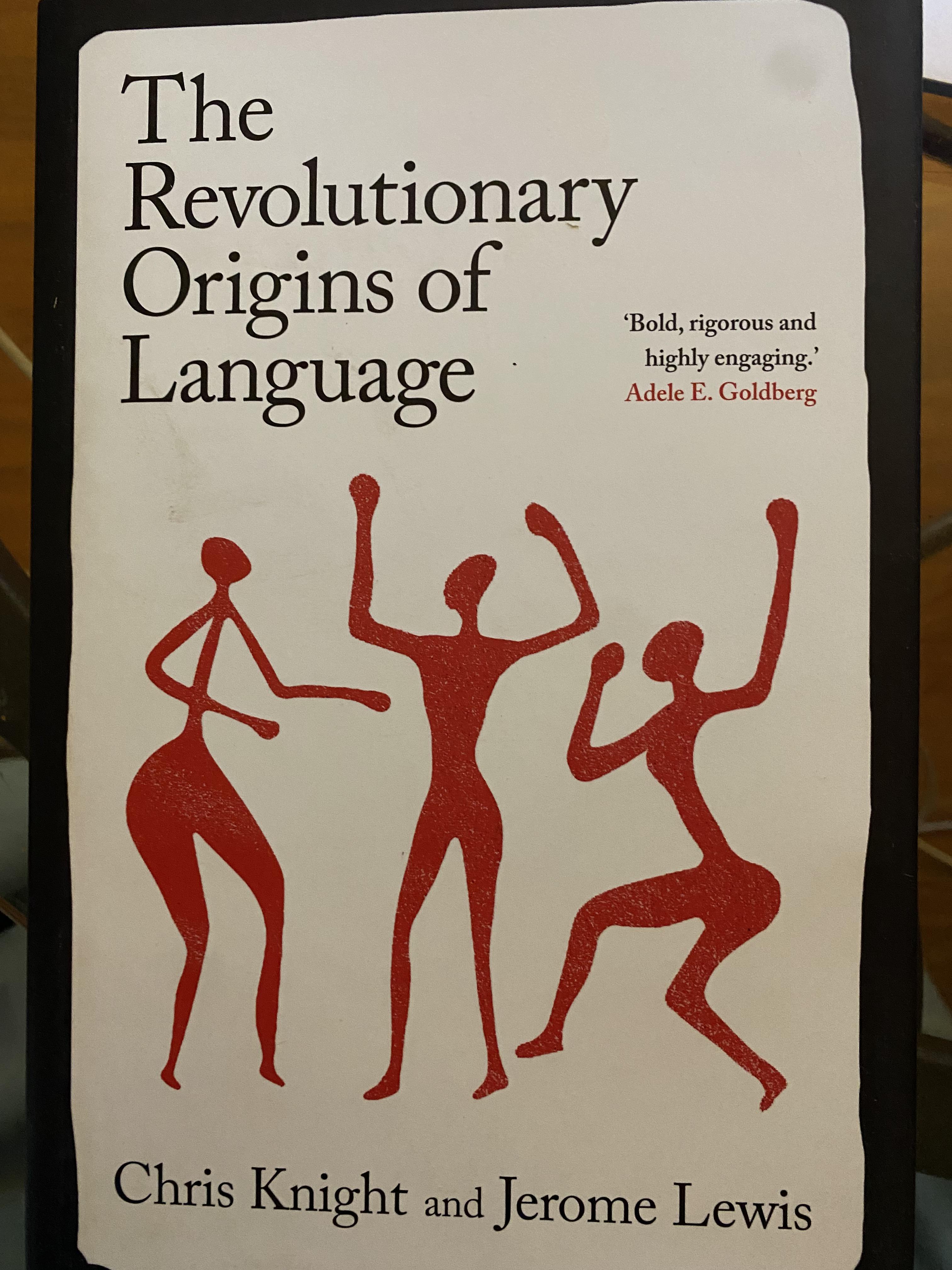
This article is inspired by the Radical Anthropology Group (RAG): Camilla Power, Chris Knight, and Jerome Lewis; and, by Knight and Lewis’s new book, The Revolutionary Origins of Language (2026), which describes the social revolution of trust required to evolve human speech. In the process, women learned to create power coalitions, level male dominance hierarchies, and create a society free of sexual harassment with an abundance of shared food and resources.
The object lesson in this story for feminist matriarchs is what it took to create a state of community trust and cooperation from primate dominance hierarchies. There had to be a transfer of social, religious and political power in order to reverse the dominance of alpha male humans and to secure female control over their own reproduction. Reverse dominance in egalitarian populations does not put women permanently in charge; rather, women serve more like the group’s immune system, ensuring a thriving egalitarian society safe from domination hierarchies and sexual harassment.
Power was not shared voluntarily, and keeping power dynamics equitable was not a one-time chore, it requires vigilance. Rituals around first menarche and the New Moon are a major leveling mechanism that keep communities egalitarian in a great deal of African indigenous and Hunter-Gatherer populations (Power and Watts, 1997). Going by as many names as the people who celebrate it, the Eland Bull Dance and related !Kung menarche rituals celebrate a newly menstruating girl who is secluded in a hut while the women of the community dance around her in eland antelope costumes. Nearby, an elder mimics a bull eland (the game and most prized catch in the region). Because living Kalahari San communities still perform this exact ceremony today, anthropologists know precisely what ancient rock paintings of this ritual are showing us (Lewis-Williams 1981; Power 2004).
Here is the sequence Kalahari San elders describe as common to almost all of the ceremonies (Power and Watts 1997; Power 2004):
- 1. Circle the girl and block the men. When a girl gets her first period, the women of the camp surround her, paint themselves with bright red ochre (a natural red earth pigment), and drive young, marriageable men out of camp. The pigment acts as a collective signal that all the women are menstruating so men cannot single out a single woman who is fertile since they are all saying in essence, they all are, and are all standing together rendering every woman off-limits sexually (Power 1999, 2010).
- 2. Pretend to be animals (“wrong species”). The women remove their back aprons, tie on ostrich-eggshell “tails,” and dance in a circle mimicking mating eland cows (Power and Watts 1997).
- 3. Flip the gender roles (“wrong sex”). Instead of treating the menstruating girl as a bride, the women treat her as the male Eland Bull by presenting their hindquarters to her as if they are animals mating with a bull (Power and Watts 1997, 2000).
- 4. Set the time (“wrong time”). By collectively pretending to be hunted animals mating with a bull, the women send an unmistakable message: We are off-limits as human wives right now. In San belief, coming near menstrual blood ruins a hunter’s weapons and luck.
- 5. Timing, the Moon, and the Hunting Ultimatum: The Eland Bull Dance begins when a girl gets her first period, and she stays secluded inside her hut until the new crescent moon appears. During this dark-moon phase, nobody hunts, and women each month enforce the sexual taboo, drive young men out of camp, and set the terms: normal married life will not resume until men bring back meat to share. Once the new crescent moon appears and waxes toward full, providing moonlight for tracking, the men go out to hunt, bring big game back to camp to be cooked, share it fairly with the group, and then the sexual ban is lifted.
Safe Environment for Women
The reason this ritual is so extraordinary is the power appropriated by the women. Ordinarily, large male apes try to monopolize and fight over a single female in estrus. Here, women create a ritual where a collective “No” is echoed by all women, making every possible taboo come into play until men respect sexual boundaries and share food properly. As a result of this ritual dance, no woman, especially the newly fertile girl, is sexually harassed. Women and children are safe from intimidation because every woman in camp is saying No! to alpha-male bullying in unison. (Power, Watts, and Knight 2021).
Girls Learn Reproductive Autonomy
By protecting the young girl’s menarche and collectively staging a loud ritual No! to the men, older women teach the next generation that they are in control of their bodies as they enter adulthood (Power and Watts 1997) and, how to continue the ritual.
Women’s No! is a Well Documented Long Term Continent-Wide, Possibly Global, Tradition
To this day, similar rituals are still performed among hunter-gatherers across Africa: the collective “No” is acted out in animal mimicry and gestures, women apply red ochre cosmetically, and the performance explodes into a chorus of defiant laughter (Power 2010; Knight and Lewis 2026). This is not merely a theoretical thought experiment; we can see this exact collective “No!” painted on ancient rock walls and still enacted by living hunter-gatherer communities today (Power 2004).
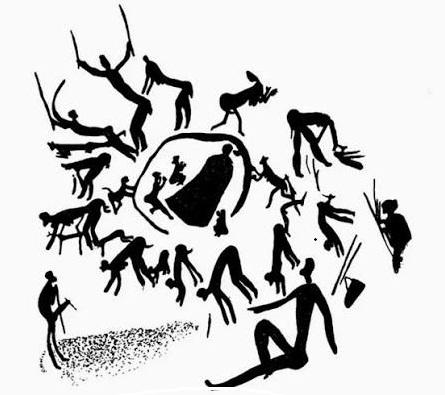
In Southern Africa’s Drakensberg Mountains (at Giant’s Castle, bordering Lesotho), a famous rock painting at Fulton’s Rock is the clearest depiction, and possibly the newest, of a girl’s coming-of-age ceremony: the Eland Bull Dance (Lewis-Williams 1981). On the rock wall, a young girl sits wrapped in a cloak inside a small shelter while a circle of women dances and claps around her, and a horned eland figure appears nearby. While the Fulton’s Rock painting can only be broadly dated to roughly 2,000 to 3,000 years ago (since mineral pigments cannot be directly radiocarbon-dated), ground red-ochre “crayons” used for body painting trace the underlying ritual tradition back at least 100,000 years (Knight, Power, and Watts 1995; Power 2010).
We see variations of this same strategy across living African hunter-gatherer groups and along the route humans took out of Africa:
- The Hadza of Tanzania: When a girl begins menstruating, women announce that “she has shot a zebra,” smear themselves with red ochre and animal fat, sing sacred songs, and chase men out of camp with sticks (Power and Watts 2000; Power 2017). Declaring that a menstruating girl “has shot a zebra” is a powerful symbolic inversion that equates menstrual blood with the potent blood of big game. By claiming she has made a major kill, the women assert control over reproduction, dictate when men must hunt, and declare themselves in a heightened ritual state (epeme) equal to a successful hunter (Woodburn 1982b; Power 2017). By acting out the role of hunters and driving men away, they demonstrate that men do not hold a monopoly on hunting power, ritual authority, or camp control. There is rich historical irony here: at the famous 1966 Man the Hunter symposium, anthropologist James Woodburn (1968) was documenting this very society—where women staged fierce maitoko initiations, chased men out of camp with sticks, and announced a girl had “shot a zebra.” His fieldwork quietly carried the ethnographic seeds that feminist anthropologists like Sally Slocum (1975) and later Camilla Power and the Radical Anthropology Group used to dismantle the male-centric hunting myth.
- The Mbendjele BaYaka of the Congo: Where Jerome Lewis lived and worked for decades, women use loud polyphonic singing, synchronized dancing, and public teasing (Ngoku) every new moon to shut down aggressive men and demand shared meat (Knight and Lewis 2026).
How do we know the meaning of the rock art isn’t just guesswork? Anthropologists verified the Fulton’s Rock painting through direct ethnographic continuity, comparing the imagery with field observations of living Kalahari San elders as well as nineteenth-century San oral histories preserved in the Bleek and Lloyd Archive in Cape Town (Lewis-Williams 1981; Power 2004). When San elders examine the painting’s layout: a cloaked girl inside a curved shelter, a ring of clapping women outside, and a horned eland figure, they recognize every element of the Eland Bull Dance, are able to explain why men are barred from camp, why women mimic eland cows, and how the taboo protects hunting luck and enforces meat-sharing (Lewis-Williams 1981; Power and Watts 1997).
Out of Africa and the Evolutionary Shift to Speech
As humans migrated out of Africa, they carried these traditions with them. In South African caves like Blombos Cave, archaeologists recover 100,000-year-old red ochre crayons; in Ice Age Europe, they find carvings like the Goddess of Laussel in France, a female figure painted in red ochre holding a crescent bison horn carved with 13 notches for the 13 lunar months of the year, linking women’s monthly cycles directly to the horned game men had to hunt (Knight 1991; Power 2004).
Trust Allows Speech to Develop
Once the alpha-male intimidation problem was solved through female solidarity and laughter, early human groups could shift from loud defensive choruses to low-cost, trusted vocal signals (Knight and Lewis 2026). This laid the necessary foundation for speech to evolve using animal mimicry and metaphorical gestures to discuss unseen game, coordinate hunts, and enforce sharing rules (Knight, Power, and Watts 1995; Knight and Lewis 2026). Language could then expand around all the activities of daily living across the rainforests, plains, and deserts of Africa, and eventually the world.
Camilla Power’s Human Evolutionary Analysis
While Chris Knight framed the origins of speech around a collective female “sex strike” that overturned primate dominance hierarchies (Knight 1991), anthropologist Camilla Power grounds this transition in Darwinian evolutionary biology through her Female Cosmetic Coalitions model (Power 1999, 2009). Power argues that as hominin brain sizes expanded, raising big-brained human babies required massive amounts of food and reliable male provisioning rather than alpha-male philandering (Power 2009; Power, Watts, and Knight 2021). Because visible menstruation risked attracting dominant males to single fertile individuals at the expense of pregnant or nursing mothers, female coalitions used red ochre to collectively “sham” menstruation (Power 1999, 2010). By scrambling fertility signals and enforcing a shared taboo, they transformed a biological signal into a collective cosmetic fiction—establishing the high-trust solidarity and shared symbolic conventions required for displaced, metaphorical speech to emerge (Power 2009, 2010).
Ultimately, saying “No!” was never just about stopping a bully. In immediate-return hunter-gatherer societies, sexual equality did not happen by accident or male goodwill. Sexual equality required women seizing decisive collective counter-power over sex, blood, and the camp to keep the entire community balanced and healthy (Woodburn 1982a; Power 2017). By banding together behind red ochre, making sexual access conditional on respect and shared meat, and surrounding every newly menstruating girl with a united wall of women, female coalitions turned reproductive autonomy into both the foundation of human language and a living legacy passed from one generation of women to the next (Power and Watts 1997; Power, Watts, and Knight 2021).
References:
- Knight, Chris. 1991. Blood Relations: Menstruation and the Origins of Culture. New Haven, CT: Yale University Press.
- Knight, Chris, and Jerome Lewis. 2026. The Revolutionary Origins of Language. New Haven, CT: Yale University Press.
- Knight, Chris, Camilla Power, and Ian Watts. 1995. “The Human Symbolic Revolution: A Darwinian Account.” Cambridge Archaeological Journal 5 (1): 75–114.
- Lewis-Williams, J. David. 1981. Believing and Seeing: Symbolic Meanings in Southern San Rock Paintings. London: Academic Press.
- Power, Camilla. 1999. “Beauty Magic: The Origins of Art.” In The Evolution of Culture: An Interdisciplinary View, edited by Robin Dunbar, Chris Knight, and Camilla Power, 92–112. Edinburgh: Edinburgh University Press.
- Power, Camilla. 2004. “Women in Prehistoric Rock Art.” In New Perspectives on Prehistoric Art, edited by Günter Berghaus, 75–103. Westport, CT: Praeger.
- Power, Camilla. 2009. “Sexual Selection Models for the Emergence of Symbolic Communication: Why They Should Be Reversed.” In The Cradle of Language, edited by Rudolf Botha and Chris Knight, 257–280. Oxford: Oxford University Press.
- Power, Camilla. 2010. “Cosmetics, Identity and Consciousness.” Journal of Consciousness Studies 17 (7–8): 73–94.
- Power, Camilla. 2017. “Hadza Epeme and the Evolutionary Origins of Ritual.” In Human Origins: Contributions from Social Anthropology, edited by Camilla Power, Morna Finnegan, and Hilary Callan, 152–173. New York: Berghahn Books.
- Power, Camilla, and Ian Watts. 1997. “The Woman with the Zebra’s Penis: Gender, Mutability and Performance.” Journal of the Royal Anthropological Institute 3 (3): 537–560.
- Power, Camilla, and Ian Watts. 2000. “First Gender, Wrong Sex.” In Gender and Material Culture in Archaeological Perspective, edited by Moira Donald and Linda Hurcombe, 101–116. London: Macmillan.
- Power, Camilla, Ian Watts, and Chris Knight. 2021. “The Symbolic Revolution: A Sexual Conflict Model.” In The Oxford Handbook of Human Symbolic Evolution, edited by Nathalie Gontier, Andy Lock, and Chris Sinha, 253–284. Oxford: Oxford University Press.
- Slocum, Sally. 1975. “Woman the Gatherer: Male Bias in Anthropology.” In Toward an Anthropology of Women, edited by Rayna R. Reiter, 36–50. New York: Monthly Review Press.
- Woodburn, James. 1968. “An Introduction to Hadza Ecology.” In Man the Hunter, edited by Richard B. Lee and Irven DeVore, 49–55. Chicago: Aldine.
- Woodburn, James. 1982a. “Egalitarian Societies.” Man (New Series) 17 (3): 431–451.
- Woodburn, James. 1982b. “Social Dimensions of Death in Four African Hunting and Gathering Societies.” In Death and the Regeneration of Life, edited by Maurice Bloch and Jonathan Parry, 187–210. Cambridge: Cambridge University Press.