Hi all! Christmas is coming up and my boyfriend has been collecting copper for a couple years now. He works blue collar and has been gathering whatever scraps he can so he can either make jewelry or make some cash off it. I want to make this possible for him but I don't know a thing about this stuff.
I know he'll need a crucible, but what kind and size? How do you heat it, do I need to buy a torch? I'm pretty much looking for a shopping list to make sure he has the resources to start this new hobby. Any help/advice is appreciated!
We run a small jewellery casting workshop in Scotland, producing around 30–50 silver and gold items per week. I'm trying to automate as much of the finishing process as possible, ideally taking castings from basic sprue removal and minimal sanding through to a fine jewellery polish.
I've been experimenting with different media in a cheap Holzmann vibratory tumbler, which isn't really designed for this kind of work.
My current process is:
Remove sprues and clean up obvious casting defects.
Sand to approximately 400 grit.
8 hours with medium plastic cutting media (RPG).
8 hours with medium/fine plastic media (RKH/4).
8 hours with fine porcelain polishing media (RP05/04).
I'm using water and finishing compound, refreshing the water every four hours.
The final polishing stage produces a decent shine, but the cutting stages aren't adequately removing the shallow filing and sanding marks. This is particularly noticeable on silver channel rings and signet rings with large, flat surfaces. The finish looks shiny, but isn't good enough for the fine polish our customers expect.
I'm wondering whether the machine itself is the limiting factor.
I'm considering investing in a Raytech Adjusta-Vibe AV25, potentially with more aggressive ceramic cutting media. However, these machines cost around £1,000–£1,500 here in the UK, and there's nowhere nearby I can see one operating.
Before spending that kind of money, I'd really appreciate hearing from anyone with experience using the AV25 or similar industrial vibratory finishing machines.
Can these machines genuinely remove shallow filing and sanding marks from minimally prepared silver and gold castings, or is significant hand sanding still unavoidable?
I'm particularly interested in wet finishing processes rather than dry abrasive systems.
I'm not concerned about long processing times. If a machine takes 24–48 hours to do something that would otherwise require several hours of manual finishing, that's a worthwhile trade-off for our workshop.
There's surprisingly little practical information available about this, so I'd be grateful for any real-world experience or advice.
hello, i'm an eneneering student and i have to deisgn a mold for a piece i chose. I'm using cast iron in a sand mold, but since it's a tubing piece, it has a long wall, witch is a problem for premature solidification (Heuvers). I'm thinking of solving it by intruducing a slope in radious of the tubing. does it make sence?
The camera brings out every little flaw so it's not quite as bad as it looks. This was made by taking an off the shelf STL design, modifying slightly printing an open face mold. The mold was heated to 300F and the PLA was pulled out. The mold material was designed to be very strong, creating it's own issues, this allows preservation of detail.
It was pored in pewter, the mold was preheated to 400 minus cooling in transport and setup. A gold oxide developed and the metal had a crystalline structure. I'm going to try lower temperatures as well as quenching the mold after pouring to try and get the best of both worlds.
One the process is worked out, I try this with aluminum. I'm also working on doing split molds this way. There was some damage during cleanout, mold release is one of the things I'm working on.
u/Jerry_Rigg said he wanted to see all the couplas, so that's what these are
The one with all the burnt coke under is is the one we usually use during pours. On average taps for it are 50lb and we tap every 20-30min when it's running full bore.
This appears to be a natural gas powered burner using forced air. Is this really advantageous over another NG or propane burner ?
I use a DIY NG gas / air burner with forced air and another for propane and the NG one runs up till 1400 C and the propane one 1500 C, the latter melting cast iron.
I've been experimenting with surface prep and plating methods ahead of a mokume-gane billet project, basically throwing everything at the wall to see what would stick.
This started as a slow-cooled aluminum pour that developed really sharp, mirror-bright dendritic freeze needles right out of the mold (last couple of photos show how it looked pre-bath). I originally threw it into a DC copper nitrate cell just trying to get a copper plate to hold on aluminum, which accidentally planted microscopic copper seed points across the surface.
After leaving it in the copper growth bath, the cell simultaneously deep-etched the internal dendritic grain boundaries into high relief (giving the top face a wild Widmanstätten-like geometric lattice) while growing anchored, sparkling copper crystal clusters into the pockets on the bottom.
I was originally planning to shape and flatten it for a stack, but once I pulled it out and saw the crystal relief on both sides, I realized touching it with a hammer or file would ruin it. Came out way better than anything I actually planned!
Can the PLA be burned out of something like this? It was charred and fluffy. The sprue cleaned right out with a wire and blowing on it. The dome seems to be untouchable, can't get a wire in, can't blow air in
Burn harder? Would switching to wax resin make this possible?
Yeah, I know, the black filament was a bad idea. Exactly how much dirtier is colored filament?
I own a small machine shop and have had several requests over the last few years to replicate damaged cast bronze parts on commercial fishing equipment. Some of these aren't made anymore and welding isn't always practical, and in some cases I'd like to offer an improved product customers.
I have a Cress heat treat oven that had plenty of heat capability (I've had it up to 2250F on a test run), but the height is only 7.25" clear in my top oven. It's 11" wide and 16" deep.
Questions-
-Is this a terrible idea to use this oven?
- If not, what type of crucible shold I be looking at?
I like doing it, I spend far too much time and money fiddling around with this stuff. Is there any light at the end of the tunnel where I wind up making minimum wage after considering all the expenses?
I want to do some upgrades but sometimes I wonder if this road goes anywhere.
I've been doing some lost PLA bronze casting (95% copper, 5% aluminum).
I have been running burn out firings up to 1000⁰f, and have had some success. Im wondering if that's necessary though. I've noticed that when people do lost foam casting, they don't bother with burnout, just pour the metal directly into the foam.
If you have experience doing lost PLA casting and have tried with burnout and without, please let me know what your experience has been. Thanks!
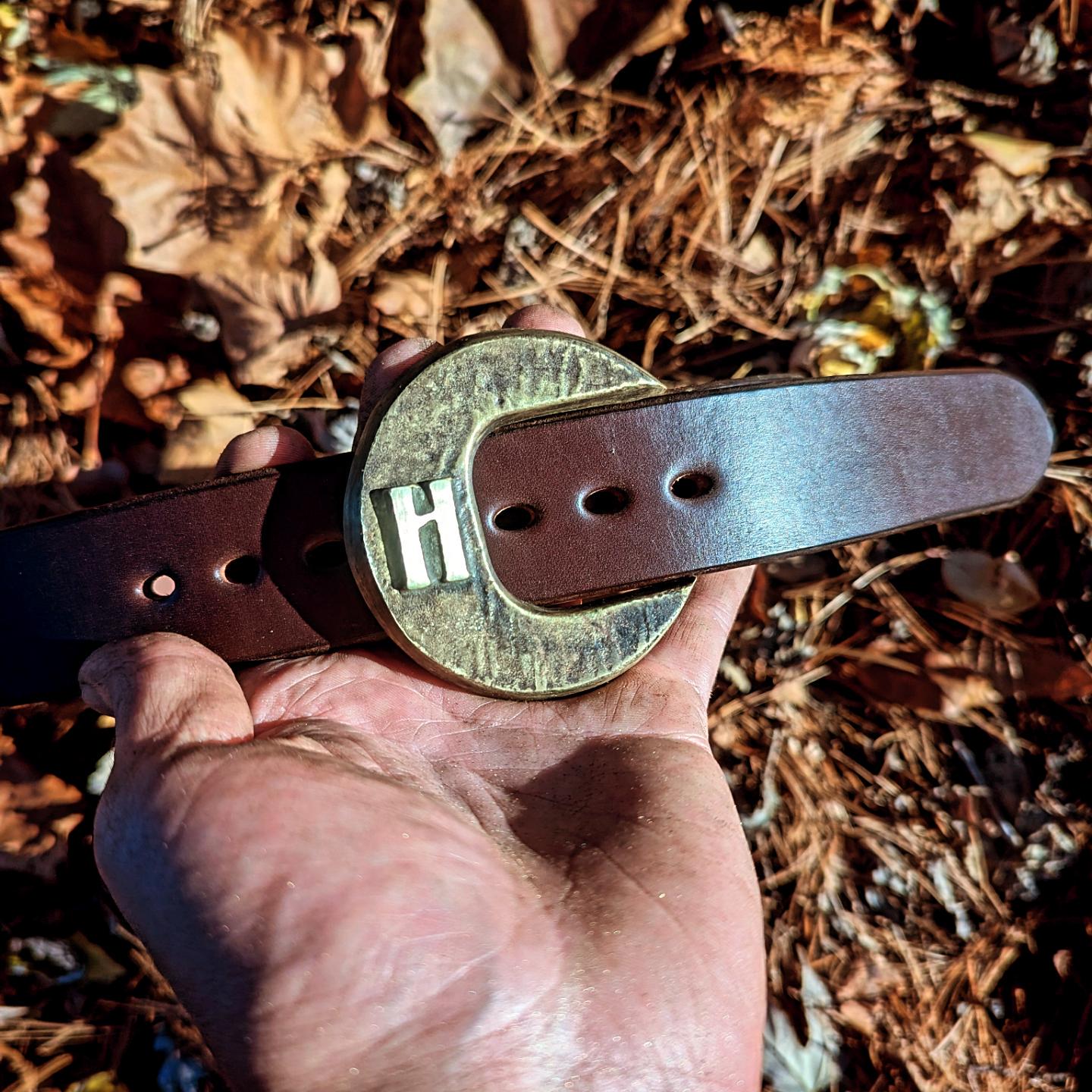
Thought I would share this as it used what I thought was an interesting idea I hadn't really heard of before. I wanted the ability to put initials on castings but didn't want to have to make 26 different patterns for each buckle shape I make. So I had a custom set of letter stamps made so that I would be able to put an impression in the petrobond after my flask was rammed up. I have also done experiments with adding texture to castings by messing with the sand. I had always wanted my flask packed as neatly as possible but it opened up new ideas when I realized I could mess with the sand before casting. Have you ever done something like this?