r/MilitaryWorldbuilding • • Aug 17 '26

Meta Join our Discord!

8 Upvotes

Looking to discuss your world building in more detail? Looking to share Works in progress or find friends for games?

Come join us at https://discord.gg/militaryworldbuilding

An adult only community focused on world building and art appreciation, as well as refining the finer points of your project!


r/MilitaryWorldbuilding • • Aug 14 '26

MWB Rules: World Building Requirement

14 Upvotes

Reminder:

Howdy MWB community!

TL:DR: All posts to MWB require worldbuilding.

Just wanted to give everyone a quick reminder about the world building requirements on when posting to MWB.

Unlike the main R/ worldbuilding subreddit MWB has a fairly relaxed approach to the required additional context on posts made here. We don't require personal authorial context or detailed descriptions of intent. HOWEVER: all posts must contain some degree of world building information!

What does world building information look like? Well, at a bare minimum we need to understand how something you've created fits into your world. Sometimes this context is contained in the image itself, and the description only needs to contain a brief description or time period. other times, for example when posting aircraft, guns or other hardware we need more information.

The basics we typically want to see (aim to have at least most of these details, or similar information that allows a reader to understand how the object fits your world):

  • Time period/in universe year
  • Faction(s) using the object
  • Manufacturer/designer
  • Price
  • Number made
  • geographic origin
  • reason it was created
  • reason it is used
  • problems it solves
  • problems it creates
  • pros/cons
  • fun fact
  • not so fun fact
  • characters who use this item
  • thoughts of people from the world about the item
  • Where the item shows up in your larger project and why

r/MilitaryWorldbuilding • • 8h ago

Lore Helldiver Squad and Helldiver Deployment Package, c. 2186 [OC]

Thumbnail
gallery
60 Upvotes

Well my original post was removed by the filters, so that's fun. THIS POST IS NOT INTENDED TO PROMOTE VIOLENCE IN ANY WAY. THIS POST IS FOR EDUCATIONAL AND ENJOYMENT ONLY. Anyway, enjoy!

First in, always!
- Motto of Able Company, 1st Battalion, 135th Helldiver Regiment (Mechanized)

Tracing their origins to the Air Commandos and Air-Naval Gunfire Liaison Companies (ANGLICO) of decades past (though ANGLICO's still exist amongst Super Earth Marine formations), the Helldivers represent an elite combination of shock troops, Forward Observers (FO's), and Joint Terminal Attack Controllers (JTAC's) that utilize superior tactics and firepower to overwhelm and destroy the enemy. Deployed deep behind enemy lines, Helldivers leverage the firepower of their paired Super Destroyer to deliver timely naval gunfire and air support to compensate for the (frankly hilarious) numbers disparity they often face.

HELLDIVER SQUAD

The Helldiver squad is the most basic deployable unit of the Helldiver Corps. Often outnumbered by a factor of 100, Helldivers utilize superior tactics, mobility, and firepower to rapidly overwhelm and destroy the enemy before they can call in reinforcements. Highly trained and tactically empowered at extremely low levels, Helldivers are considered operational-level assets that have very few equivalents on the modern battlefield. As per SEAF TO/E, each Helldiver Squad consists of 4 men at full strength:

- A Squad Leader, ranking Sergeant (E-5), and armed with an GL-21 Grenade Launcher, a AR-23 Liberator, and a P-2 Peacemaker

- A Squad Marksman, ranking Corporal (E-4), and armed with an APW-1 Anti-Material Rifle, a AR-23 Liberator, and a P-2 Peacemaker

- A Anti-Tank Gunner, ranking Corporal (E-4), and armed with an GR-8 Recoilless Rifle, a AR-23 Liberator, and a P-2 Peacemaker

- A Machine Gunner, ranking Corporal (E-4), and armed with an MG-43 Machine Gun, a SG-8 Punisher, and a P-2 Peacemaker

As a note, Helldiver ranks vary wildly, usually trending slightly higher (e.g. Squads led by Staff Sergeants and comprise mostly of Sergeants). In addition, weaponry amongst Helldivers vary wildly, with gear tailored for the mission and the threat (e.g. heavier weapons are brought out against the Automatons). It's not uncommon for members of the squad to load up with extra ammunition and grenades, given the numbers disparity they often face. Usual combat loads include 10-12 magazines, 5 G-6 Fragmentation grenades, and 2 specialty grenades (smoke, gas, thermite, etc. Smokes are especially useful, mostly for marking purposes). B-1 Supply Packs are available, usually 2 per squad and carried by the Squad Leader and the Squad Marksman. Additionally, readily available resupply pods keep the squad supplied deep behind enemy lines as well.

When in doubt or out of ammo, pod-based strategems can be used as weapons, to great and blunt effect.
- FM 8-107 "Helldiver Operations"

Helldivers are capable of most forms of insertion and extraction within the SEAF's inventory, from air (parachute, helicopter/SPIE, glider), land (foot, vehicle), sea (small boat, SCUBA), or space (orbital drop pod, orbital glider). Given the nature of their operations, most Helldivers are inserted either by air or orbitally. On the ground, additional mobility and firepower is provided by the M-102 Gunner FRV and it's pintle-mounted MG-206 HMG.

In terms of weaponry, Helldivers have access to a wide variety of weapon systems for use against the foes of democracy. A standard SOP is to cover the "Big Four" of support weapons: explosives, precision, anti-tank, and anti-infantry. Following the "Big Four" allows Helldivers to cover the most common threats they'll face in most missions against hostile forces: massed infantry, heavy armor, and subterranean entires and exits. Additionally, the precision aspect of the "Big Four" allows the squad to maintain stand-off distance and a range advantage over the enemy. Finally, the Squad Leader's Grenade Launcher (the explosive portion of the "Big Four") allows him to mark targets, either for the Squad's organic weapon systems or for supporting assets (i.e. aircraft).

HELLDIVER DEPLOYMENT PACKAGE

While the Helldiver provides the eyes and ears for their paired Super Destroyer, the Super Destroyer provides much of the punch and firepower in return. Packing high caliber artillery (a 380mm main battery with a 120mm secondary battery, amongst other weapon systems), vehicle and Eagle strike support, and up to 20 variable-yield NUX-223 thermonuclear warheads, the Super Destroyer is a highly specialized vessel that excels at one thing: orbit-to-ground fire support. This combined space-ground force is augmented by the onboard Eagle Strike Fighter and the pair of Pelican shuttles carried on board the Super Destroyer. This total force is known as a Helldiver Deployment Package, a modular unit that can expanded or downsized as needed. A standard package calls for 4 Super Destroyers and their associated Helldiver complement (totaling 268 personnel, spit across 8 command staff, 84 Helldivers, and 176 crew in total), a Strike Fighter Detachment with 4 Eagle Strike Fighters from a naval Strike Fighter Squadron (VFA), and a Airlift/Recovery detachment with 8 Pelican Shuttles (4 transport and 4 cargo) from a Fleet Logistics Multi-Mission Squadron (VRM). All in, a standard Helldiver Deployment Package totals 292 personnel, with 92 Officers, 16 Warrant Officers, and 184 Enlisted personnel. A Helldiver Deployment package could be scaled down to a single Super Destroyer and associated complement (totaling 71 pax, with 21 Officers, 4 Warrant Officers, and 46 Enlisted), or expanded to 8 Super Destroyers and associated complement (totaling 584 personnel, split across 184 Officers, 16 Warrant Officers, and 368 Enlisted personnel).

Being surrounded and outgunned sucks a lot less when you have a few Eagles and a couple megatons of explosives to back you up.
- Unnamed Helldiver, 1st Helldiver Regiment (Colonial)

Beyond their attached Super Destroyer, Helldivers can expect regular support from Eagle Strike Fighters and from Pelican shuttles for their missions. While Eagle Strike Fighters are not as capable as air-to-air (space-to-space?) platforms when compared to the Super Sparrow Fighter or as bombers compared to the BT-1317 Bomber, they strike (pun intended) an excellent middle ground and excel in Helldiver Support profiles. Armed with a plethora of air-to-ground ordnance and a trusty 23mm rotary cannon, Eagle Strike Fighters are extremely deadly CAS platforms. They are also capable of being 'Fast FAC's', coordinating with other strike platforms with their extensive onboard sensor suite, laser designators, and/or with WP smoke rockets

While Eagles assist Helldivers during combat, Pelicans assist Helldivers in getting in and out of combat, and by delivering heavier items (i.e. vehicles) to the fight. Pelicans are versatile craft capable of many roles, from transport to cargo delivery to air-to-air refueling, and their space-to-ground capability makes them a perfect infiltration and extraction platform for Helldivers. While looked down upon by the fighter pilots (as is tradition), Pelican pilots are amongst the best in the Fleet, and boast some of the highest combat flight hours amongst Super Earth's naval aviators.

Finally, the Super Destroyer represents home-away-from-home for the package's personnel. With the limited space aboard Super Destroyers, crew members are generalists who are cross-trained on each other's tasks. Divided into several different departments, Super Destroyer crews operate on 8-hour shifts, synchronized to Super Earth Standard/Zulu-time. This means that at least one specialist or the department officer is on duty at all times, with the entirety of the crew on duty when the Super Destroyer enters combat. The crew is augmented by heavy automation throughout the Super Destroyer, which keeps the crewing requirements lean. The level of automation is extensive, similar to the Alfa-class submarines of decades past. With the demanding nature of crewing a Super Destroyer, crews go through a grueling training pipeline, although training is more technical rather than physical in nature. Lasting about a year and a half, this training pipeline has a 50-70% attrition rate. Despite the grueling nature of the training and life aboard a Super Destroyer, it's a position that is one of the most sought after in the Fleet, with shorter deployments compared to other assignments (usually around 90 days), medical and retirement benefits, and most importantly of all, almost doubled pay.

NOTES AND ATTRIBUTATIONS

- These organizations are NOT CANON. They are simply what I think would be cool and practical.

- I'm not taking the piss with the "highly trained" remark. Helldiver candidates are selected from within the SEAF, and at minimum rank Lance Corporal (E-3) with at least 2 combat deployments, amongst a littany of other requirements. The Helldiver training pipeline is brutal, with a 70-90% attrition rate. From selection to training, the pipeline takes roughly a year before candidates can earn their capes.

- Prior to an operational deployment, Helldivers and the Deployment Package's Command Element will decide on primary and alternate infiltration and exfiltration points. Extraction zones are marked by the Super Destroyer using Exfiltration Beacons, which are jamming-resistant (useful given the prevalence of Automaton EWAR assets). Should an immediate extraction be required, Pelican Transports can "hover" over suitable areas or can use SPIE to extract Helldivers from "hot" landing zones.

- NUX-223 Hellbombs can either be fired from orbit for safety or can be armed on the ground for precision sabotage operations.

- Pelican pilots and copilots are billeted as warrant officers, however officers can and often do pilot them. Eagle pilots are billeted as Captains, but Lieutenants and other ranks can pilot them. I'm debating if the SEAF use a unified (singular) rank structure or if they use mutliple (most likely two, with the ground forces and the fleet). For now, assume these are ground force ranks (i.e. Captains are O-3's).

- While the SMG-37 Defender SMG sees fairly limited use amongst the Ground Forces, it sees heavy use by SEAF naval personnel, both for ship defense and for boarding operations. The Defender fires the inherently subsonic 12x25mm, which is prized for its stopping power and for it's relatively low risk for overpenetration (and the accompanying explosive decompression aboard ships in orbit). Additionally, it's low rate of fire makes it controllable during automatic fire, and it's compact nature makes it easy to maneuver throughout the cramped quarters of a ship. Usually, Super Destroyers will maintain an arms room of 50 Defenders, and doctrinally, Super Destroyer crews are able to raise a 10-man rifle party for boarding operations (somewhat similar to the defunct Navy Rifle Squad).

- The lineage of the Helldiver Corps could also be traced to the Raven FAC's and possibly to the MAC-V-SOG Recon Teams of Vietnam, but other formations within the SEAF also claim these lineages (in particular, confusion over the differences between Vietnam-era LRRP's and MAC-V-SOG Recon Teams have led to some Ranger Companies claiming MAC-V-SOG lineages).

- I know that the parent organization the Helldivers are apart of is known as the Helldiver Division in game. In my opinion, the word "Division" implies that the Helldivers are a tactical unit, when in reality they are a strategic/operational asset. I chose the word "Corps" instead in the same vein as Uncle Sam's Misguided Children.

EDIT: - The Helldiver Deployment Package lacks organic sustainment beyond the supplies carried aboard the Super Destroyer. Resupply can be handled either in port or by dedicated supply ships.

- I used helldivers.wiki.gg for the weapon images, helldivers.fandom.com for the flag of Super Earth, and recolored ranks found on en.wikipedia.org. No AI was used in the creation of these graphics.

Well, this one was both fun and painful to write, and an upload failure didn't help either. I'll include anything I missed in the comments. Anyway, comments and questions are welcomed and encouraged. For Super Earth and Democracy!


r/MilitaryWorldbuilding • • 9h ago

Infantry Federal Republic of Drausk Uniform

Post image
15 Upvotes

The Federal Republic of Drausk is a country shaped by its rivers, ports and the rather uncomfortable fact that none of its regions can function entirely on its own, its older settlements developed along a large river network that connects the industrial interior to the coastal ports. The coastal provinces became known for shipbuilding, trade and fishing, while the inland regions grew around metalworking, mining and agriculture. For a long time, these regions had their own interests and local governments, and cooperation between them wasn't always particularly smooth

That changed after a naval blockade cut off several of the main river mouths. The event, still remembered in Drausk as the Long Closure, disrupted the movement of food, fuel and industrial materials across the country. Some inland districts were nearly cut off from supplies, while the ports found themselves unable to maintain their industries the political settlement that followed eventually led to the modern federal republic, this experience left a pretty lasting mark on Drausk, Its armed forces place a lot of importance on transport, supply lines, engineering and keeping units operational far from home. The army isn't built entirely around winning battles through superior firepower, getting men and equipment to the front, and making sure they can stay there, is considered just as important, the uniforms shown here belong to the regular army and the National Guard. The standard infantry uniform uses a dark reddish brown colour, with a fairly bulky tunic, matching trousers and standardized chest equipment and the colour actually has an older history, some of the first federal field formations were equipped through the same industrial workshops that supplied railway and dock workers. Their heavy work cloth was inexpensive to produce in large quantities, held up reasonably well to dirt and wear, and had a distinctive dark iron-red tone. It eventually became associated with the army, even after the original practical reasons became less important, the helmet-mounted goggles are another detail that became common through Drausk's military habits because troops frequently travel in open transport, work around industrial facilities and take part in coastal landings, where dust, wind and sea spray can become a nuisance. Rather than being treated as specialist equipment, goggles became a normal part of the infantryman's kit, the second uniform is a warm-weather variant, intended mainly for the hotter southern districts and certain overseas deployments. It uses a short-sleeved shirt, shorts, high socks and lighter equipment. It isn't meant to replace the regular uniform everywhere the weather gets warm, though. The exposed legs are less practical in dense scrub and rough terrain, so its use depends on the environment and the assignment, soo there's still plenty of Drausk's history I haven't worked out yet, but I wanted the uniforms to feel like they belonged to a country with its own history, rather than just being a collection of military designs I thought looked interesting


r/MilitaryWorldbuilding • • 6h ago

Weapon Northern alliance infantry weapons of the grand war

Thumbnail
gallery
7 Upvotes

last post got several guns missing or wrongly named so here’s the remake

Sometime after the American revolution the British Empire made a alliance with the Russian empire which grew to include Norway, Sweden, denmark, Japan and Austria. This alliance is known as the Northern Alliance.

upon seeing such a massive power bloc on their doorstep Germany started seeking to make an alliance of their own: the southern European alliance, typically shortened to SEA started as just Germany, France and Belgium, but it grew to include Spain, china, Italy, Greece, and Hungary.


r/MilitaryWorldbuilding • • 4h ago

Prompt What started your worlds war/wars

5 Upvotes

I want to know the reasons for conflict in your worlds!
In mine it started due to a collapsed economy being blamed on a neighbouring economic power. How about you?


r/MilitaryWorldbuilding • • 11h ago

Infantry A.P.A. and S.U.N. Uniforms

Thumbnail
gallery
8 Upvotes

For context, the Sovereign Union of Nations is basically NATO, and the Asian- Pacific Accord is like SEATO, but successful. The order of the countries is: Philippines, South Vietnam (They split into two in this universe), South Korea, Japan, Australia, France, Italy, Canada, the UK, and the US. A.P.A. is yellow, and S.U.N. is navy blue. thoughts?


r/MilitaryWorldbuilding • • 20h ago

Lore Practicing thumbnails sketches on my world

Post image
19 Upvotes

I have been building a sci-fi world set in the 2070s where humanity is fighting a losing war against a massive fungal catastrophe.

Basically fungus is a space-faring alien lifeform, and scientists discovered a new type of fungus in a meteor crater in China that can generate a huge amount of heat when digesting bio-matter. They engineered it to digest all kind of things and put it power plants, and eventually fungus became as instrumental to human's technology as silicon. Until the fungus evolved and basically turned into a hivemind.

Two major outbreaks, called the Sporefalls, have devastated civilization. Around 80% of the world's food-growing capacity is gone, much of Asia and Africa has been destroyed, and Europe is now a major battlefield.

Neo-EU is the new European military organisation (the UK isnt invited) after NATO basically fell apart.

DOMINUS is a military organizations specialised in anti-fungal warfare. Its leader is a human-fungal hybrid. And the main story revolves around them.


r/MilitaryWorldbuilding • • 1d ago

Prompt What would your nation’s military(pick one if you have multiple) do in this situation

16 Upvotes

a enemy nation is attacking a nation that is your closest ally

the enemy is at a similar strength to the nation you picked

here are a few things to consider

  • what units would “respond” as a first wave
  • how would you manage supply and logistics
  • would there be a draft(if there isn’t one already)
  • what other information should I know about this?

r/MilitaryWorldbuilding • • 1d ago

Weapon The Tapan Guns Series (Rifle, SMG, and Pistol)

Thumbnail
gallery
109 Upvotes

Hey guys, the terrible butter spreader is here. I am proudly presenting to you guys the Tapan series arms of the Sundrashir army; all use the same 10.5mm caliber, which is commonly found throughout Sundrashir. And yes, this time I will try my best to translate my ideas better to avoid misunderstandings, and btw, shout-out to you guys who gave me the benefit of the doubt and really looked at the designs carefully in my last MG design post; I really, really appreciate it. Thanks!

Here are the descriptions of the arms in this carousel

Tapan Otromati Tepe 32 (Ta.R(o). 32): The Sundrashir Army and Marine common service rifle; it is a semi-automatic, gas-operated rifle that uses the 10.5x50mm cartridge; it can hold 13 rounds per magazine; the barrel of the rifle features an array of fins to spread out heat evenly (and yes, the open nature of it could become a safety hazard if the user not careful), the rifle also come with an standard Passo Tepe 1 bayonet, and instead of using a hole for insertion into the barrel, it use clamp design, so the bayonet is attached by hanging the end part to a hook then snap it around the gas barrel.

There are around +5,000,000 rifles made and spread around many other oceanic nations in the Ksamtui region, with some variations in shape and materials, but overall the rifle was made from the same anti-seawater corrosion material that can be found in their ships and Ta.M. 30 MG; the wood parts were also made from a wood that has been dried to the point where it could not absorb, or minimally absorb, moisture in the air and sea.

Tapan Me'shri Tepe 5 (Ta.M. 5): The most widely used SMG for aggressive close-range combat; it is the go-to patrol armament favored by patrol and police units. It is light, simple, and easy to maintain, although it lacks protective cover for the ejector hole from dirt and sand, making it prone to jamming. It uses the 10.5x25mm cartridge; it can hold up to 30 rounds per magazine and uses a blowback mechanism for loading. It features a removable grip, and the grip itself can be oriented vertically or horizontally (since it lacks a proper rotation locking mechanism).

There are around +6,500,000 smgs made and spread around many other oceanic nations; again, it is made from special anti-corrosive metaloid and hard, dried wood.

Tapan Vesci Tepe 14 (Ta.V. 14): a common pistol issued amongst officers and police forces, it is a blowback-operated pistol that uses the 10.5x17mm cartridge; it could hold up to 7 rounds of ammunition.

There are around +1,500,000 pistols made and spread around the Sundrashir army and Police officers, scouts, and other auxiliary units; it is not distributed or sold outside Sundrashir due to a lack of interest from other nations.

That is all I can showcase for now. Thanks for reading this far; see you guys in the next post.


r/MilitaryWorldbuilding • • 1d ago

Weapon MK-X

Thumbnail
gallery
54 Upvotes

MK (Massaut Kevehr) platform, the platform known and loved by the people in the F.P. You probably used the MKA-11 back when you were in the F.N.D.F. (Free Principality National Defense Force); your dad probably used the MK-9 "back in his day"; and your wife's boyfriend probably used an MK-11 with the MK-LL kit in his high-speed cool guy unit, the W.O.S. (Wolfgt Ouvurg Spetsnacija). It's just so common to the point that some might view it as a weapon family that's as big as the AK and the AR platform, but produced by and only by the F.N.C.I. (Freedom Principality National Central Industries)

But not anymore. M.T.W.C., the company those generals told the F.N.C.I. not to worry about, has come up with the MK-X, an upgraded version of the F.N.C.I.'s newest MK-11 platform. It features an M-LOK handguard with the front end big enough to fit an SD suppressor, ambidextrous controls including a swappable charging handle, M.T.W.C.'s M65 spec pistol grip, and an adjustable gas system. If the F.N.C.I. is the one that brings the MK platform to the 21st century, the M.T.W.C. is the one that brings it to the 20s' standard.

The .270 F.P. (6.62x39mm) version of the MK-X platform has been adopted by the F.N.D.F.. and will most likely see service in some higher-tier units by the end of 2026. Its 7.62x51mm version has drawn some attention among the operators in the G.M.A.R.M. (General Military Assets & Resources Management), the PMC branch of the M.T.W.C., especially those with prior service records in the F.N.D.F. Meanwhile, on the other side of the earth, in Daluonia (more commonly known as the Republic of Daluo), the Daluonian government has shown interest in adopting the MK-X in 6.8x51mm.

Overall, the success of the MK-X meant the M.T.W.C. is another step closer to replacing the government-owned F.N.C.I. from the national defense supply chain.

Editor's note:

The MK family is a weapon system started by a friend of mine; the same thing goes for the general setting of the Freedom Principality. I'm just a part of the F.P. military-industrial complex. Also, I might make a post about the whole MK family once I sort everything out. There's also the MK-LL bullpup kit made by the M.T.W.C. Feel free to check it out.

Edit: I forgot to add my handles on the last picture lol.


r/MilitaryWorldbuilding • • 1d ago

Weapon So upgrade for the SPX 20MM

Thumbnail
gallery
7 Upvotes

I have upgraded the weapon i have designed, it is the SPX 20MM "sheep"™️, now with a few upgrades the fire selector switch has been added, it is pretty anti left handed gotta work on that, it has an ak107 pulley system so you have (some) comfort, it now has a scope and yes... it has a fire selector switch because its full and semi automatic🥲, a horror to shoot, the secound handle has been moved forward,and its an open bolt design... a sphistcated nightmare


r/MilitaryWorldbuilding • • 1d ago

Advice How does your world handle orbital bombardments?

6 Upvotes

Star warships in my setting use mainly plasma based weaponry along with some missiles. The plasma turbocannons work by binding plasma with a magnetic field and then firing it off. The largest turbocannons fire bolts with 2000 gigajoules of energy. The magnetic field begins to slowly fall apart once fired, causing the bolt to dissipate, which gives it an effective range. Firing it into the atmosphere bleeds off magnetic cohesion and energy at an even faster rate.

The problem that I'm having trouble with is that even when losing energy and magnetic cohesion in the atmosphere, the bolts have tremendous impact. My setting takes inspiration from WWII operations and wants to treat orbital bombardment like a preparatory barrage, but the effect as the plasma weapons are designed is too destructive. Why not just blast away the enemy troops and land your army to mop up? Either weapons are too powerful to be used or are too weak to have any effect. The energy level could be tuned for orbital bombardments, but then I'm back at why not just blast away, why need a large ground operation at all?

How do you handle this conundrum in your world?


r/MilitaryWorldbuilding • • 2d ago

Infantry Halo - UNSC Infantry company, battalion support element and Battalion organization chart.

Thumbnail
gallery
15 Upvotes

Wheeled artillery company and HQ supply Recon sections not included here

Doctrine

Prologue:
I know that my unit structuring doesn’t exactly make sense without some explanation. The idea is that as different humans united in to a single standardized units it would take military philosophy and theory from multiple places. Over hundreds of years this would evolve in the certain aspects we find strange in 2026. but in 500 years i find it hard to believe there was no innovation and the western doctrine of late 20th century / early 21st century remain the standard in 500 years.

Larger unit size:
Because of the vaster distances of space, varying size of planets and amount of empty space on the planet give a units a wider effect area for operations. It can be a good way to keep unit cohesion longer as a squad takes a higher percentage of casualties. A unit above 60% strength can still be relatively effective, but the more up to strength it is the more the firepower increases. General units operate in the 65% to 80% strength because unit retain effectiveness at a lower strength. Though overkill in the pre-covenant era it can gives increased unit effectiveness and flexibility.

Because of the size is doubles, it allowed functions as a very strong but is more effective across a wider area. . The extra assets allow for a wider range of independent initiative at a lower unit level that can make a larger impact. But one of the main things the extra unit strength can account for is casualties. Personnel dispersed between multiple vehicles can minimize loses.

Squad size:
Because of a number of factor the area of operations becomes larger and harder to cover. A way to adapt to using larger unit formations is increasing the personnel numbers and ability to sustain operations independently. This is done by increasing the strength by increasing formation size and mobility. Part of this is more vehicles to increase mobility, part of this increase is a vehicles section in the squad of 6 people. So an extremely over strength squad of 16-18 men would break down into; a 4-6 person vehicle section, 2 man command team, 1 weapons team, 2 fire teams. If the vehicle section leaves the vehicles it’s an additional 1-2 fire teams.

Fire support:
Eliminating platoon or company mortar team opens up more fighting men. Enfaces on battalion level guided artillery assets to make up the difference

Because of increase distance replacing mortars with battalion level artillery sections simplifies but expands fire support. Mobile fire support company intended to dig in and create a fire base for expanded fire mission range.

A combination of orbital targeting assists and specialized munitions being standardized allows for precise targeting. Artillery shells are fitted with a missile booster to propel to attitude and lower boost once gliding fins are deployed.

Frac-Forward Recon artillery company:
Meant to establish a firebase and operate as forward support or as a minute artillery unit with a scoot and shoot doctrine


r/MilitaryWorldbuilding • • 2d ago

Prompt Recruiting

8 Upvotes

Try to recruit me. Pitch your armies, navies, space fleets, air forces, etc as if I walked up to your booth at a career fair.


r/MilitaryWorldbuilding • • 2d ago

Equipment Vanguard Service Uniform

Post image
11 Upvotes

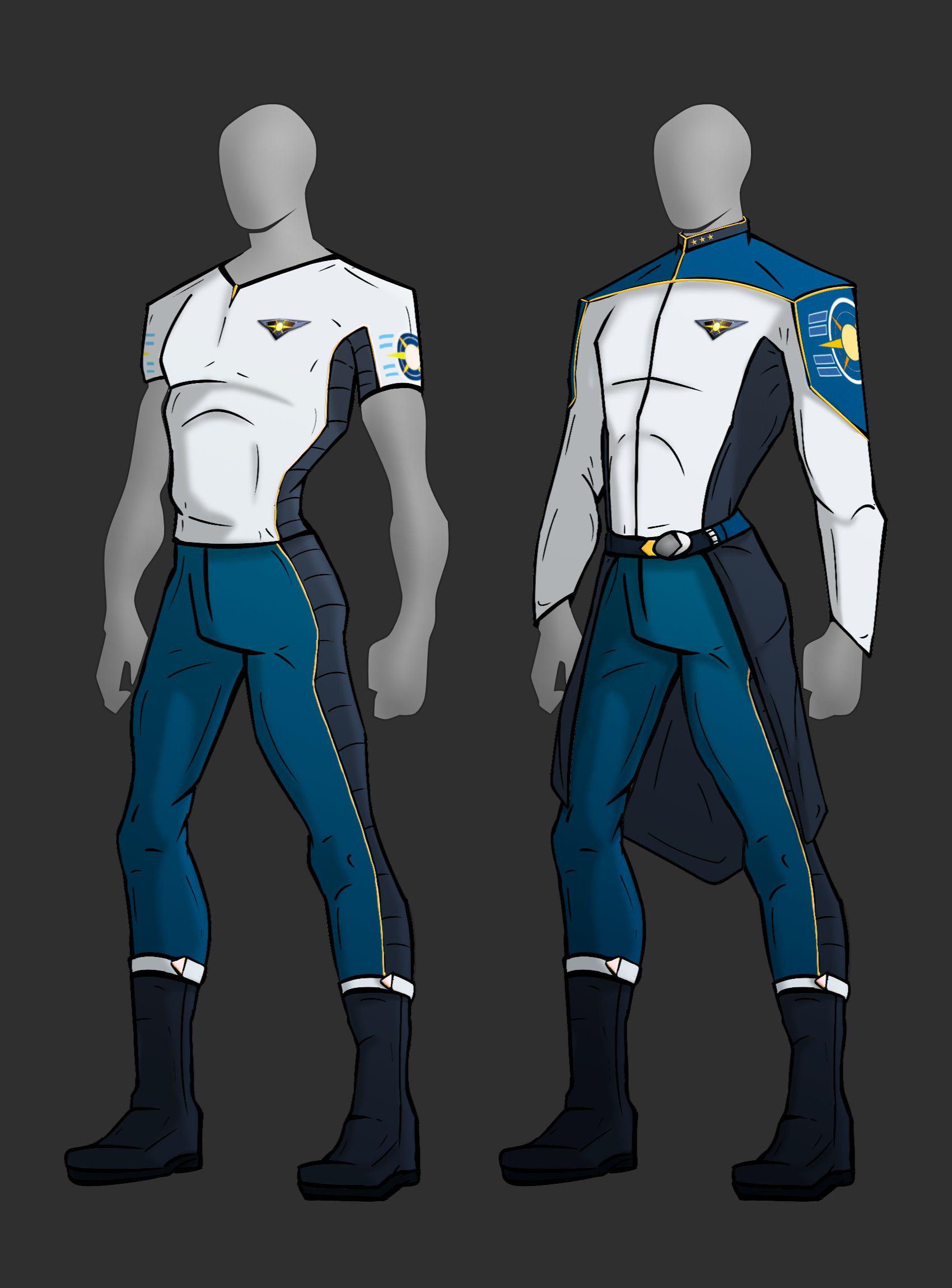
This is my uniform design for the Vanguard, the defense and emergency response organization of the Solar Commonwealth.

On the left is the basic uniform, with the added overcoat on the right. Officers always wear the coat on duty. There are other variants to accommodate different species as well, but I haven't drawn those yet.

It's made of a material called polymesh, which incorporates alloy fibers into the textiles for increased durability. It has a reactive gel layer that helps diffuse damage from weapons. A 21st century firearm wouldn't be able to penetrate it.

The back of the coat has an emergency life support field generator. It can protect someone in a vacuum for a few hours.

The design was inspired by Mass Effect and Star Trek.

This universe is from my sci-fi TTRPG project: Tangent Space


r/MilitaryWorldbuilding • • 2d ago

Federal Constitutional Republic of Libertarius Corpus Aerium Navale — Navy of Liberty FS-21E Aquila Maris

Post image
12 Upvotes

English Name: Sea Eagle

Classification: Naval stealth air-superiority and multirole fighter

Operator: Corpus Aerium Navale

Primary Squadron: VF-91 Custodes Caeli

Squadron English Name: Guardians of the Sky

Squadron Motto: Vincimus Supra Mare — “We Conquer Above the Sea.”

The FS-21E Aquila Maris is a fifth-generation naval stealth fighter operated by the Federal Constitutional Republic of Libertarius Corpus Aerium Navale. Designed to provide advanced air-superiority capabilities for the FCRL Navy, the aircraft combines low-observable characteristics, high-performance flight capabilities, integrated electronic systems, and naval aviation compatibility. It is intended to complement the FS-20E Aquila Navalis, providing a distinct fighter platform within the Navy's carrier aviation establishment. The aircraft's design emphasizes stability, high-performance flight, and an integrated low-observable exterior. Its internal systems are incorporated into the overall airframe, allowing the aircraft to maintain a relatively clean external profile. Its naval construction incorporates reinforced structural elements and specialized aviation equipment required for carrier-based service. The aircraft is designed to operate aboard the FCRL Navy's nuclear-powered aircraft carriers and other compatible naval aviation facilities.

The Aquila Maris features broad, swept wings and an integrated aerodynamic configuration designed for high-speed flight and maneuverability. Its wing surfaces, fuselage, and control systems are coordinated through an advanced computerized flight-control architecture. Its twin vertical stabilizers provide directional stability and form part of its low-observable design. The aircraft also incorporates integrated aerodynamic control surfaces that are managed by its onboard flight-control systems. The overall configuration gives the aircraft a distinctive silhouette, separating it visually from the FS-20E Aquila Navalis while maintaining a common naval aviation identity.

The FS-21E was designed around an integrated low-observable philosophy. Its airframe incorporates carefully blended surfaces, reduced external protrusions, specialized exterior materials, and internal payload storage intended to reduce its visibility to detection systems. Its survivability is supported by integrated electronic protection systems, threat-awareness equipment, secure communications, and advanced sensor technology. The aircraft combines its low-observable characteristics with information processing and situational awareness systems to support its operational role.

The FS-21E is powered by two advanced afterburning turbofan engines with integrated thrust-vectoring capability. Its propulsion system is designed to provide high-speed performance, efficient flight at extended ranges, and sufficient power for its integrated electronic systems. The aircraft is capable of supersonic flight and possesses advanced flight-control capabilities. Its propulsion and aerodynamic systems are coordinated through an integrated digital flight-management architecture.

The aircraft incorporates thrust-vectoring technology, allowing its propulsion system to contribute to directional control. The system operates alongside its aerodynamic control surfaces and computerized flight-control architecture. Thrust vectoring provides additional control capability across different flight conditions and forms part of the aircraft's integrated propulsion and flight-management system.

The Aquila Maris incorporates an advanced avionics architecture designed to integrate its sensors, communications, navigation, and flight-management systems. Its equipment includes active electronically scanned array radar, infrared sensing systems, electronic warfare equipment, secure communications, and integrated navigation systems. Through sensor fusion, information collected from multiple systems is processed into a unified operational picture. The aircraft's cockpit incorporates advanced displays, digital flight-management systems, and a helmet-mounted interface.

The FS-21E incorporates an internal payload-bay system designed to preserve its low-observable characteristics while supporting its primary air-superiority role and broader multirole requirements. Its payload architecture accommodates compatible guided weapons, mission equipment, and specialized aviation stores. An integrated internal cannon system provides an additional onboard armament capability. The aircraft's internal arrangement is supported by an integrated management and monitoring system that provides information regarding equipment status and aircraft configuration.

The Aquila Maris is designed specifically for naval aviation and incorporates reinforced structural elements, specialized landing equipment, and an arresting system compatible with aircraft carrier operations. Its naval configuration is intended to support repeated carrier-based operations and maintain aircraft reliability in maritime environments. The aircraft incorporates corrosion-resistant materials, protected electronic systems, and specialized maintenance provisions for prolonged service aboard naval vessels. Its naval operating configuration includes provisions for carrier recovery and shipboard storage, making it suitable for deployment aboard the FCRL Navy's supercarrier fleet.

The FS-21E incorporates advanced flight-control technology and propulsion systems that support specialized low-speed handling characteristics. Its primary configuration remains a carrier-based fighter designed for conventional carrier operations. The aircraft is not a true vertical-takeoff-and-landing aircraft. Its naval compatibility is based on conventional carrier launch and recovery operations, rather than full vertical landing capability.

Production was undertaken through the FCRL aerospace industry, with manufacturing, modernization, and long-term maintenance supported by domestic aerospace facilities and Libertarian Innovative Industries. The production programme provided the Navy with a substantial fleet of stealth air-superiority fighters while maintaining a more specialized role within the broader naval aviation establishment. A total of 360 FS-21E Aquila Maris aircraft were manufactured for the Federal Constitutional Republic of Libertarius Corpus Aerium Navale.

Development of the FS-21E began in the early 2010s as part of a naval aviation modernization programme intended to provide the Corpus Aerium Navale with an advanced stealth air-superiority fighter. The programme focused on adapting high-performance aviation technologies to the demands of naval service while maintaining the aircraft's primary role as an air-superiority platform.

VF-91 is particularly associated with the NLV Libertas and the Libertas-class supercarrier fleet. Its aircraft carry the established squadron markings and individual radio callsigns, including Aquila Maris 1, Aquila Maris 2, Aquila Maris 3, and onward. Its motto, Vincimus Supra Mare, translates to “We Conquer Above the Sea.” The phrase reflects its naval heritage and its identity as an air-superiority squadron. The VF-91 Custodes Caeli, meaning Guardians of the Sky, is an elite naval air-superiority squadron operating the FS-21E Aquila Maris. The squadron was established around the aircraft's specialized capabilities and maintains a dedicated fleet of FS-21E fighters.

The FS-21E Aquila Maris represents an important component of the FCRL Navy's advanced aviation establishment. Its combination of low-observable characteristics, advanced avionics, integrated propulsion systems, and naval compatibility makes it one of the most prestigious aircraft within the Corpus Aerium Navale. The aircraft's service alongside the FS-20E Aquila Navalis provides the Navy with two distinct fighter identities, each associated with its own aviation traditions and capabilities. The FS-21E remains particularly associated with specialized air-superiority aviation and the VF-91 Custodes Caeli. Aircraft Motto: Vincimus Supra Mare. “We Conquer Above the Sea.”


r/MilitaryWorldbuilding • • 2d ago

Lore New Frontiers

6 Upvotes

Crusader-class Fleetcarrier
NAVCOM — replacement for the Lilith-class escort carrier

The Crusader-class is the Commonwealth’s new fleet carrier, intended to succeed the Lilith-class as the centerpiece of a strike group. It is larger, carries a heavier air wing, and is built for sustained operations on the Nimbus-facing and treaty-gate lanes. The first hulls are entering service with the strike groups.

Role:

• Flagship and aviation core of a strike group.

• Sustained fighter, gunboat, and gunship operations over longer periods than a Lilith could support.

• Command platform for the group commander when a separate Icarus-class cruiser is not present.

• Able to embark a larger Archangel detachment and more David-class gunboats, plus limited additional strike or electronic-warfare aircraft.

Outer hall:

Primary axis: Thrust axis runs bow-to-stern. During powered flight the crew experiences continuous acceleration (typically 0.3–0.8 g for sustained burns; higher only for short combat or emergency maneuvers). Decks and ladders are oriented for this.

Spin section: A pair of heavy counter-rotating arms located amidship, clear of the flight deck and engine plume. Spun up only during long coast periods to give the crew 0.4–0.7 g. The arms are locked and secured before any high-thrust burn or Drop. They are not used during flight operations.

Flight deck / hangars: Two large through-deck hangars (port and starboard) plus a smaller upper recovery deck. All flight operations occur in free-fall or under low thrust. on the deck aircraft are handled with mechanical arms, magnetic locks, and careful sequencing. Recovery is the most dangerous evolution and is done under minimal acceleration whenever possible.

Propulsion and power:

• 2 antimatter engines facing out wards at the stern, a couple large radiators a long the hall, and a new heat sink system that is built internally to absorb more heat efficiently.

• Abyssal Drive for inter-system transit (standard Commonwealth pattern; the ship still needs a Charon or gate support for non-Drop escorts**).**

• Reaction mass is stored in armored tanks along the keel and in the spin-arm roots. A full load supports weeks of low-thrust station-keeping or a few high-thrust engagements before a tender is required.

• Power for sensors, catapults, and point defense comes from the main reactor which is a Mk 5 matter-antimatter reactor, with small solar batteries for short peak loads or emergency power.

(Let me know what yall think🙏)


r/MilitaryWorldbuilding • • 2d ago

Prompt How does your military compare to their enemy in terms of doctrine?

7 Upvotes

Assuming you have a specific "protagonist" military or a favourite one, how does their doctrine differ from their enemies? Think of it like the lots of comparisons between America and Russia or China - their infantry, aircraft, navies, and all the different things they emphasise.


r/MilitaryWorldbuilding • • 2d ago

Prompt What do your headquarters look like at each echelon?

1 Upvotes

for my sci-fi army, it looks like

  • Battalion: HQ section(12 person)
  • Brigade up: HQ battalion

Battalion HQ section-

A Lt colonel,a XO, a command sergeant major, a personal officer, a intelligence officer, an organization officer, a logistics officer, a plans officer, a communications officer, a chaplain, a JAG officer, a media specialist 

Brigade HQ battalion-

A Colonel ,a XO, a command sergeant major, a personal officer, a intelligence officer, an organization officer, a logistics officer, a plans officer, a communications officer, a chaplain, a JAG officer, a media specialist 

Mortar company 

Special missions company (Sniper platoon+IED disposal platoon+Chemical platoon+Firefighting platoon )

Medical company(note this company is for rear lines treatment, not frontline combat medics)


r/MilitaryWorldbuilding • • 4d ago

Weapon Spade Machining Weaponry Evolution Line

Post image
200 Upvotes

SSU-1937 (Spad Samhail Uathoibríoch 1937 // Spade Automatic Model 1937) A Double Stack 9x19 Parabellum Pistol, inspired by other designs like the FN Hi-Power of its era, and Spade Machining's first firearm model after only being an entrenching tool company.

SSU-1938 Pocket Pistol variant of the SSU-37, created widely for the civilian market, chambered in .32 ACP, .38 ACP, or 9x19 Parabellum.

SSU-52 (Spad Samhail Uathoibríoch 1952 // Spade Automatic Model 1952) , Experimental rifle built up to fire the .280 Enfield cartridge in a more conventional layout than the EM2 Rifle.

SSU-1937/57 (Spad Samhail Uathoibríoch 1937/57 // Spade Automatic Model 1937/57) An updated SSU-1937 converted into a Machine Pistol configuration.

FRN-66 (Féin-luchtaithe Raidhfil Nua-aimseartha // Modern Self-Loading Rifle) Cold War Era 5.56x45 NATO Assault Rifle with some basis from the AR-18.

FRN-66 Para Paratrooper version of the FRN-66.

FN-68 (Fo-mheaisínghunna Nua-aimseartha // Modern Submachine Gun) 9x19 Parabellum Submachine Gun conversion of the FRN Platform with quad-stack magazines.

FRN-72 Newer pattern of the FRN Platform, overall simpler construction/design along with improvements such as larger charging handle, addition of a carry handle, and gas tube heatshield.

FRN-72 "Fabhcún" (Falcon) Designated Marksman Rifle conversion of the FRN Platform, features such as a bi-pod, stock mono-pod, and proprietary scope mount are added.

SST-75 "Giorria" (Hare) (Samhail Spáide Turgnamhach // Experimental Spade Model 1975)
Prototype bullpup of the FRN Platform.

FRN-72 Modified w/ LFM-40, Modified 80s-90s era FRN modified with different furniture, charging handle, shorter compact barrel, and Spade LFM-40 Underbarrel Grenade Launcher, showing off mostly popular aftermarket and Spade made parts to improve existing FRN Rifles.

FRN-72 TR, Training rifle version of the FRN-72, chambered in .22 Long Rifle.

SSU-82 Double stack 9x19 Parabellum polymer frame handgun with similar layout and operation of the original SSU-37 but with no actual interchangeable parts.

Spade Manufacturing CAWS (Close Assault Weapon System) Fully automatic combat shotgun made for the United States CAWS Program, chambered in a belted brass 12 gauge cartridge, features a quad-stacked magazine design.

SSU-90/FN-90, Pistol and Machine Pistol kit modification of the SSU-82 series, created in response to the FBI’s adoption of the 10mm Auto cartridge.

DS-15 (Double Spring AR-15) AR-15 made for the civilian market, using a system similar to the M231 FPW, the buffer tube is loaded with two springs, allowing for a slightly shorter buffer tube, along with reducing recoil and lower weight with its light collapsible stock.

FRT-10 (féin-luchtaithe raidhfil todhchaí // Future Self-Loading Rifle) Modern era improvement of the FRN platform, bringing it up to modern standards and focusing on modularity.

FRT-10 PDW, Shortened Personal Defense Weapon version of the FRT-10 Rifle.

FRT-300, Modified FRT-10 PDW chambered for .300 Blackout, addition of changed pistol grip, handstop-added handguard, and Suppressor.

FRT-308, Designated Marksman variant of the FRT-10 system, rechambered into 7.62x51mm.

FRT-9, Modern era SMG based off the newest FRT-10, takes 9x19mm SSU-82 Magazines.

SSU-82 MHS (Modular Handgun System) The polymer framed SSU-82 with improvements and changes to match the requirements of the United States Modular Handgun System competition, overall allowing for the system to be more modular.

TIGAR (Takedown Individual next-Generation Adaptive Rifle) Modern day battle rifle version of the FRN Family, chambered in 6.8x51 and originally made for the US NGSW Trials, main improvements include an AR-15-based takedown pin system along with ambidextrous selector/bolt handle.

SHARC (Split High-velocity Automatic Rifle Compact) Modern Day Light Machine Gun originally made for the NGSW Trials, chambered in 6.8x51mm, barrel and handguard sections can split apart from the receiver, along with the folding stock to make it a very compact and easy to carry machine gun.


r/MilitaryWorldbuilding • • 4d ago

Mistlander NCO with a captured Imperial GA-20 self-loading shotgun. [The War of Mist]

Post image
24 Upvotes

Unlike the "Ol' Unreliable" 32-round 12 and 20 gauge Automatic shotgun designed by the Alquerra Small Arms company, pride supplier of the Imperial Armies, General Armouries model 20 Self-Loading shotgun was... reliable due to the lack of the drum magazine and a gas tube system that made the recoil less of a problem, compared to the direct blowback Alquerra Automatic.

In fact, many Mistlanders decided to use trophy guns in trench combat, to compensate the lack of shotguns in the Mistlander army.


r/MilitaryWorldbuilding • • 4d ago

Weapon Guys what do you guys think of my shitty gun concept

Post image
20 Upvotes

(I was on something when I made this)


r/MilitaryWorldbuilding • • 4d ago

Infantry Imperial Seaman carrying an antiquated gun that was put back in use. [The War of Mist]

Post image
24 Upvotes

There is a quote: ‘The armies broke before the navy did.’ It was true.

While the lands of the Immortal Empire in the Unsettled Regions, the borderland between the Kingdom of Mistlands and the Eternal Empire, fell to the invading armies of Mistland, the Grand Fleet of the Empire did not. In the first weeks of the war, many coastal cities of the Mistlander colonies experienced terrifying sea raids and bombardments, and those coastal defences that were available weren’t enough to destroy the armour of the Imperial ships, which were designed to overcome the hardships and hostile environment of the oceanic world of Neia and its giant waves and terrifying storms. If anything, those ships were designed specifically to store enough food, fuel, and water to sustain life on them for prolonged periods of time. Some dreadnoughts had special areas to grow special crops (mostly fungi, kelp, and special moss that could be milled into flour) and to even produce liquid fuel from plant and animal waste and the ship’s crew’s waste. Albeit all those measures were intended to ease supplying, not to replace it completely.

However, the Grand Fleet quickly found that the ports where it was possible to refuel and resupply were vanishing with terrifying speed, as the invading armies were quickly capturing territories on land, in other words, out of reach for the navy. Soon, there came orders: to retreat and to help the army and civilians to retreat.

Imperial seamen had to abandon their sacred seas, where their rule was once unquestionable. Soon, many seamen had to fight on foot with whatever guns they had, because often they had to protect evacuating civilians from the invading armies.

Unlike the army, the fleets were a real threat to the Kingdom of Mistland. In the first year of the war, there wasn’t a single victory of the Royal Navy over the Imperial Navy, only a few times when both sides considered it a draw.


r/MilitaryWorldbuilding • • 5d ago

Imperial League Officer's Dress Uniform

Post image
13 Upvotes

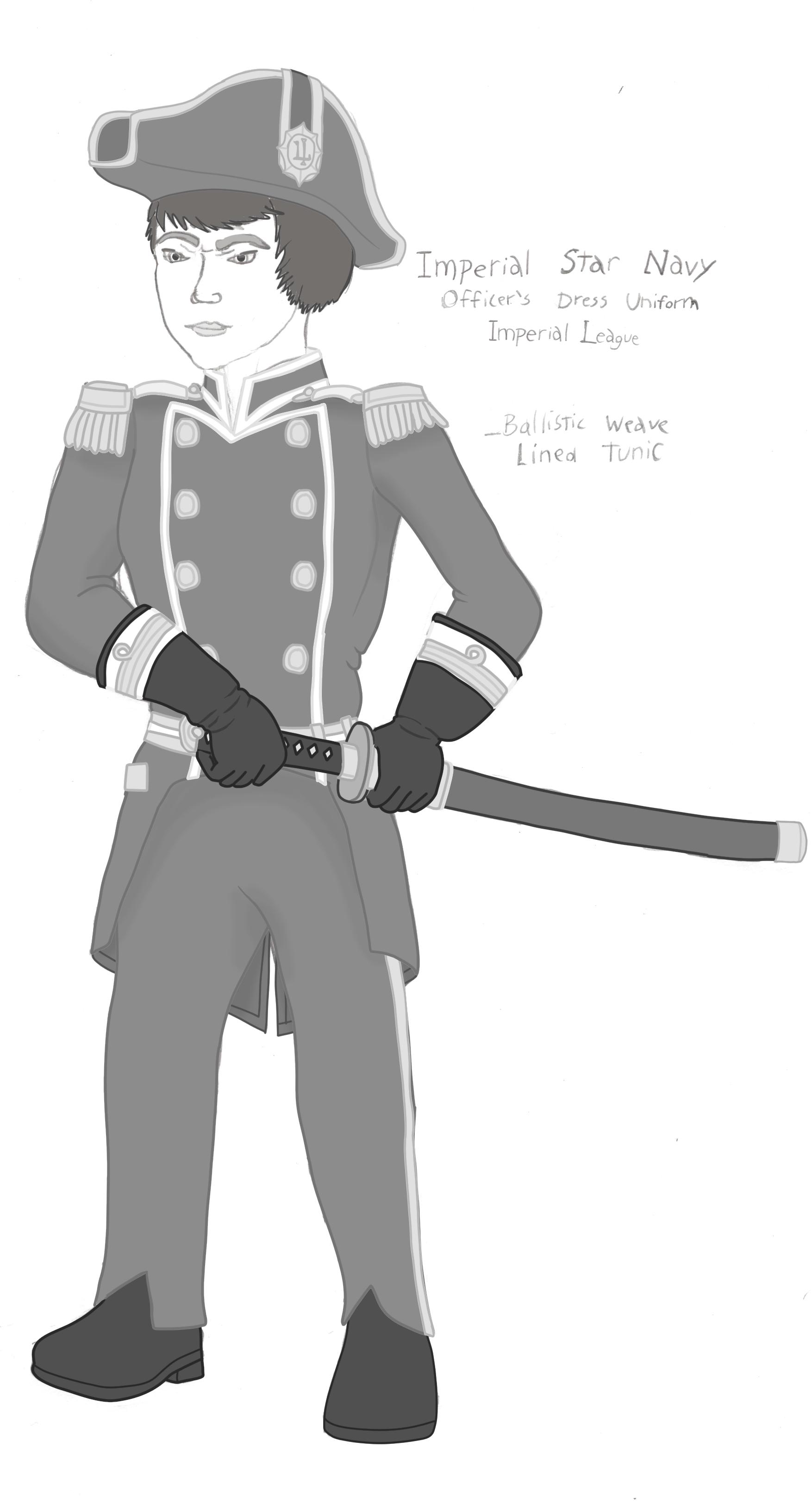
Built around the shotgun marriages of the Empires of Alvion and Nagara and formally declared in 2071 CI/25 RY during the darkest days of the Third Global War, the Imperial League played a major role in the defeat of the Autarchists (especially at sea) and endured afterwards taking in several more members, most of which were parliamentary democracies. In the Post-War era, it found itself in a complicated position. On the one hand, the United Global (later Interstellar) Communes was spreading among the territories it had liberated as well as by socialist revolutionary movements and democratic elections. On the other hand there was a coalition which would become the the Federated Nations which while similarly aligned against Communard expansion found themselves at odds with each other. No one thing lead to the divide and contributing causes ranged from differences in policy, concerns over power dynamics, trade disputes, several dubious actions (including coup d'etats engineered by FN members, the backing of questionable regimes and the Imperial Leagues commitment to maintaining it's Colonial holdings) and more, though the brief Yashishima Islands War in 2081 CI/35 RY is generally seen as the splitting point. The military forces of IL member states were at first kept at a national level beyond a few joint command and special operations forces, which remains the case for planetary armies to this day. But in 2083 CI/37 RY the UGC launched the Étoile Rouge-1, the first man-made satellite, prompting the League to create a unified space program in response. In 2123 CI/77 this would give rise to the Imperial Star Navy.

There have been several revisions of the Imperial Star Navy uniform over the last couple centuries, though one feature which has remained consistent are deliberately anachronistic dress uniforms, hearkening back to the glories of the age of sail and ironclads with double breasted tunics, polished boots, long gloves, gleaming epaulettes and bicorn hats. While simpler working uniforms exist, many ISN officers (especially those of Captain Rank or above) prefer to do much of their work dressed to impress. Despite appearances, the uniforms are made with modern ballistic lining that's lightweight and offers significant protection against shrapnel and cartridge pistol fire.

If one was to compare the officers of the Imperial Star Navy to those of the People's Cosmic Command or the Federal Space Force they are somewhat more elitist. Leaving aside wartime, all officers (including those promoted from the ratings) must receive at least nine months of academy training. More emphasis is also placed on formalities and comportment as well as history and the social sciences. Sometimes this gives them a reputation for being stiff, self important or overly focused on trivial things, but when push comes to shove they have proven themselves on numerous occasions.