r/MuslimAcademics • • Jun 23 '26

Open Discussion Thread Weekly Open Discussion Thread

4 Upvotes

This is where you can discuss personal religious questions, or any other Islam related general question without needing to adhere to the academic framework of the general sub.


r/MuslimAcademics • • Jun 16 '26

Update to the Rules.

11 Upvotes

The rules of r/MuslimAcademics have been updated as per the new change in management. Please reread the rules. We are allowing a greater range of topics to be discussed in an academic setting. Additionally, we are allowing the use of AI for academics SUMMARIES only. All citations must be double-checked. AI is FORBIDDEN in academic debates and discussions


r/MuslimAcademics • • 5h ago

On Our Own Terms: Multiple Modernities, Multiple Secularities, and the Islamic Civilisational Imaginary | Part I – Clearing the Ground

Thumbnail
themaydan.com
1 Upvotes

Faheem A. Hussain responds to the question "Is Islam compatible with modernity?" by pointing out there has never been a single definition of modernity. Both Muslims and non-Muslim thinkers who ask this question fail to arrive at satisfying answers because they fall victim to this fallacy. Hussain describes a "plurality of modernities" and how structural convergence across societies can produce vastly differing results.


r/MuslimAcademics • • 15h ago

The painting of Plato (Aflāṭūn) in the Islamic world, charming wild animals with the sounds of his wondrous musical instrument, thereby surpassing his rival Aristotle. It was produced by Madhu a Mughal court painter during the reign of Emperor Akbar.

Post image
2 Upvotes

r/MuslimAcademics • • 22h ago

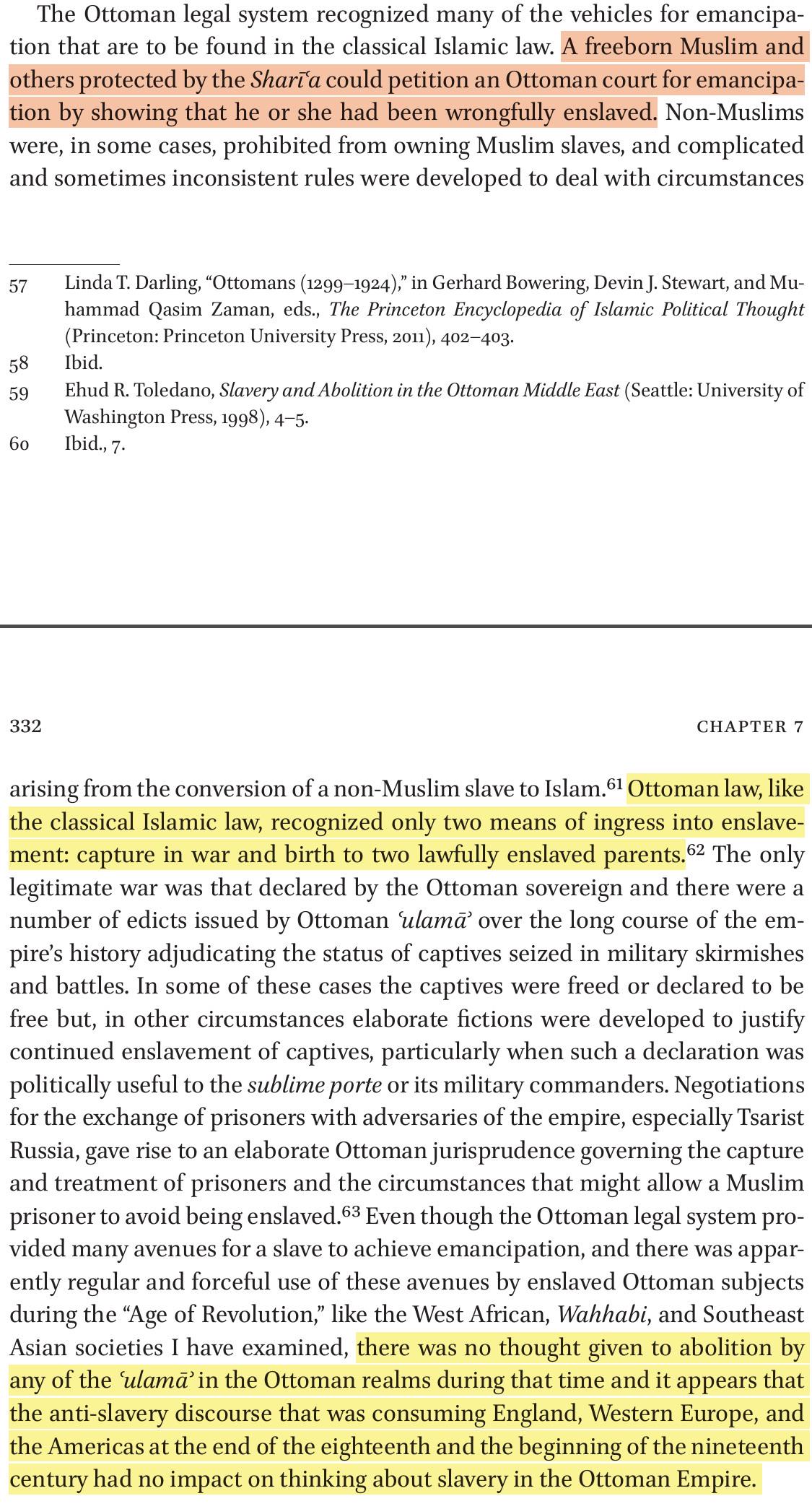
Academic Book Ottoman Islamic Scholars Recognized Slavery Through Warfare and Birth but Did Not Advocate Its Abolition

Post image
0 Upvotes

Source: “Possessed by the Right Hand - The Problem of Slavery in Islamic Law and Muslim Cultures” by Bernard K. Freamon


r/MuslimAcademics • • 1d ago

Open Discussion Thread Haqiqatjou DEMANDS The Sheikhs Cut Off Yasir Qadhi!!

2 Upvotes

https://youtu.be/R2EojbVYj6Q

This is nothing new. There is, quite rightly, a fear of challenging the status quo. This is evident throughout history, with sectarians massacring one another over seemingly minor theological differences, for example, whether the Quran is created or uncreated, and, of course, political disagreements over who should lead.

We see similar divisions in Christian theology, with differences between Catholic, Orthodox, and Protestant traditions. They, too, historically massacred one another over religious and political differences, including disputes over leadership. However, these days, such divisions are far less violent, if not largely peaceful.

This is not always the case in the Muslim world, where challenging established religious views can be extremely difficult and, in some contexts, dangerous—for example, under the Taliban, where open theological disagreement can carry serious consequences.

Besides a handful of scholars, such as the late Dr. Muhammad Shahrour, the majority, IMO, are essentially parrots, 🦜 parroting one another.

All are given the faculties to reason and understand; each is responsible for their own study and understanding. Appealing to “a scholar, politician, news channel, podcast, or hearsay says so” is no excuse. Likewise, Q 17:36 applies to scholars as well.

Ma VI 165 dated ~648-674 CE. Its first page is remarkably well-preserved, as if written today.

https://corpuscoranicum.de/en/manuscripts/107/page/1r?sura=17&verse=36

Q 17:35 (start text) ذَٰلِكَ such/that خَيْرٌ best وَأَحْسَنُ and very best تَأْوِيلًا elucidation of 17:36 وَلَا and not تَقْفُ thou pursue مَا what لَيْسَ not is لَكَ to thee بِهِ in it عِلْمٌ knowledge إِنَّ indeed السَّمْعَ the hearing وَالْبَصَرَ and the eyesight وَالْفُؤَادَ and the heart (inner emotion, sense of awareness, and the seat of conscious perception) كُلُّ each أُولَٰئِكَ those كَانَ be عَنْهُ about it مَسْؤُولًا questioned of


r/MuslimAcademics • • 1d ago

Academic Book Mullā Ṣadrā argues that all Existence is one fundamental reality manifesting in different degrees of intensity. The essences by which we categorise things are mental labels. God the One is simple & pure Being, Existence itself & is the totality of Existence.

Thumbnail
gallery
12 Upvotes

r/MuslimAcademics • • 1d ago

Review partner for Usool-ul-Fiqh

1 Upvotes

Al salamu alaikum. I am a student of knowledge studying several sciences with teachers. One of them being the Hanafi Usool-ul-fiqh text "Usool-ul-Shaashi." I am looking for a review (takraar) patner for Usool-ul-shaashi with a student of knowledge. Where I explain the book on vc. If anyone is interested in this, please let me know. Jazakallah.


r/MuslimAcademics • • 1d ago

Ijtihad (Opinion) Words That Make Room for Scientific discoveries in Qur'an.

2 Upvotes

For the umpteenth time: many Muslims don't wait for science to affirm the Qur'an, and many don't claim that it predicts modern science in detail. Our point is simply that the Qur'an uses language so elegantly that it can accommodate new discoveries without stretching or twisting its words, relying only on meanings recorded in classical Arabic dictionaries before modern science advanced.

Example 1

اللَّهُ يَعْلَمُ مَا تَحْمِلُ كُلُّ أُنثَىٰ وَمَا تَغِيضُ الْأَرْحَامُ وَمَا تَزْدَادُ ۖ وَكُلُّ شَيْءٍ عِندَهُ بِمِقْدَارٍ

The verb taghīḍ is elegant because it means what the wombs lose, and not only by external expulsion but also by disappearing into the interior of something, as in ghīḍa al-māʾ ("the water sank into the earth"). So the verb accommodates both visible miscarriage and the newly discovered phenomenon of missed miscarriage, in which the embryo dissolves and disappears inside the uterus without any visible expulsion, blood, or notice. Had other verbs been used, such as tujhiḍ*,* *tafqid tunqiṣ tusqiṭ, or tunzil, this resonance would be lost. The author of this speech seems to know that not all loss happens through visible expulsion; loss can also happen by disappearance inside the womb, without the dead embryo being expelled.

Example 2

وَالسَّمَاءِ ذَاتِ الْحُبُكِ

Ḥubuk means pathways, but specifically pathways in the form of nodes and filaments, or rippling patterns. The ancients understood it as the heaven containing pathways of stars or planets, but the word means more than that: the heavens contain pathways in the form of nodes and filaments. The cosmic web fits this. The author seems to have known that the sky contains filamentous, nodal pathways. Had other words been used, such as ṭuruq*,* aflāk*,* madārāt*, or* masārāt, this would be lost, because none of them implies node-and-filament pathways the way ḥubuk does.

Al-Tha'ālibī's commentary, written about 500 years before the cosmic web was discovered, says (roughly): Then God swore by another creation: "By the heaven with its ḥubuk." The ḥubuk are the pathways arranged in an order among the celestial bodies. It is also said of the pathways you see in water or sand when wind strikes them, and of curled hair, and of woven cloth, where the places in which threads interlace are called ḥubuk.

Conclusion

Can you understand this simple argument? It cannot be dismissed as mental gymnastics, retrofitting, or post-hoc rationalisation. It is not retrofitting, because I'm not twisting or stretching anything: the classical meanings of ghīḍ and ḥubuk already include these senses. Nor can it be dismissed as "the flexibility of Arabic," because I've shown that other Arabic verbs and nouns were available and would not have resonated with these newly discovered phenomena. So it is not an inevitable fact of the language. Nor can chance explain this, because these are just two examples among many others spanning multiple fields, including cosmology, biology, and geology.


r/MuslimAcademics • • 2d ago

Ijtihad (Opinion) Hellfire cannot be infinite in islam

3 Upvotes

The Qur'an is clear that God is just and never commits injustice.

Infinite punishment for finite sins committed by a finite being is clear injustice. Therefore, God would never do such a thing.

Surah Ghafir (40:17):

«Today every soul will be recompensed for what it has earned. There will be no injustice today. Indeed, God is swift in reckoning.»

Surah An-Nisa (4:40):

«Indeed, God does not wrong anyone, even by an atom's weight. And if there is a good deed, He multiplies it and gives from Himself a great reward.»

Surah Yunus (10:44):

«Indeed, God does not wrong people in the least, but it is people who wrong themselves.»

Surah Al-Anbiya (21:47):

«We shall set up the scales of justice for the Day of Resurrection, so no soul will be wronged in the least. And even if there is a deed as small as the weight of a mustard seed, We will bring it forth. And sufficient are We as reckoners.»

Surah Fussilat (41:46):

«Whoever does righteousness, it is for his own benefit; and whoever does evil, it is against himself. And your Lord is never unjust to His servants.»

The Qur'an is also clear that God is merciful and that His mercy encompasses all things. Hellfire is a thing, and therefore, His mercy will eventually encompass it as well.

Surah Al-A'raf (7:156–157):

«And decree for us good in this world and in the Hereafter. Indeed, we have turned to You in repentance. He said: My punishment—I afflict with it whom I will, but My mercy encompasses all things. So I will decree it for those who are mindful of Me, give zakah, and believe in Our signs. Those who follow the Messenger, the unlettered Prophet, whom they find written in what they have of the Torah and the Gospel, who commands them to what is right and forbids them from what is wrong, makes lawful for them the good things and prohibits for them the evil, and relieves them of their burden and the shackles that were upon them. So those who believe in him, honor him, support him, and follow the light sent down with him—they are the successful.»

Surah Ghafir (40:7):

«Those who carry the Throne and those around it glorify their Lord with praise and believe in Him and ask forgiveness for those who believe, saying: Our Lord, You have encompassed all things in mercy and knowledge, so forgive those who repent and follow Your way, and protect them from the punishment of Hellfire.»

Comment: Saying that these verses restrict God's mercy exclusively to those mentioned after "سَأَكْتُبُهَا" is obviously wrong. Otherwise, sinful Muslims who do not pray or give charity or follow the Prophet would remain in Hell forever, which no Muslim believes. Rather, these verses guarantee that God will grant His mercy to those mentioned; they do not exclude others from His mercy altogether.

The Qur'an is clear that God is wise, and there is no wisdom in torturing someone forever, even if that person has recognized the truth and regretted their wrongdoing countless times.

Surah Al-Mu'minun (23:107):

«Our Lord, remove us from it. If we return to wrongdoing, then indeed we would be wrongdoers.»

Surah Ghafir (40:11):

«They will say: Our Lord, You caused us to die twice and gave us life twice, and we have confessed our sins. So is there any way out?»

Surah Ghafir (40:12):

«That is because when God alone was called upon, you disbelieved, but when partners were associated with Him, you believed. So judgment belongs to God, the Most High, the Great.»

Surah Az-Zukhruf (43:77):

«And they will call: O Malik, let your Lord put an end to us! He will say: Indeed, you will remain.»

There is no purpose to fulfill in torturing someone forever once the punishment has served its purpose, unless God—God forbid—were sadistic and derived pleasure from torturing His creatures. This is contradicted by the Qur'an itself.

Surah An-Nisa (4:147):

«What would God do with your punishment if you are grateful and believe? And God is Appreciative and Knowing.»

Surah Az-Zumar (39:7):

«If you disbelieve, then indeed God is independent of you. And He does not approve of disbelief for His servants. But if you are grateful, He approves it for you. No bearer of burdens will bear the burden of another. Then to your Lord is your return, and He will inform you of what you used to do. Indeed, He knows what is within the hearts.»

Finally, the Qur'an is clear in its wording. For Paradise, it uses the expression عَطَاءً غَيْرَ مَجْذُوذٍ (an uninterrupted, unsevered gift), whereas for Hellfire it uses إِلَّا مَا شَاءَ رَبُّكَ إِنَّ رَبَّكَ فَعَّالٌ لِمَا يُرِيدُ (except as your Lord wills; indeed, your Lord is the Doer of whatever He wills).

Surah Hud (11:108):

«As for those who were blessed, they will be in Paradise, abiding therein as long as the heavens and the earth endure, except as your Lord wills—a gift uninterrupted.»

Surah Hud (11:107):

«They will remain therein as long as the heavens and the earth endure, except as your Lord wills. Indeed, your Lord is the Doer of whatever He wills.»

This distinction ties the duration of Hellfire's punishment to God's will. And His will is consistent with His wisdom, justice, and mercy.

Surah Al-An'am (6:128):

«They will say: Our Lord, some of us made use of others, and we have reached our appointed term which You appointed for us. He will say: The Fire is your residence, wherein you will abide, except as God wills. Indeed, your Lord is Wise and Knowing.»

There is another important observation concerning the dialogue in Surah Ghafir. After the inhabitants of Hellfire confess their sins and ask, «So is there any way out?», God does not respond with the same expressions found in other passages, such as «Be despised therein and do not speak to Me» (Surah Al-Mu'minun 23:108), or «Indeed, you will remain» (Surah Az-Zukhruf 43:77). Instead, the passage concludes:

Surah Ghafir (40:12):

«So judgment belongs to God, the Most High, the Great.»

This is significant because it places the ultimate judgment in God's hands. It is He who decides, and this is consistent with the repeated qualification that the duration of punishment is subject to His will. It should not be understood as an unconditional necessity independent of His wisdom, justice, and mercy.

Also, if Hellfire is infinite, there is no meaning in saying:

Surah An-Naba (78:23):

«Remaining therein for ages (لَابِثِينَ فِيهَا أَحْقَابًا).»

Or:

Surah Maryam (19:79):

«No! We will record what he says, and We will extend for him the punishment extensively (وَنَمُدُّ لَهُ مِنَ الْعَذَابِ مَدًّا).»

There is no meaning in saying that something already infinite will be extended or restricted to successive ages (أَحْقَابًا).

When you have paid for your arrogance and sins, your punishment will cease 78:26. Hell is "a fitting recompense" (jazāʾan wifāqā). God is not unjust, His mercy encompasses all things, and He does whatever He wills wisely.


r/MuslimAcademics • • 2d ago

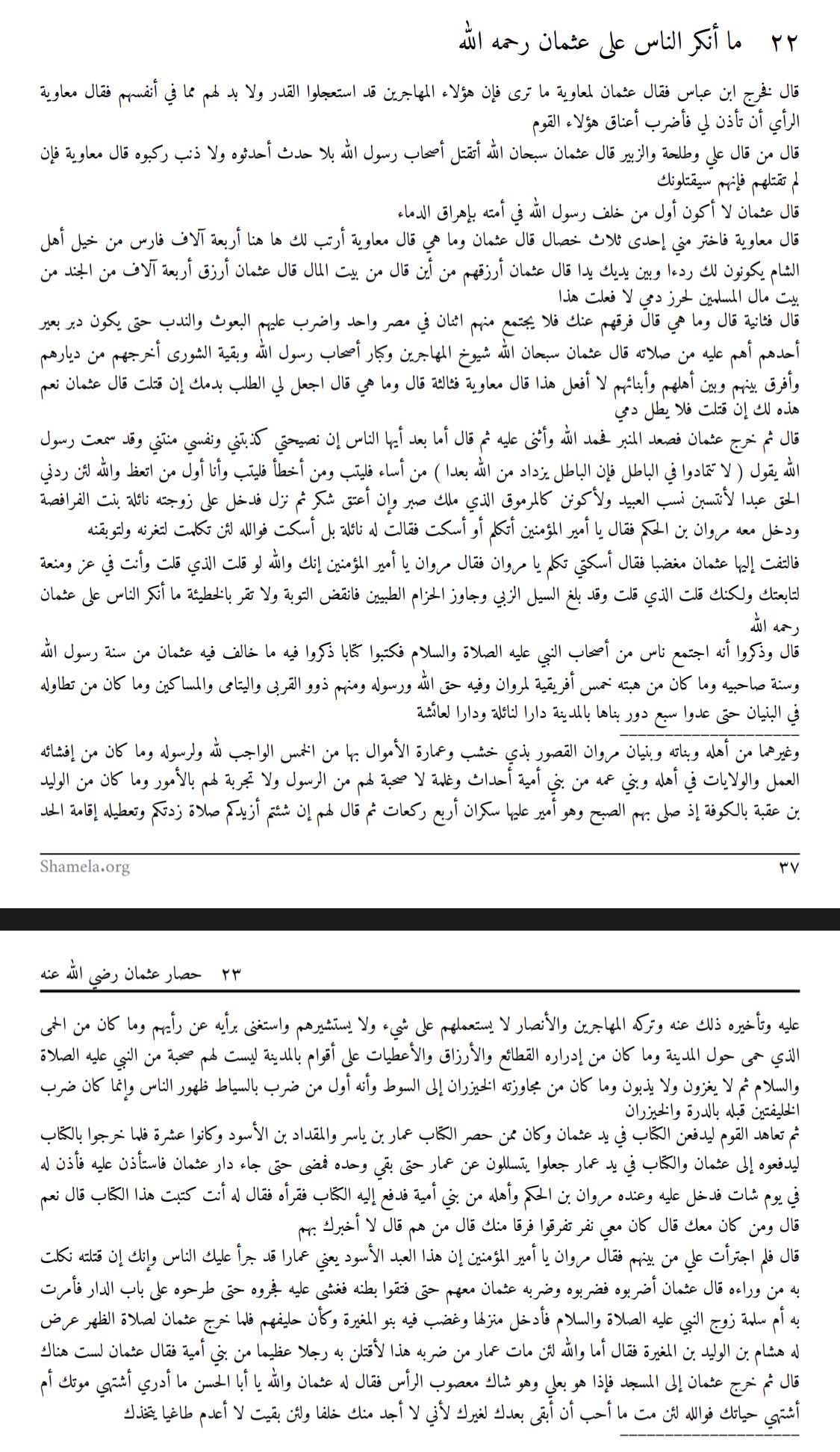
Traditionalist Source Ibn Qutaybah’s Al-Imāmah wa al-Siyāsah: The Report of ʿUthmān Ordering the Beating of ʿAmmār ibn Yāsir

Post image
0 Upvotes

Source:

- Book: Al-Imāmah wa al-Siyāsah (الإمامة والسياسة), “The Imamate and Politics.”
- Attributed author: Abū Muḥammad ʿAbd Allāh ibn Muslim ibn Qutaybah al-Dīnawarī (d. 276 AH / 889 CE), commonly known as Ibn Qutaybah.

Note: The book’s attribution to Ibn Qutaybah is disputed among scholars, although the uploaded PDF identifies him as its author.

Auto Translation:

22. What the People Criticized ʿUthmān for, may God have mercy on him

He said: Ibn ʿAbbās went out, and ʿUthmān said to Muʿāwiya, “What do you think? These Emigrants [Muhājirūn] have sought to hasten destiny, and what is within themselves will inevitably come out.”
Muʿāwiya said, “My opinion is that you permit me to strike off the necks of these men.”
He said, “Who?”
He replied, “ʿAlī, Ṭalḥa, and al-Zubayr.”
ʿUthmān said, “Glory be to God! Shall I kill the Companions of the Messenger of God when they have committed no offense and perpetrated no sin?”
Muʿāwiya said, “If you do not kill them, they will kill you.”
ʿUthmān said, “I will not be the first successor of the Messenger of God among his community to shed blood.”
Muʿāwiya said, “Then choose one of three proposals from me.”
ʿUthmān said, “What are they?”
Muʿāwiya said, “I will station here for you four thousand cavalrymen from the people of Syria. They will be your support and a force at your disposal.”
ʿUthmān said, “From where would I pay their stipends?”
He said, “From the public treasury.”
ʿUthmān said, “Pay four thousand soldiers out of the Muslims’ treasury to guard me personally? I will not do that.”
He said, “Then the second.”
ʿUthmān said, “What is it?”
He said, “Disperse them away from you, so that no two of them are gathered in the same province. Assign them to military expeditions and mobilizations until the backside of one of their camels becomes a greater concern to each of them than his prayer.”
ʿUthmān said, “Glory be to God! The elders of the Emigrants, the senior Companions of the Messenger of God, and the remaining members of the council: shall I expel them from their homes and separate them from their families and children? I will not do that.”
Muʿāwiya said, “Then the third.”
He said, “What is it?”
He replied, “Entrust me with seeking vengeance for your blood if you are killed.”
ʿUthmān said, “Yes. You have that right if I am killed, so that my blood will not go unavenged.”
He said: Then ʿUthmān went out, ascended the pulpit, praised and extolled God, and then said:
“To proceed, O people: my counsel has proven me false, and my own soul has deceived me. I heard the Messenger of God say, ‘Do not persist in falsehood, for falsehood only increases one’s distance from God.’ Whoever has done wrong, let him repent; whoever has erred, let him repent. I am the first to take heed. By God, if the truth reduces me to the status of a slave, I will associate myself with the lineage of slaves, and I will be like the enslaved man who, while owned, is patient, and when freed, is grateful.”
Then he descended and entered upon his wife, Nāʾila bint al-Farāfiṣa. Marwān ibn al-Ḥakam entered with him.
Marwān said, “Commander of the Believers, should I speak or remain silent?”
Nāʾila said to him, “Rather, remain silent! By God, if you speak, you will surely mislead him and bring him to ruin.”
ʿUthmān turned toward her angrily and said, “Be quiet. Speak, Marwān.”
Marwān said, “Commander of the Believers, by God, had you said what you just said while you possessed power and protection, I would have followed you. But you said what you said after the flood has reached the hilltops and the strap has passed the breasts. So renounce this repentance and do not acknowledge wrongdoing regarding what the people have criticized ʿUthmān for, may God have mercy on him.”
It is also related that a group of the Prophet’s Companions, peace and blessings be upon him, gathered and wrote a document in which they mentioned the matters in which ʿUthmān had departed from the practice of the Messenger of God and the practice of his two predecessors.
Among them was his granting Marwān one-fifth of the spoils of Africa, even though in it was the right of God and His Messenger, as well as the relatives, orphans, and the poor.
They also mentioned his extravagance in construction, to the point that they counted seven houses that he had built in Medina, including a house for Nāʾila, a house for ʿĀʾisha, and others for members of his family and daughters; and Marwān’s construction of palaces at Dhū Khushub and his development of estates there using wealth from the one-fifth that was due to God and His Messenger.
They also mentioned his distribution of offices and governorships among his relatives and cousins from the Umayyads: young men and youths who had no companionship with the Messenger and no experience in affairs.
They mentioned the matter of al-Walīd ibn ʿUqba in Kufa, when, while its governor, he led them in the dawn prayer while drunk and prayed four rakʿas. Then he said to them, “If you wish, I will give you more.” And [they mentioned] ʿUthmān’s failure to impose the prescribed punishment upon him and his delaying it.
They also criticized his neglect of the Emigrants and the Helpers, neither appointing them to any positions nor consulting them, while relying upon his own judgment instead of theirs.
They mentioned the protected grazing land he reserved around Medina; his continual grants of land allotments, stipends, provisions, and gifts to people in Medina who had not been Companions of the Prophet, peace and blessings be upon him, and who neither went out to fight nor defended [the community].
They also mentioned his going beyond the use of the khayzurān cane to the whip, and that he was the first to have people’s backs beaten with whips, whereas the two caliphs before him had only struck with the small staff and the khayzurān cane.

23. The Siege of ʿUthmān, may God be pleased with him

Then the group agreed that they would place the document in ʿUthmān’s hand. Among those involved in compiling the document were ʿAmmār ibn Yāsir and al-Miqdād ibn al-Aswad. They were ten men.
When they set out with the document to deliver it to ʿUthmān, with the document in ʿAmmār’s hand, they began slipping away from ʿAmmār one after another until he was left alone.
He continued until he reached ʿUthmān’s house and asked permission to enter. He was admitted on a cold day. He entered while Marwān ibn al-Ḥakam and members of ʿUthmān’s Umayyad family were with him.
He handed him the document, and ʿUthmān read it.
He said to him, “Did you write this document?”
He replied, “Yes.”
He said, “Who was with you?”
He replied, “A group of men were with me, but they scattered out of fear of you.”
He said, “Who are they?”
He replied, “I will not tell you about them.”
He said, “Then why, of all of them, did you dare to confront me?”
Marwān said, “Commander of the Believers, this black slave,” meaning ʿAmmār, “has emboldened the people against you. If you kill him, you will make an example of him for those behind him.”
ʿUthmān said, “Beat him.”
So they beat him, and ʿUthmān beat him along with them, until they injured his abdomen and he lost consciousness. They dragged him and threw him at the door of the house.
Umm Salama, the wife of the Prophet, ordered that he be brought into her house. Banū al-Mughīra became angry on his behalf, for he was their confederate.
When ʿUthmān went out for the noon prayer, Hishām ibn al-Walīd ibn al-Mughīra confronted him and said, “By God, if ʿAmmār dies from this beating, I will certainly kill in retaliation a great man from Banū Umayya.”
ʿUthmān replied, “You are not capable of that.”
Then ʿUthmān went out to the mosque and found ʿAlī there. He was ill and had his head wrapped in a bandage.
ʿUthmān said to him, “By God, Abū al-Ḥasan, I do not know whether I desire your death or desire your life. By God, if you die, I would not wish to remain after you for anyone else, because I can find no replacement for you. Yet if you remain alive, I will never be without some rebellious man who takes you as…”
[The sentence continues on the following page.]

Translation note: This is a translation of the historical narrative as presented in the attached image. It should not be understood as verification of the authenticity of the reports, particularly the allegations concerning ʿUthmān’s conduct and the beating of ʿAmmār.


r/MuslimAcademics • • 3d ago

How should I learn and determine which argument is better/right?

3 Upvotes

19M raised in the west in an islamic household, I understand the premise of islam and am a beliver myself. However, lately i've been constantly questioning things realted to islam. How should I learn the answers to these questions and determine wether they are right or wrong?

When I read a answer/debate from two perspectives regarding a question/concept, I usually come to a middle ground conclusion rather then a definitive answer or understanding/belief. For example, the concept of is eternal hellfire just? I have had compelling answers from both sides of the argument and cant come to a conclusion on which is right?

I want to strengthen my faith, but I do not want to have blind faith. How should I go about things?


r/MuslimAcademics • • 3d ago

Open Discussion Thread The Epistemic Authority of Revelation, Divine Attributes, and Objective Morality

3 Upvotes

This was paraphrased by an AI because I get it a lot my writings are not structured so I tried to make it more structured and precise most words are still mine only grammar, order and some words are changed

---------------------------------

My inquiry concerns the philosophical foundations of religious authority, particularly the relationship between God, logic, objective morality, human reason and revelation.

I am not initially assuming that God does not exist, that the Quran is man-made, or that human moral reasoning is infallible. Rather, I want to investigate whether the theological claims being made are internally coherent and whether their foundational assumptions can be rationally justified.

My central concern is this:

What justifies treating revelation as an authoritative source of objective truth, and what happens when human reason appears to conflict with it?

I will examine this through several interconnected problems.

---

  1. The epistemic authority of revelation

Suppose we accept that objective moral truths exist and that human beings possess the capacity to discover at least some of them through reason.

We must then distinguish between two functions of reason:

  1. Interpretive reason: reasoning used to understand, contextualise, defend and apply revelation.
  2. Critical reason: reasoning used to independently evaluate the truth claims and moral prescriptions of revelation, including the possibility of rejecting them.

The distinction matters because accepting the first does not necessarily entail accepting the second.

My question is whether Islamic theology, particularly Ash'arite theology, permits the second form of reasoning.

If human reason independently concludes that a particular act prescribed or permitted by the Quran is immoral, what follows?

There are several possibilities:

- Human reasoning is mistaken, and revelation retains its authority.

- The apparent contradiction results from an incorrect interpretation of revelation.

- The revelation is not genuinely divine.

What principle determines which conclusion is justified?

If reason is categorically subordinate to revelation, then what independent grounds do we have for accepting revelation as authoritative in the first place?

Conversely, if reason can independently establish moral truths and interrogate revelation, then revelation cannot possess absolute immunity from rational moral criticism.

This raises a further question: if revelation is supposed to guide human moral understanding, does it provide moral knowledge that reason cannot independently obtain, or does it primarily organise, communicate and reinforce principles that human reason could discover independently?

I do not deny that revelation could be useful even if reason can independently discover moral truths. However, its necessity and epistemic authority would require a separate justification.

2. The problem of moral grounding: Is goodness contingent or necessary?

Consider the claim:

God commands what is good because goodness is grounded in God's nature, rather than actions becoming good merely because God commands them.

This appears to avoid a simplistic form of divine command theory in which morality is entirely arbitrary.

However, it introduces another problem.

If goodness originates in God's nature, is that nature contingent or necessary?

Possibility A: Goodness is contingent upon God's will.

God determines what his nature is, or what constitutes goodness.

But if this is the case, what prevents goodness from being arbitrary? If God could have determined an entirely different standard, in what meaningful sense is his goodness objectively good?

Calling whatever God determines good does not independently establish the moral content of goodness.

Possibility B: Goodness is necessary to God's nature.

God cannot be otherwise than good, and goodness is necessarily grounded in what he is.

But then God does not choose the fundamental nature of goodness. He cannot determine otherwise what goodness is.

This raises the question of whether God has control over his own necessary nature and whether divine freedom is compatible with such necessity.

There is also an epistemological problem.

If God's nature is the standard of goodness, how can human beings know that this nature is good?

If reason can independently recognise the properties that constitute goodness, then reason possesses some independent capacity to evaluate moral claims.

If those properties are only considered good because they belong to God, the claim risks becoming circular: God is good because his nature defines goodness, and his nature is good because it is God's nature.

I therefore want to establish what makes divine goodness meaningful and how human beings can know it.

3. The problem of axioms and competing moral foundations

Even if reason can identify objective moral truths, moral disagreements remain.

Different ethical systems may begin with different foundational assumptions or axioms.

For example, two people might disagree about justice because they begin with different conceptions of what justice fundamentally requires.

Some foundational propositions cannot be established merely by deriving them from other propositions within the same system. At some point, reasoning depends upon fundamental premises.

This creates an epistemological problem for revelation.

Suppose two competing interpretations of justice are internally coherent but depend upon different foundational assumptions.

If the Quran is supposed to establish which foundational assumption is correct, how does it do so?

There are two broad possibilities:

  1. It establishes the correct axiom through reasoning.
  2. It asserts the axiom through revelation.

If it relies on reasoning, then the argument must be examined through reason, including the possibility of criticism.

If it merely asserts the axiom, what justifies accepting that assertion over competing foundational claims?

Furthermore, the existence of multiple interpretations must not be confused with the existence of multiple objective truths.

A truth can have different applications depending on circumstances without becoming relative to individual perspectives.

I therefore distinguish between:

- Objective truth.

- Different interpretations of truth.

- Context-dependent applications of truth.

- Fundamentally incompatible claims about truth.

The existence of interpretive nuance does not establish that contradictory interpretations are simultaneously correct.

4. The relationship between God and logic

Consider God and logic as two conceptual objects for the purpose of examining the relationship between them.

The relationship between divine action and human free will, for instance, is intelligible to us through logical relations.

This raises the question: is God bound by logic?

There are several possibilities.

Possibility A: Logic exists independently of God.

Logical necessities are not products of divine choice.

God cannot actualise logical contradictions.

This raises questions about whether logical necessity is external to God or whether it is simply a feature of reality that cannot coherently be otherwise.

Possibility B: Logic is grounded in God's necessary nature.

Logical truths are expressions of what God necessarily is.

God cannot act contrary to his nature.

However, if logical truths are necessary consequences of God's nature, God cannot choose to have a different nature.

Does this constitute a limitation on divine freedom?

Possibility C: Logic is entirely contingent upon divine will.

God determines what is logically possible and what is impossible.

But this creates another problem.

Can God make contradictions possible? If not, then there are necessities that God cannot alter. If yes, then the meaning of logical impossibility and logical necessity becomes unclear.

The fundamental question is whether God's omnipotence includes control over logical possibility itself, or whether omnipotence operates within necessary truths.

Furthermore, if God is necessarily what he is, can he become otherwise?

If he cannot, is he eternally fixed in his nature? And what exactly does divine freedom mean if God cannot choose to be different?

I want to distinguish an inability resulting from insufficient power from an inability resulting from logical incoherence or necessary identity.

5. Divine omniscience and the nature of truth

If God knows everything that can possibly be known, what determines the boundaries of possibility and truth?

There are several possibilities:

  1. Truth is arbitrarily determined by divine will.
  2. Truth exists independently of God.
  3. Truth is grounded necessarily in God's nature.

If truth is arbitrarily determined, then what provides a standard against which God's knowledge can be called perfect?

If God can determine anything to be true and subsequently call his knowledge perfect, does perfection retain any meaningful content?

If truth exists independently of God, then God appears to know truths that are not products of his will.

If truth is grounded necessarily in God's nature, then his knowledge of those truths is necessary rather than contingent.

But this again raises the question of whether God controls his own nature and whether he has freedom over what he necessarily is.

I therefore want to understand the relationship between divine omniscience, necessary truth, contingency and divine freedom.

6. The problem of evil and divine intervention

Consider the relationship between human free will and divine intervention.

If God is omnipotent, omniscient and perfectly good, why does he permit suffering that he could prevent?

In particular, could God intervene to prevent suffering while preserving human freedom?

The problem becomes especially significant when considering suffering that appears unrelated to the exercise of human free will, such as the suffering of very young children.

There are two broad possibilities:

Possibility A: God cannot prevent certain suffering without compromising some necessary feature of reality.

If this is the case, what determines that necessity?

Is it logically impossible for God to preserve human freedom while preventing the suffering in question?

If God is grounded in necessary logical truths, the theist must explain why the alternative world is impossible.

Possibility B: God can prevent the suffering but chooses not to.

In that case, the decision requires moral justification.

If God has the capacity to prevent an instance of suffering without sacrificing an equally or more valuable outcome, why does he permit it?

Simply asserting that God's decision is good does not establish that it is good.

A further problem concerns the claim that God necessarily possesses a perfect nature.

Even if God cannot become imperfect, this does not independently establish that every action he performs is the morally best available action.

The relationship between necessary divine perfection and the moral justification of particular divine decisions must therefore be explained.

My concern is not merely whether suffering can coexist logically with God's existence, but whether the actual distribution and nature of suffering can be reconciled with the conception of divine goodness being defended.

7. The epistemic problem of identifying revelation

Even if the existence of God is established, this does not independently establish that a particular religion or religious text is divine revelation.

There are several distinct propositions:

  1. God exists.
  2. God possesses certain attributes.
  3. God communicates with human beings.
  4. A particular historical revelation originates from God.
  5. The text has been reliably transmitted.
  6. A particular interpretation accurately represents its intended meaning.

Each proposition requires justification.

The existence of God does not automatically establish the truth of Islam, Christianity, Hinduism or any other religious tradition.

If every religious tradition begins by assuming its own foundational framework and then interprets reality through that framework, what distinguishes the correct framework from competing ones?

Saying that a religion is true because it is God's word presupposes that the text is God's word.

This risks circular reasoning unless independent grounds are provided.

The mathematical analogy is insufficient here.

A mathematical answer can be independently verified through a demonstrable process. A religious claim about divine authorship requires historical, philosophical and epistemological justification.

Furthermore, saying that every aspect of reality is revelation does not establish that a particular interpretation of reality, or a particular religious text, is correct.

Reason must remain involved in determining which claims are justified.

8. The moral classification of riqq

A separate but related question concerns the Quranic institution of riqq and whether it can meaningfully be distinguished from slavery.

My concern is not simply whether raqiq possessed rights or whether the institution was historically identical to every other form of slavery.

An institution should be evaluated according to its actual legal and moral characteristics rather than its terminology.

Consider the following questions:

- Could a person be placed into the institution without their consent?

- Could the person independently terminate the relationship?

- Could the person leave whenever they wished?

- Did another individual possess legally recognised authority over their person?

- Could their status be inherited or transferred?

- Were their freedoms restricted by virtue of their status?

The existence of rights, education, property ownership, legal protections and opportunities for upward mobility does not independently establish the absence of slavery.

Likewise, the existence of enslaved individuals who became rulers does not establish that the institution itself was non-coercive.

The crucial distinction is between possessing certain rights within an institution and possessing the freedom to reject that institution.

A person may enjoy substantial benefits and still lack the fundamental freedom to terminate their legal status.

The analogy with ordinary debt or employment is therefore insufficient unless the relevant differences in consent, ownership, coercion and exit rights are established.

If a raqiq could only obtain freedom through a prescribed contractual process, rather than possessing an unconditional right to leave, this requires moral examination.

The possibility that some individuals voluntarily remained in the arrangement does not establish that the institution itself was morally justified.

Ultimately, I want to determine whether the Quranic institution can be defended as categorically distinct from slavery, or whether the distinction is primarily terminological.

9. My central thesis and unresolved questions

The preceding problems converge on one fundamental concern:

What justifies granting revelation authority over human moral judgement, and how can that authority be established without presupposing the truth of the revelation itself?

I am not yet claiming that the Quran is necessarily man-made.

Rather, I am questioning the epistemological and moral foundations required to establish that it is divine.

If reason can independently identify objective moral truths, revelation must be open to rational examination.

If reason cannot independently identify moral truths, then claims about God's goodness, justice and perfection become difficult to establish through human understanding.

If goodness is grounded in God's necessary nature, its relationship with divine freedom and human moral knowledge must be explained.

If God determines all possibility and truth through arbitrary will, the meaningfulness of objective goodness and perfection must be defended.

If God is necessarily constrained by his nature, the nature of that necessity and its implications for omnipotence must be clarified.

Finally, even if God's existence and goodness are established, the divine origin and moral authority of a particular revelation require independent justification.

My objective is to determine whether these theological claims can form a coherent system, whether their foundational assumptions are justified, and whether the Quran's moral authority can withstand independent philosophical examination.


r/MuslimAcademics • • 3d ago

Ijtihad (Opinion) Sun, night & day in Qur'an.

2 Upvotes

وَالشَّمْسِ وَضُحَاهَا

وَالْقَمَرِ إِذَا تَلَاهَا

وَالنَّهَارِ إِذَا جَلَّاهَا

وَاللَّيْلِ إِذَا يَغْشَاهَا

(Ash-Shams 91:1-4)

When we say that something was revealed to us, it implies that the thing was already there. It had not gone anywhere; it was simply unnoticed or hidden from us.

Likewise, when we say that something was covered, it implies that the thing is still there, only hidden from view. Covering something does not make it disappear or go away.

When you say "I covered something," it means the thing was still in its place and you just hid it from view. It does not mean you moved the thing itself.

Nearly all ancient people understood the sun's motion as the sun moving around the earth. When it rises, day begins, and when it sets, night begins. In this view, day is the sun's appearance and night is its absence.

The Quran, however, words it differently. It says that the day reveals the sun, and that the night covers it (Ash-Shams 91:3-4). It does not say that the sun's rising brings about the day, or that its setting brings about the night.

And this fits what we now know. The sun does not truly rise or set. It stays in its place, and as the earth rotates, the side facing the sun experiences day, when the sun's presence is revealed. When the earth turns away, darkness falls and the sun is hidden from us.

During the night, the sun did not go anywhere. It was only hidden from observers on earth, while remaining exactly where it was.


r/MuslimAcademics • • 4d ago

Academic Book Al-Shafi'i didn't single-handedly invent the usul al-fiqh. He was an important catalyst in the Islamic world shift toward hadith-centric legal theory, eventually leading to the creation of actual usul al-fiqh textbooks by Ibn Surayj & others a century later.

Thumbnail
gallery
5 Upvotes

r/MuslimAcademics • • 4d ago

How do the muslims on here reconcile the historical critical method and islam

3 Upvotes

Im kinda going through a phase of doubts due to the hcm,like how do yall explain the hadith skepticism, the reapeating of scientific knowledge of the time and more, also what about miracles that make you believe like i used to believe in scientific miracles and stuff but as well as like the linguistic miracle but even that I doubt a bit


r/MuslimAcademics • • 4d ago

Academic Resource Check out New Hadith Resource and Visualize Chains of Transmission

Thumbnail sunan.io
2 Upvotes

Check out this one for the Aisha age Hadith chain of transmission: https://sunan.io/en/book/sahih-al-bukhari/text/7941?view=transmissions


r/MuslimAcademics • • 4d ago

Questions Thoughts on only having 1 child? currently wife and i don't think we will have another one child.

1 Upvotes

salams! we have 1 daughter that's about 22 months and unfortunately don't think we will be able to have another due to a multitude of issues.
Would that be okay? do we have to have another one? any thoughts?


r/MuslimAcademics • • 4d ago

Gender Equality in Islam

1 Upvotes

Is it looked down upon today in Islam for multiple women to be married to one man? I can not wrap my head around how this can be a "good" decision for women when the man can receive "more" out of the marriages. This is a genuine question, and I want to understand how this discussion is talked about today, as I understand a lot of marriages in the past were economic/political. Is it different in the various branches?


r/MuslimAcademics • • 4d ago

Why was slavery allowed in islam?

0 Upvotes
  1. What Decides The Relation Between Free Will and God's Intervention?

Consider this: What decides the relation between free will and god's intervention? See this from a perspective above in your thought. Make god and free will both an object, although god is neither an object nor subject, and what is making that connection between them is that logic. If it is logic then is god bound by logic?

You are saying, God's nature is god, Logic is a part of god and God is outside his nature i.e the system i.e logic. But atleast 1 must be false. If you drop B like an ashari scholar then what decided the relation between god's intervention and free will? If it was just a choice and not an, "it had to be for that is logically necessary" then it was a deliberate choice i.e god chooses to watch suffering not because of logicality but rather a choice.

2. The Trilemma I Put

The above is a trilemma where you need to either accept reason can infer good or bad and if so slavery is bad and if so what follows is that quran is man made or you need to accept the cost that god CHOOSES to let suffering be when he can interfere while preserving free will as he is above logic as most muslims like say 60% of the world.

3. What Does God Even Know?

If you say due to god's nature his action cannot be bad so let me ask you this in return: If God knows all that's possible to know what decides what is possible? What does God even know?

Arbitrary information he makes as truth? If so perfect knowledge has no standard to be perfect against because if it is so then perfect doesn't mean anything i.e if he can do anything and call it perfect arbitrarily he is powerful not perfect. OR truth as an independent entity OR a third option i.e his knowledge stems from his nature but this poses the question again is that knowledge necessary or contingent and if necessary then he has no freedom over what he is.

4. Why Reason Must Judge Good

To even claim goodness flows out of him I need to understand and define goodness but if that is arbitrary then how can you claim god is good and perfect as WE understand and so they NEED to concede reason can judge good.

And precisely when you concede reason CAN judge good then this poses questions like what is the use of quran and then slavery is bad but a perfect god wont make a mistake therefore quran must be man made because the last defense of an ashari scholar is your reason cannot judge revelation but this poses many other problems.

5. The Defense That Riqq Is Not Slavery And Why It Fails

He argues like this, a serf in medieval Europe was not a slave, they had some rights but also obligations, they were not free to leave, we understand serfdom on its own terms as not slavery. So riqq was also not slavery but its own system. Raqiq were not slaves, bond-holders were not masters or lords but sponsors who protected their rights, provided for them, helped them transition out. How it played out was not always just, some muslims used it to justify slavery and were wrong. He asks why did slaves rule as administrators of Ottoman and Mamluk empires, why were slaves paid and educated, why did slaves own property, why did slaves have the right to sue their masters and order their contracts terminated, why did christian leaders think Umar's servant was the caliph when he journeyed to Jerusalem. So picture doesn't line up with slavery.

My reply to that is this is that, giving more rights to a raqiq doesn't change the category that he is a slave if you still value freedom over being a raqiq, then freedom is the higher good then as you equivocate it as a job it is not because quitting should be my choice will i starve to death or my owner if i quit and even if some people stayed willingly is an example, not a justification for the idea itself. Mamluks ruling doesn't prove riqq is not ownership, it just proves some owned people managed to seize power.

6. On Reason Interrogating Revelation And The Axiom Problem

Then i assume you disagree with the asharism then. Of course progressives reject divine command theory. Which is why the Quran constantly tells us to use our reason.

If someday reason says that a specific act in the quran is not good i.e evil do you concede the conclusion that quran is man made or that quran is to be used just as a reference book for application of principles because you just said reason can independently infer good and bad and not literally.

Because if you now argue that even with reason people do argue on the definition of justice i.e it can have 2-3 meanings so quran guides you to the correct one i believe that this difference is due to the fundamental axiom assumed which cannot be proved or disproved by logic, ofcourse except for non contradiction but even then a few axioms remain, if by nature an axiom cannot be proved or disproved by reason how does quran convey one axiom is true through logic but due to an axiom's nature i.e impossible to do so.

i am asking even with reason there are two types one is for defending and understanding the text and the other which asharism rejects is reason interrogating the revelation making it a judge of revelation i.e above it do you mean this type of reason when quran says to use our reason and, if so then is god bound by logic i mean can he interfere free and fully while preserving free will i.e does a thing like logical contradiction bound him i mean he must be the one who decided what is possible and what is not and decided the truths which are necessary through his nature then is he bound by that necessity of the truths and, when you say that good and bad are not arbitrary it comes from god's nature i assume you meant that knowlege of good and bad is necessary then can god not control what he is.

7. Is God Stuck In A State? And The Best Argument Fails

Q) So he is bound by himself i.e he is something and not the other then can he not be the other thing i mean can he change but change signifies time so is god stuck in a state?

Ans — If god is not stuck in his perfect form rather it is nonsense to be worse than what he is, So then the "he has no obligation to do the best argument fail".


r/MuslimAcademics • • 4d ago

Ijtihad (Opinion) Qur'an and Embryology

1 Upvotes

The Qur’an states that a nutfah from the male semen, meaning a drop-like part of the seminal fluid, mixes with another contribution from the female, without specifying exactly what that contribution is, to form the body of the embryo.

The relevant verses are:

أَلَمْ يَكُ نُطْفَةً مِنْ مَنِيٍّ يُمْنَىٰ — “Was he not a drop of semen emitted?”

إِنَّا خَلَقْنَا الْإِنْسَانَ مِنْ نُطْفَةٍ أَمْشَاجٍ نَبْتَلِيهِ — “Indeed, We created man from a mixed drop, in order to test him.”

إِنَّا خَلَقْنَاكُمْ مِنْ ذَكَرٍ وَأُنْثَىٰ — “Indeed, We created you from a male and a female.”

Then this develops into what is called an ʿalaqah, which has several meanings: something that clings, a leech-like entity, and thick or clotted blood.

All three descriptions fit aspects of embryological development: the embryo resembles a leech in shape, attaches to the uterine wall, and obtains nourishment from maternal blood. The blood at this stage is not yet circulating through a fully established embryonic cardiovascular system. Rather, blood accumulates in spaces within the developing placenta and remains relatively stagnant.

The claim that all classical commentators understood ʿalaqah exclusively as a blood clot is demonstrably false.

For example, Ibn Kathir, in his interpretation of:

فَخَلَقْنَا النُّطْفَةَ عَلَقَةً

says:

صَارَتْ حَمْرَاءَ مِثْلَ الْعَلَقَةِ مُسْتَطِيلَةً

“It became red, resembling an elongated leech.”

Al-Mawardi, in his interpretation of the same verse, says:

الْعَلَقَةُ الدَّمُ الطَّرِيُّ الَّذِي خُلِقَ مِنَ النُّطْفَةِ، سُمِّيَ عَلَقَةً لِأَنَّهُ أَوَّلُ أَحْوَالِ الْعُلُوقِ.

“Al-‘Alaqah is fresh (thick) blood that develops from the nutfah. It was called ‘alaqah because it represents the first stage of attachment.”

Thus, the meanings of something that clings and something resembling a leech are attested in classical tafsirs. They are not meanings invented after the invention of the microscope. They are also documented in ancient Arabic dictionaries.

For example, in Al-Sihah by Al-Jawhari, under the root علق, we find:

عَلَقَ: الدَّمُ الْغَلِيظُ، وَالْقِطْعَةُ مِنْهُ عَلَقَةٌ.

وَالْعَلَقَةُ: دُودَةٌ فِي الْمَاءِ تَمْصُّ الدَّمَ، وَالْجَمْعُ عَلَقٌ.

“‘Alaq refers to thick blood, and a piece of it is called an ‘alaqah.

An ‘alaqah is also a worm found in water that sucks blood. Its plural is ‘alaq.”

And in Mufradat Alfaz al-Qur'an by Al-Raghib al-Isfahani (d. 502 AH):

عَلَقَ: الْعَلَقُ: التَّشَبُّثُ بِالشَّيْءِ.

“‘Alaq: attachment or clinging to something.”

So the Qur'an describes a drop-like part derived from the male seminal fluid, which mixes with a female contribution. This is consistent with the meaning of amshaj (أمشاج), meaning mixed or mingled, and with the verse:

إِنَّا خَلَقْنَاكُمْ مِنْ ذَكَرٍ وَأُنْثَىٰ.

Al-Qurtubi, in his commentary on this verse, explicitly discusses the two contributions. He writes:

ذَهَبَ قَوْمٌ مِنَ الْأَوَائِلِ إِلَى أَنَّ الْجَنِينَ إِنَّمَا يَكُونُ مِنْ مَاءِ الرَّجُلِ وَحْدَهُ، وَيَتَرَبَّى فِي رَحِمِ الْأُمِّ، وَيَسْتَمِدُّ مِنَ الدَّمِ الَّذِي يَكُونُ فِيهِ.

“Some of the early scholars held that the embryo is formed exclusively from the man's reproductive fluid, grows in the mother's womb, and draws nourishment from the blood found therein.”

He then explains the evidence they cited before rejecting their position, concluding:

وَالصَّحِيحُ أَنَّ الْخَلْقَ إِنَّمَا يَكُونُ مِنْ مَاءِ الرَّجُلِ وَالْمَرْأَةِ لِهَذِهِ الْآيَةِ، فَإِنَّهَا نَصٌّ لَا يَحْتَمِلُ التَّأْوِيلَ.

“The correct position is that creation takes place through the reproductive fluid of both the man and the woman, on the basis of this verse, for it is an explicit text that does not admit of reinterpretation.”

Therefore, the sequence is as follows: a drop-like part of the male seminal fluid (the head of a sperm cell is drop-like) combines with a female reproductive contribution to form the nutfah amshaj.

This then develops into an ʿalaqah: an entity that attaches to the uterine wall, resembles a leech in shape and function, and is associated with accumulated blood that is not yet circulating normally.

The Mudghah Stage

Then the ʿalaqah develops into a mudghah, meaning a chewable piece of flesh.

The embryo bears a resemblance to chewed objects, which have teeth marks on them:

(a) The somites appear on the embryo, resembling the marks left by teeth on chewed objects.

(b) The embryo also has a curvature resembling the curved pattern of teeth marks made by chewing along the curved jaw.

At this stage, some organs and structures are already recognizable, while others are still undergoing differentiation or have not yet acquired a recognizable anatomical form.

Thus, the embryo at this stage is a mass comprising both differentiated and undifferentiated structures, with some parts already formed and others still developing. This is consistent with the description:

مُضْغَةٍ مُخَلَّقَةٍ وَغَيْرِ مُخَلَّقَةٍ

“An embryonic lump of flesh, partly formed and partly unformed.”

This is a particularly striking description when considered in the context of embryonic development.

The embryo is neither an entirely undifferentiated mass nor a miniature, fully formed human. Rather, it contains recognizable structures alongside tissues that have not yet acquired their definitive anatomical identities.

Differentiation is gradual, and different parts of the embryo develop at different rates. This also resonates with the Qur'anic description of human development as a successive process occurring in distinct stages:

يَخْلُقُكُمْ فِي بُطُونِ أُمَّهَاتِكُمْ خَلْقًا مِنْ بَعْدِ خَلْقٍ

“He creates you in the wombs of your mothers, creation after creation.” (Qur'an 39:6)

And:

مَا لَكُمْ لَا تَرْجُونَ لِلَّهِ وَقَارًا ۝ وَقَدْ خَلَقَكُمْ أَطْوَارًا

“What is the matter with you that you do not attribute due grandeur to Allah, when He has created you in successive stages?” (Qur'an 71:13–14)

The expressions خَلْقًا مِنْ بَعْدِ خَلْقٍ (creation after creation) and أَطْوَارًا (in successive stages) are particularly relevant to the gradual nature of embryonic development.

The embryo passes through successive developmental stages, during which some structures become recognizable while others remain undifferentiated or continue undergoing differentiation.

Bones and Flesh

Then, from the undifferentiated parts of that mudghah, which already contains formed parts, bones appear, and then they get covered with muscles.

There is nothing in:

فَخَلَقْنَا الْمُضْغَةَ عِظَامًا فَكَسَوْنَا الْعِظَامَ لَحْمًا

that says the entire mudghah becomes a skeleton. This is complete nonsense.

The verses make it clear that there are already formed and unformed parts within the mudghah. The bones arise from the unformed parts alone, and then they get covered with muscles.

And again, فَكَسَوْنَا الْعِظَامَ لَحْمًا is explicit in the wording of the Qur'an: the bones get covered; it does not say that the muscles are created at that moment.

When you say, "I covered my body with a shirt," no rational person would understand that you created the T-shirt at that moment and then put it on.

The verb "cover" implicitly means that the T-shirt already existed and that you simply put it around the intended object.

Muscles do cover bones after there are bones to cover, of course, not before. So the verse says that the muscles are already there but only go and cover the bones after they appear.

This is explicit in the wording of the Qur'an.

Where Are These Prevalent Ancient Myths in the Qur'an?

Can you now tell me where these prevalent ancient myths are in the Qur'an?

The Qur'an does not say that a male embryo develops on the right side of the uterus and a female embryo on the left.

The Qur'an does not say that a woman's menstrual blood contributes to the formation of the embryo.

The Qur'an does not say that the man's semen transforms into specific organs, such as blood vessels, bones, and tendons, while the woman's menstrual blood transforms into other specific organs, such as the liver and muscles.

Greek embryological theories do not describe the man's reproductive fluid and the woman's reproductive fluid mixing together to become nutfah amshaj, as the Qur'an does. Rather, they describe the woman's fluid coagulating the man's semen. Furthermore, in the Qur'an, the nutfah amshaj itself develops into an ʿalaqah; the sperm is not merely an agent that activates menstrual blood.

The Qur'an contains no theory of human development in which the human being is formed all at once and then merely grows larger, as proposed by the theory of preformation.

The Qur'an does not say that bones form before flesh. Rather, bones develop and are subsequently clothed with flesh that already exists and has been formed.

The Qur'an does not say that the embryo develops from the entirety of the semen.

The Qur'an does not say that male embryos develop faster than female embryos.


r/MuslimAcademics • • 5d ago

Why Was Surah Al-Lahab Revealed Against Prophet Muhammad's ﷺ Uncle, Abu Lahab?

2 Upvotes

Why Was Surah Al-Lahab Revealed? | Reacting to Its Cinematic Explanation | AI Quran Series

Have you ever wondered why an entire Surah of the Qur'an addresses Abu Lahab? He was Prophet Muhammad's ﷺ uncle, yet he became a fierce opponent of the Prophet and his message. I made this short reaction


r/MuslimAcademics • • 5d ago

The Qurʾānic Doublets and pre-canonical texts

6 Upvotes

Gabriel Said Reynolds identifies twenty-nine Qurʾānic doublets, passages of at least nine words or lemmata that recur with little or no variation, and classifies their members as Meccan or Medinan according to Nöldeke’s chronology. He argues that their length and word-for-word fixity point to written composition, and that the scarcity of doublets crossing the Meccan–Medinan boundary, only three of twenty-nine, is better explained by two separately formed pre-canonical texts, one Meccan and one Medinan, than by repetition within a continuous process of proclamation. This article tests that inference through a statistical analysis of a systematic scan of the whole Qurʾān, which yields 134 two-member, verse-contained doublets. Of these, 18.7 percent cross the boundary, nearly twice Reynolds’ figure, and the largest group links late Meccan sūras with Q 2, the first Medinan sūra. Because Nöldeke used verse length as a dating criterion, and a nine-word threshold draws doublets toward sūras with long verses, the selection of doublets and their chronological classification share a common factor. Once this factor and the distance between paired sūras are taken into account, most of the same-side majority is expected from the structure of the corpus. A residual shortfall of crossings remains at the Meccan–Medinan junction, but a larger one occurs within the Medinan sequence, where no textual division has been proposed. The distribution of doublets therefore does not identify the Meccan–Medinan boundary as the point at which two separate texts were joined, and it provides no independent evidence for Reynolds’ two-text hypothesis. The article further argues that the Gospel analogy lacks the comparative evidence on which its force depends, and that doublets embedded in exchanges with present opponents point to reuse within a continuous process of composition rather than to the redaction of separate texts.

https://www.reddit.com/r/NewQuranicStudies/s/kJ24nQsq8R


r/MuslimAcademics • • 5d ago

Ijtihad (Opinion) Earth was created at the end of the cosmos in Qur'an.

3 Upvotes

I finished making the chair out of wood.

Wood was the raw material from which I began making the chair. It went through certain stages of formation and processing until it came close to becoming a finished chair. It was then completed.

The same applies to the heavens being completed from smoke. This means that smoke was the primordial material from which the substance of the heavens began to be created. This material went through certain stages of formation until the heavens came close to completion. They were then completed.

The Earth was created with its mountains firmly established and its provisions determined, while the heavens already existed in the form of unfinished smoke, the material from which they were being formed, but their creation had not yet been completed. Their formation was subsequently brought to completion.

Therefore, the Earth was created before the completion of the heavens, not before the creation of the heavens themselves.

This is because the verb qadāhunna (قضاهن) indicates that the seven heavens already existed and had been brought into existence, but their formation was not yet complete. The text does not say that God created them at that point, nor that He made them seven. Rather, it says that He completed them as seven (فَقَضَاهُنَّ سَبْعَ سَمَاوَاتٍ).

So, the actual sequence is as follows: God first created the primordial smoke. That smoke underwent some stages of formation, but remained the prevailing condition of the heavens. God then created the Earth, established its mountains, and determined its provisions. After that, He turned to the heavens, which were still dominated by that primordial smoke, and completed their formation.

In other words, He completed not created the heavens after completing the Earth. He did not create them at that point (خَلَقَهُنَّ سَبْعَ سَمَاوَاتٍ), nor did He make them into seven (جَعَلَهُنَّ سَبْعَ سَمَاوَاتٍ). Rather, He completed them as seven heavens (فَقَضَاهُنَّ سَبْعَ سَمَاوَاتٍ).

And the Arabic word for smoke (دخان) is equivalent to anything that looks and behaves like what we today call a gas. The Arabs did not care about the chemical composition of things, but rather their appearance and behaviour. They called fumes from heated metals smoke, dust in the air smoke, mist smoke, water vapour smoke, and smoke from fire smoke.

The accurate translation of Surah Fussilat (41:9–12)

41:9

قُلْ أَئِنَّكُمْ لَتَكْفُرُونَ بِالَّذِي خَلَقَ الْأَرْضَ فِي يَوْمَيْنِ وَتَجْعَلُونَ لَهُ أَنْدَادًا ۚ ذَٰلِكَ رَبُّ الْعَالَمِينَ

Translation: Say, “Do you indeed disbelieve in the One who created the Earth in two Days and attribute to Him equals? That is the Lord of all worlds.”

41:10

وَجَعَلَ فِيهَا رَوَاسِيَ مِنْ فَوْقِهَا وَبَارَكَ فِيهَا وَقَدَّرَ فِيهَا أَقْوَاتَهَا فِي أَرْبَعَةِ أَيَّامٍ سَوَاءً لِلسَّائِلِينَ

Translation: He placed upon it firmly established mountains, blessed it, and determined its provisions within four Days, equally for all who ask.

41:11

ثُمَّ اسْتَوَىٰ إِلَى السَّمَاءِ وَهِيَ دُخَانٌ فَقَالَ لَهَا وَلِلْأَرْضِ ائْتِيَا طَوْعًا أَوْ كَرْهًا قَالَتَا أَتَيْنَا طَائِعِينَ

Translation: Then He turned towards the heaven while it was smoke, and said to it and to the Earth, “Come, willingly or unwillingly.” They both said, “We come willingly.”

41:12

فَقَضَاهُنَّ سَبْعَ سَمَاوَاتٍ فِي يَوْمَيْنِ وَأَوْحَىٰ فِي كُلِّ سَمَاءٍ أَمْرَهَا وَزَيَّنَّا السَّمَاءَ الدُّنْيَا بِمَصَابِيحَ وَحِفْظًا ۚ ذَٰلِكَ تَقْدِيرُ الْعَزِيزِ الْعَلِيمِ

Translation: So He completed them as seven heavens in two Days, and assigned to each heaven its command. And We adorned the lowest heaven with lights and protection. Such is the determination of the Almighty, the All-Knowing.


r/MuslimAcademics • • 6d ago

Academic Book In the Koranic worldview, Natural phenomena such as rain, wind, structure of the heavens, alternation of day & night are not to be understood merely as natural phenomena instead they are symbols or signs pointing to Divine intervention, care, wisdom, & providence.

Thumbnail
gallery
8 Upvotes