r/NAM_NeuralAmpModeler • • 5h ago

XRecer Brings TONE3000 to the New XR1

Thumbnail
tone3000.com
5 Upvotes

XRecer just announced the XR1, a new multi-fx unit with native NAM A2 support and TONE3000 built in. You can browse TONE3000 on the 10-inch touchscreen, download amp captures and cab IRs over Wi-Fi, and drop them into a preset. You can also capture your own gear right with NAM from the unit and that's powered by TONE3000.

Pre-orders opened over the weekend at $1,399 so it's competing with Neural DSP's Quad Cortex, Line 6 Helix and ToneX pedals.


r/NAM_NeuralAmpModeler • • 3h ago

Has anyone compared parametric A2 captures against the original Neural DSP amp?

2 Upvotes

Has anyone actually captured a Neural DSP amp with parametric A2 and played them side by side? I’m curious how close it gets when you turn the gain knob, roll back your guitar volume or dig in harder.

The bit that got me thinking is that I could use Codex to script REAPER to cycle through the amp settings, render the audio and kick off parametric A2 training. Once it’s set up, I could leave it running unattended and reuse the same workflow for other amps.

If the captures get close enough that you’d happily play them instead, what does that mean for amp sim companies in general? Is parametric capture an existential threat, or what would still make you pay for the full plugin?


r/NAM_NeuralAmpModeler • • 43m ago

Been in hospital for a month someone catch me up with the newest best tones.

1 Upvotes

So long story short wound up in the hospital for a little over a month and havent checked wondering if anyone has found any incredible amp only captures over the last 30 days would care to get a brother back in in the tone hunting game. I feel so behind.


r/NAM_NeuralAmpModeler • • 6h ago

Etherea Modular (formerly NAM Modular Rig): now hosts your AUv3 plugins, plus Girth, Tidal, Rewind and send/return

0 Upvotes

Hi all, I'm the solo dev behind what used to be NAM Modular Rig. It's now called Etherea Modular. Same app, same bundle, so your update and purchase carry over. The new name fits better, since it's grown from an amp host into an ambient, experimental rig that happens to run your NAM captures really well.

If you haven't seen it: it's a guitar pedalboard for iPad and iPhone that you wire, modulate and morph like a modular synth. Load your own Neural Amp Modeler captures and cab IRs (you can also browse TONE3000 inside the app), then put amps and effects anywhere on the board. Series, parallel, split, join, or feedback loops, whatever you like.

What's new in update v1.0.6

  • Host AUv3 plugins as blocks. Load any AUv3 effect you've installed into the rig and wire it like any other module. Its parameters get MIDI Learn and can be driven by LFOs, envelopes and sequencers. Its mix morphs with your scenes, and plugin state can be saved per scene. Put your favorite reverb or compressor between a NAM amp and a Tidal, and modulate it.
  • Send / Return blocks. Route audio through buses, including feedback loops through a bus. Build parallel reverb sends, shared effects, or feedback loops that go somewhere weird.
  • Girth. A stereo width and thickening block with detune, bass-mono, saturation and auto gain. It makes a mono amp sound wide without wrecking the low end.
  • Tidal. An ambient tremolo with its own delay, wander and tempo-synced motion. It's good for slow, swimmy textures.
  • Rewind. A history scrub with tape, grain and glitch modes. Grab the last few seconds of what you played and pull it back or smear it.
  • Song record. Record your whole performance to a 24-bit WAV from inside the app, in both Modular and Micro. Play, record, and drop the file into your DAW.
  • Cleaner, roomier landscape layout. The module grid scales better on iPad and phone, with a three-letter code under each module icon, a glowing scene strip, and a rearranged header (tuner now sits next to the DSP meter).
  • Fixes for the grid shrinking when you switched tabs, and Looper and File Player tiles that didn't fit the board.

What it's about, in case you're new

  • Wire it any way. Up to 36 modules with feedback loops.
  • Modulate everything. 4 LFOs, 4 envelopes, 4 step sequencers and a pitch follower can drive any control. MIDI Learn works on every control.
  • Morph between 8 scenes in time or with a pedal. Captures and cabs crossfade as you go.
  • A small set of deep effects instead of a huge pile: 6 delay models, 11 reverb types, shimmer, polyphonic pitch, spectral freeze and more.
  • Standalone and AUv3. Use Etherea as an AUv3 effect in GarageBand, AUM, Logic and other hosts, or run it as its own app. Hosting plugins inside the rig and song record are in the standalone app.

Etherea Micro (free) release v1.0.3 with song record

The pocket version, formerly NAM A2 MicroRig, is now Etherea Micro. It's free, with two rails of six slots, one LFO, one envelope, four named scenes and MIDI Learn. It runs as an AUv3 plugin or in standalone and now includes song record as well. It has the same engine and the same layout polish, and it's a good way to try the idea before deciding on the full one.

Modular: https://apps.apple.com/us/app/etherea-modular-guitar-rig/id6820717950
Micro (free): https://apps.apple.com/us/app/etherea-micro-guitar-rig/id6830330417

Thanks for reading, and happy to answer questions!


r/NAM_NeuralAmpModeler • • 1d ago

I made a free tool that turns NAM captures into ToneX models with no amp, cables or interface (Windows + Mac)

Thumbnail
reddit.com
5 Upvotes

r/NAM_NeuralAmpModeler • • 1d ago

Discussion NAMFORUM News Weekly: November 16 to 22, 2026

3 Upvotes

Title: Independent developers are pushing NAM into territory manufacturers haven't reached yet

Some remarkable work is happening in the NAM community, and several independent developers deserve much more recognition.

This week we're highlighting pioneering work by Marco (Faverooo), who's developing an open-source parametric neural modeling ecosystem, and Derek Bui (nocaseguy), whose NAM A2-Lite implementation brought new capabilities to existing Line 6 hardware.

Other developers, including wisemandenny with HXtra, are already building on those breakthroughs.

Marco has even joined NAMFORUM to introduce his complete open-source parametric capture ecosystem.

There's some seriously impressive engineering behind these projects, and we think the people responsible deserve to be recognized.

Read this week's NAMFORUM News Weekly and meet the developers behind the innovations!

If you're working on something that advances neural capture technology, we'd love to hear about it.


r/NAM_NeuralAmpModeler • • 21h ago

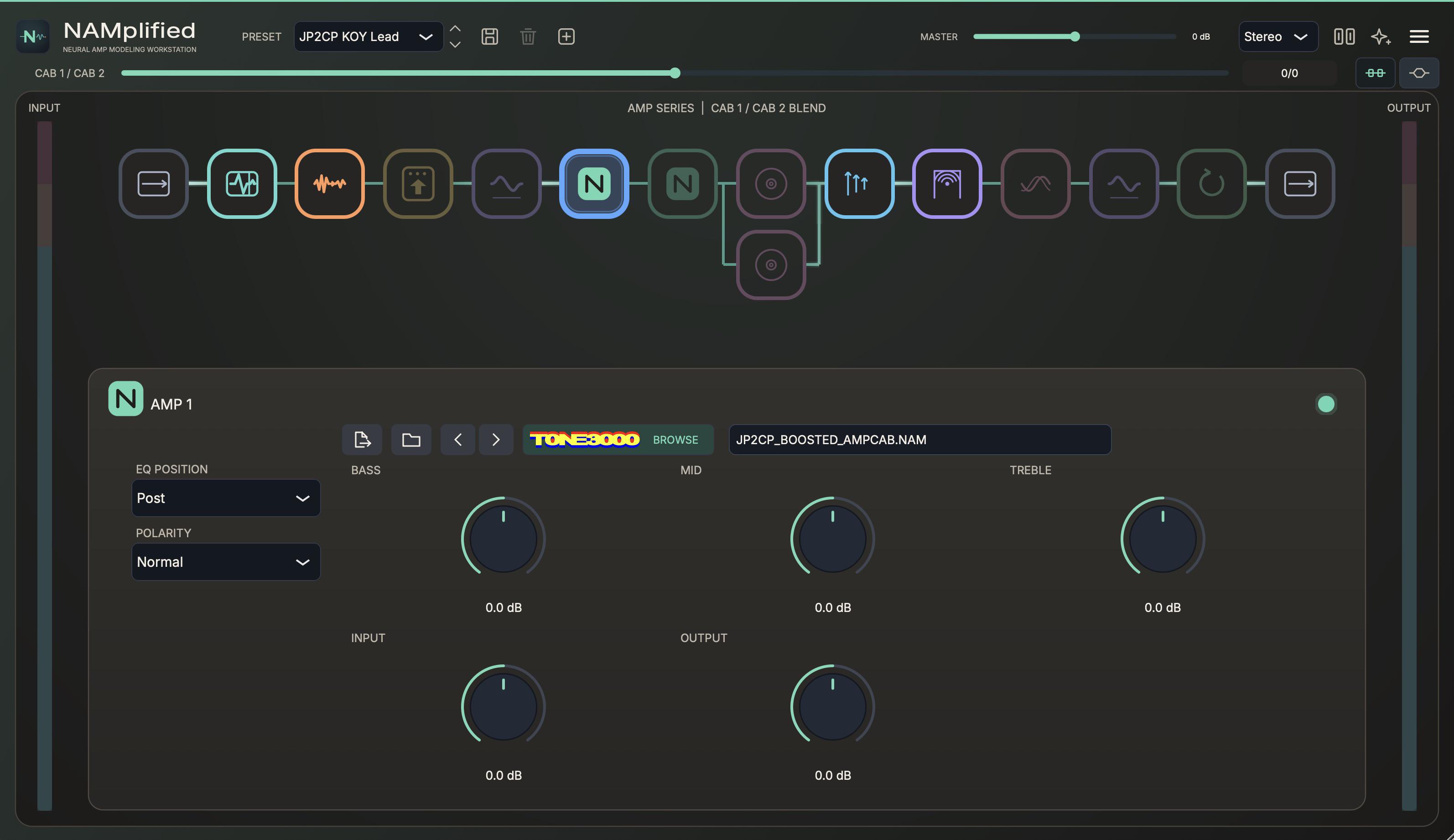
NAMplified 1.1.0 - free DSP plugin

Post image
0 Upvotes

NAMplified 1.1.0 – What’s New

Pitch Shifter: New pitch-shifting effect.
Bug Fixes: Various fixes and stability improvements.

NAMplified – Core Features

Dual Amp Setup: Load two NAM amp captures simultaneously.
Pedal Capture: Load an additional NAM pedal capture.
Flexible Routing: Series and parallel amp configurations.
Amp Mixing: Blend two amp sounds.
Frequency Split: Split low and high frequencies between amps.
Dual Cab IRs: Independent cabinet IRs for each amp.
Capture Browser: Browse and switch between NAM captures without changing your rig.
Built-in Effects: Shape your tone with integrated effects.
4-Track Looper: Record and layer guitar loops.
Preset Builder: Create, customize, and save complete guitar rigs.
Free & Open Source.

Website: https://sedosa-guitar.github.io/namplified-web/


r/NAM_NeuralAmpModeler • • 1d ago

Looking to build my own NAM hardware

5 Upvotes

Hi,

I have been daydreaming about building my own NAM unit so I have full control over the capabilities, design and software.

Any of yous brainstorming about the same thing? I'm curious about your considerations regarding hardware, functionality, ... Perhaps a little community grows from it (or if it already exists someone can point me to it 😉 I know about coyopedal of course).

Cheers!


r/NAM_NeuralAmpModeler • • 1d ago

Discussion Mooer Future Flex: £199 AI Amp Modeler With NAM A2 & Speakers

Thumbnail
guitarbomb.com
3 Upvotes

Mooer Future Flex: £199 AI-powered portable tone workstation with 124+ amps/effects, dual inputs, 15W speakers, NAM A2 support, and stem separation.


r/NAM_NeuralAmpModeler • • 1d ago

MODELING vs PROFILING: NAM A2 contro TRIODE sullo STESSO AMPLI!

Thumbnail
youtube.com
0 Upvotes

r/NAM_NeuralAmpModeler • • 2d ago

ToneRig 1.4.2

Post image
27 Upvotes

Recently pushed this update, pretty proud of the new effects here.

ToneRig 1.4.2 is out!

Five new effects are available in the app and AUv3.

- Bass Chorus adds movement and stereo width while keeping your dry low end intact.

- Triad Comp offers Bus, FET, and Vintage compression with a dry blend.

- Ricochet is a stereo ping-pong delay with repeats that bounce between left and right.

- Plummet shifts your pitch down.

- Glide lets you sweep pitch up or down with an expression pedal.

Improvements

- Set the tuner’s A4 reference from 430 to 450 Hz. ToneRig saves your setting and shares it between the app and AUv3.

- Use up to eight NAM blocks per preset in the app and AUv3.

- Improved tracking and response for Octaver and Bass Synth.

- Linked stereo gain controls are available in Edit, Snaps, and Live. Edit and Snaps also show the preset name and Tap Tempo.

- Preset names and Snap badges are easier to read.

- Audio Settings are simpler, with detailed readings in Audio Diagnostics.

- Fixed a crash when recalling saved Stratosphere plug-in settings.

- Fixed iCloud backup and restore issues, an AUv3 reverb control crash, and AUv3 latency reporting during preset changes.

ToneRig is free to use and Pro version is probably one of the cheapest if not the cheapest out there for this many features of an app. There are more coming for ToneRig.
Feel free to drop feedback and/or suggestions!


r/NAM_NeuralAmpModeler • • 2d ago

Kemper is back with a BIG ANNOUNCEMENT (Interview with Christoph Kemper)

Thumbnail
youtube.com
4 Upvotes

r/NAM_NeuralAmpModeler • • 2d ago

Mesa Mark III Captures

Thumbnail
youtu.be
3 Upvotes

Been messing around with my Mesa Mark III captures again 🤘 This is the Red one from my NAM A2 pack, which is still my favorite. I wrote a little Drop C demo for it using my Harley Benton Custom SC with EMGs.

I put the full mix first, then the rhythm guitars and solo on their own. Backing track is at the end if anyone wants to jam over it.

What do you guys think? I really like how Red sounds on the palm mutes, but I’m curious if you guys like it more for the riffs or the solo.


r/NAM_NeuralAmpModeler • • 3d ago

Vendor Free NAM capture of Matchless HC-30 on Tone3000

Post image
55 Upvotes

Hey all, here's a free capture of our Matchless HC-30 - the head version of the DC-30.

Mark Sampson's best known design, and the amp that put Matchless on the map. Roots in the vintage AC30, but it's very much its own thing - that steely top end with loads of bite and definition but no brittleness, and a low end that's stronger and tighter than a Top Boost. Chords get real authority and you still hear every note.

The EF86 channel is the one we keep coming back to. The compression on it feels completely different to the 12AX7 side.

That's what this capture is - EF86 channel, right at the edge of breakup:

https://www.tone3000.com/tones/matchless-hc-30-ef86-edge-of-breakup-110434

And if you dig it, our Black Week sale is on - up to 67% off everything:

https://amalgamcaptures.com

Hope you dig it.


r/NAM_NeuralAmpModeler • • 2d ago

NAM A2 captures playing in a browser tab. Looking for people to test it.

Thumbnail
reddit.com
3 Upvotes

r/NAM_NeuralAmpModeler • • 1d ago

Vendor [Ad] AXON: NAM A1/A2 player with amps, cabs, IRs and pedals. Black Friday $24.99 (reg $29.99), Mac & Windows

0 Upvotes

Ad / disclosure: I'm Joel, the solo developer of AXON.

AXON loads any NAM capture (A1 or the new A2, with A2 Full/Lite switching) and builds a full rig around it: 13 pedals, built-in amps if you want them, built-in cabs or your own IRs, a 9-band EQ, delay, reverb and a doubler. It adds no latency of its own and has a built-in noise gate.

Formats: Mac AU / VST3 / standalone (Apple Silicon & Intel, macOS 11+), Pro Tools AAX on Mac, Windows VST3 / standalone (Win 10/11 64-bit). One license covers Mac and Windows, no subscription, updates free.

Black Friday: $24.99 (regular $49.99), ends Dec 1. There's a free demo with 3 presets at https://axonguitar.com

Happy to answer questions about how it handles captures.


r/NAM_NeuralAmpModeler • • 2d ago

Looking for a great orange rockerverb capture

4 Upvotes

Hi everyone, I am looking for the best Orange Rockerverb capture, free or paid? Do you have recommendations? thanks a lot


r/NAM_NeuralAmpModeler • • 2d ago

Vendor Integrating NAM on new Plugins

0 Upvotes

I've built a free plugin (https://tonecraftdsp.com/) and I am interested to know if integrating NAM into it would be a competitive advantage ... Or do you think modelling should be 'separate' from NAM?


r/NAM_NeuralAmpModeler • • 2d ago

SoundShed Guitar – Plate reverb and York Audio IR volume

0 Upvotes

After trying several plugins for loading NAM captures, I've settled on SoundShed Guitar, and I'm really enjoying it so far!

I have two questions for those of you who use it:

  1. Plate reverb: Is there really no plate reverb included? I find it a bit surprising that such a commonly used reverb type is missing. Am I overlooking something, or is it simply not available?
  2. York Audio IR volume: I use York Audio IRs, and when I load one into SoundShed Guitar, the volume is extremely high. I end up having to turn down the IR output to get a reasonable level. How do you guys usually handle this? Do you simply lower the IR output, or is there a better way to calibrate the levels?

My general input level is already properly calibrated, so I'm mainly wondering how you manage the output level of your IRs.

Thanks in advance!


r/NAM_NeuralAmpModeler • • 3d ago

irio pro v1.4.0 release - finally with TONE3000 implementation

Thumbnail
gallery
5 Upvotes

Hej,

I'm happy to announce that irio pro v1.4.0 has just been approved by apple - so it will roll out anytime :)

I hope you'll like it!

Also check out the new website:

https://iriopro.com
https://apps.apple.com/app/id6791682190
https://www.youtube.com/@iriopro

- New TONE3000 built in, in the standalone app and the plugin.

- New amp: irio plex, an algorithmic, dynamic amp and speaker in one module

- New pedals: FLOverdrive and naranja phase.

- New modifier: morph, a one-shot A to B sweep.

- New library browser for all files, with folders, filters and drag and drop.

- MIDI notes and clock from other apps on the same device, can target the irio pro app. The plugin stays an audio effect, not an AU instrument.

- midi in: an on-screen keyboard, and module picker has a new MIDI section.

- Mirror: now also works for irio pro running as a plugin in a host app.

- Loop sync: one shared cycle for linked loopers.

- Linked modules: FILES, PAN and TRANSPORT options. Linked loopers and recorders record together.

- New manual with search & chapters.

- Scenes: STAY makes a module ignore a scene change. A switch changes only what differs for smother transitions.

- New knob locks on MIX, FEEDBACK and delay TIME.

- Note values down to 1/64. A synced knob steps through the note values when tapped.

- Seperate assignable looper pads LOOP RECORD, LOOP PLAY and LOOP OVERDUB for foot controllers.

- Subtle master fader on the top meters. LEVEL, MASTER and MUTE on the input and output cards. Level controls go down to silence.

- prime verb: machine II with the classic steps and ranges, machine I with a VINTAGE | CLEAN switch.

- prime clock: a WET | DRY+WET switch to select if INPUT saturates wet & dry or only wet signal.

- rivet comp and duress comp have been optimized.

- irio delay fix: FDBK from 0 to 100 %. Longer feedbacks now possible.

- Clip lights for every peak over 0 dBFS.

- Faster first opens of Presets, Settings and the library.

- When the audio cannot start, irio pro says why and offers TRY AGAIN.

- Plugin: AUTO lanes show what uses them.

- Many fixes and optimizations.

Thanks again for all the great feedback and ideas you have provided :)

Best,

Mads


r/NAM_NeuralAmpModeler • • 3d ago

Going Fully NAM on My HX Stomp No Turning Back :)

Thumbnail
youtu.be
20 Upvotes

All we wanted was NAM A2 on the HX Stomp. We got way more. This week the unofficial HXtra 1.2 firmware goes on my MAIN Stomp: Focus View, model pictures, NAM with IRs, 6 snapshots across banks, virtual footswitches, and more. Plus my take on being called a "prompt junkie" and an "armchair developer. By Eric from Line 6 lol Shout out to HXtra and Nocaseguy for pushing this to reality


r/NAM_NeuralAmpModeler • • 3d ago

Neural Space: Inside the making of a Digital Modeller

Post image
4 Upvotes

I thought I would take some time out to reflect upon my experience in building Neural Space and share it with fellow guitar players and digital modelling enthusiasts. When I was 10, I was gifted a toy guitar by my grandfather, and that’s where my journey started. In the first few years, I would listen to songs on the radio/cassette and try to figure out songs by ear. Years later, we had access to the internet, Guitar Pro tabs, forums, and YouTube videos, and that expanded my horizon into this world of guitar. I still remember the day I walked into a music store to buy my first electric guitar. They had only two guitars - a ’90s Samick Strat and an Ibanez RG. I went ahead with the Strat; it’s still my number 1 guitar to this day. Living in this part of the world also meant that access to good guitar gear and tube amps was limited; stores did not carry them, and if they did, they were out of reach for most of us. I got a Korg multi-effects unit from a college senior, and that’s where my journey into digital modellers started. I have to acknowledge that the reason why I’m able to make an app like Neural Space is because brands like Line 6, Fractal, Kemper, NeuralDSP, and others showed us the way of what good products can do. This learning continues to evolve with the impactful work done by Steven to create NAM, and the good people at Tone3000 to further improve accessibility and ease of adoption of this technology.

If you have worked with a digital modeller, you would perhaps relate to some of this experience - the latency of the product makes you feel uninspired to create anything new, and you end up scrolling through a list of amp models and tweaking them endlessly to make your sound work. Both of these factors, in my opinion, are key to what inspires you to play and create. We need the sound to be instant, like how we hear it when an amp is connected to the guitar in a room; we need to feel those dynamics. I hate to break this to you, but I do not think recreating that is possible. Nothing can recreate the experience of playing through a real amp. What is established, however, is that this little latency gap is the key for you to fully explore and appreciate that true amplifier experience. Is more processing power or better architecture required to close this gap? Aren’t our mobile devices today powerful enough to deliver that compute? Moreover, in the world of AI, why restrict yourself to a list of amps when there can be infinitely more possible amps if a model has truly learned the behaviour of amplifiers? These things made me wonder if there was a better experience that could be delivered. Up until now, I had experience working on Digital Public Infrastructure consulting projects, so this field of music tech was new to me. Of course, as a longtime musician, I knew what I wanted to hear, and I knew how the interface had to be built, but putting it into code meant this would be a challenging journey. At the same time, the guitar effects modelling industry seemed to be changing; with the introduction of NAM, open-source models have established a clear superiority in tone, performing on par with or even better than the gear we’ve been used to. Entering such a highly competitive and changing industry was a difficult decision. I spent the next year making Neural Space.

There are two broad approaches to building a modeller: you either build every part of the app yourself, or you piece together what is open-source (note that some implementations might require you to get a licence from the entity you source the code from). The core decision to be taken initially was whether to build our own tech for Digital Amplifiers or use NAM as a base for the amp modelling. The NAM A1 architecture had already proven its case; after creating and going through hundreds of files, I was convinced that NAM was the way to go. It felt right, it felt accurate, and more importantly, it sounded amazing. Then came the question of whether a mobile or tablet device would be able to keep up with the load and deliver within a sub-3ms latency target. That meant I first had to make a minimalist build to prove that this could even exist as a concept. You’d think that with all the AI assistance on offer, building this from concept to production would be a few hours of work, but reality is far from that. Decisions you have to make range from which AI code aggregator to use and which reasoning models will work best for your case (balancing quality output vs. cost), to continuously reminding your AI tool of the basics so that you do not drift away into making something else. Perhaps all these issues will eventually ease out with better reasoning models in the long term, but in my experience, the more detailed and clear you are about what you want to build - and the more clearly the model understands your requirements - the more accurate and fast the results will be. The real test, however, is in the output of sound, and this is where AI coding agents will disappoint you the most. The more complex your requirements get, the more context is lost by the model; only patience and perseverance get rewarded. When you build things that have not yet been made, the models start to steer in their own direction, making decisions based on guesswork at times rather than facts from the real world. In my case, the model decided that the GPUs of modern-day iPhones and iPads were capable of running NAM. Two months into development, after a lot of trial and error, I got to hear my first amp model. Words can’t express the joy I had, but it was short-lived since I discovered two major issues - I could not go below a latency of 5.33 ms (256 samples / 48 kHz); moreover, with every scroll in the app, the sound would vanish as the GPU could not keep up with the load. It meant that if the chunk of audio did not get processed under 5.33 ms, the audio was lost. The newer-generation iPads could handle the load at 128 samples (better latency); however, the GPU was still struggling to manage the app UI and audio at the same time. The AI model was convinced that if the GPU could not handle the load, there was no way the CPU could handle it. Spending months on development only to find out your core work might not be any good was disappointing. I knew NAM was built in a way that even lower-power chips could handle it, but in the tests I was doing, real-world results seemed to be very different. Perhaps this was one of my biggest learnings: AI models at best give you answers based on probability—trust them for the work they have seen, but their judgements cannot be taken at face value. If I heard that lower-power chips should be able to run NAM, I should trust that statement. I opened my Cursor tab, asked it to move the NAM implementation to the CPU, selected the best reasoning model in the hope that this would work, and voilà, it did. 32 samples, 0.67 ms. The guitar feedback felt instant. Progress at last. That was the day I finally felt this project could be a reality.

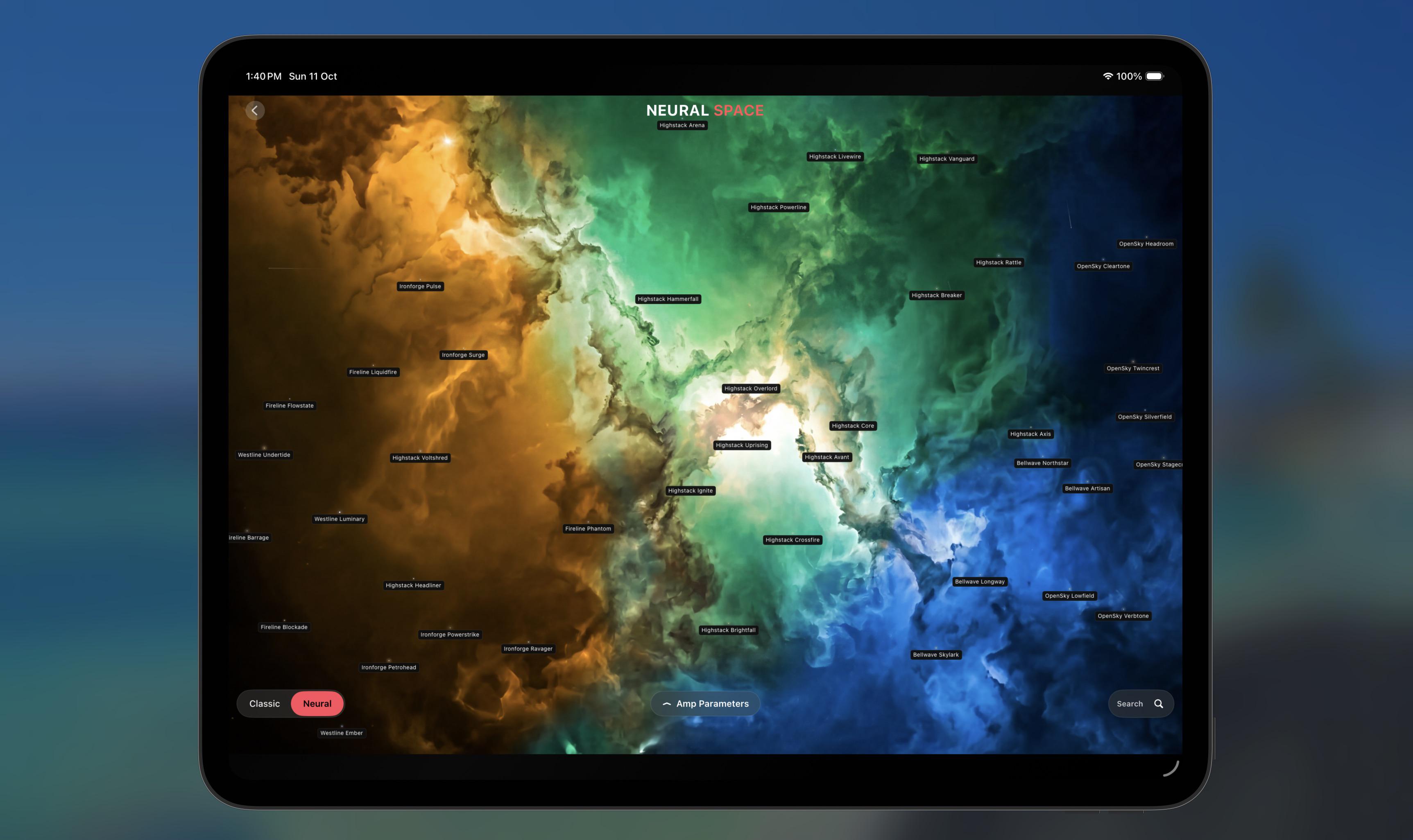
So why call it Neural Space? In my mind, if you are truly able to model a significant number of amplifiers, you could place them on a map by their similarity and spaces in-between these amplifiers would also exhibit amplifier behaviour. Imagine if these amplifiers, which look like planets, are placed on a map. The visual of the map you see here is what turned out after the analysis: the clean amps are placed in blue, mid-gain amps are placed in green, and high-gain amps are placed in gold. Now imagine the space in between those planets. Do those spaces also represent amplifier behaviour? Are they new amplifiers that do not exist in the real world, but only exist virtually? More importantly, what will those spaces sound like - their nearest neighbours, or entirely new hybrids? I had a lot of questions, and the only way to find out was to build and test it out. Let’s now understand more about the core amplifiers in Neural Space. Imagine a bunch of numbers in a sequence representing an amplifier; let’s say 20,000 numbers are enough to represent amplifier behaviour. Now, in the same format, another 20,000 numbers might represent another amplifier. Now, the question to solve was: what is the right approach to making this map? Do we reduce the dimensions to learn the most important features and then try to fill the space in between these planets? Or should we average out these numbers based on the distance from the nearest planets? Another option was to create a hypernetwork, a neural network of neural networks (our amp models). There could be many recipes for the map, but making 16 million grid points on a map sound good was going to be a challenging task. I must have gone through eight versions of the map, all coming up with a different way to fill that void; two approaches in particular made more sense to me. The Classic mode of the map lets you mix the audio in a traditional way guitar players are used to—the nearest amps contribute to making the amp in the empty spaces, and you can filter out the planets, which lets you create your own custom map/tones. The Neural mode populates the weights of the neural network as you click the empty space. Imagine moving from Amp A to B on a map: you also move the numbers that represent the amplifiers in the same way, and the weights of the network move in that same direction. I assumed that would retain the amplifier behaviour. Working on the weights and biases of the neural network can dramatically alter the tone; there are tight limits under which the output is musical. Now, in theory, it might seem that the natural output for spaces in between the map would be a mix of the nearest planets (amps). This was true, but only for planets that were placed very close together on the map. For amps that were far away from each other, you would notice a slight decrease in power amp character if you moved away from the amps. The results in some of these tests were promising. I felt good about the sound, though I felt the results were nothing special. You see, the reason planets sounded distinct was because they had a lot of character in them; the farther I moved away from them, that unique character we look for in an amp faded away. So the question was: where and how do we inject that character? I started experimenting with the weights of the amp models; one particular way of moving these weights led to creating a new parameter called Gravity. Turn it up and the amp suddenly felt more alive, connected, like a special gain button. The effect of Gravity is different on NAM A1 and A2 profiles since they differ in their structure. Gravity paired with any point on the Neural mode of the map felt good.

When you look at building a modeller from an independent developer's perspective, you are constantly thinking about the ways in which you can differentiate the product. The truth is that NAM has made this industry a level playing field. The value addition is probably not in the core offering of amp modelling itself, but in the functionality built around it. The next few months went into making the effects for the app: noise gates, drives, overdrives, fuzz, User NAM + IR with Tone3000 integration, delays, reverb, modulation, and pitch blocks were added. Some particular features I wanted to add were the ability to record audio and video, play and record alongside backing tracks, automate patch changes, and include MIDI controller support. I also added a Match EQ effect - drop an isolated guitar track of the tone you want to replicate, record a few seconds of playing through it, and you should get a close-enough EQ match to the reference guitar track. Some of these learnings from Match EQ went into the creation of a Pickup Shaper block. You will be surprised how small EQ changes right at the start of your signal chain create a massive difference in tone in the later stages. The idea of the Pickup Shaper was to learn the wiring of different guitars - the pots, the pickups, and the pickup selector positions - and model them to shape the output of the pickups. I’m not claiming your Les Paul will sound like a Strat, but you’ll notice changes in clarity and tone for the better. In my experience, my old Samick Strat pickups ended up with more clarity, the sound was closer to a Strat, I could work with more amp models, and sometimes it became my default way of working.

I want to spend the next few months listening to your experience with the app. I’ve decided to release an early version which is still rough around the edges. For a while, it will be a free download, and I will continue to keep it free until I feel the build is stable. The App is scheduled to release on the App Store soon, I will update the link here once it’s available. For all updates, please follow our Instagram page.


r/NAM_NeuralAmpModeler • • 3d ago

Best way to match volume levels between clean and high-gain NAM captures?

1 Upvotes

​

Hi everyone!

I have a question about gain staging and volume matching when using NAM captures.

I've noticed that some clean amp captures, such as a Fender '65 Deluxe Reverb, sound noticeably quieter than crunch or high-gain captures, such as a Marshall JCM800.

I understand that this can be related to differences in compression, dynamics and the original capture levels.

My question is: What is the best way to compensate for these volume differences?

Should I simply increase the output volume of each individual amp capture to achieve a consistent perceived loudness?

Should I use a compressor before the NAM capture (for example, an Xotic SP Compressor) to increase the perceived volume and even out the dynamics of clean tones?

I'm particularly interested in understanding the best approach to maintain the original character and dynamics of each amp capture while keeping consistent volume levels when switching between different amps.

I'd appreciate hearing how you guys handle gain staging and volume matching in your NAM setups, especially when combining clean Fender-style amps with Marshall-style crunch tones.

Thanks!


r/NAM_NeuralAmpModeler • • 3d ago

Vendor [Vendor / Ad] Royalish NAM: 2 free Tone King Royalist captures (212 + DI) and a new 36-capture pack

0 Upvotes

Vendor post / advertisement: I am Matt from Mattfig, and this is my own capture pack. The two samples below are free; no purchase required.

Hi, Matt from Mattfig here—I made two free NAM A2 captures of a Tone King Royalist for you to try. Both are Channel 2, 1967 voicing, low gain.

212 studio (amp + cabinet + microphone response): https://www.tone3000.com/tones/tone-king-royalist-2x12-celestion-1660-112860

This uses a 2x12 loaded with Celestion 1660 speakers. Leave your separate cab IR off for a first listen.

DI amp-only: https://www.tone3000.com/tones/tone-king-royalist-112862

Use the DI with your favorite cabinet IR, or through an appropriate power amp and real guitar cabinet with the IR off. No purchase is required for either sample.

Creator disclosure: these are samples from my new Royalish NAM pack. The full pack has 36 captures: Channels 1 and 2, 1964/1967/1970 voicings, and low/mid/high gain in both 212 and DI formats (18 of each). It is $18.99: https://www.mattfig.com/product/fig-a2-royalish-nam-capture-pack

The store's Black Friday offer takes 50% off 2+ eligible individual packs automatically at checkout through December 3. Everything Packs and premade bundles are excluded.

Use a player that supports NAM A2 models. I'd love to hear which cabinet IR you pair with the DI and how the samples feel with your guitar.