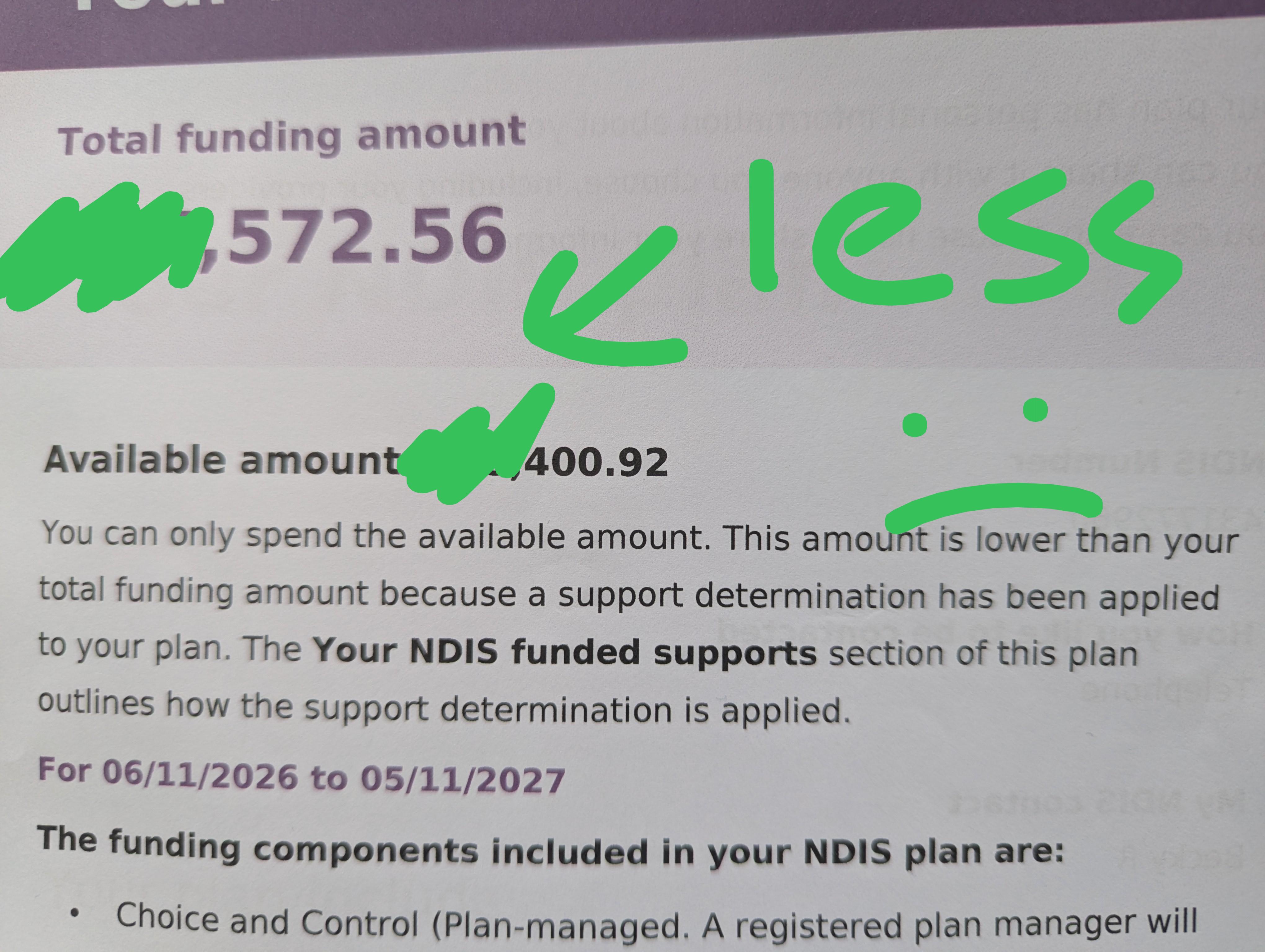
I wrote this for my local area reddit… so apologies for the “how NDIS” works explainer. But I’m hoping we can get this kind of comparison out there a bit so the media picks up on it.
I am grateful for the NDIS. I believe in measures to make it sustainable and target fraud. But today’s announcement makes ZERO sense.
AI disclosure - used to turn my anxiety, fear and exhaustion into a slightly more comprehensible format. happy to supply the original.
I’m not an NDIS provider trying to protect my business. I’m a low-income parent raising a child with disability and complex medical needs.
For anyone unfamiliar with how the NDIS works, there are three ways a participant’s funding can be managed:
- Agency-managed: The NDIA pays registered providers directly.
- Self-managed: The participant (or parent) is responsible for, paying invoices, claiming funding and maintaining records.
- Plan-managed: An independent plan manager handles invoices, payments and budget tracking on the participant’s behalf.
That third option is what the government is now proposing to restrict to a small panel of providers, reportedly as few as 20 companies nationally and they’re selling it as a fraud prevention and cost-saving measure. But… Plan management is not support coordination.
SC involves helping participants find and organise services. There are opportunities for conflicts of interest, inappropriate referrals and unnecessary billable hours.
Plan management, on the other hand, is essentially financial administration. It has its own funding category in an NDIS plan, with a standardised monthly fee. Yes bad providers can let dodgy invoices through - but PM’s don’t ordinarily earn more money because a child has more therapy appointments or because another provider charges more.
So why is the solution to eliminate almost the entire plan-management market rather than improve auditing, invoice verification and conflict-of-interest controls?
And why should we assume that 20 large, government-selected companies will be more trustworthy than hundreds of smaller operators?
Haven’t we learned anything from Workforce Australia?
We’ve already built an enormous privately operated employment-services industry, funded by taxpayers, to supposedly assist people receiving Centrelink payments into employment.
It’s a system in which providers are financially rewarded for particular outcomes, including employment placements. There have been longstanding criticisms of poor-quality services, excessive compliance activities and providers claiming outcomes for employment jobseekers largely secured themselves.
Parliamentary inquiries and the Australian National Audit Office have raised serious questions about effectiveness, procurement and value for money.
Yet here we are, proposing another restricted market of government-selected private intermediaries.
Make everyone bloody agency managed and do the work internally - while that would suck for people it wouldn’t be basically creating a new industry for Big Businesses to get Big Bucks from government contracts.
My child’s weekly NDIS-funded appointments cost around $420. Medical appointments outside the NDIS add another $110 or so in gap fees. At least Medicare generally reimburses promptly. I cannot casually absorb hundreds of dollars in therapy costs while waiting for reimbursement. Many providers have been burned by self-managed participants paying late or overspending their budgets, and some reject them outright.
And it’s not just about money.
My child has an established team of specialised practitioners, including occupational therapy and physiotherapy. They’re small Canberra businesses, employing people who have built relationships with the children and families they support.
These aren’t faceless multinational organisations. They’re people who know my child, understand his history and work collaboratively with the rest of his treating team. Plan management allows a way in which I can keep these providers connected in my child’s life
Canberra is also an expensive place to provide services. Commercial rent, staffing and operating expenses don’t magically become cheaper because the NDIA sets a national price limit.
And I’m not interested in losing effective, established therapeutic relationships simply because a different provider fits more neatly into the government’s administrative model.
My current plan manager also provides something that doesn’t appear on an invoice: practical knowledge.
Recently my child’s dietitian recommended a particular high-calorie nutritional formula. There was an unused $300 consumables budget in his NDIS plan, and I wondered whether it could cover the cost.
My plan manager explained why it couldn’t.
Not a complicated sales pitch, not an attempt to find a creative way to bill the scheme. Just an explanation of the rules, the distinction between medical and disability-related supports, and what evidence or changes would be required before eligibility could be reconsidered.
That’s what responsible plan management can look like. Someone who helps prevent inappropriate expenditure rather than facilitate it.
And what happens to the sole trader or small plan-management businesses, their employees and the families who rely on them?
Australia’s unemployment rate has just reached 4.9%, its highest since October 2021. What a peculiar time to deliberately dismantle much of an established small-business sector.
Between therapy homework, school homework, medication management, nutrition, medical appointments, communicating with multiple providers, trying to remain employed and keeping an actual household functioning, I’m already operating at capacity.
When my child finally falls asleep, sometimes that’s my first opportunity to cry from sheer exhaustion.
My plan manager takes a small but essential administrative responsibility off my shoulders.
I don’t want the NDIS to become another Workforce Australia. This plan management change makes ZERO sense.