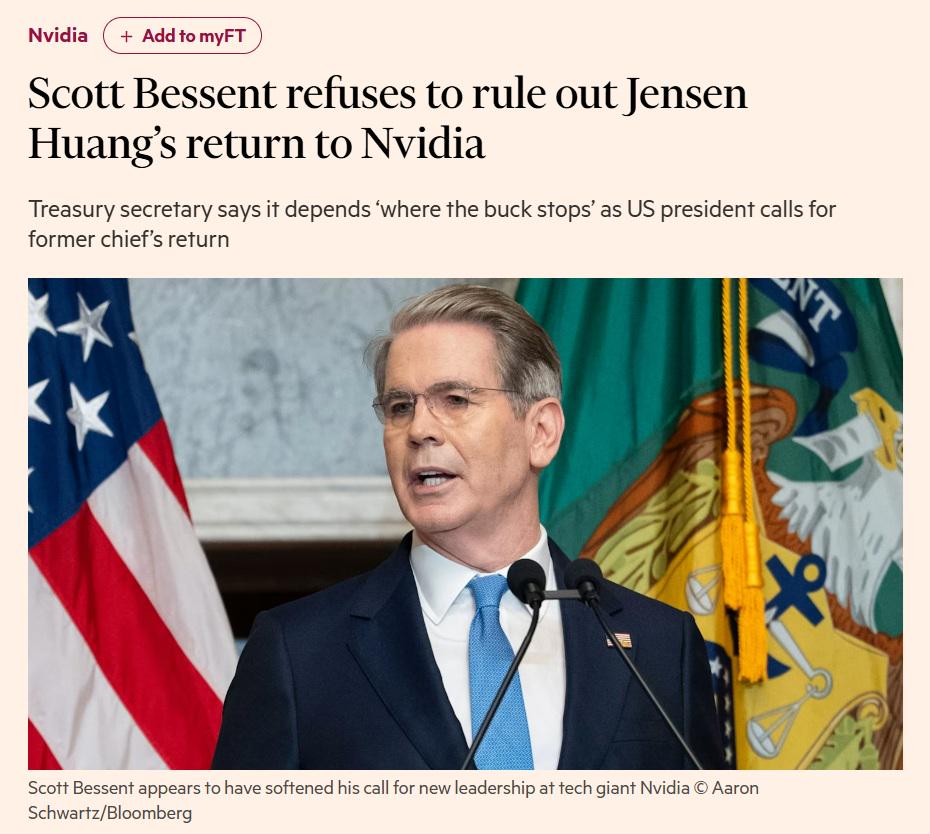
Wild theory: Was the Jensen Huang scandal deliberately timed to create a political and financial narrative around the AI market?
I want to float a theory. I have absolutely no proof of this, and I'm not claiming it's what happened. But looking at the sequence of events, I think there are enough unanswered questions to warrant some discussion.
What if the Jensen Huang scandal wasn't simply an unfortunate personal and corporate governance story, but was also politically useful to someone in Washington?
Consider the following sequence:
The administration reportedly knew about the alleged relationship and potential espionage concerns long before the story became public. If intelligence officials had information dating back to 2025, why did it surface publicly when it did?
The timing is interesting. With Republicans suffering a major midterm defeat, the administration has a political incentive to change the economic narrative and find ways to shift attention away from its own economic performance.
The affair and espionage angle create a perfect storm. Instead of simply being a personal scandal, Jensen's relationship becomes a national security issue. That puts pressure on NVIDIA, its board, and potentially Jensen himself.
Jensen's departure creates uncertainty around the most important company in the AI ecosystem. NVIDIA isn't just another technology stock. Its valuation and outlook are closely tied to the broader AI investment narrative.
Then comes the circular financing discussion. Questions about NVIDIA's investments in AI companies, those companies buying NVIDIA hardware, and the sustainability of the broader AI infrastructure spending cycle become much louder. What might previously have been dismissed as ordinary ecosystem investment suddenly looks like a potential systemic risk.
Markets begin questioning the entire AI boom. A scandal involving the industry's most prominent executive, national security concerns, accounting scrutiny, and circular financing allegations all reinforce each other.
Now consider the political angle.
What if someone within the administration saw an opportunity to use the information they already possessed to create or amplify a crisis? A deteriorating market could then be used to construct a political narrative about economic instability, corporate misconduct, China, and the failures of previous policies.
There is an important distinction here: I'm not necessarily suggesting Trump personally orchestrated this, or that the administration deliberately engineered an AI crash. Information could have been selectively leaked by people with their own political or institutional objectives, and the administration could subsequently exploit the fallout.
The questions I'd really like to discuss:
Who originally leaked the intelligence concerning Jensen's alleged relationship?
Why did information reportedly known to the administration for so long become public at this particular time?
Was the SEC already investigating NVIDIA's accounting and financing arrangements before the scandal became public?
Did Jensen's relationship with the administration or disagreements over China policy play any role?
Could the scandal have been used to accelerate scrutiny of an AI ecosystem that was already showing signs of excess?
And, perhaps most importantly, who actually benefits politically from the resulting market uncertainty?
I recognize that this is speculative, and there are perfectly reasonable alternative explanations. Jensen's personal conduct and NVIDIA's corporate governance issues may be entirely unrelated to political maneuvering.
But I find the timing and convergence of these events interesting enough that I don't think the political dimension should automatically be dismissed.
Am I connecting dots that aren't there, or is there a plausible scenario in which this information was deliberately released or amplified for political purposes, with the resulting market turmoil becoming a useful side effect?