Tom Price (U-Men):
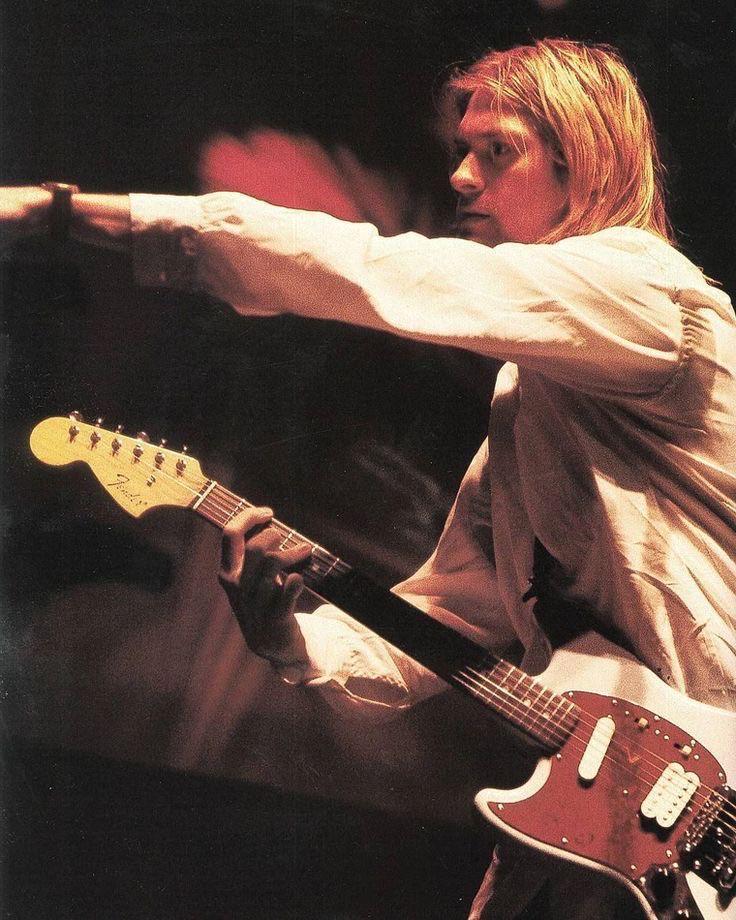
At some point in the early 1990s, I was just sitting at home on Capitol Hill. There was a knock at the door, and standing there were two nice guys from Monk magazine whom I had met around town before. They had just walked uphill from Fallout (where I was working at the time) and explained that they were looking for a couple of guitars for a photo shoot with Kurt Cobain, and someone had suggested they ask me. I felt a little bad that I only had right-handed guitars (I'm left-handed, but play right-handed; Kurt played left-handed), but I was happy to lend them my blue Fender Mustang and a vintage, surf-style Framus Strato Deluxe.
A couple of hours later, the guys from Monk came back, saying that the shoot had been a lot of fun and that Kurt had asked them to thank me for the guitars. They told me that he had been amused and impressed by the Framus - a rather bulky German guitar with lots of little buttons, switches, and other gadgets, plus a funny felt string-muting strip and a nice tremolo arm.
The blue Mustang appeared on the cover of Monk's "Seattle issue," and later, to my surprise, the Framus appeared with Kurt on the cover of - get this! - Newsweek magazine. You can't see it very clearly in the photo, but it's definitely the right-handed Framus. I assume Kurt kept it after the Monk photo shoot.
Heavier Than Heaven, Chapter 19, p. 20:
During the second week of November, Kurt took part in a photo shoot for Monk magazine, for which he was to appear on the cover of the Seattle issue. He arrived alone at Charlie Hoselton's studio and, unlike most photo shoots, was completely cooperative with the photographer.
"Let's make a deal," Kurt told Hoselton. "I'll stay as long as you want and do whatever you ask me to do. But you have to do two things for me: turn off the phone and don't open the door if anyone knocks."
Courtney had already called the studio five times looking for him. The editors of Monk persuaded Kurt to dress up as a lumberjack and pose with a chainsaw. At one point during the shoot, Kurt ventured outside. And when Hoselton asked him to pose in front of the espresso machine, Kurt went a step further - he moved the barista aside and made the coffee himself.
Photographer Charlie Hoselton recalled:
Fall 1992, a photo shoot for Monk magazine. The magazine's editors brought along a lumberjack outfit, complete with a chainsaw, and Kurt agreed to pose with it. At one point during the shoot, Kurt said he wanted a latte... He offered to work as the barista.
He made a cup of coffee for every one of us.
Jim Crotty, journalist and one of the editors of Monk magazine:
As Charles R. Cross notes in his biography of Kurt Cobain, during the second week of November, Kurt took part in a photo shoot for Monk magazine, for which he was to appear on the cover of the Seattle issue. Kurt arrived alone at Charlie Hoselton's studio and, unlike most photo shoots, was completely cooperative with the photographer.
"Let's make a deal," Kurt told Hoselton. "I'll stay as long as you want and do whatever you ask me to do. But you have to do two things for me: turn off the phone and don't open the door if anyone knocks."
The editors of Monk persuaded Kurt to dress up as a lumberjack and pose with a chainsaw. At one point during the shoot, Kurt ventured outside. And when Hoselton asked him to pose in front of the espresso machine, Kurt went a step further - he moved the barista aside and made the coffee himself.
The photo shoot resulted in the now-legendary and eerily prophetic cover featuring Kurt Cobain, Jim Crotty, and Michael Lane hanging from a cracked Space Needle. The crack in the Space Needle was part of the cover concept: it symbolized Seattle as a city of drugs and, as the author later came to feel, eerily foreshadowed Kurt's own death in that city.
After that famous photo shoot, Kurt asked Michael if he could give him a ride "home."
However, my colleague from Monk ended up driving Kurt around to several locations in downtown Seattle. At each stop, Kurt got out of the car, disappeared for a few minutes, and then returned. After the final stop, Michael noticed a change in him: Kurt was smiling, looked relaxed, and seemed at peace.