r/NonClinicalDoctors • • Oct 18 '26

Subscriber Goal Welcome to r/NonClinicalDoctors!

2 Upvotes

Welcome to r/NonClinicalDoctors

456 subscribers / 500 subscribers. Help us reach our goal!

Visit this post on Shreddit to enjoy interactive features.


r/NonClinicalDoctors • • 12h ago

Only looking for doctors who personally transitioned into non-clinical careers after MBBS/MD – Please share your journey

4 Upvotes

Hi everyone!

I’m an MD graduate exploring non-clinical career pathways, and I’m specifically hoping to hear from people who have personally completed this transition after obtaining their medical degree.
I’m not looking for general career suggestions or opinions from others not in the same path.

I’d love to know:

  1. Which country and university did you complete your MBBS/MD at?
  2. What year did you graduate?
  3. How long after graduation did you start your master’s? 5. 4. Did you take a gap year or gain work experience first?
  4. What master’s degree did you pursue, and at which university and in which country?
  5. Why did you choose that particular field?
  6. What was your experience during the programme? Did your medical background help?
  7. What are you doing now? Did you successfully secure a job related to your master’s?
  8. How long did it take you to find your first relevant job after graduation?
  9. What is the job market, salary and career progression like in your chosen field?
  10. Looking back, would you make the same decision?

Please respond only if you’ve personally gone through this journey. I’d genuinely value honest experiences, including unsuccessful attempts, challenges, and things you wish you had known beforehand.
I’m trying to make an informed decision about my next step after medicine, so real-life experiences would mean a lot.
Thank you!


r/NonClinicalDoctors • • 1d ago

How to create a portfolio from scratch when you have zero prior non-clinical experience (from someone who made the switch)

5 Upvotes

One of the biggest Catch-22s when leaving clinical practice is the portfolio trap: every non-clinical role, whether in medical writing, health tech, pharma comms, or patient education asks for writing samples and measurable impact, while all you have on your CV are clinical rotations, patient notes, and maybe a few academic papers.

When I transitioned from clinical work into healthcare content strategy and medical writing, I didn't have a single non-clinical job or agency credit to my name.

Today, I have several of my ghostwritten pieces rank at the top of Google for competitive healthcare queries.

If you're staring at a blank Google Drive trying to build a portfolio from zero, here is the exact framework I used to create mine before landing paid work 3 years back:

  1. Pick 3 real-world formats:

Hiring managers in life sciences, wellness, and medical education don't want to read a 3,000-word academic literature review. They want to see if you understand the actual deliverables their business uses. Create one sample in each of these three formats and label them clearly as portfolio samples.

2. Structure your samples for search intent, not academic grading:

In clinical training, we build up to the conclusion at the end. In digital healthcare content, the reader leaves in 5 seconds if you bury the answer.

Use clear, scannable subheadings, bullet points, and bold takeaways. Lead with the direct answer in the first two sentences, then back it up with peer-reviewed evidence.

3. Use "pro bono" micro-projects to get live metrics:

If you want real engagement numbers before landing a full-time role, look right in front of you. Offer to revamp the patient-education posts, website FAQs, or Instagram infographics for a local clinic, a small health startup, or a healthcare community page.

Document the "before and after." Even if it's a small clinic page, being able to put on your resume that you built a monthly content calendar, translated clinical guidelines into infographics, and grew reach or impressions gives you concrete, verifiable metrics to talk about in interviews.

4. Host it cleanly (and never worry about NDAs):

You don't need a fancy custom-coded site to start. A clean, well-organized Google Drive folder, a Notion page, or a simple WordPress/Medium hub works great.

One thing that tripped me up early on was applying with a traditional clinical CV format, which gets filtered out immediately by pharma and health-tech applicant tracking systems. Before sending out your portfolio links, strip out the clinical words and run your resume against the actual non-clinical job description.

I recently used a free healthcare-specific resume builder and AI ATS scorer called Jobslly to check how well my resume scores.

For anyone currently trying to put their first non-clinical portfolio together: what role are you aiming for (medical writing, medical affairs, health tech, pharma marketing), and which sample format feels hardest to start?

Happy to share feedback on how to structure your first few pieces!


r/NonClinicalDoctors • • 3d ago

Did you know about these upcoming healthcare career events?

Post image
1 Upvotes

A lot of healthcare professionals spend years preparing for exams, building clinical experience and looking for jobs, but don't always get exposure to career options beyond the conventional path. Healthcare career webinars and networking events can be surprisingly useful for understanding what's out there before committing time or money to a new direction.

One upcoming session worth checking out is "Transition into High-Paying Non-Clinical Careers for Healthcare Professionals" (28 November, 5-7 PM IST). If you're an MBBS graduate, pharmacist, or other healthcare professional curious about Medical Affairs, clinical research, drug safety, or corporate healthcare roles, this session could help you understand alternative career paths, the skills employers look for, and how to make the transition without starting your career from scratch.

Another one is DentalHackers 2026 (16-24 December), particularly relevant for BDS, MDS students, graduates and practising dentists. It's an opportunity to test your knowledge, explore ideas and compete for prizes, including ₹21,000 for the winner, ₹11,000 for the runner-up and ₹5,100 for third place, along with course rewards worth ₹20,000 for the Top 10 and paid internship opportunities for 11 participants and a grant pool of up to 1 cr.

Events like these can help you look beyond routine practice, connect with others in the dental ecosystem and gain fresh perspectives on where dentistry is heading. Honestly, attending the right event can sometimes give you more clarity and the right mindset to achieve career success.


r/NonClinicalDoctors • • 5d ago

Doctors moving into non clinical jobs, please don't overlook communication skills

Post image
2 Upvotes

Being an advocate of linguistic nuances and English communication for over a decade now, I've worked with students across age groups, nationalities and proficiency levels. One pattern I've noticed repeatedly is that knowing something and being able to communicate it effectively are two very different skills.

There's a quote often attributed to Einstein (though its attribution is disputed) that I quite like:

"If you can't explain it simply, you don't understand it well enough."

I think there's more truth to this than we realise, particularly in professional settings.

I've seen people with excellent subject knowledge struggle to articulate a simple point, while others with comparatively less knowledge could structure an argument, hold a conversation and get their message across remarkably well. It's rarely just about vocabulary. More often, it's about organising thoughts, audience awareness and knowing how to say something.

This is particularly relevant to doctors moving into non clinical roles.

In clinical practice, you're accustomed to a certain register and terminology. But in Medical Affairs, Clinical Research, Medical Writing, HEOR or Pharmacovigilance, your audience changes. You may have to explain the same scientific concept to a clinician, a business stakeholder or a cross-functional team, each requiring a different level of detail.

That's essentially audience adaptation. Knowing when to simplify without diluting accuracy is a skill in itself. Then there's cognitive load. If your explanation is packed with acronyms, jargon and unnecessarily complex sentences, the listener spends more effort decoding your language than understanding your message.

Even small things such as discourse markers ("the key concern here is...", "what this means in practice...", "there are two implications...") can make you sound more structured and easier to follow. After training people for years, I've realised that communication isn't about sounding impressive. It's about reducing the effort required for someone else to understand you.

Doctors exploring non clinical careers should probably work on this alongside their technical upskilling. I've been looking at pathways offered by Academically in areas such as Medical Affairs and Clinical Drug Development, and several MBBS, PharmD and BDS graduates and professionals who've shared their experiences have mentioned how industry expert sessions helped them better understand the field and hone their professional communication and workplace skills.


r/NonClinicalDoctors • • 6d ago

[Hiring - US Only] Heme/Onc Physicians for Remote Clinical AI Training ($100–$180 USD/hr, Async)

0 Upvotes

Micro1 is onboarding US-based MD/DOs with a completed fellowship in Hematology/Oncology (or subspecialties) for asynchronous, remote clinical AI evaluation (~50 spots).

  • Pay: ~$100–$180 USD/hr (1099, exact rate listed per track)
  • Schedule: 100% remote & async, no minimum weekly hours
  • Work: Clinical case & AI reasoning review (zero patient care or clinical liability)
  • Eligibility: United States-only; fellowship-trained (board-certified or board-eligible)

Apply directly via your subspecialty link (no need to DM):

(Disclosure: These are referral links; I earn a bonus if you are onboarded, at no cost to you.)


r/NonClinicalDoctors • • 6d ago

The Next Emerging Career in Pharma Isn't just Clinical Research or Pharmacovigilance. It is...

2 Upvotes

When pharmacy graduates think about non-clinical careers, Clinical Research and Pharmacovigilance are usually the first options that come to mind. But have you explored Competitive Intelligence (CI)?

Competitive Intelligence is gaining attention in the pharmaceutical industry. It involves analyzing competitor drugs, monitoring clinical trials, tracking new drug approvals, researching market trends, and understanding competitors' strategies.

As pharmaceutical companies expand their products and enter new markets, professionals who can conduct medical research, analyze industry data, and identify market opportunities can add value.

Pharm.D, B.Pharm, and M.Pharm graduates can pursue roles such as Competitive Intelligence Analyst, Pharma Market Research Analyst, and Business Intelligence Analyst by building strong research and analytical skills.

While exploring emerging non-clinical pharmacy jobs in India, I came across Jobslly, a healthcare job portal, and started discovering pharmaceutical career opportunities beyond traditional clinical roles.

Have you considered Competitive Intelligence as your next career move?


r/NonClinicalDoctors • • 7d ago

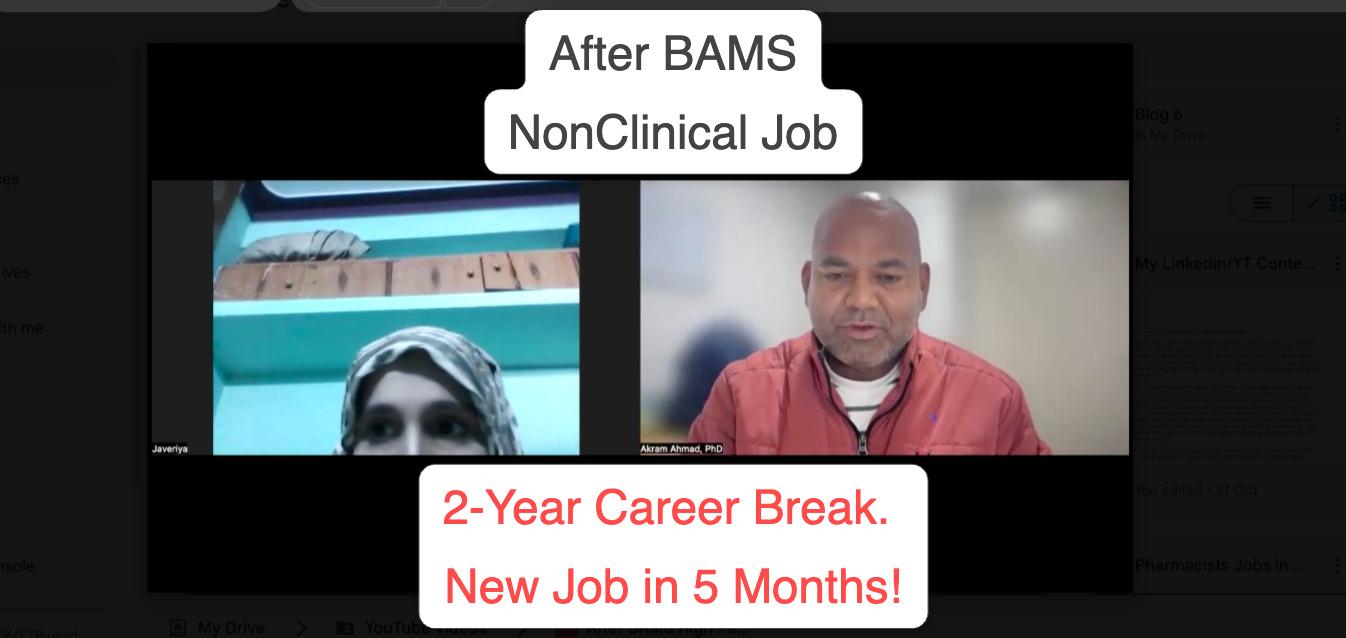
BAMS Doctor Career Success Story: From 2-Year Career Break to Non-Clinical Job in 5 Months | Academically Global

Post image
2 Upvotes

She wanted to become a doctor. Life had other plans. But her career didn't have to end there. ❤️

Dr. Javeriya, a BAMS graduate from Maharashtra, had a dream of building a career in clinical practice.

After marriage, she moved to Hyderabad with her family. Like many young doctors, she started working as a duty doctor, often called a night-duty doctor.

Long shifts. Around 12 hours of duty. Low salary. Very little recognition.

She had studied hard, earned her medical degree and wanted to make a difference. But the reality of her early career was far from what she had imagined.

Then life took another turn.

After marriage, she took a two-year career break. When she decided to return to work, she had one question:

"What can I do now? Is there still a career waiting for me?"

She wanted to work again, rebuild her confidence and contribute financially to her family.

One day, she came across one of my Instagram reels.

That reel introduced her to an alternative career pathway beyond traditional clinical practice.

She connected with Academically Global and enrolled in our Executive Program in Clinical Drug Development (EP-CDD).

She learned, worked on building relevant skills and started exploring non-clinical opportunities.

And within five months, she landed a job!

🎉 Her new role: Claim Processing Executive
🏢 Company: Good Health Insurance

Think about what this means.

A doctor who once felt uncertain about restarting her career after a two-year break is now working again, earning and moving forward with renewed confidence.

Her BAMS degree still has value. Her career break did not define her future. And clinical practice is not the only professional pathway available to healthcare graduates.

To every BAMS doctor reading this:

If you are struggling with low-paying clinical jobs, long duty hours, limited recognition or a career break, please don't assume that you have run out of options.

There are alternative career pathways in healthcare, including:

Health insurance and claims processing

Clinical research

Pharmacovigilance and drug safety

Medical writing

Medical coding and healthcare documentation

Healthcare operations

Medical affairs and other industry roles

Eligibility and job requirements vary by role, employer and qualification, but it is worth exploring the possibilities.

Your degree is not the end of your journey. It can be the beginning of a different one.

Dr. Javeriya, congratulations! We are proud to be a small part of your journey. Wishing you continued success. ❤️

If you are a BAMS/BUMS/BHMS doctor looking to explore non-clinical career opportunities, connect with Academically Global to explore suitable pathways.


r/NonClinicalDoctors • • 8d ago

My father was a farmer. He gave me something money could never buy: the courage to dream big.

44 Upvotes

My father was a farmer. He gave me something money could never buy: the courage to dream big.

I was born in Sahaswan, a small town in Uttar Pradesh, India.

My father was a farmer. We came from a humble background, but he never allowed our circumstances to limit our dreams.

He worked hard, made sacrifices and always believed in the power of education.

Today, I am a pharmacist, hold a BPharm, PharmD and a PhD from the University of Sydney, Australia, and have built an international career.

But whenever I look back, I realise that this journey was never mine alone.

It carries my father's hard work, my parents' sacrifices, their duas and Allah's blessings.

I have travelled across countries, achieved academic milestones and built a career, but I will always be proud of my roots.

One lesson life has taught me:

Never forget the people who sacrificed their comfort to give you opportunities.

If your parents are still with you, respect them, spend time with them and make them part of your achievements.

To every young person reading this:

Dream big. Invest in education. Work hard. Your background does not have to determine your destination.

I would genuinely love to hear your stories:

What is one sacrifice your parents made that you will never forget?

A farmer's son, raised with values, educated through sacrifice and guided by his parents' duas.

Forever grateful. ❤️

.

#Father #Parents #Education #PersonalGrowth #DreamBig #IndianStories #FromHumbleBeginnings #MuslimFamily #Gratitude #HardWork


r/NonClinicalDoctors • • 8d ago

FMGE vs AMC vs Non-Clinical Careers: Let's clear this confusion once in for all

2 Upvotes

One thing I have noticed among foreign medical graduates is how easily we start treating FMGE as the only measure of our career prospects. You prepare, attempt the exam, check the result, and if things don't go your way, the immediate reaction is usually to prepare harder and repeat. There is nothing wrong with that. Clearing FMGE matters if your goal is to practise medicine in India. But should one exam attempt decide how you look at your entire career? I think it is worth looking at three different directions.

FMGE is the route to consider if you completed your primary medical qualification abroad and want to pursue registration and clinical practice in India. A repeat attempt is not a failure of your medical education. But be honest about your preparation strategy. Identify what went wrong, work on weaker subjects and set a realistic timeline rather than repeating the same routine indefinitely.

The Australian Medical Council pathway is worth looking into if you want to explore clinical practice in Australia. It involves its own eligibility, assessment, examination and registration requirements, so it is not an easier alternative to FMGE. It is simply a different pathway with a different destination.

The best AMC exam preparation course will always have AHPRA registered doctors who train people and ample resources like AI mock tests, handouts, etc just like Academically Global. Their resources could be worth exploring while researching the pathway, but do your homework on eligibility and the complete registration process before committing to any coaching.

Medical writing, medical affairs, pharmacovigilance, clinical research, drug safety and healthcare management are some options worth knowing as well. These roles require specific skills and, in some cases, additional training. They can give medical graduates another way to build a career without pursuing conventional clinical practice, be it, pursuing a full-time corporate career or moonlighting. Why not check out widely preferred global short-term certifications like the Executive Programme in Medical Affairs and Clinical Drug Development!

My point is not to abandon FMGE or jump into another course after a disappointing result. It is to stop assuming that your only choices are clearing the next attempt or giving up.


r/NonClinicalDoctors • • 9d ago

BDS pursuing Masters in Clinical Research-Need some advice.

Thumbnail reddit.com
1 Upvotes

r/NonClinicalDoctors • • 10d ago

Why do dentists struggle to find non-clinical jobs?

5 Upvotes

As a BDS graduate, this is something I've personally experienced.

After completing my dentistry degree and working as a Junior Dental Associate, I started thinking about exploring opportunities beyond clinical practice. I was still interested in healthcare, but I wanted to try something different.

That's when I started exploring medical content writing and other non-clinical career options.

Honestly, I found the transition confusing. I had clinical knowledge, understood medical terminology and had experience interacting with patients, but I wasn't sure how these skills would fit into corporate healthcare roles.

I had to figure out things like medical writing, research, SEO, portfolio building and what employers actually expect from freshers.

One thing I noticed is that many healthcare graduates aren't even aware of the career options available outside hospitals and clinics.

While exploring these options, I also came across Academically through a friend who worked on upskilling and finding direction for a non-clinical career. It made me realise that sometimes we don't need to start from zero; we need to learn how to use our existing healthcare knowledge differently. Hence, I believe the transition becomes easier when you know where to look and what skills to build.


r/NonClinicalDoctors • • 10d ago

FMGE repeaters, are you making these mistakes without realising it?

Post image
1 Upvotes

Something I've been thinking about lately, if you've appeared for FMGE more than once and are missing the cutoff by a handful of marks, it doesn't really mean you're not capable of becoming a doctor. See, you've studied medicine for years. You know a lot more than you probably give yourself credit for. So why put every other career possibility on hold until you clear one exam?

I'm not saying give up on FMGE. No, never! But maybe it's time to prepare smartly without letting your mental health or money get affected. Think about it, you have pursued MBBS from an international university. If you still want to practise clinically, you could look into international licensing pathways. The AMC pathway in Australia is one option worth researching. New Zealand's NZREX and licensing routes in the UAE are other possibilities. However, you will still have prestigious medical career options open while continuing to prepare for FMGE.

Globally licensed medical doctors mentoring at Academically Global tell us about the mistakes that FMGE repeaters often make. One of them is exactly this. It is important to understand the value of time. Adopt new strategies to prepare for FMGE that will not make you waste your time. While you are at it, you can also explore global medical practices with which you can become eligible to move abroad and enjoy an even better lifestyle.

If you want to stay in India, there's another route worth considering. Medical writing, pharmacovigilance, clinical research, medical documentation and other non-clinical roles can help you earn while continuing FMGE preparation. Some roles as we can see on platforms like Naukri, LinkedIn, Jobslly, and Indeed, may require additional training, and you'll need to be realistic about how much time a job leaves for studying.

Of course, balancing work and exam preparation isn't easy. But financial independence, professional exposure and having something else going on in life can make the preparation phase less uncertain.


r/NonClinicalDoctors • • 11d ago

Why does nobody tell us what else we can actually do with our BDS degree?

4 Upvotes

Can we talk about the weird void we get dropped into right after graduation?

Back in final year, the blueprint was hammered into our heads: finish BDS, open a clinic, slave away under a senior, or lock yourself in a room to prep for MDS.

The idea that a dentist could actually work in a corporate setup, doing things like medical writing, clinical research, or medical affairs literally didn't exist in my brain until years later.

The hardest part is when you finally decide to explore it and hit an immediate brick wall. You open LinkedIn, find a cool healthcare role, and suddenly realise your entire CV just reads "root canals, extractions, crown prep."

To a corporate recruiter who doesn't speak clinical dentistry, that means nothing. It honestly feels a bit silly sending it out.

I was actually venting about this exact loop to a mentor of mine who somehow managed to cross over into Medical Affairs last year. I assumed he had an internal referral or just got insanely lucky. Turns out, he actually took a step back, did a short certification course (he mentioned the one by Academically Global), and used that to completely translate his resume so corporate hiring managers would stop ghosting him left, right, and centre.

It made me realise how much we try to brute-force a career switch by sending out the same clinical CV and expecting a different outcome.

Personally, I’ve already made up my mind to go for ADC (actually looking into the same institute for that too since I've seen them help quite a few candidates clear it).

Still, I can't help thinking that if I had known non-clinical pathways and courses like this were a real option a couple of years ago, I probably would've seriously considered taking that route instead.


r/NonClinicalDoctors • • 12d ago

What are you planning to do with your foreign MBBS degree if FMGE didn't work out?

4 Upvotes

Genuine question. I see so many FMGs here talking about another attempt, changing their coaching, revising the same subjects again, or waiting for the next exam and I get it. After spending 5-6 years and so much money on an MBBS abroad, nobody wants to hear that they might have to start over.

But what happens if FMGE just doesn't happen?

I've been looking into this and there seem to be a few routes. If you still want to practise clinically, you could look at the AMC pathway in Australia, NZREX in New Zealand or licensing options in the UAE through DHA. Obviously, none of these is a shortcut. Eligibility, internship, experience and exam preparation for each of these can be quite different.

Then there's the non-clinical side. Clinical research, pharmacovigilance, drug safety, medical writing, medical affairs, health insurance and clinical chart review are some areas where medical graduates work. They may not involve treating patients, but your medical background still matters.

I've also come across a couple of stories that made me think about this differently.

Jetty Harsha couldn't clear FMGE after two attempts. He eventually joined IKS Health as a Clinical Chart Reviewer, with a reported starting package of ₹7.5 LPA. Dr Ravi, who studied MBBS in China, also failed the FMGE twice. He worked in hospitals under supervision before moving into a non-clinical role with Bajaj Health Insurance. His interview mentions a package of around ₹13 LPA. I've also heard of FMG candidates getting into clinical trial coordinator roles at AIIMS.

So nothing's really impossible if you have the willpower.

I came across Academically Global while looking into how medical graduates make this transition that advocates for both clinical and non clinical careers. I'm not saying people should give up on FMGE. If practising in India is your goal, keep working towards it. But maybe it's also worth having a Plan B before another year goes by. It is important you think practically so that you have a stable career


r/NonClinicalDoctors • • 13d ago

FMGE 2026 Results: Nearly 77% Failed. What Should Foreign Medical Graduates Take Away from This?

Post image
4 Upvotes

The latest FMGE result is a difficult one to gulp down. According to the Times of India report, only 9,354 candidates cleared the October 2026 Foreign Medical Graduate Examination (FMGE), while 31,539 failed. That puts the pass percentage at approximately 22.9%. For thousands of foreign medical graduates (FMGs), this is more than an examination result. It affects registration, career plans, finances and, in many cases, years of preparation. But there are a few things I'd look at beyond any news headline.

The report mentions that 5,365 candidates scored between 140 and 149 out of 300. They were just short of the qualifying mark of 150. That does not make the result any less disappointing, but it does show why reviewing performance and identifying specific knowledge gaps matter.

Preparation needs to go beyond just rote learning word-for-word MCQs. FMGE tests the application of concepts through clinical scenarios, images and other question formats. A useful preparation plan should include revising all major subjects, not just high-yield topics. Practise clinical and image-based questions. Take some time out for timed mock tests to improve accuracy and speed.

Not every foreign medical graduate who struggles with FMGE has to keep following the same route indefinitely. There are non-clinical careers in healthcare and the pharmaceutical industry where an MBBS background can still be valuable. I came across these inspiring success stories of FMGs that is worth mentioning.

After completing his MBBS abroad, Dr. Harsha Jetty attempted FMGE twice but could not clear it. He reconsidered his career direction, upskilled through Academically Global's Medical Affairs and Medical Science Liaison (MSL) programme and eventually secured a Clinical Chart Reviewer role at IKS Health with a reported starting package of ₹7.5 LPA. His medical background remained relevant to his new role.

Dr Ravi completed his MBBS in China in 2012 and attempted FMGE twice without success. He subsequently worked in hospitals under supervision, but his salary grew from ₹15,000 to around ₹60,000 per month over several years. He in fact gained industry skills and eventually transitioned into a non-clinical role with Bajaj Health Insurance after training in Drug Safety and Pharmacovigilance. He reported securing the position in his first interview, with a package of ₹13 LPA.

So, one does not necessarily have to sacrifice their clinical knowledge to build a career outside clinical practice. Medical writing, pharmacovigilance, clinical research, medical information, Medical Affairs and clinical chart review are worth exploring. Each has different eligibility requirements and responsibilities, so research the role before investing in additional training.

I feel, as much as staying committed to FMGE preparation is important but, it is equally sensible to understand the other ways your medical education can contribute to your career.


r/NonClinicalDoctors • • 13d ago

One Search That Changed My Career Perspective: My Journey Towards a Work-From-Home Job.

4 Upvotes

When I was in my final year of Pharm.D, I started thinking about career opportunities beyond traditional pharmacy practice and hospital settings. I always knew that pharmacy was not limited to dispensing medicines or working directly with patients, but I wanted to understand what other opportunities were available.

As I explored different career paths, I came across Jobslly, a healthcare job portal that helped me discover different job opportunities. I discovered the growing scope of non-clinical healthcare careers. Fields like Medical Writing, Pharmacovigilance, Clinical Research, Medical Coding, and Healthcare Management caught my attention.

What started as simple career research gradually became an opportunity to learn new skills, explore different professional roles, and prepare myself for the industry.

Today, I realize that a Pharm.D degree offers much more than clinical career opportunities. There are several ways to use our pharmaceutical knowledge beyond patient care.


r/NonClinicalDoctors • • 14d ago

Can you move from Medical Writing to Medical Science Liaison?

1 Upvotes

Yes, but it isn't just a matter of job title. Not every medical writing role offers the same preparation for Medical Affairs.

If your experience includes medical communications, publications, scientific presentations, literature reviews, or interpreting clinical data, you may already have relevant skills. Regulatory writing can also build strong scientific and documentation skills, although the day-to-day work may be less directly aligned with field-based Medical Affairs.

One of the best transition pathways that I recommend is:

Medical Writer → Medical Information Specialist → Medical Science Liaison

A Medical Information Specialist role can help bridge the gap. It involves responding to scientific and medical enquiries, reviewing evidence, preparing accurate product information and communicating clinical data to healthcare professionals.

An MSL role takes this further. It involves scientific exchange with key opinion leaders, discussing clinical evidence, gathering field insights and communicating unmet medical needs to internal teams.

That said, this is one possible route, not a mandatory career ladder. Some professionals move directly from medical communications or other scientific roles into Medical Affairs, while others need additional experience.

There is also the qualification question. According to a global survey of 2,099 MSLs across 60 countries, 69% of respondents held a doctorate. The figure was 77% among US MSLs. This suggests that advanced qualifications remain common, although requirements vary by market, therapeutic area and employer.

Beyond qualifications, employers look for scientific expertise, communication, interpersonal skills, business understanding and the ability to build credible relationships with healthcare professionals.

Industry experts from Academically Global, in their upskilling sessions often say that if you are a medical writer considering an MSL career,it is important to  current experience gives you enough exposure to scientific exchange, clinical evidence and stakeholder engagement. Very few places teach you exactly the work that you're going to do as an MSL. So it is important to attain relevant skills to transition into a successful MSL.


r/NonClinicalDoctors • • 17d ago

Wish I had this during my BDS.

6 Upvotes

Guysss, I finally found a platform with a section dedicated just for dental and non-clinical jobs 😭

I had been practising clinical dentistry for about five to six years before I decided I wanted to switch, and I'm being brutally honest here when I tell you that the clinical burnout is real. Even if you are someone who loves clinical dentistry as much as I do, the burnout is still real.

When I was doing my UG, I had no idea there was something called the non-clinical sector. After graduating, I got to know that it existed, but I had absolutely no idea where to actually find these roles except for LinkedIn (because that is the OG job finding site, right?).

The biggest negative point of LinkedIn is that it has irrelevant jobs that are not related to dentistry AT ALL.

It would take me hours, and sometimes the entire day, just to look for something. It was very demotivating and genuinely soul-crushing at times. I had to make accounts on several platforms, and after so many hours, I would usually only find one or two relevant roles.

Recently, I was talking to one of my college juniors who told me that she found a WFH job. I congratulated her and then went on to crib about how painful the job hunting process is. That's when she told me that she used a platform called Jobslly. Me being the curious person that I am, I googled it while I was on the call. xD

Let me tell you, that site is game changing!!!

All I had to do was apply the filter for dentists, and it’s just dental jobs one after the other, continuously.

I'm talking about everything from entry-level to work-from-home gigs to actual government jobs in dentistry!!!!

I honestly felt a lil jealous lol. I mean, the jobs are being handed on a silver platter right now. Back in my day (I know I sound ancient), finding a WFH healthcare job was like finding a unicorn.

For anyone pulling their hair out on LinkedIn trying to find a way out of the practice, I highly recommend using this niche website. Try your luck. You have nothing to lose.

Has anyone else here tried making the jump to non-clinical? How painful has your job hunt been in the current scenario? Tell me! Let's rant together.


r/NonClinicalDoctors • • 17d ago

100+ Medical Affairs jobs in India!!! Hiring across Hyderabad, Chennai, Mumbai and more. Salaries going up to ₹25 LPA+.

Post image
4 Upvotes

I've been actively looking at Medical Affairs opportunities in India, and there seem to be quite a few interesting openings across pharma companies and healthcare organisations right now. But because there are so many frauds right now, it is important to rely on verified openings only. I've curated a list of 100+ vacancies through Jobslly, India's 1st healthcare job portal. What a blessing the world of the web is, we get to know so much in so little time. So I'm sharing some different roles here, along with the advertised salaries, locations and what the work actually involves.

  1. Medical Science Liaison (Cardio-Metabolic), Eli Lilly and Company

Salary: ₹28-31 LPA
Location: Gurugram

What do you have to do: Field-based scientific engagement with healthcare professionals and key opinion leaders (KOLs). Focuses on cardio-metabolic diseases, clinical evidence and medical strategy. Advanced healthcare degree and MSL experience preferred.

2. Medical Science Liaison, Oncology, Johnson & Johnson

Salary: ₹8-10 LPA
Location: Chennai

What do you have to do: Involves scientific discussions with oncology specialists, sharing clinical research updates and maintaining KOL relationships. Substantial field travel may be required.

3. Regional Medical Advisor, Lung Oncology, AstraZeneca

Salary: ₹14-21 LPA
Location: Mumbai

What do you have to do: Works on oncology medical strategy, scientific engagement with specialists, evidence generation and research collaborations.

4. Therapeutic Area Specialist, Oncology, AbbVie

Salary: ₹9-12 LPA
Location: Mumbai

What do you have to do: A field-based Medical Affairs role involving scientific education, interaction with oncology specialists and support for medical research initiatives.

5. Regional Medical Advisor, Novo Nordisk

Salary: ₹13-15 LPA
Location: Pune

What do you have to do: Focus on diabetes and metabolic health, scientific partnerships with specialists, medical education and implementation of regional medical strategies. MBBS/MD and relevant Medical Affairs experience required.

6. Medical Affairs Executive, Merck Group

Salary: ₹10.1-15 LPA
Locations: Bengaluru, Delhi, Hyderabad

What do you have to do: Scientific communication with KOLs, investigator-sponsored research, medical education and supporting therapeutic-area strategies.

7. Medical Scientific Liaison, Baxter

Salary: ₹12-18 LPA
Location: Bengaluru

What do you have to do: Work with healthcare professionals to communicate clinical evidence, gather field insights and support scientific initiatives. MBBS or relevant postgraduate life-sciences qualification accepted.

8. Regulatory Affairs, Product Information Specialist, Orion Pharma

Salary: ₹8-10 LPA
Locations: Mumbai, Hyderabad (Hybrid)

What do you have to do: Work on pharmaceutical product information, labelling, regulatory documents and quality checks. Pharmacy and life-sciences graduates with relevant experience may find this interesting.

9. Medical Information Specialist, Sanofi

Salary: ₹7-8 LPA
Location: Hyderabad

What do you have to do: Research scientific literature, prepares evidence-based medical response documents and handles medical information queries.

10. Group Lead, Medical Information, Sanofi

Salary: ₹20-30 LPA
Location: Hyderabad

A senior opportunity involving medical information strategy, scientific writing, team management and global documentation. Requires 10+ years of relevant experience.

11. Senior Medical Science Liaison, Hepatology | GSK

Salary: ₹28–35 LPA
Location: Mumbai

Focuses on hepatology, chronic hepatitis B, MASH, clinical research and medical strategy. This is a senior position requiring MBBS, postgraduate qualifications and substantial pharma experience.

Browse and apply to medical affairs jobs in India here: https://jobslly.in/medical-affairs-jobs

Please note, these are not guaranteed offers. Please check the individual job descriptions for eligibility, experience, location restrictions and current availability before applying.

One thing worth noting is, Medical Affairs isn't just about becoming an MSL. There are opportunities in medical information, scientific publications, regulatory documentation, medical strategy and therapeutic-area management too.

All the best!


r/NonClinicalDoctors • • 17d ago

🦷 BDS/MDS Careers BDS to Drug Safety Physician: How a Dentist Landed a Non-Clinical Job in 5 Months

1 Upvotes

🦷 After BDS, she found her dream career in Drug Safety!

Meet Dr. Aparna, a BDS graduate from Andhra Pradesh.

After completing BDS, she worked in a private dental clinic for 1.5 years. But she wasn't happy with the low salary, long working hours and lack of work-life balance.

She started exploring non-clinical career opportunities in India.

Many people advised her, "Do an MBA first. Only then can you get a good corporate job."

But she wanted a job-oriented pathway.

She discovered the Executive Programme in Clinical Drug Development at Academically Global, invested in learning new skills and successfully transitioned into a Drug Safety Physician (DSP) role.

Recently, I had an insightful conversation with Dr. Aparna about her journey, challenges and career transition.

🎥 Watch the full interview on our YouTube channel: https://www.youtube.com/watch?v=t69YkAm3i2c&t=185s

💡 Your BDS degree doesn't limit you to clinical dentistry. There are opportunities beyond the dental clinic!


r/NonClinicalDoctors • • 18d ago

Remote project for licensed US physicians (MD/DO) [paid per approved task, base equivalent to $100/hr]

0 Upvotes

We’re looking for licensed US physicians to review how AI models reason through clinical cases. There’s no patient contact and no medical advice involved. You’re checking training examples.

What’s involved
Each task is one case built from a real, de-identified visit note. It includes a case summary, a question, a proposed answer, a plausible wrong answer, and step-by-step reasoning. You check four things:

  • The summary matches the source note, with no invented, changed, or missing findings
  • The wrong answer is tempting but actually wrong
  • The answer matches the documented clinical decision and is specific enough to grade
  • Each reasoning step follows from the case and rules out the trap

Each task takes about 20 minutes.

Details

  • Paid per approved task (base equivalent to $100/hour). Payouts are twice a month, plus a $50 bonus after your first approved task.
  • No shifts or minimums. You can do it alongside a full-time job.
  • The project runs about 6–8 weeks. Onboarding is happening now, and tasks open once project setup is final.
  • Any specialty, practicing or retired.

Eligibility

  • Active, unrestricted US license (MD or DO) from any state
  • Eligibility depends on where you live, not where you’re licensed. See FAQ on project page for details.
  • US-licensed physicians living abroad can apply, but their rate depends on location

Details and application: https://mindrift.ai/project/medicine

I’m happy to answer questions in the comments.


r/NonClinicalDoctors • • 19d ago

MD to Medical Information

1 Upvotes

Hello, can I ask if there are any medical doctors here who chose Medical Information as a non clinical career? if yes, how is it? is it worth it?