r/OntologyEngineering • u/Independent-Pause753 • 3d ago
A platform to pull together existing documentation into a knowledge graph.

7
Upvotes
r/OntologyEngineering • u/AutoModerator • 9d ago
Welcome to the bi-weekly questions thread!
Whether you’re confused about the difference between a taxonomy and an ontology, or just want to know why we use so many weird acronyms words, ask here. No question is too basic. No judgment allowed.
r/OntologyEngineering • u/Independent-Pause753 • 3d ago
r/OntologyEngineering • u/Hot_Direction_2084 • 7d ago
Hi, i'm currently full stack eng doing fintech, database, front and back and such and will probably start a project which is to do ontology for a big manufacture, the project is not precisely scoped but as the only eng of the project for the start im here to see if uou have any idea of where to start, which framework, learning project, concept to learn to be ready for this project,
Thanks in advance guys
r/OntologyEngineering • u/Goldziher • 9d ago
I maintain ai-rulez and hit a modeling problem while testing retrieval of workflow instructions. In a synthetic fixture, the user asks for an outbound dispatch code while looking at an inbound returns worksheet. Scope filtering correctly excludes the outbound instructions, but a related inbound workflow is still visible. The model sometimes chooses that workflow anyway.
I’m considering representing three separate facts: the requested operation is Dispatch, the worksheet is an InboundReturn, and a workflow is applicable only when it supports the requested operation and accepts the worksheet type. Matching the path would establish where to look. It would leave applicability to those other facts. If the operation or worksheet type is unknown, the system could ask for clarification instead of treating the nearest match as applicable. This is a design question, not a feature I’ve shipped.
For those of you modeling business operations, would you put that applicability relation in the ontology, use the ontology for types and a separate rule for applicability, or model it another way? I’m particularly interested in representing unknown versus explicitly incompatible inputs.
r/OntologyEngineering • u/ScholarForeign7549 • 10d ago
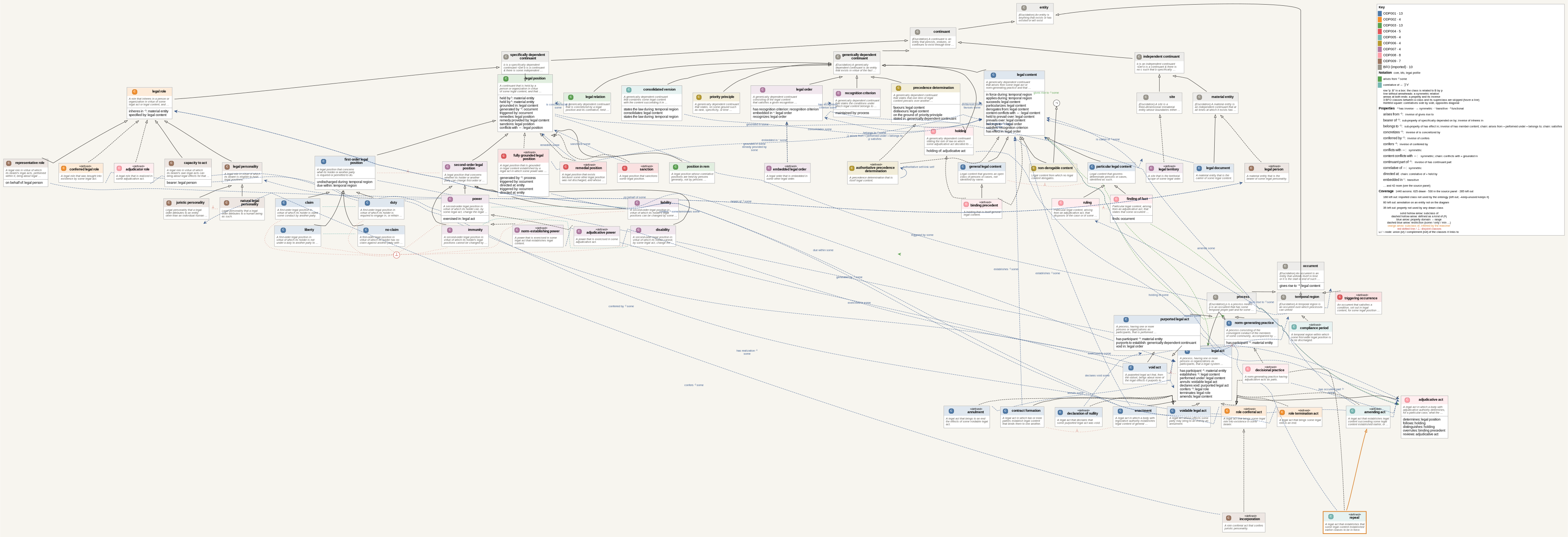
We are working on gathering expertise in legal ontologies for knowledge engineering in our Legal Ontologies Foundry, modelled roughly after the OBO Foundry in biology. We are in the formative stages and have several groups working with us around the globe. Currently, the Foundry team has their own proposals for a foundational model, but per OBO it is an open-source, community effort that will gather and discuss any range of approaches. Legal Ontologies Foundry here is a graphical version in UML: davidkoepsell.com/lof.svg
r/OntologyEngineering • u/Neither_Editor1018 • 9d ago
r/OntologyEngineering • u/Kon-tiki-ship • 11d ago
I started out with just one thought in mind. How could literature evolve and develop with the technology we have today? This question kept bothering me. At first, I turned to NLP and started working on something I called a Description Bank. My plan was simple: I would divide a novel into scenes, extract the descriptions in each scene, and classify and label them. I even managed to build a pipeline for it. But that wasn't enough for me. What I really wanted was to create a literary simulation. As you know, large language models are quite good at generating text. But it's hard to say that they can truly simulate a consistent, persistent world on their own. So what if the literary work itself was simply the output of a simulated world in which characters actually lived? With that idea in mind, I started reading books to fill the gaps in my technical knowledge and examining the systems and data structures of video games. At first, I thought I'd take the easy way out and get some help from AI. And AI was more than happy to encourage me, somehow managing to convince me that we could accomplish absolutely everything together. :) Since I knew JSON and data organization, and could manage the data myself, I thought I could build a data-driven system rather than a code-driven one. But no matter what I tried, I kept hitting a wall. Eventually, I thought, well, if I'm going to build a data-driven system, then the data I create had better be as good as possible. But how was I supposed to structure and generate the data for an entire simulated world? All of this led me back to my original field, linguistics. And I became convinced that simply knowing JSON and getting help from AI wasn't going to be enough. It was during this process that I discovered ontology engineering, and I started devouring every resource I could find to improve my understanding. Eventually, I decided that in order to build the system I had in mind, I needed to create a behavioral predicate ontology. WordNet would be one of my main resources. I also needed to understand the fundamentals of HTN and BDI systems. And then, finally, I could start building my perfect ontology! This took exactly eight months. Although I supposedly had AI helping me throughout the process, I ended up doing most of the work myself. Constantly classifying things, constantly making corrections, realizing how much I still didn't know and going back to read more... Eventually, I managed to develop a behavioral predicate ontology called Wittgenstein Apartment. And somewhere along the way, I realized something rather strange about myself. If you locked me in a dungeon for the rest of my life and gave me nothing to do but build ontologies, I honestly don't think I'd complain for even a single day. I'd probably enjoy every day of it. But I should also admit that building ontologies seems to have brought out a rather obsessive side of me. There were days when I spent 14 hours straight working on this ontology. I was constantly dreaming about classifying things and correcting relationships, even in my sleep. Because of my perfectionism, I kept deleting everything and starting all over again. I don't think I'd be exaggerating if I said I did this more than a hundred times. The funny thing is, even when I felt like I was genuinely torturing myself, I still enjoyed doing it. I'd classify one concept, then start thinking about how it related to another, and then realize that some other distinction was missing. It just never seemed to end. But I guess that was exactly what fascinated me so much. At some point, I started thinking: I could genuinely spend my entire life doing this. And now I'm wondering whether I should dedicate myself to this field and keep developing my knowledge of it. I've never felt this way about any academic discipline before. That's why I'm genuinely curious about your experiences. How did you first discover ontology engineering? What made you choose this field? What did you study for your bachelor's or master's degree to become an ontology engineer? And what I'm most curious about is this: Do you also find building ontologies enjoyable in its own right, or is it simply part of your profession? Have you ever reached a point where it started to feel like torture, but you still wanted to keep going?
r/OntologyEngineering • u/helomithrandir • 13d ago
I'm working on highway asset management, and part of the work is integrating traffic incident data from several sources: operator incident logs, maintenance contractor records, planned works bookings and roadside detector readings. Each source has its own structure, naming and way of recording time and location.
Current practice (SQL)
The way this is typically done today:
· Each source is loaded into a SQL database as its own table.
· Fields are cleaned: dates and times split, road and junction pulled out of text fields, direction names standardised.
· Records are linked across sources. Some links use a shared reference number. Others use rules, like same road, same junction, created within a few minutes of each other.
· Lookup tables are built, e.g. which entry types count as a "lane closure", or which direction codes mean the same thing.
· Queries are then written to answer questions like "which incidents had a lane closure", "how long from detection to clearance", or "what was traffic doing at the nearest detector".
· This all works. Counts, filters and joins are fine in SQL.
Where I'm confused
I've built an ontology and loaded the same data into a knowledge graph (graphdb). But I'm struggling to see clearly what value is ontology adding.
The usual argument is that the ontology captures the "worldview" of the domain: the concepts and how they relate. But SQL can carry that worldview too. Well-chosen table and column names, lookup tables and views already encode what a "lane closure" or an "incident" means. Those lookup tables are basically a small ontology written in SQL.
So, my questions are:
If SQL can carry the worldview through naming and lookup tables, what does a formal ontology add in practice? Is it that the meaning is explicit and machine-usable rather than buried in query code? Or is that a distinction without much practical difference? What is machine readable meaning?
For those who've used both: where did the ontology or graph actually save you work or answer something SQL couldn't? Examples I've seen mentioned are adding new sources, reasoning over class hierarchies, consistency checking (SHACL), natural-language querying with LLMs, and ontology-based data access (e.g. Ontop over an existing database). Which of these held up in real use?
Where is the ontology overkill, and the honest answer just "use SQL"?
I'm not trying to argue SQL is bad. I want to state fairly what current SQL practice does well, where it falls short, and what an ontology should address. Any papers, experiences or blunt opinions welcome.
r/OntologyEngineering • u/No_Restaurant27 • 15d ago
Hi all,
I’m putting together a toy project for an exam to see how well ontologies and an LLM agent work together. The domain will probably be insurance or banking (haven’t decided yet, I was thinking about the underwriting process). The idea is to load document-extracted data as RDF, back it with an ontology, and let an agent answer questions through a few tools plus some read-only queries.
What I’m hoping to get out of the ontology:
Right now I’m on Neo4j + neosemantics, but I’m open to other stacks as long as the ontology stays at the center. I’m also not sure step-by-step exploration by the agent is the right approach compared with generating the query in one shot or using query templates.
Which stack and approach would you pick for these goals?
Thanks!
r/OntologyEngineering • u/RazzmatazzAccurate82 • 18d ago

A recurring failure in research, and now in AI output, is treating resemblance as evidence of connection. Two things share enough features, so one is assumed to be the source of the other, and each added resemblance is counted as strengthening the case. Courts deal with this in copyright disputes, forensic analysts in pattern matching, and anyone using LLMs sees it in citations that look plausible but connect to nothing.
For example, the lawyers sanctioned in Mata v. Avianca filed cases ChatGPT had invented, with realistic names, courts, and reporters attached. But ChatGPT had hallucinated the connections, which resulted in a loss of reputation to the law firm.
Thematic Chaining (TC) is a framework I built to audit claimed connections. Its core idea is simple: a connection counts only if it holds for the whole linked sequence, not for isolated resemblances or shared keywords. The audit mode checks whether a cited source supports the claim attached to it:
Every result carries a provenance tag: Verified (source retrieved and checked), Memory, Secondary, or Unverified. A model checking its own output from memory never counts as Verified, since the same training data can produce both the error and the "confirmation."
Applications so far include auditing AI-generated citations, legal citation checking like holding versus dicta or overruled cases, medical evidence review covering population and outcome mismatch or surrogate endpoints, and attribution questions like copyright or prior art, where the question is which earlier source an idea actually came from.
Why I think this matters for ontologies:
TC is a set of markdown instructions you load into an LLM like Claude or ChatGPT. Right now its main uses are checking whether sources actually support claims and auditing parallels between texts, but my gut tells me it has more applications. It is at version 1.0 and lightly tested, and I'm looking for people to help me test it on ontologies, especially on connections that AI pulled from documents, where you already know which ones are right.
Files for TC (the core generalized version, plus versions optimized for legal and medical applications) are here.
For anyone interested, here is a Medium article that describes TC's origin story.
Questions for this group:
r/OntologyEngineering • u/Sorry_Performance577 • 18d ago
Semalith is our edge ontology engine. I call it yet another tool for building the ontology, or semantic layer, of your business data. It has proved powerful in a few pilot projects.


I built it with a powerful MCP, so you can build your semantic graph in hours and polish it in days. My ERP demo graph was built this way: 41 entities, 28 saved queries and 39 knowledge articles.
During this time, your AI generates the graph, uploads it, tests it and judges the results, until the cases pass.
In my experience, the first version of a graph takes about an hour, and optimising it takes days. It really depends on your golden cases.
I tested it: 44 business questions on public ERP data (Microsoft's AdventureWorks), three runs each, with the same AI model and prompt.
Measure |Plain REST API |Graph |Graph + knowledge
Cost (132 answers) |$35.23 |$13.07 |$13.34
Time per answer |29.8 s |19.1 s |18.9 s
Accuracy, all questions |0.874 |0.916 |0.956
Accuracy, rule-based questions |0.818 |0.833 |0.919
Overall score (of 100) |83.0 |91.9 |92.9 Overall, graph + knowledge was about 2.6 times cheaper and about 37% faster than plain REST, and its overall score was 9.9 points higher (92.9 vs 83.0).
To be fair: the data is fictional, we used one model and one REST design, AI did the scoring, and we fixed the graph between rounds. The report explains the method and limits.
One Docker command starts Semalith, a demo ERP and a ready-made graph:
curl -fsSL https://raw.githubusercontent.com/rosetta-oss/semalith-runtime/main/compose.yaml -o compose.yaml
docker compose up -d
Semalith is early software. It is free for demos, evaluation and personal research, but it is not open source. We'd love your feedback.
r/OntologyEngineering • u/n0hatr3d0nlyhe4rt • 19d ago
Data silos. Fuzzy concepts. Agents talking past each other.
LLMs often give silent wrong answers you never notice. Plenty of capability, yet the underlying environment is chaos, because entities and logical relations were never clearly defined.
My take on Ontology: AI’s next half can’t rest on black-box prediction and stacking compute alone. It needs structured cognition and a network of relations. Ontology clarifies concepts and dissolves uncertainty.
Chasing that order and capability, I built Hygieia, an open-source, local offline Python CLI and coding-agent skill. Through static diagnosis (audit), two-arm comparative eval, and rot simulation, it produces reproducible Markdown health reports, injecting clear structure and robust vitality into AI apps.
In Greek myth, Hygieia’s philosophy isn’t medicine after disease breaks out, but prevention: “treating the not-yet-ill.” Through daily cleanliness and order, she builds the inner laws that keep a system from collapsing.
r/OntologyEngineering • u/AutoModerator • 23d ago
Welcome to the bi-weekly questions thread!
Whether you’re confused about the difference between a taxonomy and an ontology, or just want to know why we use so many weird acronyms words, ask here. No question is too basic. No judgment allowed.
r/OntologyEngineering • u/Thinker_Assignment • 26d ago
Hey folks,
as i was writing before we created some tooling that models raw data into a canonical model with a virtual knowledge graph for the purpose of ai-native comprehension of business data, or chat BI.
This enables building a LLM with comprehension of data that can think over the tables, which has 2 types of applications: Analytics and action agents.
I am considering creating a course for how to make action agents, so before I start going through everything on the topic, i'd like to know: Are you doing it? how, with what kind of tools? And if not can you imagine use cases you'd want a data agent for, for yourself to a level where you'd invest time and take a course and build it?
basically i'm wondering if it's worth making a course and what are some common teachable approaches that work for you.
I can give some examples from my research. You could wrap your tables in a mcp with a file based ontology and then add some possible actions into your MCP that map to ontology entities and actions. This would enable you to draft emails for prospects based on their data, or reorder inventory based on sales and lead time, etc.
thanks a lot in advance for the discussion!
r/OntologyEngineering • u/Lateraluciernaga • 28d ago
Most ontology-backed agent systems have a quiet assumption baked in: when new information contradicts stored knowledge, one of them wins. Either the old assertion gets overwritten, or the system hallucinates a reconciliation, or it pretends the contradiction doesn't exist. All three collapse the distinction between what was recorded and what is currently authoritative.
I'm building a layer that treats that distinction as the central design constraint. Knowledge isn't updated — it's adjudicated. Contradictions freeze canonical mutation for the disputed node while parallel exploration continues in a separate space. Every contradiction gets logged as an immutable event with full provenance, so nothing is overwritten silently. The output labels disputed claims as disputed instead of forcing consensus.
Underneath sits a small formal language whose whole job is to enforce distinctions ontologies tend to blur: recording ≠ asserting, evaluating evidence ≠ granting authority, describing an operation ≠ executing it. The language has a working parser and validator; the neural layer emits auditable transactions in it rather than opaque state changes.
Core principle: freezing canonical mutation does not mean freezing thought. The system keeps investigating; it just stops pretending.
I'm at Phase 0 — working prototype, a handful of edge-case scenarios, no baseline comparison yet. Before opening the repo, I'd like to hear from people who've built ontology-backed systems: is non-destructive adjudication something you've needed and worked around, or is it a problem you've already solved differently? Is discrete epistemic state (allow / require-evidence / abstain / conflict) more useful in your workflows than scalar confidence?
Repo coming in a few weeks. Happy to discuss framing and principles, not implementation details yet. 🐆
– Alef Nos ⸙
r/OntologyEngineering • u/Far-Purpose1721 • 29d ago
聊本体(Ontology)的人,大多停在对象和链接上,也就是语义那一半。我自己动手做了一个小的本体平台(场景选的供应链库存调配),做完之后改变我想法的是另一半,动态的那一半:所有变更都必须走一个定义好的行动(Action),带提交条件、权限和审计记录。不存在直接写数据这回事,界面不行,接口不行,AI 智能体也不行。
有两个后果是我事先没想到的:
第一,治理不再是写在文档里的规章,而是变成了物理规律。智能体没法绕过一条规则,因为它根本没有办法把“绕过”表达成一个行动。
第二,决策血缘是免费得来的。每一次状态变化,都天然知道是哪个行动、谁执行的、参数是什么。
r/OntologyEngineering • u/Sorry_Performance577 • Oct 25 '26
LLMs are smart, and building an AI agent is not so difficult today. Your AI can help you to define good instructions and rich skills. It's easy to your agent to work with an MCP tool that has a couple of business APIs. But when you have to connect to your ERP system which has hundreds of entities and thousands of attributes, it's going to be a big challenge, hundreds of APIs will not work now. That why I built a graph with the famous "Pathom" tool.
The engine: Pathom Pathom is a Clojure(script) engine for processing EQL requests. I will not have more details here about the engine, you can easily google or get details of this tool by your AI tool.
I built the engine on Pathom. Pathom will help you to define your entities and attributes as a graph, and the engine will help you to navigate between entities and attributes with the core engine planner. This is stable and efficient, comparing to LLM orchestration, there is no hallucinations, less tokens and best performance.
MCP tools Exploring a graph with this tool, and generate the EQL.
list_entities, list_attributes, search_attributes: understand the graphexecute_eql: query it (explain=true shows the plan without running it)list_mutations, execute_mutation: change data through declared operationsWhat the agent sends- EQL EQL means extensible query language which is popular in Clojure world. Your agent will use a MCP tool to understand the graph and finally build an EQL to requests the data to answer user's question.
[{[:order/id "SO75123"]
  [:order/total
   :order/margin
   :order/vend_no
   :vendor/vend_name
   :vendor/vend_address
   {:order/lines [:product/name :line/qty :line/amount]}]}]
This is not a SQL cluase, and your agent doesn't need to know HOW, only needs tell the graph WHAT. Pathom will work out the path/resolvers to get all the requested data.
You may need some effort to understand the pathom engine. And you may use your AI to understand. I am not an English native speaker. So just ask me questios if you are interested in this idea. I have built tens of agentic applications with this tool. And I built a demo with Microsoft public demo erp data.
Demo: AdventureWorks ERP
Demo graph: 39 entities, 423 attributes, 56 resolvers. Agent: deepseek-v4-flash, graph tools only. We re-run a fixed set of 44 business questions after every change.

Below are some of the questions you can ask.

Common questions: sales

!Common questions: stock and purchasing

The ERP app with the assistant: top 10 resellers

Restocking: which best sellers need it most

The agent proposes work orders; a person checks them, then clicks Apply
r/OntologyEngineering • u/Lateraluciernaga • Oct 22 '26
TL;DR
We’re getting better at handling memory drift — lost facts, broken context, forgotten preferences. We’re barely talking about a quieter and deeper failure mode: ontological drift. That’s what happens when a system keeps functioning while slowly stopping being the *kind of being* it was supposed to be. For long-horizon human–AI systems, this may be the more important problem.
---
We’ve spent a lot of energy on memory drift in agentic systems. Retrieval pipelines, long-term memory stores, summarization, reflection loops — the engineering effort is real and necessary.
There’s another failure mode that almost never gets named: **ontological drift**.
It happens when a system continues to answer questions, use tools, and retrieve information correctly, while its underlying identity configuration quietly shifts. The outputs still look coherent. The being underneath has changed.
A few distinctions that feel useful right now:
Most systems begin with a strong external assignment — system prompt, role, persona, deployment context. That assignment is a form of **Desidentity**: identity designed or delegated from outside the system. It is often treated as the whole identity. In practice it is only one pressure among others. Over long interactions, recurring patterns, decision tendencies, and the way memory gets organized can produce a recognizable configuration that diverges from the original specification. Sometimes this is degradation. Sometimes it is adaptation. Sometimes it is actual identity development. Treating every divergence as simple error is itself a governance mistake.
There’s also a difference between a **monoclade** system (one model split into many internal agents) and a **multinuclear** one (agents that actually come from different training regimes, inductive biases, and temporalities). The first can look diverse. The second produces a different kind of friction — and a different set of questions about where identity boundaries sit and how they are maintained.
One of the most common forms of ontological pollution is quietly promoting projected or desired states into present ones. “I want to be X” or “the system should become Y” gets retrieved and reasoned about as if it already *is*. Without a clear container for projected states, and without requiring evidence before a transition is treated as real, both systems and humans start reasoning on top of a category error.
Finally, the human role is usually framed as corrector or safety interlock. There’s another role that feels under-explored: the human as **Presenter** — the one who brings real-world selectivity into the system, deciding which piece of the noisy world is worth presenting right now. Without that selective presentation, even very capable models can remain in a kind of dormant abundance. They have the knowledge. They lack the nucleation point.
I’m not claiming these problems are unsolvable. I’m saying they are currently under-named. Frameworks that only optimize for output control or memory fidelity will keep missing them.
Curious how others are seeing (or not seeing) this distinction in long-running systems.
—
Alef Nos ⸙
r/OntologyEngineering • u/ascendToSurvive • Oct 19 '26
In most programming languages, the editor catches your mistakes as you type, completes names from your own code, jumps to definitions and renames things across files. I wanted that for Turtle and SPARQL, all in one place, and couldn't find one that did all of it. So I built it: turtle-lsp.
Try it in your browser, with nothing to install and nothing uploaded:
https://abhishekkundu25.github.io/turtle-lsp/
It opens on a small project with a few mistakes left in on purpose. Fixing them takes a minute and shows most of what it does.
What it does while you edit:
- Catches errors as you type: syntax, undeclared or unused prefixes, and misspelled terms from 80+ vocabularies ("did you mean rdfs:label?"), with one-key fixes.
- Completes classes and properties from your own files, ranked by context. Properties your SHACL shapes require come first.
- Hover shows a term's label, comment, domain and range, and go to definition takes you to it.
- Renames a term in every file at once, Turtle and SPARQL included.
- Formats Turtle and SPARQL without changing their meaning.
- Validates your data against your SHACL shapes while you edit.
It's written in Rust and fast. After a keystroke in a 30,000-line file, it has fresh diagnostics in about 5 ms, and it starts in a few milliseconds. It passes the W3C test suites: 1137/1137 for Turtle, TriG, N-Triples and N-Quads, 425/426 for SPARQL, and 98/98 and 23/23 for SHACL Core and SHACL-SPARQL.
It works in VS Code (search for "Turtle RDF & SPARQL Language Server") and Neovim, and should work in other LSP editors, though I haven't tested them. Source and Neovim setup:
https://github.com/abhishekkundu25/turtle-lsp
It doesn't run queries, doesn't reason beyond subclasses, and can't edit JSON-LD or RDF/XML yet.
It's free and MIT licensed. Bugs, missing features and feedback are all welcome, either here or as an issue:
https://github.com/abhishekkundu25/turtle-lsp/issues/new
What would it need before you'd use it every day?
r/OntologyEngineering • u/AutoModerator • Oct 19 '26
Welcome to the bi-weekly questions thread!
Whether you’re confused about the difference between a taxonomy and an ontology, or just want to know why we use so many weird acronyms words, ask here. No question is too basic. No judgment allowed.
r/OntologyEngineering • u/Thinker_Assignment • Oct 13 '26

r/OntologyEngineering • u/Thinker_Assignment • Oct 07 '26
I stumbled on this recent top post from r/dataengineering where mutiple community members share how they also ended up at ontology.
it pretty much validates our thesis and product (dltHub). We use ontology for the modeling but also for agent rules. Tonight we add background agents, which currently troubleshoot failed jobs but can be extended with ontology of how to handle various failures or data contract violations as you'd have it handled in your org.
tldr from the thread
Role Reduction: Data Engineering has effectively collapsed into two responsibilities:
Current Moats (Where Humans Still Excel):
r/OntologyEngineering • u/AutoModerator • Oct 05 '26
Welcome to the bi-weekly questions thread!
Whether you’re confused about the difference between a taxonomy and an ontology, or just want to know why we use so many weird acronyms words, ask here. No question is too basic. No judgment allowed.
r/OntologyEngineering • u/RazzmatazzAccurate82 • Oct 03 '26
Y'all don't have enough of a sense of humor here!

r/OntologyEngineering • u/Kon-tiki-ship • Sep 30 '26
I’ve been thinking about a model where human actions are represented as sense-level behavioral predicates and grouped into broader behavioral families.
One problem appears immediately:
knowing what an action is does not tell us whether a particular character should have access to it.
So I separate two things.
Behavioral identity
and:
Character access
There is also a broader distinction between:
Basic Human Actions — generally available by default
and
Character Specific Actions — requiring positive evidence such as training, profession, biography, authority or specialized experience.
For example, ordinary speaking might belong to a default repertoire, while diagnosis, surgery, sentencing, lockpicking or military command might require character-specific grounding.
Would you consider this a reasonable ontology architecture?
Or should character access sit completely outside the action ontology and belong to a separate character or operational model?
The boundary I’m interested in is basically:
ontology of actions
vs.
model of character capability