r/PersonalFinance4All • • 1d ago

what should I do

1 Upvotes

Hello, I am seeking advice on what to do with my money

I am a 21 year old male based in the chicago-milwaukee area

I have 17 grand in-between two different bank accounts. savings and a checkings

half of my checks go to one bank account and the other half go to another account and one of those bank accounts is a high yield savings account.

I have about another $3000 in an s and p 500 Roth ira account VOO. I haven't put any money in my roth ira in like 7 months though and I should probably be investing in it a lot more.

I make like $35 an hour and my checks are probably depending on how much I work $1000- $1400 after tax's a week.

I have no expenses in my life besides the property taxs on the hunting land I inherited in the UP of Michigan when my grandma died which is $1000 every year.

I live with my parents and don't pay rent, or buy food or have a car payment or anything. so I save every single dollar I make besides gas on getting to work and basic car maintenance. yes I know I am very blessed

I AM VERY INTRESTED IN GETTING INTO STOCKS AND REALESTATE.

I have a robin hood account and I have never bought a stock before in my life.

I am interested as well as getting into buying duplex's and triplexes and stuff like that.

I might be moving to Arizona or Nevada for a job opportunity in the next year where I would have to live on my own but I am not sure if i am going to do that yet. so i might hold off on the real-estate for now plus i probably dont have enough to even start problem is the new job i want is very hard to get ( job would pay the same per hour wise in about 5 years and almost the same benefits but would just be way safer way less travel and be better overall and not as much hours all the time) what I am in right now everybody makes the big number off overtime.

i am probably going to be making 150- 250 k a year in the next 4-5 years. and probably even 300k-500 k after that problem is my job is extremely hard and idk if i can stick with it that long. most people dont make it through

I have a pension and full insurance from work ( not sure how good my company insurance is) (and I only have my moms insurance till I'm 26) and every year 25% of what I make goes into a contribution savings plan from work

any information helps greatly thank you!

I dont want to work my entire life I want to be a boss one day or have my money work for me my jobs is very dangerous requires a ton of travel and long hours. thats why I am looking for something new for work

also that big number of what I can make is working like 80-100 hour weeks all year.

I sometimes wish I went to college


r/PersonalFinance4All • • 1d ago

30 years old, savings in the bank, living at home, and trying to figure out how to build financial independence

2 Upvotes

I'm 30 and at a point where I'm trying to make some important decisions about money, work, and my future.

I have some savings (over $60k), currently live with my parents, and don't have many major recurring expenses.

On paper, I recognize that I'm in a better financial position than many people my age. But I also don't have the consistent income or independent living situation that I'd like to have.

I'm trying to figure out how to approach the next few years intelligently.

Some things I'm interested in pursuing include:

  • Building a small business around art and photography
  • Selling vintage photographs and collectibles
  • Flipping furniture and other items
  • Freelance work and odd jobs
  • Building multiple income streams
  • Eventually investing in real estate or other assets
  • Becoming financially independent without depending on a traditional employer

I have a tendency to think about the big picture and want to build something substantial. I've even thought about having a long-term goal of $20–30 million, although I'm questioning whether that's an unnecessarily high target.

At the same time, I know I need to focus on the practical steps: earning consistent income, managing expenses, building a business, and making sensible financial decisions.

I'm also trying to balance not being reckless with money against being too afraid to spend money on opportunities that could help me grow.

For people who have been in a similar position:

  1. What would you prioritize financially at 30?
  2. How much of your savings would you keep accessible versus invest in building a business?
  3. Would you focus on getting reliable income first or developing a business around your interests?
  4. How do you evaluate whether a business idea is worth investing time and money into?
  5. What financial mistakes should I avoid?
  6. How did you transition from living with family to supporting yourself?
  7. If you were starting over with savings but inconsistent income, what would you do?

I'm not looking for a get-rich-quick strategy. I want to build a life where I can support myself, enjoy my work, and have long-term financial security.

I'd appreciate practical advice and honest experiences.


r/PersonalFinance4All • • 1d ago

Airbnb income and expense tracker math: a side-income Airbnb that looks like $650 a month is $420 once $2,760 of small purchases are logged

0 Upvotes

Chart: one illustrative Airbnb, one year. Profit counting only the big bills vs profit with every purchase logged.

Plenty of households run an Airbnb as side income and plan around one monthly number. That number usually comes from the big bills: the mortgage, utilities and the cleaner. The small purchases go on the family card during grocery and household runs, and they never show up on the Airbnb side. Here's one illustrative year. Swap in your own numbers.

The big bills (what usually gets counted)

  • Payouts after platform fees: 245 booked nights over 75 stays, $36,750
  • Mortgage, property tax, insurance and condo fee: $1,640 a month, $19,680
  • Utilities and internet: $210 a month, $2,520
  • Cleaning: 75 stays × $90, $6,750

$36,750 - $28,950 = $7,800 for the year, or $650 a month.

The small purchases (what goes missing)

CategoryHow it adds upYear
Supplies and restocking (coffee, toiletries, paper, laundry soap)$85 a month$1,020
Apps and subscriptions (pricing tool, streaming, smart lock app)$35 a month$420
Linens, towels and small replacementsover the year$1,170
Welcome treats75 stays × $2$150
Total$2,760

With every purchase logged, the Airbnb made $7,800 - $2,760 = $5,040, or $420 a month. The small stuff took more than a third of the profit, about $36.80 per stay.

The same mistake shows up in the family budget, in reverse

$2,340 of those purchases (everything except the apps) went on the card used for groceries and household shopping.

  • Grocery and household budget: $800 a month, $9,600 a year
  • What the card showed: $11,400, so the family looked $1,800 over budget
  • Take out the Airbnb purchases: $11,400 - $2,340 = $9,060, which is $540 under budget

So the household budget said "cut groceries," and the Airbnb said "$650 a month of extra income." Both were off by the same $2,760: $2,340 in the grocery and household line, plus $420 of apps in the family's subscriptions line, $35 a month that looked like personal spending.

Before you plan around Airbnb income

  1. Put Airbnb purchases on one card or account that's only for the Airbnb, or split the receipt when it's a mixed shopping run.
  2. Log the small stuff by category, even $2 items, and total it for the year.
  3. Divide it by the number of stays. At $36.80 a stay, that's a cost your nightly rate or cleaning fee has to cover.
  4. Recheck the household budget without the Airbnb purchases before you cut anything.

This is profit before income tax, and the figures are illustrative, not a real property, and not investment, tax or legal advice.

If you host, where do the small Airbnb purchases end up in your records: on the Airbnb's books, or buried in the household budget?

The Airbnb Income and Expense Tracker's Monthly Dashboard, as shown on its assetafc.com page (sample data).

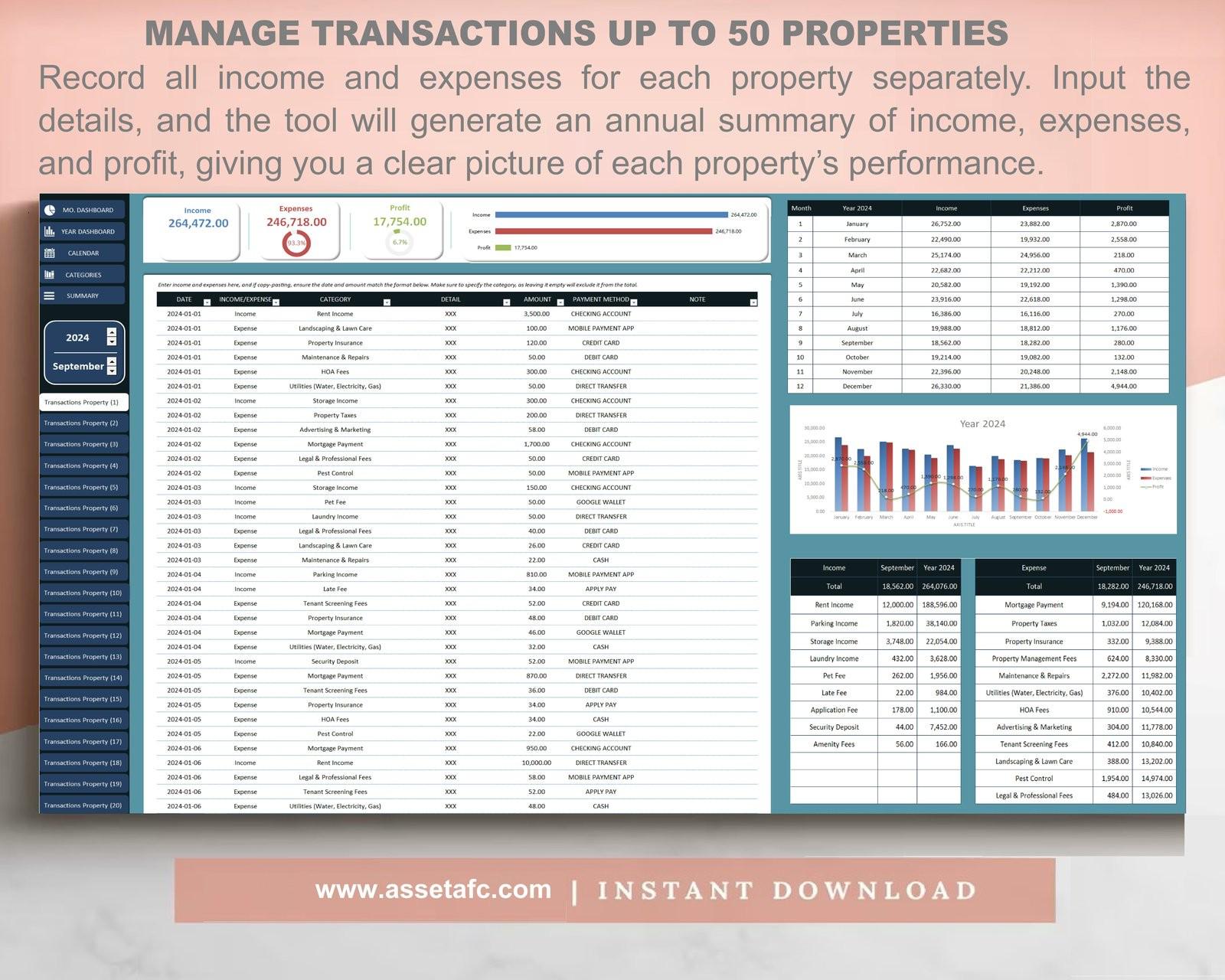
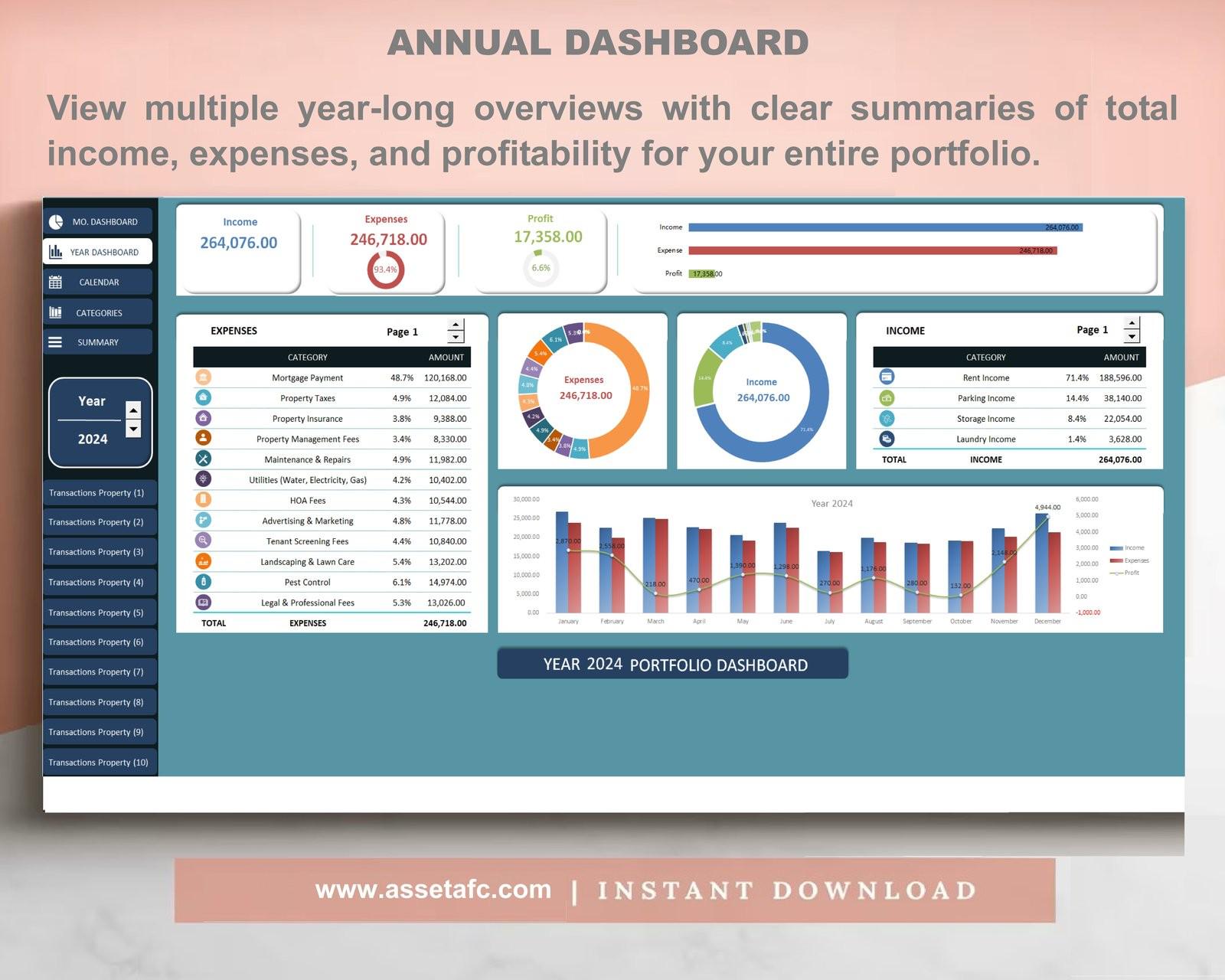
Disclosure: I'm posting for Asset AFC, and we build real estate investing tools. The Airbnb Income and Expense Tracker tracks income and expenses for up to 50 properties, whether they're Airbnbs, traditional rentals or a mix, with categories you can customize for things like cleaning fees and software subscriptions. It gives an annual summary of income, expenses and profit for each property by category, plus monthly and yearly dashboards, a portfolio calendar of daily income and expenses, and a final summary, and the calculations are automatic. Keeping Airbnb purchases off the family card is a step you'd do alongside it. It's available as a one-time purchase. Through December 1, use code BFCM40 for 40% off on our website. More tools from Asset AFC are on the assetafc.com website.


r/PersonalFinance4All • • 1d ago

Investing Portfolio Feasibility

1 Upvotes

Investment Plan Feasibility

Yearly, Biennial, Quadrennial or Quintennial purchase of 10 shares of each to grow a portfolio through reinvestment:

SCHB SCHX SPTM
ITOT VONE VTHR VTI
IWV VOO IVV
VUG MGK
EQAL RSP EUSA QQQE QQEW
IWF IVE IGV
MAGS MAGP AIMG
HYGH HYG TLT LQD
KBWD SDY SDIV WDIV DIV KBWB VIG VYM HDV
VRP VXUS VEA VGK IXUS ACWX VSS
VT


r/PersonalFinance4All • • 1d ago

Rental income and expense tracker: one $4,800 furnace bill turned a $6,000 rental year into $1,200

1 Upvotes

Is my rental property making money? Most landlords answer with a month: "the rent covers everything and leaves about $500." That's usually true of an ordinary month. It just isn't the answer to the question, because the bills that decide whether a rental makes money don't arrive evenly.

This post follows one illustrative rental through two versions of the same year. The numbers are made up for the example, so use your own rent, bills and records. It's general information, not investment, tax, lending or legal advice.

The rental: one illustrative property

  • Rent is $2,400 a month, or $28,800 for the year. No vacancy, self-managed, and the owner pays no utilities.
  • Every month the same four bills go out: the mortgage payment $1,450 (counted in full, principal and interest together, because all of it leaves your account), property taxes $250, property insurance $100 and small repairs $100.
  • Those four add up to $1,900 a month.

Everything is before tax. "Profit" below means rent in minus every bill paid out.

A steady year: $500 a month, $6,000 for the year

Rent of $2,400 less $1,900 of bills leaves $500 in an ordinary month. Over twelve months, income is $28,800 and expenses are $22,800, so the year keeps $6,000, or 20.8% of the rent.

Nothing is wrong with that picture. It's also the picture most people carry in their heads, and it's the one that quietly breaks.

The same year with one furnace bill

Now keep everything the same, but on March 14 the furnace fails and you pay $4,800 to replace it. That's a Maintenance & Repairs entry, and it lands in one month.

  • March: $2,400 in, $1,900 + $4,800 = $6,700 out, so March is −$4,300.
  • The other eleven months still keep $500 each, which is $5,500.
  • The year: $5,500 − $4,300 = $1,200. Expenses were $27,600, and profit is 4.2% of the rent.

One illustrative rental, two years: the same rent and ordinary bills, with and without one $4,800 furnace bill.

The bill is 80% of the steady year's profit. Spread over twelve months, it costs $400 a month, and $500 − $400 = $100. Same answer from the other direction: the year ÷ 12 is $100 a month, not $500.

The same year by month looks fine in eleven months and like a disaster in March; the year kept $1,200, or $100 a month.

Look at the left chart. Eleven months look healthy, one month looks like a disaster, and neither view tells you what the rental did. Look at the right chart and the picture is clear: this is a rental that kept $1,200 on $28,800 of rent.

Why one month misleads

A month feels like the natural unit because rent and the mortgage payment arrive monthly. Repairs and replacements don't. A bill like the furnace doesn't wait for a convenient month, and it doesn't come back in a tidy, equal amount the next month either. So the ordinary month describes the bills that repeat, and the year describes everything. When the two disagree, the year is the one that matches your bank account.

It also changes how a rental compares with another one. Two rentals can both "keep $500 a month" in an ordinary month while one of them kept $6,000 over the year and the other kept $1,200. Quoting the month hides that. Quoting the year ÷ 12 doesn't.

Rental property cash flow: how to judge the year

You don't need a complicated system. You need every entry in one place, for the whole year, and then three steps:

Step 1. Log every entry, on the date it happened. Rent when it's paid, each bill when you pay it. A repair you pay in March belongs to March.

The tracker's transaction log: each income and expense by property and date, with a year-to-date summary. Sample data only, not a customer file.

Step 2. Add the big bill where it landed. Don't smooth it out in your notes or leave it off because it "isn't a normal expense." It left your account. Step 3. Add up the year, then divide by twelve. That figure is the monthly cash flow you can rely on. Your ordinary month is only the starting point.

The Yearly Dashboard: income, expenses and profit for the year, which you can then divide by twelve. Sample data only.

What counts as a bill? Anything that really left your account for the rental: the full mortgage payment, property taxes, insurance, small repairs and the big one. Keep each rental separate, so a good one can't hide a weak one in a combined total.

Two cautions. First, this works on actual entries, not on what you meant to spend. Second, it says nothing about whether a bill should have been expected, or whether the rental is worth keeping. It just shows you what the rental really kept. What you do with that is your decision.

ONE STEP THIS WEEK

Pull up your last twelve months for one rental. Total the rent, total the bills, and divide the difference by twelve. Then compare it with the number you usually quote. If the two are far apart, the gap is the bill you've been calling "unusual."

Judge a rental by its year, divided by twelve, not by its ordinary month.

I post for Asset AFC, which makes this tracker: the Multi-Property Rental Income and Expense Tracker is a one-time purchase that keeps a full year of entries in one place, and the full walkthrough is in the blog, Is My Rental Property Making Money? Judge the Year, Not the Month.

Illustrative numbers only. General information, not investment, tax or legal advice.


r/PersonalFinance4All • • 2d ago

pregnancy financial assistance

0 Upvotes

my wife and I are having our first baby. I understand it can get really expensive. we are in Baltimore county and I make 70-75k. she wants to quit her job at some point but we have not decided when yet.

I want to know what programs are available for assistance that I could possibly qualify for?


r/PersonalFinance4All • • 2d ago

Some of us we don't know how we use our money.

Post image
0 Upvotes

Give me a good money advice and how I can manage my money or spend in a good way


r/PersonalFinance4All • • 3d ago

Wednesday Ask Anything (Nov 25): no dumb money questions

5 Upvotes

Not sure what an expense ratio is? Whether to pay off debt or save first? How a tax bracket actually works? Ask it here. Every expert started out asking the same question.

Answerers: explain the why, not just the answer. Mention your country if the rules depend on it.


r/PersonalFinance4All • • 3d ago

Budgeting is like cooking a new recipe for the first time, and thinking of it that way helped me stop avoiding it

Post image
1 Upvotes

When you try a new recipe, you don't just start throwing things in a pan. You read the steps, write a grocery list, and work out what it'll cost. We put that much planning into dinner, but a lot of us make money decisions on gut feeling.

Most of the time, the fear of "messing it up" comes from not knowing the process well enough. Knowing the steps doesn't help much if you never act on them. And you don't need to be a chef to cook something good. You need clear directions and the right ingredients. Budgeting works the same way.

1. Directions, then ingredients, then budget

Plan in that order. The budget is the step that matters most, because it decides which ingredients you can actually buy. When one thing is missing, the whole dish can change.

  • Separate needs from wants.
  • Rank things by how soon you need them.
  • Pay for those first.

A bigger budget helps, but how you allocate it matters more. If one version of a recipe needs expensive ingredients and special tools, and another gets the same result more simply, most of us would choose the simpler one. Money is no different.

2. Cutting costs isn't the only move

When money gets tight, most people's first instinct is to cut spending. That's often right. But it's also worth asking how you could increase what comes in. People who build wealth over time tend to look at both sides of the scale, not just the expense side.

Businesses do something similar. A discount costs them a bit of margin now, but they use it to win customers they keep for years. A short-term cost, managed on purpose, can turn into a long-term gain.

3. Good debt vs. bad debt

This is the part people find confusing. Say you take a loan to buy a property. The loan is a liability, but the property is an asset. If it brings in rent, that income helps cover the EMI. If you later sell it for more than you paid, you get your money back plus a gain.

The key point is that borrowing only makes sense when it buys something that earns or grows. Borrowing to fund lifestyle spending, or taking new loans to pay off old ones, is how people get stuck.

4. A simple way to start

  • Get a rough picture of where your money goes each month.
  • List your "ingredients": fixed costs, savings goals, and the things you'd like to have.
  • Give each one an amount, not just a label.
  • Check back after a month, like tasting the dish, and adjust.

It doesn't have to be perfect the first time. Your first attempt at a new recipe rarely is.

How do you approach budgeting? Do you plan everything out or adjust as you go?

About me: I'm Dr. Bennet J, Vice President at GHL India Ventures. I write about personal finance habits. I'm sharing this for discussion, not to promote anything.


r/PersonalFinance4All • • 4d ago

Money Notes #4: $553 of planned returns, but only $370 came back as cash

Post image
0 Upvotes

Welcome back to Money Notes, a short read from Asset AFC on everyday money, posted right here in the sub.

A return isn't money back until the refund posts.

A two-minute read on the "I'm sending it back anyway" pile, and why it often costs more than you think.

THE TRAP

Late November is when a lot of "just in case" buying happens: two sizes of the same jacket, a gadget to try out, a gift you're not sure about. The plan is to keep what works and return the rest. So in your head, the returns are already undone. The money is as good as back.

It isn't. A return is a to-do with a deadline, and the money only counts once it shows up in your account.

A NOVEMBER EXAMPLE

One household spends $1,140 on the card over the big shopping weekend at the end of the month (Fri Nov 27 to Sun Nov 29). Four things are maybes, and they plan to send them back:

  • Stand mixer: $249
  • Jacket: $129
  • Boots: $96
  • Headphones: $79

That's $553 of planned returns. In their heads the weekend cost $587, and that's the number they budget December around.

Here's how the returns actually go:

  • Stand mixer: returned in store on Tue, Dec 1. The refund reaches the card on Wed, Dec 9. $249 back.
  • Jacket: mailed back on Mon, Dec 7. The store keeps an $8 return-shipping fee, and $121 posts on Fri, Dec 18.
  • Boots: that item is store credit only. $96 lands on a store gift card, not back on the card.
  • Headphones: bought on the Friday, with 30 days to return, so the last day is Sun, Dec 27. The box sits by the door through the holidays. $0 back.

By Dec 31, $370 has come back as cash. The weekend really cost $770, not $587. That's $183 more than they planned for: $8 in fees, $96 stuck as store credit and $79 for a missed deadline. Even the refunds that worked took two to three weeks to arrive.

WHY IT HAPPENS

Deciding to return something feels like the end of the job. The money side only finishes when the refund posts, and there are four ways it leaks on the way:

  • Fees. Return shipping or restocking fees come off the refund.
  • Refund method. Some items or stores give store credit instead of money back. Credit has value, but only at that store.
  • Deadlines. Windows run from the purchase date, and a busy December eats them.
  • Timing. Card refunds can take days or weeks. If one lands after your statement date, that bill can still include the full charge.

None of these are big on their own. Together they turn "I spent $587" into $770.

THE FIX: A RETURNS LIST

Count a return as money back only when the refund posts. Until then, it's still spent.

Keep one short list for everything you plan to return. One line per item:

  • Item and amount
  • Store, and how you'll return it (in store or by mail)
  • Last day to return
  • Refund method (back to the card or store credit)
  • Date the refund actually posted

Our household's list would have caught most of the $183. The headphones' Dec 27 deadline sits right there on the page, so they go back in time: $79. The jacket goes back in store instead of by mail, so there's no $8 fee. That's $457 back as cash, and the weekend costs $683. And if the $96 store credit goes toward something already on their December list (not an extra), the weekend lands at the $587 they planned.

ONE STEP FOR THIS WEEK

✓ Write down everything you're thinking of returning, with the amount and the last return day. Put a reminder on your calendar five days before the earliest date, and cross each line off only when the refund shows up.

What's in your returns pile right now, and when is its deadline? Drop it in the comments. We read every answer.

FROM ASSET AFC

Want to see what your shopping weekend really cost?

Multiple Account Income & Expense Tracker fits this example. Record each purchase on the card account the day you buy it, and record each refund on the day it actually posts, in a refunds category you set up yourself. The Monthly Dashboard shows income, expenses and net cash flow across all your accounts, so December shows the weekend's real cost, not the planned one. The Calendar view tracks daily activity, so you can see the day each refund arrived.

It's one of the financial tools at Asset AFC.

Disclosure: this post is from Asset AFC, which makes the tool mentioned.

More Money Notes soon, right here in the sub. Educational content, not financial, tax or legal advice. All figures are examples.


r/PersonalFinance4All • • 4d ago

Three rentals at year end: the one bought in July shows a $550 loss, but it makes $625 a rented month, the most of the three

Post image
1 Upvotes

Chart: three illustrative rentals. Profit shown for the year vs a normal rented month × 12.

Year end is when a lot of landlords line up their rentals and ask which one is pulling its weight. If one of them was bought partway through the year, the annual totals can point you at the wrong property. Here's one illustrative portfolio of three long-term rentals. Swap in your own numbers.

The year, as the totals show it

Three rentals, this yearIncomeExpensesProfit
A (owned all year)$25,200$19,800$5,400
B (owned all year)$23,400$18,600$4,800
C (bought July 1)$11,500$12,050-$550
Portfolio$60,100$50,450$9,650

Read that way, C is the problem: it lost money while A and B made $450 and $400 a month.

What's inside C's year

  • Owned 6 months, July to December. July went to getting it ready, and the tenant moved in August 1, so 5 months of rent at $2,300: $11,500.
  • Regular costs: mortgage payment $1,150 (principal and interest), property tax $260, insurance $115, repairs $100, other $50 = $1,675 a month. Six months: $10,050.
  • One-time setup: paint, cleaning and new locks $1,450; smoke/CO detectors and small fixes $350; listing and tenant screening $200 = $2,000.
  • Expenses $12,050 against income $11,500: -$550.

C in a normal rented month

$2,300 rent - $1,675 = $625 a month. That's $175 more than A ($450) and $225 more than B ($400). Over a full normal year, that's $7,500 vs $5,400 and $4,800.

Where the $550 loss came from

The start-up: one empty month carrying $1,675 of costs, plus $2,000 of setup = $3,675. Five rented months at $625 earned back $3,125 of it. $3,125 - $3,675 = -$550.

At $625 a month, the whole start-up takes about 6 rented months to earn back ($3,675 / $625 = 5.9). So C should cross even around January, not "lose money every year".

On these numbers, the weakest monthly earner is B, not C. Two caveats: five months is a thin sample for repairs on a newly bought house, and this compares monthly cash flow only, not the return on the different amount of cash each property took to buy.

Before you compare your rentals at year end

  1. Note the months each property was owned and rented this year.
  2. Put one-time setup costs in their own category instead of mixing them into repairs.
  3. Compare profit per normal rented month, not per calendar year.
  4. Treat the start-up as a payback: setup plus carrying costs while empty, divided by the normal monthly profit.
  5. Run the comparison again once the newer property has 12 full months.

This is cash flow only, before income tax. The mortgage payment includes principal, which pays down the loan, so the property's profit in accounting terms is higher than the cash flow shown. The figures are illustrative, not real properties, and not investment, tax or legal advice.

If you bought a rental partway through a year, how do you compare it with the ones you've owned all year: per rented month, or do you wait for a full year of numbers?

Disclosure: I'm posting for Asset AFC, and we build personal finance and real estate tools. Multi-Property Rental Income and Expense Tracker records income and expenses for each property separately, for up to 50 properties or just one, and gives each property an annual summary of income, expenses and profit, divided by category. You can customize the income and expense categories, a monthly dashboard shows total income, expenses and net cash flow across all properties, and a yearly dashboard and final summary cover the whole portfolio. It's available as a one-time purchase. More tools are on the assetafc.com website.

Asset AFC Team


r/PersonalFinance4All • • 5d ago

Financial community of excellence

1 Upvotes

In God, we trust


r/PersonalFinance4All • • 6d ago

What credit score do i need to refinance my car?

1 Upvotes

Most articles about auto refinancing give a vague "the higher the better" answer about credit scores, but that's not very helpful for someone trying to figure out if they even qualify. There has to be a practical threshold where real offers start appearing.

How much do factors beyond the score itself, like payment history, debt to income ratio, and the vehicle's value, affect whether someone gets approved? It would be useful to understand the actual landscape rather than the generic advice.


r/PersonalFinance4All • • 7d ago

A $2,280 rental that looks like $265 a month: $41 after a 5% vacancy line and a $110 repair reserve

1 Upvotes

Chart: one illustrative rental. Optimistic monthly cash flow, then the same figure after a 5% vacancy allowance and a $110 maintenance reserve.

A cash-flow number with no vacancy line and no repair reserve is a wish, not a result. Here's one illustrative rental, run two ways. Swap in your own numbers.

The stack that doesn't change

  • Rent: $2,280
  • Operating costs (property tax, insurance and management, as one bundle): -$710
  • Mortgage payment (principal and interest): -$1,305
  • Optimistic cash flow, with no vacancy and no repair reserve: $265 a month, $3,180 a year

Add two operating buffers

  • Vacancy allowance, 5% of rent: $114 a month. That is not a prediction that this unit will be empty 18 days a year. It is a line so the model does not assume rent is collected in full every month. Over a year it is $1,368, or 0.6 months of rent.
  • Maintenance reserve for routine repairs (faucets, appliances, minor fixes): $110 a month, $1,320 a year. This is not a CapEx sinking fund for a roof or a furnace replacement. That habit still matters; it is a separate line.

The same rental, once both lines are filled in

Same rental, monthlyOptimisticWith buffers
Gross rent$2,280$2,280
Operating (tax, insurance, management)-$710-$710
Mortgage (principal and interest)-$1,305-$1,305
Vacancy allowance (5% of rent)$0-$114
Maintenance reserve (routine repairs, not CapEx)$0-$110
Net cash flow$265$41

Cash flow with buffers is $41 a month, $492 a year. The optimistic figure was about 6.5 times that. The whole gap is $224 a month, $2,688 a year: $114 + $110. Operating costs and the mortgage did not change.

Cash-on-cash on the same $68,000 cash in

  • Optimistic: $3,180 ÷ $68,000, about 4.7%
  • With buffers: $492 ÷ $68,000, about 0.7%

Same purchase, same rent, same mortgage. The only change is putting a vacancy percent and a maintenance reserve on the sheet before you trust the cash-flow or cash-on-cash number.

Before you trust a cash-flow figure

  1. Write gross rent and the vacancy percent you are willing to use (here, 5%).
  2. Write a monthly maintenance reserve that is not the CapEx sinking fund.
  3. Recompute monthly cash flow with both lines in.
  4. Recompute cash-on-cash on the same cash invested.
  5. Ask whether the deal still works when vacancy and repairs are numbers, not blanks.

This is cash flow only, before income tax. The figures are illustrative, not a real property, and not investment, tax or legal advice.

If you underwrite a rental, do you put a vacancy percent and a repair reserve on the sheet before you trust the cash-flow number, or do those lines stay at zero until something happens?

Disclosure: I'm posting for Asset AFC, and we build personal finance and real estate tools. Deal Instant Analyzer lets you evaluate a rental by entering the purchase price, rental income, expenses and financing terms, and it calculates cash-on-cash return, cap rate, rental yield and debt coverage ratio. It's available as a one-time purchase. More tools are on the assetafc.com website.

Asset AFC Team


r/PersonalFinance4All • • 8d ago

15-year vs 30-year mortgage on a rental: +$251 a month vs −$360, and $100,092 less owed at year 10

2 Upvotes

A 15-year vs 30-year mortgage on a rental is usually framed as "pay less interest" against "keep more cash flow." Both are true. What helps more is putting the two loans on the same rental, with the same rent and the same costs, and following where every dollar of the payment goes.

This post does that for one illustrative rental loan. The numbers are made up for the example, so use your lender's quotes, your real rent and your real costs. It's general information, not investment, tax or legal advice.

The setup: one rental, two loan lengths

The loan is $250,000. To keep the comparison clean, both lengths use the same illustrative rate, 6%, so the number of years is the only thing that changes. Lenders may quote a different rate for each length. If yours does, rerun both with the real quotes: a lower rate on the shorter loan narrows the payment gap, but it doesn't close it.

The rent is $2,400 a month. Every cost that isn't the mortgage (property tax, insurance, repairs and a vacancy allowance) comes to $650 a month. That leaves $1,750 a month before the loan.

The math compounds monthly to keep it simple. Canadian fixed-rate mortgages typically compound semi-annually, so a lender's figure will come out slightly different. In Canada the same choice usually shows up as the amortization period, which is separate from the term; ask your lender which lengths they offer on a rental.

Monthly payment and cash flow

  • 30-year payment: $1,499 a month. Cash flow: $1,750 − $1,499 = +$251.
  • 15-year payment: $2,110 a month. Cash flow: $1,750 − $2,110 = −$360.

Table: one illustrative $250,000 rental loan at 6% on both lengths — payment, cash flow, year-one principal, the year-10 balance and total interest.

Same house, same rent, same costs. The 30-year loan leaves $251 a month after the mortgage. The 15-year loan needs $360 a month from your pocket, before a single repair surprise. The gap is $611 a month, or $7,329 over a year.

That's the whole case for the longer loan in one line: the property carries itself, with a cushion.

Where the extra $611 a month actually goes

Here's the part the "more interest vs less interest" framing hides. In year one:

  • The 30-year loan pays down $3,070 of principal, with $14,916 of interest.
  • The 15-year loan pays down $10,604 of principal, with $14,712 of interest.

Interest in year one is almost the same on both; the shorter loan pays $204 less. So the extra $7,329 isn't spent. Nearly all of it goes straight to principal, and the 15-year loan pays off $7,534 more in year one because it's also paying a little less interest.

That's why "a 15-year mortgage costs more each month" isn't quite right. The money still leaves your bank account, but it lands in the property as equity. A shorter loan is forced savings. The real question is whether the rental can afford to save that fast.

Ten years out, and over the life of each loan

Keep going and the gap grows:

  • Balance owed after 10 years: $209,214 on the 30-year, $109,122 on the 15-year. That's $100,092 less debt.
  • Total interest over each loan, if each is paid to the end on schedule: $289,595 on the 30-year vs $129,736 on the 15-year, or $159,859 less.

Chart: cash flow a month after the loan (left), and the balance still owed year by year (right). At year 10 the 15-year owes $100,092 less; it's paid off at year 15.

Many rentals are sold or refinanced long before the last payment, so the 10-year balance is often the more useful number. It's roughly what you'd have to pay off if you sold or refinanced around then.

Required payment vs optional payment

There's a third way to look at the choice. At the same rate, if you take the 30-year loan and pay $2,110 every month anyway, it pays off on the same 15-year schedule. The difference is that the extra $611 is optional. In a month with a vacancy or a new water heater, you can drop back to $1,499. With the 15-year loan, $2,110 is required every month, whatever the rental does.

Two things to check before you count on that flexibility:

  • Prepayment terms. Some mortgages limit how much extra you can pay each year, or charge for paying more. Read your terms or ask your lender.
  • The rate on each length. If your lender quotes the shorter loan at a lower rate, paying the 30-year loan like a 15-year one costs more interest than the real 15-year loan. That extra interest is the price of the flexibility, so run both with the actual quotes.

When each length fits

The numbers don't make the choice, but they make it clearer:

  • The 30-year loan fits when the rent leaves only a modest margin over the payment, when reserves are thin, or when you'd rather keep the cushion and decide month by month how much extra to pay.
  • The 15-year loan fits when what the rent leaves comfortably covers the higher payment and still leaves a cushion for vacancies and repairs, and you want the payoff locked in rather than left to willpower.
  • Neither fits if even the 30-year payment leaves nothing. Then the issue is the purchase price, the rent or the down payment, not the loan length.

Card: five checks on the same rental — price both payments, subtract each from what the rent leaves, follow the extra $611 a month, look 10 years out, then decide whether the higher payment is required or optional.

One step this week

Ask your lender for two quotes on the same loan amount: the shortest and the longest length they'd offer on the rental. Subtract each payment from what the rent leaves after every other cost. If the shorter loan's number is negative, write down exactly where that money would come from every month.

A shorter loan isn't a cost. It's forced savings. Make sure the rent can carry it.

If you've had to choose a loan length on a rental, did cash flow or the payoff date decide it?

Disclosure: I'm posting for Asset AFC, and we build personal finance and real estate tools. Mortgage, Loan & HELOC Amortization tracks principal and interest payments over the life of a mortgage from the loan amount, term and rate you enter, and gives summaries of total payments, interest vs principal and the outstanding balance at term. It calculates interest monthly (annual rate ÷ 12), the same method as this example, and lets you test extra monthly prepayments, so you can check a 30-year loan paid like a 15-year one. It also supports fixed and variable rates and lets you choose your currency. It's available as a one-time purchase. More tools from Asset AFC are on the assetafc.com website.

Illustrative numbers only. General information, not investment, tax or legal advice.

This piece is also on our site: https://assetafc.com/blog/news/15-year-vs-30-year-mortgage-on-a-rental-property-run-the-cash-flow-first


r/PersonalFinance4All • • 9d ago

Redeem for free 1 Billion Muse Tokens. We use Muse every day. It's a personal AI agent, and it does the work for us.

Post image
1 Upvotes

We use Muse every day. It's a personal AI agent, and it does the work for us.

If you want to try it: redeem my code 𝗫𝗤𝗡𝗪𝗣𝟮 in Settings, under Redeem token, and we'll both get 1 billion Muse tokens. It's free to redeem — no cost, just enter the code. That tops up your usage so it never runs out — and the more you use it, the more I get too.

One thing to know: the Redeem option only shows in Settings for the first 48 hours after you join, so redeem it soon after signing up.

Code: XQNWP2

https://muse.ai/join


r/PersonalFinance4All • • 9d ago

I want to pay off my card this year but have no idea what I should send each month

1 Upvotes

I promised myself last year that this card would be paid off before January, but it's now November and I still haven’t worked out the payments.

At the moment, I send some money after payday, then another payment if I have anything left later in the month. The amount isn’t consistent either.

How did you work out a monthly payment when you first made a payoff plan? Dividing the balance by the months left won’t include the interest, and I’m still using the card occasionally.

I need to find out whether December (this year) is possible before I keep promising myself it is.


r/PersonalFinance4All • • 10d ago

Wednesday Ask Anything (Nov 18): no dumb money questions

3 Upvotes

Not sure what an expense ratio is? Whether to pay off debt or save first? How a tax bracket actually works? Ask it here. Every expert started out asking the same question.

Answerers: explain the *why*, not just the answer. Mention your country if the rules depend on it.


r/PersonalFinance4All • • 11d ago

Money Notes #3: January can bring in $6,540, but $2,180 of it isn't a raise

2 Upvotes
Three months in 2027 get a third paycheck on this every-other-Friday cycle: $2,180 extra in January, July and December, $6,540 in total.

Welcome back to Money Notes, a short read from Asset AFC on everyday money, posted right here in the sub.

The third payday isn't a raise.

A two-minute read on the extra paycheck that shows up in some months, and why it isn't bonus money.

THE TRAP

If you're paid every other Friday, most months have two paydays. A few have three. The third one feels like a bonus: the month is already covered, and a whole extra paycheck lands on top. It isn't a raise. It's the same pay you already earn, bunched into a month that happens to have an extra Friday.

A 2027 EXAMPLE

One household takes home $2,180 every other Friday. In a usual month that's $4,360 in. Their regular spending is $4,100, so about $260 is left.

2027 has 53 Fridays. If this household's payday falls on Friday, Jan 1 — and then every other Friday after that — they get 27 paychecks, not 26. Three months have a third payday:

  • January: the 1st, 15th and 29th
  • July: the 2nd, 16th and 30th
  • December: the 3rd, 17th and 31st

That's $6,540 coming in during January, $2,180 more than a usual month.

On paper, January looks generous. If they treat the extra $2,180 as spending money, it can disappear in a week or two.

In our example they book a weekend trip ($820), buy a "we had a great month" treat ($700), do some extra shopping ($390) and go out more than usual ($210). That's $2,120. January still ends with $320 left — close to a normal month — and the third paycheck is effectively gone. Savings didn't move.

WHY IT HAPPENS

A year isn't 24 paychecks. "Twice a month" would be 24, or $52,320 at this pay. Every-other-Friday pay is 26 most years, and 27 in 2027 on this Friday cycle: $58,860. The difference is those third paydays, $6,540 this year. They were always part of the annual pay. They just don't land evenly.

THE FIX: LIVE ON TWO

This household doesn't need to earn more, and it doesn't have to skip every treat. It needs a rule for the third payday before the month begins.

The rule is simple: live on the first two paychecks, the way you do in a usual month. The day the third one arrives, move it to savings (or to a bill or debt you already planned). In January, that means $4,360 covers the $4,100 of regular spending, the usual $260 can stay as a buffer, and $2,180 goes to savings on Jan 29.

Do that in January, July and December, and $6,540 reaches savings in 2027. Same pay, same regular spending. Only the destination of the third paycheck changed.

One tip: Friday, Jan 1, 2027 is a public holiday, so that deposit may post on Thursday, Dec 31 instead. If it does, December 2026 is the month with three paychecks, and January has two. The rule still holds: wherever the third deposit lands, move it then.

IF YOUR PAYDAY IS A DIFFERENT DAY

If you're paid every other Friday on the other cycle — Jan 8, Jan 22, and so on — 2027 has 26 paychecks for you. Your third paydays land in April (the 2nd, 16th and 30th) and October (the 1st, 15th and 29th). Two extras, $4,360 at this pay, and the same rule.

If you're paid on the 1st and the 15th, every month already has two deposits and this lump doesn't show up. The useful check is still the same: look at the calendar, count the deposits in each month, and decide in advance what an extra one is for.

ONE STEP FOR THIS WEEK

✓ Circle your remaining paydays through December 2027. Mark any month with three. Next to each third payday, write where that paycheck will go before it arrives.

Which month is your next three-payday month? Drop it in the comments. We read every answer.

FROM ASSET AFC

Want to see a three-payday month next to a usual one?

Multiple Account Income & Expense Tracker handles exactly this example. Record each paycheck in checking, and record the move to savings on the third payday as a transfer between your own accounts. The Monthly Dashboard shows income, expenses and net cash flow across all your accounts, so January's extra deposit is easy to see against a two-paycheck month. The Calendar view tracks daily activity, and you can set your own categories, including savings.

It's one of the financial tools at Asset AFC.

Disclosure: this post is from Asset AFC, which makes the tool mentioned.

More Money Notes soon, right here in the sub. Educational content, not financial, tax or legal advice. All figures are examples.


r/PersonalFinance4All • • 13d ago

Just saved 8k/year tracking all my subscriptions

2 Upvotes

Boy oh howdy did they get up there! I was ruthless. From Calendly to my phone bill.

Switched from 150/month to 10/month wild.

I had subscriptions I’d found from years ago. Left and right. I am still spending fairly high on Claude code I have the max20 plan but I love it and may go to the normal max plan. All that’s left is a 400/ month car payment I’d like to refinance since it’s very far along paid off…. Man oh man have I been irresponsible with money. 10k/year down the drain hurts.

Even wilder to see just how much came from crazy places. Super high Verizon bill. Adobe. Forgotten emails and website subscriptions. Yowza.


r/PersonalFinance4All • • 13d ago

What is your biggest financial goal for 2027?

4 Upvotes

Everyone has a financial goal they want to achieve. 💰

As we look toward 2027, I’m curious to know what matters most to you. Is your goal to save more money, start a business, invest for the future, pay off debt, or achieve financial freedom?

Share your biggest financial goal for 2027 and tell us why it’s important to you. Let’s motivate and learn from each other! 📈🚀


r/PersonalFinance4All • • 13d ago

Setting aside $220 a month for $2,640 of irregular bills still left September $660 short

3 Upvotes

A yearly total can make irregular bills look manageable, and the month they land can still blow a hole in the account. Here's an illustrative year. Swap in your own numbers.

The month that usually looks fine

  • Take-home pay: $3,820
  • Regular monthly spending (rent, groceries, utilities, transport and other routine bills): $3,350
  • Apparent leftover: $470

The irregular bills, $2,640 for the year

  • January renewals: $160
  • April service visit: $320
  • June registration: $400
  • September insurance: $1,760

Divided across 12 months, that is $220 a month. $470 minus $220 leaves $250 of true unallocated leftover, and the year as a whole still works: $3,820 × 12 = $45,840 in, $3,350 × 12 + $2,640 = $42,840 out, $3,000 left ($250 × 12).

What September looks like with no set-aside

  • That month's spending: $3,350 + $1,760 = $5,110
  • Shortfall vs pay: $1,290

The other eleven months had room. September did not. The leftover was never reserved for that bill.

A $220 monthly set-aside, started at $0 in January

Add $220 at the start of each month, then pay any irregular bill that lands:

  • After the September deposit, the fund holds $1,100 ($220 × 9, minus the $160, $320 and $400 already paid)
  • The $1,760 insurance bill still leaves the fund $660 short

$220 a month matches the yearly total, but three months of set-aside (October through December) have not been saved yet when the biggest bill arrives.

The missing piece is a $660 head start

Start the fund with $660 (three months of the $220 set-aside, which the $250 leftover can build in about three months), then keep setting aside $220 a month:

  • September's deposit brings the fund to $1,760, which pays the insurance in full and leaves $0
  • October, November and December add $220 each and rebuild the $660, so the next September is already funded

Do you set money aside for known irregular bills before the month they hit, or do they come out of that month's leftover?


Disclosure: I'm posting for Asset AFC, and we make personal finance tools. If you want one place to record the set-asides and the bills they pay, the Single Account Income & Expense Tracker lets you log income and expenses, customize categories, and see monthly and yearly totals and balance, as a one-time purchase. More tools from Asset AFC are on the assetafc.com website.


r/PersonalFinance4All • • 15d ago

Is this budgeting strategy okay?

3 Upvotes

I’m a teen for context. Only bill is an American Express Gold I buy with needs and wants. Tis going to be a long read but I want to be precise and help you understand what I’m trying to do.

I before, used to every bi weekly check, just did (paycheck amount divided by 3) since I had 3 different areas to allocate money.

I had guilt free, savings and investments. However, this slowly began making me confused and making multiple credit card payments in one statement was also confusing since I made payments 2 times in a month because I’d pay the card with the guilt free money and whatever guilt free money is left, goes to investments and savings.

Is it okay to keep 2 bi weekly checks in checking for one month, spend as needed and on wants and whatever is left goes to savings and investments? i have good self control and mindful of spending.

My only con I can think of is:

I won’t be able to tell what is earned income and what is unearned income if extra money comes to my checking, basically it gets mixed in my checking, I was told money is fungible but I’m afraid of over contributing my income amount. I think to avoid this, any extra money I earn within that month gets auto swept into savings.

Also if I spend money in this month, and the statement ends this month as well (like usual for all credit cards) is it okay to make a payment in full at the end of the month even if the credit card isn’t due till next month?

(For example, statement ends Nov 22, I spent on the card from first day of paycheck to Nov 30 and pay whatever I spent within that time frame) or should I just pay the statement balance even if it ends on Nov 22 and then once all bills are paid, do I just allocate everything and keep $0 in my checking and wait a week till payday again?

I don’t think I left out anything but let me know if you have any questions.


r/PersonalFinance4All • • 17d ago

What are some financial hygiene practices that you swear by?

13 Upvotes

As stated, I’m starting 2027 fresh. I have credit card debt and nothing else - no savings no investment nothing.

I’d like to develop some good hygiene habits. What are your must-do’s?

Will saving all statements be helpful? Reviewing your annual insurance payments? Start a spreadsheet with what content to track?

I’ve tried tracking receipts but it’s impossible for me.

Many thanks in advance!


r/PersonalFinance4All • • 18d ago

Money Notes #2: December ends with $1,790 left, but the account hits −$240 on Dec 17

3 Upvotes

Welcome back to Money Notes, a short read from Asset AFC on everyday money, posted right here in the sub.

The month adds up. The 17th doesn't.

A two-minute read on December's mid-month dip, and how to see it coming before it happens.

THE SNAG

December is the month where the total can look fine while one week doesn't. Gift shopping, a dinner you're hosting and a few regular bills all land in the same stretch. If they all come out of one paycheck, the account can drop below zero days before the next payday, even when the month as a whole has room.

When that happens, the bank may decline the payment, or cover it and charge an overdraft fee. Neither is fun a week before the holidays.

AN EXAMPLE DECEMBER

One household, one checking account, paid every other Friday: $2,900 on Dec 4 and $2,900 on Dec 18. They start December with $2,100 in the account, and rent ($1,600) comes out on Tuesday, Dec 1.

Over the month, $5,800 comes in and $6,110 goes out, including $1,600 of gift shopping. That's $310 more than came in, and the starting balance covers it: on Dec 31 there's still $1,790 in the account. On paper, December works.

Day by day, it doesn't. The account goes below zero on Dec 16 and bottoms out here:

−$240 on Dec 17, the day before payday 2.

WHY IT HAPPENS

Look at what each paycheck has to carry. The Dec 4 paycheck covers two gift runs ($700 and $600), the car payment ($420), the card payment ($450), utilities ($230), car insurance ($280), the holiday dinner ($340), phone and internet ($140) and two weeks of groceries ($320, at $160 a week). That's $3,480 out against $2,900 in, $580 more than the paycheck.

The Dec 18 paycheck covers one smaller gift run ($300), the trip home ($250) and two weeks of groceries ($320): $870 out.

Same month, very lopsided timing. The second paycheck sits mostly untouched while the first one runs dry.

THE FIX: LINE SPENDING UP WITH PAYDAYS

This household doesn't need to spend less in December. It needs to move one thing. The $600 gift run planned for Saturday, Dec 12 moves to Saturday, Dec 19, the day after payday 2.

Now the first paycheck covers $2,880 of spending against $2,900 in, and the second covers $1,470. The lowest balance all month goes from −$240 to $340 (on Dec 3, before the first payday), and the account never drops below a $300 cushion.

Same money in, same money out, same $1,790 on Dec 31. Only the order changed.

IF YOU'RE PAID ON A DIFFERENT SCHEDULE

The same check works for any pay schedule, whether it's twice a month, monthly or every other week. Split the month at each payday, add up what has to come out before the next one, and compare it to the paycheck. If one stretch comes up short, move what can move (gift shopping, hosting, a one-off purchase) to after the next payday, or put a little aside from November's paychecks for it.

One tip: a deposit isn't always available the moment it lands, so leave a day of slack before a big payment that's due right after payday.

ONE STEP FOR THIS WEEK

✓ Write December's paydays on a calendar. Under each one, list every bill and planned purchase until the next payday and add them up. If a stretch comes up short, move one item.

What's the December cost that always seems to land in the wrong week for you? Drop it in the comments. We read every answer.

FROM ASSET AFC

Want to see your December day by day?

Single Account Income & Expense Tracker handles exactly this example. Enter each paycheck, bill and planned gift run with its date on the Transactions tab. The Calendar tab shows your income and expenses day by day through the month, so a stretch like Dec 4–17, with big spending and no money coming in, is easy to spot before you're in it. The Monthly Dashboard shows the month's income, expenses and overall balance, and you can set your own categories, like Gifts and Hosting.

It's one of the financial tools at Asset AFC.

Disclosure: this post is from Asset AFC, which makes the tool mentioned.

More Money Notes soon, right here in the sub. Educational content, not financial, tax or legal advice. All figures are examples.