r/PeterAttia • u/huwo28 • 49m ago
Simple carbs and fruit sugar impact on LDL
reddit.com
1
Upvotes
r/PeterAttia • u/Snappy_Coral3814 • 19h ago
I've done finger prick collection cards before. Getting the drops onto the card was fiddlier than I expected, although ordinary blood draws don't bother me. Much easier when my only job is to sit still. Looking at the Goodlabs home kits now. They include a Tasso+ collection tube, and the comprehensive option lists both green and purple tubes. I'm more interested in how manageable that collection is than in the biomarker count at this point. I'd be doing it alone because my wife leaves for work before me.
Anyone who's collected more than one tube this way, would you have wanted someone around the first time?
r/PeterAttia • u/Many_Geologist6125 • 14h ago
Has the debate about whether LDL is directly causative or at least an exacerbator of heart disease been settled?
The only thing that I am sad about is that it could take up to 13 more years for Lipfendra to go generic in the US.
A low dose hydrophilic statin (pravastatin), plus ezetimibe, plus Lipfendra/enlicitide should be extremely well tolerated in most people and lead to a dramatic decline in LDL well below 50 for most people. And, a change in heart disease risk as well.
r/PeterAttia • u/Artist-in-Residence2 • 11h ago
Now hear me out...
Most of us are constantly told that beer and alcohol are strictly bad for our health. And obviously, drinking to excess or downing mass-produced, pasteurised light beers won't do anyone any favors.
However, traditional, unpasteurised, naturally fermented beer is a completely different story. When beer isn't stripped of its living compounds through heavy filtration and pasteurisation, it retains beneficial brewer’s yeast (Saccharomyces cerevisiae), live probiotics, polyphenols from hops and barley, trace minerals (like silicon and magnesium), and a rich profile of B-vitamins.
Let's also consider how beauty industries already recognise this: in South Korea, beer yeast (maekju hyomo) is a massive ingredient in shampoos and scalp treatments, touted for its high concentration of biotin, amino acids, and B-vitamins that promote thick, luscious hair.
If those nutrients are indeed potent enough to revitalise hair follicles from the outside, it raises an interesting question about what traditional fermented brews can do from the inside, especially for the gut microbiome.
Historically, fermented beverages were staples across long-lived cultures precisely because fermentation turns simple grains into bioavailable nutrients and gut-friendly compounds. Between the prebiotic fibers from malted grains, the antioxidant polyphenols in hops, and the beneficial yeast strains, could small, mindful amounts of raw, organic fermented beer actually function as a longevity tonic rather than a vice?
I'll be curious what everyone thinks: do you notice a difference between mass-produced commercial beers and unpasteurised, traditionally fermented ones?
r/PeterAttia • u/Arvind_VeevoHealth • 20h ago
So looking through Peter’s work I’ve obviously been seeing that he’s a great proponent of heart scanning in general being a cornerstone of heart disease prevention. And at the same time highlights the fact that the CAC score can’t tell you everything: a score of 0 can be misleading.
So then a CCTA seems to be the logical next step, especially with the advanced technology now, so you can see your exact plaque composition and where your arterial blockages are concentrated.
But obviously, easier said than done. The wait time I had for a CCTA through a hospital in the U.S was a minimum of 6 months and insurance wasn’t covering it. There isn’t as much of an emphasis on preventative care in the U.S healthcare system as there should be. But the CCTA was important to me, my dad had died so young of a heart attack and I knew my cholesterol was genetically high. So I flew back to India where wait times aren’t an issue and got mine done.
My question: what is it that stops you from getting the CCTA scan done in the U.S?
Is it the price? A CAC scan you just have to pay about $200 for versus the $1200+ for a CCTA. Is that price differential too high to be considered worth it?
Is it the hospital wait times that are discouraging or you simply forget and get busy?
Is it that your doctor hasn’t prescribed it so it seems unnecessary?
The reason I ask is because I’m trying to figure out a way for the healthcare system here to be more focussed on preventing heart attacks rather than just reacting to them after the fact. A lot of lives could be saved and with long term planning, a lot of insurance money too. Veevo Health and the CCTAs we provide are a part of that preventative care and with more demand for the scan, they could become more accessible and cheaper so I’m trying to see where the mental block actually is for people.
r/PeterAttia • u/SurelyNotACult • 22h ago

r/PeterAttia • u/Many_Geologist6125 • 23h ago
I find that these 2 groups of people are the biggest proofs of how LDL is the main driver of atherosclerosis.
People without NPC1L1 or a dysfunctional version of it, have lower LDL and lower heart disease and dementia risks.
PCSK9 inactivating mutations lead to LDL numbers of like 14mg/dl and 88% lower heart disease risk.
But, do these people seem to have any other health issues that we can find (statistically or otherwise?)?
r/PeterAttia • u/SurelyNotACult • 1d ago

r/PeterAttia • u/mrmojorisin12345 • 3d ago
I did a body scan at my doctor's office today and I have excellent stats. Very lean body fat with plenty of muscle mass. I can show a photo, but I just have a question about the "phase angle" being 5.0. I have read that this is slightly abnormal/low for a young healthy woman. What does this mean? There is nothing abnormal in my scan or bloodwork and I have no health conditions.
r/PeterAttia • u/Sensitive_Area_4201 • 3d ago
r/PeterAttia • u/haveagoodlifee • 4d ago
r/PeterAttia • u/thrillhouse_10 • 4d ago
I’m having a hard time getting consensus on how important zone to is to my mitochondria health
I currently do the 4 x 4 once a week and do 3 to 4 strength sessions weekly but these don’t typically hit a consistent zone too. They range from zone 1 to 3. Finally I play pickle ball averaging once a week, but somewhat inconsistent where I range between zone two and five.
How much of a priority do people make for zone?
r/PeterAttia • u/greermarie • 4d ago

r/PeterAttia • u/M_Barooq • 5d ago
r/PeterAttia • u/dosstx • 6d ago
Hey all,
I built a tool that uses only the best cited peer reviewed medical sources published from the last couple of years. It’s a curated collection of open-access medical research articles from PubMed Central that the Longevity Assistant can search when answering health, longevity, exercise, nutrition, and prevention questions. The corpus favors higher-evidence publication types: systematic reviews, meta-analyses, randomized controlled trials, clinical trials, practice guidelines, cohort studies, and Mendelian randomization studies.
Btw: If you want to check it out yourself, you can do so here: https://www.modernmedlife.com/longevity-assistant
Go ahead and give me your hardest questions and let me know what you think of the tool's response!
r/PeterAttia • u/Arvind_VeevoHealth • 7d ago
The clip is a CCTA heart scan. The 3D heart at the start mostly looks impressive, wanted to add it because as a layperson it really fascinated me when I first got my own CCTA. But even on the view of the heart you can see the bulging of the arteries as an indication of plaque build up.
The part that matters is the second half: each main artery is digitally straightened and traced end to end. That’s where a reader measures three things along every segment: how narrow the channel is, how much plaque there is, and what kind. Calcified plaque shows up bright, and soft plaque shows up dark against the contrast they put into your body.
That last measurement, the kind of plaque, is where most of the interesting research is:
I wanted to share this research with the clip for anyone still confused about or considering CCTAs especially debating between a CAC and a CCTA. I had to learn a lot of this myself when I figured out I had a genetic propensity towards heart attacks, so wanted to pass on the knowledge and discuss it a little.
Let me know if you all want to see more clips or images of these scans or if this helped at all.
r/PeterAttia • u/Andrii_Dre • 7d ago
Be honest: what do you actually do for longevity?
I'm 26M. For about a year now my week looks like this:
That's all. Nothing fancy. Just my own routine, N=1.
What about you?
And what would you add from your own experience?
r/PeterAttia • u/CrescentMoon311 • 7d ago
r/PeterAttia • u/Dizzy-Nerve-7571 • 8d ago
I was thinking about moving my red light routine into the bathroom just to make it easier to fit into my day. But then I started wondering if the humidity from showers could be an issue, especially with near-infrared panels.
Do you need a panel specifically made for humid environments, or is it better to keep it in another room altogether? Curious if anyone here has tried this setup and how you went about it.
r/PeterAttia • u/Born-Common-9727 • 8d ago
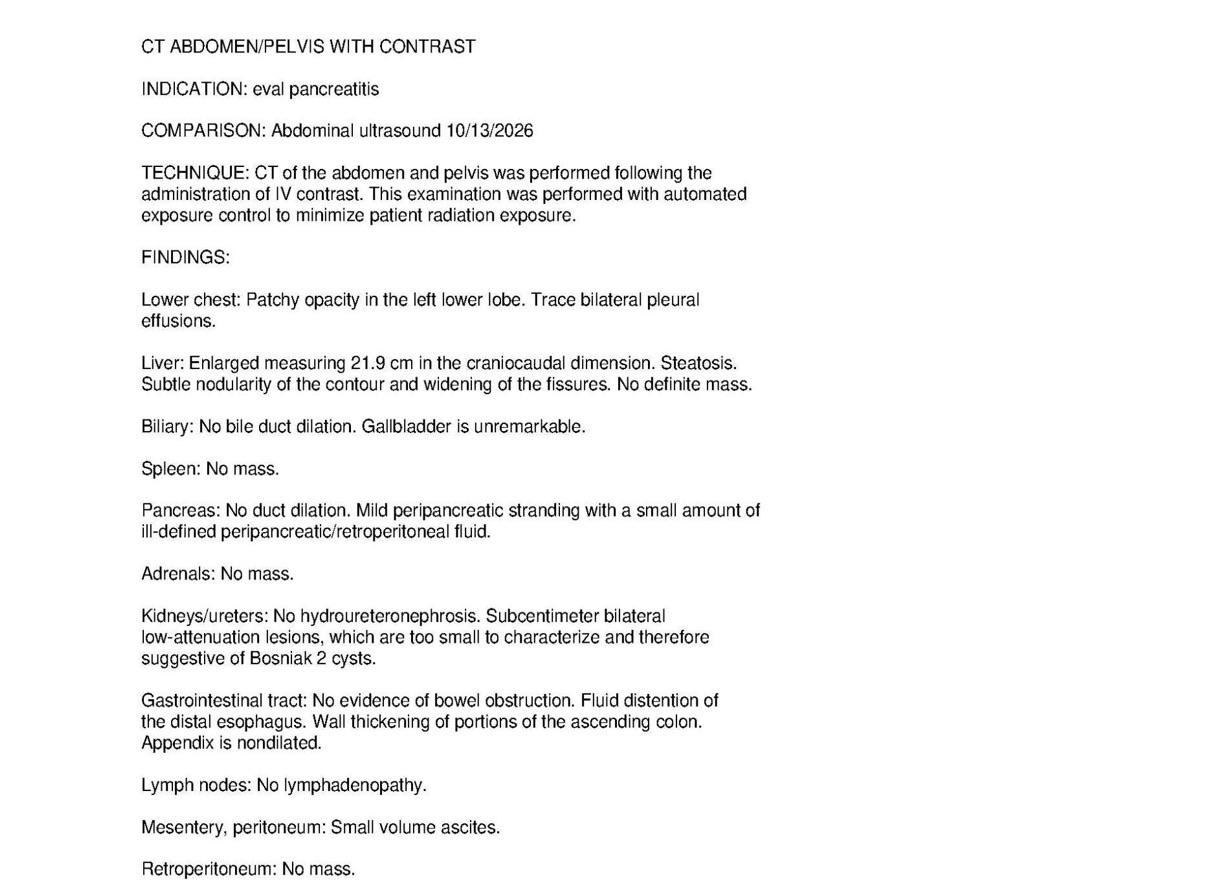
31, Male, 6’3”, 179 lbs
Hello all,
Recently after falling off the wagon the hardest I have in a long time (drinking around the clock, lack of eating towards the end of the “bender”) I was hospitalized. My bilirubin was extremely high and had pancreatitis. I have a history of alcohol use but never complications of this nature. I believe much of it had to do with lack of nutrition, as my electrolytes were in an alarming place (I.E. Sodium level of 114 when first admitted.)
This is no sob story, I am completely sober and receiving assistance for a month and a half now (incident was early October after drinking for 3 months straight (hard seltzers). My blood work continues to improve with every lab result I have received since. Thankful to move forward in better health.
As someone not well versed in medical terminology. I did receive this CT scan of my abdomen and was wondering exactly what it entails. How screwed I am potentially, etc. While I was shortly briefed on it, there was a lot going on and I’m not sure I retained all said information.
I understand this is not a recovery sub and I am strictly seeking info, as this sub appears very knowledgeable and dedicated to understanding health and health related risks
Appreciate any input. Attached is the Abdominal CT results.
r/PeterAttia • u/DrKevinTran • 8d ago

I'm a Doctor of Pharmacy and I carry APOE4/4, so I see a lot of people in my position retesting plasma p-tau217 every few months to check whether their protocol is working. I put that question to Dr. Heather Sandison, a naturopathic doctor who runs a memory-care practice and wrote Reversing Alzheimer's. Her answer is more cautious than the way the test is often marketed, so I'm curious how this sub sees it.
What she said
What the literature adds
The rest of the hour is practical: start with one change, and if you try keto, measure blood ketones and get HbA1c, fasting insulin, hsCRP and lipids first, with lipids again at about 12 weeks. A "zero carb" matcha blend spiked her blood sugar to 170 on a CGM.
My question for this sub: if you test p-tau217, what would a change in your number actually make you do differently? Or do you treat it as a one-time risk read and track function instead?
r/PeterAttia • u/AfshineEmraniMD • 8d ago


