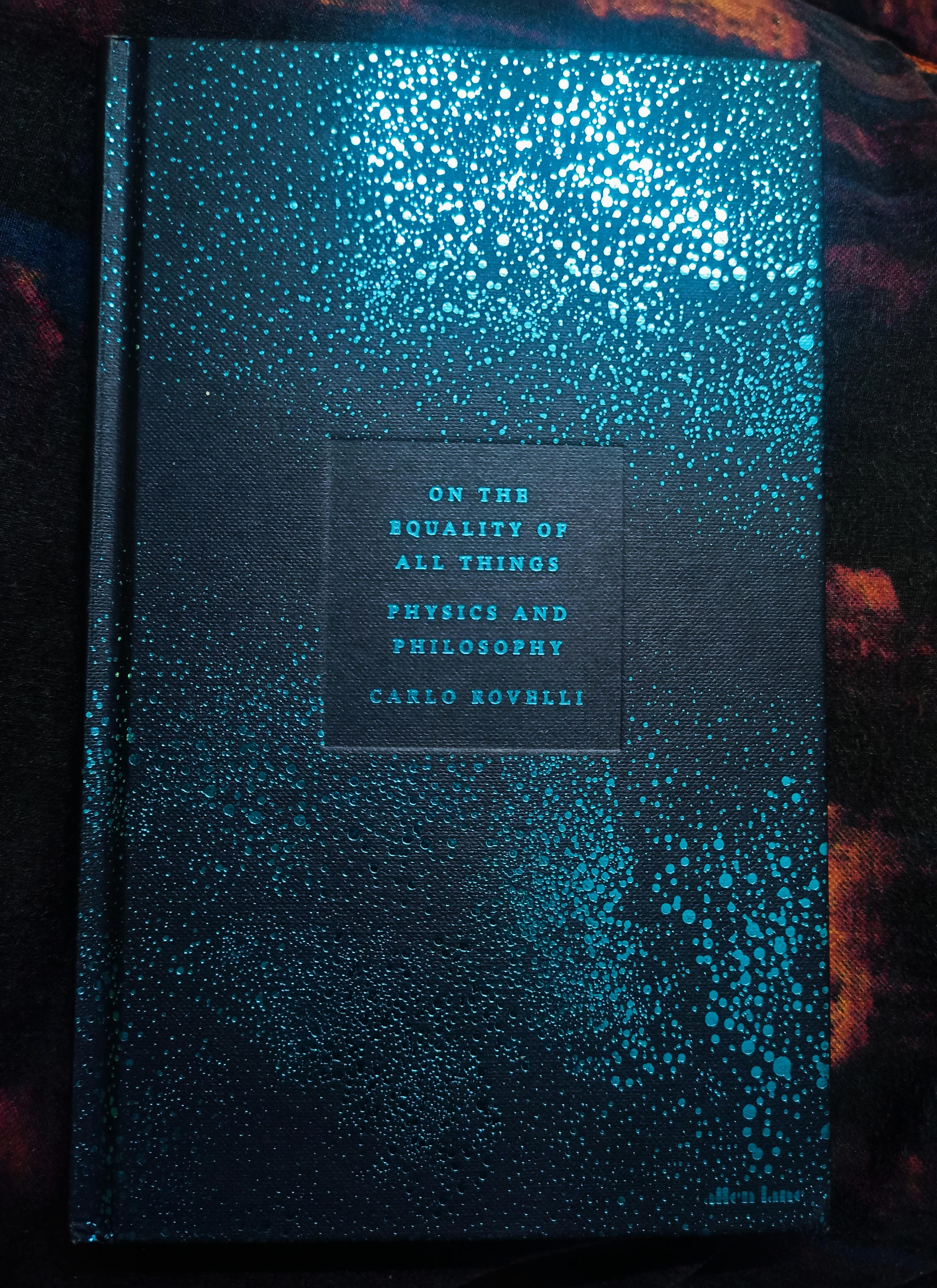
Premise:
It teaches anti-foundationalism (or Emptiness essentially, but in Physics and Morality) with examples from latest scientific ideas from space, time, matter, quanta, morality, consciousness etc. Subjectivism is hence, concluded to be the only reasonable scientific idea given the evidence currently, according to Rovelli.
Structure of the Book + Short summary:
1. Relational structure of Reality
- Concepts are products of experience, which is very limited, never absolute. Properties are attributed (mistakenly) to things themselves, instead of their relations with other things. Eg. Speed of a train.
- Niels Bohr's words rephrased: "properties of a physical system can't be considered independently from the interactions through which these properties manifest themselves, or from systems to which they manifest themselves."
- Every interaction leaves a trace. {Locard, anyone? 😆}
- Quanta: contextuality, probability, granularity. Double slit experiment simply says this - the electron doesn't have a definite position as long as it's not interacting; Wigner's friend problem is a good illustration (still mindboggling)
2. From Inside the Circle:
- Knowledge: How we (subject) possess information about the world(object). This information is necessarily embodied in some physical configuration. This includes errors, hence uncertainties. Famous fable of the Dreaming Butterfly.
- Max Born's statement on the root cause of all evil. In Buddhism and Vedanta too, I think, it's Ignorance, Desire to Attachment to certain ideas. Partial certainties is what we have, and it's really good enough for the world to reliably work and continue upon!
- The adherence to Ultimate Absolute Reality is, in Rovelli's terms, "projections of a psychological or cultural anxiety, extrapolations produced by fears of creatures..." - what Devdutt calls "Mythology" - Humans are insecure, hungry and afraid. So they come up with stories, symbols and rituals (myths) which help them cope. {I recently read Devdutt's book, so comparison was imminent}
- Circularity: "Circularity is a problem for those who aim to find an ultimate foundation from which everything follows linearly".
- Page 43 presents I think Rovelli's weakest argument - (argument by personal incredulity?) "...we would have found it by now" - that's a dangerous slope I think - For a scientist no less!
3. Spacetime
- Time: Stone is a process. Events==> Process. Time Dilation: "Duration between 2 events depends on the path between them." Space: a relationship between things/events. Newton's 'true space' is a version of Einstein's Gravitational Field which diffuses and oscillates, moves and is moved by the masses/energies of all other objects/fields. Distance is a manifestation of the gravitational field.
- Reality is a set of fields, which are extended entities - not sitting in Space or evolving in Time, but they're extension itself is Space and their evolution itself is Time.
- Loop Quantum gravity stuff I don't get at all.
4. Inhabiting flow of time
- Arrow of time, entropy. "Systems that detect Arrow of time do so by tracking dissipation".
- Cause and Effect, Memory and Causation... "Causal orientation of the world is only statistical". I think this relates to the entropy definition about Evolution of microstates ? Not sure.
- His free will compatibilism is not to my agreement- I think Sapolsky's arguments are sufficient for that.
5. What exists?
- By equality of all things, Rovelli means that the level of criteria we use to study a phenomenon (physics, chemistry, biology, psychology, sociology etc) are all equally relevant. None is more or less "fundamental" than the other- unless one is seeking the true ultimate foundation of everything - which is a meaningless exercise given current understanding of sciences. "Multiple descriptions of reality are a testament to unity in science, not disunity."
- His arguments against absolute moralism and realism, wrt to perspectivism/relationalism.
6. Without certainty or foundations
- Relations, processes, perspectives. The world as we know it admits to being described from within. We know it from within, we can't escape it. - reminds me of this banger line: "There are nexuses, causal relationships that cannot be separated." (Kudos to you if you can recognize where it's from 😆)
- Using Zhuangzhi - Huizi Fish story to discuss Nagel's Bat problem and Chalmers' Hard Consciousness problem - nice. Rovelli says, we always have an incomplete description of reality, be it a stone, fish or a friend. It's an arbitrary divide between "physical" and "mental" processes. Both are relational, both incompletely knowable.
Afterword: How science works:
- "ambiguity of concepts and language isn't a weakness but it's very strength - its infinite capacity to adapt,expand, evolve, slipping from ambiguity to ambiguity. It is ingenuity".
- We think in metaphors, analogies. Evolution of concepts is science.
What I need to learn more about:
- Intuitively I understood most of it because halfway thru the book, I was asking myself that "isn't this what Nagarjuna said also? Am I wrong to connect these?". Very happy to have it clearly stated by the author from 4th chapter onwards - it IS Emptiness. "All phenomenon is interrelated; or causation by interdependence, inherently empty".
- Having said that, I will happily confess - some chapters' technicalities flew right over my head 🥲 Loop Quantum Gravity. Hamiltonian stuff etc. Will try to read up more about that stuff...Recommendations are most welcome🙏
Conclusion:
Ever since reading about Shunyata (many years ago), I've been relating modern science to it, especially Quantum Physics' Uncertainty and Einstein's Relativity. I'm no scientist, and only have vague ideas about this stuff... But had always found them quite similar. This book explains why I thought so.
In essence, if one knows about Shunyata, I think anti-foundationalism becomes a way of life for them - one begins to accept skepticism as a humbling way of life. To be wary of absolute claims, to always be curious, to be ready to update one's beliefs given sufficient evidence - but I also saw the fears associated with such way of thinking while discussing it with a good friend - "that feeling of no foundation below you, isn't that scary? Nihilistic?" He put it in much better words than I could - "no foundation". I admitted, it is mentally exhausting at times - Oh how relaxing it would be to just accept a fixed permanent ultimate reality as described by X... but the questions never stop.
I'm sure I must have misunderstood a lot of ideas in here - still, this book has spurred me on to know more about the ideas mentioned above, and added more books on my TBR: Tao of Physics, More Heat than Light, Wittgenstein, Nagarjuna...
I'd recommend it for any layperson really, except the 3rd chapter - everything else is explained quite well. Good book for science/philosophy readers.
Rating: 8/10 (-2 for LQG which wasn't clear at all here, and Pg 43 where it's like an argument from his incredulity)
You can see more pics/passages from the book here - this sub limits 1 pic per post.