r/Physics • u/hopethaticandoit • 6d ago
Image Transitioning from an Electrical Engineering bachelor student to a master in Physics
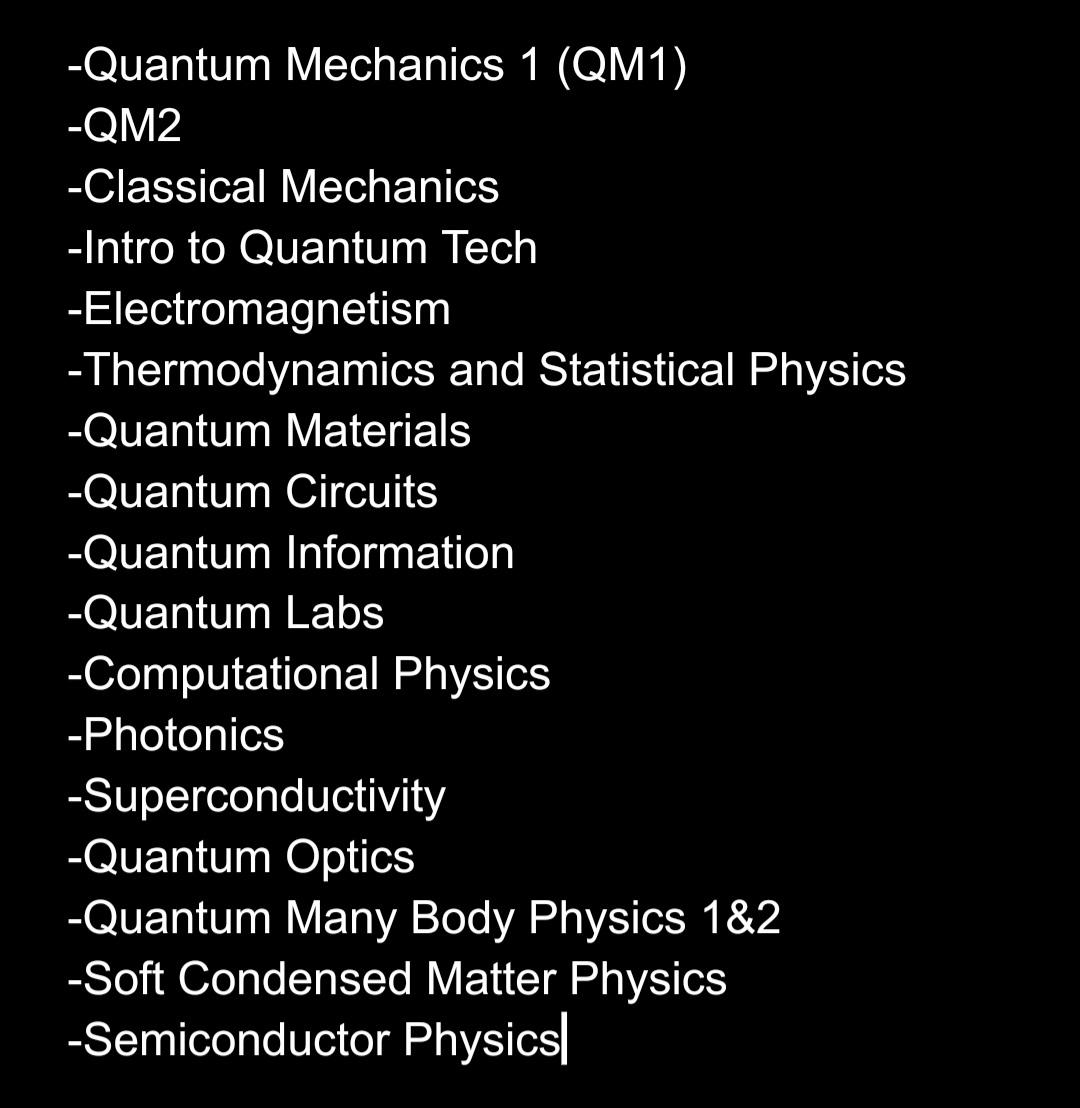
Hi (^-^) I hope you guys are doing well, and I am very curious about if it's possible for someone with an EE bachelor to do a master degree in Physics. A bit about my background: I am currently a bsc student majoring in EE and taking a minor in Quantum Tech at a university in Northern Europe (#1 in my country btw). My GPA is 4.9x/5, and now I’m working as a teaching assistant for some physics courses, research assistant for a research group about quantum things at my school, and I’m planning to spend 20ects of my bachelor thesis for this group too. Below there I also attached a list of some physics courses that I have taken/am taking at school.
To sum up, I believe that I already have a solid platform of physics knowledge. Currently, I already have an offer to go for a master degree in Engineering Physics at the university where I am studying. However, for personal reasons, I would like to apply to other MSc/Phd programs as well to broaden my opportunities.
I would like to ask whether transitioning from EE to Physics is possible, especially for top tier universities in Europe and the US? Would a bachelor's degree in EE be viewed as a weakness when applying to Physics programs, even if I have taken a lot of Physics courses?
210
u/ironny 6d ago
This is like when pretty women post to r/amiugly
ETA: Not saying you want attention, just saying you don't know how well-positioned you are 😆
56
u/Hawaiipineapple98 6d ago
you clearly need more dancing classes
24
u/Andrei_Khan 6d ago
Definitely possible imo. The courses you have taken are considered minor or a dual mjaor requirements in my uni. Transition to physics from EE or ME and vice versa happens more often than ppl think.
26
u/Ntroepy 6d ago
I would say having an EE degree by itself is definitely a weakness by itself, but you seem to have compensated by taking many physics classes.
It helps that your looking towards engineering or applied physics as theoretical physics might be a harder play.
Can any of your colleagues physics professors write letters of recommendation saying how passionate you are about physics and are smart/driven enough to succeed? Or, better yet, are any an alumni of universities that you want to attend or at least know physics professors at those places?
8
u/ExtremeAd7729 6d ago
Yeah definitely possible. I know people who transitioned from EE to Physics in grad school and they did it without having taken any physics courses (other than the basic ones engineering students take) prior to that.
6
u/dad3murph 6d ago
Of course? Like I have a little trouble believing that you would even doubt it TBH. I only got a bachelors, but took a few of the more advanced grad courses as electives, and there was a guy who made took an identical path in one class that I met. I think we were taking statistical mechanics. Probably the hardest class I took, he was handling it as well as anyone.
5
u/Hummerville 6d ago
Noone is even considering if your undergrad is a 'weakness'. Just how you are performing in grad school. I went from BSEE to Physics PhD. They don't give a shit
3
u/LemonHead0428 Astrophysics 6d ago
I don't think you would have major issues as long as you did well in your physics courses, especially if you are interested in more "applied" than "theoretical" specialties. With an EE background, I would think programs with specialties in instrumentation would take you very seriously (again, assuming your grades are broadly good). Research experience is also undeniably important, somewhat less so for a MS first as opposed to straight into a PhD.
3
u/ilan-brami-rosilio 6d ago
Not a problem at all.
At the maximum, they may require you to complete a few other courses from Physics undergrad, but based on the list above, it seems unlikely.
Anyway, you're good to go.
The best thig will be to approach the head of the physics M.S. program and ask him/her directly. You'll get the official answer.
3
u/bongclown0 6d ago
Its certainly possible. One notable example is Paul Dirac. Another relatively recent one is Ramamurthi Shankar.
3
u/qtc0 6d ago
I transitioned from a masters in EE to a phd in astrophysics. Wasn’t bad at all. Especially since my thesis was in instrumentation.
4
u/cabbagemeister Mathematical physics 6d ago
Your course list is good, definitely more than alot of physics undergrads, especially for applied physics
2
u/B008YMAN 6d ago
One of the visiting professors at our university was actually a licensed Mechanical engineer before he pivoted to Theoretical Nuclear Physics in his graduate studies and post-doctorate so you should be fine more or less
2
u/ROBIN_1764 5d ago
I have a professor at my institute who did EE and went straight for Phd in Condensed matter physics, you're alright
1
u/PaganAttrition 6d ago
I went from aerospace masters degree to physics PhD with fewer courses than this.
1
u/Mooks79 6d ago
I switched from EE to physics after my first year.
1
u/LostWall1389 5d ago
Go into the applied physics, astronomy instrumentation, medical, nuclear fields which would benefit from EE knowledge. There’s quite a lot.
1
u/LionSuneater 5d ago edited 2h ago
You're good to go
1
u/AltoidNerd 5d ago
It has been my observation they EE students generally are the most prepared to make that switch. You seem like one of the more prepared ones among that group. You’re good
1
u/DubayaTF 5d ago
You're prepared for it. Masters in physics isn't broadly considered useful. Those tend to be participation awards for dropping out of PhD programs in the US, but maybe it's different in Europe.
Ed Witten had an undergrad degree in history and Princeton took him for a PhD in physics.
1
u/operafan77 5d ago
I did my bachelors in BME, and I was able to get a 2:1 for my Masters in photonics and optoelectronics.
1
u/Comprehensive_Food51 4d ago
You definitely have everything you need, I don’t know for Europe but here in Canada (I guess US is similar?) I really don’t see why a supervisor won’t take you as their grad student. Plus many people who graduate in dual programs like math and physics don’t have much more advanced physics courses than this and are much appreciated by professor for grad positions. And you also have all the basics (CM, QM, stat mechs, EM). One of my physics professors who was a theoretical physicist initially graduated from physical engineering and went into physics at a prestigious university for grad school, and another one was a physics major and did a PhD in physical engineering (not physics) and still landed in physics research with a professor position. There’s overlap between some areas of both fields and your profile is very strong.
1
u/Tjmac145 3d ago edited 3d ago
I think it's definitely possible! I kinda did the opposite (Eng. Physics -> EE). I definitely found that the physics background helped sooooo much, especially with solid-state/QM device physics. Idk what it's like in Europe, but I imagine you'll just need to find a good supervisor who'll take you on without the full Physics bachelor's.
You could also find a EE supervisor that comes from a physics background. At my Uni. a lot of the profs working on the cool stuff (Optics, IC physics, QM memory... etc. ) don't have engineering degrees
1
u/settembre55 3d ago
Complimenti ho grande ammirazione per chi riesce a capire queste cose io farei una fatica esagerata mi deprimo della mia pochezza solo al pensiero!
0
u/Senanb 6d ago
I am someone with a masters in Physics and I am recommending you to stay in Electrical engineering. It is a much more employable major. The only interviews I have gotten is either for a PhD or at hedge funds. Your options at the moment in the current job market are limited to PhD, hedge funds or teaching. That is all for now.
0
u/drinkingcarrots 6d ago
Might want more classical mechanic and electromagnetism if there are deeper classes. But honestly it looks fine, you should be alright.
-4
u/seekingdefs 6d ago
No QFT? No string theory? No GR?