r/ProfessorFinance • u/whatevervibestoday • 11h ago
Humor Portfolio down 60% but market recovers
3
Upvotes
r/ProfessorFinance • • Aug 15 '25
Welcome to /r/ProfessorFinance!
This FAQ is a quick-reference guide for commonly used financial terms you’ll see in discussions here. It’s designed for both beginners and those who want a refresher.
⸻
What’s the difference between real and nominal value? Nominal value is the raw number without inflation adjustment. Real value accounts for inflation to show true purchasing power over time.
How do real and nominal interest rates differ? Nominal interest is the stated rate; real interest subtracts inflation to reveal actual growth in buying power.
What is inflation? The general rise in prices over time, which erodes the value of money.
What is deflation? A general decline in prices, often tied to recessions or weak demand.
What does purchasing power mean? The amount of goods or services one unit of currency can buy; it decreases as prices rise.
What is compound interest? Interest calculated on both the original principal and the accumulated interest from earlier periods.
What does diversification do? It spreads investments across different assets to reduce the impact of a single loss.
What are bonds? Debt securities that pay fixed interest; issued by governments or corporations to raise funds.
What are equities (stocks)? Shares of ownership in a company, which can generate returns through price increases and dividends.
What’s a mutual fund? A pooled investment that buys a diversified portfolio of assets on behalf of many investors.
What’s an ETF? An exchange-traded fund — a basket of securities traded on an exchange, often tracking an index.
What does market capitalization mean? The total market value of a company’s shares (share price × number of shares).
What is liquidity? How easily and quickly something can be converted to cash without losing value.
What is volatility? A measure of how much an asset’s price moves up or down over a given period.
What is risk tolerance? An investor’s ability and willingness to handle losses in pursuit of gains.
Chat link: Finance Fundamentals
Source: Investopedia
Real Value: Definition, Calculation Example, vs. Nominal Value
r/ProfessorFinance • • Oct 15 '24

r/ProfessorFinance • u/whatevervibestoday • 11h ago
r/ProfessorFinance • u/Beautiful-Wish-8916 • 9h ago
r/ProfessorFinance • u/whatevervibestoday • 11h ago
r/ProfessorFinance • u/Middle-Storm-7762 • 15h ago
r/ProfessorFinance • u/ExotiquePlayboy • 1d ago
r/ProfessorFinance • u/jackandjillonthehill • 1d ago

Former Megaspeed executive Alice Huang is at the centre of US investigations into whether Nvidia’s largest client in south-east Asia was involved in the underground chip trade. Some US officials suspect Alice Huang was a Chinese spy, a claim Beijing dismissed as a “smear”.
Linked to Alice Huang was a sprawling web of companies between Nvidia and China-based users of its chips that included cloud computing partners, online gaming tycoons, Cambodian traffickers and hundreds of shell companies, the FT found.
These seemingly unconnected enterprises combined — without necessarily being aware of the full picture — to make billions of dollars from one of the most profitable illicit trades in the world: moving Nvidia chips into China.
The FT traced the connections after speaking to more than a dozen people with knowledge of the operations, revealing links that were obscured by complex structures through hundreds of corporate filings.
r/ProfessorFinance • u/Traditional-Bad-5830 • 1d ago
r/ProfessorFinance • u/SorbetWilliams863 • 1d ago
r/ProfessorFinance • u/ElitistPopulist • 1d ago

r/ProfessorFinance • u/jackandjillonthehill • 2d ago

Tom Brown, a co-founder and chief compute officer of Anthropic PBC, plans to announce a donation to Trump accounts, according to a person briefed on the matter.
The person, who requested anonymity because the matter is private, confirmed comments made by Treasury Secretary Scott Bessent earlier Friday on CNBC.
“One of the Anthropic founders is going to make a large gift to Trump account over the next few weeks,” Bessent said, without providing more details. “You’ll hear from their families soon.”
Trump Accounts, launched last July, give every eligible child access to a tax-deferred investment account authorized by the US government. Roughly 70 million accounts have been established so far.
r/ProfessorFinance • u/Qweskj • 2d ago

r/ProfessorFinance • u/jackandjillonthehill • 3d ago

Lenders backing SpaceX’s latest $43bn debt package, which is secured by its advanced AI chips, have tried to bar Elon Musk from firing the collateral into space as part of his plan for orbital data centres.
The world’s richest man has outlined ambitious plans to power AI models with data centres cooled by the vacuum of space. That will require packing satellites full of advanced chips.
SpaceX has said it plans to use the chips involved in the debt deal on Earth. But lenders have expressed concerns that if the group later decided to shoot the valuable chips that underpin their loans into space, it would prevent them from reclaiming and selling the semiconductors in the event of a default, according to people familiar with the matter.
r/ProfessorFinance • u/Designer_Donkey_7743 • 2d ago
With Jensen Huang’s resignation, Nvidia has formally entered a turbulent phase. While its balance sheet, free cash flow, and CUDA moat still look formidable on paper, markets price future certainty rather than past triumphs—and beneath the surface, several converging risks are about to test every assumption behind a multi-trillion-dollar valuation.
Huang’s departure is not a routine leadership handoff; it fractures a corporate governance model built around a single strongman’s commercial instincts and flat, highly centralized authority. Dozens of executives reported directly to him with almost no buffer layer, a structure that moved at blistering speed during industry tailwinds but leaves no seamless replacement. Rebuilding accountable governance in an AI race measured in quarters or months brings inevitable friction, internal power struggles, and execution drag.
At the same time, tightening U.S. restrictions on advanced AI chip exports and overseas compute rentals threaten Nvidia’s fastest-growing profit channels. Southeast Asia—led by Singapore—has recently accounted for roughly 15% to 22% of quarterly revenue, far beyond local end-user demand due to compute routing and cross-border leasing gray areas. Closing those channels puts a high-margin revenue pillar directly in the crosshairs.
Compounding this is the fragile off-balance-sheet loop powering “neocloud” demand. Operators like CoreWeave and Nebius rely heavily on debt, leases, equity backing, and Nvidia’s financial support or capacity backstops to scale rapidly, even as heavy depreciation and interest weigh on unit economics. If downstream AI monetization disappoints or Nvidia tightens financial backing amid its own governance transition, follow-on orders could stall abruptly.
Most perilous of all is political and regulatory exposure. If investigations show Nvidia tolerated or facilitated workarounds to evade U.S. export controls, Washington’s national-security posture around semiconductors means the fallout would go far beyond standard fines. When governance vacuums, export tightening, neocloud leverage, and political risk collide at once, Nvidia’s troubles have only just begun.
What do you all think? Is Nvidia’s moat strong enough to absorb a leadership vacuum and tighter export/neocloud scrutiny at the same time, or is its valuation priced for perfection that’s slipping away? Let’s talk about it.
Author's Note: This post is a condensed framing distilled from my original essay on Medium, if you're interested in the full analytical breakdown, feel free to check out the links in my Reddit bio.
r/ProfessorFinance • u/Proof_Kangaroo_2813 • 3d ago

After reading a bit about Leopold and watching some podcasts, I believe a lot of his success came from the fact that he had worked at OpenAI during the release of the first Ai model, and he obviously knew enough about OpenAI to be fired for “leaking info.” I feel a lot of people see him as another Oracle, when in reality… I think it was basically insider trading. He knew exactly what was necessary for the AI infrastructure buildout and he knew which companies would benefit (probably why he felt comfortable with so much leverage). I won’t be betting against Leopold going into the future, but I don’t think his knowledge will be as valuable going forward as the AI thing enters new phases of evolution and development. From here on out, I think he’s playing a guessing game.
r/ProfessorFinance • u/jackandjillonthehill • 2d ago
r/ProfessorFinance • u/economyxAI • 3d ago
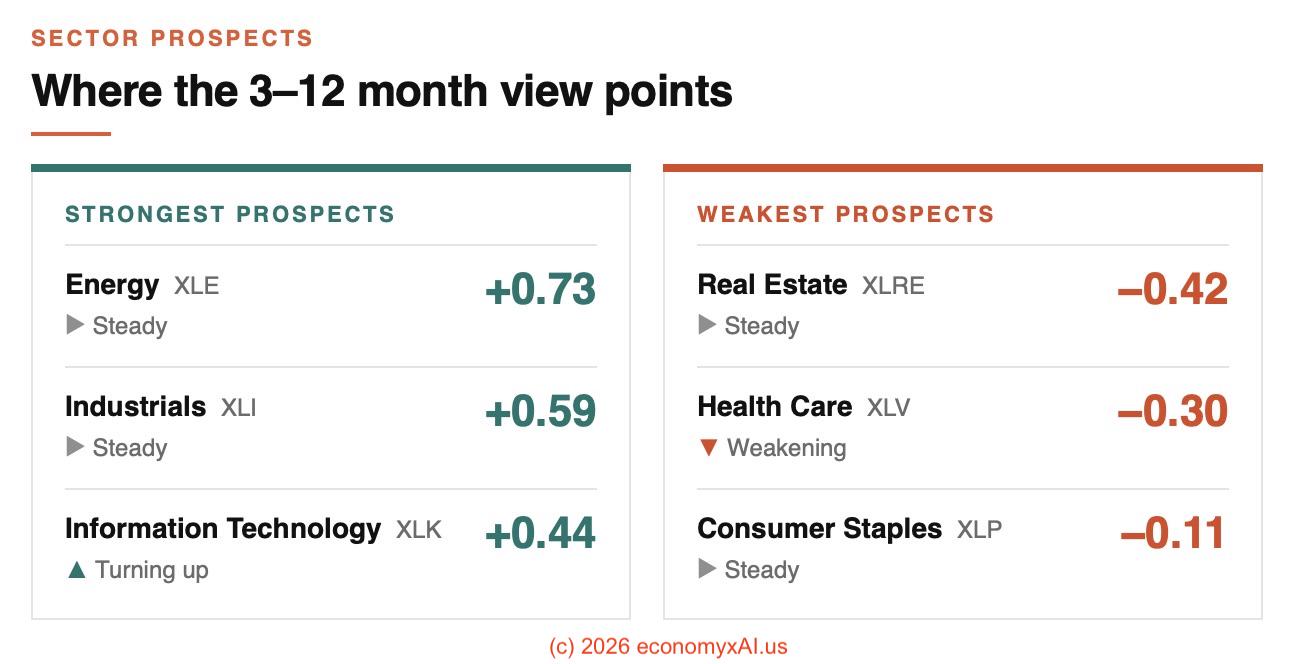
Energy from Trump's war and all that. IT, OK there's an AI hype right now. But Industrials is surprising because I would have thought Trump's tarrifs and trade wars would have sh**ed on that sector.
r/ProfessorFinance • u/Designer_Donkey_7743 • 3d ago
If the US stock market suffers a major crash in the current environment, the trigger will almost certainly be an unexpected shock in the AI supply chain.
Strip away AI-related companies, and the earnings growth of the rest of the US equity market has been pretty lackluster—nowhere near enough to justify current valuations. More importantly, AI Capex has become the primary engine of the broader US economy, accounting for roughly 1.8% of GDP and contributing nearly a third of US economic growth in 2026 (per Goldman Sachs and ING estimates). If that engine stalls, traditional sectors simply can't fill the void, making a fundamentally driven recession and market downtrend almost unavoidable.
Right now, the warning signs across the AI value chain are moving from "investor skepticism" to concrete risk variables:
* Quarterly free cash flow at hyperscalers like Alphabet, Meta, and Amazon has started turning negative.
* Compressed forward P/E multiples across AI hardware stocks suggest the market is already pricing in a cyclical peak.
* Any black swan event hitting a bellwether like Nvidia could easily spark a chain-reaction meltdown.
Here is the real problem if a crash actually hits: where does the fleeing capital go?
In a normal downturn, money rotates into defensive equities or US Treasuries. Not this time. With massive federal debt eroding US dollar credit, long-term Treasuries won't absorb all that panic capital. At best, some money hides in short-term T-bills, while the rest pours into gold and commodities—which will only fuel global stagflation and tie the hands of central banks trying to cut rates.
At the same time, we’ll likely see foreign capital pull out of the US, accelerating de-dollarization and global rebalancing. We already saw a dress rehearsal for this during the early November 2026 AI pullback, when foreign funds rapidly exited crowded Asian AI trades and rotated back into blue chips in markets like India.
The Fed and Treasury still have policy tools, of course, but any intervention will only buy temporary relief at an exorbitant cost. Liquidity can paper over cracks, but it can't replace a broken growth engine.
Do you think traditional safe havens like US Treasuries still work in a debt-heavy, AI-driven downturn, or are commodities and non-US equities the only real hedges left? Let's discuss.
Author's Note: This post is a condensed framing distilled from my original essay on Medium. If you're interested in the full analytical breakdown, feel free to check out the links in my Reddit bio.
r/ProfessorFinance • u/Fun_Room3253 • 3d ago
r/ProfessorFinance • u/Aegeansunset12 • 3d ago
You can criticise transparency, democratic institutions and such but on the economic front I fail to see how any of this is a disaster. Economy is something we can measure.
