That's exactly why it's so powerful. Why spend all the effort writing fast code if you can just use a much simpler language to describe the task on a higher level and call fast code? People use Python because it's easy to read and write, not because its interpreter is fast
I will never understand the Python hate. It's essentially just a level of abstraction higher than C, which makes it more accessible than ever to write powerful code.
I'm starting to think it's literally not that deep. It just feels good to gatekeep.
By that logic C++ doesn't actually do anything since it's compiled to assembly/machine code which is what actually does everything.
It's not quite the same since Python is not compiled, but the point still stands that higher level languages provide an extra layer of abstraction, making complex programs easier to write, making them useful.
As someone else said, I hate the type system, and it's compounded by poor documentation. My lab has a pretty large data analysis framework written in Python and every time I need to write more code that interacts with it, it's like pulling teeth to find out how to do anything. I never know what type an object is until I waste my time doing debug inspection or print statements. Once I know what type the object is, I don't know what methods that type has available because every library is documented in a different way and none of them seem to just list the methods underneath each type.
It's like the entire language was made to be learned by following tutorials instead of reading documentation. It's no wonder everyone I know is using AI to write it instead of dealing with this shit.
"That's just shitty code" is of course true, but hard to convince them of when it's the typical way the language is written. Aside from that, the language shouldn't require me to write comments that will inevitably become outdated, it should just have a functioning type system.
My lab has a pretty large data analysis framework written in Python and every time I need to write more code that interacts with it, it's like pulling teeth to find out how to do anything
That just sounds like your lab doesn't know how to write python. The vanilla language has had a built in type annotation library for nearly a decade now. On top of that, you can use validator libraries like pydantic to make all of the assertive data models you need.
Also, the second you start talking about documentation, I gotta stop you in your tracks. Documentation is not a technical problem associated with any language in particular, it's 10 times outta 10 a human problem. Be-it you/your-coworers are lazy, just want to close a ticket, or "this is just a prototype", it comes down to your company's culture about doing due diligence. Python has nothing to do with that, and if you're blaming PyDocStrings of all things, one of the easiest things of all-time to use, then I'm sorry but that's a you problem. lol
> Documentation is not a technical problem associated with any language in particular, it's 10 times outta 10 a human problem
Of course documentation problems can be solved by human effort, but python in particular lends itself to poorly documented libraries. The documentation for any specific method doesn't tell me exactly what types to pass in because it basically *can't* tell me what types to pass in. It will just try to coerce any arguments into something that works internally. Sometimes it'll work and sometimes it won't.
> it comes down to your company's culture about doing due diligence
This is simply not addressing my complaint at all. I'm not complaining about poor internal documentation of our own code (though I could), I'm complaining about public libraries not clearly telling me how to use them.
A lot of seems like bad practices. The type issue can be partially mitigated by type hints. Just make sure you read the warnings generated by the interpreter.
Literally just use type hints + mypy/pyright and this is a complete non issue. Bit concerning the lab you work at hasn't figured this basic principle out yet
I hate the cruft like __blahblah__ everywhere, names like hasattr, the fact that you can’t put multiple statements in a lambda, the fact that imports can pollute local scope and you can’t easily tell where a given identifier came from in a file, and the other package management problems that didn’t have an elegant solution until uv.
I haven’t messed with mypy, but from what I can tell, it isn’t as sophisticated and expressive as Typescript.
The virtual machine still doesn’t perform well compared to V8 for JS, as far as I understand. You can accomplish a lot with Python sure, but Modern JS/Typescript is a more capable high level dynamic language, it just doesn’t have the breadth of libraries for ML and scientific computing that Python does
Some of the stupid shit is fixed as the language evolves, like uv and TS over JS. New stupid shit appears too (node_modules bloat).
Python does well, or at least okay enough, what it proposes to do. So does Typescript. I don't get the point of stating that TS is "more capable" and then following up with "but Python has ML".
I was replying to the comment of someone saying they think the hate is superficial. Just providing an example of the more substantive personal reasons I hate Python. We’re all allowed to have our personal opinions about what stupid shit we hate in particular.
By more capable I meant the core of the language has better performance and type checking.
Nothing, once you know that, unlike other languages, it is O(N log N), NOT O(N). The issue is that the most common use case, unordered_set, is the "exception" because of the chosen naming.
Better naming would be set and ordered_set, like other languages do. It would prevent newcomers to the language from mistakenly using set when what they want is unordered_set, a silly mistake that's easy to make. I did it myself.
People do that to any and all languages, the more popular and established the language is the more hate it will get. This was the norm when I studied masters in data science many years ago, and I was told it was the norm many years prior. I even participated; like some kind of spontaneus religious syntax cults of neckbeards and misfits.
Luckily I outgrew it quickly. I like python, js, php, haskell, prolog, all the "C"s, and so on. They're all fun.
F*** Java though, it's s*** and ******, ***** ** never again. (/s)
I like Python, but I have some stuff I dislike about it. For example, half-baked typing. And some libraries being written in such a way thry are completely useless in terms of type hints and intelisense.
There are solutions to all of those, ranging from providing a shell script that does all of that for them, to using pyinstaller to make an exe that includes the interpreter, to using a tool like uv.
But yeah, if you're gonna use an interpreted language, you gotta have an interpreter. And it's definitely true that it's more work on your end if you don't want your users to have to understand computers.
Right? This guy thinks it’s difficult to make python work cross platform. From another of their comments it seems like they can get node to work cross platform just fine but python is too much. Use what you want to use but I think this guy needs to read a tutorial or two
What do you use instead? I’ve not found a high level language that doesn’t require some complex environment set up and works universally without configuration.
Well you see, this script will be used once a day every day. The C program is better because it will break even over time! (720 000 days -> 1972 years) After that, its all performance benefit baby
It would take three-quarters of a million runs to break even in pure time, even discounting the fact that in nearly all cases, computer-seconds are millions if not billions or trillions of times cheaper than developer-seconds.
Someone once wrote a bash script that used jq to parse through a few thousand large json files and do stuff with the data. It would take hours to run, but people figured it was just the massive amount of data. It was at the point where we'd run it over night.
I had a thought: no, it's execing jq for each file. Exec is slow.
Did it in python, that just iterated through the directory and used the built in json stuff. It did the same job in 10 minutes.
Could C be faster? Maybe. Did we care at that point?
I am currently a developer at one of the big banks, and I don't think people here have heard of "milliseconds" before.
If you're in the right field, micro-optimizations are everything, but in 99% of situations, good enough is truly good enough. The difference between 20ms and 50ms has never directly been meaningful in my life outside of entertainment (games, movies, music).
Yes, "under the hood" my computer OS and my router and the intercontinental cables do need to care about this. 99.9% of employees don't because it's done for them.
Lmao brother my second sentence was "if you're in the right field...", which it sounds like you are.
You're part of the backbone of society, but it's something I never have to worry about of thanks to people like you. I get to use springboot and angular to build internal apps where there's no customer who complains about slow loading screens.
Yes, but how often are you actually building an application that's meant to be run directly as compiled thousands of times over and over again with no I/O, database queries, or dependence on any other blocking code that takes Ionger than 50ms?
In that scenario, sure, Python is the wrong choice. But in the vast majority of real world applications, the raw execution speed of a for loop doesn't really matter that much, and there's probably already a library built for Python that does exactly what you need way better than you'd ever be able to build yourself in Rust or C++.
It really does add up though. Every library that has that mentality is why modern programs are soo poor performing even though computers are way faster.
I'm not talking about libraries, I'm talking about applications. Libraries are more likely to fall into the scenario I mentioned where python is genuinely a bad choice. But even then, there are plenty of examples of pure Python libraries that are highly performant in a real world context. Look at Starlette, for example, or any of the built-in python modules.
Python provides high-level abstraction and easier to understand code. Yes, this comes at a cost. But like any abstraction, if properly applied, it can result in far better performing code than you ever would have been able to write without it.
Code is read more than it is written. You don't pay only 8 hours in this example.
Also consider the compounding cost. Imagine saying to your manager: "we can do it fast and simple in python in two weeks, or we can do it "properly" in 8 weeks to get a marginal increase in performance that is basically unnoticeable at our scale."
Imagine the fucking side eye you're gonna get.
But then, if these 30ms can mean the difference between your drone dodging or striking a lamppost, then please, do use C.
Which is exactly why all "Python do slow" arguments are bad. Yes, of course, if I would do my matrix multiplications in Python for loops it would take forever. But I am using torch with cuda backend. Which is faster than any C++ code i am able to write
No python by-far does not have dependency-hell, save for a small handful of libraries that have dependencies outside of the python ecosystem. Think GPU libraries like cuda and what not. Those have a lot of hell to deal with specifically because of the escaped ecosystem and dependence on physical hardware.
Complaining that dependencies have dependencies as if it's some massive sin is like opening up the hood of a car and discovering that the engine is made up of smaller parts. shocked pikachu face. By this logic, every programing language on earth is a dependency hell.
You don't get cross-dependency conflicts much if-ever anymore, (the actual definition of DH). Python is smart enough to version your site packages based on python's minor-versions, such-that even if you do have two of the same site packages, (say one for py3.9 and another for py3.14), then it will resolve the correct version per-library, based on how the package is declared.
Node used to not do this, which is when and where DH became most infamous. But even Node does the same sub-versioning these days. If you're still getting stuck in dependency hell in this day and age, that's just a skill issue.
That's not really true IMO, Python is one of the more "batteries included" languages. Node has improved a lot with built-ins and newer libs but that used to be the classic example of importing a module to do basic things like string padding or asserts.
Not to say your experience is wrong, it's just the projects you've seen probably made the choice to import more things, or were doing something specific that needed more deps.
Python dependency hell means someone is doing something wrong somewhere. Each project should just have its own venv when you download it and the maintainer of the project needs to pin the dependency versions. A lot of projects define a minimum version but not a maximum version for their dependencies so when any of them introduce breaking changes in an update (which I see happening often) people won't be able to run the project anymore. Just define a maximum version for everything things are chill.
Why would I reinvent the wheel every time I need something that rolls? Of course I’m going to use libraries. I’ve got other shit in my life to do besides rewriting the same code somebody already wrote and put out there specifically for folks reuse.
While in a sense this is true, C gives you the ability to write code once and compile it for different computer architectures. You can't really do that with assembly, nor with maschine code
C doesn't actually do anything without the compilers. And the cross compatibility was the point of a high language like C (and it's compiler's), whereas assembly is basically always architecture specific.
Ok but like compute is so cheap compared to human time that most people actually don't give a fuck and give me enough money to have my own place. And when resources are constraint enough or its system programming, they use C, C++ or Rust and do their own thing without bordering python developers.
Maybe and I would try to change it but what I do it's deployed to AWS and I don't work at Microsoft which is the worst offender in this. So I'm powerless.
There's a difference between not being optimized and being poorly designed in the first place. Saving milliseconds on how fast your app load isn't worth developer time. That same app taking seconds to load a single image is a bad developer and no amount of "compute is cheap" is going to fix that.
I don't get the Python hate, I'm not going to implement a function from scratch when I can just import it in python. If it gets the job done, who cares if its written in some other language.
Weird it's almost like most programming concepts and task have already been written. Oh well better write my seven layered interface class set to do crud ops on my db table like a big boy! 🤓
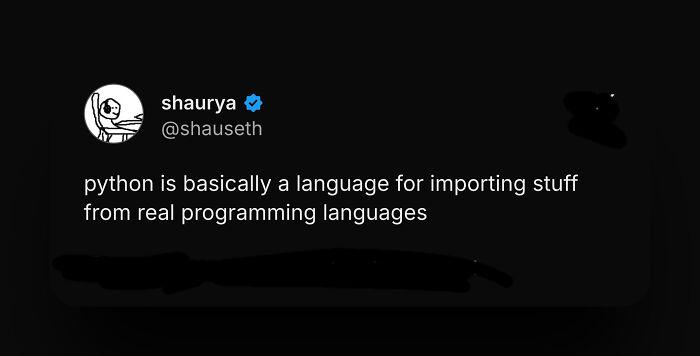
529
u/TapRemarkable9652 Sep 08 '26 •
from C import fix()
fix(my_codebase):
return jasoN
698
u/mlnm_falcon Sep 08 '26
684
u/TheJaskinator Sep 08 '26
That's exactly why it's so powerful. Why spend all the effort writing fast code if you can just use a much simpler language to describe the task on a higher level and call fast code? People use Python because it's easy to read and write, not because its interpreter is fast
42
u/Amekaze Sep 08 '26
Python is proof that like 85% of the hard problems were solved decades ago. Right now we are just re arranging the solutions on different datasets.
79
u/Anaxamander57 Sep 08 '26
And that's an incredibly useful abstraction.
16
u/Something13457 Sep 09 '26
Wow, youre telling me someone already did it better and I can just do an install and abstract it?
How fucking terrible
66
u/dewey-defeats-truman Sep 08 '26
You mean I get all the speed and memory benefits of using a more powerful language, as well as the ease of reading and writing Python? Sign me up!
19
u/Bee-Aromatic Sep 08 '26
Why would I reinvent the wheel every time I need something that rolls? Of course I’m going to use libraries. I’ve got other shit in my life to do besides rewriting the same code somebody already wrote and put out there specifically for folks reuse.
89
u/setibeings Sep 08 '26
And C is just language written for people who don't want to write the assembly for themselves.
And assembly language is just a crutch for people who don't want to write machine language.
And computers are just for people who don't want to do all of of that calculation using a pen and paper.
And pen and paper are just for people who don't want to keep all of those numbers in their heads.
And heads are just... You get the idea.
48
u/frikilinux2 Sep 08 '26
Ok but like compute is so cheap compared to human time that most people actually don't give a fuck and give me enough money to have my own place. And when resources are constraint enough or its system programming, they use C, C++ or Rust and do their own thing without bordering python developers.
15
u/Darkstar_111 Sep 08 '26
How DARE YOU!
I mean, that's TRUE... but how dare you!
5
u/wann_bubatz_egal Sep 08 '26
from html import HTML
5
u/ChickenSpaceProgram Sep 09 '26
python code is just a dignified bash script
5
u/EskilPotet Sep 09 '26
This has to be the single most reposted meme on this sub by now
4
u/firemark_pl Sep 08 '26
That's the scroll of truth!
Yeah Im upset.
4
u/ThatFireGuy0 Sep 08 '26
I thought this until I found you can compile Python into real languages, which is somehow better
10
u/0-0x0 Sep 08 '26
Python was how we prompted other languages before prompting LLMs was a thing.
3
u/plz-no-b4n Sep 08 '26
Yes, and…?
3
u/inobody_somebody Sep 09 '26
I don't get the Python hate, I'm not going to implement a function from scratch when I can just import it in python. If it gets the job done, who cares if its written in some other language.
3
u/geeshta Sep 09 '26
"real programming languages" are just languages to import real programs (binaries)
2
u/Gold-Bat-3225 Sep 08 '26
the praying is the load bearing part
1
u/JaaXxii Sep 08 '26
Sounds like the English language too
1
u/ArcheopteryxRex Sep 09 '26
It is a tremendously useful glue language.
1
u/Character-Education3 Sep 09 '26
Hell yeah, fuck yeah!
1
u/BlazeCrystal Sep 09 '26
For looking like almost written english, one gets whole bunch of normie support
1
u/Kadabrium Sep 09 '26
human jit
1
u/stlcdr Sep 09 '26
Next up:
Programming Python is just the same as vibe coding.
1
u/RatbyteGames Sep 09 '26
Shots fired!
1
u/you-should-learn-c Sep 09 '26
That's the fucking point
1
u/Exact-Pound-6993 Sep 09 '26
1
u/SeventhOblivion Sep 10 '26
Weird it's almost like most programming concepts and task have already been written. Oh well better write my seven layered interface class set to do crud ops on my db table like a big boy! 🤓
1
u/ArchiveOfTheButton Sep 10 '26
i mean isnt that the point of a scripting lang tho
1
u/collabskus Sep 12 '26
Numpy is love
1
u/False-Beautiful-1246 Sep 22 '26
Cython users crying in the corner of the room because no one cares
1
u/TheRealLargedwarf Sep 29 '26
Python is Bash++
1
u/LPedraz Sep 08 '26
All but assembly are.
-1
u/q0099 Sep 08 '26
r/Angryupvote