I dont think so, Wolfram Alpha is deterministic. Whereas an LLM is non-deterministic by design. Personally i feel vibe coding or vibe mathing is inherently non-deterministic.
Its gotten a little better with the introduction of subagents, but sometimed I truly want to know what their algorythm spat out to propose certain changes. No, I do not want to refactor across 4 classes to make 1 unit test work, I told you to fix the unit tests so I hit my ai mandate encouraged quota
They are not. Floating point math and difference in how quickly parallel operations on GPU are finished causes them to be not deterministic even with temp=0. You can force them to be deterministic by forcing some operations to be executed in specific order but you lose a lot of performance.
Also, and this is pedantic and arguable, it’s worth considering whether any model that cannot be retrained to produce the same statistical surface is non-deterministic by nature.
If I sort shapes into piles using some amount of randomness would you say that the resulting piles are deterministic just because they stay the same every time you go through them? Or would you say they’re non-deterministic because the process that created the piles in the first place was non-deterministic?
It doesn't matter how you make the model, if you are executing it on a GPU without steps to have deterministic results you will not have deterministic results. Ensuring the output of computations on GPU is deterministic has performance impact.
Hold on, I’m agreeing with you. We’re saying the same thing in different ways.
The kind of race conditions you’re referencing are because of the model architecture I’m referencing.
You can absolutely get ML outputs that don’t change using certain model architectures. But that’s only because those architectures either enforce order of execution or use steps where order of execution doesn’t result in changes to outputs. I can’t think of a modern LLM that uses such an architecture.
True, but it's also true that running an LLM at 0 "temperature" (which makes it truly deterministic) also often renders it unusable. So almost every inference setup defaults to using a certain amount of randomness.
Specific LLMs used for specific coding tasks. I don't run any of my Qwen models at 0 temp, that results in them getting stuck in reasoning loops, and also producing sub-par output when they do return something.
That, plus now if you use an agent you have to make sure it's the exact same version of the same agent with the same prompt history or you could just be receiving a different output.
It's like the modern incarnation of trying to figure out what strain of weed the original coder was smoking
LLMs are not non deterministic by design??? Why do people always get this wrong. If you use the same seed and disable the temperature setting you will always get the same result. It's just a f*cking Compute Graph.
I feel like P=NP if true would imply that there exist deep and important results as yet unknown in a number of mathematical fields from group theory to algebraic geometry and could will be the most important breakthrough in our understanding of the structure of finite groups and the result would stand on something more profound than even the TSW conjecture.
You would get money for this proof too. I remember discussing with my Algo prof how I also too just felt like there is absolutely no way p=np. Like its a hunch but one I'd bet a lot on
It's incredibly unlikely. There's a reason all of the best computer scientists haven't been able to prove it thus far. Lol, you'd get more than money... You would break the world. Especially if you were adversarial. Everything becomes an 0day.
But this could also become largely irrelevant regardless of proving it depending on how quantum plays out here. The rules of classical computation are only confined to that structure. Meaningless if you can walk into another dimension with different axioms
You could have galactic algorithms that do p=np and not break the world because they require something stupid or the polynomial is still so large it would take a billion years to break encryption. There was a beat of djikstras that is like this, noone will use it cause its overhead is insane compared to the default
Brilliant. You just gotta make sure to consider the separate case of P=0 first so you're not doing division by zero. But that's a trivial case anyways.
I'm sorry but this is stupid. Constants and degrees of polynomials can be huge making even polynomial algorithms impractical. It would have no practical implications.
An algorithm with O(x10^20) runtime may as well be exponential.
No, this is stupid. Such polynomial algorithms simply don't show up. P (or BPP to be more precise) is generally agreed to be class of tractable problems because the constant and degrees are almost always reasonable. You only get something ridiculous like O(x10^20) if you specifically try to construct it.
If they are equal it would give you some theoretical construction of a polynomial algorithms for any NP algorithm. The catch would be that the exponents are huge but technically it's polynomial.
idk why everyone keeps saying this. Everyone is quite certain that it will be proven that P!=NP. P=NP is extremely unlikely and there's many reasons for this.
I would submit that we also need a proof of the conjecture first postulated by a certain Clinician Andre and his rather meddling associate of the canine persuasion so to speak, which posits that there is indeed a Unified Bitch Theory.
that’s actually incredibly valid. it was a poor assumption i made in an attempt to be less derogatory but ended up being worse, completely missing the point that a bitch can just be anyone of annoyance.
mathematically, it actually increases the set of what cannot be in the 99 problem set and i would argue drastically increases the complexity
It's easy getting the answer you're looking for, what's hard is understanding the problem enough, that's no different either with AI or having a calculator in a physics exam. The tool will only get you so far as you're ready to put into words
That source doesn’t say that Open AI stole anything. They cannot actually tell - but either way the guys working manually on it had not yet produced any proof. Open AI published a novel proof and it was to the actual problem. They also had a different approach and offered to let the original guys author the paper if they agreed that open ai had helped solve it.
I’m no Open AI lover but it is a bit disingenuous to allude that they cheated their way to an answer when they were admittedly the first to prove anything.
Open AI actually used the guys non-trivial approach to the problem.
Them mentioning him regardless and even mentioning they cannot rule out customer data was used was certainly something marketing loved to write in there
I don't understand why people keep parotting that when the truth is so easily findable. To make it short :
Late August 2026, Leven Alpöge and Tristan Buckmaster solved the 3D Euler problem (with Claude, so AI as well), which is a small part of the Navier Stokes.
5 September, the openAI agents first solved the 3D Euler problem (that part is the drama, because some say that they used the data of Alpöge and Buckmaster), then they solved the full Navier-stokes.
8 September, openAI announced a Lean-checked proof of the C and D statements of the Millenium Prize. Another drama is that, on that same day, Buckmaster posted his proof of a part of the Navier Stokes problem (but, not the full problem, unlike openAI).
My loose understanding is that, the mathematicians figured put the first step. They figured out an approach that seemed like it could lead to the full solution.
To rigorously figure out and prove the full solution, (something academics prefer doing slowly and surely ) was going to take them time and effort.
Well suddenly less then a week later openAI announces they have a full solution using that approach. They used an obscene amount of computational power not available to anyone else to basically brute force figure out the full solution.
The question is now who deserves that credit? How did openAI know to use their approach? The mathematicians figured out the key, they would have figured out the full solution given time. openAI jumped the gun before they physically ever could due to absurd resources, but how did openAI know to try that? Did they spy on the mathematicians? It seems likely.
There are bigger implications besides questions of theft and espionage. Will human mathematicians ever be credited with another discovery? Or will AI companies get to claim all the credit because their tools took human ideas and crunched the numbers on a massive inhuman scale. Especially with how sketchy they’re acting and how loose and amoral AI companies act when data gathering.
Mathematician here! This is exactly where there is concern. Most big problems that are solved come together from a small collection of new ideas. In this case, a team announced a very promising direction, then the problem itself was solved by GPT in an approach suspiciously like that idea.
Even if it turns out GPT did not steal the research, their models are trained on the entirety of the Internet and have almost certainly absorbed some of this approach. We don't need AI solving problems in math, particularly not ones that don't really result in any surprising new results (this is, in fact, not that relevant to math so much as is it a problem of great mathematical interest).
So now, with results that feel suspicious being published by an AI company cheering themselves on, there is great fear in the community at large that AI is just gonna steal any promising direction that's openly stated.
Mathematics has long been an open community of shared ideas, and that's now very much in danger.
They offered him a false dichotomy of two choices that both served their purpose while acting sketchy as hell. Implying he should have accepted is absurd.
It’s like they offered the Van Gogh credit for the sketch of his painting while they used AI to generate what a fully painted version would look like. All while they were celebrating creating an amazing impressionist painting.
The problem here is that one of the mathematicians who worked on the solution, Leven Alpöge, also works for Anthropic. Anthropic wants to leave his name without credit and give it wholly to Tristan Buckmaster. It doesn't solve the problem of Anthropic wanting to take some amount of credit as a company, and that they/ any company with vast amounts of compute can just take the ideas that others have proposed and take credit away from the actual humans
OpenAI also claims that part of why they started looking at millennium prizes is that they heard Anthropic had already been working on one, they weren't the first to start using AI to do that. Funnily enough, one of the guys in the pair that were working on this one happens to work at Anthropic.
On the contrary : the guys at openAI put the agents to work very soon after they heard the Alpöge and Buckmaster has solved the 3D Euler problem, and we know that the whole thing took 88 hours, so 5 September is totally reasonable.
They had 1000 agents running non-stop for 88 hours. The whole thing costed 15m usd.
And Buckmaster himself said that he had no idea how to actually do what the openAI agents did. The only thing he is contesting is the credit for the 3D Euler problem, not the Navier Stokes.
I don't have the details, but I'm assuming it's as simple as taking the cost of having a model run for one hour, then multiplicating it by 88 and then by 10000.
And yeah, there is some irony in using 15 million to solve a problem with a prize money of 1 million (especially when they said that they would refuse the prize money anyway), but the point of science has never been to make money.
They did it because they want to ipo soon and this would be a positive headline for them in the WSJ. They got exactly what they wanted and don't need the $1MUSD.
$15M is the based on how many tokens they used, as in what it would cost someone other than Open AI to buy 130 billion output tokens. Though the model they actually used isn't currently available commercially.
There's already a lot of claims and/or false/wrong "proofs" of the Riemann conjecture on the internet. AI only needs to learn them and tell us they are legit! Solved 🤗
I don't understand why people use codex or anything like that. The first hit on Google says it gives "direct access to local file system". Basically your machine and everything on it is now theirs. Who needs exploits when victims just willingly install an implant?
I get the ability to be more efficient but at what price? Congratulations it's now training on your family photos, tax returns, medical bills, and more (including your close held math proof project or that local project you're working on for fun but could turn into a startup)!
Has AI actually solved any major, unsolved problems from computer science? Because "AI can do programming" is the comp-sci equivalent of "computers can do arithmetic". And neither will be the end of their respective field.
Reminds me of a half remembered ancedote about 2 scientists reviewing a fairly pop-sci type book. Scientist 1: As a mathematician, chemist, and biologist I noticed a lot of flaws in those chapters; but the chapter on astronomy was fascinating. Scientist 2: What a coincidence, as an astronomer I had the exact opposite experience
With 'get a foothold' into a topic I mean exactly that. AI usually does not make up all the stuff. The more specific and detailed the answer get the more 'dangerous' it gets. But AI is pretty good to get a summary / an overview of a topic. With that I can deepen my search by other means. For fun: AI -> wikipedia. For real: AI -> wikipedia -> technical documentation/specification/research papers.
Edit: like with real people. I takes a (long) while till I trust/believe anybody something at face value without doublechecking.
But "finding exploits" is largely just busy-work. Have you seen how modern fuzzing suites work? They just throw odd occurrences and inputs at the target until something interesting happens. That was essentially automated long before AI, just less efficiently so.
Most of the "new" exploits AI "discovers" are just known issues in little-used codepaths. Take the copy-fail exploit for instance. "don't allow the user arbitrary, kernel-level write access into protected memory regions" was hardly news. It's just that that happened in a module almost noone was using (and thus noone was actively maintaining or debugging).
I say a regular old fuzzing suite given the same amount of billions of dollars in compute could've found all those issues. And probably more. It's just that noone runs that big a fuzzing farm and then publishes their exploits. On the contrary, the people running vulnerability discovery on that scale will actively prevent the bugs they found from being fixed: nation-state actors.
AI is really good at barfing out code that I then have to spend hours fixing because it got everything wrong, and made anything it did get right way to verbose.
Having TA'd (really just taught for my prof) a coding class the semester the university rolled out AI access, it's also great at rolling out technically correct code that has nothing to do with the problem at hand and is beyond the user's ability to critically evaluate.
I had to tell one student that I could tell he used chatgpt to finish his homework because it was the first time I'd seen him bother to fill out the name and date section of an assignment template, let alone comment his code or use functions that weren't in our curriculum.
honestly that all these AI companies are super obsessed with trying different methods to solve maths problems is kind of showing the absolutely massively positive regard for maths that they all have.
Yeah it's somewhat funny to me, because computers were already great at finding counterexamples long before AI.
We basically apply the infinite monkey theorem with lightning fast and highly scalable monkeys to find possible examples that destroy hypothesis.
We also can now snort AI slop Lean code that can be automatically verified to search for proofs as well.
But whoever knows programming also knows: Working code != good code and if you don't understand the code in question maintenance is hell.
The same is true with vibe proofs: For example they improved an important bound on the Riemann Hypothesis significantly with AI, however, no one could made sense now of the gibberish that was created.
Math is a "Strukturwissenschaft" (structural science). We study why things work. The results are important, but so are the inner workings and the process to get there and to understand why this works in the first place. take the famous scene from The Hitchhiker's Guide to the Galaxy: Deep Thought brought the answer to everything which is 42, but no one knew how to make sense of that. The same will happen here: AI will verify a theorem but no one knows why the hell it is true in the first place.
And then there is the fact that Lean as a tool isn't perfect either. Just recently someone found a bug with a faulty proof that compiled while it was not true. So understanding is important to be absolutely certain as well.
Mathematics is completely different from what calculators and they actually took the job of lot of women who were called “computers” who used to do heavy calculations by hand
The noose isn't around our neck cause AI can help solve problems. It's cause so many people are so fucking gullible and drink the Kool aid so hard you're all drowning in it.
There's plenty of information coming out that shows the AI didn't "solve" anything. It applied training data they stole from researchers using their platform.
AI was likely part of what was helping this researchers do the work. Which could be great if that's what OpenAI was marketing - a tool to accelerate humans. But instead, they stole the work and passed it off in 2 dangerous ways:
As if they get all the credit
As if the model did it independently from first principles
Not to mention all this extra stuff that they didn't solve it but made a counter example and can't actually explain why it works. This part admittedly I'm not good enough at math to really know what this means.
It's the same thing with programming. It can only do what it does because they're training off our work. Have any of you ever tried to get it to work with a new major update or new technology? It's already a dumbass most of the time with code it DOES have training data on but it literally can't function with code outside the training data.
Everyone needs to accept that these companies are lying to you constantly, stealing from you constantly, and all LLMs are a function of their training data. That doesn't make them bad or not an extremely useful tool, but they are not actual intelligence, they are not going to replace humans completely anytime soon, and without our training data OpenAI and anthropic are fucked.
I think they didn't really solve it. The core prompt was a stolen idea from a real mathematician. In order for a truly AI solves something, the AI have to spontaneously start wondering things.
It is just another cheap, fuck up thing by the AI company, alongside with their many infringe on copyright.
but they did solve a problem that was unsolvable for centuries, while many humans tried to solve it right?
When AI cures cancer, you will probably be the new generation of antivaxxers who will let their kids die cause "the solution came from ai and i dont understand ai therefore i hate it".
They brute forced something that may or maybe not prove something, but potentially finding a counter example.
This problem already has "solutions" (though no perfect or full) and their effortd still needed people. It wasnt just "go find a proof for the agent swarm".
Its marketing PR and will take months before it can be properly reviewed.
However, one question is why didnt OpenAI release it through the proper channels, like every other maths paper....
If you know the story, there are two people who are working on it and probably gonna solve it soon.
And you make a lot of assumptions here. So. Maybe try harder next time.
Edit: a few more input, I am okay with some scientists using AI tools to solve things. I am not okay with some AI companies stealing idea from someone else. Then solves it and claims it as their AI did. Bonus point is because one of the two mathematician is from anthropic so they absolutely don't want to mention it.
Ah man, I remember finding out how horrible it is to read soulless code. The fact there was NO thought behind it. I used to read code trying to find the mental framework of the author, so I could understand the trade offs they made, or at least debate them with myself before arguing and wasting the authors time. With AI code, there is no reason. No thought process. It is random code that might or might not work. There is no “well it will prevent xyz in the future” line of thought.
I can only imagine how horrible this must be for math. You no longer can assume the author has some level of capability, a mental framework they applied to the logic of their solution. You have to check every step and combine them all to check if it actually makes sense. I feel sorry for the mathematicians that used to expand their minds by reading other peoples work. There is nothing in AI code or math that will expand your mind. Just randomness that might or might not make any sense.
That’s something that is missing from these discussions about solving these mathematical problems. Is they aren’t generally solved as “Proofs”, which as you say are the soul of a solution.
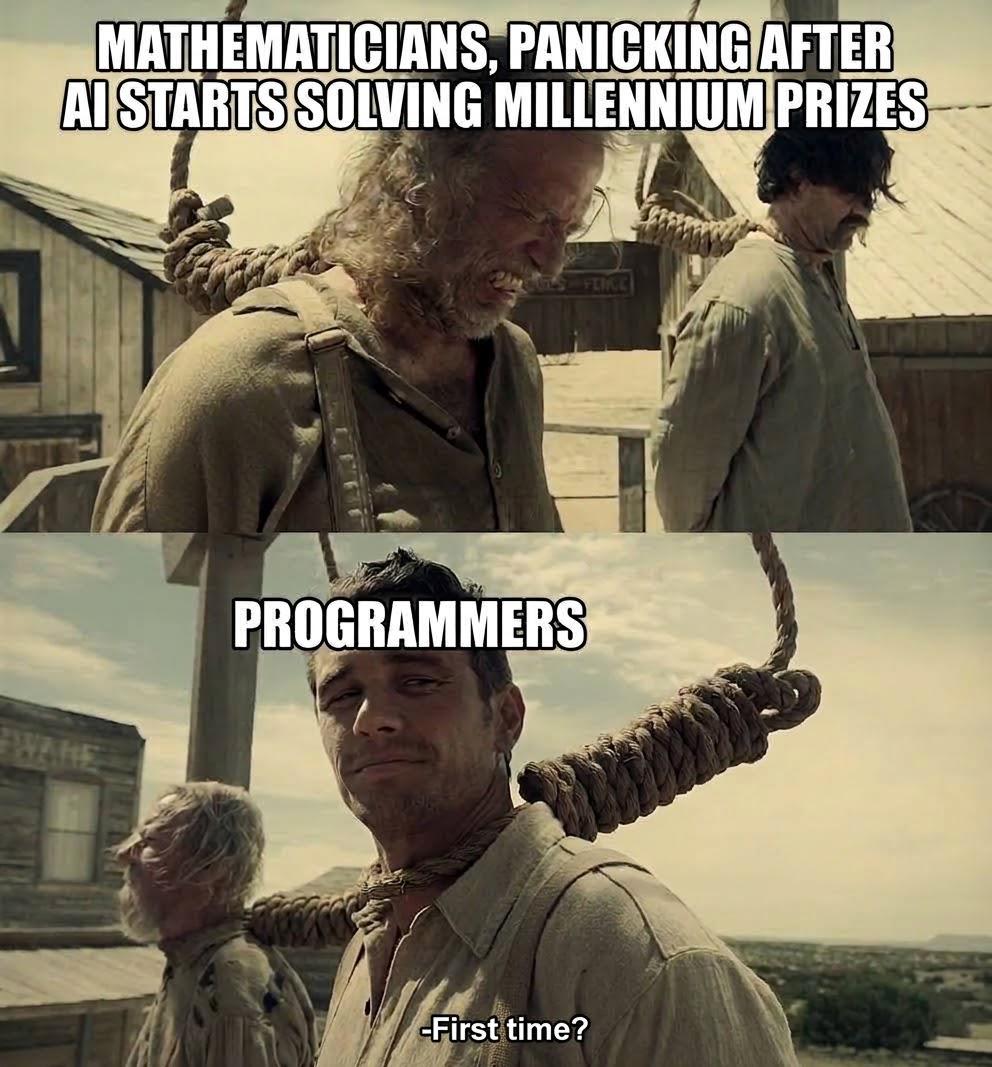
Another way of looking at it... Programmers are on the left and James Franco "everyone who's job was replaced by software" saying "first time?"
I mean I'm part of it but the lack of self awareness from the SWE/programming community is kind of insane. Like I'm seeing "feel bad" videos for all the people out of work who used to make 250k/yr and all I can think is "nobody made videos for the literal hundreds of millions (maybe Billions?) that have been displaced by software and robotics over the last 50 years." Because nobody cares about them, apparently.
But in my own mind, I've spent my career automating... It would not be lost on me that making pity videos after getting laid off due to automation finally coming after ME would sort of be... in bad taste. Right? Like if you spend 20 years making software that repalces people (and this is what most software has done - most of it falls into this bucket) I would be like "yeah this sucks but... This is what I was doing to every one else for 20 years. Made a killing too! Sign on bonuses, stock options, free lunches, all sorts of great shit."
Legitamte question - does the average SWE really think they have not been a part of displacing other folks into struggling long before GPT?
I think part of that is historically speaking, SWE/robotics replacement had a few “upsides” if you want to call them that:
- Often created products people really wanted to use for cheaper (see: Netflix, Uber) - Often created new jobs (so many industries like all sorts of IT, consulting, cybersecurity, SWE, PM, chips, etc.) - The jobs are generally good, high paying, high prestige, good working conditions jobs - The jobs go to the “right people” - educated smart people - Many people consider the job to be inherently enjoyable in a way a lot of other jobs aren’t (ie. a lot of SWE people actually like coding) - Happened with some degree of slowness - decades to ramp up usually - Affected the “right jobs” - usually not the most high paid, high prestige jobs - Affected the “right people” - lower skill labor - Often had more localized effects (one team replaced, one town’s factory workers closed)
I think fundamentally you’re right that SWEs are in the business of labor replacement, and it’s finally time for us to reap what we’ve sown, but I think there’s reasons why the average SWE can feel like we’re “different”.
I wouldn’t say most SWEs like coding, but I’d say a higher % probably genuinely like it, more so than most other professions. People code as a hobby, even if there’s no financial benefit. Lots of people’s favorite class in college involved CS. There’s a nerd culture around SWE that you wouldn’t say in say, consulting - most of my friends in consulting don’t like their job for any reason other than money and fancy dinners lol. At least me personally, I genuinely enjoy SWE work a good chunk of the time.
AI so far hasn’t diminished my enjoyment of coding itself because it has thankfully decreased the amount of time I spend dealing with random bugs, one-off hacky scripts/tests, and trying to find documentation for one random function. And has prevented me from making some dumbass decisions when I missed something. It lets me focus more on design, which is nice. Though to be fair, I think things may change in the future with more advanced models, and also I do think I use AI more carefully than most (I still try to understand every line of code, which I think is growing uncommon lol).
Lol this is unironically whats going on. I haven't heard anything about this but since reddit is hey achshually-ing it im gonna look into and its probably true.
I'm still not convinced vibe coding can give you a good result if you're not already good at coding and could do the things you're asking the AI to do.
It will never not be wild to me that programmers sat and helped develop their own replacement. The fact that genAI turned out to be garbage was the best case scenario for them.
MATHEMATICIANS No one PANICKING AFTER AI STARTS SOLVING company tries to steal the solution for MILLENNIUM PRIZES from the actual human that solved it.
I'm calling it now - Harness Engineer is the new Full Stack Developer. People are already using 20,000 line custom harnesses, so imagine what they'll demand in a few years.
not to the extent of now with modern AIs, but computational brute forcing and then NNs (which are already decades old) have been used to tackle math problems for decades.
I am willing to bet in a few months time there is a quite story about how the "proof" is no actual very good and everyone will just ignore it and go on about the next thing.
2.1k
u/bhannik-itiswatitis Sep 10 '26 •
vibe mathing
564
u/Cant_Win Sep 10 '26
P = NP is still out there!
325
u/zirky Sep 10 '26 edited Sep 11 '26 •
i propose the jay z conjecture: mathematically prove that a successful rapper is able to have 99 problems and a bitch was not among them
edit: went back to the original lyrics because i feel i made a poor assumption
1.5k
u/mpanase Sep 10 '26
to be more precise, after ai starts solving millennium prizes one day after somebody else publishes a solution
132
u/SoldRIP Sep 11 '26
Has AI actually solved any major, unsolved problems from computer science? Because "AI can do programming" is the comp-sci equivalent of "computers can do arithmetic". And neither will be the end of their respective field.
60
u/danfish_77 Sep 10 '26
Mathematicians famously have so many job opportunities to steal lol
67
u/Multidream Sep 11 '26
Buddy, mathematicians have been getting the short end of the stick for like 50 years now, this meme really oughtta be swapped
40
u/WhyTheOverlyLongName Sep 10 '26
English textile workers:
13
u/cuntmong Sep 11 '26
AI VCs are rejoicing as they have finally cracked AGI for the 4th or 5th time
8
u/SignoreBanana Sep 11 '26
I genuinely feel bad for mathematicians though. They get a lot of joy out of solving the problems and it's their entire job.
We build software products. Problem solving was just the fun part about it.
8
u/Cephell Sep 11 '26
Solve or counter example? Be honest.
8
u/AndyceeIT Sep 11 '26
In fairness, Mathematicians survived the pocket calculator too
7
u/Brovas Sep 11 '26
The noose isn't around our neck cause AI can help solve problems. It's cause so many people are so fucking gullible and drink the Kool aid so hard you're all drowning in it.
There's plenty of information coming out that shows the AI didn't "solve" anything. It applied training data they stole from researchers using their platform.
AI was likely part of what was helping this researchers do the work. Which could be great if that's what OpenAI was marketing - a tool to accelerate humans. But instead, they stole the work and passed it off in 2 dangerous ways:
Not to mention all this extra stuff that they didn't solve it but made a counter example and can't actually explain why it works. This part admittedly I'm not good enough at math to really know what this means.
It's the same thing with programming. It can only do what it does because they're training off our work. Have any of you ever tried to get it to work with a new major update or new technology? It's already a dumbass most of the time with code it DOES have training data on but it literally can't function with code outside the training data.
Everyone needs to accept that these companies are lying to you constantly, stealing from you constantly, and all LLMs are a function of their training data. That doesn't make them bad or not an extremely useful tool, but they are not actual intelligence, they are not going to replace humans completely anytime soon, and without our training data OpenAI and anthropic are fucked.
26
u/MoonsterGoopter Sep 11 '26
"AI starts solving"
no it didn't. what a morally bankrupt industry.
5
u/badudx Sep 11 '26
Name one
27
u/gundam1945 Sep 11 '26
I think they didn't really solve it. The core prompt was a stolen idea from a real mathematician. In order for a truly AI solves something, the AI have to spontaneously start wondering things.
It is just another cheap, fuck up thing by the AI company, alongside with their many infringe on copyright.
4
u/flinxsl Sep 11 '26
It still sucks really bad at electrical engineering.
4
u/MalaysiaTeacher Sep 11 '26
You're acting like coding was LLM's first challenge. Spoiler: it was maths.
3
u/smooth_kid_wtg Sep 12 '26
AI didn't solve the prize, it stole the work from mathematicians.
9
u/RustOnTheEdge Sep 11 '26
Ah man, I remember finding out how horrible it is to read soulless code. The fact there was NO thought behind it. I used to read code trying to find the mental framework of the author, so I could understand the trade offs they made, or at least debate them with myself before arguing and wasting the authors time. With AI code, there is no reason. No thought process. It is random code that might or might not work. There is no “well it will prevent xyz in the future” line of thought.
I can only imagine how horrible this must be for math. You no longer can assume the author has some level of capability, a mental framework they applied to the logic of their solution. You have to check every step and combine them all to check if it actually makes sense. I feel sorry for the mathematicians that used to expand their minds by reading other peoples work. There is nothing in AI code or math that will expand your mind. Just randomness that might or might not make any sense.
15
u/watduhdamhell Sep 10 '26 edited Sep 10 '26
Another way of looking at it... Programmers are on the left and James Franco "everyone who's job was replaced by software" saying "first time?"
I mean I'm part of it but the lack of self awareness from the SWE/programming community is kind of insane. Like I'm seeing "feel bad" videos for all the people out of work who used to make 250k/yr and all I can think is "nobody made videos for the literal hundreds of millions (maybe Billions?) that have been displaced by software and robotics over the last 50 years." Because nobody cares about them, apparently.
But in my own mind, I've spent my career automating... It would not be lost on me that making pity videos after getting laid off due to automation finally coming after ME would sort of be... in bad taste. Right? Like if you spend 20 years making software that repalces people (and this is what most software has done - most of it falls into this bucket) I would be like "yeah this sucks but... This is what I was doing to every one else for 20 years. Made a killing too! Sign on bonuses, stock options, free lunches, all sorts of great shit."
Legitamte question - does the average SWE really think they have not been a part of displacing other folks into struggling long before GPT?
34
u/balbok7721 Sep 10 '26
If anyone actully cares. (AI didnt actually discover anything)
https://www.youtube.com/watch?v=ZJ8KThKAfbs
4
u/walterbanana Sep 11 '26
I'm still not convinced vibe coding can give you a good result if you're not already good at coding and could do the things you're asking the AI to do.
2
u/Ov3rdose_EvE Sep 11 '26
it stole that knowledge from mathematicans.
2
u/DukeOfSlough Sep 11 '26
Please, no. I don't think there could be something worse than maths phd equipped with AI.
2
u/Geesuv Sep 11 '26
It will never not be wild to me that programmers sat and helped develop their own replacement. The fact that genAI turned out to be garbage was the best case scenario for them.
2
u/berael Sep 11 '26
MATHEMATICIANSNo one PANICKING AFTER AISTARTS SOLVINGcompany tries to steal the solution for MILLENNIUM PRIZES from the actual human that solved it.2
u/Rainmaker526 Sep 11 '26
It didn't solve. It stole. As it always does.
3
u/blackcomb-pc Sep 11 '26
No it didn’t. OpenAI stole the solution.
2
u/bunoso Sep 11 '26
The real credit goes to Lean programming language that actually verified the proof
1
u/whirlboy Sep 11 '26
What about mathematicans back when calculators were invented? First time?
1
u/chiniyabadam Sep 11 '26
Proof by ChatGPT
1
u/lardgsus Sep 11 '26
"oh no it's helping"
1
u/RobertVandenberg Sep 12 '26
The irony is, math is the absolute foundation of LLM so it can be said that math gives birth to it. Now the offspring is taking over its mother.
1
u/promptmike Sep 12 '26
I'm calling it now - Harness Engineer is the new Full Stack Developer. People are already using 20,000 line custom harnesses, so imagine what they'll demand in a few years.
1
u/zromitsman Sep 12 '26
wasn't that one of the very specific purposes of scientific AI (the use of AI before chat chippy tea)
1
u/Stunning_Ride_220 Sep 12 '26
Panicking?
Nawr, but just like the programmers they get their stuff stolen and get screwed.
0
u/erebuxy Sep 10 '26
Computational math is not a new thing
0
u/flipinbits Sep 11 '26
You’re telling me AI will turn me into a good mathematician just like it made me an artist!?
-1
u/Random_182f2565 Sep 11 '26
Why mathematicians aren't happy that they get new tools to work with? Are they stupid?
-5
u/Pares_Marchant Sep 11 '26
What do you mean? Math has been under assault by computer science for several decades now.
0
u/[deleted] Sep 11 '26
[deleted] — view deleted comment