or the supreme confidence it has that the latest solution it gave you will fix all the problems even though it is the same fix it gave 5 tries ago. "oh this will definitely work!"
I literally was doing something similar to this today. I was asking ChatGPT to sketch out how a donation banner would look on my website, then showing Claude the sketch, then pasting Claude's notes to ChatGPT to revise it. It seemed to work pretty well.
"review it yourself, push the branch, create the MR, wait for the pipeline to be green, merge it, merge to stage, merge stage to master, tag master with changelog and give me the pipeline for the deploy trigger" -> *clicks button*
if your repo's / team's claude.md doesn't enforce that it only communicate with github on your behalf using SSH instead of PAT your boss gets what they deserve.
First time I felt worried when doing that, now it's daily. I feel bad but there is no way of going faster. Plus "give me the ! commands so you can check the output".
My comment exagerates it a bit, I do test and review everything, but I still omit the gitlab UI clicking and let the LLM handle that via cli.
Also a lot of first review is done by CI-Pipelines (linter, security, dependency-deprecation check, and so on) and also a first code-review by our rules, so when I see the output first it already has a decent quality most of the time, but sometimes (regularly to an extent) the solution approach is hardcode bullshit and then it gets thrown away.
OK, now that we have been using these models for a bit, here’s my observation:
They are genuinely good enough that they can produce something good enough for QA very quickly. More quickly than they could with a human in the loop.
However, there are people on my team who, unfortunately, have turned into meat proxies who seemingly just copy + paste things to and from LLMs. Even on Teams/Slack. Other than it being frustrating to receive multi-paragraph messages to “What’s the problem?” when the issue can be described in a single sentence (e.g., there are some records in the DB with missing data), I really see that these people do not get the full value of AI.
It is just painfully apparent that humans still contribute background knowledge and critical framing for these models. The people who do the above misuse them and set them to answering the wrong problems. And it has become disturbingly difficult to explain to them what the actual issue is on the phone because they have ceded all thinking to the AI. These people get sidestepped. I am talking “senior” people. It actually pisses me off and I have to watch myself.
In those cases, we’ll have some stupid fucking issue and they will just keep sending these slop suggestions that completely miss the fucking point. I think this is prob only an issue in enterprise settings where you have many teams working on many codebases with many external tools so there is no way one model can “see” the issue easily without a nudge in the prompt. In those cases, I am running into walls way more often than I used to and basically have to get other people involved to solve some issues and replace the meat proxies with people who still have fully functioning brains. Admittedly, this is happening at the systems level normally, not a specific bug in one
I have not written a line of code myself in months. Nor have many of my peers. But it is still very clear who is thinking and who has stopped.
TL;DR: AI is good enough the the value of line by line code review just isn’t there unless it’s a high risk feature or bug fix. However, there are a class of colleague at my workplace who now don’t understand ANYTHING and the AI just isn’t good enough to be that valuable when they’re using it.
Strongly agree with this. And in my own experience, all LLMs still have this really bad habit of solving for the most immediate solution possible. Hardcoding values, piggybacking off of unrelated but existing infrastructure, etc. It absolutely takes a human who already knows how code works to be able to tell the difference between a clean solution and a shaky tower of toothpicks that only solves the problem if the problem is the one specific question asked in that moment.
Yeah they produce a f ton of code and their fixes often don't "generalize". So even if it's looking fine i still have to do lots of testing. It may be impressive what they can pull off so quickly but the code is often not great for maintaining. Some of us will probably have to do broad cleanups in the next few years once the technical burden gets too expansive.
I have seen to opposite too where it gives me some crazy generic solution to the problem that utilizes all the libraries and 12 pages, just to add 2 + 2 (not the actual problem).
Honestly sometimes I copy and paste the Claude explanation because it's easier - but especially if it's concepts that are beyond my understanding. AI has pushed us into new territories very quickly that prior, would take me time to reason and understand, but with the go go go as fast you can mentallity I just don't have the time, or the mental brain capacity to digest all this information.
it really is a lose - lose situation. If you take the time to understand it you're too slow if you don't you just output slop. Either something big will break and the trust in AI will falter, or AI will get so good it truly can be trusted. What a time to be alive 😰
Especially if you are involved in a project where safety is part of the project. You will not be able to blame the AI if someone gets hurt of even killed. Being fired would be the least of you worries in this case.
That's a wonderful notion. I'll say I push on each director that filters through our program. I'm not sure if any have stuck around for more than a year or two. Unfortunately the most knowledgeable person, quite literally, worldwide in our application and its business cases was allowed to walk away from the company because someone in management refused to pay people what their worth. Lucky for us he's moved into another area. I could go on for pages. Some programs need to die. When there is no investment in a program, that program is already on its last leg. At this point many of us are just trying to gauge the ground under us to do our best to land elsewhere when the plug is inevitably pulled on our program.
I'm curious if European business culture and government has slipped as far as it has on the American side. It genuinely feels like it has gotten so hostile here in the last couple years.
I do the same. But what else can we do when they don’t want to hire new people and push the workload of 5 into 1 person?
For fuck sake, I’m in charge of the codebase, I’m a project leader, I’m in charge of the quality management system, and I’m in charge of mentoring interns.
If it is beyond my understanding I clearly mark in the PR that I had trouble wrapping my head around it. With that said - if the code builds, and runs, and did what I needed it to do - and I'm at a point where I'm comfortable with it where I know there's nothing absolutely maliscious in there - I'm okay leaving it at that.
I mean, for example, I'm happy when my car turns on, but I don't know what a spark plug is, or how it's inner workings work. I cannot be expected to know every single thing, every library, every NPM install - our heads would explode.
252
u/coldnitrogen Sep 30 '26
Review it with ChatGPT, copy paste the review onto the Claude prompt. Rinse, repeat.
52
u/kshetriiiiiiiiii Sep 30 '26
Why waste time reading code when the users will find the bugs for free?
37
u/cob59 Sep 30 '26
59
u/notAGreatIdeaForName Sep 30 '26
"review it yourself, push the branch, create the MR, wait for the pipeline to be green, merge it, merge to stage, merge stage to master, tag master with changelog and give me the pipeline for the deploy trigger" -> *clicks button*
It's honest work!
26
u/Single-Virus4935 Sep 30 '26
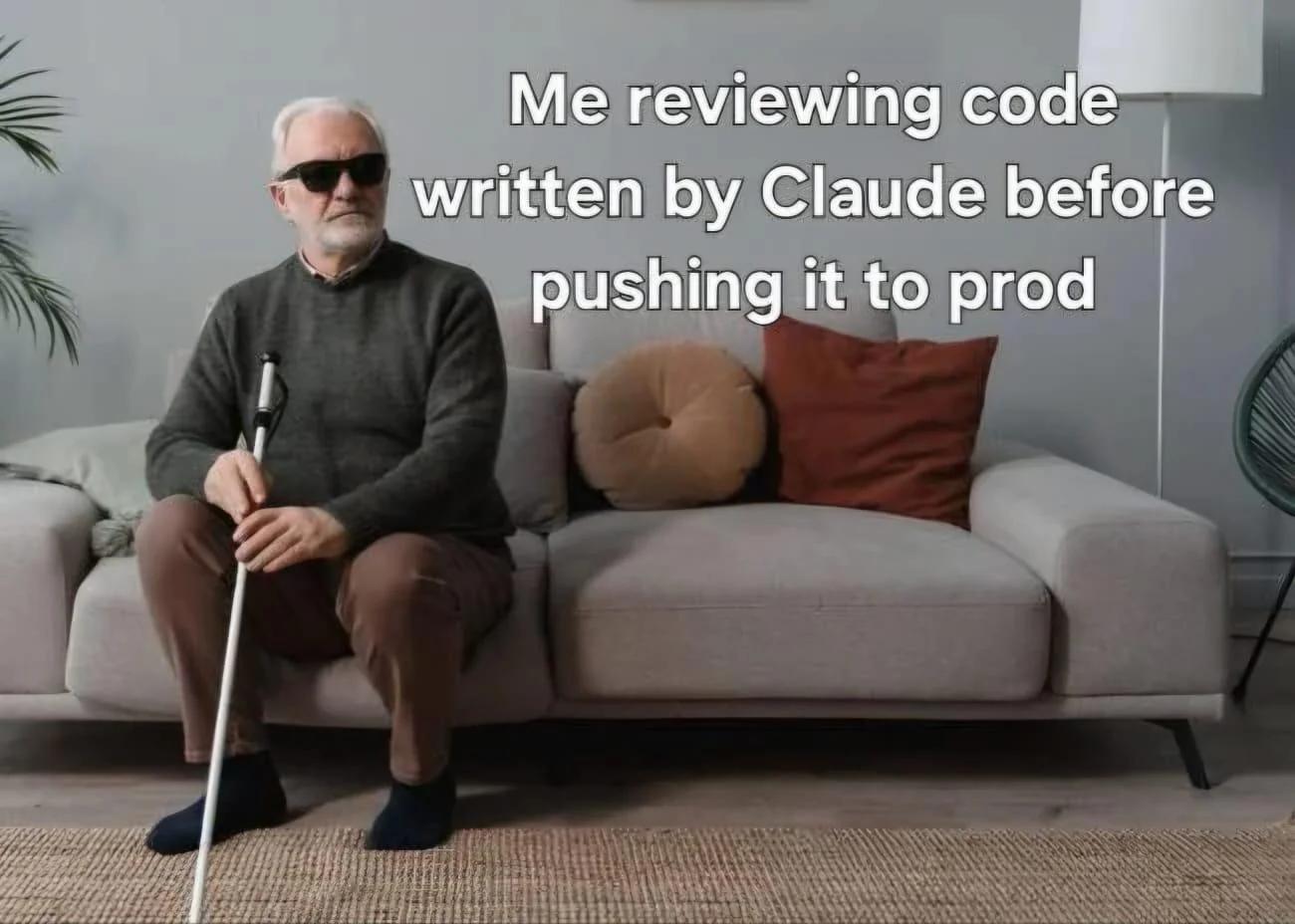
"Me" reviewing code written by Claude before pushing it to prod.
Me "reviewing" code written by Claude before pushing it to prod.
Me reviewing "code" written by Claude before pushing it to prod.
Me reviewing code "written" by Claude before pushing it to prod.
Me reviewing code written by "Claude" before pushing it to prod.
Me reviewing code written by Claude "before" pushing it to prod.
Me reviewing code written by Claude before "pushing" it to prod.
Me reviewing code written by Claude before pushing it to "prod".
24
u/mrwishart Sep 30 '26
38
u/cc_apt107 Sep 30 '26 edited Sep 30 '26
OK, now that we have been using these models for a bit, here’s my observation:
They are genuinely good enough that they can produce something good enough for QA very quickly. More quickly than they could with a human in the loop.
However, there are people on my team who, unfortunately, have turned into meat proxies who seemingly just copy + paste things to and from LLMs. Even on Teams/Slack. Other than it being frustrating to receive multi-paragraph messages to “What’s the problem?” when the issue can be described in a single sentence (e.g., there are some records in the DB with missing data), I really see that these people do not get the full value of AI.
It is just painfully apparent that humans still contribute background knowledge and critical framing for these models. The people who do the above misuse them and set them to answering the wrong problems. And it has become disturbingly difficult to explain to them what the actual issue is on the phone because they have ceded all thinking to the AI. These people get sidestepped. I am talking “senior” people. It actually pisses me off and I have to watch myself.
In those cases, we’ll have some stupid fucking issue and they will just keep sending these slop suggestions that completely miss the fucking point. I think this is prob only an issue in enterprise settings where you have many teams working on many codebases with many external tools so there is no way one model can “see” the issue easily without a nudge in the prompt. In those cases, I am running into walls way more often than I used to and basically have to get other people involved to solve some issues and replace the meat proxies with people who still have fully functioning brains. Admittedly, this is happening at the systems level normally, not a specific bug in one
I have not written a line of code myself in months. Nor have many of my peers. But it is still very clear who is thinking and who has stopped.
TL;DR: AI is good enough the the value of line by line code review just isn’t there unless it’s a high risk feature or bug fix. However, there are a class of colleague at my workplace who now don’t understand ANYTHING and the AI just isn’t good enough to be that valuable when they’re using it.
4
u/miraj31415 Sep 30 '26
What do people think about Claude generating a quiz to ensure the developer understands the Claude summary of changes?
3
u/TheNeck94 Oct 02 '26
meh, the bubble will pop and there's going to be a lot of useless devs.
3
u/mo__shakib Oct 03 '26
Production is the real unit test anyway
2
u/WisePotato42 Sep 30 '26
Hmm, huh, yep... Alright, looks like code!
2
u/Noch_ein_Kamel Sep 30 '26
Don't trust the french...
2
u/falcon0041 Sep 30 '26
You don't have a PR Agent ?
2
u/Weird_Albatross_9659 Sep 30 '26
So original
2
u/redpiapps Sep 30 '26
my review process is now just reading claude's review of claude's code while claude rewrites it. im middle management with extra steps
2
u/NevJay Sep 30 '26
Raaaaaaaaah we get it you guys don't code raaaaaaaaah
Can we joke about something else now?
1
u/want8memes Sep 30 '26
I am blind
1
u/InsideFar7107 Sep 30 '26
May the force be with you
1
u/HaroerHaktak Sep 30 '26
You treat the AI like you would any intern. You trust it until it don't then you blame someone else.
0
u/[deleted] Sep 30 '26
[deleted] — view deleted comment