Drooling 80s/90s devs "just buy IBM/MS and only use their stuff" --> drooling us "hurr durr use libraries made by randos" --> Jedi "just buy IBM/MS and only use their stuff".
It was good while it lasted, internet. They're gonna look back on us like pioneers of the old west: smelly, ignorant, but free to build like jerks.
Frankly, goodbye to component packs too. Personally I haven't used a package in a long time, besides the giga-libraries like React. AI can replicate most of what's out there.
Still sounds preferable to me. I'd rather have hidden exploits that nobody knows about, than exploits everybody knows about and are actively exploiting. Not to mention supply chain attacks, and bad actors contributing infected code.
You do realize that even if no one published that your software has exploits, they can still be exploited? Probably scanned and found automatically too
You do realize that even if no one published that your software has exploits, they can still be exploited? Probably scanned and found automatically too
Good luck with that. Seems like a wasted effort if suitable stable well tested library exists in most cases (exception might be if you need some small well defined feature out of the library).
I feel some personal schadenfreude because in my former career we were constantly getting hammered for not having containers patched up to the minute.
Sorry but when the container was spun, it was updated. It was not my job to continue patching them. As a developer I wrote code. I fixed my bugs and those of others. I worked on many many different products, patches, containers, integrations.
But when the infrastructure itself is broken at random times, I’m not going to lose my weekend because management won’t staff and run a continuing maintenance team.
We didn’t have a maintenance team - the “move fast and break things” ethos of management didn’t want to budget and staff for this kind of issue.
So if I roll a container and six months later a CVE bomb hits, the lack of staffing and any sort of plan to update all the containers is well above my pay grade. Even if that container had been updated two weeks ago, a new CVE can pee all over everything, at any time, for any reason.
they need the equivalent of a CVE fire department, and most companies don’t have that.
These “emergencies” are purely management’s poor budgeting and staffing problems.
In the beginning, sure, I pitched in. But when management starts relying on my overtime instead of properly staffing the solution and integrating it into the product maintenance cycle, NO. I’m not doing both jobs. I develop, I fix bugs, I add features, I integrate into product, I write tests, I fix build breakages, I review the code of others, I test my own code in isolation and with others.
Do not ask me to reach back and do maintenance too. One or the other, because both are full time jobs.
I’m out now. I am watching my former coworkers scrambling around while management cracks the whip. I miss development, but I don’t miss the random fire fighting that could be easily avoided with planning and budgeting.
Time for management to earn those cushy bonuses they take instead of staffing this function. It’s not going away, it’s getting bigger.
147
u/Abject-Kitchen3198 Oct 24 '26
Before they get better. Goodbye 876 npm packages from who knows where, welcome back few well rounded commercially supported component packs.
24
u/Rivilen Oct 24 '26
Everyday a new Jackson-core finding, or Jackson-databind, or tomcat, or spring, or opentelemetry…
44
u/supershinythings Oct 24 '26
I feel some personal schadenfreude because in my former career we were constantly getting hammered for not having containers patched up to the minute.
Sorry but when the container was spun, it was updated. It was not my job to continue patching them. As a developer I wrote code. I fixed my bugs and those of others. I worked on many many different products, patches, containers, integrations.
But when the infrastructure itself is broken at random times, I’m not going to lose my weekend because management won’t staff and run a continuing maintenance team.
We didn’t have a maintenance team - the “move fast and break things” ethos of management didn’t want to budget and staff for this kind of issue.
So if I roll a container and six months later a CVE bomb hits, the lack of staffing and any sort of plan to update all the containers is well above my pay grade. Even if that container had been updated two weeks ago, a new CVE can pee all over everything, at any time, for any reason.
they need the equivalent of a CVE fire department, and most companies don’t have that.
These “emergencies” are purely management’s poor budgeting and staffing problems.
In the beginning, sure, I pitched in. But when management starts relying on my overtime instead of properly staffing the solution and integrating it into the product maintenance cycle, NO. I’m not doing both jobs. I develop, I fix bugs, I add features, I integrate into product, I write tests, I fix build breakages, I review the code of others, I test my own code in isolation and with others.
Do not ask me to reach back and do maintenance too. One or the other, because both are full time jobs.
I’m out now. I am watching my former coworkers scrambling around while management cracks the whip. I miss development, but I don’t miss the random fire fighting that could be easily avoided with planning and budgeting.
Time for management to earn those cushy bonuses they take instead of staffing this function. It’s not going away, it’s getting bigger.
13
u/Sakura48 Oct 25 '26
Waiting for .NET cve so I can take a day off
8
u/Palinon Oct 24 '26
Yup, my job is now mostly reviewing Ai written security reports and trying to decode them.
6
u/Gophix_0 Oct 25 '26
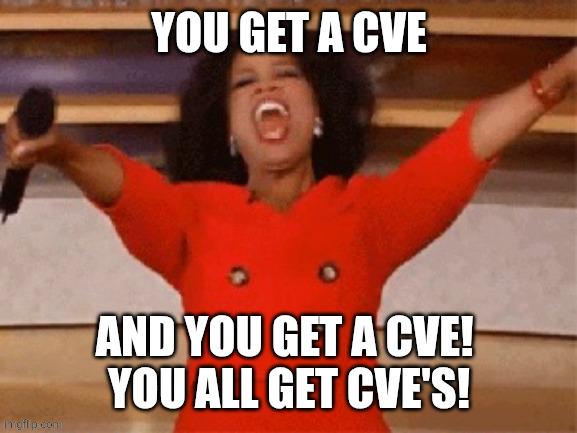
CVE's, CVE's!!!
3
u/seba07 Oct 24 '26
Cyber resilience act is going to be fun...