10 years ago, I was writing their first Java8 software. Now I'm working on updating it to Java 17 servers... oh wait they are speaking of maaaaaybe going for Java 21
i have. trying to compile software for a robot on outdated 32 bit Debian. because somehow that thing ran a 64 bit x86 CPU, but 32 bit userspace. I never got their shitty framework to compile
We have a file logging library (zlog) with thousands of calls. We're not switching to std::format. Even after they fix it so it can do all the printf stuff. Just checking an LLM translation would break whoever got that job.
We're slowly moving to std::ranges::for_each/all_of/etc but that's not a migration so much as a progression when we change code that uses older versions.
There's a whole bunch of similar stuff, we mostly try to avoid having too much clang-tidy whining.
Depends on the companies. Tech giants would be losing potential employees if they stuck with outdated standards, and that loss outweighs costs of upgrades.
Security updates, more and potentially better frameworks, more efficiency,... dont know about c++ but the things the java team added since 8... boy, the reduced server costs will pay for themselves pretty fast
I saw a fair amount of stuff break with C++20, because of comparator generation causing ambiguities. Largely due to the original code being poorly written, but breakage nonetheless.
And ABI compat isn't even part of the standard, it's for standard library implementations to deal with. They're the ones who decided to do the ABI breaks, not the committee.
And turning on all the new warnings and hints and clang-tidy updates and cpp-check checks and other fun stuff. Wherein you learn that sometimes passing a std::string to printf "works" because of SSO, and it's worked in prod for ages.
I honestly don't remember the details or the compiler version. I think the error was because some of our types only partly conformed to ideas of sorting, and that caused some weird interaction where some types in a vector didn't want to test for just ">=" but some other things as well, which we didn't need so didn't implement. Neither "==" nor ">" were there for our types.
The solution was to use more spaceship operators. The error message was clean but we didn't really know how <=> worked yet, so it delayed us a week or so.
Honestly some of the newer shit doesn't even look like C++ to me anymore. IE:
constexpr auto my_meta_type = int; // Reflected metadata of 'int' [:my_meta_type:] my_variable = 42; // Splicing it back into code; compiles as: int my_variable = 42;
The code generation / reflection stuff is amazing.
Historically, when you'd need type information (without manually defining it), you'd have to add an extra compilation step where a custom tool either manually searches the codebase or interrogates a compiler API, now, you can just write compile-time code in your codebase that automagically populates a data structure for you with any type information you could desire.
It'll be really useful for my (hobby) game engine, where I was previously considering traversing the Clang AST
If you look at what engines currently use for reflection (ugly macros mostly), this can be a huge improvement if the engine can be rewritten with this in mind.
But the sad part is I can only see maybe UE going with it with the next major release because they can force this kind of change, but open source stuff is never getting it most likely, way too much inertia.
I love C++ because it's an un-opinionated, multi paradigm language where you can do whatever you want but that shit is horrendous. Freedom was a mistake.
I am glad you can code how you like, but corona virus social distancing protocols are in effect
You get used to it, and if you expand the above back into C-style code it turns into an utter abomination. Especially with code where you need to write "if any of these, find a matching one of those" type sequences, and {hopefully soon... serialise it to JSON and send it}
Fundamentally C++ is limited by its roots, which is why Rust people are so unbearable {changes hats} about the utter perfection of the language.
Hard disagree.
True C is readable, but kinda annoying it has to bring in pointers.
Edit, realized I bungled the test_the_thing. Fuck it IDK, coding on mobile sucks
Int test_the_thing  (*blah blah, args){
     Return blah;
}
Void func(){
     Blah result;
     If(test_the_thing(&result, args) ){
           Do stuff;
}

}
Cpp pass by reference makes it pretty sweet and simple for ez cases.
Int test_the_thing  (&blah blah, args){
     Return blah;
}
Void func(){
     Blah result;
     If(test_the_thing(result, args) ){
           Do stuff;
}

}
The return result by argument pattern is a little eeeh, but it makes sense considering that's often how it has to work under the hood anyway. Optionals are syntactic sugar alternative for the same semantics.
I can see why each incremental change is made and how it leads to what you like. E.g. yeah the two part of statement is kinda nice for this simple case. But the end result is pretty bad imo.
To me, it's like those overly clever nested ternary statements, but worse. Super fun to write, echnically a couple characters more concise, but so tangled together that reading it is miserable.
Defining and constructing an anonymous class in an if statements conditional is just way too much going on there for simple shit, and way way too much going on for complex shit!
But the beauty of c++ is that's just like my opinion sis and you can do you <3
I just hate that you can't have an optional reference, and it breaks my templates occasionally and I have to go look up how to actually do template metaprogramming.
Excited for 26 though, I believe they've filled that gap.
Yep, the shiny new if-two-statements, upgraded from the old if-statement. It's surprisingly convenient, partly because I used to get frustrated at not being able to explicitly test "if(auto foo=some_random_shit))" and I loathe implicit "nullptr is 0 and also false"
I eagerly std::await the even more improved if-three-statements-and-a-loop "operator" 🔥
What you (and I) really want is pattern matching. It tends to be a superior solution to all that. And doesn't have the limitation of "only declare one variable in your if".
I have some switch statements on "tags" that are fixed length strings. Which I pack into int64's so that I can switch on them because we only use ~200 of them so a map is unnecessary overhead. Pattern matching, you say?
It's just a constexpr function, could be a macro in C, because we don't even have enough characters to fill the 8 byte int. No need to even pack them!
I'm not sure how to take this. It seems both that pattern matching could help your use case (though it would depend a lot on the details) and that it's not related to the "null pointer is false" issue you were complaining about.
Pattern matching a single instance is unrelated to a switch statement (we hope). But pattern matching in general is only loosely related to single if statements. Sure, "does this one input match this one pattern" is an if, but a more common use is "given this pattern fan out based on the input" or in the case I gave "if this is a tag, fan out based on the tag content". HTML or JSON parsing, for example.
I think it's both. Whenever I check an optional, what I really want is to also dereference it if it matches. If you look at pattern matching usage in Rust, it's a lot more ifs than matches.
Nope, that's not allowed. The previous standard let you say "if(auto foo = something)" and if foo could be interpreted as a boolean you had a valid if() statement. The new one lets you have two statements, the auto assign and the test.
The win here is the scoped auto variable, FWIW. If avoids the abominable pattern where you either alternate declaration/conditional, or a pile of declarations then a string of tests, mixing assignments in whatever way is least horrible. So you get a chain of declare-assign-test statements in a nice vertical line rather than a >
the compile time reflection is incredible. only zig and jai have something that can really match it in power, and they're significantly simpler languages.
We've migrated to c++20 and thinking of 23, but it was insane 2.5 year act. Build system rewrite(and ~12 merged prs in cmake) was required to make it cleaner but now it works for ios, win, mac, linux, android.
During 2012-2016, I was so excited and ambitious to learn and use C++ profesionally. Later on when its' standardization becoming more and more ridiculous, it does more damage to me rather on making things easier.
C++ 20 (and the following streamlining of C++ 23) was a monumental upgrade in making it easier to use and avoiding foot guns without having to always write your own standard library, what are you even talking about?
If those optional features where implementing sensible things, sure. For example, can you, using the standard library, print vector<vector<int>> to stdout easily? As far as I can tell, no, you need to write loops or recursion yourself.
Almost like as if there is no one single correct way to print out such structure. If you always want to print it out the same way then no one stops you from writing your own mini library to do it in your every project. Go back to Python if you want the language to hold your hand and decide stuff for you.
This is why I find it so frustrating. Yes, std::format is the exact kind of construct you would expect to solve this problem. However it does not work with any collection out of the box.
We tried to make it work but ended up making a recursive templated function instead. Now, I guess everyone can make their own recursive templating function, but then why do we even gave std::format
430
u/LoveOfSpreadsheets Oct 27 '26
*cries in Java8*
108
u/mguid65 Oct 27 '26
Basically what I told someone a couple days ago.
John Businessman in his business formal wear at Legacy Inc. will never switch away from C++98 anyway.
218
u/No-Adeptness5810 Oct 27 '26
Dude i migrated a massive project from c++17 to c++26 in like 15 minutes i dont get the drama
48
u/No-Con-2790 Oct 27 '26
And there is me who is just glad that C++98 is over.
22
u/echtma Oct 27 '26
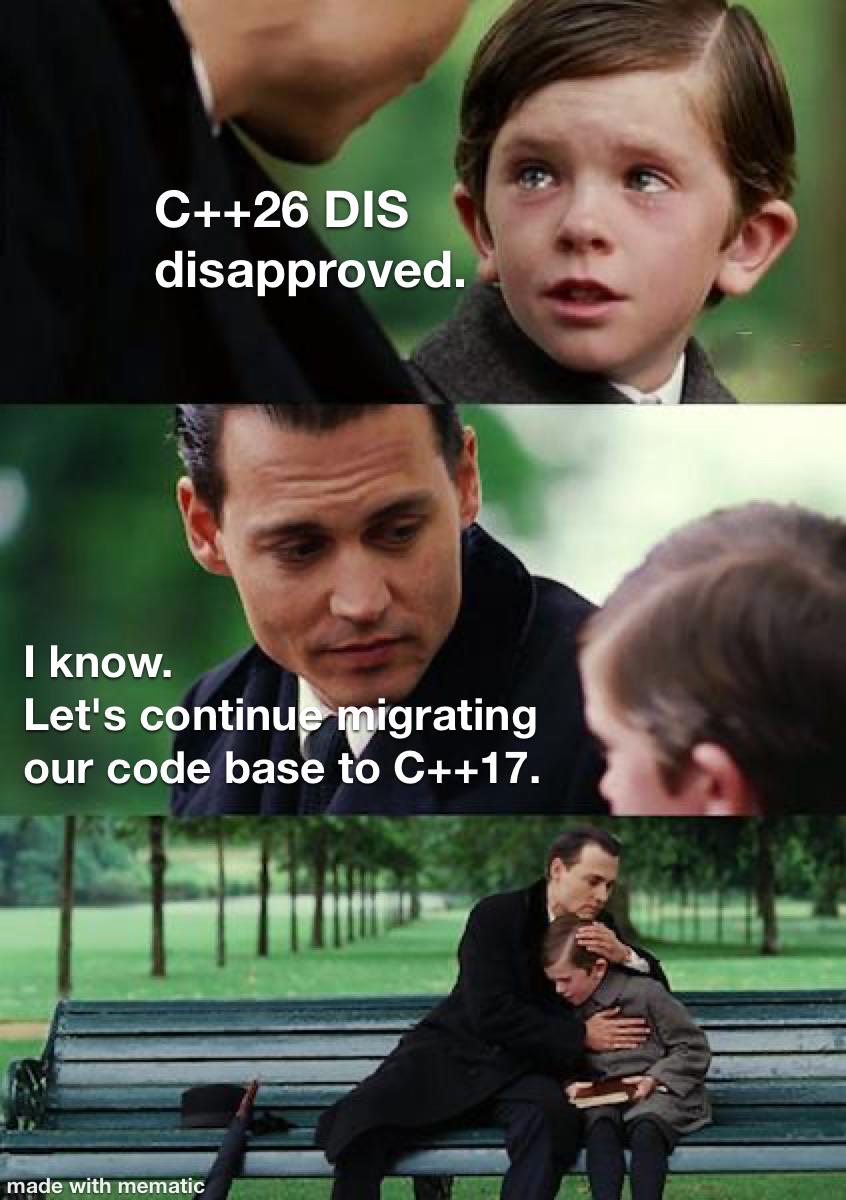
DIS = Draft International Standard
Just in case anyone else was wondering.
59
u/Antervis Oct 27 '26
C++03 -> 11 migration was a pain in the ass because of std::string changes, but after that it was basically just changing compiler flags, no?
70
u/Excession638 Oct 27 '26
No contracts!
31
u/Luna_Wolfxvi Oct 27 '26
Honestly some of the newer shit doesn't even look like C++ to me anymore. IE:
constexpr auto my_meta_type = int; // Reflected metadata of 'int' [:my_meta_type:] my_variable = 42; // Splicing it back into code; compiles as: int my_variable = 42;
7
u/WoodsGold Oct 27 '26
Net Framework 🥴😢
3
u/7DBBA101 Oct 28 '26
I felt very fancy when I upgraded to C99 from ANSI C a couple of years ago
3
u/Ascendo_Aquila 29d ago
We've migrated to c++20 and thinking of 23, but it was insane 2.5 year act. Build system rewrite(and ~12 merged prs in cmake) was required to make it cleaner but now it works for ios, win, mac, linux, android.
2
u/Legal-Software Oct 27 '26
Far too aggressive of a standardization schedule for a supposedly stable language. The signal-to-noise ratio is also getting worse between versions.
0
u/Excellent-Baker1058 Oct 27 '26
I see this meme, every alternate week
-12
u/mas-mas-itu Oct 27 '26
During 2012-2016, I was so excited and ambitious to learn and use C++ profesionally. Later on when its' standardization becoming more and more ridiculous, it does more damage to me rather on making things easier.