Fun fact: On Friday, 15 January 2027 at 08:00:00 UTC, the Unix timestamp will pass 1800000000. Such a 100 million second mark is reached only every three years. What is even more unusual is that this happens at a full hour of regular time, which only happens every 55 years!
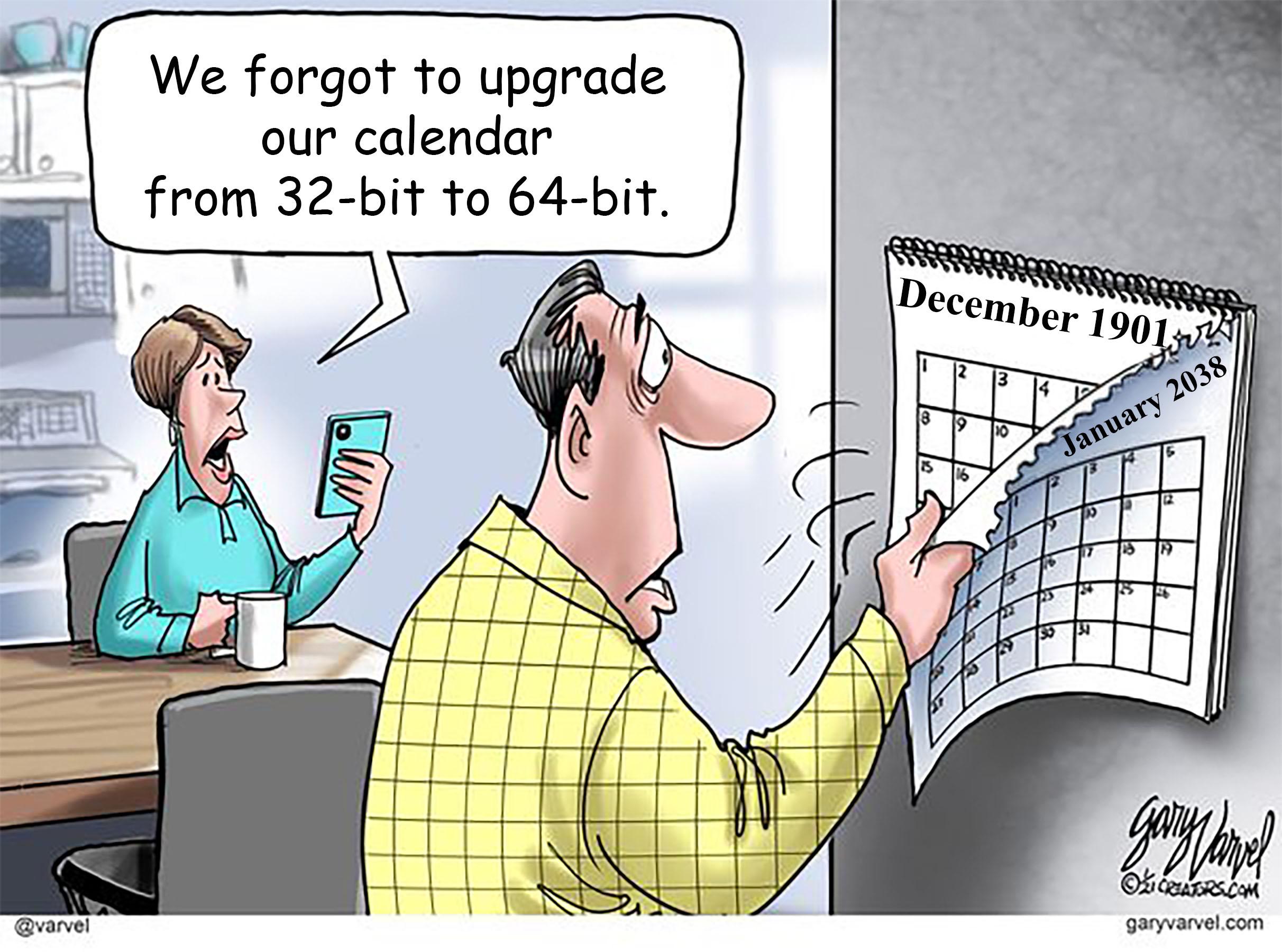
The UNIX date/time is stored as a signed integer. It started at 0, aligned to Jan 1, 1970, and counts up from there. When it hits its maximum (all 1s, in binary) and rolls over, the number will change from +2,147,483,647 to -2,147,483,647, which puts it on December 13th, 1901.
Which is a great example of why using unsigned causes problems without giving you much in return: If reaching X is possible, reaching 2X is also possible.
So you're better off using signed numbers in case you want to do subtractions at any point to prevent the much more likely underflow problem.
And then switch from N bits to 2N bits, because that increases the range not by 2, but by 2N. For most applications, 64 bit numbers are large enough that they will outlast humanity, no matter the dimension. Most applications could do all their math in 64bit doubles (and just skip ints entirely for convenience), because that leaves you with 53 bits of mantissa (and a sign), over 50% more bits than your standard 32 bit int. The 64-bit double floating point format has a largest (finite) representable value of 253 = 9,007,199,254,740,992 (9000 trillion). To compare, int32 is only 2,147,483,647, (2.14 billion, a number small enough that if you need good precision (cents, milliseconds, centimeters on a global scale, etc), you can absolutely run out).
While I don't love the thought, you could write banking software using 64 bit floating point math and store cents, and you'd probably be okay, since you won't ever have a total of 90 billion dollars in one value where you cannot risk losing a single cent for rounding. Only for your yearly reporting ("we transferred a total of X" type values) you'd lose precision, and frankly you wouldn't need to know the exact cent amounts for that anyway.
And to get back to the topic at hand: If we use 64bit floats for the unix Epoch starting at 1970 and do seconds, we can do until about 285 million years (+1970) before using floats bites us in the ass. Even if we improved accuracy to milliseconds and used the "wrong" format of 64bit floats, we can do until the year 287396. Probably good enough. That's why some languages do this, such as lua. The 64bit float is just extremely versatile without relevant sacrifices for 99.9% of applications.
Can you tell that I've had this argument a few times with old people who insisted to use unsigned ints for vector indexing (and all kinds of other nonsensical specific number types for variables instead of just hitting everything with the 64bit float hammer) and then it broke because someone wrote a subtraction?
I still say there is a lot of stuff you should do not with floats, but with (signed) ints. Floating point precision can cause problems and some use cases simply don't allow decimal numbers, so theoretically allowing them will allow other errors to creep in.
A 64bit float is a superior int than the 32 bit int, because it contains a 54 bit int with identical math. There is no scenario where the 64bit float loses to the 32bit int. On modern CPUs, there is no performance difference.
The only time the two differ is when the int starts to completely fail, but the float can still cope, such as trying to do 2,000,000,000 * 100: The int32 cannot handle this, the float64 can. I can't think of a case when I would prefer the accidental overflow to the math just working normally, but it is possible that such a scenario exists.
You're right in that a int64 has some upsides to the float64: When you want to do one million trillion cents plus one cent, for example. My point is that these cases are so rare that you're better off always using the f64 as a default, and only deviate from it if you can prove that you need to, for example when you know you're building a banking app for a rich country's budget. If you default to the int, you have a ton of very trivial cases where you have the wrong type, such as 1/2. Fractions are a lot more common than numbers over 9000 trillion.
So when you say "a lot of stuff", this is nothing for int32 (mathematically provably so), and a shockingly irrelevant amount for int64 - As I said originally, probably some sort of research simulation software at CERN, possibly. Nothing that uses numbers in a normal human range.
You can fit twice as many int32s in a cache line. That alone is a huge performance gain. Modern CPUs are more memory-bound than they are compute-bound. Not only that, but with AVX commands, you can process twice as many int32s at the same time. So yes, performance wise, there is a huge difference between a 2N bit datatype and an N bit one.
Sure, if you have a use case where you need that many numbers in a row and int32 is good enough. Meaning you need an array/vector of them, and your performance is cache-limited.
But there's a catch: If you read (let's say) a million numbers in a gigantic array, you're not actually cache-size-limited, you're actually running at full throughput of your cache read speed, because your pre-fetcher will bring the numbers in faster than you can work on them. You won't be able to measure a difference because to your program, the cache will always look full. We have very large caches nowadays.
And how often does that matter? Have you ever written software where your performance was cache-bound on raw integer arrays? I've worked in CAD/CAM over ten years ago and even there we had dozens of other bottlenecks first. Unless you work on the ffmpeg library (maybe 500 people worldwide), this doesn't come up.
My point has always been that int32 superiority to float64 is an edge case, only affecting something like 1 line of code per million written. I'm sure windows has twelve places in its hundred million lines where it matters, but it also has a hundred million lines where it doesn't matter. But that's a position that junior devs on reddit just never get who have zero practical experience and then write "bUt CaChE!" when that's not even true because they don't know about prefetching and TLBs.
I'll be very impressed if you can even write a completely made-up piece of code where you can measure a performance drop going from int32 to float64, to be honest. Just look at current FSR4.1: They have a "slow" version which is int-based for older GPUs and a "fast" version with floating point math for only new GPUs which can support that. Turns out the two versions are very difficult to distinguish and have nearly the same performance (but the float version is actually slightly faster on GPUs which support it). And that's your best case scenario!
I wouldn't know what to try, and I had Claude try and it also failed.
I don't know much about GPUs, so I won't go there. But, by your logic, very few people actually write performance-critical code, so why bother! Let's do everything in Python and Electron. For most software that's written today, they are completely sufficient.
What you say about the prefetcher is true, but software can be incredibly complex, and a smaller data type is inherently easier to fit in the cache, thus, on average, there will be fewer misses. Arguing otherwise is bordering on bad faith.
And it is convenient that you said nothing about vectorization; processing two int32s in place of your 1 double (or 16 instead of 8, rather) does seem to be quite significant...
Well obviously a 64 bit number will be superior in many ways to a 32 bit number, but that is not what I intended to say. If you know that your number should always stay whole, enforce it to be.
My G, you lack faith in humanity. Those are dinosaur numbers, and humanity invented its way into flight as hairless bipeds. We can do better than the big lizards. If we're fucking around with numbers, why not go with 256? Push the scale out so far we can really fuck around with it.
Who cares? 256 means we can display time in femtoseconds until the heat death of the universe. If we're future proofing lets never think about it ever again, even with edge cases. If we're not going to have fun with it why not just restart the clock in 1970? Its not like time is real.
Because 64 bit is the sweet spot. Only if you want to do something like uniquely number every atom in the universe do you run out of values. All atoms in our solar system? Still doable.
But yes, there are edge cases where f64 isn't sufficient. They are very rare. It makes sense that we have 64bit hardware, and we simulate higher bit numbers in software for the rare cases where we need it. It would be a waste of hardware to have 128bit or 256bit machines, because we would not actually use it.
time_t isn't just for absolute time, it's also for differences, so negative values are meaningful.
It's similar to the reason that lseek uses a signed long: when using SEEK_CUR, offsets may be negative, when using SEEK_END they will usually be negative.
Also: time_t is usually at least a signed long; early versions of UnixTM had a 16-bit int.
I imagine in 1970 they had some date data about recent years, like the 60s. You'd not want to make it impossible to represent anything in the past. Wikipedia tells me the first Unix was being developed in 1969 so it's not like 1970 was already firmly in the rearview at that point. They probably saw it as a balanced mid-point of past and future.
A decision that probably paid off for a few years as old databases were migrated, then was of no consequence for decades, and then more recently, yeah has totally halved the runway. I suppose they could/should have made the epoch 1960 or 1950 instead and gone unsigned, though ultimately the 32 bits was gonna get us eventually.
Using this reasoning i've decided to replace my 64bit timestamps with 1bit timestamps. As long as i have finite memory i can't solve the issue anyways, may as well save some memory.
In seriousness though, we know how our representations of time fit into the physical world, the realistic longevity of our universe and species. 64 bits more than fully solved it. Sliding a window around with 32 would not. Stated differently, the big O of 2N... is N. It's can-kicking. Solving it in a practical, physics-bounded sense needed more of a quadratic expansion, i.e. more bits. But not infinity bits.
"They" checked the actuarial tables, realized none of "them" were likely to be alive in 68 years, and decided the technical debt is just the next dev's problem.
Wouldn't it be "-2,147,483,648" instead? Otherwise you only have 2,147,483,647 * 2 + 1 possible values which is short of 232 by one. Or is there a reason I don't know that it's missing a value?
i just looked this up, i had no idea about the divisible by 400 years rule to leap year. so I’m guessing in NTP timestamps a Feb 29th 1900 exists when it shouldn’t?
I don't actually know for NTP, but this is a feature for excel for compatibility with previous software.
Afaik some stuff starts on 1901 to just sidestep the problem (Mac version iirc)
It is likely that the original devs either didn't know, or they figured out that adding more code in the days you had to fit your program on a floppy for that one date in 1900 nobody is going to use or care about anyway wasn't worth it.
I get at this time it would be a huge issue to fix. But when they first made Excel, they could have added a compatibility mode toggle in the options. Or just fixed it and activated a compatibility mode when you opened a file in the Lotus' file format. Back then it was quite common for proprietary software to do things differently from one to the other, and such behavior wouldn't have been out of place.
No the timestamp is stored in as a signed 32 bit integer, so it loops back to -2147483648 seconds. If it was an unsigned 32 bit integer it would have been fine all the way up to the year 2106
Yes, they thought about it. and still decided that saving a single (!) byte (2 BCD digits would have been necessary, 4 bit each), was worth the inevitable problem that would arise.
Yhe Unix time stamp starts with 1970 and rolls over in 2038. Some places Microsoft used their own times that will roll over in March of 2036.
When everyone was fixing and auditing theor systems so that things would not break at the Y2K switch, their official compliance page stated that they were then Y2K compliant, but that nothing was guaranteed to work beyond December 2035.
unless they're using unix timestamps to display the day on every day of the calendar, that doesn't have to be the case. You can create a 32 bit calendar app that displays days after jan 19 2038, it'll just never reach them
It also depends on your basis point and needs too - the dates on digital tachograph cards are 32 bit unsigned epoch time, because they don't care about anything before about 2005 and that gives you time out to 2106ish with second resolution.
The nice thing about it being signed is that signed overflow is undefined behavior in C, so wrapping isn't actually guaranteed to happen. Compilers could search for anything named time_t, and silently add a check for overflow that starts using a 64-bit value instead. More polite than making demons fly out your nose.
I only now notice the insane head shape of this guy. I've seen this thousands of times yet it's the first time I notice he's more nose than anything else
Based on the way the crowdstrick patch went untested and was pushed out unquestioned by anyone before bricking all of the systems it was installed on and how more and more people are just vibecoding and blindly trusting the ai to do it right i don't hold out much hope for anyone to get it right and not fuck up everything.
Nope. Most sofware uses unix timestamps in utc. that way not every software needs to know how to convert timezones and all the stuff that comes with it. a simple number that goes up every second is much nicer to deal with. you can always have a central library convert it to local datetime if a human needs to see it.
Unix is useful because it has no time zone information to deal with. How long is between this date in this time zone and this other date in this other timezone? Well let’s subtract the timezone offsets. Wait, but time 1 is in daylight savings time during its date. And actually time 2 is a time that occurs twice since the clock rolls back daylight savings time. And also there is a leap day here. And until recently a leap second can be announced suddenly and you need to add that to the moist of leap seconds.
Or alternatively you can use a number that counts up by 1 every second. Or millisecond if that’s needed. And use subtraction to find time differences. If you are using it for UI some person builds a Unix to local timezone converter and everyone sides it. And for input it’s the other way around. Now everything is easy.
Also now you don’t store strings with timezone information with really complex date math.
? Unix can be converted to a standard time of any timezone, but you can’t know which timezone to give without knowing which timezone to give. And you can do time arithmetic in Unix.
So you need an extra field for the timezone. Yeah, we're both saying the same thing, except you're getting upvoted, because I'm dunking on a stupid concept from the 70s.
Wtf are you talking about? There's no field being stored for a time zone. You store the absolute time, and when you render you render it in the user's requested timezone...
Wtf are you talking about? Maybe you have to know the context in which a datetime was stored, how else will you know what time it was for the user, not just in utc, not just in your timezone.
No. It just represents a time. It's not supposed to also carry time zone information. It's like saying "aren't numbers a bit outdated? The unit isn't even included when you use a number"
It is objectively not. The time zone is handled at the display level. It would be even more confusing to try and represent the time zone as well as the date in a single integer. You are acting like the unix time stamp is meant to be directly displayed
That is bad practice, but you could still store it in a specific time zone with a unix time stamp if you want to for some reason, you just have to also store the time zone. But again that's bad practice
If it's some kind of user's time, you have to know the context in which that time was stored. Was it daytime? Without timezone, you have no way of knowing. You only know what it means in YOUR timezone.
How could you NOT have the timezone for a stored time? Only if timezone doesn't matter: if ALL (and I do mean ALL) times are in UTC only, or if you only ever store local time. When timezones get involved, you're fucked if you don't store them.
But that's stored separately, because if that context changes it's alot more complicated for the display layer to correct for it. Some regions have dst exceptions or have changed offsets at some point etc. if you store the time in utc and the time zone, you only need to know the current offset. If you need the original context, you'll need both time stamps anyways.
No, just misinformed. Even in a lot of Java code you get a time then convert it to how you want it displayed.
And it’s not just Unix/Linux. The old MSC compilers from the DOS and early Windows days couldn’t decide what Epoch would be. On one version, it was the standard 1/1/1970. Another version, it was 1/1/1900. Which would run out even quicker.
The unix timestamp is an extremely elegant solution to an EXTREMELY complex problem
A timestamp in java is represented by the Instant object. It's a universal representation of a particular moment in time that every single computer on earth can agree with, regardless of which date or time it represents on that particular machine's region. It is then trivial to convert back to a human readable date following local rules
And it's a single number! That's amazing! Knowing whether a timestamp happened after another is as simple as timestampA > timestampB. You do not need to parse day, month, year, hour, minute, second, and time zone from a string that you best hope was formatted properly to ISO 8601.
Here's an amazing read and an amazing Tom Scott video about just how hard it would be to deal with dates without epoch:
And you loose user context. You cannot know the time on the user's wall clock at the time they did something, because a single number pinned to UTC cannot store that. That's what I was trying get at, but people don't seem to want to understand when or why this is a useful metric.
When the user's local doesn't matter, a single number is fine. In fact, most datetime values are a single value under the bonnet. But the point was never to know what MY time is for a given action. I wanted to know what THEIR time was. And without timezone, I have no way of knowing. A person in Tokyo did something when it was 12:00 on their wall clock, which is 3:00 in UTC. Without timezone information, I have no more information than a user who did something at 3:00. I cannot know what THEIR time on the clock was. I can only guess if I happen to know (by other means) where in the world they are.
Oh, and I never opposed the use of an epoch. Of course, 0 has to mean something.
I doubt it's the "whole point". I suspect the whole point is to have a compact 32-bit number to represent datetime. A missing timezone was just an unfortunate choice.
In the 70s, a compact format would almost certainly be the main selling point. At any cost, I would say. I mean, only 4 bytes! That's 6 less than an even stupider datetime storage format.
375
u/amateurfunk 26d ago
Fun fact: On Friday, 15 January 2027 at 08:00:00 UTC, the Unix timestamp will pass 1800000000. Such a 100 million second mark is reached only every three years. What is even more unusual is that this happens at a full hour of regular time, which only happens every 55 years!
669
u/Phoenix-95 26d ago
Wouldn't it go back to Jan 1970, not Dec 1901?
86
u/Mughi1138 26d ago
Or 2036 if you use Microsoft software
38
u/liad88 26d ago
The bug starts after January 19th, so technically the calendar should not have January 20 an on.
6
u/MCplayer331 26d ago
r/bonehurtingjuice
6
u/EuenovAyabayya 26d ago
Something something COBOL
12
u/korneev123123 26d ago
2038
2+0+3=5, so it becomes 58
5+1 and 8-1
it becomes 67. See? They tried to warn as all along!
7
u/SAI_Peregrinus 26d ago
The nice thing about it being signed is that signed overflow is undefined behavior in C, so wrapping isn't actually guaranteed to happen. Compilers could search for anything named time_t, and silently add a check for overflow that starts using a 64-bit value instead. More polite than making demons fly out your nose.
2
u/Taiten89 26d ago
We need to trade IBM 5100's around, otherwise WWIII will break out (totally not a scam)
3
u/Devatator_ 26d ago
I only now notice the insane head shape of this guy. I've seen this thousands of times yet it's the first time I notice he's more nose than anything else
3
u/MatthiasWM 26d ago
Apple Newton MessagePads, the predecessor to the iPhone and iPad has had this issue since 2010 and will again in 2038, going back to January 1904.
But thanks to AI, all relevant places in the firmware have been found, and a patch will be there in time.
1
u/crmsncbr 26d ago
We still have files timestamped as 2038...
1
u/Codix_ 25d ago
We really need to have a subreddit for fixing this on all legacy system and software that we can.
1
u/JackNotOLantern 24d ago
The 2000 thing (but worse) is coming is just over 10 years
1
u/Extension_Option_122 24d ago
You could also just upgrade from a int32 to a uint32, giving you additional 68 years.
The company I work at does this.
-7
u/AbdullahMRiad 26d ago
I think by then they'll create a new timestamp format anchored to 1/1/2020 or something
-13
u/thanatica 26d ago
Isn't a unix timestamp a bit, outdated? For lack of a better word.
For one, it contains no timezone information, so it can only ever represent local time.
I'm probably cussing in church here...
0
u/[deleted] 26d ago
[deleted] — view deleted comment