MAIN FEEDS
Do you want to continue?
https://www.reddit.com/r/ProgrammerHumor/comments/1y4fzqm/productionisnotreadyforthis/
r/ProgrammerHumor • u/BugFeaturesOnly • 2d ago
19 comments sorted by
41
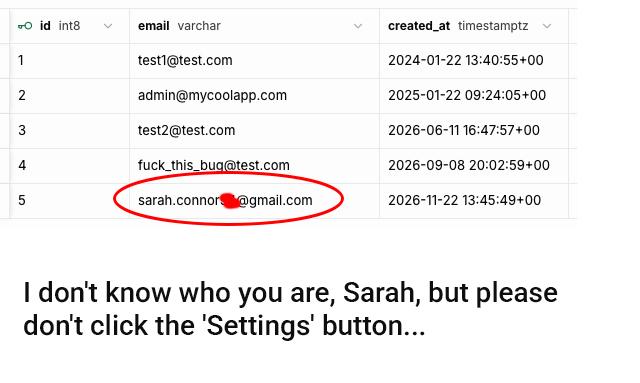
Thank god you censored the bottom half of a single character of sarah connors email address
8 u/BugFeaturesOnly 2d ago Hey, I had to protect her identity from Skynet somehow 1 u/OmegaPoint6 1d ago Thats actually skynet's honeypot account
8
Hey, I had to protect her identity from Skynet somehow
1 u/OmegaPoint6 1d ago Thats actually skynet's honeypot account
1
Thats actually skynet's honeypot account
6
address me
prod is not ready for 3 users with the same key thing after the primary key thing overflows
2 u/gaaasstly 2d ago Isn't the PK id (int8) which is a 64-bit value? 1 u/Key_River7180 2d ago idk coming from c an int8 holds a value from -128 to 128, 8 bit signed int 2 u/KeyAdhesiveness9481 2d ago In postgres, int8 is 8 bytes, 64 bits. 1 u/Key_River7180 2d ago typical postgres 1 u/gaaasstly 2d ago No worries. I thought the same thing after reading your comment and then remembered I was looking at a db and not C code.
2
Isn't the PK id (int8) which is a 64-bit value?
1 u/Key_River7180 2d ago idk coming from c an int8 holds a value from -128 to 128, 8 bit signed int 2 u/KeyAdhesiveness9481 2d ago In postgres, int8 is 8 bytes, 64 bits. 1 u/Key_River7180 2d ago typical postgres 1 u/gaaasstly 2d ago No worries. I thought the same thing after reading your comment and then remembered I was looking at a db and not C code.
idk coming from c an int8 holds a value from -128 to 128, 8 bit signed int
2 u/KeyAdhesiveness9481 2d ago In postgres, int8 is 8 bytes, 64 bits. 1 u/Key_River7180 2d ago typical postgres 1 u/gaaasstly 2d ago No worries. I thought the same thing after reading your comment and then remembered I was looking at a db and not C code.
In postgres, int8 is 8 bytes, 64 bits.
1 u/Key_River7180 2d ago typical postgres
typical postgres
No worries. I thought the same thing after reading your comment and then remembered I was looking at a db and not C code.
DO NOT USE AUTO INCREMENT NUMBERS FOR PRIMARY KEYS
1 u/razor_train 1d ago There are plenty of cases where autoincrement is completely valid. 2 u/ruiz_julie_728 1d ago Auto-increment is fine when one database owns ID allocation; independently writing databases are where another strategy matters. 0 u/ArtVandelayVienna 19h ago Yeah, sure, in case I need to scale my cake recipe database to 500 servers worldwide. 1 u/FabioTheFox 19h ago Until you need to merge data or handle backup stuff, just use UUIDV7 1 u/ArtVandelayVienna 7h ago But the downside:UUIDv7 = 128 bit = 16 bytes long. Auto-Inkrement based on standard Integer: 4 bytes long.=> index size x4=> more IOs, needs more RAM=> worse cache hit rate=> bad join performance 1 u/FabioTheFox 6h ago It performs the same as an auto increment, modern Postgres for example supports it by default and there is no performance hit in both single entity queries and ranged queries or whatever else you need
There are plenty of cases where autoincrement is completely valid.
2 u/ruiz_julie_728 1d ago Auto-increment is fine when one database owns ID allocation; independently writing databases are where another strategy matters.
Auto-increment is fine when one database owns ID allocation; independently writing databases are where another strategy matters.
0
Yeah, sure, in case I need to scale my cake recipe database to 500 servers worldwide.
1 u/FabioTheFox 19h ago Until you need to merge data or handle backup stuff, just use UUIDV7 1 u/ArtVandelayVienna 7h ago But the downside:UUIDv7 = 128 bit = 16 bytes long. Auto-Inkrement based on standard Integer: 4 bytes long.=> index size x4=> more IOs, needs more RAM=> worse cache hit rate=> bad join performance 1 u/FabioTheFox 6h ago It performs the same as an auto increment, modern Postgres for example supports it by default and there is no performance hit in both single entity queries and ranged queries or whatever else you need
Until you need to merge data or handle backup stuff, just use UUIDV7
1 u/ArtVandelayVienna 7h ago But the downside:UUIDv7 = 128 bit = 16 bytes long. Auto-Inkrement based on standard Integer: 4 bytes long.=> index size x4=> more IOs, needs more RAM=> worse cache hit rate=> bad join performance 1 u/FabioTheFox 6h ago It performs the same as an auto increment, modern Postgres for example supports it by default and there is no performance hit in both single entity queries and ranged queries or whatever else you need
But the downside:
UUIDv7 = 128 bit = 16 bytes long. Auto-Inkrement based on standard Integer: 4 bytes long.
=> index size x4=> more IOs, needs more RAM=> worse cache hit rate=> bad join performance
1 u/FabioTheFox 6h ago It performs the same as an auto increment, modern Postgres for example supports it by default and there is no performance hit in both single entity queries and ranged queries or whatever else you need
It performs the same as an auto increment, modern Postgres for example supports it by default and there is no performance hit in both single entity queries and ranged queries or whatever else you need
[deleted] — view deleted comment
11 u/fr000gs 2d ago why is there a prod DB and a pricing page on your "side project" 6 u/KeyAdhesiveness9481 2d ago
11
why is there a prod DB and a pricing page on your "side project"
41
u/bjorneylol 2d ago
Thank god you censored the bottom half of a single character of sarah connors email address
6
u/ReapBoyz 2d ago
address me
1
u/Key_River7180 2d ago
prod is not ready for 3 users with the same key thing after the primary key thing overflows
1
u/FabioTheFox 1d ago
DO NOT USE AUTO INCREMENT NUMBERS FOR PRIMARY KEYS
0
u/[deleted] 2d ago
[deleted] — view deleted comment