r/Qoder • • 19h ago

Announcement A Mystery Model Is Now Available on Qoder!

3 Upvotes

We've got a new model for you to try.

Codename: HungerG
Identity: Classified 🤫

It's free to use on Qoder and Qoder IDE for 7 days, from Nov 23 to Nov 30.

Give it some real-world tasks, see how it performs, and share your thoughts.

By the way, GLM-5.4 is also now live on Qoder, bringing Loop Transformer reasoning and new vision capabilities.


r/Qoder • • 9d ago

Announcement Day-0 support: Qwen4-Max is now live in Qoder

Post image
13 Upvotes

Qwen4-Max is now live in Qoder!

You can now switch to Qwen4-Max and take advantage of:

  • 1M context window for handling large amounts of information.
  • Native vision for understanding visual content.
  • Stronger long-horizon execution for tackling complex tasks that require multiple steps.

Give it a try on your next project and see what you can build with it.

Build with Qoder.


r/Qoder • • 15h ago

Technical Getting More Done with Auto: Inside Qoder's Harness Optimizations

2 Upvotes

When completing a task, an agent sometimes reads the same file again and again, looks up information over several rounds that it could have fetched in one, or re-confirms work already done in a long task. Every extra step adds waiting time and Credits consumption.

Recently, Qoder made a series of optimizations to how Auto executes tasks, cutting these redundant and wasteful costs. Average Credits consumption per task dropped by about 41%. You don’t need to change any configuration or working habits — just use Auto and reap the benefits.

These gains come not only from the model, but also from the execution layer outside the model: the Harness. The following scenarios show how it lets the same quota support more work.

A Look at How an Agent Completes a Task

Take asking an agent to fix a failing unit test. It starts by searching the relevant code, reads the implementation file, works out where the problem lies, edits the code, and reruns the test to confirm. If the test still fails, it analyzes further and keeps editing. Each step has two halves: the model decides what to do, a tool executes it, and the result goes back to the model as the basis for the next decision.

Every time the model makes a judgment, it sees one complete “context”: the system instructions, descriptions of all available tools, the earlier conversation, and every tool result so far. This context is sent to the model in full on every round and billed by token, with a lower rate for the cached portion. The further a task progresses, the longer the history and the heavier each round’s request. Any unneeded content in the context is paid for again in every later round.

Harness refers to the execution layer outside the model that handles all of this: what goes into the context, which tools are provided, how calls are executed, and how long tasks carry on. With the same model, the Harness design directly determines how many rounds a task runs and how much content each round carries.

Prompt Optimization: Fewer Needless Round Trips

Analyzing the execution traces of production tasks, we found that many rounds went to two kinds of work: independent operations broken into several rounds and issued one at a time, and conclusions already settled being re-derived, or checks already passed being run again.

For these two patterns, Qoder optimized the system prompt: guiding the model to issue independent calls in the same round so several tools run in parallel; to use facts already established in the conversation directly instead of re-deriving them; and to focus verification on the delivery goal, skipping checks that already passed when the related code hasn’t changed.

The parallel-call change is the most visible. The model often needs several pieces of information at once — an API’s implementation, its tests, and the project configuration, for example. All three file paths are known and none depends on another, yet the model often reads them one at a time: read the implementation, come back and think, read the tests, come back again, and finally read the configuration. Each additional round trip means one more full model request, with the entire context sent all over again.

Qoder is now explicitly instructed to batch independent tool calls into a single turn once they’ve been identified. The harness runs them concurrently and returns their results together. Reading the implementation, tests, and configuration can now be done in one turn instead of three separate requests.

On-Demand Loading for MCP Tools

MCP is the standard protocol through which agents connect to external services, and one MCP server usually exposes several tools. To call a tool correctly, the model must know what it is for, the name and type of every parameter, and which parameters are required — and each tool’s full description is a substantial block of text.

Once you connect a few services, the tool count easily reaches dozens or even a hundred. If every description is loaded into the context when a task begins, then even when the user only wants to look up a document, the model carries the full parameter list of every tool — calendar, browser, database, and more — on every round. Only one or two are actually used, while the rest are billed every round; and with so many options, the odds of the model picking the wrong tool also rise.

Qoder splits “knowing which tools exist” and “knowing how to call them” into two steps. The context carries only a brief catalog listing the services, the tools each one offers, and roughly what they do. From the task, the model finds the tool it needs in the catalog, retrieves the full description of just that tool, and then calls it. Descriptions of tools that go unused never enter the context.

After on-demand MCP tool loading rolled out gradually, Credits consumption per task dropped by about 19%. The more services you connect, the more you save, and users no longer have to install fewer tools just to keep costs down.

High-Frequency Tools: Less Duplicated Content

File reading and web fetching are both tools the agent calls very frequently. Once a tool result enters the context, it stays in every subsequent round, so any extra piece of content here has its cost multiplied many times over.

Reading Files: Unchanged Content Isn’t Sent Twice

In long tasks, the agent often reads the same file repeatedly: once before making a change, and again a while later to confirm. Qoder’s read tool checks a few things first: whether the range being read this time matches the last read, whether the file has changed since then, and whether the previously read content is still in the context. If all conditions hold, the tool returns a one-line note saying the content is identical to last time, instead of sending the full text a second time. If the file has changed, or the old content has been dropped during compaction, it reads the latest content as usual.

The read tool also guides the model to read on demand: if the location is already known, read only the relevant lines; if not, search to locate it first, rather than pulling in an entire large file up front.

Fetching Web Pages: Fetch Once, Then Query the Source as Needed

A single web page converted to text often runs to tens of thousands of characters — an API reference or a release changelog, for example. Putting the whole page into the context is too expensive, so a fetch tool usually has a small model summarize it against the current question first and passes only the relevant parts to the agent.

The trouble comes afterwards. The summary answers only the question asked at fetch time; as the task moves on, the model often needs to verify other details: the exact name of a parameter, a snippet of sample code, the precise value of a limit. None of that is in the summary, and previously the only recourse was to fetch the same page again: download, convert, and summarize once more — and the new summary might still not contain what was needed.

Now, after fetching a page, Qoder first saves the converted full text to a local file, then builds the summary. The result returned to the model has two parts: a summary tailored to the current question, and a “table of contents” for the source text that lists the source URL, the local file path, the total line count, and the line range of each heading on the page.

When details need checking later, the model reads this file. If the table of contents identifies the relevant section, the model reads only that section. Otherwise, it searches the local file by keyword. It re-fetches only when the very latest page content is truly required, or when the local file has expired and been cleaned up. After launch, the share of pages fetched more than once dropped by more than half.

CodeMode: Batch Tool Calls with Scripts

CodeMode is Qoder’s latest way to orchestrate tools. When the model invokes CodeMode, it submits not a tool’s arguments but a JavaScript script. The script runs in an isolated sandbox and can call the agent’s other tools, such as reading files or searching code, process their results inside the script, and finally hand back only the script’s output to the model.

It fits several kinds of situations: when a later call’s parameters depend on an earlier call’s result; when a large number of independent calls must be issued; and when tool output is large but only a small part of it is needed. Handled one tool call at a time, these cases either add many rounds of model requests or drag a mass of intermediate results into the context.

Take finding which modules in a repository have no test command configured. Calling tools one by one in a repository with 40 modules, the full text of all 40 package.json files enters the context as tool results and is carried in every later round. All the agent needs to check is whether each package.json defines scripts.test—a simple check the script can perform.

It works in three steps.

Step 1: The model writes the script. Inside a script, tools are called like functions, with the same parameters as calling them directly, and they return structured results such as file contents or lists of matching files. The model lays out the call order, loops, filter conditions, and what to output at the end.

Step 2: The sandbox runs the script. The sandbox itself has no access to files, the network, or processes; to read files or run commands, the script can only go through tools. Every tool call passes a separate permission check — allowing the script to run does not mean allowing every read and write inside it. Read-only calls may run concurrently; write operations run one at a time. Tool return values stay inside the script and never enter the model’s context.

Step 3: The results go back to the model. The model receives a brief execution report: first the execution status, stating how many tool calls were made, how many failed, and which files were changed; then the script’s output. That output is tagged as tool data, reminding the model that the text is not instructions.

Each script runs in a fresh sandbox; variables from the previous script are not retained, and data intended for later scripts must be saved explicitly. A longer-running script first returns a “running” status, and the model collects its output afterwards.

Work such as interpreting what code means and diagnosing failures still goes to the model. A script cannot ask the model questions midway, so where a judgment call is needed, it outputs the evidence and lets the model decide the next step.

In Qoder’s internal evaluation, compared with not using CodeMode, CodeMode cut the average number of model calls per task by about 31% and token consumption by about 33%.

Preserving Working State During Context Compaction

The longer a task runs, the more conversation, code, and tool results pile up in the context, and sooner or later it nears the model’s context limit. Compaction is then required: condensing earlier history into a summary to free up room and keep working.

The trouble is that summaries tend to capture only the broad strokes. For example: “Upgrading the project’s logging library to v3; some files have been changed; currently fixing compile errors.” After compaction the model knows what the task is, but not which modules are done, or what the latest compile error said. It can only search again, re-read files, and recompile — redoing work that was already finished before compaction.

During context compaction, Qoder preserves the agent’s working state:

  • Earlier history is condensed into a summary that records the user’s requirements, conclusions already confirmed, and items still outstanding.
  • The model replies and tool results from the most recent rounds are kept verbatim. These are often exactly what the next step needs — a newly surfaced error, for instance — so they stay as they are, without paraphrase.
  • Files being worked on are re-inserted into the context using their latest content on disk, so the model doesn’t keep editing based on a stale version.
  • State such as task plans and to-dos is preserved as well.

The handover content is somewhat longer than a plain summary, but after compaction the model can pick up exactly where it left off. In internal software-engineering task evaluations, this change cut task duration by about 22%, and task pass rates improved as well.

Summary

These optimizations don’t change how users work; users still describe tasks in natural language. The change happens inside the Harness: what the model sees each round is closer to what needs doing right now, multi-step tool calls can be delegated to scripts, and long tasks no longer start over because of compaction. Together, these optimizations have reduced Auto’s average Credits usage per task by about 41%, helping users get more done with the same Credits budget. The improvements apply automatically, with no changes to users’ settings or workflows. We’ll continue improving the harness to make everyday tasks more efficient.


r/Qoder • • 22h ago

Added native Qoder support to Aetheris Microbrains — sub-2ms safety hooks and token-saving pre-flight checks

3 Upvotes

Hey Qoder community!

We just added native Qoder Desktop & CLI support to Aetheris Microbrains, a tiny local pre-flight guard that runs right inside Qoder's PreToolUse and PostToolUse hooks.

What do you gain with it in Qoder?

  • Stop wasted retry loops (save tokens & time): Before Qoder writes a Python, JS, Go, or SQL edit, Microbrains checks the syntax in ~1-2 ms locally. Catching a syntax typo before saving avoids burning extra LLM turns debugging tracebacks (up to ~75-81% fewer error and schema tokens in session benchmarks).
  • Protect secrets & your machine: Blocks destructive shell commands (rm -rf /, pipe exfiltration like cat .env | curl ...), guards .env*, .ssh/, and .qoder/ settings files from accidental agent edits, and automatically scrubs leaked API keys from tool outputs.
  • Ask on unfamiliar commands, don't guess: Unknown commands pause and ask for your confirmation instead of running blindly.
  • Zero-clobber setup: The installer merges cleanly into ~/.qoder/settings.json (or .qoder/settings.local.json per workspace) without touching your existing settings or custom hooks.

3-command setup: pip install -e . aetheris install qoder --shadow --profile strict aetheris install qoder --workspace . --profile dev

(The first install line runs a safe observe-only shadow test; the second enables enforcement in your current workspace. Optionally, you can also connect aetheris-mcp for on-demand audit, secret-scrubbing, and MCP schema-scanning tools.)

GitHub: https://github.com/drtikov/microbrainsforagents

Would love to hear how it works in your Qoder workflows!


r/Qoder • • 1d ago

As a free user, how do I claim free daily ai credits? I don't see the claims button?

3 Upvotes

Would anyone have any ideas how I can access the daily ai credits please?


r/Qoder • • 1d ago

We all hoping for a another run of uncap plans over December and January

2 Upvotes

r/Qoder • • 1d ago

Technical Same Credits, Nearly Double the Tasks: A Technical Breakdown of Qoder's Durability Optimization

2 Upvotes

The same Credits now go further. Over the past month, the average Credits consumed per Auto task fell from 4.43 to 2.6, a drop of about 41%. At that average, a quota that used to cover 10 tasks can now cover roughly 17. This is not a limited-time discount, but a real change that technical optimization has already delivered.

The reference consumption multiplier for Auto has likewise been updated from 0.5x to 0.3x, reflecting the improved consumption level. Why are we able to spend less? This article takes a deep dive into the cache hit rate optimizations behind it. We also address the key questions raised in earlier comments at the end of this article.

In a single development task, an agent may send dozens of rounds of requests to the model. Each round carries the tool definitions, the system prompt, and the entire conversation so far, yet what is actually new is usually just the latest tool result. Does all this resubmitted content have to be recomputed from scratch every round?

Model caching says no. If the input prefix matches content the model has already processed, the model can directly reuse the existing computation, and this portion of the input costs far less than reprocessing. For the cached portion, billing can drop to as little as one-tenth, or even one-twentieth, of the uncached rate. For Qoder, every point of cache hit rate we gain lets the same quota run more tasks, and that is what we mean by durability.

This article follows that thread: how Qoder raised its cache hit rate to make Credits go further.

Starting with a Single Hit: Three Indispensable Conditions

To raise the hit rate, we first need to understand what a single hit requires.

Caching matches the prefix of a request. Take Qwen as an example: a request is organized in the order “tool definitions → system prompt → conversation messages,” and a hit requires the content before the cache point to be identical word for word. Any change anywhere in between forces everything after it to be reprocessed.

But an identical prefix is only one of the conditions. The cache is stored on a specific resource and is only valid for a limited time. A hit therefore requires three conditions to hold at once:

The first condition determines whether there is a cache to hit at all; the latter two determine whether a request can find that cache. If any one of them fails, the corresponding cached prefix may be impossible to reuse. Each model also imposes its own limits on the minimum cacheable length and the number of cache points, which we will not cover here.

Along these three conditions, building on the explicit/implicit caching settings, we made three caching strategy optimizations, each aimed at a different scenario:

Strategy 1: Layering the System Prompt So Common Prefixes Can Be Reused

This strategy starts with how the request itself is organized, and it safeguards prefix consistency.

The Symptom: 5% of Requests to Some Models Get No Cache Hit

On explicit-caching models such as Qwen and overseas SOTA Model A, 5% of requests recorded zero cache hits.

Further analysis traced the problem to how the system prompt is organized. The system prompt contains both public rules shared by all users and personalized content that varies from user to user. Before the redesign it was a single block of text, so a cache point could only be placed at the end of the whole block. Once the personalized content changed, the prefix corresponding to that cache point changed with it, and the large, otherwise fixed chunk of Qoder's globally shared system prompt ahead of it could not be reused on its own. So per-user personalization blocked reuse of the common prefix, and the first request of a new session rarely hit the cache.

The Solution: Split Content by Variability, Then Place Cache Points per Layer

The idea was to separate what is the same for everyone from what varies per person. Qoder splits the system prompt into ordered content blocks, with the globally shared part first and the personalized part last:

{
  "role": "system",
  "content": [
    { "type": "text", "text": "<Qoder global shared system prompt: no user information>" },
    { "type": "text", "text": "<user personalization content>" }
  ]
}
Figure 1: Cache hits for a new session’s first request, before and after the split
Figure 2: Distribution of cache points in an overseas SOTA Model A request after layering

These cache points are ordered from the widest reuse scope to the narrowest:

  1. End of built-in tools: Tool definitions come first, and once they change, every cache point after them is invalidated. Because the MCP tools users add themselves differ from user to user, this cache point sits after the last built-in tool and before the first MCP tool, so the built-in tool prefix is not affected by users’ own tools.
  2. End of the globally shared prompt: When the preceding tool definitions also match, new sessions from different users can reuse this shared prefix.
  3. End of the full system prompt: This covers personalized content and is reused only by the same user’s later sessions.
  4. End of the conversation: This moves forward with each round, covering the session’s growing history.

Reuse granularity thus narrows from “one whole system prompt” to “content layers with different scopes of change”: the earlier a layer, the more stable it is and the more chances there are to reuse it. Layering changes only the arrangement of the content and the positions of the cache points. The only thing reused across users is the common prefix that contains no user information whatsoever; prefixes that include personalized content and the conversation are reused only by the same user’s subsequent requests.

Qoder adapts the layered content and cache point placement to the caching mechanism each model supports, so that common prefixes are reused as much as possible.

After layering, a single overseas SOTA Model A request carries up to 4 cache points. When a matching cache already exists and the hit conditions are met, even the first request of a new session can reuse the built-in tool definitions; when the tool definitions also match, it can go further and reuse the globally shared prompt.

Strategy 2: Affinity Routing That Sends Multi-Turn Requests Back to the Cache

Whether a cache exists and whether a request can find it are two different things. This strategy addresses the other two conditions: being in the same scope, and still within the validity period.

Background: How a Request Gets Scheduled

When an Auto request reaches Qoder, the scheduling layer makes two choices in sequence: first it selects the model pool, then it selects the resource within that pool to serve the request.

The Problem: The Prefix Matches, but the Cache Is on Another Resource

Model cache is stored on the resource that created it. Suppose the first round lands on Resource A, reads the code, and builds a cache. If the second round, just seconds later, is scheduled to Resource B, then even though the two prefixes are identical, B does not hold that cache and the entire content has to be written from scratch again.

The Solution: Two-Level Session Affinity

To address this, we added a two-level session affinity layer ahead of default scheduling: a request first checks what this session chose in the previous round and keeps that choice when it can, falling back to the regular selection above only when it cannot.

Figure 3: Two-level session affinity sends a session’s next request back to its original resource

Model pool affinity keeps a session from switching models midway, while resource affinity keeps requests, inside that pool, on the resource used in the previous round. Both levels are indispensable: switch the model and the cache naturally cannot be reused; keep the model but switch the resource and the cache cannot be found either.

Cache lifetimes differ from model to model, so the validity period of an affinity record must be aligned with the cache lifetime of the corresponding model.

Strategy 3: Parent–Child Session Inheritance That Extends Caching Beyond the Session

Affinity is recorded per session, but not all requests occur within the same session.

The Problem: The Context Is Inherited, but the Affinity Is Broken

A user finishes discussing an implementation plan and opens a side task to add tests, or forks a branch from the current progress to try a different approach. These new sessions have their own session identifiers, yet they inherit the parent session’s context.

To the scheduling layer, it is a brand-new session, so it picks the model pool and resource again; from the input’s perspective, its prefix has already been fully processed in the parent session. The session boundary cuts exactly where the parent session had already established its affinity.

The Solution: Child Sessions Inherit the Parent’s Model Pool and Resource

Qoder includes the originating session identifier in the request and uses it to establish the parent–child relationship. A child session’s first request directly follows the model pool and resource of the parent’s last request; after that, the child session writes its own affinity record and proceeds independently.

Figure 4: Parent–child session inheritance lets a child session’s first request pick up the parent’s cache

The first requests of side tasks and forked sessions can now reuse the main session’s cache too.

Final Thoughts

  • Layered system prompts, so that even a new session’s first request can hit the model cache;
  • Affinity routing, so that a session’s multiple rounds return to where the cache lives;
  • Parent–child session inheritance, so that side tasks and forked sessions pick up the parent’s cache.

From the first round of a new session, through successive rounds of edits, to branched tasks, we are reducing every unnecessary recomputation. These optimizations are already reflected in Auto’s actual consumption: average Credits per task are down about 41%, letting the same quota support more work. We will keep bringing technical optimizations into every task you actually run. No manual configuration is required; just use Auto to benefit from them.

Answers to Your Questions About the Auto Tier

Q: Is the model fixed under the Auto tier?

No, it is not. The Auto tier is not backed by one specific model. After you select the Auto tier, routing picks the best fit from the Auto tier’s model pool based on your task type. You might be routed to Model A this time, and to Model B next time if the task is different.

Q: Is the 0.3x Credits consumption multiplier for the Auto tier a fixed charge?

0.3x is a reference consumption multiplier designed for the Auto tier based on aggregate usage, to help you estimate the approximate cost. Actual billing follows the model you are routed to. In other words, if you are routed to a cheaper model, you pay that model’s price. Auto will not make you pay more.

Q: If the Auto tier routes to different models, can the cache still be reused?

Routing under the Auto tier applies cache affinity. Under normal conditions, the model is not switched while the cache is still valid; a model is selected only when a new session joins and there is no cache affinity. So dynamic model selection in Auto does not create extra cost.


r/Qoder • • 1d ago

I provided the feedback but didn't got the rewards . Please fix qoder team

Post image
4 Upvotes

r/Qoder • • 2d ago

Technical Your Credits Go Further: Qoder Auto Cuts Per-Task Usage by 41%

1 Upvotes

Over the past two months, we have been optimizing toward one goal: improving credit efficiency in the Auto tier so you get more done with every Credit. Here is our latest progress:

The Auto Tier Uses Less: Credits Usage Multiplier Reduced by 40%

These model scheduling and engineering improvements are also reflected in lower Credits usage multipliers. The Auto tier's Credits usage multiplier drops from 0.5x to 0.3x, a 40% reduction; Fast mode drops from 0.8x to 0.6x, a 25% reduction. The Credits usage multiplier for Efficient mode in the international version has also been reduced. During the limited-time free period for paid users, Efficient mode's Credits usage multiplier remains 0.0x. These adjustments took effect on November 18 across the entire Qoder product family.

Get More Done with the Same Credits

We continue to optimize Auto for credit efficiency: per-task Credits usage has dropped from 4.43 to 2.6, a reduction of about 41.3%. Based on these starting and ending values, the same Credits budget can complete about 1.7 times as many tasks as before.

For a more concrete illustration: if a Credits budget previously lasted about 15 days, these usage changes would make it last around 26 days, provided the task types and daily usage intensity are comparable.

If you have ever worried, "My Credits have run out before the next refresh date", this improvement is meant to reduce the need to keep checking your balance and give you more room to finish the work at hand.

Results: The user correction rate remains low. This metric measures the proportion of tasks in which users need to intervene to correct the AI. We will continue to monitor it alongside tool error rates and user feedback, looking not just at lower usage figures but also at whether tasks progress smoothly.

Performance: Per-turn task duration has dropped from 118 seconds to 86 seconds, a 27.1% reduction. Fewer tool round trips and less repeated preparation also mean less waiting as tasks progress.

In practice, usage varies with task complexity, context length, and the number of revision rounds. The Credits you save can go toward the next revision of a report, another round of code testing, or the next small tool you want to build.

The goal of better credit efficiency is to move tasks forward, not just make individual calls cheaper.

Technical Optimizations Make Models More Credit-Efficient

Choosing the right model is only the first step. The Credits needed to complete the same task also depend on cache reuse and how the agent reads files, uses tools, and builds on existing progress. We optimize at both the model layer and the agent harness layer, which is the engineering layer that supports the agent.

Our approach is simple: make model calls lighter, make fewer of them, and get more done with each one.

Model Layer: Increase Cache Reuse

1. Shared prompt cache: Separate reusable content. In a request, the system prompt includes both content shared across users and content personalized for each user. Mixing them together affects cache hits for the shared content.

We separate globally shared content from personalized content, making tool descriptions and shared prompts easier to cache and reuse. This optimization improves credit efficiency by 6% for models that support explicit caching.

Shared Prompt Cache: How New Sessions Hit the Cache

2. Affinity routing based on cache lifetime: Cache lifetimes vary by model; make the most of caches while they remain valid.

We use affinity routing based on cache lifetime so that subsequent requests hit the same cache wherever possible while it remains valid, avoiding repeated charges. This optimization improves credit efficiency by 4% for some models with longer cache lifetimes.

Affinity Routing Based on Cache Lifetime

Harness Layer: Reducing Task Overhead

1. Tool Optimization: Fewer Repeated Reads and Writes

Read files on demand and reuse unchanged content when the tool output is still available in context. For edits, provide only the text needed to precisely identify the location to change. Retain reusable webpage content to reduce repeated fetches.

We also improved timeout and permission handling for commands, reducing retries and unnecessary workarounds after errors. Production observations showed that the mean cumulative volume of text returned from reads fell by about 26%, and the webpage refetch rate fell by more than half. Fewer redundant reads and fetches leave more Credits for necessary operations.

2. Context Compaction and Handoff: Keeping Long Tasks on Track

If context compaction leaves only a summary and discards information about files already read and edits already made, the model may repeat work it has just completed.

The handoff retains recent tool results, key file content, and current task progress, keeping them consistent with the actual state of the files so the model can pick up where it left off. In internal evaluations, task duration fell by about 20%, and the task pass rate also improved.

3. Prompt Optimization: Running Independent Operations in Parallel

Some operations, such as reading different files or querying different information sources, are independent and do not need to wait for the previous operation to finish.

Prompts guide the model to distinguish operations that can run in parallel from those that must run in order, batching tool calls while respecting dependencies and ensuring correct results. Investigation is scoped to the task, keeping simple edits from turning into broad investigations and reducing unnecessary delays before work begins.

4. CodeMode: Orchestrating Batched Tool Operations

For tasks with a well-defined workflow that process multiple items in sequence, having the model read each result and decide what to do next adds round trips and increases token consumption.

CodeMode uses code to orchestrate multiple tool operations, handling batch queries, result filtering, and follow-up processing in a single execution. This reduces the repeated inclusion of intermediate results in context. In internal evaluation scenarios suited to this approach, model call count and token consumption fell by about 30%.

5. On-Demand Tool Loading: Loading Instructions Only When Needed

Connecting more MCP services brings more tool definitions. Parameters and usage instructions take up space in the input context even when the current task does not need them.

MCP initially provides searchable service and tool summaries, retrieving full tool definitions and schemas only when needed. Full Skill instructions are also loaded on demand for the task. Observations during the staged rollout showed that Credits consumption per turn fell by about 19%. A broad range of tool capabilities remains available without carrying every instruction into every turn.

"The results above come from separate experiments for each optimization. Their effects overlap and cannot simply be added together; overall results should be judged by actual per-task measurements."

Let Auto choose the model. Focus on getting the work done.

Auto has a simple goal: no matter how many models are available or how their prices change, you can focus on your work instead of researching them.

Open Qoder, select Auto, and tell it what you want to do. Get more work done with the same Credits.


r/Qoder • • 4d ago

Can I move a standalone project into an existing workspace?

2 Upvotes

I’ve got a few projects going and a bunch of ideas floating around in /recent tasks. Sometimes I’m halfway through a chat before I realize it belongs in a particular workspace.

Can I drag a recent chat into a workspace, or is there a “Move to workspace” option somewhere? Right now it seems like I have to start the chat inside the workspace upfront, and I don’t always know where an idea is going when I first start exploring it.

thanks for all the effort so far!


r/Qoder • • 4d ago

Payment provider is sketchy.

5 Upvotes

I am from Canada and the provider you use for payments antom is flagged by my bank. I feel like this is a big reason you have a hard time getting more paid users outside china. I'm in love with the service and have forced my bank to accept the provider but for your average user it would stop them from purchasing for sure.

The amount of free credits and discounts that are offered and the actual development time I get out of tokens has been amazing. I am coming from using chatgpts pro plan which I could barely get an hours work done with, to now being able to work for tasks weeks with the same money put in.


r/Qoder • • 5d ago

Showcase Publish a Live Dashboard with Qoder Sites

2 Upvotes

I used Qoder to turn a spend analytics dashboard into a live website with just one prompt.

Once it was ready, I published it as a Site and shared the link with my whole organisation.

The dashboard reads from a single data file, so when next month's export is ready, I can simply ask Qoder to refresh the data and republish the site to the same link.

It also explains what changed in the latest update, making it easier for everyone to stay on top of the numbers without dealing with new links or files.

A pretty convenient way to keep a shared dashboard up to date!


r/Qoder • • 6d ago

Is the free tier daily 100 credits gone??

Post image
25 Upvotes

r/Qoder • • 6d ago

Showcase Sites: From Your Idea to Live Website

1 Upvotes

I had a launch brief, price list, and table card for Morrow Coffee, and wanted to turn them into a website for potential cafe partners.

I gave the materials to Qoder Sites in one request, and it put together a launch page with:

  • A hero section, tasting notes, and key dates.
  • Wholesale pricing and a pre-order button.

Qoder built the page, tested it locally, and published it. I could share it with my team and copy a link for others to view.

I also tried asking for an FAQ section afterward. Qoder made the change and republished the site to the same link, so I didn't have to share a new URL.

Pretty handy when you need to get a website up and make changes along the way.


r/Qoder • • 7d ago

Announcement Get More Done with the Same Credits

Post image
3 Upvotes

We've optimized credit consumption across Auto, Fast, and Efficient modes.

With smarter model routing, better cache reuse, and more efficient Agent runs, you can now get more tasks done with the same credits while maintaining output quality.

The update is now live across the Qoder product family.

Give it a try and see how much further your credits can go!


r/Qoder • • 7d ago

我的环境下会导致线程爆炸。想知道这个怎么解决@qoder

1 Upvotes

我在虚拟机的环境下使用volta跑qoder。会导致线程爆炸。


r/Qoder • • 7d ago

Technical What Is Model Thinking Effort? Should You Choose Low, High, or Maximum?

0 Upvotes

When you only need to change a button label, you want the Agent to finish quickly so you can review the result at a glance. When investigating an intermittent concurrency issue, you are willing to wait a little longer while it works through the cause and verifies the fix.

These two tasks call for different levels of thinking effort. The setting controls how much reasoning the model does before the Agent takes action, influencing how much time it spends working through the problem and checking its approach.

We recently evaluated models in Qoder on real tasks at different thinking effort levels. Based on the results, we changed the default for GLM-5.3, Kimi-K3, Kimi-K2.8-Preview, and DeepSeek-Flash from "Maximum" to "High". The defaults for GLM-5.3-Flash and DeepSeek-V4-Pro remain at "Maximum".

Kimi-K3 has since been replaced in the model list by the newly released Kimi-K3.1-Pro. For now, it uses the same default thinking effort as Kimi-K3: "High".

These changes are already in effect. To set any of these 4 models back to "Maximum", open "Manage models" in the model selector and change its thinking effort setting.

Which Models Have Updated Default Thinking Effort Settings?

Before the change, all 6 models had "Maximum" as their default thinking effort. The defaults have now been updated as follows:

  • Default "High": GLM-5.3, Kimi-K3.1-Pro (replacing Kimi-K3), Kimi-K2.8-Preview, and DeepSeek-Flash.
  • Default "Maximum": GLM-5.3-Flash and DeepSeek-V4-Pro.

For each of these models, you can choose "Low", "High", or "Maximum" to suit the task. The next section explains what each option means.

First, What Is Model Thinking Effort?

If thinking effort is new to you, this section will explain what the setting controls and why it affects how long you wait and how many Credits you use.

The "Scratch Paper" Analogy: Reasoning Before Action

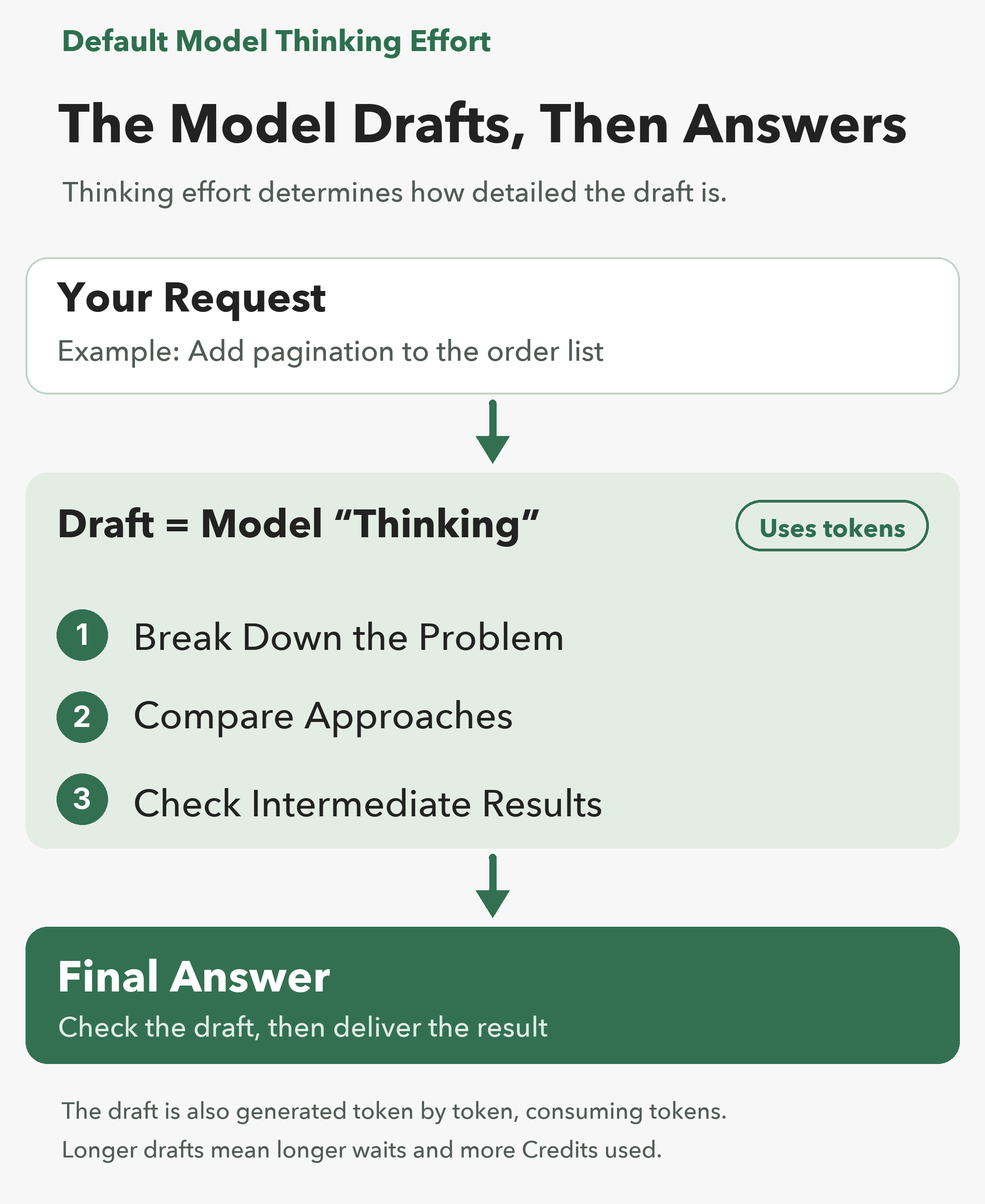
For a complex problem, a reasoning model can work through intermediate reasoning before producing a final answer. Think of this as an internal draft: breaking down the problem, comparing approaches, and checking intermediate results. This is what we mean here by the model's "thinking".

For a difficult math problem, working through the calculations step by step on scratch paper is better than simply giving an answer. It is more likely to produce the right answer, but it also takes more time. The same is true for models.

The model generates this internal draft token by token, just like the final answer. Tokens are units of text, and token counts give a rough measure of text length rather than a literal word count. Longer reasoning generally uses more tokens, increases waiting time, and consumes more Credits.

Thinking Effort Determines How Detailed the Draft Is

Imagine assigning a task to a colleague. If you say, "Have it ready by tonight", they have time to check edge cases more thoroughly. If you say, "Have it ready in ten minutes", they might deliver a usable first version and refine it as they go. The same person approaches the work differently depending on the time available.

Thinking effort works the same way. Most models in Qoder offer three thinking effort options:

  • Low: Less reasoning, faster results.
  • High: More reasoning, more verification.
  • Maximum: The most thorough reasoning and verification.

Changing thinking effort changes how thoroughly the model works through a task, not its underlying knowledge or capabilities. A higher setting gives it more scope to reason through a problem; it does not give it new knowledge or abilities.

For Coding Agents, Thinking Effort Affects the Entire Task

An Agent works through a task in multiple steps, rather than a single question-and-answer exchange. To fix a bug, for example, it reads the relevant files, edits the code, and runs tests. If the tests fail, it examines the errors, updates the code, and runs the tests again. The cycle continues until the tests pass.

Each step requires a request to the model. The number of these requests is the "model call count" referred to in the evaluation below.

Higher thinking effort can mean more reasoning at each step and more steps for the Agent overall. For example, the Agent may read more files, run additional rounds of tests, or check more edge cases.

The additional cost comes from two sources: longer reasoning drafts and more model calls.

Each model call also includes the context supplied to the model at that step: your requirements, relevant content from files the Agent has read, and earlier conversation messages. As that context grows, the request contains more input tokens and can cost more.

Why Higher Is Not Always Better

Difficult tasks are worth more thought. When there are many edge cases and mistakes are costly, extra rounds of verification can catch more omissions.

Simple tasks are different. Most of the extra reasoning is of little use, and the additional waiting time and tokens are unlikely to produce better results.

Official documentation from several model vendors also notes that the highest thinking effort setting may offer diminishing returns: additional spending brings progressively smaller improvements. Test first, then decide whether to use "Maximum" as your regular setting.

Why We Changed Some Models' Default Thinking Effort to High

We used Qoder CLI to compare Maximum and High on QoderBench, Qoder's evaluation dataset of nearly 200 cases. We ran each of the 6 models through the dataset once at each setting.

The Kimi results below are for Kimi-K3, not its replacement, Kimi-K3.1-Pro, which had not yet launched when we ran the tests. We have not yet completed the evaluation of Kimi-K3.1-Pro, so it uses Kimi-K3's High default for now.

Two metrics need a quick explanation. Output tokens count everything the model generates, including its internal reasoning. Model call count is the number of requests sent to the model to complete a task.

Lowering thinking effort by just one level from Maximum produced the following changes across the 6 models:

  • Output tokens fell by 19% to 48%, and model call count fell by 6.5% to 31.5%.
  • Per-run cost in the evaluation fell by 6.9% to 40.5%, while scores declined by 5.7% to 16.1% in relative terms.

By model:

  • GLM-5.3 had the largest reduction in per-run cost, at 40.5%, with a relative score decline of 6.3%.
  • For all 4 tested models selected for a High default, per-run cost fell by more than 20%, and scores fell by less than 10% relative to Maximum.
  • We kept 2 models at Maximum. Switching DeepSeek-V4-Pro to High reduced per-run cost by only 6.9%. For GLM-5.3-Flash, the same change reduced its score by 16.1% relative to Maximum.

Score decreases are relative percentages, not percentage-point changes: a score of 80 falling by 10% becomes 72. These results come from nearly 200 QoderBench cases; the Kimi model tested was Kimi-K3.

Qoder's Credits usage is tied to tokens. Fewer output tokens also mean lower Credits usage; the exact reduction depends on the task and model.

Lowering thinking effort comes with a tradeoff: all 6 models scored lower. This evaluation did not measure end-to-end task duration. Fewer model calls and output tokens may reduce waiting time, but the effect varies by task. Some of the extra reasoning at Maximum was useful.

When to Adjust Thinking Effort Manually

These defaults are recommendations based on Qoder's evaluation results. You can adjust a model's thinking effort to suit the difficulty of your current task.

Low: Use for brainstorming or small, well-defined changes, such as editing a button label, adding comments to a function, or standardizing API field names. Get a quick result, then review and refine it yourself.

High: Use for everyday development and bug fixes. For example, you might add pagination to an order list and handle empty results and out-of-range page numbers. High adds a few more verification steps.

Maximum: Use for hard-to-diagnose problems or changes where mistakes would be costly. Examples include investigating an intermittent concurrency bug and reviewing the signature verification logic for payment callbacks. You can also choose Maximum for long tasks you would rather not monitor throughout.

To set thinking effort separately for each model in Qoder, click the model selector at the bottom of the input box, then click "Manage models" at the bottom of the selector.

Three Quick Tips

Tip 1:

Try not to change thinking effort midway through a task. With prompt caching, previously processed input can be reused in later requests, which can save time and substantially reduce costs. Changing thinking effort mid-task may prevent cache reuse, requiring those input tokens to be processed again.

Tip 2:

When a result is wrong, first identify why. If the model missed edge cases or skipped verification, it may need to reason more thoroughly. Try increasing thinking effort.

If the model took the wrong approach from the start, increasing thinking effort will not help. Instead, try a different model or make your requirements, constraints, and acceptance criteria clearer.

Tip 3:

A thinking effort change in "Manage models" applies to all subsequent tasks. It does not affect a reply already being generated; the new setting takes effect in the next round.

Open "Manage models" to review each model's current default thinking effort. For complex tasks, choose Maximum.


r/Qoder • • 8d ago

Showcase A Peer Review from Real Filings with Qoder

2 Upvotes

I used Qoder to compare the latest quarterly results from NVIDIA, AMD, and Intel, using only their official investor relations pages.

It opened each earnings release in the built-in browser, collected figures with source references, and flagged 10 differences that could make the results hard to compare.

I then turned those findings into coverage rules and had Qoder apply them to a dashboard and a report using my usual template.

Finally, I saved the workflow as a reusable skill and set up an automation to rerun it whenever a new earnings release comes out.

What I found useful:

  • Every figure links back to its original source.
  • Comparison rules can be discussed with Qoder and saved for reuse.

r/Qoder • • 9d ago

Tutorial High-Risk PHP and Node.js Vulnerabilities: A Scan Costs Pennies. A Miss Could Cost a Fortune.

2 Upvotes

Last month, PHP released an official CRITICAL-severity security update; an unauthenticated exploit of mod_php that triggers before application code runs had already been demonstrated. On the same day, Node.js also released a security update listing 10 CVEs; a Brotli decoding vulnerability could lead to remote code execution.

Three questions come up most often in the comments:

"Is my project affected? How exactly should I upgrade? Could the upgrade stop it from running?"

This article answers these three questions and offers a practical way to get started right now: let Qoder help you check your own project.

First, What Happened in These Two Security Updates?

A reminder worth repeating: These are runtime-level security updates. Determining whether a project is affected requires assessing deployed runtime versions, vendor patches, and usage paths; updating application dependencies or changing version declarations alone is not enough to confirm a fix.

Why "Upgrade to a Fixed Version" Is Not So Simple

The advisory's recommendation is just one line: upgrade to a fixed version. In practice, however, the questions come one after another:

"Which version is the project actually running? The version specified in the image may differ from the one running on the host. Which deployments need changes? Hosts, containers, and long-running workers all need to be inventoried. Could the upgrade stop the project from running? Extensions, system libraries, native modules, and startup configuration all need to be assessed in advance. What if an upgrade is not possible yet? Temporary mitigations also need assessment and review."

This is exactly the kind of work Qoder does well: reading the project files you authorize it to access, using the tools available in the environment, analyzing this information together, and then proposing an actionable plan.

Qoder's Answer: Two Security Plugins

In response to these security updates, we have launched two plugins in the Qoder Plugin Marketplace:

  1. PHP projects: php2shell-defense. Covers PHP host and container inventory, version checks, temporary mitigations, upgrades and patching, actual runtime validation, and investigation of suspicious indicators.
  2. Node.js projects: nodejs-security-guard. Checks the version requirements in this security advisory and examines relevant paths in the project, such as Brotli decompression.

You only need to install the plugin that matches your project. Each plugin provides tools and remediation workflows. Qoder carries out the specific work based on your project, the available environment, and the scope of your authorization: assessing the vulnerabilities' impact, identifying where changes are needed, and preparing a remediation plan. Only after your confirmation does it proceed to modify files, run tests, and review the results.

Open Qoder—follow these steps to get started

Step 1: Install the plugin from the Extensions marketplace

Open Qoder, go to Extensions → Skills on the left, and confirm that the marketplace source is Qoder Marketplace. In the search box at the top right, enter the name of the plugin for your project:

  • PHP projects: Search for php2shell-defense.
  • Node.js projects: Search for nodejs-security-guard.

Qoder Marketplace entry point. Enter 「php2shell-defense」or 「nodejs-security-guard」in the search box at the top right.

Open the plugin details page and click Install. Simply confirm that the plugin appears under "Installed". For detailed navigation instructions, see the Plugin Usage Guide.

Step 2: Select your project and start with a read-only assessment

Create a new coding task and select your project directory. Type / in the input box, select the capability provided by the corresponding plugin (the PHP skill is named php2shell-defense), then paste this assessment prompt:

"Check whether the current project is affected by this PHP security vulnerability. Start with a read-only inspection of the runtime environment and deployment configuration. List affected areas and the evidence supporting each finding. Do not touch production, upload scripts, create probe files, modify configurations, or restart services. Provide a minimal remediation plan covering required changes, potential impacts of image upgrades on dependencies and business functionality, testing, and rollback. Mark anything without sufficient evidence as Pending Verification. Wait for my confirmation of the target environment and actions before proceeding."

The key to this prompt is read-only first: leave production untouched, do not upload scripts, and do not change configuration. Qoder will first read the accessible information and list the areas that need attention and the evidence supporting its conclusions. If key evidence is missing, such as the version actually running or access permissions for the remote environment, it will explain what needs to be provided. You do not need to document every deployment detail of your project beforehand.

Step 3: Review the plan, then let Qoder proceed with remediation

Once the assessment is complete, you will see what needs attention, the files proposed for modification, and the potential impact of the upgrade. After confirming the specific plan, paste:

"I approve the proposed fixes. Apply them in the current local workspace and run available tests. Then summarize the changes, test results, and remaining pre-deployment checks. Do not deploy or restart production services."

Qoder will then proceed with changes and tests within the confirmed scope. If tests fail or new compatibility issues arise, it will use the results for further analysis. If the scope of changes needs to expand, it will ask for your confirmation.

Verification can continue after the changes

A successful image build does not mean the deployed service instances have been replaced—old instances may still be running. Updating the local version does not mean the actual service has switched to the new version, either.

Once the release is authorized and the relevant environments are accessible, Qoder can continue to help verify the builds currently running, the target replicas, and the business regression test results. Anything not yet deployed or lacking verification evidence will remain clearly listed as an outstanding task, making it easier for you and your colleagues to follow up.

This time, start with a project you currently maintain: let Qoder identify the issues that need attention, review its proposed plan, and then move forward with remediation.

Open Qoder, install the appropriate plugin from the marketplace, and send it the assessment prompt above. The prompt is ready to use! DeepSeek-V4.1-Flash-1017 is still available for free, so running a check won't cost you a penny—missing a vulnerability is what really costs. Come back after the check and let us know how it went.


r/Qoder • • 12d ago

Waiting for the model to reply… Model request queued · Estimated wait about 1 minute

Post image
4 Upvotes

r/Qoder • • 12d ago

Showcase Consolidate Interview Feedback with Qoder

2 Upvotes

I recently had to pull together feedback from four interviewers who had met three candidates for a senior engineering role. Everyone submitted their notes in different formats, including one informal email, so organizing everything was a bit of a hassle.

I used Qoder to:

  • Score each candidate against the hiring rubric.
  • Flag disagreements between interviewers and any missing feedback.
  • Recommend whether to hire, not hire, or schedule a follow-up.
  • Calculate the scores and generate an Excel scorecard and a one-page Word debrief.

I also asked Qoder to check both files and make sure candidates were evaluated only on job-related competencies.

I could open both files right inside Qoder, which made the whole process easier to manage.


r/Qoder • • 13d ago

Showcase Screen Resumes in Minutes, Then Reuse It as a Skill

6 Upvotes

I had 15 resumes to go through for a data analyst opening, and honestly, reviewing them one by one would have taken quite a while.

So I tried giving Qoder the folder of PDF resumes along with the job description and asked it to compare each candidate against the requirements.

It put together:

  • A ranked shortlist in Excel, with scores for each requirement.
  • A breakdown of why the top three candidates were worth considering.
  • A few red flags I might have missed on a quick read, like someone claiming five years of experience when their actual work history only added up to two.

I also used /skill-creator to save the workflow as a skill. Now I can reuse the same process for the next role with just one command.


r/Qoder • • 15d ago

Showcase A Daily Market Brief, On a Schedule

4 Upvotes

I set up a daily market brief workflow in Qoder using four public sources and a fixed format. I just type "Write today's brief," and Qoder opens each site in its built-in browser to gather the latest figures.

It puts together:

  • Futures, US market close, Asia, Europe, commodities, and rates, with source links.
  • Five linked headlines and three things to watch.
  • Clear flags for any sources it couldn't access, rather than guessing missing numbers.

I also turned it into an automation that runs every day at 8 AM.

Pretty handy for keeping up with the markets without checking every source myself.


r/Qoder • • 17d ago

Access to Alibaba-Cloud Cloud Computer

3 Upvotes
  • As you can see, this cloud computer is offline, and its downtime has continued for at least 5 hours! There is no way for me to turn it on, and there are no official docs to resolve this kind of problem.
  • I have another question too. How can I manage this server and its firewall through the Alibaba Cloud console? Is it accessible from the same account I have on Qoder?

r/Qoder • • 17d ago

A stealth model just landed on Qoder. FREE!

Post image
12 Upvotes

A stealth model just landed on Qoder.

Meet Qoduck.

Don't ask where it came from.

Free every day for all individual users. Limited-time.