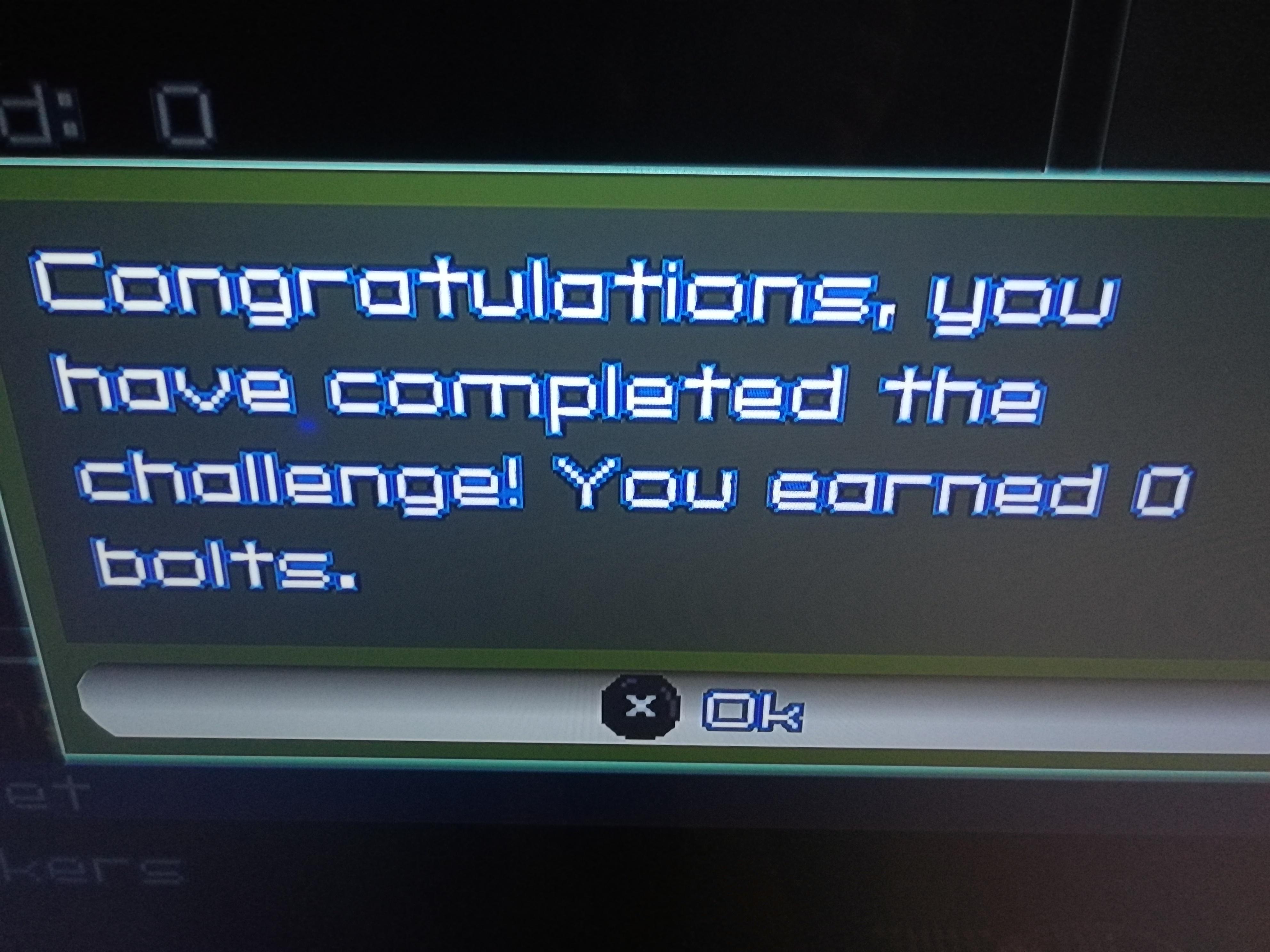
Recently I posted in comments a screenshot here showing an internal debug menu from the PC version of Rift Apart with an option labeled "Game Type: Multiplayer".
u/0dqir0, as a mod, said it was fine to make a separate post about what’s actually there.
Disclaimer 1: All data was obtained legally by analyzing and researching the EXE of the release PC version of the game via Ghidra.
Disclaimer 2: AI assisted with translation and text structuring, as well as a search assistant across Ghidra. Well, sorry, English isn't my native language, and manually researching 300,000 game functions isn't exactly a pleasant work.
Disclaimer 3: I won't give technical details with addresses, RVAs, or structure descriptions because... would you read such nerd stuff?
Disclaimer 4: This is still nerd stuff, haha.
Turns out, there is quite a lot of cut multiplayer architecture still sitting in the binary.
Here is what's actually left in the game:
1. That broken debug menu
Why was almost everything showing <crashed>? Because in the retail PC build, the staging manager context isn’t initialized on startup. When you force the debug menu to show up, its getter functions try to read data from null pointers, panic a bit, and fall back to printing <crashed> for level names and checkpoints (Actually, it's not the menu itself, but my crooked tool so that there is no emptiness there, but the essence remains the same).
Still, the menu logic itself is fully compiled in. It has an actual toggle between kCampaign and kMultiplayer. And at the bottom, there is a player roster tied to an internal ClientManager that supports up to 16 player slots. It even pulls your chosen character name (Ratchet/Rivet) and grabs your Steam persona name through Steamworks to put a neat Character (SteamName) button in the lobby list.
2. The 120+ "Remote" classes
In client-server network code, your local character runs on HeroLocal, while any other player connected over the network runs on HeroRemote. Inside Rift Apart, there are over 120 separate HeroState...Remote classes, and they specifically cover mechanics that only exist in Rift Apart:
HeroStatePhaseAirDashRemote - Networking clone for the Phantom Dash mid-air.HeroStatePhaseDodgeRemote - Networking clone for the Phantom Dodge.HeroStatePhaseWallRunRemote - Networking clone for Wall Running through dimensional phase-shifts.HeroStateHoverbootRemote - Networking clone for skating around on Hoverboots.HeroAimManagerRemote & HeroWeaponManagerRemote - Replicating weapon aiming and shooting for remote players.
3. Dedicated 2-player campaign difficulty settings
This was probably the most interesting find. In the game's data tables, the difficulty settings aren't just the standard ones we have in the menu. There are separate definitions specifically configured for two players:
kCampaignEasyDifficulty vs kCampaignEasyDifficulty2PlayerskCampaignNormalDifficulty vs kCampaignNormalDifficulty2PlayerskCampaignHardDifficulty vs kCampaignHardDifficulty2PlayerskCampaignHardestDifficulty vs kCampaignHardestDifficulty2Players
You don't create dedicated 2Players campaign difficulty tiers unless you're actively balancing combat encounters (enemy health, damage, spawn rates) for two players running through the story at the same time.
4. Round lifecycle and engine flags
The multiplayer traces go beyond player movement. The engine still contains the exact events and console flags needed to run a multiplayer match:
- Round Events: The engine’s event bus has registered event classes for
MultiplayerRoundStartEvent and MultiplayerRoundEndEvent. The game literally has logic for when a multiplayer round starts and ends. UnlockMultiplayer & UnlockMultiplayerSave: Engine flags to enable the multiplayer interface and give it an isolated save slot, so it wouldn't overwrite your single-player campaign progress.LanMode & LateJoinEnable: Flags for local subnet discovery and hot-joining (connecting to a match that's already in progress without reloading).EnableInMultiplayer: A setting in the dynamic dialogue system (EmergentVOManager) that controlled whether characters would still banter and talk to each other during a multiplayer match.
5. Extra details (Vulgarity warnings and camera notes)
A couple of other small details that were fun to spot:
- Profile Flags: In the player profile data, there's a neat sequence of flags stored in a row:
kFlagInitialCharacterPicked, kFlagInitialVanityApplied (armor/colors), kFlagVulgarityWarningShown (the classic online safety warning about inappropriate names/chat), and kFlagUnlockedMultiplayer. - Notes for Level Designers: In the documentation for the camera scripting nodes, there is a specific note warning designers that
OnCameraCreate might trigger multiple times in a multiplayer setting because multiple players are spawning in.
Obviously, none of this made it into the final game. And no, this isn't something that can just be "turned on" with a simple config tweak - the high-level classes and menu skeletons are there, but the low-level network replication backend was either stripped before release or never finished.
Still, it’s pretty clear that co-op/multiplayer was much further along in development than just an early pitch on a whiteboard. They had network classes for Rift Apart's exact traversal mechanics, difficulty scaling for two campaign players, and round lifecycle events built right into the engine.
...Or maybe Insomniac's terrifying corporate codebase standards and Luna Engine architecture just strictly force developers to write duplicate Remote classes for their net infrastructure, even when a game doesn't actually need them. Whichever of these two 'fairy tales' sounds more believable to you, feel free to go with that one :)
Bonus: Why does the title say "or even 10"? R&C 2016 also has Remote classes for all gameplay actions, but there are no such striking examples of a dedicated multiplayer system. It's more of a hybrid of Sunset Overdrive's legacy with some attempts at a new multiplayer experience.
Your ad could have been here. Courtesy of Gadgetron.