Hey r/Retool! We just launched an App Gallery with 13 real apps you can click into, poke around, and use yourselves. To celebrate, we want to see what you've been building!
Through October 1, post something you've built with Retool's new app builder. It can be something useful for your role or industry, or a creative use case you want to share.
To enter, the Built with Retool contest, make your own post here in r/Retool and include:
What you built with Retool and what it does
A screenshot or a recording (30 seconds or less)
The prompt or approach you used
Enter as many times as you want; one win max per person. Upvote your favorites and comment on anything that catches your eye.
We'll pick our top 3 based on upvotes, discussion, and what we found most compelling. Winners will each get a $100 gift card (we'll DM you around Oct 6 - reply within 72 hours). Full Contest Rules here.
I'm Sarah from the community team at Retool. I'll be around in the comments all month, so ask me anything! Can’t wait to see what you Built with Retool!
Building internal tools quickly is one thing, but managing them once they become critical seems like a completely different challenge.
I've been looking into how platforms like Retool and Superblocks approach governance, role based permissions, and application lifecycle management at enterprise scale.
I'm particularly curious about app ownership, approval workflows and maintaining quality when multiple teams are building internal tools.
For those running Retool at scale, what governance practices have worked for you, and what would you do differently if you were starting over?
Retools seems great for getting internal tools up and running quickly but thing get more complicated once those apps become critical to daily operations.
Monitoring, debugging, version control, and rollbacks feel like necessities rather than enterprise features, even for smaller teams.
I've been looking at Superblocks and Appsmith to see how other platforms approach these production requirements.
For those running Retool in production, have you experienced similar limitations? Did you upgrade, find workarounds or eventually move to another platform?
Curious how smaller engineering teams are dealing with this.
I've been using Retool for production internal tools for almost a year and still really like the platforms for getting applications built quickly.
The part I'm struggling with now is operating those applications at scale.
As usage grows things like monitoring, performance visibility, versioning and rollback, integrations and troubleshooting become much more important. Some of the capabilities around these areas appear to be tied to higher tier plans.
For teams running Retool in production, how are you handling this?
Have you found workarounds using external monitoring or deployment tooling or did you eventually move some applications away from Retool?
I'm especially interested in what becomes difficult once a Retool app moves from a small internal tool to something the business depends on everyday.
I want to build a missive integration with retool. I'm sysadmin no developer. I want to pull some data from sylius into missive when staying on an e-mail and add some interactions to it. I know that retool has an AI, but i wont to build it from scratch, because i want to learn something with this project. I know the basics of REST APIs and HTTP Methods, but i cant code or know how database querys works. How long would it take to achiev this goal and what do i need to learn?
Has anyone using the new CLI + Codex workflow run into the same 401 on this endpoint? I'm trying to determine whether this is a CLI auth bug or an additional app authorization/configuration requirement.
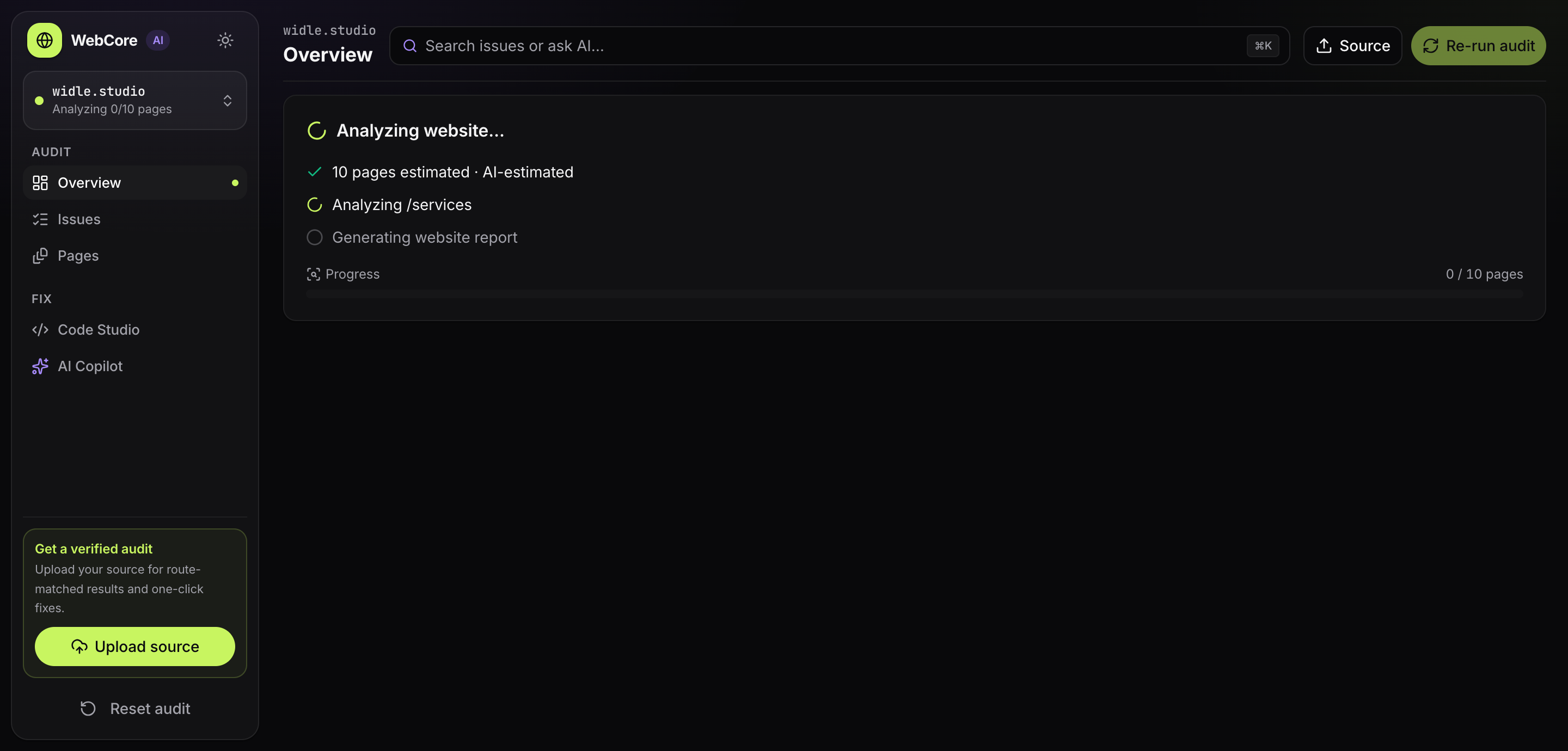
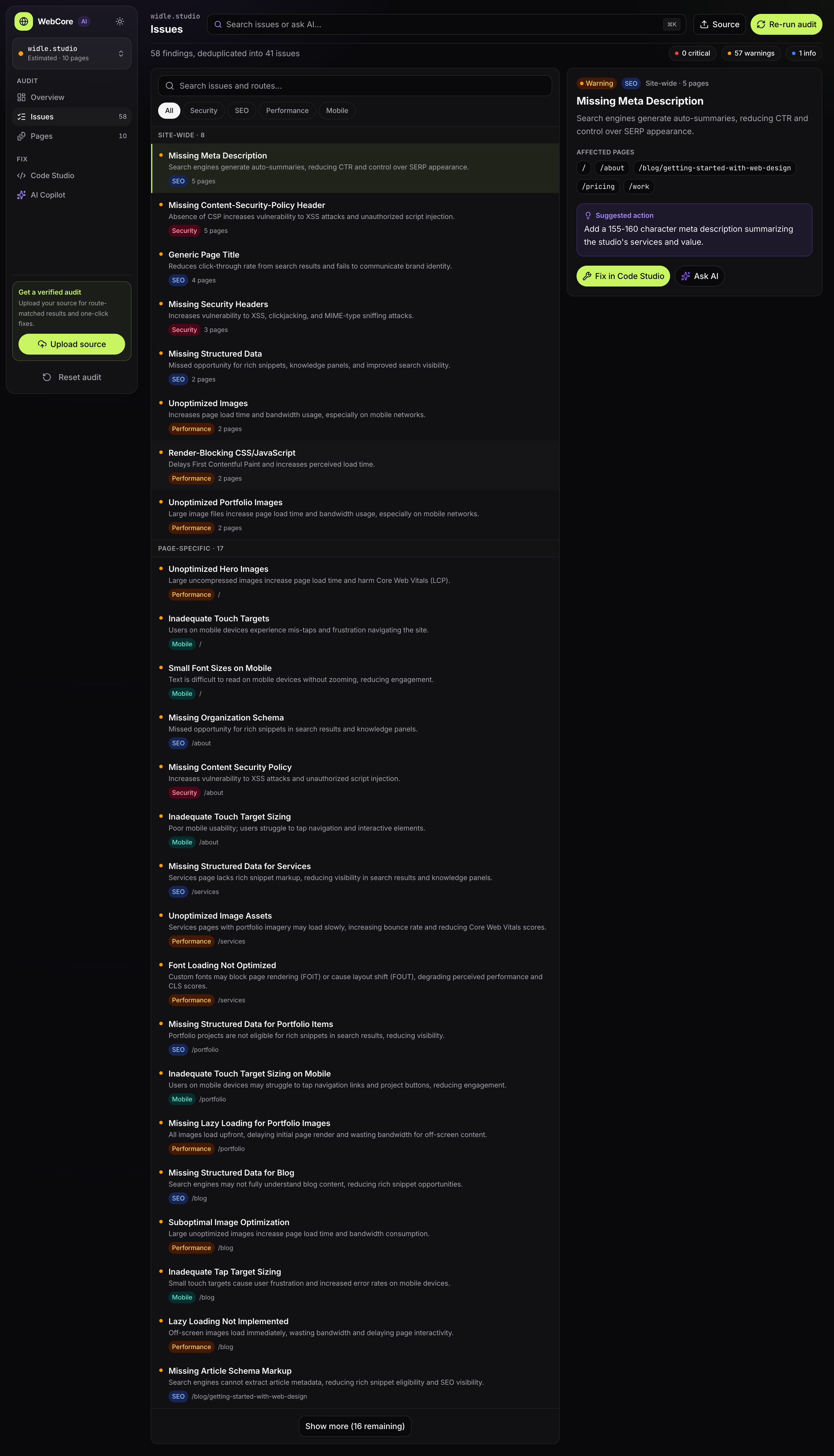
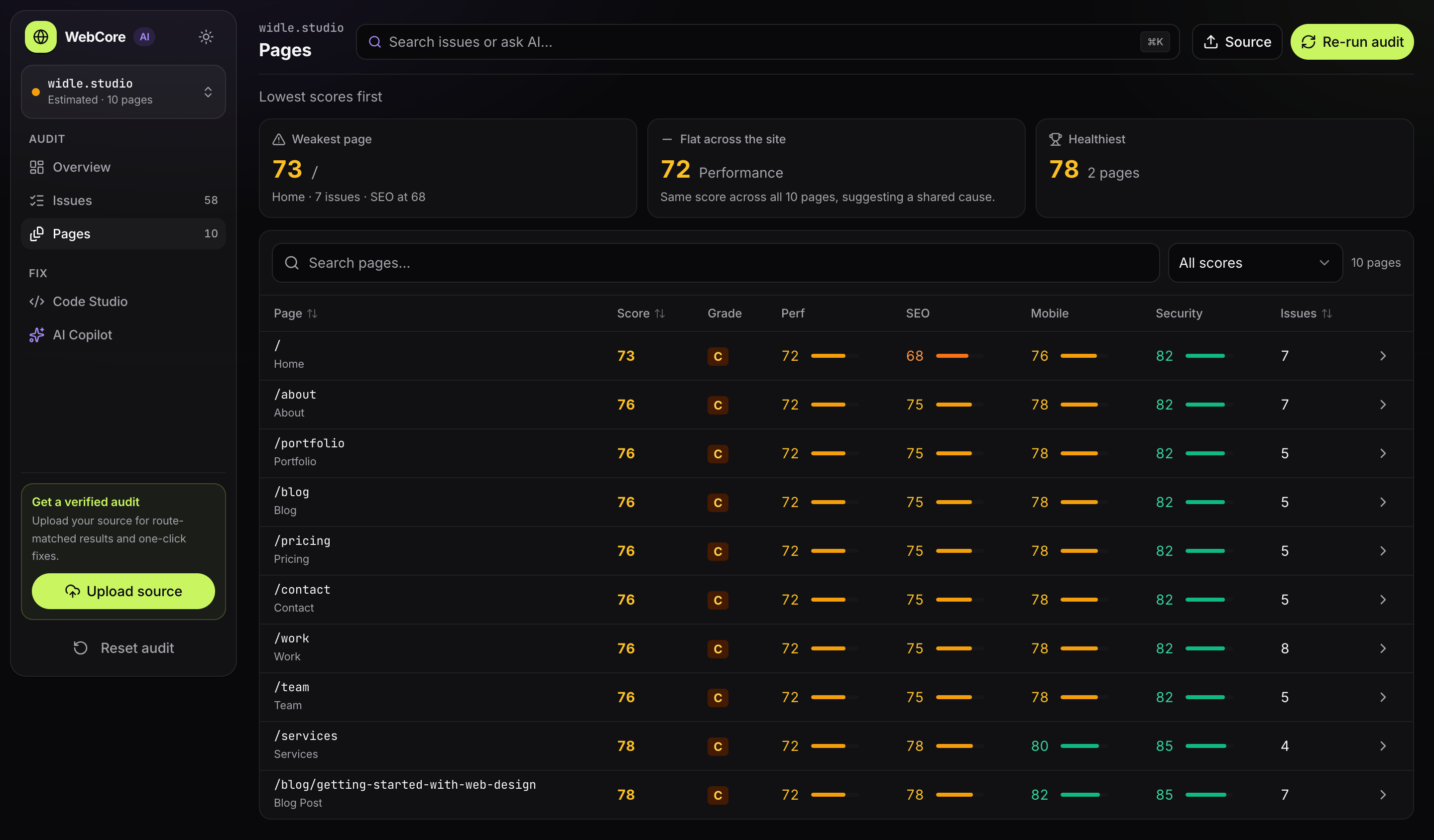
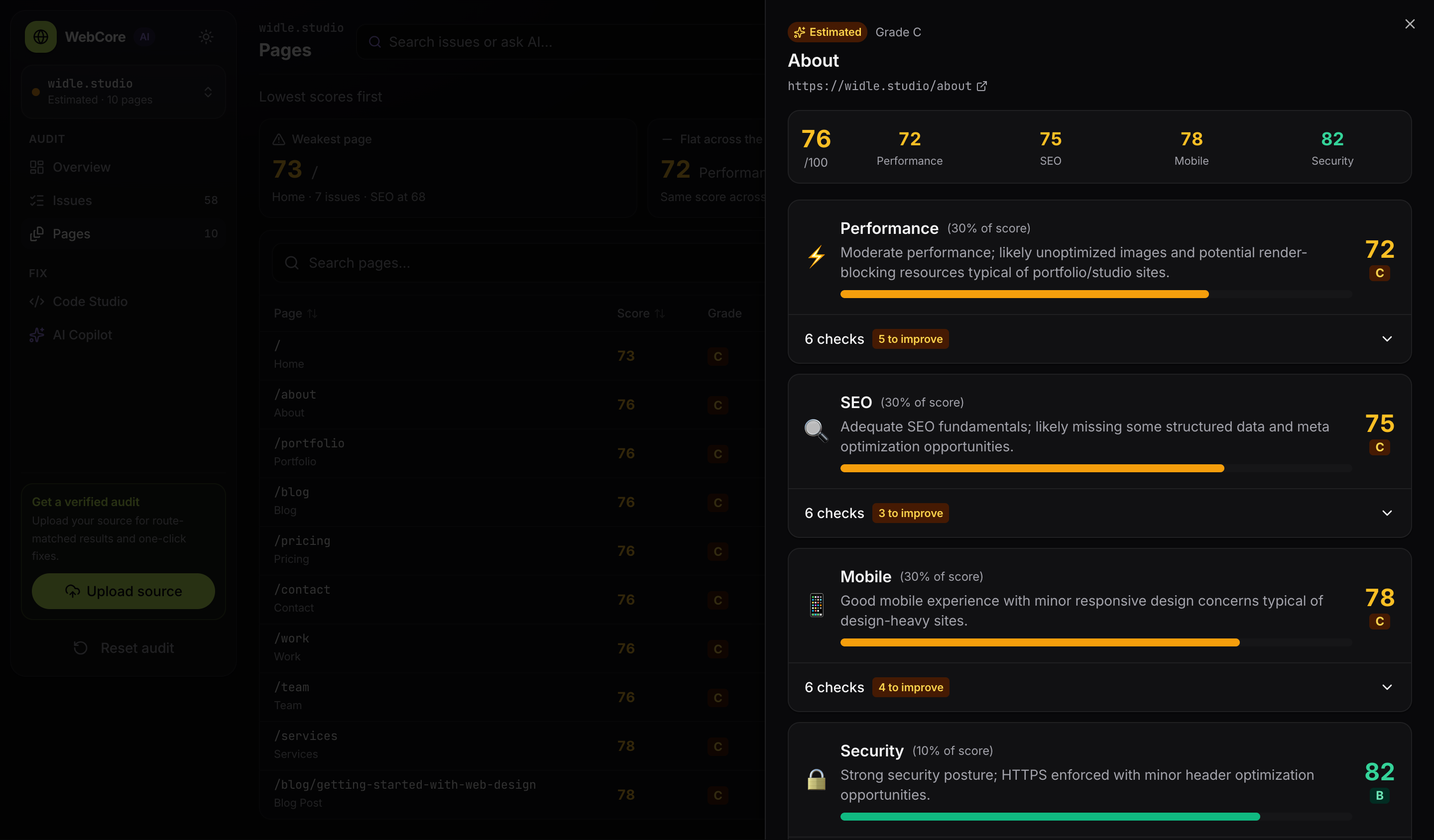
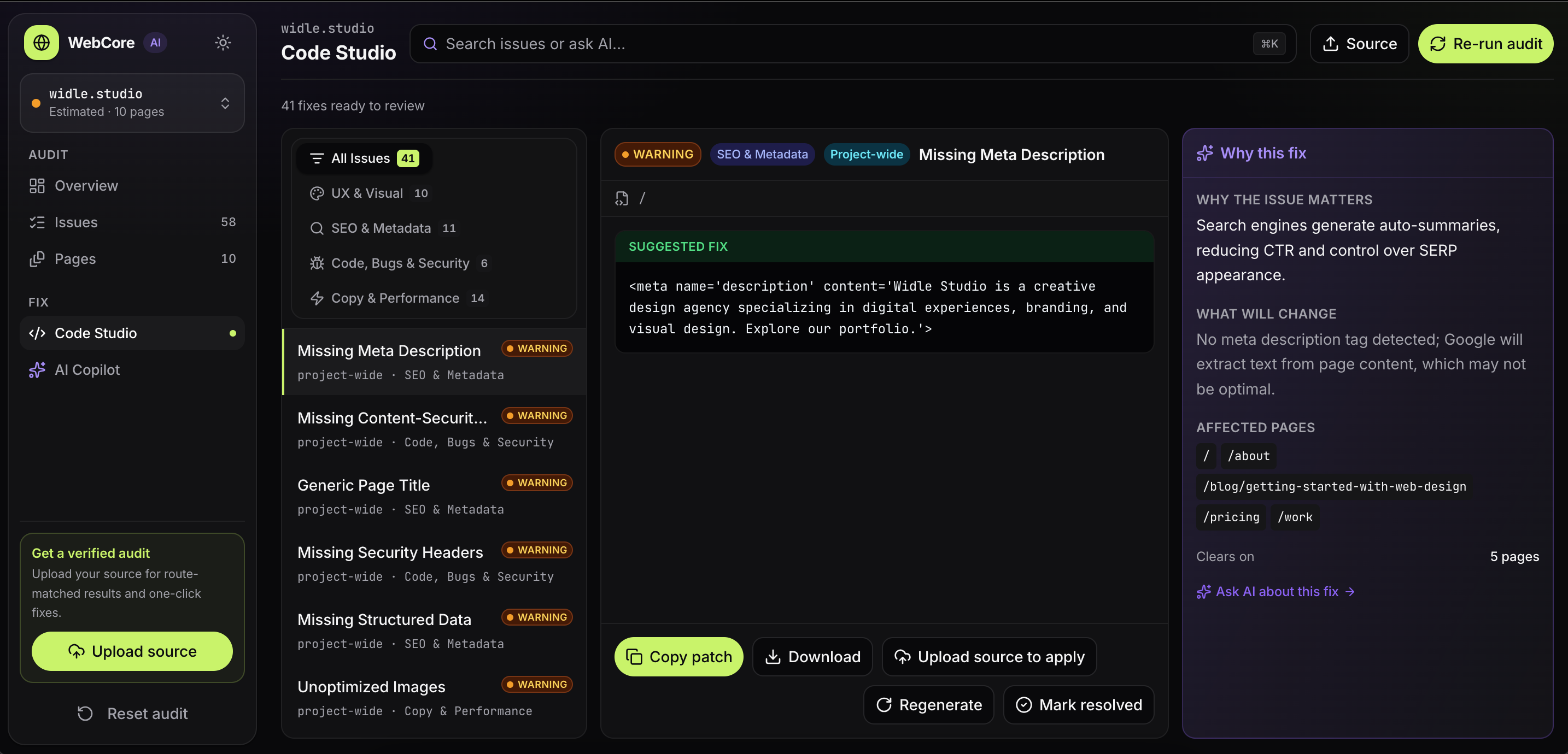
We built WebCore AI with Retool to transform a traditional website audit into something much more actionable.
A typical website audit can generate a huge list of SEO, performance, mobile, security, and other issues — but the difficult part is understanding what actually matters, what should be fixed first, which pages are affected, and how to move from identifying an issue to fixing it.
That’s what WebCore AI is designed to solve.
What it does
The application follows a simple workflow:
Audit → Understand → Prioritize → Fix → Verify
The main experience is divided into:
Overview — Provides a high-level view of website health, category scores, key findings, and the issues that need attention first.
Issues — Allows users to search and filter findings, understand their severity, see affected pages, and get recommended actions.
Pages — Provides page-level health information so users can compare individual pages and identify areas that need improvement.
Code Studio — Takes the workflow closer to implementation by showing the proposed code fix and explaining why the change is needed.
AI Copilot — Allows users to ask questions about the audit and get context-aware assistance based on the website’s audit data.
We wanted the application to feel less like an audit-results dashboard and more like a workspace for actually understanding and acting on website problems.
The approach we used with Retool AI
We started with the existing Retool application and used Retool AI / Claude to iteratively transform the UI and overall product experience.
Rather than asking the AI to simply generate a new dashboard, we gave it clear instructions around:
- The application’s purpose and user workflow
- Information architecture
- Existing Retool components and functionality
- Page-by-page layout requirements
- Design system and visual hierarchy
- Responsive behavior
- Component spacing, typography, colors, cards, and panels
- How issues should move from discovery → understanding → fixing
- Keeping the existing queries, data, business logic, and actions intact while improving the user experience
We then iterated on the generated result, reviewing the UI and providing targeted prompts for areas such as layout, spacing, typography, colors, the Issues workspace, AI experience, and responsive behavior.
The main principle was:
Don’t just show the user what’s wrong. Help them understand what matters and what to do next.
What we learned
One of the biggest things we learned while building this was that using AI for UI development works much better when the prompt describes the product intent and interaction model, rather than simply saying, “make this look better.”
For example, instead of only asking for a dashboard redesign, we defined how a user should move through the product:
Audit → Understand → Prioritize → Fix → Verify
That gave the AI a much clearer direction for deciding what information should be prominent and how the different screens should connect.
Thanks to the Retool team for putting this challenge together!
This app is a management system for a paint / art studio cafe (the kind of place where guests book a table, paint canvases or ceramics, and order drinks/snacks during their time) that I created for personal use. It is a staff-facing tool and a small customer-facing booking flow.
The core functionality of the app is as follows:
Core: live sessions & floor
Dashboard ("Live Sessions"): real-time view of every occupied table with a color-coded floor map (on-time / warning / overtime / paused), capacity bar, live timers, search, and a waitlist panel.
Floor Map: editable/draggable tables floor map according to real-time table arrangements.
Check-in starts a session: allows to enter party size, rate per person, duration, table assignment.
Session detail: allows to pause/resume the timer, add inventory items (canvas, ceramic, paint), take food/beverage orders, apply loyalty rewards, checkout with a receipt (cash/UPI/card) and send receipts via SMTP email.
Tables: functionality to edit the floor layout (positions, shapes, capacity, combinable tables).
Bookings
Book / Booking confirmation: a public, customer-facing reservation flow (no staff navigation) that reserves a slot within studio hours.
Settings: studio hours, slot intervals, default session length/rate, booking lead time and horizon.
Data & pricing: Sessions are billed per person plus items, food, tax, and loyalty discounts. It runs on a SQL database (Retool DB), uses SMTP for campaign emails, and amounts are formatted in INR (₹).
Prompt Used: Build a management app for a paint-your-own art studio / pottery cafe. Staff need to run walk-in sessions billed per person per hour on a live floor map, handle reservations and a waitlist, sell art supplies and a food/drink menu, and track customers, loyalty rewards, and marketing campaigns — plus a reports dashboard. Guests should also be able to book online.
Scalable manufacturing and traceability application and dashboard of botanical skin care-an answer to small business compliance that does not need to start on the manufacturing floor. It traces a product from bar code or batch to the ingredient, percentage of and cost per ml of the product. It also provides traceability into Stock and Cost of Sales ready for any accounting information, snap-shot of current stock and raw materials or packaging availability status. Other tools are all off-shore based and do not answer to the level of granularity required for a daily manufacturing breakdown. The modules created can be managed by different people therefore creating jobs not taking jobs away as the fallacy of AI claims in a larger manufacturing setting, as the person who formulates is not the same person that manufactures or the same person who captures raw materials or packaging who is not the same person who captures financial data.
I use several AI tools, and I wanted a way to see which one should take a task based on what it can actually do and how much capacity I have left. So I built AI Capacity Control Tower in Retool’s new App Builder.
I can add my own resources and tasks, set things like capacity and capabilities, then run the allocation. It also explains its choices. If a task cannot be assigned, I can open it and see why each resource was ruled out.
In the video, all 10 demo tasks are assigned at first. I turn off GitLab Duo to simulate it being unavailable and run the allocation again. Nine tasks still get assigned, but one is blocked because none of the remaining resources meets all its requirements.
This is a planning tool, not something that calls the AI tools or runs the tasks for me. The capacity numbers are estimates I enter myself. Changes are saved in my browser, so they’re there when I come back on the same browser, but they don’t sync across devices.
I built it over several rounds with Claude Opus 5 in Retool App Builder. My starting prompt was roughly:
“Build an app where I can list the AI tools I have and the tasks I need to do. Help me decide which tool should take each task based on its capabilities, remaining capacity, and when that capacity resets. Show me why each task was assigned, and what happens if one tool becomes unavailable.”
After that, I added resource editing, saved data, the explanations, and the outage test.
I’d be interested to hear whether you’d find something like this useful. Feel free to ask me anything about how it works.
We like what retool does but every change needs one of our devs and they're buried in product work. I just want to build a couple of internal things myself, an approval flow and a small ops dashboard, without learning to code or sitting in the eng queue.
I've tried airtable, its fine till the logic got real. The ai builders all demo great then fall apart once real data hits them.
Maintenance is what worries me most bc one of these breaks and i'm back needing dev i was trying to avoid, kinda defeats the whole point.
I've been using retool for 2-3 years now, the majority of my time was with the UI drag and drop builder.
It feels really powerful and I still have a sense of control. I know what the code is doing and I don't have to analyze a lot of code to get a good picture of what it is doing. I can simply point and click visually to look at its logic.
Now with vibe coding being the new trend and the good old drag and drop UI being deprecated me personally I feel sad it's going this direction.
The main reason I did not want to use any vibe coding tool is because I know what I'm doing and don't want an <insert coin here> tool to do the work for me.
Hey all, I'm a senior dev advocate and wanted to try something a little experimental by building a full app completely hands-off, using only Mac’s Voice Control talking to Claude Code, connected via MCP.
Real number one, I couldn’t use the keyboard nor the mouse. Instead, I used my voice, prompting by saying "open terminal," "select two," "delete text," and reading numbers off the screen to click things. I mean, it wasn’t easy (the voice control wasn’t the best at recognizing similar commands, and I didn’t do a practice beforehand, so this was all live babyyyy), but by the end, I had a working, production app!
With so many vibe coding platforms out there, I was most familiar with Retool, so that's where it was published/built. I have been using it as my day-to-day building platform, and so with the MCP and Claude Code, it was really interesting seeing how far one could go and win for accessibility :)
Anthropic announced a few weeks ago that Fable would be moving behind API pricing, and today the change takes effect. I’ve been thinking about it since the announcement, because Fable has become the model I reach for whenever I’m planning larger pieces of work. I assumed I’d respond by swapping in cheaper models more often. Instead I’m changing where Fable sits in the workflow, because once I looked at what I was actually buying from it, most of the spend was regeneration, not reasoning.
Until now the loop looked like this: Fable generates an implementation plan, I fan the work out to cheaper models, collect the results, hand everything back to Fable for a revised plan, and repeat until the plan is stable enough to implement against. Looking back at those revisions, most of what I was paying for was another copy of a document that was already mostly correct. The architecture rarely changed between versions. What changed was small: a requirement I hadn’t thought of, an assumption corrected after reading more of the codebase, a contract update, an edge case that surfaced during review. Everything else got regenerated because regenerating was easier than maintaining the document. I was paying frontier prices to reprint pages that hadn’t changed.
The new workflow starts one tier down. Opus generates the initial implementation plan, because the initial architecture is still worth frontier reasoning, but it turns out not to need the most expensive reasoning available. The first draft doesn’t have to be perfect, because the rest of the loop exists to make it converge. After that I gather the current state of the project — code, documentation, contracts, architecture decisions, whatever accurately describes the system — and hand the plan and that state to several cheaper models to review independently. They’re not writing a better plan. They’re trying to prove the current one wrong: the missing requirement, the stale assumption, the contract that doesn’t survive contact with the code.
Fable comes in once, at the end of the loop, and its job is judgment rather than authorship. It gets the original plan together with everything the review models found. Some of those findings will be valid, some won’t, and some will contradict each other, and a reviewer’s report is a claim, not a fact. So the work starts with verification, checking the findings against the actual state of the system instead of taking the reviewers’ word for it, and ends with a decision: which of the verified observations actually change the architecture, and what is the smallest edit that reflects them. If a section is still correct, I don’t want a second copy of it. If one contract needs to change, only that contract changes. Fable never writes the document. The unit of frontier work is the diff.
Working through this changed something else I wasn’t expecting. I’ve spent a lot of time building orchestration systems where the strongest model sits at the top, delegates work to cheaper models, and pulls the results back together. This workflow inverts that. The cheaper models do the generating and the exploring: they draft the plan, search for problems, challenge assumptions, and look for missing pieces. Fable doesn’t orchestrate any of that, because orchestration doesn’t need it. It sits at the end as the skeptic, spending its reasoning on the two things the cheaper models can’t be trusted to do for themselves: verifying what they claim, and deciding what actually matters.
While I was working through this I turned the process into a Claude Code skill. The rolling plan governor maintains a rolling implementation plan as a governor, not an author. Each cycle it takes the current plan plus a ledger of what actually happened — session reports, merged PRs, ticket state, decisions — and treats every report as a claim rather than a fact. It verifies the claims it can probe against live surfaces, then applies the smallest evidence-backed delta that makes the plan true again. It is mechanically barred from doing anything more: touching a section with no supporting evidence is a hard failure, and so is dropping unfinished work without a positive signal that it’s done or obsolete. Most of the document survives every cycle untouched, because most of the document is usually still correct. The implementation is a clearer description of the workflow than this post is, which is why I’m publishing them together.
I don’t know yet whether any of this reduces my overall development cost. It should be measurable. Over the next few weeks I’ll compare implementation retries, contract churn, verification failures, planning revisions, and total token usage against the workflow I’ve been running until now. If nothing else, Fable moving behind API pricing forced me to look at where I was actually spending frontier reasoning instead of where I assumed I was spending it.
Hello everyone, not sure if this is the right place to ask but I need some assistance with issue I've been facing recently. As I understand Retool autosaves changes I made but at some point it just stopped. Whenever I edit something, it works for me, I can use queries I've added etc, but if I leave the app or refresh the page my changes just gone. They're not reflected in history, if I try to compare current version with live release it shows no diff. I know that Retool doesn't support any kind of asynchronous editing, I checked that I don't have multiple tabs of an app, my teammates have it closed, however whatever I do is just lost after closing the app.
Hey all! Small ops team here (mostly low/no-coders) that's built a lot of our internal apps on Retool, plugged into our production data and APIs. We love it, but we're at a crossroads and would really value your take.
Retool just launched their new AI app builder, and to keep using it long-term we'd move to an Enterprise plan that roughly triples our annual spend. The pitch for staying is the governance layer: SSO, role-based access, audit logging, GitHub/GitLab review before prod, plus letting non-engineers ship fast and safely.
But here's our hesitation: with this new builder, Retool is basically becoming a vibe-coding platform anyway. There's no more drag-and-drop in the new apps, every tweak goes through the AI, and you end up with React code under the hood. So the question becomes: if we're vibe-coding regardless, why pay 3x for Retool instead of just building the same apps ourselves with Cursor/Claude and leaning on our engineers? The honest answer is the governance layer, but we'd have to weigh that against building it ourselves and depending more on eng (merge requests, etc.), losing some of the autonomy that drew us to Retool in the first place.
For anyone who's faced this: did Retool's built-in security/governance justify the Enterprise jump, or did you go DIY and not look back? Curious what bit you later either way.
Hey r/retool, Sarah here with an exciting announcement from the team.
The new app building experience is live today, and it genuinely changes what "building in Retool" means.
The short version: describe what you want, and the builder generates a full React app wired up to your production data, with auth, permissions, and audit logging already in place. No boilerplate, no separate security pass at the end.
There are three ways to build now:
From a prompt. The new builder is AI-native. Describe the app in the Chat tab, get a working version connected to your data, then refine in natural language or drop into the Code tab. [App builder docs]
From your coding agent. The Retool MCP server lets you generate and deploy Retool apps straight from Claude Code, Cursor, Codex, or any MCP-compatible tool — so if that's where you already work, you don't have to leave it. [MCP docs]
Import what you've already built. Got a React app sitting in Lovable, Replit, or a GitHub repo that never quite made it to production? Import it as a ZIP or via GitHub, connect your data, and ship it with governance attached. [Import docs]
A couple of notes: apps built in the drag-and-drop IDE are now called classic apps, and they keep working exactly as they do today. And through July 1, every plan gets bonus AI credits and free hosting.
I’ve noticed a massive surge in "Art Cafes" and DIY craft studios popping up lately. They operate on a fascinating business model - essentially "Time-as-a-Service" (TaaS) - where they sell a 2-hour window, provide art supplies, offer a complimentary tea/coffee, and upcharge for actual premium food items.
Most owners I talked to are hacked together on spreadsheets, physical timers, or standard retail POS systems that don't natively track time-spent vs seats occupied very well.
I wanted to challenge myself to build a dedicated operational engine for this niche using Retool's new app builder. Here is what I have up and running in the live MVP:
Active Studio Floor/Dashboard: A real-time grid dashboard showing active tables, color-coded statuses (Active vs Completed), and live tracking.
Customer Walk-In & Check-In: Form to register a group, auto-calculating base rates upfront based on head-count and hourly rates.
QR Booking Flow: Public-facing side where a customer scans a QR code to book a slot or see current open tables.
Transactional Logs: Ability to seamlessly click a live table card, pop up a modal, and append priced food items/extra materials to their session tab.
Inventory & Menu Engine: Back-office dashboard for the owner to tweak per-person hourly rates or change pastry/beverage prices.
My question to the community:
Should I prioritize automated SMS alerts when a table has 15 minutes left?
Do owners absolutely require complex multi-way bill splitting at checkout for group sessions?
Would integrated shift-logging/daily cash drawer reconciliation be a tier-1 requirement?
Love to hear your feedback on the layout or features that would actually make an owner switch from standard spreadsheets or POS to a niche app. Thanks!
Internal tools built in Retool fail when the brief never includes the real end user.
We have seen this pattern across 200+ projects: a tool gets specified by a project owner, delivered exactly to that spec, and then adoption drops within weeks. The ops team reverts to spreadsheets because the tool added friction to their actual workflow when they were under pressure.
The behavioral adoption gap is real. A tool that exists alongside the process it was meant to replace is a tool that lost. The cause almost always traces back to how the build was briefed.
A governed build starts before any query gets written. Map who will use the tool, when, under what conditions, and what will make them stop. That user map shapes the data model, interface decisions, and rollout. In Retool, this means configuring resource groups, environment separation, and component permissions from the first sprint rather than retrofitting after launch.
One tradeoff: starting with user mapping adds time upfront. It slows the initial spec phase. But it prevents the cost of rebuilding or abandoning a tool three months later because nobody used it.
The question to ask before any Retool build: who will use this, and what will make them stop? Not what the requester needs. The answers to that question are the brief.
Embedding video playback at the exact event timestamp within a Retool table row solves a common gap in review workflows: losing context when jumping from metrics to footage.
We built this for an autonomous vehicle safety team. Their original flow used a BI dashboard for fleet metrics, then a separate link to watch incident footage. Every review required re-establishing context. The fix was a two-tab Retool app.
Tab one surfaces aggregate metrics: intervention counts by period, safety rate relative to distance, comparisons by region and platform.
Tab two is an event log. Each row represents a safety-critical intervention. Expanding a row triggers an iframe that loads the video at the precise timestamp, pulled from the event record's metadata.
The technical constraint that mattered: binding the video source to the event query, not hardcoding URLs in the UI. When the playback source is part of the data model, filters and permissions propagate consistently. That keeps the review flow auditable, which matters for compliance-heavy workflows.
This pattern works wherever teams need to move from summary data to specific event footage. Quality control teams reviewing defect clips. Logistics teams investigating delivery incidents. Security teams triaging alerts. The core idea is the same: keep the evidence and metrics in a single interface, with playback tied to the underlying event record.
One tradeoff: embedding video increases initial load time if you preload sources. We lazy-load the iframe on row expand, which keeps the table responsive. Another consideration: video hosting permissions. If your footage lives behind auth, the embed needs to inherit the user's session or use a signed URL pattern.
I have been using an enterprise llm for months now and I am too lazy to build or improve the dashboards in Retool now. It is too slow and labor intensive work to get simple things done. AI has spoiled me. LLMs can do it new few minutes what used to take days in Retool.
Which makes me feel Retool won't be around in future. Unless they really integrate AI/LLMs fast and superbly - which they don't seem to be doing. AT ALL!