r/Rigging • • 3d ago

Rigging - D/d ratio

Post image

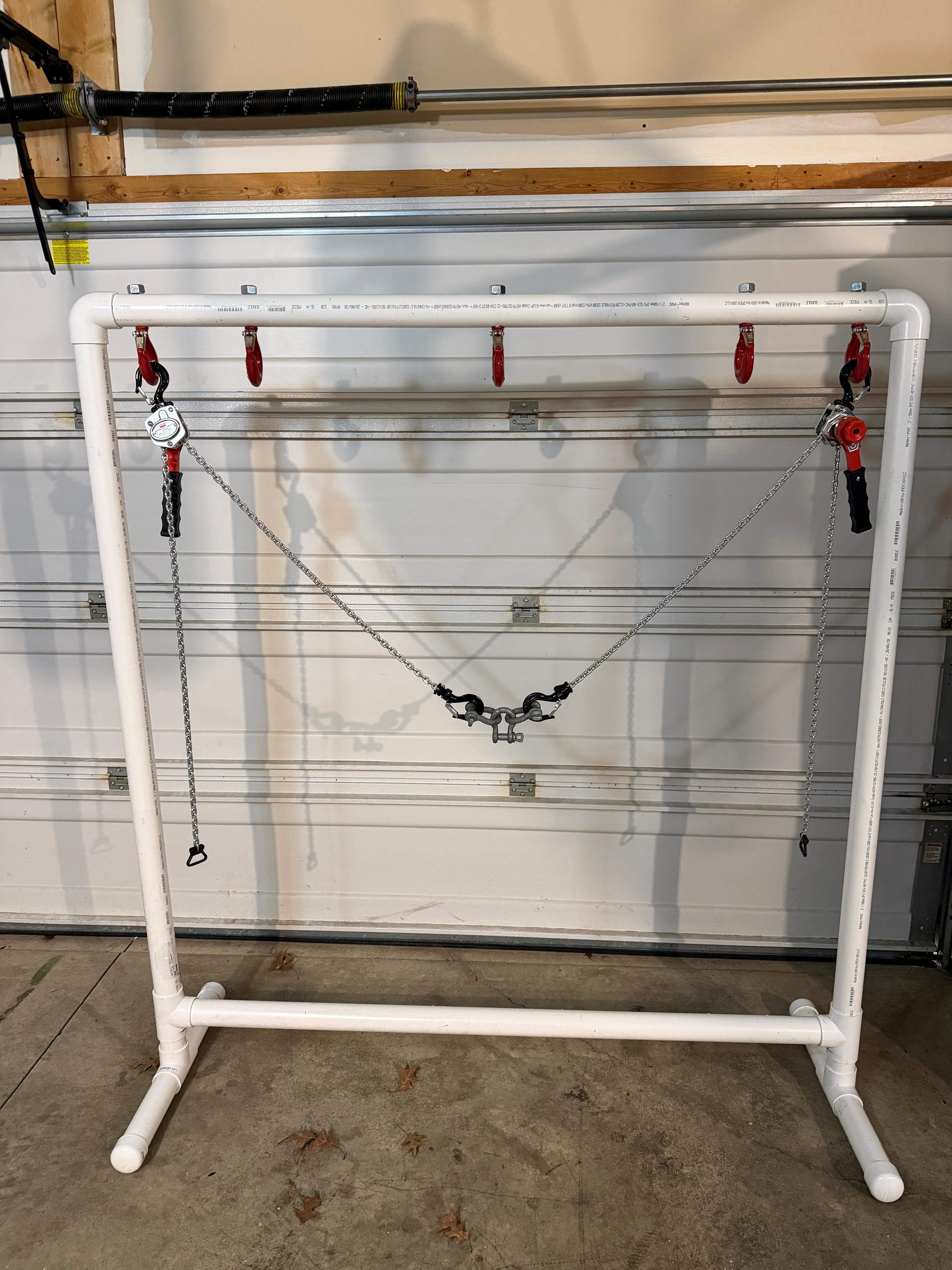
I'm trying to instruct on D/d ratio and tension in the sling or line load. Is this allowable with a lever hoist? Also, do I need to deduct/reduce due to the shackles being the same size? Thanks in advance.

25 Upvotes

39 comments sorted by

58

u/craneguy 3d ago • Bravo

You're an instructor? God help us all.

-11

u/KnotaRigger 3d ago

18

u/craneguy 3d ago

Hahahaha. What is that nonsense? Your username is the only accurate thing here.

0

u/[deleted] 3d ago

[deleted] — view deleted comment

1

u/Sumn5932 3d ago

I thought u were replying to slow as daylight btw

1

u/sloasdaylight 2d ago

I was summoned?

7

u/Idkmanitcouldwork 3d ago

“Are you sure?” Lol

13

u/sloasdaylight 3d ago

That diagram either doesn't make any sense or is for some significantly more complicated rigging calculations than we have context for.

According to the values given in that diagram, the two slings are different lengths, with the left sling being 11.03' long, and the right sling being 12' long. Because the sling lengths are different, the angle of loading is also different. It's given to be 65 degrees on the left, and calculated to be 56.44 degrees on the right. If we assume symmetrical loading, this will give a tension value of ~8,275lbs for the sling on the left, and 9,000 for the sling on the right, meaning you would most likely need a 7/8" diameter choker for both sides, given the choker configuration.

However this isn't accurate because the sling on the left is closer to the center of gravity of the load (assuming an equally distributed weight) than the one on the right. Given there is no information provided for the length of the piece, we'll assume that the piece is being lifted at exactly the ends of it, giving it an overall length of 11.29ft. Working with that information, we can work out that the vertical share of the load being taken by the left sling is actually 8,808lbs, and the vertical share taken by the right sling is 6,191lbs.

Given those figures, we can calculate that the tension on the left sling is approximately 9,718lbs, and the tension on the right sling is approximately 7,429lbs. Given both are demonstrated to be in a choker configuration instead of a single bridle, we can then calculate that the left choker must be rated for at least 12,957lbs, (we'll go with 13,000lbs) and the right sling for 9905lbs. That would probably necessitate a 7/8" diameter wire rope for the left sling, and most likely a 3/4" diameter wire rope for the right sling, depending on the manufacturer.

So which answer do you want me to put down, 3/4" or 7/8"?

Seeing as how you're asking questions about D/d ratios and sling capacity reductions based on that, I don't know what you're trying to prove based on that picture.


To answer a question that every instructor ought to know about D/d, never send a choker around a shackle pin, sheave, whatever, that is the same diameter or smaller than the wire rope. Doing so applies a 50% capacity reduction to the sling, meaning a basket configuration is only as good as the straight pull strength of the rope itself. In order to have a basket (cradle) hitch have 2x capacity as a straight pull you need a D/d ratio of at least 25:1 based on most manufacturer specifications. Most sheaves have a 6:1 D/d ratio

Is this allowable with a lever hoist?

I don't even know what this question is supposed to ask, of course you can do that provided you account for the increased loading by the sling angles and you're not exceeding the rated load of the components due to those decreased sling angles. You may have to apply a capacity reduction to the shackle you're using as a collector ring at the bottom depending on what the included angle between the hooks is. IOW as the load is raised in the set up you have in your picture, your capacity is going to be reduced significantly due to additional loading on the chains and the shackles attached to the load shackle spreading out.

You also need to put shackles between the hooks of your comealongs and the red hooks they're attached to at the top.

If you're going to be teaching people how to rig, you need to actually know how to rig.

4

u/lIlIIIIlllIIlIIIllll 3d ago

Why are you assuming the slings are different lengths? Doesn’t make any sense

11

u/sloasdaylight 3d ago edited 3d ago

There is no assumption that the slings are different lengths, the way the information is presented the slings must be different lengths.

You need to use sin to figure out the length of the left sling. We know the angle is 65 degrees (180-115 = 65) if the height from the load to the hook is given as 10ft, we can set up the equation sin(65) = 10/length. Doing the math gives us a sling length of 11.03ft. For the right side the vertical distance is still 10 ft, but we’re given a sling length of 12ft, so working again with sin we can find that the angle of loading is equal to the arcsin of 10/12, which is equal to 56.44 degrees. So either the angle is wrong on the left, or the sling length is wrong on the right, they both can’t be true.

0

u/You-Asked-Me 2d ago

This reply is excellent. I am sorry that is is not seen since the OP's comment got down voted.

Also, I don't think you mentioned but they need a shackle, pear or oval ring in that hook, at least for stage rigging purposes. This looks like something more industrial though, and I am unaware if cranes or other host hooks are allowed to have multiple loads at different angles.

Last, at least for the ETCP standard, I believe that they would error on all hardware being used rated at the same working load as the highest load, so in this case all steel slings would be 7/8"

In entertainment rigging, we mostly deal in 1-ton(or smaller) and 2-ton chain hoists.

1-ton gets 3/8" steel, and 2-ton gets 1/2" steel.

3/8" is rated to 1.9 tons. So technically you can make a 90-degree bridle with both legs 3/8" steel, and then the down leg 1/2" or hook the chain right to the shackle for a 2-ton load. Each leg would have 1,565 pounds.

This, however, is basically never done, we would use all 1/2 steel, so no matter what way some local rigger decided to hang that point, it could never exceed any component of the system.

1

u/sloasdaylight 2d ago

I am unaware if cranes or other host hooks are allowed to have multiple loads at different angles.

They are, however there are limits. Once you start having the slings located anywhere other than the bottom of the hook, you need to apply capacity reductions to the hook itself to account for the eccentric loading of the hook. If you tip load a hook you need to apply either a 60 or 40% capacity reduction I think, I'd have to go back and check to be sure.

I believe that they would error on all hardware being used rated at the same working load as the highest load, so in this case all steel slings would be 7/8"

This is standard practice in construction as well. I tell all of my apprentices to grab rigging that is rated for the entire weight of the load when possible (this isn't always the case, but it's a good practice)

3/8" is rated to 1.9 tons.

Most 3/8" wire rope chokers I'm familiar with only have a straight pull rating of 1.4t, a choke rating of 1.1t and a basket rating of 2.9t, at least with the standard 5:1 design factor we work with in construction. If your design (safety) factor is like 4:1, then I could see that 1.9t number, but I'd double check that if I were you. If I needed to fly a 1.9t piece I would use at least a half inch wire rope choker, and in reality I would look for a 5/8" diameter choker to account for capacity reductions due to extensive use of choker hitches in the construction industry.

So technically you can make a 90-degree bridle with both legs 3/8" steel, and then the down leg 1/2" or hook the chain right to the shackle for a 2-ton load. Each leg would have 1,565 pounds.

That's not correct. If you hook up 2 3/8" chokers in a twin leg bridle with a 90 degree included angle at the hook/shackle/collector ring, you'd have 45 degree angles at the point of attachment, which would give you a loading of 1,414lbs on each sling assuming a 2t load, not 1,565. If you're getting 1,565lbs of tension on each sling with a 90 degree angle at the top then you've got a load more than 2 tons being carried (2213lbs, specifically), or an included angle of ~100 degrees at the shackle, requiring a capacity reduction of the shackle's WLL unless the manufacturer allows for a greater included angle than 90 degrees.

2

u/You-Asked-Me 2d ago

Sorry, I did not make that clear. And I probably mistyped the rating.(I think 1/2" is rated to 1.9 tons in a choker?) In concert rigging chokers are rarely used. Usually its a basket around the roof beams, and then a straight sling for a bridle leg, so you do not have to derate for the choke.

And I was using metric tons, since that is how hoists are rated. Sorry for the confusion

1

u/sloasdaylight 2d ago

I think 1/2" is rated to 1.9 tons in a choker?

1/2" IWRC slings are rated to 2.2t in a choke for all the ones I can recall, which works itself out to about 1.8t in a choke config, maybe more or less depending on how the manufacturer decides to rate it.

In concert rigging chokers are rarely used. Usually its a basket around the roof beams, and then a straight sling for a bridle leg, so you do not have to derate for the choke.

Yea that tracks, in the construction industry (specifically steel erection, which is my specialty) choker hitches are used all the time, so that's kinda what I default to for most applications.

And I was using metric tons, since that is how hoists are rated

Ahh, yea that makes a lot of sense, I dunno why I didn't pick up on that when I worked through the math lol.

1

u/wackyvorlon 3d ago

This isn’t rigging in the industrial sense. The loads are not that high.

13

u/IntheOlympicMTs 3d ago

Where I come from that’s an adjustable bridal. Add third and you could adjust forward and back.

As D/d we wouldn’t apply that to items like a shackle on a shackle or shackle on a hook. We only account for that on wires and nylons.

0

u/sir_lance_alot12 3d ago

Yo what is D/d? I come from a theatrical/entertainment side of things.

8

u/IntheOlympicMTs 3d ago

Diameter of the larger gear divided by the smaller gear like a 1” shackle with 3/4 wire attached. It would be 1/.5=2 then there’s a graph/chart that tells how efficient your set up is. At 2 you’d be 65%.

Think of it like bending a rope over a basketball compared to a plywood corner edge. The rope will hold more on the ball than on the edge.

I’m sure there’s better explanations but I’m pooping so…

5

u/HairballTheory 3d ago

Bro bending a rope in the toilet bowl

4

u/DoubleBarrellRye 3d ago

its the Diameter of your Sheave or lift Point , divided by the diameter of your Cable or lifting line

25/1 no loss of efficiency , so a 1" cable requires a 25" Sheave to maintain 100% WLL efficiency

2/1 is 65% efficiency , but your example is missing that that would be for a running line not a sling , for a sling you have a basket in the eye , so rule of thumb is one size larger shackle keeps your WLL for cable due to the fact its doubled then reduced by 35% , obviously a thimble is also a better option for eyes , or wide body shackles

1

u/Dazzling-Sink3289 3d ago

Since nobody is really telling you what it's really about, just how it works: D/d factor is why you put burlap around your beams when rigging. If you bend steel wire too short, it breaks, and by increasing the radius, you take that problem away.

9

u/kony2012neverforget 3d ago

Starting a betting pool on whether the shackle will get sideloaded in this class or knot 😉. My dms are open.

It’ll work like superbowl squares. We’re guessing the angle of the next picture he sends. A dollar per degree, but as many as you want in blocks of 5°.

Say “put me down for 115°-119°” or “131°-135° looks promising, lock me in there”

8

u/zacmakes 3d ago

are you sure you're not trying to demonstrate bridle angle?

7

u/Temporary_Buy3238 3d ago

This entire thread is the dumbest shit I’ve ever read and I hope y’all ain’t in charge of lifting anything over peoples heads.

The lack of understanding of simple concepts like D:d ratio and bridle angles/tension here is staggering

1

u/iEARNman848 3d ago

Since nobody has mentioned it, I will. That PVC rack ain't gonna hold what those lever hoists are rated for. 🤣

2

u/KnotaRigger 2d ago

It was a display. Thanks

1

u/iEARNman848 2d ago

I know. I forgot the "/s"

2

u/901CountryBlumpkin69 3d ago

No. øD/d is specific to bending wire rope around a radius. There’s a similar relationship for chain as well. But not hardware. For quality hardware (Crosby, Van Beest, or other reputable name brands, etc) point loading is accounted for in the capacity, and your limiting factor nearly always will be the smallest rated capacity.

1

u/CaramelOk3498 3d ago

I would say the Shackle WLL should be reduced by 50% since it is being side loaded, plus add in the second picture with the question, the sling angle being almost 120 degrees and choked around the price at that means you’re gonna need a giant diameter wire rope.

1

u/sloasdaylight 3d ago

It depends on the included angle between the two lines once a load is applied. Right now there's a pretty significant bend in the lines, but as a load is applied to the central shackle the lines will straighten, and then we can tell what the angle is going to be. Some manufacturers allow you to side-load their anchor or bow type shackles all the way to an included angle of 90 or even 120 degrees (I believe Crosby allows up to 90) before you need to apply a capacity reduction. My guess is that with a sufficiently heavy load to remove the slack in those lines he would probably be just on the cusp of that limit before he would need to apply a cap reduction.

1

u/Rakhanishu666 3d ago

D/d ratio minimum is 1:1 when using wire rope slings where I work.

I personally wouldn’t worry about D/d ratio when it comes to shackles but I’ll probably get flamed for that here.

But Since your middle shackle is side loaded you reduce wll by half.

And your ratchet set up is how I jump components through boats/ships.

1

u/-FARTHAMMER- 1d ago

I don't see how you can be an instructor and have to ask reddit for questions.

1

u/-FARTHAMMER- 1d ago

Put an LID above the ratchets and a known weight out of that shackle and that will demonstrate load distribution because of sling angle tension. Which has nothing to do with dD ratio. Again I don't see how the fuck you can be an instructor.

0

u/chrizcore 3d ago

What is this about? Are we talking entertainment rigging? I'm confused.

5

u/sloasdaylight 3d ago

No, this is like industrial/construction rigging. This sub kinda has two different sides to it, the industrial/construction rigging side, and the entertainment rigging side. It leads to some really interesting and honestly amusing posts where sometimes people are talking 100% past each other.

2

u/chrizcore 3d ago

got it

16

u/cienfuegones 3d ago • Bravo

I confess I don’t understand what you’re asking. There are no slings or lines in your photo affected by D/d ratio. You have a bunch of hardware that should have WLL limits that can be ascertained to be within limits with a given load, but it will be quite low due to the pvc anchor substrate fyi.

2

u/BadQuail 3d ago

but it said it was sch 40. . .

3

u/Embarrassed_Sea6537 3d ago

Side load that shackle ❤️

2

u/kony2012neverforget 3d ago

He could but will he?? No one is sure right now.