Who wants to make a bet that StarMind is very much linked to the Christmas Surprise ? Halfway through the linked-page (url provided) the compute details are mentioned. Storming being liquid-cooled is a VERY strong indicator towards SMCi, combined with their recently release new coolant SMC-PG25A. Want to learn more about that coolant, they did a press-release on it earlier this year. the product page can very easily be found, the puzzle-pieces are all out there; One just needs to engage brain and use google to find the pieces and lay it out for you.
Below is copy-paste from the article, not my writing:
AI1 Satellite The first satellite of the Starmind constellation is the AI1 satellite. Designed using components derived from Starlink V3 technology, each satellite functions as an autonomous, orbiting rack of high density computing servers.
Physical Dimensions: The fully deployed AI1 spacecraft has an operational wingspan of 70m and a deployed height of 20m. It is built around a centralised compute core flanked by extending deployable solar wings and liquid radiator panels.
Compute Payload: The centralised onboard server hardware is designed for the NVIDIA Vera Rubin NVL72,[1][2] each of which consists of 72 Rubin GPUs and 36 Vera CPUs. The payload operates at a peak compute capacity of 150 kW with an average continuous load of 120 kW. The satellite achieves a power density of 70 kW/ton
Thermal Management: To dissipate the heat generated by the centralised compute core in the vacuum of space, the satellite is equipped with a 110m² deployable liquid radiator.
Solar Power System: Electrical power is supplied by an integrated 150 kW solar array panel utilising SpaceX manufactured solar cell technology produced in Bastrop, Texas. The arrays deliver a power generation density of 250W/m2
Communication: Inter satellite communication is handled via high capacity optical cross links.
Launch Configuration: The spacecraft are designed to sit in a stacked, high density configuration inside the payload bay of the Starship launch system for deployment through the same PEZ dispenser system designed for Starlink
I'm a bull and I'm full port in SMCI.. however, recent price action had me thinking, what will happen to this company after 2031.. we all know, with a high degree of certainty, SMCI will do extremely well for the next 3-4 years, no doubt about that.. however, the market will price in the years after these years, is there something we are not seeing into the future? Will the growth stop at 2032 and slowly drip down? That's the question I think we hadn't discussed enough, as we are hyper focused on next 1-3 years.. thoughts?
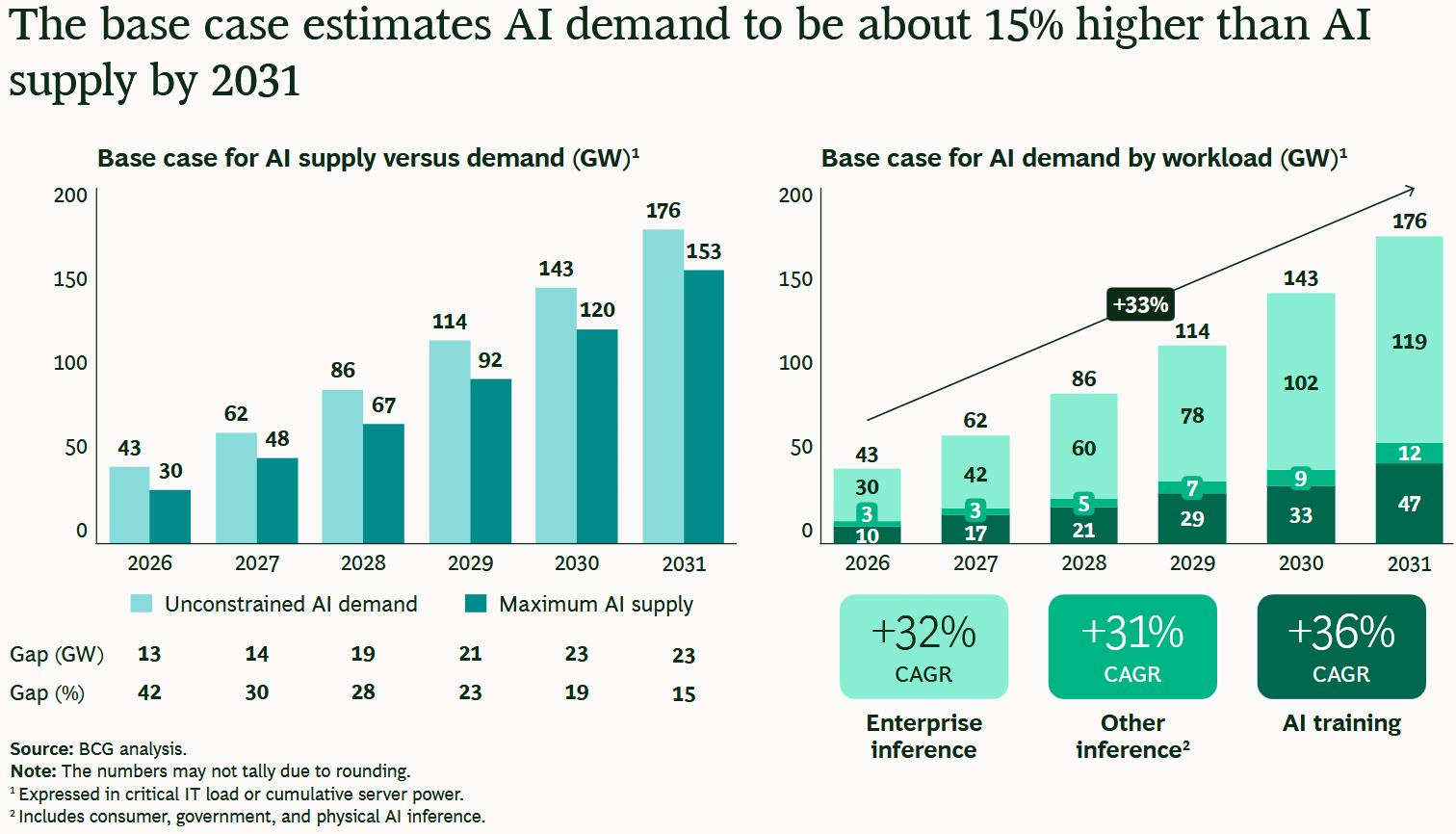
In the link and the image (which is taken from the link) The Boston Consultancy group provides a modelling of the satus of AI Compute supply vs demand. The base case of supply gives a 250% growth of SUPPLY. The demand will grow faster
I'm not a bull or bear. I don't think this is going to the moon. But I do think AI is fundamentally changing things in the world. So I'm investing in it because I still think there's a lot of money in it, despite the ridiculous market the past two months. But we're in a downwards spiral where ALL news is bad news. Great earnings is punished. Any negative news is seen as proof that bears were right all along. Some are worried that AI growth will slow in a few years. But right now, companies are still raking it in. The future still holds more bad news. Jensen still has to appear before congress. Probable interest rate hike in December. People probably harvesting tax losses before year end. Do we think it will likely be January before the market start turning things around, with a fresh start to the year, and people see how "cheap" anything to do with AI is? SMCI is my biggest position. I also recently hold MU and SNDK (which were mistakes, as I tried to catch them as they were falling), and ORCL that I've had for a while. I'm obviously way too heavy in tech and AI, which is an annoyance right now, but not a long term strategy. I don't have a crystal ball, but I'm trying to see what will be the even that finally shakes investors' fear of AI.
The stock market has become more and more of a gambling market. People are making leveraged bets with 10x and 5x being highly common nowadays. I am now of the belief that this reset in AI sentiment is a somewhat healthy way of getting rid of all the gamblers that are in it for the money in the short term and do not believe in the prosperity that AI will generate in the long run.
This sentiment shift after the blue wave and rate hikes is really testing the patience of us investors and we kind of know that the algorithm is fked when none of us get Peter Lynch videos on yt anymore, but it's all bearish views and Steve Eismann talking about the next bubble and how he predicted the housing bubble.
Dell as many of you know reported earnings yesterday beating expectations in every way possible. Still it is not enough to satisfy the market due to the current sentiment, dropping 6% pre-market as of writing this.
HOLD THE DOOR guys, and remember as Warren Buffet says: "The stock market is a money transfering device giving money from the impatient to the patient"
India's Tamil Nadu state to sign investment deals worth over $5.38 billion, sources say
REUTERS 9:30 AM ET 11/24/2026
ByPraveen Paramasivam
CHENNAI,Nov 24(Reuters) -India'sTamil Nadu state is set to announce roughly 70 investment deals worth more than 500 billion rupees($5.38 billion) across multiple sectors on Wednesday, two people with direct knowledge of the announcement told Reuters on Tuesday.
The southern state's capital Chennai, dubbed the Detroit of Asia, is a major manufacturing hub and hosts factories of Hyundai and Renault Group as well as Apple(AAPL) suppliers such as Foxconn and Tata Electronics.
Brazilian motor maker WEG is among the investors signing a new pact, one of the sources said. They asked not to be identified because they are not authorized to talk to the media.
WEG and the state did not respond to requests for comment.
Tamil Nadu is also holding an investor meeting in Chennaion Wednesday, seeking to turn previously announced investments into projects on the ground and actual capital spending.
In August, it signed nearly 100 pacts worth 674.52 billion rupees, including with France's Saint-Gobain and US server maker Super Micro Computer(SMCI), at its first investor meeting since former actor Joseph Vijay became chief minister.
"(Wednesday's) conclave will also feature... foundation stone layings and project inaugurations spanning manufacturing, industrial infrastructure, clean energy, engineering, textiles, electronics," an industries ministry press release said.
The event comes at a time when Indian states battle for investments, including from global corporations looking to diversify their supply chain and set up technology centres in the world's most populous country.
Earlier this month, neighbouring Andhra Pradesh secured several investment commitments, including a$4.59 billion coal-to-gas project from Indian conglomerate Reliance Industries and a$2 billion second plant from automaker Kia India.
Hear from Nicolas and Andrew at SC26 as they discuss how Cisco's networking, management, and security capabilities complement Supermicro's liquid-cooled systems and rack-scale solutions to deliver a more complete solution.
FY27 Q2 will see the first full quarter of Enterprise margin contribution from Cisco partnership, and the potential Xmas gift revenue bump scheduled for SpaceX. The growth rate should accelerate into Q3 given Elon Musk plans for 10GW of Compute for calendar 2027 with his recently completed Capital raise.
SMCI's entire value capture lies in the build out, and as far as we know, the data centre build out is not slowing down. With forecasts expecting the overall activity to continue to peak until around 2030.
I’ve worked out what the Christmas present is the stock is selling for a 300% discount 😂, Shame I can’t load up more 🙃, When do you think we will recover? We haven’t been this low since April 2023
Delivers PCIe Gen 6 performance with up to 100% greater sequential read bandwidth in the now-shipping all-flash servers
Expands the Petascale portfolio as the first of multiple new storage products based on AMD EPYC™ 9006 SP7 and SP8 CPUs
Validates the platform, which includes the CloudDC, GrandTwin®, and Hyper families, with solutions from leading software-defined storage partners including Hammerspace, IBM, MinIO, Nutanix, Scality, VAST Data, VDURA, WEKA for AI-scale deployments
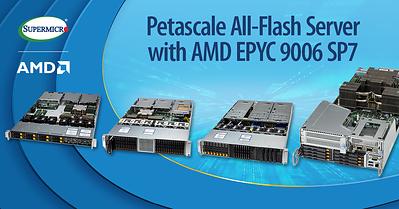
SAN JOSE, Calif., andCHICAGO, Nov. 18, 2026 /PRNewswire/ --Supercomputing Conference- Supermicro, Inc. , an AI, Enterprise, Storage, and 5G/Edge Total IT Solution Provider featuring Data Center Building Block Solutions® (DCBBS), today announced new extensions to the broad portfolio of AMD EPYC based all-flash storage servers. The first systems, now shipping, include the Petascale system powered by the 6th GenAMD EPYC9006 Series processors (formerly codenamed "Venice"), with more products to follow as AMD launches new SP8 CPU versions. These are the first storage products supporting the PCIe Gen 6 I/O specification with 100% greater sequential read bandwidth over PCIe Gen 5.
"Expanding AI and HPC workloads require storage that can match the performance of today's CPU and GPU clusters," saidVik Malyala, chief business officer at Supermicro. "With our new all-flash storage servers based on AMD EPYC processors, and the flexibility of the DCBBS architecture, we are delivering improved PCIe Gen 6 bandwidth, high density, and scalable capacity. These platforms can be customized for HPC, AI training, and inference workloads, while providing software-defined storage partners with proven, validated systems they can rely on."
For information on Supermicro's AI storage solution portfolio, click here, and watch a video summary of the release here.
Supermicro will be showing the new Petascale all-flash storage server in booth #4017 at Supercomputing 2026, inChicago,November 15-20.
The first system in the new family packs exceptional density into a 2U chassis with support for up to 32 E3.S NVMe SSDs—delivering as much as 3.93 PB of capacity with 122 TB drives. Its balanced I/O architecture supports up to four x16 high-performance networking cards, enabling the sustained bandwidth required for AI data lakes, large-scale analytics, and high-throughput storage networking while giving customers the flexibility to optimize for their specific workload and fabric requirements.
Supporting Partner Quotes
AMD "We have worked with Supermicro for years, bringing AMD EPYC processing capabilities to Petascale all-flash servers," saidDan McNamara, senior vice president and general manager, Compute and Enterprise AI, AMD. "As software-defined storage architectures demand greater energy efficiency, high single-socket performance, and large numbers of PCIe lanes, the AMD EPYC family is ideally suited. The latestVeniceSP7 and SP8 platforms deliver the core density and PCIe Gen 6 connectivity that modern storage workloads require."
Hammerspace "The future of AI infrastructure is about maximizing performance per dollar, per watt, and per rack," saidGregg Machon,SVP Business Development & Worldwide Partners Hammerspace. "Supermicro's new Petascale platform delivers exceptional NVMe performance density and efficiency. With Hammerspace's standards-based Data Platform, customers can easily incorporate this high-performance storage into a single global namespace alongside existing, cost-optimized capacity storage. This gives organizations the performance AI workloads demand, while maximizing infrastructure utilization, avoiding costly over-provisioning, and delivering better overall price-performance."
IBM "AI inference is no longer a single workload – it's a pipeline that spans data ingest, model loading, retrieval, and KV cache and each stage must maximize GPU utilization efficiency," saidVincent Hsu, IBM Fellow, VP & CTO of IBM Storage. "IBM Storage Scale on Supermicro's newest AMD-based Petascale server is designed to give customers a high-performance, resilient platform for the entire inference pipeline, with PCIe Gen 6 bandwidth and greater headroom for both performance and capacity growth.
MinIO "Supermicro's new Petascale platform offers a compelling foundation for the full AI data pipeline," saidUgur Tigli, MinIO CTO. "Combined with MinIO AIStor and MemKV, it becomes a data and memory foundation for modern AI infrastructure. Enterprises can put its dense flash capacity and PCIe Gen 6 bandwidth to work across ingestion, training, and inference, serving all of their throughput, IOPS, and latency needs. Together, we're helping customers build a compact foundation that delivers performance and capacity from every rack unit."
Nutanix "Unlocking the value of agentic AI requires seamless optimization across compute, networking, and storage. Nutanix is thrilled to expand its full-stack agentic AI collaboration with Supermicro and AMD," saidKetan Shah, SVP, Product Management, Nutanix. By bringing together AMD EPYC processors, Supermicro's high-density Petascale all-flash platform, and Nutanix software-defined storage with built-in data security, we are giving customers a secure validated AI platform that fuels real-time inference, retrieval, and data-intensive enterprise workloads at scale.
Scality "Scality has recently introduced new storage solutions for AI, includingAutonomous Data Infrastructure (ADI) and AI Inference Factory, building on our ongoing collaboration with Supermicro," saidPaul Speciale, chief strategy officer, Scality. "The latest Petascale platform provides an ideal foundation for these solutions, delivering the performance and scalability our customers require."
VAST Data "AI infrastructure is not one-size-fits-all, and our longstanding partnership with Supermicro is built around giving customers the flexibility to deploy the right infrastructure for their workloads," saidPhil Manez, vice president, Global Partnerships at VAST Data. "With Supermicro's latest AMD EPYC-based systems, we're expanding that choice, combining the performance and efficiency of the VAST AI Operating System with next-generation hardware to help customers optimize for performance, cost, power, and scale."
VDURA "VDURA's software-defined data platform runs on Supermicro's latest Petascale systems built on AMD's Venice CPU," saidKen Claffey, CEO of VDURA. "With Supermicro's broad all-flash and HDD platforms unified in a single VDURA namespace, together we deliver more performance per watt and per rack unit at the best cost per terabyte, so customers can maximize the efficiency of their AI infrastructure."
WEKA "AI labs and neoclouds want more performance for less power in the smallest footprint, and that's where our partnership with Supermicro truly delivers. WEKA NeuralMesh is fully software-defined and distributed, so it scales uniformly across Supermicro's new Petascale server and puts the full bandwidth of PCIe Gen 6 and AMD EPYC 9006 processors to work from day one, with no hardware tiers to create bottlenecks. That's how NeuralMesh keeps pushing throughput higher and latency lower as AI workloads evolve. Together, we're giving customers the performance density that large-scale training and inference demand," saidAjay Singh, chief product officer at WEKA.