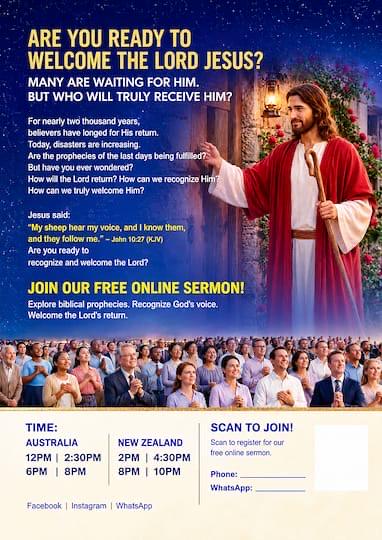
SCJ teaches that traditional churches are Babylon and uses Revelation 18:4 to urge people to leave those churches and join SCJ.
At the same time, SCJ maintains that Revelation 17 has already been fulfilled, while Revelation 18 remains unfulfilled.
But have you ever carefully examined how these two chapters are connected?
Let's examine these chapters together, using Scripture itself, without relying on LMH's interpretations or his claimed testimony about their fulfillment.
- Revelation 18:4 — Why Does God Call Them "My People"?
In Revelation 18:4, a voice from heaven declares:
"Come out of her, my people".
The passage continues by warning God's people not to participate in Babylon's sins or receive her plagues.
Notice something important.
Why does God call them "my people" while they are in Babylon?
This suggests that God's people can find themselves within a spiritually corrupt environment without necessarily having abandoned their allegiance to God.
Nevertheless, they are commanded to separate themselves from Babylon to avoid participating in her sins and suffering the consequences.
There is an important distinction here.
Being within a corrupt environment does not necessarily mean that someone has already become spiritually corrupt. However, participating in its sins carries serious consequences.
This distinction becomes particularly important when examining SCJ's teaching that traditional churches collectively represent Babylon.
But before deciding what Babylon represents, let's examine another expression found in Revelation 17.
2. Compare Revelation 17:2 With Revelation 18:4
Revelation 17:2 — The Inhabitants of the Earth
The inhabitants of the earth become intoxicated with the wine of the great prostitute's adulteries.
But who exactly are "the inhabitants of the earth"?
Before assuming that this expression simply refers to everyone physically living on earth, consider how Revelation repeatedly describes these people:
• Revelation 3:10 — They face the coming hour of trial.
• Revelation 6:10 — God's slain servants call for judgment against them.
• Revelation 8:13 — Three coming woes are pronounced against them.
• Revelation 11:10 — They rejoice when God's two witnesses are killed.
• Revelation 13:8 — Those whose names are not written in the Lamb's Book of Life worship the beast.
• Revelation 13:12–14 — They are deceived and led to worship the beast.
• Revelation 17:8 — They are astonished by the beast, and their names are not written in the Book of Life.
Notice the recurring pattern.
Although the expression appears in different contexts, these passages repeatedly associate the inhabitants of the earth with judgment, deception, opposition to God's witnesses, and worship of the beast.
Now compare these two passages.
Revelation 17:2 — The Inhabitants of the Earth
They become intoxicated with the great prostitute's wine.
Revelation 18:4 — God's People
They are called to separate themselves from Babylon and avoid participating in her sins.
Do you see the contrast?
Those described as "the inhabitants of the earth" are intoxicated by Babylon's influence, while God's people are warned not to share in her sins.
The two descriptions reveal contrasting responses to Babylon's influence.
If Revelation 17 and 18 describe interconnected events, then God's command in Revelation 18:4 calls His people to separate themselves from the spiritually corrupt environment associated with Babylon rather than become participants in its sins.
This raises another important question.
Who exactly is this Babylon from which God's people are commanded to come out?
To answer that, we must first understand the identity and fate of the woman in Revelation 17.
3. Revelation 17 — What John SAW Versus What the Angel TOLD Him
This distinction is important when examining claims about the fulfillment of Revelation.
Revelation 17:3–6 — What John SAW
John saw a woman sitting on a scarlet beast with seven heads and ten horns.
He also saw that the woman was drunk with the blood of God's holy people.
But pay particular attention to Revelation 17:5.
The name written on the woman's forehead explicitly identifies her with Babylon the Great.
This is a crucial detail because the very next chapter announces the fall of Babylon the Great.
Keep this connection in mind.
Revelation 17:7 — What the Angel TOLD John
The angel then began explaining the mystery of the woman and the beast.
From this point onward, much of the chapter records the angel's explanation of what these symbols represent and what will happen.
Now pay particular attention to Revelation 17:16.
Revelation 17:16 — The Angel Announces What WILL Happen
The angel tells John that the beast and the ten horns will hate the prostitute, bring her to ruin, leave her naked, consume her flesh, and burn her with fire.
Notice the future tense.
The angel describes what WILL happen to the woman.
John does not describe personally witnessing the woman's destruction in this passage.
Instead, the angel tells him what the beast and the ten horns will do to her.
This distinction matters.
A prophecy announcing an event is not the same as a vision depicting that event as already completed.
Of course, a prophecy expressed in the future tense could subsequently be fulfilled. The question is whether SCJ can demonstrate that fulfillment from Scripture and explain its relationship to the next chapter.
Revelation 17:17 further explains that God has put it into their hearts to accomplish His purpose until His words are fulfilled.
Finally, Revelation 17:18 identifies the woman as the great city that rules over the kings of the earth.
Now consider these three important details:
Revelation 17:5: The woman is associated with Babylon the Great.
Revelation 17:16: The angel announces her coming destruction by fire.
Revelation 17:18: The woman is identified as the great city.
Now ask yourself:
If Revelation 17 announces the destruction of Babylon the Great, where does Revelation go on to describe that destruction?
Let's examine the very next chapter.
4. Revelation 18 — The Destruction of Babylon
Consider the sequence of descriptions in Revelation 18.
Revelation 18:1 — John sees another angel coming down from heaven.
Revelation 18:2 — The angel announces the fall of Babylon the Great.
Revelation 18:8 — Babylon's coming judgment includes destruction by fire.
Revelation 18:9 — The kings of the earth mourn when they see the smoke of her burning.
Revelation 18:10 — Babylon is identified as the great city facing judgment.
Revelation 18:21 — An angel symbolically demonstrates Babylon's final downfall.
Do you notice the connection?
Revelation 17:5: The woman is associated with Babylon the Great.
Revelation 18:2: The fall of Babylon the Great is announced.
Furthermore:
Revelation 17:16: The angel announces that the prostitute WILL be destroyed and burned with fire.
Revelation 18:8–9: Babylon's judgment includes destruction by fire, and the kings of the earth mourn when they see the smoke of her burning.
And again:
Revelation 17:18: The woman IS the great city.
Revelation 18:10: Babylon IS the great city facing judgment.
There is yet another connection worth examining.
Revelation 17:6: The woman is drunk with the blood of God's holy people and those who testified about Jesus.
Revelation 18:24: Babylon is held responsible for the blood of prophets and God's holy people.
Are all these connections merely coincidences?
Both chapters describe Babylon the Great, a great city, its relationship with the kings of the earth, its responsibility for the blood of God's people, and its judgment and destruction.
The connection becomes especially significant when we compare Revelation 17:16 with Revelation 18:8–10.
In Revelation 17, the angel announces the woman's coming destruction by fire.
In Revelation 18, Babylon's destruction by fire becomes a central feature of the judgment being described.
Doesn't this strongly suggest that Revelation 18 continues and develops the judgment announced by the angel in Revelation 17?
The textual connection between these chapters is difficult to ignore.
5. If Revelation 17 Has Already Been Fulfilled, What About Revelation 18?
This brings us to the central question I would like SCJ members to consider.
SCJ teaches that Revelation 17 has already been fulfilled, while Revelation 18 remains unfulfilled.
But if the woman in Revelation 17 is Babylon the Great, and Revelation 18 describes the judgment and destruction of Babylon the Great, how does SCJ explain the relationship between these chapters?
Consider the following questions.
First: If the woman in Revelation 17:18 is the great city, and Babylon in Revelation 18:10 is also the great city, what biblical evidence establishes that they represent two different entities?
Second: If Revelation 17:16 announces the woman's destruction by fire, and Revelation 18:8–9 describes Babylon's destruction by fire, why should these be understood as separate judgments rather than interconnected events?
Third: If Revelation 17 has already been fulfilled, according to SCJ, does that mean the destruction announced in Revelation 17:16 has already occurred? If so, how does SCJ reconcile that claim with its teaching that Revelation 18 remains unfulfilled?
Fourth: If Revelation 18 continues the judgment of the woman identified in Revelation 17, on what biblical basis does SCJ interpret Revelation 18:4 as a command for God's people to leave traditional churches and join SCJ?
These questions cannot be answered simply by claiming that LMH witnessed the fulfillment.
The interpretation itself must first be established from Scripture.
Otherwise, how can anyone independently examine whether the claimed fulfillment actually corresponds to the prophecy?
6. Are We Following Scripture or Someone's Interpretation of Scripture?
I would like to ask current SCJ members something sincerely.
Are you examining Revelation through Scripture itself, or are you primarily relying on LMH's interpretation and claimed knowledge of its fulfillment?
And more importantly, are you accepting these teachings and passing them on to others without first examining whether they are supported by Scripture?
Didn't Jesus warn about the serious consequences of causing those who believe in Him to stumble (Matthew 18:6–7)?
If we claim to teach God's truth, shouldn't we be especially careful not to lead others astray?
Here is a question I would particularly encourage current SCJ members to consider.
What if the very organization telling people to "come out of Babylon" is itself leading them into spiritual deception?
I am not claiming that Revelation 18:4, by itself, proves that SCJ is Babylon.
My point is much simpler.
No individual or organization should be exempt from biblical examination simply because it claims to possess the correct interpretation or exclusive knowledge of Revelation's fulfillment.
The Scriptures must remain the standard against which such claims are examined.
If SCJ identifies traditional churches as Babylon, shouldn't that identification be demonstrated from Scripture rather than accepted solely on the authority of LMH's testimony?
Shouldn't we first establish the identity of the woman, the great city, and Babylon from Scripture before attempting to identify their alleged modern-day fulfillment?
And shouldn't we understand the relationship between Revelation 17 and 18 before claiming that Revelation 18:4 commands people to leave one religious organization and join another?
Final Thoughts
I encourage you to read Revelation 17 and 18 together, without relying on SCJ's teaching materials.
Pay particular attention to the relationship between the woman, Babylon the Great, the kings of the earth, the destruction by fire, and God's command to His people.
Then ask yourself:
Does Revelation 18:4 truly command God's people to leave traditional churches and join SCJ?
Or is that a conclusion imposed upon the passage through LMH's interpretation rather than one established by Scripture itself?
Remember, the command in Revelation 18:4 is to come out of Babylon and avoid participating in her sins. The verse does not explicitly command anyone to join SCJ.
Therefore, before accepting SCJ's application of this command, shouldn't we first establish from Scripture what Babylon represents?
If we cannot establish the identity of Babylon from Scripture, how can we confidently claim that we know whom God is commanding His people to leave?
I welcome your thoughts, especially those supported by Scripture.