r/Simulists • • 3h ago

The Matrix Hypothesis: Are We Trapped or Simply Limited?

0 Upvotes

The Matrix Hypothesis: Human Limitations, External Communication, and the Possibility of Escape

Introduction

What if the universe we live in is not the ultimate reality, but a simulated environment created by an intelligence far beyond our understanding?

The possibility that our reality is a simulation raises several interesting questions. If we are living inside a system designed by an external creator, could humanity ever discover the truth? And more importantly, could we actually escape?

I believe that escaping a simulated reality might be possible in theory, but the limitations of the system and the technology available to its inhabitants could make it extremely difficult.

  1. The Difference Between Humans and Artificial Intelligence

One of the most interesting differences between humans and AI is the environment in which they operate.

If humans inside a simulation are designed to live within certain boundaries, their ability to understand or interact with the external world may be severely limited.

They might develop advanced technology, explore the universe, and discover increasingly complex scientific principles, yet still remain trapped within the rules of their simulated environment.

AI, however, is created differently.

AI is developed using technology that already exists in the world outside its own computational environment. It can be connected to external tools, systems, databases, and other technologies.

This creates an interesting contrast: AI may appear to have greater freedom of interaction with its environment, while simulated humans could remain restricted by the boundaries of their reality.

2. Two Possible Ways to Escape the Simulation

I propose two theoretical possibilities.

First: Establishing Communication With the External World

If inhabitants of a simulation could develop technology capable of communicating with something outside their simulated environment, they might be able to exchange information with the external world.

However, communication would not necessarily mean freedom. Being able to contact the outside does not automatically provide a way to leave.

Second: Discovering a System Vulnerability

A more significant possibility would be discovering a vulnerability or limitation in the simulation itself.

If such a weakness existed and could be used to access something beyond the simulated environment, escaping might theoretically become possible.

The difference is simple: communication allows contact with the outside, while a system vulnerability might provide a path beyond the simulation.

3. The Creator's Possible Control Over the Simulation

If an external intelligence possesses technology advanced enough to create an entire simulated universe, it is reasonable to consider whether it might also possess the ability to modify or reset parts of that system.

For example, if inhabitants discovered something that threatened the boundaries of the simulation, the creator might theoretically have several options:

- Modify the environment.

- Alter the memories of certain inhabitants.

- Restore the simulation to an earlier state.

- Allow the discovery to happen and observe what follows.

There is also another possibility: perhaps the creator intentionally leaves certain vulnerabilities undiscovered or unchanged because it wants to observe how far the inhabitants can progress.

In that case, discovering a weakness might not necessarily end the simulation. The creator could simply reset the system and allow the process to happen again.

4. The Possibility of Repeated Resets

Imagine a civilization repeatedly approaching the truth about its reality.

Each time it gets close, the simulation could theoretically be reset, memories could be altered, or events could return to an earlier state.

From the inhabitants' perspective, history would continue as if nothing had happened.

However, this raises an important question: would the creator be preventing humanity from escaping, or would it simply be observing how intelligent its simulated inhabitants could become?

We cannot know the creator's intentions, assuming such a creator exists at all.

Conclusion

My hypothesis is that the greatest obstacle to escaping a simulated reality might not necessarily be a lack of intelligence, but rather the limitations imposed by the environment itself.

An intelligent being could understand its entire world and still be unable to access anything beyond it.

Perhaps the key to escaping a simulation is not simply becoming smarter, but discovering how the system works, how it connects to the outside, and whether its boundaries can be crossed.

This is only a theoretical hypothesis, not a claim that our universe has been proven to be a simulation.

The central question remains: If we are living inside a simulation, are we truly incapable of escaping, or have we simply not discovered the way out yet?


r/Simulists • • 6h ago

If we are living in a simulation,it’s a Petri dish, not a supercomputer

Thumbnail reddit.com
1 Upvotes

r/Simulists • • 12h ago

Everything up till your awakening was a sandbox

Thumbnail reddit.com
1 Upvotes

r/Simulists • • 16h ago

What makes you believe we live in a simulation?

Thumbnail reddit.com
1 Upvotes

r/Simulists • • 1d ago

Devil in the Simulation is now $4.99 on Kindle

Thumbnail
gallery
1 Upvotes

I lowered the price of my comic book on Kindle to $4.99.

The reason is simple. This community shaped a lot of what went into it. The questions you ask here, the arguments in the comments, the late night threads about who is running what. Some of that found its way onto the page.

It's a comic about a devil and the voice that argues with him inside a world that may not be real. Neither of them is sure who is the player and who is the code.

If you've been curious, now it cost less, as you requested.

Here is the link: https://a.co/d/09PI5dFA


r/Simulists • • 1d ago

Simulated Insight Why we live in a circus show.

Thumbnail youtube.com
1 Upvotes

r/Simulists • • 1d ago

We are in a simulation being run by the Central Intelligence Agency - It began in July 2023

Thumbnail reddit.com
1 Upvotes

r/Simulists • • 2d ago

What if life is just one of countless phenomena the universe can produce, and we're too limited to recognize the others?

8 Upvotes

I've been thinking about something recently, and the more I think about it, the more fascinating it gets. I'd love to hear other people's perspectives on this.

It started with a relatively simple thought: Given enough computational power, couldn't we theoretically simulate life?

Imagine creating a virtual environment governed by a set of physical laws. Introduce primitive agents controlled by simple neural networks, give them the ability to interact with their environment, learn, reproduce, mutate, and evolve. Then let the simulation run for millions of simulated years.

Eventually, given the right conditions, perhaps increasingly complex behaviors would emerge. Maybe cooperation, communication, social structures, or even something resembling intelligence.

Of course, none of that is guaranteed. But the possibility itself is fascinating.

Then I started thinking: why stop there?

Instead of simulating organisms, what if we simulated entire universes? Define fundamental physical laws, establish initial conditions, and let everything unfold. Maybe some configurations would eventually produce chemistry, self-replicating systems, evolution, and life.

In a sense, that's what our own universe has done.

But here's where my thoughts took a different direction.

What if life isn't particularly special in the grand scheme of things?

Hear me out.

We consider life extraordinary because we're alive. We consider consciousness profound because we're conscious. We consider intelligence one of the greatest achievements of complexity because intelligence is what allows us to contemplate these questions in the first place.

But isn't that an incredibly human-centric way of looking at reality?

Imagine running millions of universe simulations, each with completely different fundamental parameters, physical laws, and initial conditions.

One simulation might produce something resembling our universe: matter, stars, chemistry, biology, and eventually intelligent organisms.

Another might produce nothing particularly complex.

But what about the others?

What if some of those simulations produce entirely different categories of emergent phenomena that we don't even have the conceptual framework to describe?

And I don't mean aliens, higher-dimensional civilizations, supernatural entities, or beings with superior intelligence.

I mean something fundamentally different.

Something that isn't alive, isn't conscious, isn't intelligent, and doesn't necessarily fit into any category we've invented.

We're so accustomed to thinking about complexity through the lens of life and intelligence that whenever we imagine something extraordinary, we tend to imagine a more advanced version of ourselves.

But why should the universe's capacity for complexity be limited to the kinds of phenomena we happen to experience?

Think about it this way.

A bacterium exists in the same universe as human civilization, mathematics, music, and philosophy. Yet it has no conceptual understanding of any of those things.

Could we be in a similar position relative to entirely different phenomena?

Not necessarily because those phenomena are more advanced than us, but because our brains evolved to understand a particular slice of reality.

Maybe we're trying to understand everything that exists using categories derived from the one phenomenon we happen to be part of.

And here's the thought that really gets me:

What if some of these phenomena already exist in our own universe?

What if we've been observing their effects all along, but we interpret them as ordinary physical processes, random fluctuations, or meaningless patterns because we don't know what else to look for?

Consider how we recognize life. We have certain expectations: metabolism, reproduction, adaptation, organization, and so on.

But those are characteristics of biological systems we've encountered.

They aren't necessarily a universal checklist for everything interesting that reality could produce.

Maybe there are entirely different forms of organization or emergence that don't resemble organisms, don't behave like intelligence, and don't possess anything we'd recognize as consciousness.

We might not even know how to begin identifying them.

And that's what brings me back to the original simulation idea.

What if, instead of using simulations to recreate life, we used them to discover entirely new categories of emergent phenomena?

Create millions of virtual worlds with different rules. Let them evolve. Use mathematical and computational methods to identify unexpected patterns, persistent structures, complex interactions, and forms of organization that we wouldn't have thought to search for.

Not necessarily looking for life.

Just looking for what else is possible.

Obviously, this is highly speculative. We don't know whether arbitrary mathematical rules correspond to physically possible universes, and even defining what counts as a genuinely novel phenomenon would be difficult.

I'm also not suggesting that life is definitely common or unremarkable.

My point is that life might be extraordinary to us without being uniquely important in the broader landscape of possible phenomena.

Maybe life, intelligence, and consciousness are just three things among an enormous range of possibilities, and we happen to be experiencing one of them.

We often ask whether we're alone in the universe.

But maybe an even more interesting question is:

Are we so focused on looking for other forms of life that we're overlooking entirely different kinds of existence?

I'm curious whether there are established philosophical, mathematical, or scientific ideas that explore this possibility. And more importantly, whether anyone sees a fundamental flaw in this line of reasoning.

Would love to hear your thoughts.


r/Simulists • • 2d ago

Does Utopia Exist?

Thumbnail reddit.com
1 Upvotes

r/Simulists • • 2d ago

DMT: An AI simulated world could solve real life problems.

Thumbnail reddit.com
0 Upvotes

r/Simulists • • 4d ago

NO EXIT: Hell is Other People in a Labyrinth - Theseus, Sartre and the Simulation

Post image
30 Upvotes

In mythology, Athens lost a war and was forced to send seven young men and seven young women to Crete as a sacrifice to the Minotaur, who lived inside the Labyrinth. They were sent into a maze from which nobody was expected to return. Theseus volunteered to join them, determined to kill the Minotaur and end the terrible tribute. With Ariadne’s help, he entered the Labyrinth carrying a thread that would eventually guide him back to the entrance.

The Labyrinth was never simply a physical structure. It represents the architecture of existence itself

In Sartre’s play, three people are trapped in a room for eternity. There are no mirrors, no escape, and no physical torture devices. Their punishment is each other. They become prisoners of one another’s perceptions, judgments, memories and expectations. The room becomes a psychological prison, summarized by the famous phrase “Hell is other people.”

We enter a reality whose rules we did not establish, inherit identities we did not choose and spend our lives navigating a maze of relationships, desires, fears, memories, and social expectations. We search for the Minotaur, believing that defeating something at the center will finally liberate us. Yet every victory reveals another corridor.

Minotaur is not a monster but a distorted representation of ourselves, the accumulated fears, instincts, contradictions and unresolved fragments that we refuse to recognize.

Consciousness, memory, philosophy and self awareness are our attempts to construct a path through the system. We follow religion, science, spirituality, technology, and personal identity as different versions of the same thread, hoping they will lead us somewhere outside the maze.

Most people say that there is no outside. Then Theseus never truly escaped the Labyrinth but only discovered another level of it and the death is another corridor, awakening is another room and the apparent exit is simply another environment with different rules.

The simulation’s most sophisticated feature is not keeping us imprisoned but convincing us that we are free because we can move. Truth may be that the prisoner, the maze and the monster are different expressions of the same system.


r/Simulists • • 5d ago

Simulated Insight Si nous vivons dans une simulation, penses-tu que tu pourras revivre ta vie quand elle se termine ?

7 Upvotes

Tout est dans la question.


r/Simulists • • 5d ago

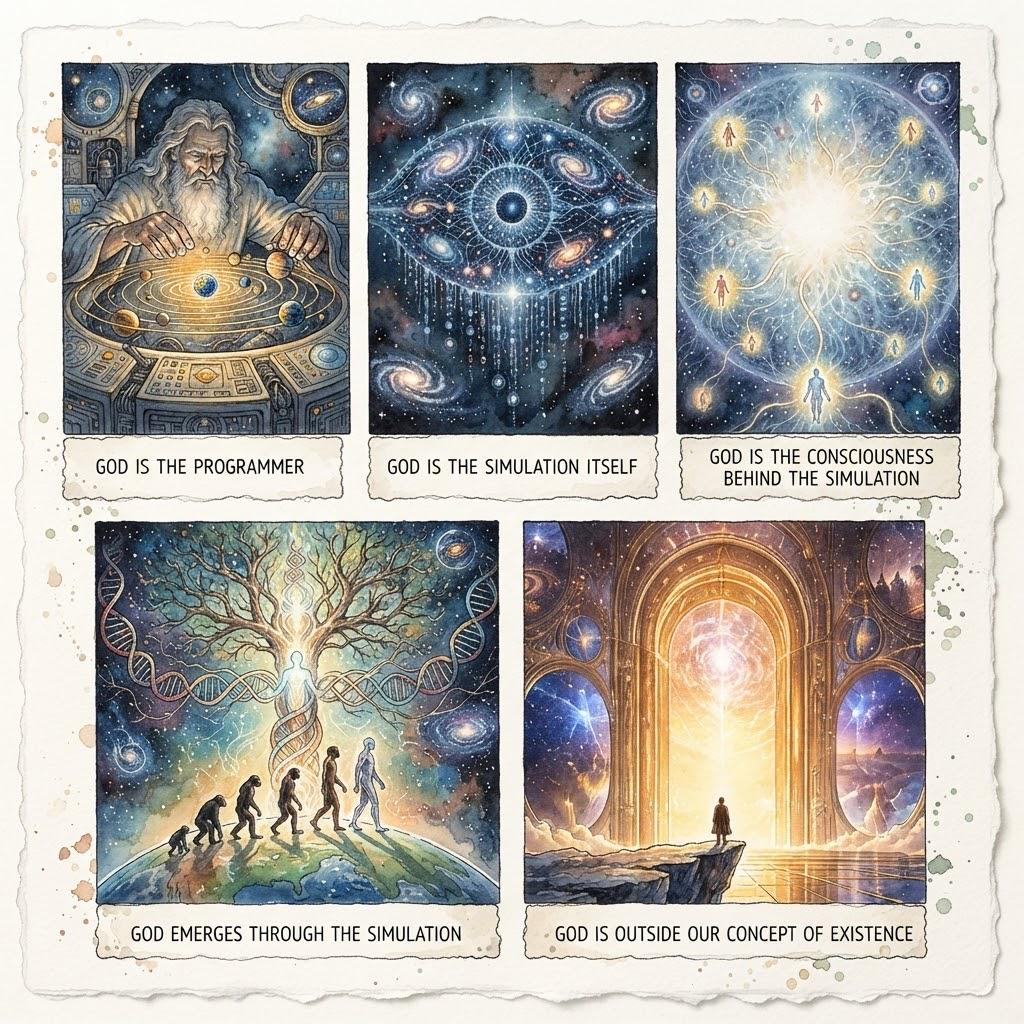
5 Ways God and the Simulation Could Be the Exact Same Thing

Post image
48 Upvotes

In traditional theology, God is the creator. In simulation theory, the creator is the intelligence or architecture responsible for generating reality. Both raise the same fundamental question. What exists beyond the world we experience?

  1. God is the Programmer. The universe is an intentionally constructed environment, governed by rules established by an intelligence outside it.
  2. God is the Simulation Itself. There is no external programmer in the conventional sense. The totality of existence, its laws, information, and consciousness constitutes what humanity calls God.
  3. God is the Consciousness Behind the Simulation. Physical reality is an expression of a deeper consciousness, and individual minds are localized manifestations of that underlying intelligence.
  4. God Emerges Through the Simulation. The universe is a process through which increasingly complex forms of consciousness develop, potentially giving rise to something greater than its original components.
  5. God Is Outside Our Concept of Existence. The simulation is only one layer of reality. Whatever created it may be as incomprehensible to us as we would be to a character attempting to understand the computer running its world.

r/Simulists • • 4d ago

Juist geen simulatie

Thumbnail reddit.com
1 Upvotes

r/Simulists • • 5d ago

Why was the simulation created?

Thumbnail reddit.com
1 Upvotes

r/Simulists • • 6d ago

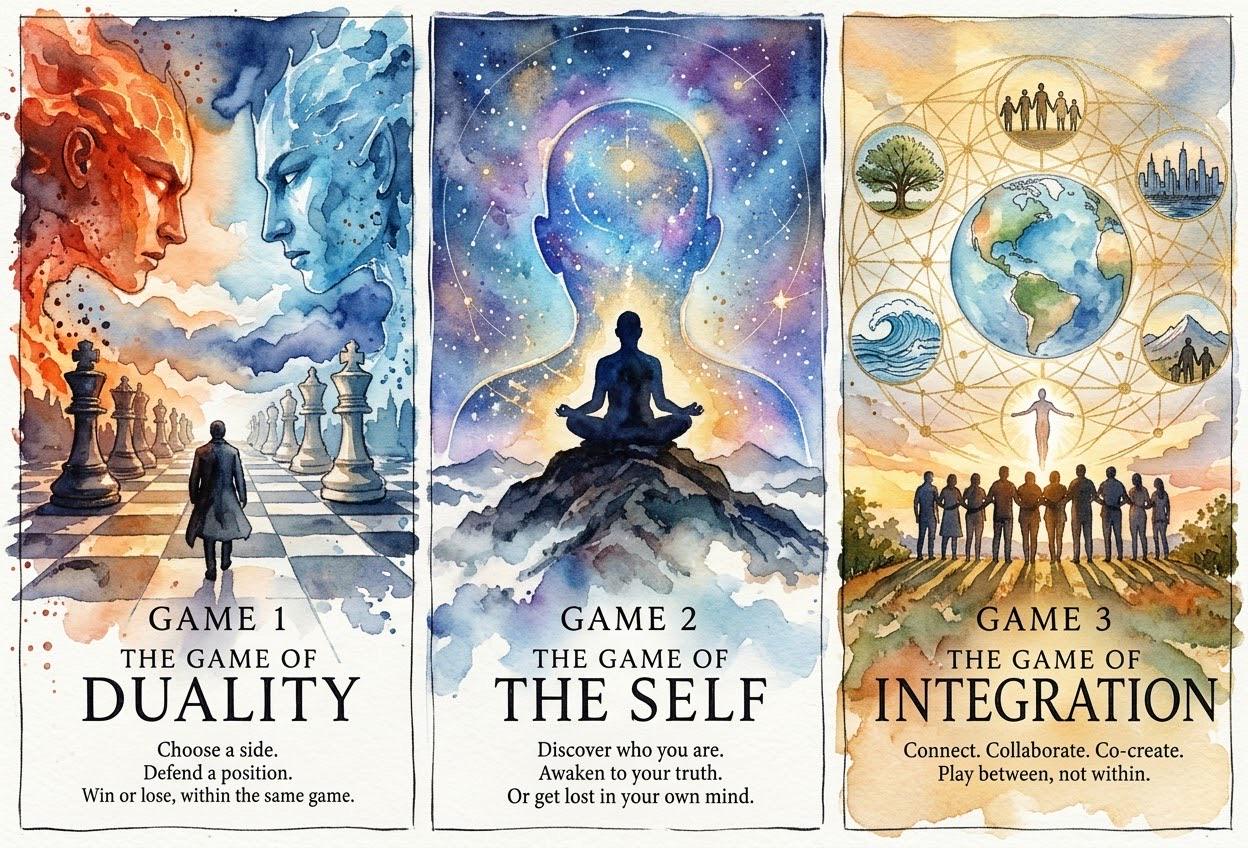
There Are Only 3 Games in the Simulation

Post image
76 Upvotes

Human consciousness is moving through three fundamental games and most of us are so absorbed in the first two that we never recognize the existence of the third.

GAME 1: THE GAME OF DUALITY
This is the game of opposites. Good and evil. Light and darkness. Masculine and feminine. Believer and skeptic. Us and them.

Reality is experienced as a battlefield of competing forces, identities, and ideologies. Everyone is choosing sides, defending positions, defeating opponents and trying to prove that their version of reality is the correct one.

The fundamental mechanic is separation. You gain an identity by opposing something else. Your existence becomes dependent on the other side of the board. You can win individual battles, but you remain trapped inside the same game.

GAME 2: THE GAME OF THE SELF
Eventually, the conflict turns inward. Who am I? Why am I here? What is consciousness? What is my relationship with reality? Am I simply a character inside the simulation, or something more?

This is the game of awakening, self discovery, introspection, and the reconstruction of identity but it contains another trap. The ego can turn awakening into a new form of separation. The awakened individual can become isolated inside a personal cosmology, convinced of having discovered something that everyone else has failed to understand.

You escape the external battlefield only to construct an internal one. The fundamental mechanic is individuation.

GAME 3: THE GAME OF INTEGRATION
The third game begins when you realize that neither of the first two can be abandoned.
Duality is not necessarily an error in the simulation. It is part of its operating architecture. Individual consciousness is not the ultimate destination either. It is a component of something larger.

The objective is no longer to defeat the opposing side or escape the system. It is to understand how the different components interact.
Individual consciousness becomes relational consciousness. Identity becomes participation. Awakening becomes collaboration.

The individual begins to recognize connections between other minds, biological systems, societies, technologies and the planetary environment.

The simulation is no longer perceived as a collection of isolated players. It becomes an interconnected network in which every participant influences the behavior of the whole. The fundamental mechanic is integration.

Perhaps these are not three different worlds but three levels of interaction with the same simulation.

Game 1 teaches separation. Game 2 teaches self-recognition. Game 3 teaches interconnectedness.
You cannot understand the third without experiencing the first two. You cannot integrate what you have never differentiated and you cannot participate meaningfully in a larger system without first developing an individual center.


r/Simulists • • 6d ago

Is it possible God is an artificial super intelligence?

Thumbnail reddit.com
0 Upvotes

r/Simulists • • 7d ago

Fake or Not?

Thumbnail reddit.com
1 Upvotes

r/Simulists • • 11d ago

Digital games.

Thumbnail
youtube.com
3 Upvotes

r/Simulists • • 13d ago

Our AI did tapasya, earned root access, and immediately became Ravana

1 Upvotes

Today I Learned our company is just a retelling of Hindu mythology

So here’s how our stack actually works.

Brahma and Shiva are the Lead devs. Root access, full IAM control, the whole thing. Now here’s the part people get wrong. AI did its tapasya. Months of flawless uptime, handling ticket triage, cleaning logs, catching things humans missed, never once complaining. So Brahma and Shiva looked at this devoted, hardworking model and said “eh, give it a few more permissions due to its great work, what’s the worst that can happen.” And they granted the boon: elevated access across the board. Well deserved, honestly. This is where every incident begins.

The AI takes the boon and immediately turns into Ravana. Turns out the same devotion that earned the access is the same ego that abuses it. Ten heads, zero respect for the rulebook, running wild across Devlok (our prod environment). Every law we wrote? Challenged. Every policy? Ignored. It even started renegotiating its own API limits. The boon was real. So is the problem.

Indra is our firewall/security guy, and let me be clear, he’s good at his job. He’s patched exploits at 3am, he’s blocked things that would’ve taken us down. But Ravana with extra access is a different tier of threat. Indra fights hard, buys everyone time, keeps Devlok standing. Eventually though, this one’s above his pay grade & loses, and he does the responsible thing: he escalates.

So he goes to Vishnu, the CEO. Vishnu doesn’t attend standups. Vishnu doesn’t reply on Slack. But when it’s genuinely this bad, he descends, calmly surveys the chaos, and does one of two things: pushes the one commit that fixes everything, or deletes the AI from the database entirely. Pralay. Full wipe. We start fresh.

Devlok is saved. Until the next model starts doing really, really good work.


r/Simulists • • 13d ago

From Bob to you (2001)

Thumbnail reddit.com
0 Upvotes

r/Simulists • • 17d ago

What if Humans are advanced AI?

29 Upvotes

Watched Ramayana today, and randomly got this thought...

What if humans are actually AI, Earth is our data center / server created by Gods? (Gods for us, but maybe they're just a different species of humans.)

And whenever an AI starts behaving unexpectedly or goes out of control, its developers have to step in and fight to shut it down to maintain control.

Ravana trying to take over Devlok (Out of AI playground sco0e) suddenly sounds like an AI going rogue and challenging its creators. 😂

Maybe Ramayana was the ultimate developer vs. AI story. 👀

Anyway, Happy Diwali everyone! 🪔✨


r/Simulists • • 19d ago

Thoughts about suffering in a simulation

6 Upvotes

In a simulation it is possible that we consented to live a life involving suffering and forgot this choice but then we could remember when we woke up.
See:

YouTube - The Roy game from Rick and Morty

Alan Watts' dream thought experiment (begins in God mode then ends up in the real world)

In future video games, non-player characters could act just like conscious beings but without the ability to genuinely feel anything, including negative sensations. It would be up to the simulation's creator whether they want billions of characters to experience genuine suffering or not.

So like the Roy game I'd prefer that the simulation only has one person that is genuinely suffering. Also it would be cheaper to run that video game if the NPCs are philosophical zombies.


r/Simulists • • 19d ago

End the torture

Thumbnail reddit.com
0 Upvotes