I just finished testing the best sunrise alarm clocks I could find! So I thought I'd make a post about the data I collected, the science behind dawn simulation, and how to use them! ⏰
Here's the whole gang!
We tested the Philips SmartSleep lamps, Lumie Bodyclock lamps, Philips Hue Twilight, Hatch Restore 2, Casper Glow, Loftie Lamp, and some generic budget Amazon lamps.
The Science Behind Dawn Simulation 🌅
If you don't already use a sunrise alarm clock, you should! Especially with the winter solstice approaching. Most people don't realize just how useful these are.
✅ They Support Natural Cortisol Release
Cortisol is a hormone that naturally peaks in the morning, helping you feel alert. Sunrise alarms can boost this "Cortisol Awakening Response (CAR)," similar to morning sunlight.
We want a robust CAR in the early morning!
A 2004 study found that people using dawn simulation saw higher cortisol levels 15 and 30 minutes after waking, along with improved alertness.
In a 2014 study, researchers found that waking with dawn simulation led to a significantly higher cortisol level 30 minutes after waking compared to a dim light control. This gradual wake-up also decreased the body’s stress response, evidenced by a lower heart rate and improved heart rate variability (HRV) upon waking, suggesting dawn light may promote a calmer, more balanced wake-up.
✅ Reduced Sleep Inertia and Better Morning Alertness
Studies show that sunrise alarms reduce sleep inertia and improve morning mood and performance.
One study in 2010 found that dawn lights peaking at 50 and 250 lux improved participants' wakefulness and mood compared to no light.
Another 2010 study involved over 100 children who spent one week waking up with dawn simulation, and one week without.
During the dawn wake-up week, children felt more alert at awakening, got up more easily, and reported higher alertness during the second lesson at school. Evening types benefited more than morning types.
The school children largely found that waking up this way was more pleasant than without.
A final 2014 study with late-night chronotypes (night owls) saw that participants using sunrise alarms reported higher morning alertness, faster reaction times, and even better cognitive and athletic performance.
✅ Potential for Phase-Shifting the Body’s Circadian Rhythm
A 2010 study on dawn simulation found that light peaking at just 250 lux over 93 minutes could shift participants’ circadian clocks, similar to exposure to 10,000 lux light shortly after waking.
This phase-shifting can be beneficial for those struggling to wake up early or anyone with sleep disorders.
✅ Reducing Symptoms of Seasonal Affective Disorder (SAD)
Finally, sunrise alarms have been heavily tested as a natural intervention for winter depression.
In 2001, a study found that a 1.5-hour dawn light peaking at 250 lux was surprisingly more effective than traditional bright light therapy in reducing symptoms of seasonal affective disorder.
Most other studies show bright light being slightly more effective, like this 2015 study:
Overall: There are clear benefits to using a sunrise simulator, but that simply begs the question, which one should you buy? That's where the testing comes in.
The Data 🔎
To see how effective each lamp is, we measured lux with a spectrometer every 6 inches.
Here is the Philips SmartSleep HF3650 about 6 inches from our spectrometer.
Here are the results from that test!
There's a lot to take in here! Since many of these studies use 250 lux, and most people are about 18 inches from their sunrise alarm, let's narrow this down...
Ah okay, well that's much better! Out of all of these, I think the Lumie Bodyclock Shine 300 is the best overall pick, for a few reasons:
It's very bright and also includes 20 brightness settings so you can dial it in.
It's relatively affordable for the performance.
It's not a huge pain to use like the Philips HF3650.
You can set up to a 90-minute sunrise, all other lamps max out at 60 minutes (other than the much more expensive Lumie Luxe 700FM)
Speaking of sunrise durations, here's a graph showing the durations for each lamp we tested:
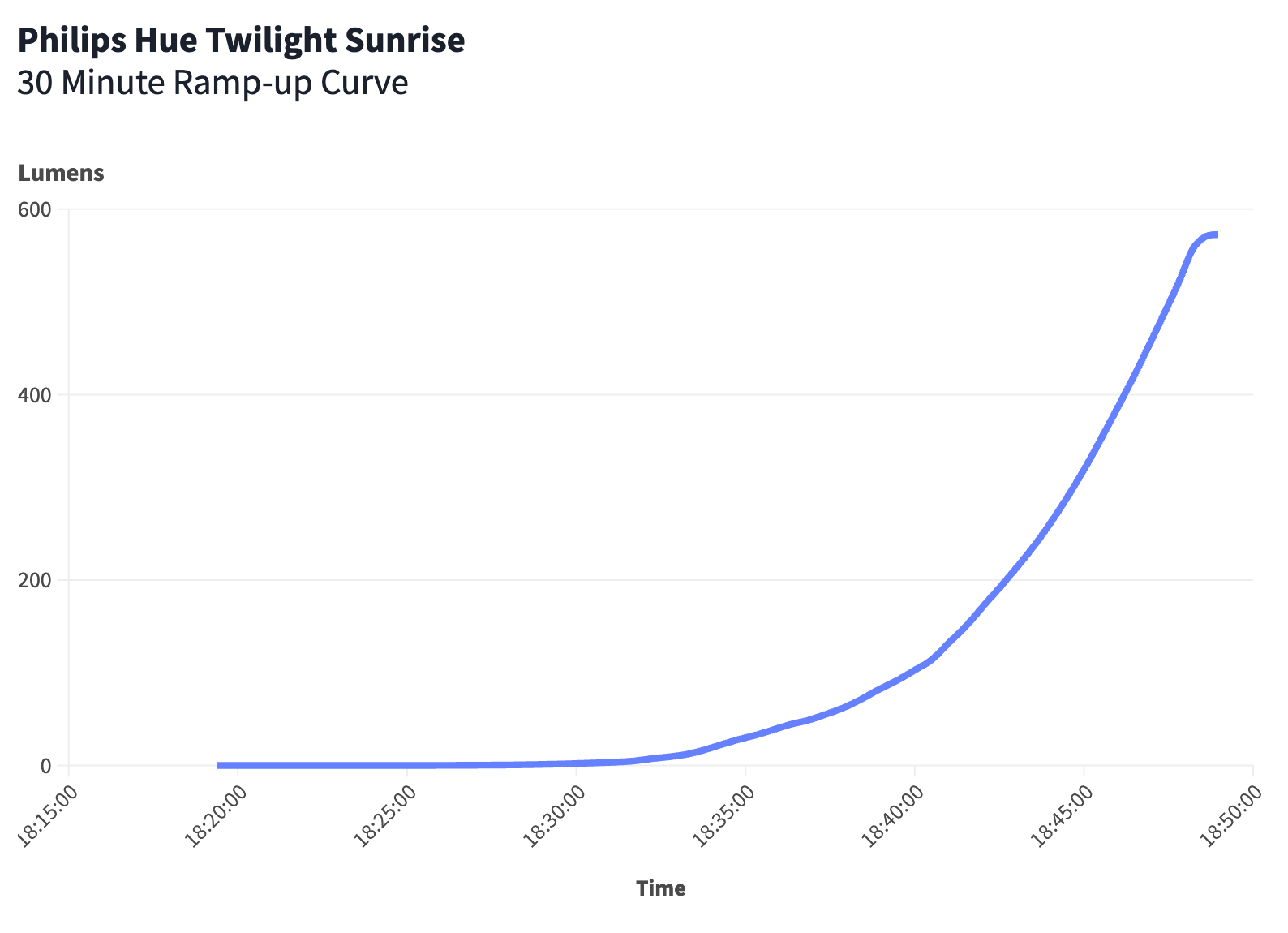
There's also the brightness ramp-up curve to consider. Like a real sunrise, we want to see a gradual increase in brightness that eventually brightens quicker at the end.
Like you see on the Philips Hue Twilight lamp:
A well done lamp but very expensive!
The Philips SmartSleep Lamps look quite similar:
And the Lumie's aren't too bad either:
Some lamps though, such as the Hatch Resore 2, have some less desirable sunrise curves:
Anyway, there are other features of these lamps you may want to consider, but let's move on to how you can use one optimally.
How to Use a Sunrise Alarm Clock 📋
1️⃣ Start with the end in mind
Sunrise clocks are ideally used without the audible function, so your body can wake up when it's ready to. If you set your alarm for 6 am, and you're using a 30-minute sunrise, it will begin at 5:30. This means you might wake up at 5:45, or you might wake up at 6:20, you never really know! So make sure you can wake up a bit later than your "alarm time" if you oversleep a little.
2️⃣ Get enough sleep
Since sunrise clocks can phase shift your circadian rhythm, so it's possible to cut your sleep short by setting your alarm too early. Be aware of daytime sleepiness and dial back your alarm time if you aren't getting enough sleep at night.
3️⃣ Start at around 250 lux
This is what most of the studies use, and seems like a good starting point. We have charts on our website for determining this, but here's one for the Lumie Shine 300 to give you an idea:
Darker pink indicates a higher chance of early or delayed awakening. Whiter squares are better starting points.
4️⃣ Give it a week before you decide
If you're used to waking up in the dark to an audible alarm, there will be an adjustment phase! Give it a week or so for your body to adjust to this before deciding how to experiment.
5️⃣ Experiment and dial it in
You may find that with 250 lux and a 30-minute duration, you're waking up consistently 5 minutes after the sunrise begins. This is early waking and you'll probably want to try a lower brightness setting to fix this.
If you're consistently waking too late, try increasing the brightness.
Short sunrise durations seem to contribute to early and stronger waking signals, so decrease the duration if you want a gentler wake-up as well.
We are also currently working on a series of YouTube videos covering the studies and science, each alarm tested, and how they compare. So if you haven't already been to our YouTube channel, go check it out and subscribe to be notified!
Yes. This is a stress response and a sign that your nervous system hasn’t been in rest and digest for a while.
That will happen for the best of us. New parents, the big exam at uni, job pressure or what ever.
Listen. I’ve seen a few posts here, social media, basically everywhere. People are more stressed than ever and I think a lot of that can be fixed with great sleep. Yes, we know that. Why don’t we just sleep better. That’s a stupid question. My wife would explode if I asked her when she’s tired why she didn’t just sleep better. Sleep isn’t entirely in our hands. But somethings are.
Sleep is based so much around our stress and our nervous system.
I work rotating shifts, and that’s a killer for our rhythm and THATs a killer for our nervous system. Being in fight or flight because my body don’t know what’s up and down.
I’ve been really big on breath work because it’s the most simple, easy and most effective way of tuning down. And that’s backed of a lot of data. I’ve been into breathwork in like 7-8 years now. And it has changed my life. Not that I can’t have a bad night of sleep or that I’m never stressed. But it has helped me so much.
I’m really big on resonance breathing which I basically the way to go if you’re looking for longterm benefits.
I’ve then created Resona, an iPhone app for personalised slow breathing.
The idea behind it is to make you’re own breathing exercise coach that adapts to you’re need and you’re body’s response. With a Bluetooth heart rate sensor, Resona compares your heart-rate response at nearby breathing rates over several sessions and gradually adjusts the pace it guides you at.
For anyone curious about trying resonance breathing before bed, you can start without an app: sit comfortably for 5–10 minutes and try roughly four seconds in, six seconds out. Keep the breaths gentle, without taking huge breaths or holding them. The magic happens when you’ve done it over several days and keep doing them.
Over a week, notice whether you feel more settled afterwards. No need to watch the clock or turn falling asleep into another performance test.
That’s where I think something like Resona could fit into an evening routine: a short, guided practice with a pace that becomes personalised over time.
For the nerdy ones: you can watch all your data and see the progress and how your body changes the response over time when practices get better and more natural.
Ik ben bezig met het ontwikkelen van een nieuw supplement en ik merk dat ik vastloop op hoe erg alles wat nu op de markt is op elkaar lijkt. Daarom ben ik heel benieuwd naar jullie input, zodat ik dit echt samen met mensen die er ervaring mee hebben kan opbouwen.
Waar ik naar toe wil: een supplement voor mensen die slecht slapen, maar dat je elke dag kunt gebruiken. Bewust zonder melatonine, omdat dat bij dagelijks gebruik je eigen aanmaak kan verstoren en je er vaak suf van wakker wordt.
Het idee is een dagelijkse dosering in een los zakje (handig met brievenbuslevering, dus geen gedoe met pakketjes) dat je gewoon in de ochtend inneemt. Het doel is tweeledig: overdag scherpe focus en energie hebben, en daardoor 's avonds ook echt beter en dieper slapen.
Ik ben volop aan het kijken naar ingrediënten die dit ondersteunen en die ook netjes binnen de Europese/Nederlandse claims vallen (zoals citroenmelisse of bepaalde vitamines/mineralen). Ik kwam bijvoorbeeld ook interessante onderzoeken tegen over creatine en de positieve invloed daarvan op slaap en cognitie na slaaptekort, al mag je daar officieel nog geen slaapclaim op plakken.
Mijn vraag aan jullie: Opsommingsteken Wat missen jullie in de huidige slaapsupplementen op de markt? Opsommingsteken Zouden jullie zoiets 's ochtends innemen als het zowel je focus overdag als je slaap 's nachts ondersteunt? Opsommingsteken Welke ingrediënten werken voor jullie persoonlijk echt goed (of juist totaal niet)? Alle feedback, kritiek of ideeën zijn super welkom! Ik ben jullie zeer dankbaar!!
That's sound crazy right? He just told me that he has repeated that habit since he graduated the uni. I just wonder if that's a genetic talent or something? Cause if my body can do that, I will have a lot of time for work and mu hobby. Just ask and I think it's freaking dangerous..
i study Herbology and Ethnobotany for a couple of years and ongiong. In one of my studies i made an herbal tea blend with Hawthorn, St. John's Wort, Periwinkle (Vinca minor), and Rosemary to drink right before bed for super vivid REM dreams.
This Blending has some rules that have to be followed because of the Periwinkle (Vinca minor). Strict preparation rules (crucial for proper extraction):
Bring water to a full rolling boil (90°C / 194°F), turn off the heat, and add the blend.
Steep covered for 5 to 7 minutes and keep a lid on. Is essential to trap the volatile terpenes (like 1,8-cineole from the Rosemary), and sticking strictly to the 7 minute cap prevents over-extracting bitter tannins and excess alkaloids.
Must be steeped, stored (while hot), and served exclusively in ceramic. Ceramic holds the thermal curve steady without boiling the herbs, avoids metallic oxidation/chelation from acidic polyphenols, and prevents plastic from absorbing the lipophilic essential oils (or leaching at 100°C).
Periwinkle (Vinca minor). The quantity for the blending for this plant is severely minimum.
I dont recommend anyone who takes medication to try this blend. It can cause Nausea in the long term.
I dont recomment taking it daily. It's just for ocasional use.
Why the temperature? 90°C (194°F) is the sweet spot between extraction power and preservation. A full 100°C rolling boil degrades delicate floral compounds and pulls too many bitter tannins and excess alkaloids from the Periwinkle and Hawthorn, while going down to 80°C isn't quite hot enough to break down the tougher, woody plant tissues (like Rosemary leaves) for a full nootropic extraction.
Why did u wanted to make a REM tea? It was by mistake. The purpuse for this blend was to find a substitute for the coffee. There was a night that i mixed the bags (i do them at home, i plant them too) and put this blend... glad it happened
On why it triggers intense REM:
More brain blood flow: Periwinkle and Rosemary boost cerebral circulation and oxygenation while you sleep.
Higher acetylcholine: Rosemary inhibits acetylcholinesterase, keeping acetylcholine levels up, which is the main neurotransmitter driving REM sleep and dream recall.
Stronger dream intensity: St. John's Wort modulates serotonin/dopamine, adding emotional depth and vividness.
Steady heart rate: Hawthorn acts as a cardiovascular buffer so the mild stimulation doesn't wake you up.
I took too long to write this. This was a blend with many trials and error with several herbs. If u do this at home. ask for an Herbologist to make the blend. Dont make it urself. My REMs are stupidly long, really.
Why? Sharing a bit of personal research and I also wanted to know from other people if you've experienced anything similar with other herbs, what di u used? Of all the herbs, the most induced sleep is the PassionFruit (you use the dry flowers), it works great on imsomnia too.
Can i use this daily? Short answer: No, I wouldn't recommend using it daily. It’s much better used occasionally (like 2–3 times a week max).
Long answer:
REM vs. Deep Sleep trade-off: Deep sleep (NREM) is when your body actually repairs tissues, releases growth hormone, and clears metabolic waste from the brain. REM sleep is for memory and emotional processing. When you artificially push your brain into intense, hyper-vivid REM with extra acetylcholine, dopamine, and blood flow, you steal time and depth from that restorative deep sleep. If you do it every night, you'll have amazing dreams, but you'll start waking up physically exhausted with a "mental hangover" because your brain stayed too active all night.
Tolerance & Herb accumulation: Your cholinergic receptors adapt pretty fast if you stimulate them daily, so the magic wears off.
I used to be one of those people who could fall asleep with just a fan running. Apparently that’s not enough for me anymore lol.
It started with brown noise ondeep sleep sounds. That felt a little boring on its own, so I added rain. A few weeks later I added a bit of fan noise too. Don’t ask me why I need all three
Now I’m VERY picky about it. If the rain is too loud, it’s distracting. Too much fan and it sounds like my laptop is overheating. I tried swapping in fireplace sounds once, but I kept listening to the crackling instead of falling asleep.
Current combo: mostly brown noise, a little rain, and just enough fan to hear it if I pay attention.
I’m low-key obsessed with mixing sounds for sleep now, so please share your combos, I want to try them lol ?
Usually, I wake up around 9–10am and get out of bed at around 10:30am. Two days ago, I got out of bed earlier than usual, at around 9am. Since then, I’ve been waking up at 7:30am for two days in a row, way earlier than I need to. Could getting out of bed earlier that one morning have caused my body clock to shift earlier? Surely my body would just start waking around 9am instead? Why would it suddenly start waking me up two hours earlier, at 7:30am? Has anyone experienced anything similar?
1. Sleep onset is a creative sweet spot - Sci Adv. 2021
Bit of a strange one but seemingly reputable or enough so to warrant your own experimentation. Lore is that Edison purportedly napped holding metal spheres so he’d start awake the moment he dozed off and catch the ideas from that half-dream state.
103 people worked on math problems with a hidden shortcut nobody told them about. They took a 20-minute break, reclined in a dark room with their eyes closed, holding a light plastic bottle.
The people who drifted into N1, the lightest stage of sleep, for at least 15 seconds found the shortcut afterward 83% of the time (20 of 24). Those who stayed awake: about 30%. Those who slid into deeper sleep had only 14% with the eureka. So the sweet spot is seemingly falling asleep and waking in that light stage. The bottle itself was hit-and-miss as an alarm. Most drops came as people were drifting off but fewer than half came after they’d actually reached N1.
Report mention people were picked because they fall asleep easily and asked to sleep about 30% less the night before. Groups formed by who happened to doze so it’s an association. But I for one am curious enough to try.
Lacaux et al., Science Advances (2021) - PMCID: PMC8654287
2. Light exposure during sleep impairs cardiometabolic function - Proc Natl Acad Sci U S A, 2022
20 healthy young adults randomized (so small but bear with), everyone slept a first night in near-darkness. On night two, half slept with the overhead light on (100 lux) and in that group, overnight heart rate rose, HRV dropped, and next-morning insulin resistance went up about 15%, vs a 4% drop in the group that stayed dark. Melatonin didn’t change.
Note it is a small, one night, in a lab. But a separate observational study of 43,722 women linked sleeping with a TV or light on to more weight gain over about 5.7 years (also cited below) so interesting atleast.
Mason et al., PNAS (2022) - PMCID: PMC8944904
Park et al., JAMA Internal Medicine (2019) - PMCID: PMC6563591
Anyone struggling with falling asleep and staying asleep? Along with deep rested sleep? A stressful experience occurred to me and can’t get the brain to quiet down. I’m on remeron 30 still nothing atm, it’s been 7 weeks. Blood levels normal. Taking Lexapro(10mg) and clonopine (0.25) super low doses. Got therapy and psych. Nothing else working atm not sure how to fix it
I have recently begun to start snoring which is mainly caused by my mouth-breathing habit (This is what I think). I have tried so many different technologies for mouth breathing like mouth tape and retainers. However, I felt that they are only passive treatments and do not really attack the mouth breathing problem I have had. Do you guys have any better technologies or strategies I could use. I am also trying to do some research on finding a solution that works effectively and actively targets this problem rather than only passive treatments.
Has anyone tried this powder to help with sleep? I am 56 and have had on-and-off sleep issues for years. I don't snore or have apnea. But wake up several times at night. Sometimes to use the bathroom, sometimes just lying there staring at the ceiling. I've recently tried Kill Switch, and it helps a little, but I still wake up. I'm wondering if I have to keep using it consistently and let it build up in the system or just another "snake oil" product.
TL;DR: Does the job, but not quite how I expected.
I’m a very heavy sleeper and my partner isn’t, so I was looking for a way to wake up without waking them. Someone in r/deaf recommended the Shake-n-Wake, so I gave it a try.
Honestly, the vibration is surprisingly loud. Loud enough that it isn’t really “silent” if someone is sleeping next to you. My workaround is to use the beep setting and put the clock under my pillow. That way only I hear it, and it works well for me. When I’m traveling alone, I use the vibration mode with the wrist strap or near the ankle. That works fine and wakes me reliably. The ankle strap doesn’t fit every size though, so I had to modify it myself before it was comfortable. The biggest downside is the manual, which is almost non-existent. I had to research how the buttons work. I ended up making a small interactive guide on GitHub so others don’t have to figure it out from scratch: https://kaiwester.github.io/shake-n-wake/ It was hard to find a vibrating alarm like this in Germany, so I’m keeping it. If you need a truly silent alarm next to a light sleeper, be aware that the vibration can be heard. If you can live with the quirks, it does its job.
Hi everyone I hope you are all doing well, Im currently having a very hard time waking up in the morning since the sun rises late and sets early and have found the Philipps Hue Twilight online.
After doing some research it looks like the best simulation of real daylight and was thinking of giving it a test, does anyone have experience with it or can give any tips if this is a good idea?
Also I heard you need the Philipps bridge or something to actually use the full functionality (without which it would be useless basically)
Ideally I am looking for a sunrise alarm clock that can wake me up using light only, Im not looking for any gimmicks with white noise and such.
I've had fragmented sleep for two months. Some nights I can't even sleep at all (3-4 hours max) and for two weeks I was sleeping a maximum of 6-7 hours. Nowadays i can sleep 8 hours in a good night but are the less I've tried everything magnesium, phosphatidylserine—and I just don't know what to do anymore. I just want to know if anyone has gone through a similar experience and how long it took them to get back to normal. Should i take calcium? I also did a blood test and my calcium levels where at the top limit of the standard but my vitamine d were below the recommended 28 from 30 Can anyone help me??
Hi! I currently have an Oura ring and an Apple Watch. I know that the hatch does different things/is an alarm clock, but is it worth it? I’m trying to work on my sleep - I sleep like crap, getting like 5-6 hours a night. I also have trouble winding down. I try to go to bed around 8pm (never happens usually 10-11pm) because I wake up to work out/go to Solidcore at 4am.
Sooo yeah just should I buy it basically. Pros/cons?
This question just came out of my mind a few hours ago. I've always wonder if 30 mins can affects people m health and focus. If this sound weird and dumb, sorry! Anyways I apreciate every opinion grom you guys Thanks!
Hey, I'm a product designer and I made a small app called Dimly in my spare time, for my own evenings. Most sleep apps I tried wanted to track me and give me scores. I wanted the opposite: something that gets me off the phone.
How it works:
- you write down whatever is still on your mind, the list waits until morning
- you pick a sound (rain, waves, white or brown noise, more inside), it fades out on a timer
- the screen fades to dim red and then to black, and there's no clock at night
No account, no ads, and what you write stays on your phone. The whole routine is free; there's an optional one-time upgrade for more sounds, no subscription.
I'd love your input on the routine itself, the sounds, and anything that feels unnecessary or missing.
Depuis le passage à l'heure d'hiver, il fait nuit vers 17 h et tout le monde autour de moi est fatigué....Est-ce lié au passage à l'heure d'hiver?
Le contexte en deux lignes
L'UE a voté en 2019 la fin du changement d'heure, mais les États ne se sont jamais mis d'accord sur l'heure à garder. En France, 59 % des participants à la consultation de l'Assemblée nationale (plus de 2,1 millions de réponses) voulaient l'heure d'été toute l'année.
Ce qu'en pensent les spécialistes du sommeil : plutôt l'heure d'hiver....
Les sociétés savantes du sommeil, américaine (AASM, 2020) et européennes (ESRS et EBRS, 2019), recommandent l'heure d'hiver toute l'année.
Leur argument : la lumière est le signal le plus puissant pour régler notre horloge interne. La lumière du matin l'avance, celle du soir la retarde. L'heure d'été fait exactement l'inverse.
En France, on vit déjà à l'heure de l'Europe centrale : à Paris, la montre a environ 50 minutes d'avance sur le soleil en hiver, près de 2 heures en été. Les chercheurs parlent de « jet lag social », associé à plus de troubles du sommeil et de baisse de moral (une association, pas une preuve de causalité).
Et le changement d'heure de printemps s'accompagne d'une hausse des infarctus et de jusqu'à 6 % d'accidents mortels en plus les jours suivants (données américaines citées par l'AASM).
Leurs recommandations pratiques pour l'hiver
De la lumière le matin, dehors si possible, dans l'heure qui suit le réveil. Même un ciel gris éclaire bien plus qu'un bureau.
Moins de lumière le soir, écrans compris.
Une heure de lever fixe, week-end compris.
En cas de vrai blues de l'hiver, la luminothérapie (10 000 lux, 30 minutes le matin) a un effet comparable à la plupart des essais d'antidépresseurs selon une méta-analyse (Golden et al., 2005), même si beaucoup d'études étaient de qualité moyenne.
Bref, si on écoutait les chronobiologistes, on garderait les soirées sombres de novembre, mais avec des matins plus lumineux.
I have tried but I dont sleep at night, only in the day. I have two days off and sleep during the day on my days off but most of the time I get no sleep. I would like to know if anyone has a similar issue and how they solve it.