r/StarlinkEngineering • u/OlegKutkov • 1d ago
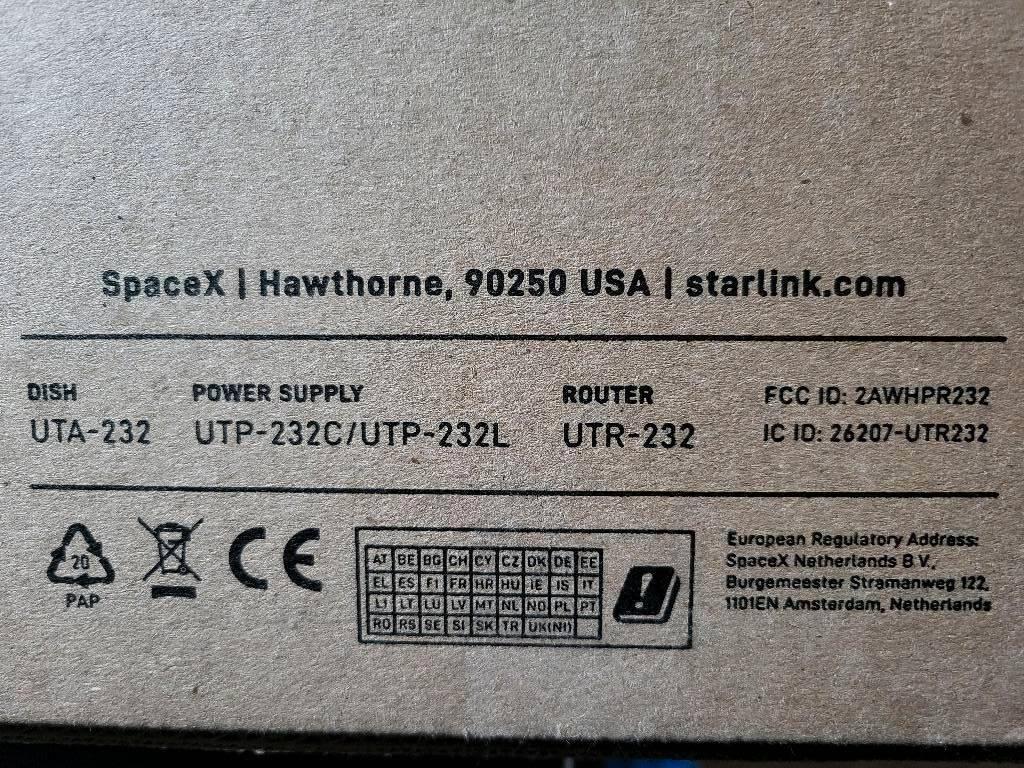
Starlink Mini2 built-in router details (USB Ethernet support)
reddit.com
3
Upvotes
r/StarlinkEngineering • u/_mother • May 10 '21
A place for members of r/StarlinkEngineering to chat with each other
r/StarlinkEngineering • u/OlegKutkov • 1d ago
r/StarlinkEngineering • u/TomaszNowakowski • 1d ago
r/StarlinkEngineering • u/panuvic • 1d ago

r/StarlinkEngineering • u/http-brandon • 1d ago
I'm a PNT/navigation researcher in Asia, where Starlink isnt here, so I cant record the downlink myself. I'm looking for someone with a Ku-band LNB and a wideband SDR who'd be willing to make one short recording for a research paper.
What is needed
- A bare Ku-band LNB/LNBF (no dish) pointed at zenith, on a tripod about 7-10 m from a tall building wall (3+ storeys, glass or smooth concrete ideal)
- An SDR with at least ~50 MHz of bandwidth (USRP B200/B210, X3xx, or similar; RTL-SDR/HackRF are too narrow, sadly)
- One Starlink channel, about 10 minutes next to the wall, plus 2 minutes in open sky
- Raw IQ (8- or 16-bit), plus a short note of time, location, antenna height and SDR settings. A GPSDO is nice to have but not required
It's receive only: only the public sync sequences are used, nothing is decoded, and no user data is kept. The minimum recording is about 80 GB, and I can provide a cloud upload link. I have a two page guide with exact settings and a pass prediction for your location, and I'll do all the processing.
You'd be acknowledged in the paper for the data, and I'm happy to share the processed results (delay-Doppler maps of the building reflections, which are pretty cool to see. And if you want, we can co-author papers in the future! This is prolly wht I'm more excited for)
If you're interested or have questions, comment or DM me.
cheers
r/StarlinkEngineering • u/OlegKutkov • 2d ago
In the latest firmware releases, Starlink finally introduced a signal-quality metric in its gRPC telemetry. No authentication or account is required.
The value is named signalQuality, and it reports values from 0 to 1.0. These values are real SNR values divided by 10 and clamped to the 0.0-1.0 range.
To get the Starlink SNR value, we can simply multiply signalQuality by 10.
Sure, we can't get any value higher than 10, which effectively means >=10 dB; 0 is the noise level.
Example request with SNR calculation:
# grpcurl -plaintext -d '{"get_status":{}}' 192.168.100.1:9200 SpaceX.API.Device.Device/Handle | jq -r '.dishGetStatus.signalQuality' | awk '{printf "SNR=%.1f dB\n", $1 * 10}'
SNR=6.8 dB
I wrote a simple program that reads and shows values.


r/StarlinkEngineering • u/panuvic • 2d ago

if you are below parallel 30 ;-)
r/StarlinkEngineering • u/panuvic • 3d ago

also inspired http://oac.uvic.ca/cccleo named after dave too
r/StarlinkEngineering • u/reibogado • 4d ago
r/StarlinkEngineering • u/Live-Nefariousness79 • 4d ago
TLDR: Beams and satellites are limited in number, but the beams are steerable. Are they actually moved around to follow demand hotspots?
I've read the SpaceX filings and some other technical material. Let's take the current Direct to Cell fleet of about 630 satellites.
Each satellite has a fixed number of beams. Each beam makes a circle roughly 35–40 km across on the ground when the satellite is right overhead (SpaceX says ~900 sq km per beam), and a bigger, stretched one when the satellite is lower, around 30° elevation. SpaceX's own graphic says 256 beams per V1 satellite and 1,024 for V2, but I suspect far fewer are actually lit at the same time. Either way, even with this many satellites, it isn't possible to cover the entire Earth at once.
Some countries are outside Starlink's focus. But take one particular country. I used SGP4 to propagate the satellites, and for a mid-sized country like Kenya, only about 3 to 4 satellites can see any part of it at a given moment, on average. If only a fraction of their beams are lit at once, 3 to 4 satellites can't cover the whole country's land area at the same time. That's especially true since they're also covering the neighbouring countries and the sea.
So what I'm trying to check is: are the beams focused on demand hotspots? Does Starlink have the capability to do that? I know they say the beams are steerable, but how dynamic is that in practice?
Also, since the number of beams is fixed: say someone on the west side of the country requests service while the beams are pointed at the east side. What happens in the background? Does a beam get re-pointed to the west, does the phone wait for a beam / satellite to come round, or does it just get no service?
r/StarlinkEngineering • u/Technical_Delay8753 • 5d ago
Hello, I am just getting on this project so forgive me if its something I can see from the starlink interface or not, I am just wondering, from the starlink router, is there anyway to connect it via VPN, to another Starlink device? kind of a site to site vpn? or would I have to use a external router/firewall for this?
r/StarlinkEngineering • u/ibravh8 • 6d ago
r/StarlinkEngineering • u/jxjputaoshu • 8d ago

Why does the Starlink satellite downlink beacon consist of nine spectral lines? Are they transmitted intentionally, or are they unintended emissions? If they are simply local oscillator (LO) leakage, why are there nine spectral lines instead of just one?
The mystery has finally been solved! https://sdr-x.github.io/starlink-beacon-why-9-peak/
According to the patent US12615097B2 — Near Zero Intermediate Frequency (NZIF) Compensation of Local Oscillator Leakage, Starlink’s solution works as follows:
A small frequency offset is first introduced into the communication signal in the digital baseband. The patent gives an example of: delta-F = 40kHz.
The local oscillator of zero-IF transceiver is then tuned with a small frequency offset in the opposite direction relative to the target carrier frequency.
The two frequency shifts effectively cancel each other out for the desired communication signal. Consequently, the communication signal remains centered at the intended center frequency.
However, the LO leakage is no longer located at the center frequency. Instead, it appears at the center frequency plus or minus the small frequency offset.
By assigning different small frequency offsets to different local oscillators (with opposite offsets in the digital baseband accordingly), the resulting LO leakage signals are no longer coherent with one another (thanks to the frequency shifting). This greatly reduces the risk of accidental coherent addition that could cause the radiated power spectral density to exceed regulatory limits.
In the patent example, the resulting RF local oscillator leakage signals are separated by approximately 40 kHz. This closely matches the approximately 44 kHz spacing between the nine spectral lines reported in many Starlink observations.
Why nine different LO leakage frequencies rather than four or a thousand?
This is probably an engineering trade-off between performance and implementation complexity: https://sdr-x.github.io/starlink-beacon-why-9-peak/
r/StarlinkEngineering • u/panuvic • 13d ago

r/StarlinkEngineering • u/DragonflyNo8792 • 13d ago
Bonjour à tous.
J'ai commandé un kit mini, sur le site officiel starlink, qui devrait être livré mi novembre, mais j'ai l'impression que ça ne bouge pas. Dois-je m'attendre à des longs retards?
r/StarlinkEngineering • u/toddalwell • 13d ago
Check out our latest NGX View - Starlink Fleet Management (displayed in NOC wallboard). We offer full monitoring, metrics, service aware alerting and visualization for your Starlink Fleets from 2-20,000 installations without the need to install any hardware onsite. Receive service alerts via Slack, Telegram, email, Whatsapp, etc. (the NGX View is a real screen showing actual field telemetry)

r/StarlinkEngineering • u/GoonedOutOO • 15d ago
r/StarlinkEngineering • u/panuvic • 16d ago
feedback welcome
r/StarlinkEngineering • u/jxjputaoshu • 18d ago

Using two SDRs and two LNBs to simultaneously measure Starlink terminal transmissions [1,2] and receiver LO leakage [3,4], I confirmed that, during normal operation, the terminal consistently selects the same channel number for both uplink and downlink. In other words, the uplink and downlink channels are paired via choosing the same channel number (TDD switching between UL and DL), even though their center frequencies are different (FDD).
Starlink downlink channel numbers 0–7 correspond to eight 500 MHz channels spanning 10.7–12.7 GHz. Uplink channel numbers 0–7 correspond to eight 62.5 MHz channels spanning 14.0–14.5 GHz.
(I replaced the previous software-controlled AD9361 frequency-hopping implementation, which achieved 10,000 hops per second [1,2], with hardware-controlled hopping, enabling measurements at 80,000 hops per second.)
https://sdr-x.github.io/starlink-ul-dl-pair-80k-hop-ad9361/
Attached are several screenshots captured during real-time measurements.
Each row represents one channel. Vertical axis: Signal strength (dB). Horizontal axis: Time (seconds), with a total span of 70 seconds The left panel shows activity across the eight uplink channels (measured by scanning 8 possible UL frequencies of transmitted RF signals). The right panel shows activity across the eight downlink channels (measured by scanning 8 possible DL frequencies of receive local-oscillator leakage).
During ten minutes of visual observation, I did not observe a single instance in which the uplink and downlink channel numbers differed.
r/StarlinkEngineering • u/GloryMatlab • 19d ago
A spectrum or constellation plot can reveal the bandwidth and modulation features of a Starlink downlink recording. Explaining which resources carry headers, how those headers describe the payload, and which channel codes protect each region requires a more complete connection between the waveform, decoded control bits, and coding relations.
This article summarizes our analysis of a Starlink Ku-band downlink recording. The data come from a single continuous capture lasting approximately 24 ms, with 18 complete frames included in the analysis. We identify two protocol data unit headers in each frame, recover their convolutional code and CRC, and relate modulation and coding scheme fields to subsequent resource allocations. We also recover and validate coding relations for several payload formats.
The focus here is what we can currently say about the contents of a frame. We briefly review the established synchronization and pilot structure, then concentrate on the headers, resource allocations, and payload coding. Format numbers follow the MCS index interpretation used in the current manuscript.
r/StarlinkEngineering • u/Kazix62 • 19d ago
r/StarlinkEngineering • u/Kazix62 • 20d ago