r/StartInvestIN • • 2d ago

⭐ Gold & Precious Metals Silver crashed 60% in 10 months (₹4.2L → ₹1.7L/kg). If you hold a silver ETF, read this before you sell or buy more!

45 Upvotes

TL;DR

  • Silver is down ~60% from its January peak. On MCX it went from ₹4.20 lakh/kg to about ₹1.69 lakh/kg.
  • The supply deficit everyone talked about is still there. The price crashed anyway, because price follows money flows, not headlines.
  • If you're down 60%, you need +150% just to break even. There's a table below, and a 30-second test if you already hold silver.

In January 2026, Indian investors put ₹9,463 crore into silver ETFs in one month. That was more than double December's figure.

Silver peaked that same month. If you bought then, you're down about 60% today.

Back in January we posted about the pattern silver follows: Silver Prices Are Up. The Reason May Not Be What You Think

What happened, in plain words

Silver rose about 170% in 2025 and another 60% in early 2026.

A lot of that buying was speculative, especially from traders in China.

On 30 January, exchanges raised the cash traders had to put up to hold leveraged positions. People who couldn't pay were forced to sell. That started the fall.

Since then three things kept pushing it down:

  • The US dollar got stronger. Silver is priced in dollars, so a strong dollar usually means a weaker silver price.
  • Markets now expect the US Fed to raise rates in December. Silver pays no interest, so when interest rates go up, holding it costs you more.
  • Investors who bought for the rally are leaving. Silver held in ETFs worldwide is down about 55 million ounces this year.

The numbers

Late Jan 2026Mid-Nov 2026Change
Silver, international ($/oz)~$121~$45-62%
Silver, MCX (₹/kg)₹4,20,000~₹1,69,000-60%
Gold, international ($/oz)~$5,064~$3,768-26%

Yes, gold fell too. But look at the gap: gold fell about a quarter, silver fell nearly two-thirds.

That's what "silver is a leveraged bet on gold" means in practice.

Whatever gold does, silver does harder, in both directions.

The shortage was real. It didn't matter.

This is the part worth remembering.

The Silver Institute still expects 2026 to be the sixth straight year of supply deficit, meaning the world uses more silver than it mines and recycles.

Meanwhile, demand actually fell. Total demand is forecast down 5% this year, and solar demand down 19%, the biggest drop on record.

So "there's a shortage" was true in January and is still true now. The price went from $121 to $45 anyway. Shortage headlines tell you nothing about timing.

One number to watch: the gold-silver ratio

It's simple: how many ounces of silver buy one ounce of gold.

  • In January it hit 45.4, the lowest since 2011. Silver was very expensive compared to gold.
  • Today it's about 82. Silver is now cheap compared to gold.
  • The Silver Institute's long-run average is just under 60.

What this does NOT tell you: whether silver has hit bottom. In 2011 the ratio also climbed after the peak, and silver kept falling for years. "Cheap compared to gold" can stay cheap for a long time.

The recovery math

Losses and gains aren't symmetric. Here's how much you need to climb back after a fall:

If your investment fallsIt needs to rise this much to break even
10%11%
20%25%
30%43%
40%67%
50%100%
60% (silver from the Jan peak)150%
70%233%

₹1 lakh put into silver at the January peak is worth roughly ₹40,000 today. To get back to ₹1 lakh, silver has to go up 2.5x.

For context: people who bought at the 2011 peak (around $49) waited roughly 14 years to see that price again.

Already holding silver? The 30-second test

Don't sell because it fell. Don't hold because you hope it comes back. Ask one question:

"If I had this money in cash today, would I buy silver with it, at this price, at this size?"

  • Yes: you're holding for a reason. Fine.
  • No, because it's too big a part of my portfolio: that's a sizing problem. Fix the size, not the asset.
  • No, I only bought because everyone was talking about it: be honest with yourself about that.

If you've been running a monthly SIP into a silver ETF, the same question applies to the next installment, not just the money already in.

Thinking of buying the dip? Run this checklist first

  • I have an emergency fund (3–6 months of expenses) that I'm not touching
  • My core equity SIP (e.g. a Nifty 50 index fund, direct plan) is running, and I'm not cutting it to fund this
  • Silver will be a small slice of my total portfolio, not the main bet
  • I'm fine if it drops another 30% after I buy
  • I won't need this money for at least 5 years
  • I'm using a silver ETF or fund of fund, not jewellery or coins (making charges + GST eat your returns)

If you can't tick all six, the dip isn't for you yet.

My opinion (push back if you disagree)

If you're in your first 2–3 years of investing, your silver allocation should be zero. Not 5%. Zero.

Here's why.

  • Silver pays no interest or dividends
  • . It just went -60% in ten months, and in the last cycle it took 14 years to recover.
  • Your first few years should be about building the habit: SIP in a broad index fund, emergency fund, done.
  • Watching a holding drop 60% early on is how people quit investing for good.

The fair counter-argument: the ratio is at 82, so silver is historically cheap compared to gold, and buying after a crash is how you get good prices. That's a real point. I just don't think it's a beginner's trade.

💬 If you bought silver in 2025 or 2026: what was the one thing that convinced you to buy, a news headline, a friend, a YouTube video, or your own research? Trying to see where this rally actually came from for people in this sub.

Sources: AMFI monthly data (silver ETF flows); MCX (₹ prices); Silver Institute / Metals Focus 2026 interim review (deficit, demand); Kitco and USAGOLD (international prices, gold-silver ratio); Silver Institute, "Is the Gold-Silver Ratio Relevant Today?" (July 2026) for the long-run ratio.

Not financial advice. This post explains what happened and how to think about it, not what silver will do next.


r/StartInvestIN • • 8d ago

🆘 Help Needed Started from zero a few weeks ago. Please review my first SIP plan (₹20K/month, 20 years)

3 Upvotes

About me: 25, just started investing. Zero knowledge a few weeks back, so I've been reading a lot.

Risk Appetite: Moderate

Goal: long-term wealth creation

Horizon: 20 years

Current status: I have ₹4.45L in FDs. I'm also building a 12-month FD ladder (one FD a month, each equal to one month of expenses) so a layoff wouldn't hurt, about 8 months left to finish it. Until then my SIP is ₹20K/month with a 10% yearly step-up. Once the ladder is done, the money going into FDs moves to SIPs, and some of it to PPF or a hybrid fund.

Allocation (current SIP, ₹20K):

Navi Nifty 50 Index (Direct) 35%

Parag Parikh Flexi Cap (Direct) 40%

Nippon India Small Cap (Direct) 15%

Hybrid (not picked yet) 10%

Why these funds:

Navi Nifty 50: I compared UTI, Bandhan, HDFC, ICICI and Navi. Returns were nearly the same, so I went with the lowest TER (0.06%). I couldn't find a site showing tracking difference, so TER is the only thing I compared on. Navi's AUM is smaller than UTI's, but it's still a few thousand crore and it's an index fund, so I'm not too worried.

Parag Parikh Flexi: compared with ABSL, ICICI Pru and Motilal. It had the lowest standard deviation (10.07), highest Sortino (0.97), lowest TER and the lowest downside capture (57% vs 82-93% for the others). I also liked its 5-year rolling returns. The catch is that its upside capture is only 76%, and it has a 2% exit load within a year (not a problem for a 20-year plan).

Nippon India Small Cap: I first liked Bandhan Small Cap (Sortino 1.27, alpha 9.54, lowest TER), but it launched in 2020, so its returns aren't comparable with funds from 2013, and 7 years doesn't cover a full small-cap downturn. Nippon, HDFC and Quant all go back to 2013. Between them, Nippon has a better upside capture (91%) than HDFC (79%) with the same downside (74%).

Hybrid: I want something to cushion the equity part. I'm still comparing conservative hybrids. DSP and HDFC look best on downside capture (35% and 37%).

Since I'm building the FD ladder anyway, I'm holding off on a big hybrid allocation for now. After the ladder is done, I'll probably split the safe part between PPF (7.1%, tax free) and a hybrid fund, since hybrid gains are taxed at my slab rate.

Feedback I'd like

  1. Is 15% in small cap about right for a moderate risk profile and 20-year horizon?
  2. Nifty 50 and a flexi cap hold many of the same stocks. Is it worth keeping both, or should I simplify?
  3. Does going with Nippon over Bandhan make sense, or is Bandhan's higher Sortino worth the shorter history?
  4. For the safe part, PPF vs a conservative hybrid fund: which would you use, or both?
  5. Anything I'm missing, like international exposure or gaps in the plan?

Thanks in advance, happy to share more numbers.

Note: I collected the fund metrics myself. I used AI to draft this post.


r/StartInvestIN • • 15d ago

💬 Discussion I started this sub with zero members. Tomorrow 8–10 PM IST, ask me anything about money (AMA)

11 Upvotes

AMA: Thursday, 12 Nov, 8:00 – 10:00 PM IST

We’ve done this before, and your questions last time turned into some of our best posts. So here we go again.

Drop your questions below, starting now. I’ll answer live tomorrow from 8 PM.

First, a few things to make this easy:

  • No question is too basic. “What is a mutual fund?” is welcome here. Everyone started somewhere, including me
  • You don’t need to share exact numbers. “I earn around ₹50K” or “I have some savings” is enough for a useful answer
  • Nobody gets judged. Bad loans, panic selling, a ULIP your uncle sold you: we’ve all been there
  • Others can chime in too. If you know something useful, reply. Some of the best answers last time came from members

Things you could ask about:

  • Your first salary: what to do with it, and in what order
  • Emergency funds, insurance, credit cards
  • Mutual funds: index vs active, direct vs regular, how many is too many
  • Tax basics: old vs new regime, LTCG, the stuff nobody explains
  • EPF, PPF, NPS: which one, and how much
  • Mistakes you want to fix, or want to avoid

Ground rules:

  • One question per comment, so others can upvote it
  • Upvote the questions you want answered. I’ll start with the top ones
  • I won’t tell you which specific stock or fund to buy. I’ll explain how to think about the choice

💬 What’s the one money question you’ve been holding back on asking? This is the place.


r/StartInvestIN • • 17d ago

🧠 Money Basics We are 5k members Strong. Here're 5 Money Mistakes That We Wish Our Members to Avoid Always.

20 Upvotes

5,000 of you. Wow.

When we started r/StartInvestIN, the goal was simple: one place where young Indians could ask “dumb” money questions without getting roasted.

It turns out there are no dumb questions, only expensive mistakes.

So instead of a long thank-you speech, here are 5 mistakes we see again and again. A few of us made every single one.

1. Investing before you have an emergency fund

2. Buying insurance that “also gives returns”

  • Endowment and money-back plans try to do two jobs and usually do both badly.
  • They’re the phone-cum-toaster of finance.
  • Fix: Get pure term cover if someone depends on you. Get your own health policy too, because the office one ends when the job does. Invest separately.
  • Want to know more? check - ULIPs: Why Mis-selling Still Happens (Even When Investors Are Smarter)

3. Paying only the “minimum due” on your credit card

4. Staying in regular mutual fund plans

  • It’s the same fund and the same manager, but with a higher expense ratio because the distributor’s commission is built in.
  • Don't pay it unless you are getting genuine benefits from distributor.
  • A 1% yearly gap sounds tiny. On ₹10 lakh over 20 years, 12% vs 11% works out to roughly ₹96 lakh vs ₹81 lakh (illustrative).
  • Fix: Switch to direct plans
  • Want to know more? check - Direct vs. Regular Plans: Same Fund, Different Price Tags!

5. Chasing whatever was hot last year

  • Defence, PSU, EV, AI… By the time a theme reaches your family WhatsApp group, the early money has already left.
  • A broad market fund already owns the winners, and you don’t have to time anything.
  • Fix: Build a boring core first. Excitement is optional.
  • Want to know more? check - The Great Thematic Fund Reality Check: From Hero to Zero in 18 Months

Now you decide

5,000 people is enough to build something proper. What should we do next? Reply with a number, and upvote the ones you agree with:

  1. A weekly “No Dumb Questions” thread
  2. A beginner wiki: from first salary to first portfolio
  3. A monthly portfolio teardown (anonymised reader portfolios)
  4. A tax-planning series before March
  5. An AMA on anything and everything finance
  6. Something else (tell us)

We’ll build the top two votes first.

💬 And which of these 5 have you made? No judgement, we’re counting ours too.


r/StartInvestIN • • 18d ago

📈 Equity & Growth Funds Parag Parikh Flexi Cap Is Underperforming. Is the Fund Broken?

32 Upvotes

PPFC Is 34th Out of 43 Flexi Caps This Year. Should You Be Worried? This comes up here almost every week.

Someone has had a SIP in Parag Parikh Flexi Cap for 2–3 years, opens the app, sees about 0% for the year, and starts wondering:

“Did PPFC stop working?”

The short answer: not necessarily.

But the numbers do show something important.

PPFC is having a genuinely poor year relative to its flexi-cap peers. And the reason has a lot to do with what the fund has become over the past few years.

We looked at that in earlier post: 🚨 Has Parag Parikh Flexi Cap Fund lost its Flexibility?

So we put PPFC next to representive five popular flexi caps: HDFC, Kotak, ABSL, WhiteOak and Helios.

Data is as of 6 Nov 2026, direct growth plans.

(1) Is short term really is that bad?

Fund1W1M1Y
PPFC5.28%5.56%0.18%
HDFC Flexi6.78%7.19%4.04%
Kotak Flexi6.97%5.70%1.35%
ABSL Flexi5.81%4.93%8.42%
WhiteOak Flexi6.24%4.59%4.33%
Helios Flexi7.14%5.23%6.11%
Category avg6.12%3.69%3.02%

So if PPFC has felt disappointing this year, the numbers confirm that feeling.

But that's only one year. And that's where things get interesting.

(2) Zoom out and it looks very different

Fund3Y5Y10Y
PPFC13.63%11.90%17.55%
HDFC Flexi17.65%16.70%16.56%
Kotak Flexi13.17%10.93%13.72%
ABSL Flexi16.51%11.89%14.16%
WhiteOak Flexi15.59%––
Category avg12.66%10.40%13.33%

Now the picture changes.

  • Over 10 years, PPFC still has the best return in this group.
  • Over 3 and 5 years, it is above the category average but behind HDFC and ABSL.
  • HDFC Flexi has been the strongest fund here over 3 and 5 years. It's worth saying that plainly.

So this isn't a story of:

“PPFC was amazing and suddenly became a bad fund.”

It's more like:

“PPFC has gone through a period where its particular investment style stopped being rewarded.”

And this isn't the first time.

(3) This has happened before

Here's how PPFC compared with the other major funds over different years:

YearPPFCHDFCKotakABSLPPFC rank
20163.86%8.16%10.75%16.24%Last
201730.10%38.05%35.86%35.07%Last
20180.16%-2.62%0.16%-3.03%Joint 1st
201915.34%7.43%13.36%9.53%1st
202033.55%7.05%12.89%17.11%1st
202146.97%37.00%26.59%31.38%1st
2022-6.29%19.09%5.98%-0.27%Last
202337.64%31.45%25.31%26.99%1st*
202424.81%24.33%17.52%19.49%3rd*
20258.55%12.16%10.42%12.09%4th*
2026 YTD-1.28%2.79%-0.42%5.59%Last*

*Ranked among all six funds, including WhiteOak and Helios.

Look at the pattern. PPFC didn't beat everyone every year.

  • It had periods where it dominated: 2019 → 2021
  • Then it had a terrible relative year: 2022
  • Then it dominated again: 2023

And now we're seeing another period of relative underperformance.

That's important because investors who started during the 2020–21 or 2023 runs could easily have assumed that PPFC winning was normal.

It wasn't. Neither is PPFC losing today.

(4) So why is PPFC lagging this time?

There isn't one reason. There are four.

A. The market rewarded the parts PPFC owns the least

Over the year to early August 2026:

IndexReturn
Nifty 100+2.4%
Nifty Midcap 150+10.5%
Nifty Smallcap 250+9.5%

Mid and smallcap stocks did much better than large caps.

And PPFC is now heavily tilted towards large caps. That's not necessarily a mistake by the fund manager.

It's partly a consequence of its size.

A ~₹1.45 lakh crore fund can't move into mid- and small-caps as easily as a ₹5,000–₹10,000 crore fund.

If a smaller fund wants to buy ₹500 crore of a mid-cap, that's manageable. For PPFC, ₹500 crore is barely a rounding error.

And buying aggressively into smaller companies can itself move the stock price.

The bigger the ship gets, the harder it becomes to turn.

B. A lot of money was sitting outside equities

At one point in late 2025, roughly ~24–25% of PPFC was in cash, debt and money-market instruments.

By March 2026, it was still around 19%. That has a very simple consequence.

When markets fall, cash can cushion the portfolio. When markets rise, cash becomes a drag.

If the market goes up 15% and 20% of your portfolio isn't participating in that rally, you will naturally lag a fully invested competitor.

And that's exactly what happened during a period when mid and smallcaps were doing well.

C. The foreign stocks are a separate bet

PPFC doesn't invest only in India. Alphabet, Microsoft, Amazon and other foreign stocks make up a meaningful part of the portfolio.

That's useful diversification but it also means PPFC won't behave exactly like an Indian flexi-cap fund.

Those stocks helped PPFC in some periods. They hurt in others.

And there's another constraint:

PPFAS can't simply keep adding unlimited fresh money to overseas stocks whenever it wants because of regulatory limits.

So international exposure can be both a source of diversification and a source of relative underperformance.

D. Size matters

PPFC is now around ₹1.45 lakh crore in assets. HDFC Flexi is around ₹1.08 lakh crore.

Helios and WhiteOak are both below ₹10,000 crore.

That difference matters.

A smaller fund has more room to move across the market-cap spectrum. PPFC has become a giant.

And once a fund becomes that large, the strategy that worked when it had ₹5,000 crore doesn't necessarily work in exactly the same way at ₹1.45 lakh crore.

What it isn't - Expense

PPFC's expense ratio is around 0.69%, making it one of the cheaper funds in this group.

Only Kotak is slightly lower at around 0.66%.

So this isn't a case of:

“The fund is expensive, therefore it underperformed.”

The difference is much more about what the fund owns and how it manages money.

(5) Things are starting to change

This is where I'd pay attention. PPFC's allocation outside equities has come down significantly.

18.9% in March → ~8% in October

That means much more of the portfolio is now participating in the equity market. And look at the 1-month numbers:

  • PPFC: 5.56%
  • Category average: 3.69%

That's good enough to put PPFC 12th out of 48 over that period.

One good month proves absolutely nothing. But it does tell us something interesting:

One of the biggest headwinds, the large cash allocation has materially reduced.

The fund hasn't suddenly transformed. It's still a very large, large-cap-heavy, value-oriented fund.

But the portfolio is changing.

(6) So what should you do?

Stop or switch if:

  • You expected mid/small-cap returns from this fund. It won’t give you that now.
  • You can’t sit through 2–3 years of lagging peers. It has done that before and will again.
  • Your portfolio already has plenty of large-cap exposure and PPFC no longer adds enough diversification.
  • You bought it simply because it was the previous year's top performer.

Stay if:

  • You bought it for what it is: a calm large-cap fund that looks for good value, with some foreign stocks and a cash cushion.
  • You hold it for 7+ years and judge it over a full market cycle, not one year.
  • You specifically like the manager's style of buying fewer businesses, holding them for longer and waiting for valuations to work.

Don't replace PPFC with whichever flexi-cap is currently at the top of the table.

That's performance chasing.

You sell the fund that has disappointed you after a bad year and buy the fund that just had a great year. Then the cycle reverses.

Also remember that switching counts as redeeming. You may pay capital gains tax, plus an exit load if your units are less than a year old.

The bigger lesson

PPFC's 1-year performance is bad. There's no need to sugar-coat that.

34th out of 43 is not good.

But a 1-year ranking doesn't tell you whether the fund is broken. The more useful question is:

What changed?

The answer appears to be a combination of:

  • Mid- and small-caps outperforming large caps
  • PPFC's large-cap-heavy portfolio
  • A relatively large cash/debt allocation during the rally
  • Foreign equity exposure behaving differently from Indian equities
  • The sheer size of the fund limiting how aggressively it can move into smaller companies

And we've seen PPFC lag before.

It lagged in 2016–17. It lagged badly in 2022.

Then it went on to deliver some of its strongest relative performance.

So: PPFC didn't suddenly become a bad fund.

The market simply stopped rewarding the things that made PPFC look brilliant in previous cycles.

And that's one of the hardest parts of investing:

A good strategy can underperform for years without becoming a bad strategy.

The question isn't:

“Is PPFC the best flexi-cap this year?”

It's:

“Do I still want the strategy I'm getting from PPFC?”

💬 Are you holding PPFC on its own, or alongside another flexi-cap/mid-cap fund? And did this year's performance change your view?

Disclosure: Not financial advice. Do your own research before investing.


r/StartInvestIN • • 18d ago

💬 Discussion Why my ppfc didn't perform well?

Post image
8 Upvotes

r/StartInvestIN • • 20d ago

💬 Discussion Are FIIs really back?

8 Upvotes

Yesterday, the Sensex jumped 2,008 points (+2.6%) to 79,310. The Nifty closed at 24,536.

It was the sixth consecutive session of gains, taking the Nifty's rally over the six sessions to more than 8%. Both indices are still down more than 6% for 2026.

Most headlines will say:

“FIIs are back.”

That's partly true.

But the actual numbers tell a much more interesting story.

What FIIs did in 2026

PeriodFII net equity flow
Jan–Mar−₹1,31,122 cr
Apr–Jun−₹1,43,151 cr
Jul–Sep+₹13,970 cr
October−₹34,843 cr
November, first 4 trading days+₹22,693 cr
2026 so far−₹2,72,453 cr

Source: NSDL

From January to October, FIIs pulled out ₹2.95 lakh crore. March alone accounted for ₹1.18 lakh crore of selling.

Then November started. In the first four trading days, FIIs bought ₹22,693 crore. That’s about ~10% of what they sold from January to October.

Over roughly the same stretch, the Nifty went up about 7%. Why?

How 5% of the money moved the market 7%

Imagine a stock trading at ₹100. A big investor shows up wanting a lot of shares, but there aren’t enough sellers at ₹100.

So they bid ₹101, then ₹103, then ₹105.

Nothing about the company changed. Same factories, same employees, same profits.

What changed is who wants to buy, and how badly.

After months of heavy selling, most people who wanted out are already out. So when a few buyers come back, there isn’t much standing in their way.

It took ₹22,000 crore to move the market, not ₹3 lakh crore.

So why did FIIs leave?

There wasn't one single reason.

1. The AI trade pulled money elsewhere

Global investors were pouring money into AI-related opportunities, particularly in markets such as Taiwan and South Korea.

India had relatively little direct exposure to the semiconductor/AI hardware boom, while investors also worried about the impact of AI on Indian IT services.

So some global money simply had a more exciting place to go.

2. Oil became a huge problem

India imports most of its crude oil.

So when crude prices rise sharply:

higher oil → higher import bill → pressure on inflation and the rupee → tougher environment for Indian equities.

This relationship has shown up clearly in FII flows.

JM Financial's recent analysis found that FII flows have historically been much weaker when Brent is above roughly $105, while flows improve when crude falls.

3. Global yields and risk appetite mattered

When US bond yields are high, investors can get attractive returns from relatively low-risk US assets.

That makes expensive emerging-market equities harder to justify.

And when global yields fall, the relative equation changes.

Meanwhile, Indians kept buying

That domestic money provided an important counterweight to FII selling.

Your SIP wasn't necessarily buying the exact stocks an FII was selling.

But millions of Indian investors continuing to put money into mutual funds meant there was a steady pool of domestic demand even while foreign money was leaving.

That's one reason the Indian market didn't fall as much as the size of FII selling might have suggested.

But don't take the wrong lesson

This does not mean: “FIIs are buying, so buy everything.”

Three or four days of buying don't establish a new trend. It's at best is a signal.

And this is where your SIP matters

Imagine you started a SIP when FIIs were selling heavily. Every month, your money kept going in. The market was boring.

Maybe your portfolio was even showing losses. It was tempting to think:

“Why am I investing when the market isn't going anywhere?”

Now look at what happened.

The moment global money started coming back, prices moved quickly. That's the frustrating part about investing.

You don't get to know beforehand when the boring period is about to end.

If you stop investing because nothing is happening, you may miss the part where everything suddenly starts happening.

The bigger lesson

The Indian market can be driven by two very different forces over different time periods.

In the short term:

Liquidity, flows, oil, currencies, interest rates and sentiment can move prices dramatically.

Over the long term:

Earnings, cash flows, productivity, valuations and business quality matter much more.

That's why you can have:

Good businesses + heavy FII selling = falling prices

and later:

Same businesses + FII buying = sharply rising prices

The businesses didn't transform overnight. The marginal buyer changed.

Sometimes, the money moves first. The fundamentals take longer.

And that's exactly why investing can test your patience.

💬 What did you do during the FII selling this year?

Did you keep your SIP running, reduce it, pause it or actually invest more?

And now that FIIs are buying again:

Do you think this is the beginning of a sustained return of foreign money, or just a short-term rotation?

Sources: NSDL, AMFI, NSE, JM Financial


r/StartInvestIN • • 27d ago

🧠 Money Basics 3 Investing Mistakes That Make People Loose The Most in Investing

16 Upvotes

This is a basics post, and basics matter more than fund picks.

Most people don’t lose money by choosing the wrong fund. They lose it by starting late, sitting in FDs, or quitting after two boring years.

Let's see it in details!

1. “Pehle settle ho jao, phir invest karna.” Should you wait?

No. Every year you wait costs more than the year before it.

₹3,000/month in a mutual fund, until age 60:

Start atYou investAt 10%At 12%
22₹13.7L₹1.38 Cr₹2.34 Cr
25₹12.6L₹1.03 Cr₹1.65 Cr
30₹10.8L₹62L₹92L

The 22 year-old puts in just ₹2.9L more than the 30-year-old and ends up with ₹96L+ more. That is pure compounding power.

2. “FD safe hai.” Are FDs enough?

Safe from losing rupees. Not safe from losing value.

A 6.25% FD, after tax, against 5.54% inflation (Sept 2026):

Tax slabReal return
0%+0.7%
20%−0.6%
30%−1.2%

Use FDs for your emergency fund and anything you need within 2 years. For goals 7+ years away, equity wins. The Nifty 50 has never given a negative return over any 7-year period since 1999.

3. “Do saal se market kuch nahi de raha.” Should you stop your SIP?

This is the most expensive mistake of 2026.

The frustration is fair. The Nifty was ~26,300 in Sept 2024 and is in the 22,700s now. Two-year SIPs are sitting in negatives.

But here’s what history says. In 20 years of SIP data, there were 32 cases of zero or negative 2-year returns. After 5 years, not one was still negative. About 7 in 10 crossed double digits.

The 2008 crash was far worse. A ₹10,000 SIP started at the January 2008 peak grew ₹21.2L into ₹75.2L by 2025, about 13% a year.

Flat markets are when your SIP quietly buys more units. And they end suddenly. Missing just the 5 best days since 2005 cut Nifty returns from 13.2% to 10.9% a year. You can’t catch those days from the sidelines.

How to Start?

  1. Emergency fund: 6 months of expenses in an FD or liquid fund
  2. Insurance: health cover, plus term cover if anyone depends on you
  3. One fund: Good active or index fund, direct plan, monthly SIP
  4. Step it up: raise the SIP 10% with every increment

Find dedicated post on each of the above point on Wiki!

No sector funds. No tips. Boring works.

💬 Has your SIP felt pointless these last two years? What kept you going, or what made you stop?


r/StartInvestIN • • 29d ago

❓ Questions 🗓️ Monthly Investing Q&A - Ask Anything and Everything

7 Upvotes

New to investing? Stuck somewhere? Overthinking a decision?

This thread is for you.
No question is “too small” here. We've all been beginners.

💬 Ask anything:

  • “Which mutual fund should I start with?”
  • “How do SIPs actually work?”
  • “ELSS vs PPF vs NPS - what’s the difference?”
  • “Should I invest or clear my loan first?”
  • “How do I even read my CAMS statement?”
  • Or anything else you’re unsure about

🤝 For regulars:

If you’ve been around for a while - jump in and help.

You don’t need to be an expert.
Sometimes a simple, honest answer helps more than a perfect one.

👋 New here?

Drop a quick intro if you’re comfortable:

  • Age / stage of career / Financial Goals
  • What you’re trying to figure out

Makes it easier for others to guide you better.

Start asking below 👇


r/StartInvestIN • • Oct 18 '26

💬 Discussion MF ON STEROIDS

1 Upvotes

SIP 30K MOTILAL OSWAL ACTIVE MOMENTUM FUND

SIP 30 K UNION ACTIVE MOMENTUM FUND

SIP OF 30 K MOTILAL OSWAL BSE MIDCAP 150 MOMENTUM 30 FUND

SIP OF 20 K IN SAMCO SMALL CAP FUND

SIP OF 10 K IN MFFANG ETF 15 YR HORIZON KINDLY REVIEW AND GIVE INSIGHTS I KNOW THIS PORTFOLIO GETS MAXMUM 70 PERCENT DRAW DOWN BUT LETS SEE


r/StartInvestIN • • Oct 17 '26

⭐ Gold & Precious Metals 🟡 SEBI Just Shut the Gold Fund Door. The Gold ETF Door Is Still Wide Open!

18 Upvotes

“SEBI banned gold mutual funds.”

That’s what your WhatsApp group might say this week. It’s not quite what happened.

What Actually Changed

After a nudge from SEBI, fund houses stopped accepting fresh money into Gold Fund of Funds (FoFs). These are the gold funds you can buy without a demat account.

Which one are you?

You...Now
Have a gold MF SIP already runningContinues as normal ✅
Planned to start a gold SIP this DiwaliBlocked❌
Wanted to put your bonus in as a lumpsumBlocked❌
Want to move money from an equity/debt fund into goldBlocked ❌
Want to exitOpen ✅
Buy Gold ETFs through a demat accountOpen ✅

Why Now?

The rupee has been hitting record lows. India imports most of its gold and pays in dollars, so every rupee chasing gold adds to that pressure.

Dussehra and Diwali are around the corner, and gold fund inflows surged last festive season. SEBI seems to be getting ahead of it

Here’s The Odd Part

The bigger door is also still open

  • Gold ETFs hold ~66% of the industry’s gold fund assets.
  • The MF (FoFs) that were just blocked hold ~34%.

Gold ETFs and Gold FoFs may sound similar, but they work differently.

  • Gold ETF: You buy and sell units on the stock exchange through a demat account.
  • Gold FoF: You invest through a mutual fund, which invests in Gold ETF units on your behalf. You don't need a demat account.

So why not block ETFs too?

A mutual fund house can restrict fresh subscriptions to its FoF. A Gold ETF, meanwhile, trades between buyers and sellers on the stock exchange.

If you want to buy an ETF, another investor may be willing to sell you their existing units. That transaction doesn't necessarily require the creation of new units.

This is why restricting fresh FoF investments is not the same as shutting down ETF trading.

But there's a catch worth watching.

The One Thing to Watch: The NAV Premium

Ideally, a Gold ETF's market price should stay close to the value of the gold it represents.

Suppose the underlying gold is worth ₹100 per ETF unit.

If you buy that unit for ₹105, you're paying a 5% premium over its underlying value.

Why could this happen?

If blocked MF money walks over to ETFs, demand for ETF units goes up. Normally, new units get created to meet that demand.

If AMCs also slow down creating new units, a fixed supply of units meets more buyers. The ETF price can then drift above the value of the gold it actually holds.

We covered this mechanism in more detail in our earlier post: 3 Big AMCs Just Blocked Large Gold ETF Purchases. Here's What's Actually Going On.

What to actually do

  • Running SIP? Do nothing. It keeps going.
  • Want to add gold? A Gold ETF via demat still works. Compare the market price with the iNAV first.
  • Festive urge to go big? Gold is a 10–15% hedge, not a Diwali shopping list.

The one-line version: SEBI closed the smaller gold door and left the bigger one open. If you use the bigger one, just check you’re not paying extra at the gate.

💬 Will this actually slow India’s gold buying, or will the money just walk over to ETFs? Which side are you on?


r/StartInvestIN • • Oct 14 '26

💬 Discussion SHOULD I BUY NIFTY50 ETF?

0 Upvotes

Should I buy NIFTY50 ETF now....And which one?


r/StartInvestIN • • Oct 10 '26

Banks Keep Saying They’re Not Getting Enough Deposits. What’s Really Behind It?

13 Upvotes

For the last two years, Indian banks have kept saying the same thing:

“We’re not getting enough deposits.”

That’s why your bank app keeps pushing “special FD rates” at you.

But here’s the strange part. Banks create deposits every time they give a loan.

So how can the banking system as a whole run short? Let’s try to understand it bite by bite!

🏠 Chapter 1: Your loan creates money

You’re 25, earning ₹15 lakh a year, and you take a ₹50 lakh home loan.

The bank doesn’t pull ₹50 lakh out of someone else’s FD. It simply credits ₹50 lakh to your account.

  • The bank now owns your loan: ₹50 lakh you owe it.
  • The bank now owes you a deposit: ₹50 lakh sitting in your account.

That deposit didn’t exist a second earlier. Loans create deposits, not the other way round.

You pay the builder, who banks somewhere else. Your bank loses the deposit, but the builder’s bank gains it.

For India’s banking system as a whole, nothing changed. The money is still in the system, just in a different bank.

So for the whole system to run short, money has to do one of two things:

  1. Leave India altogether, or
  2. Stay, but in hands banks can’t rely on.

Your money did both. Here’s how.

😴 Chapter 2: Your FD looks boring

You have ₹1 lakh saved, and your bank offers a 7% FD.

That’s ₹7,000 a year in interest. After tax (ignoring cess):

  • In the 30% slab, you keep ₹4,900 (a 4.9% return).
  • In the 15% slab, you keep ₹5,950 (a 5.95% return).

Rates weren’t low by accident. RBI cut rates and bought about ₹10 lakh crore of government bonds to keep interest rates down.

Meanwhile, long-term equity gains up to ₹1.25 lakh a year are tax-free, and the rest is taxed at 12.5%.

So you do what millions of young Indians did. You start a SIP, or put money in a higher-rate FD from an NBFC (a non-bank finance company).

Let’s follow both.

📈 Chapter 3: Your SIP and the man in New York

You invest ₹10,000 through your SIP. Here’s where it travels:

  1. It leaves your savings account and lands in the mutual fund’s bank account.
  2. The fund buys shares from someone.
  3. That seller gets ₹10,000 in their bank account.

Still in the system, so far so good. But who sold you those shares?

Often, it’s a company promoter or another big investor. Sometimes, it’s a fund manager in New York.

Why is he selling? Because of you, and millions like you.

In last few years, Indians poured a record funds into equity, twice the previous record. Some stocks traded at high multiples, while those earnings grow only 10–12% a year.

To him, India looks overpriced. Taiwan, Korea and Brazil look cheaper.

So he sells to you, collects your rupees, and converts them into dollars to take away.

That’s the moment your money leaves the banking system. The rupees are gone, and RBI dips into its reserves to supply those dollars.

He wasn’t alone. Foreign portfolio investors pulled out crores. Last year, for the first time, net foreign investment into India turned negative.

There’s a second leak, and it also comes from low rates.

Picture an importer who has to pay a supplier in dollars next year.

Say a dollar costs ₹95 today. Because Indian and US interest rates were only about 2% apart, he could lock in that dollar for a year ahead at about ₹97, just 2% more.

If he expects the rupee to fall more than that, locking in now is a no-brainer. Thousands of importers, investors and speculators did exactly this.

Add it all up, and RBI sold ~$190+ billion over two years. India’s actual dollar needs explained only about ~$75 billion of it.

Low rates sent your money into expensive stocks, and expensive stocks sent foreign money home.

🏢 Chapter 4: Your NBFC FD and the “wrong hands” problem

Now the other route: you put ₹5 lakh in an NBFC FD at a higher rate.

  1. ₹5 lakh leaves your savings account and lands in the NBFC’s bank account.
  2. The NBFC lends it out, and it lands in the borrower’s bank account.

It’s still in the system. An NBFC can’t create new money the way a bank does. It only moves existing money around.

So what’s the problem? The rupees are the same, but they’re no longer yours.

Banks follow a global rule. Every bank must ask: “If trouble hits, how much money could walk out in the next 30 days?” It must then keep enough cash and government bonds to cover all of it.

And the answer depends on whose money it is:

Whose moneyHow much the bank must assume leaves in a month
Your FD, locked for more than a monthNone
Your regular savings accountA small share
A company’s current account25–100%
An NBFC’s money (including your NBFC FD)All of it

Your bank FD was the most reliable money a bank could hold. Move the same ₹5 lakh to an NBFC, and the bank must assume it could vanish within 30 days.

The same goes for your SIP money while it sits with fund houses and big sellers.

Banks typically need about ₹120 of deposits for every ₹100 they lend. That only works if most of those deposits are the reliable kind.

The system didn’t just lose deposits. It lost the deposits banks can actually use.

So, What’s the Fix?

Start with making FD Tax on par with others.

The argument is straightforward: if savers keep more of their FD interest after tax, bank deposits may become more attractive.

Then savers return to bank FDs, money stops overcrowding equities, and expensive valuations stop pushing foreign investors out.

And deposits are only one part of the story. Credit demand, foreign capital flows, government borrowing, RBI operations and competition from other financial products all influence the banking system.

Here the answer links to one of our earlier post - What’s Actually Behind FII Selling of Indian Equities?

🎯 Why This Matters To You

  • Your FD rates: banks may have to pay more to win your money back.
  • Your loan rates: when stable money costs banks more, that cost eventually shows up in your EMI.

Should you worry about your bank’s safety? No. This is a cost problem, not a safety problem.

Banks aren’t short of money. They’re short of money that stays.

💬 If FD interest were taxed like equity gains, would you move some money back to bank FDs?

Poll:

  • Yes, a decent chunk
  • Only my emergency fund
  • No, equity for long-term goals; banks need to adapt
  • I’ve never actually checked my FD’s post-tax return 😅

r/StartInvestIN • • Oct 09 '26

💬 Discussion Bond market effect

3 Upvotes

Everybody sees bond yields going higher in US and other developed economies. I think that means bond prices, particularly those bonds in our mutual funds will fall.
So how does one invest in debt funds? Is this what a market cycle looks like?

PS: newbie to investing but very much into financial disclipline and keeping steady with my investments.


r/StartInvestIN • • Oct 03 '26

Nifty fell ~6% in September. So did gold. Wasn't gold supposed to protect you? 🤔

12 Upvotes

Quick data check first.

September 2026:

AssetSeptember move
Nifty 50 (TRI)~-6.03%
Nifty Midcap 150 (TRI)~-7.07%
Gold (global, USD)~-6.6%
Gold (India, 24K)~-5.4%

Your stocks fell. Your "safe" gold fell by about the same amount.

Zoom out to January and it looks worse:

  • Nifty 50 TRI is down ~12.61% year to date
  • Global gold is about ~25% below its January all-time high
  • Indian 24K gold went from about ₹1,83,050 per 10g in late January to about ₹1,52,235 at the end of September, a fall of about ~17%

So anyone who bought gold in January "to protect my portfolio" took losses on both sides.

Most people's mental model is simple: stocks fall → gold rises. That clearly didn't happen this time.

Let's look at why.

One Common Enemy: Interest Rates

In September, gold and Indian stocks were reacting to the same thing.

The US Fed raised rates to 3.75–4.00% and signalled more hikes ahead. (I covered this in my last post, linked below.)

The US 10-year Treasury yield ended September around 5.3%.

Here's how that one event hit both assets:

How it hit gold:

  • Gold pays ₹0 in interest
  • A US government bond now pays ~5.3%
  • So holding gold has a bigger opportunity cost → gold sells off

How it hit Indian stocks:

  • Higher US yields → foreign investors (FIIs) pull money from emerging markets like India
  • Crude oil prices also jumped, which is bad news for India because we import most of our oil

👉 When the cause of a fall is rising interest rates, gold and stocks can fall together, because both are being re-priced against the same thing: what you can earn risk-free elsewhere.

So, Is Gold Useless as a Hedge?

No. But it protects you against specific risks, not against every fall in the Nifty and that too in over short period.

Type of market fallWhat gold usually does
Rate shock (Fed hikes, yields jump)Often falls with stocks ← Sept 2026
Liquidity panic (March 2020)Falls first, rises later
Rate cuts / money printing after a crisisRises strongly (2020: new highs by August)
Rupee crisisIndian gold rises even if global gold doesn't

If you read my earlier post on gold during wars, this is the same idea from a different angle.

Gold isn't the opposite of the Nifty over short period. It's insurance against currency debasement, inflation and the policy response after a crisis.

A rate hike is close to the opposite of that. It's the scenario gold handles worst.

And over a longer window, gold will still do its job.

Global gold is up ~7.7% year on year, while the Nifty 50 TRI is down 7.09%.

Over 1 month, gold failed you. Over 1 year, it didn't but it still can. Over 5 year, it won't.

Something Indian about This Fall

Did you notice Indian gold fell less than global gold?

  • Global gold: ~25% below its January peak
  • Indian gold: ~17% below its January peak

Two reasons:

  • 1️⃣ The rupee weakened. It lost about ~7% against the dollar over the past year. When the rupee falls, gold in India becomes more expensive even if global gold doesn't move.
  • 2️⃣ The import duty went up. India's effective duty on gold rose from 6% to 15% on 13 May 2026. That raised the domestic price, independent of what global gold did.

👉 Part of your gold "value" right now comes from a government policy, not from gold itself.

If the duty is ever cut back, Indian gold could fall even if global gold stays flat. Keep that in mind when you compare gold returns.

What Happened to the "Gold for Safety" Crowd

  • January 2026: Indians opened 12 lakh new gold ETF folios in a single month
  • August 2026: barely 4,000

That was after a nearly 60% rally in 2025. People bought gold for safety right at the top, then watched their stocks and their gold fall together.

The Key Takeaway

Gold is not a "stocks went down, so gold goes up" button.

  • It protects against currency weakness, inflation and the aftermath of a crisis
  • It works over years, not weeks
  • It does not reliably protect you in a rate-driven sell-off

So the better question isn't "will gold protect me if the Nifty falls?"

It's "what is causing the Nifty to fall?"

If the answer is interest rates, gold may fall right along with it.

Previous posts:


r/StartInvestIN • • Sep 30 '26

🆘 Help Needed Got it on listing day need suggestions please , am all-in

Post image
1 Upvotes

r/StartInvestIN • • Sep 28 '26

🆘 Help Needed Inputs Needed: Bond Investments

Thumbnail reddit.com
1 Upvotes

r/StartInvestIN • • Sep 28 '26

❓ Questions 🗓️ Monthly Investing Q&A - Ask Anything and Everything

3 Upvotes

New to investing? Stuck somewhere? Overthinking a decision?

This thread is for you.
No question is “too small” here. We've all been beginners.

💬 Ask anything:

  • “Which mutual fund should I start with?”
  • “How do SIPs actually work?”
  • “ELSS vs PPF vs NPS - what’s the difference?”
  • “Should I invest or clear my loan first?”
  • “How do I even read my CAMS statement?”
  • Or anything else you’re unsure about

🤝 For regulars:

If you’ve been around for a while - jump in and help.

You don’t need to be an expert.
Sometimes a simple, honest answer helps more than a perfect one.

👋 New here?

Drop a quick intro if you’re comfortable:

  • Age / stage of career / Financial Goals
  • What you’re trying to figure out

Makes it easier for others to guide you better.

Start asking below 👇


r/StartInvestIN • • Sep 27 '26

🆘 Help Needed 22, first-time investor — built a 3-goal SIP portfolio, want a sanity check on my fund shortlist (Large Cap + Flexi Cap) and ADVICE!!!

4 Upvotes

Hey all, long-time lurker, first-time investor. Working as a software engineer, stable income, no dependents. Never invested in equity/mf before — this will be my first. Wanted to share my full thought process (not just "which fund should I buy") so you can poke holes in the structure, not just the picks.

My situation:

₹20,000/month total I can commit via SIP right now

Moderate-aggressive risk profile (my assumption to begin with)

Not banking on a long IT career — planning to start my own thing eventually, so not leaning on EPF/NPS for the long-term goal.

My 3 goals & how I've structured the SIP:

Near-term (~5.5 yrs) — ₹8,000/month -> Starting at 65% equity / 35% debt.

Mid-term (~8-10 yrs) — ₹5,000/month -> Fixed ~75% equity / 25% debt.

Long-term (12+ yrs, no fixed target) — ₹7,000/month 70% domestic equity / 15% international (US feeder) / 15% gold.

Now the actual research — where I need your eyes:

Large Cap (for the near-term bucket's equity sleeve):

Shortlisted after filtering for consistency + no recent fund manager changes:

Nippon India Large Cap Dir Gr

Invesco India Large Cap Dir Gr

ICICI Prudential Large Cap Dir Gr

Also wondering — should I even be considering ICICI Pru Nifty Next 50 Index Fund as an alternative here, or does that not make sense for a conservative near-term bucket given Next 50 is arguably higher-volatility than a standard large cap fund? Or any other Index Fund recommendation?

Flexi Cap (for Mid-term + Long-term equity sleeves):

Filtered on 3Y rolling return consistency, alpha, Sharpe, and removed funds with recent manager changes. Current shortlist:

JM Flexi Cap

Quant Flexi Cap

Edelweiss Flexi Cap

Parag Parikh Flexi Cap

(I also looked at Motilal Oswal, HDFC, and HSBC Flexi Cap but dropped them due to recent fund manager changes.)

What I'd love feedback on:

  1. Any obvious red flags in the large cap or flexi cap shortlists?
  2. Does the Nifty Next 50 / any other Index Fund idea make sense anywhere in this portfolio, or should I drop it?
  3. Is the overall 3-bucket structure over engineered for someone just starting out, or reasonable?
  4. Anything about the 70/15/15 long-term structure (domestic/international/gold) that experienced folks would flag?

Not looking for "just buy X and forget it" — genuinely want to understand what I might be missing. Thanks in advance!


r/StartInvestIN • • Sep 18 '26

🆘 Help Needed Confused in what mutual funds to invest-newbie here

3 Upvotes

Hi, my sister is looking to invest ₹20000 each in 3 different funds for her son's future(All One time SIP), I already got her to invest the 1st ₹20000 in Whiteoak Capital midcap fund and I'm confused about the rest. I was looking into the posts here and considering SBI/KOTAK Nifty 50 Index fund, and maybe SBI gold direct plan growth or any mid cap fund.

Also is this the right time to invest all in one go because the no of units allocated differ depending on when you invest?

Suggestions and advice is highly appreciated.


r/StartInvestIN • • Sep 18 '26

Market Analysis Gold Crashed ₹2,000 in a Day. Why? 🤔

11 Upvotes

Yesterday, MCX Gold fell nearly ₹2,000 per 10 grams. Silver fell almost ₹4,600 per kg.

That’s a pretty big move for something people usually think of as a “safe” investment.

So what happened?

The answer starts with something that pays interest.

Gold vs US Government Bonds

Gold is often treated as a safe-haven asset.

But when investors think about safety, there’s another obvious option: US Government Bonds.

And there’s one key difference between the two:
- US Treasury bonds pay you interest.
- Gold pays you ₹0.

Gold can appreciate in price, but it doesn’t send you a coupon every six months.

Now imagine you have two options:
- Option A: Hold gold → 0% income
- Option B: Hold a US Treasury → earn interest
If Treasury yields rise, Option B suddenly becomes more attractive.
And that’s exactly what markets were reacting to.

🇺🇸 What did the Fed do?

Yesterday, the US Federal Reserve (US’s Central Bank) increased its policy rate by 25 basis points (0.25%), taking the Fed funds target range to 3.75%–4.00%.

It was the first Fed rate hike in three years.

Why does this matter for gold?

Because higher interest rates generally push bond yields higher.

And when you can earn a higher return from safe US government debt, holding an asset that generates no income becomes relatively less attractive.

🥇 So is gold no longer “safe”?

Not at all. Gold doesn’t only compete with bonds.

Investors also buy gold because of:
• Inflation fears
• Geopolitical risk
• Currency weakness
• Central-bank buying
• Fear of financial instability
• Expectations of future rate cuts

So a Fed hike is one piece of the puzzle, not a magic switch that determines gold prices.

In fact, after the initial sell-off, global gold prices later recovered as the dollar weakened and US Treasury yields eased.

Markets constantly compare:
Gold’s potential return + safety + diversification
vs.
Bond yield + safety + liquidity
And the balance between these keeps changing.

The simple takeaway:

- Gold pays no interest.
- US Treasuries do.
So when the return available from relatively safe bonds rises, the opportunity cost of holding gold rises.
And sometimes, the market reprices gold very quickly.

Not because gold suddenly became worthless.
But because the return investors can get elsewhere changed.
That’s how interconnected financial markets are.

Source: Federal Reserve / MCX market reports / Reuters


r/StartInvestIN • • Sep 09 '26

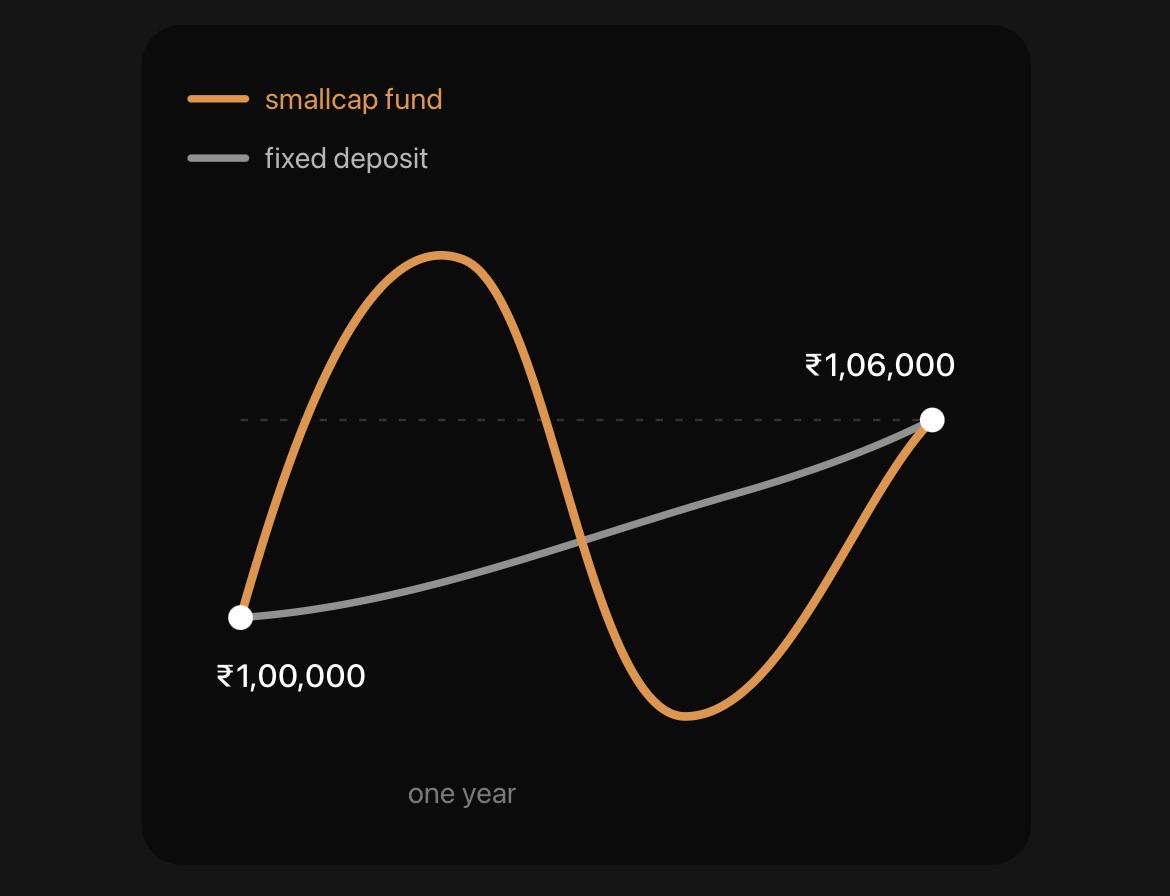
🧠 Money Basics Volatility

Post image
6 Upvotes

Volatility = how wildly the price swings on the way to where it's going.

₹1,00,000 in an FD → ₹1,06,000 in a year. It never moved. You never checked.

₹1,00,000 in a smallcap fund → ₹1,06,000 in a year too. But it touched ₹1,42,000 in March and ₹68,000 in August.

Same destination. Completely different ride.


r/StartInvestIN • • Sep 07 '26

💬 Discussion What’s Actually Behind FII Selling of Indian Equities?

13 Upvotes

FIIs are selling.

The rupee is under pressure.

Indian equity valuations still look expensive compared with many global markets.

And yet domestic investors continue pouring money into equities.

Why? This is not random situation but there are structural reasons behind it.

Let's deep dive into it in this post.

Caution: This is going to be long yet intrestring read!

Start with The Boring Part - FDs & Debt

Imagine you're a high-income Indian investor. A FD gives you around ~6%.

Sounds decent.

But if your marginal tax rate is ~30%, your 6% becomes roughly: 6% × (1 − 30%) = 4.2% after tax

Now add inflation.

Your "safe" investment may barely generate a positive real return.

And this isn't just about FDs. India has also made long-term debt funds less attractive from a tax perspective post April,2023.

So, Where does the Money Go?

Money doesn't disappear. If debt gives you poor post-tax returns, you look elsewhere.

  • Gold.
  • Real estate.
  • Overseas assets.
  • And, mostly, equities.

India has had an extraordinary surge in domestic equity demand.

In FY25 alone:

  • ~₹6.1 lakh crore of equity demand came from mutual funds.
  • Add individuals, insurance companies, pension funds and others: Another ~₹2.7 lakh crore.
  • Total domestic equity demand: ₹8.8 lakh crore.

Against this, total fresh equity supply through IPOs, FPOs, QIPs, rights issues, OFS and other primary-market activity was around: ~₹4.6 lakh crore.

So where does the additional supply come from?

  • Promoters.
  • Strategic investors.
  • Private equity investors.
  • And, FIIs

Remember LG, Hyundai IPO. Foreign Promoters. Yes - Same Thing

When domestic savings are disproportionately pushed toward equities, high valuations create a very attractive exit window for existing owners.

Now, Let's See The Situation from FII POV

Suppose you're a global investor looking at India.

  • You like India's growth story.
  • You like Indian companies.

But you see some companies trading at P/E multiples of 40x, 50x, 60x 70x or even 80x.

  • At some point, the question changes from: *"*Do I like India?"
  • To: "Do I want to buy India at THIS price?"

Meanwhile, an existing foreign investor who entered years ago may be thinking:

"These valuations look fantastic. Maybe this is a good time to exit."

So you can have a strange situation:

India remains attractive as an economy, but Indian assets become less attractive at their current prices.

That's how you can have strong domestic buying and persistent foreign selling at the same time.

Then The Rupee Enters The Story

When a foreign investor sells crores of Indian equities and takes the money home, they eventually need to convert rupees into foreign currency.

  • More demand for dollars.
  • More pressure on the rupee.

And the same falling rupee itself can make overseas investments look increasingly attractive to an Indian investor.

  • Imagine the US market returns 10%.
  • But the rupee depreciates another 5%.
  • Your return in rupee terms is roughly: 10% + 5% = ~15%

So now you're comparing:

  • Indian equity in rupees vs US equity + a potentially weakening rupee.
  • Gold gets a similar tailwind because gold is priced globally in dollars.

So a weaker rupee can make foreign assets and gold look even more attractive to domestic savers.

Which can create another feedback loop:

Rupee falls → foreign assets look more attractive → more Indian money wants to move abroad → more dollar demand.

And This is Where RBI Gets Pulled in

The RBI can't simply watch the rupee fall indefinitely.

So it intervenes in the FX market.

RBI intervention in the spot and forward FX markets across FY25 and FY26 was estimated at around ~$192 billion.

The point is that intervening in one market can create consequences in another.

They're connected.

And Then Comes The RBI Part II

In June 2026, the RBI introduced a special FCNR Deposits (B) with dollar-rupee swap facility.

The objective was to encourage banks to bring in foreign currency deposits from NRIs and other eligible sources.

That effectively allows NRIs and foreign savers to earn whopping ~12-15% return in this scheme.

And the response was enormous. By August 31: ~$127 billion

Now Think about the contrast.

  • A domestic saver puts ₹100 into a FD.
  • They earn interest.
  • Then a large portion can disappear in tax.
  • Meanwhile, to attract foreign currency into India, the RBI is effectively willing to subsidise the cost of foreign-currency funding through its swap facility.

Who pays for that extra return? RBI but effectively through Indian Tax Payers' Money

That's the policy question I think deserves much more attention.

This is The Bigger Problem

India wants:

  • Low interest rates → to support borrowers and growth.
  • Strong equity markets → to support capital formation.
  • Foreign capital inflows → to finance the external deficit.
  • A stable rupee → to control imported inflation and external vulnerability.

But these objectives don't operate independently.

Push down domestic rates too aggressively:

(1) Debt becomes less attractive → savings move elsewhere.

Savings move into equities:

(2) Equity demand rises → valuations can become stretched.

Valuations become stretched:

(3) Foreign investors become more reluctant to buy and existing investors get better exit opportunities.

Foreign investors sell:

(4) Rupee comes under pressure.

Rupee weakens:

(5) US assets and gold become more attractive to Indian investors.

More demand for dollars:

(6) More pressure on the rupee.

And then the RBI has to intervene again.

That's the loop.

So What Should India Actually Do?

If the government wants domestic savings to fund Indian businesses, infrastructure and capital formation, then domestic savers need attractive post-tax alternatives.

Some obvious possibilities:

1. Stop taxing different asset classes so unevenly

Tax should not become the primary reason someone chooses equity over debt.

2. Reconsider the taxation of long-term debt investments

If inflation is reducing the real value of money, taxing nominal gains without accounting for inflation can penalise long-term savers.

3. Give Indians more freedom to diversify overseas

Indian mutual funds still face a $7 billion industry-wide limit for overseas securities, with a separate $1 billion limit for overseas ETFs.

The result?

Even when Indian investors want global diversification, the doors are increasingly closed. Several international mutual funds have had to restrict fresh investments after hitting these limits.

4. Think beyond individual policies

Don't look at:

  • Bond-market intervention
  • Equity flows
  • FII selling
  • Rupee depreciation
  • Overseas investment restrictions
  • NRI deposit schemes

as separate problems.

They are connected.

The Bigger Takeaway

Maybe the question isn't:

"Why are FIIs selling India?"

Maybe the better question is:

"Why are we making it so difficult for India's own savings to find a sensible home?"

When debt becomes unattractive after tax, money doesn't disappear.

It moves.

And if enough money moves into equities, gold and overseas assets, the consequences eventually show up in valuations, capital flows and the rupee.

India doesn't have a shortage of savings.

It may have a capital-allocation problem created partly by the incentives we give those savings.

And that is a much bigger problem than FII selling alone.

Disclaimer: This is an economic/market discussion, not investment advice. The relationships described above are not the only reasons for equity valuations, FII flows or rupee movements.


r/StartInvestIN • • Sep 05 '26

📊 Tax Planning You Lost ₹25k on an Investment. You Could Still Turn That Loss Into a Tax Saving. That's TAX HARVESTING!

13 Upvotes

You probably think of a losing investment in only one way: “I’ll hold it until it recovers.”

But if you already have taxable capital gains elsewhere in your portfolio, there’s another option.

You can sell the losing investment, realize the loss, and use that loss to reduce your taxable gains.

This is called tax-loss harvesting.

And it can potentially save you thousands in tax.

How does it work?

Let's say you have:

  • Investment A: ₹1,50,000 gain
  • Investment B: ₹25,000 loss
  • Investment C: ₹50,000 gain

Instead of looking at Investment B and thinking “I lost ₹25,000”, you can ask:

“Can I use this ₹25,000 loss to offset some of my gains?”

If the answer is yes, your taxable capital gains can come down.

The basic idea:

  • Capital Gains − Eligible Capital Losses = Net Capital Gains
  • Lower net gains → lower tax.

But there are two important rules.

First, what are STCL and LTCL?

These simply mean:

  • STCL = Short-Term Capital Loss - loss from an investment held for the short-term
  • LTCL = Long-Term Capital Loss - loss from an investment held for the long-term

For listed equity and equity-oriented mutual funds, the usual dividing line is 12 months.

So, for example:

  • Sell an equity mutual fund after 8 months at a loss → STCL
  • Sell it after 13 months at a loss → LTCL

Rule #1: What can you offset?

This is where it gets interesting.

Short-Term Capital Loss (STCL):

  • Can be set off against Short-Term Capital Gains (STCG)
  • Can also be set off against Long-Term Capital Gains (LTCG)

Long-Term Capital Loss (LTCL):

  • Can be set off against Long-Term Capital Gains (LTCG)
  • Cannot be set off against STCG

So STCL gives you more flexibility.

Rule #2: Your unused loss doesn't simply disappear

Suppose you realize a ₹25,000 loss but don't have enough eligible gains to use it this year.

You can generally carry forward the unused capital loss for up to 8 assessment years.

That means a loss realized today can potentially become useful against eligible gains in future years too.

Important: To carry forward the loss, you generally need to file your income-tax return within the prescribed due date.

Let's Understand with an Example

Meet Jay.

He's 25 and has:

  • Nifty Index Fund: ₹1,50,000 LTCG
  • Small Cap Fund: ₹25,000 STCL
  • Stock XYZ: ₹50,000 LTCG

Jay's total LTCG is ₹2,00,000.

Assume these gains are taxable at 12.5%.

Without harvesting the loss:

₹2,00,000 LTCG × 12.5% = ₹25,000 tax

With tax-loss harvesting:

₹2,00,000 gains − ₹25,000 loss = ₹1,75,000 net LTCG

Tax: ₹1,75,000 × 12.5% = ₹21,875

Potential tax saving: ₹3,125

The ₹25,000 loss didn't magically disappear.

Jay used it to reduce the amount of gain on which he pays tax.

When can tax-loss harvesting make sense?

There are a few situations where it can be particularly useful:

  • Portfolio rebalancing: You're already planning to sell an investment, so you can look for losses that can offset gains.
  • Year-end tax planning: Review your gains and losses before March 31 instead of discovering them while filing your ITR months later.
  • Goal-based withdrawals: If you're redeeming investments for a large expense, look at your entire portfolio rather than each investment separately.
  • Market corrections: A temporary fall can create opportunities to realize losses, provided you still make sense of the underlying investment decision.

But don't make this mistake

Don't sell a good investment just to save tax.

Tax-loss harvesting only makes sense when the overall benefit outweighs the costs and investment risks.

Before doing it, consider:

  • Brokerage and other transaction costs
  • STT and applicable charges
  • Whether you actually want to exit the investment
  • Whether you plan to buy it back
  • The risk that the investment rises before you re-enter
  • Whether the tax saving is large enough to justify the transaction

The goal isn't to create losses for a tax deduction.

The goal is to make an existing investment loss more useful.

A simple checklist

Before the financial year ends:

1. Look at your portfolio.
Identify your realized and unrealized gains and losses.

2. Classify them.
Check whether each gain/loss is short-term or long-term.

3. Match the losses with eligible gains.
STCL and LTCL don't have the same set-off rules.

4. Calculate the actual benefit.
Compare the potential tax saving with transaction costs and the investment implications.

5. Don't rush.
Tax planning works better when you start reviewing your portfolio well before March 31.

The Key Summary

A losing investment isn't necessarily only a loss.

If you were already considering selling it, the tax loss you realize could help reduce the tax on gains elsewhere in your portfolio.

That's tax-loss harvesting.

And it's one of those small tax-planning techniques that can quietly add up over the years.

📌 Want to explore more tax-related investing topics?

Check out the "📊 Tax Planning" post flair on r/StartInvestIN - we've covered several other investment-tax rules and misconceptions there.


r/StartInvestIN • • Sep 04 '26

📈 Equity & Growth Funds Portfolio Review Please — ₹57K across 4 MFs + 6 Stocks (India, Beginner)

3 Upvotes

Hi everyone, I'm a beginner investor from India. Started recently with a total portfolio of ~₹57K split between mutual funds and direct stocks. Would really appreciate your feedback and suggestions.

Mutual Funds (₹45K invested → ₹47.6K current, +5.46%)

  • Parag Parikh Flexi Cap Fund
  • UTI Nifty Next 50 Index Fund
  • Axis Small Cap Fund
  • Invesco India Mid Cap Fund

Direct Stocks (₹11.9K invested → ₹11.5K current, -2.95%)

  • TATAGOLD, Wipro, IOCL, ITC, Tata Steel, Motilal NASDAQ 100

Questions:

  1. Is my mutual fund mix good for long-term (5-7+ years)?
  2. Am I over-diversified or under-diversified?
  3. Any suggestions on what to add/reduce?

Thanks in advance! ✌️