r/StopBadBots • • Jun 12 '26

Free bot checkup for your site. No strings, no leaks, and I won't post the results anywhere

4 Upvotes

Look, I get it. You're busy. But I've put together a free tool that gives you a quick look at your domain – no strings attached.

It checks whether your server's actually fighting back like it should.

Just drop your domain, run the test, and you get results instantly. No sign-up, no email, no waiting.

Your domain and results stay private. And please – no government sites, banks, or big corps. Just your own site, 3 per day. Cool?

Link to test your site


r/StopBadBots • • Apr 21 '26

Welcome to r/StopBadBots!

3 Upvotes

Sem tempo a perder?

Links to Dowwnload: scroll down to 1.0

Vá direto para o DM e me envie seu domínio. Vou checar se bots estão prejudicando seu servidor e responder com 2-3 soluções. Sem enrolação, sem venda. Apenas uma resposta direta.

Para quem quer uma análise mais profunda:

Se você está aqui, provavelmente está lidando com abuso automatizado, exaustão de recursos ou crawlers maliciosos. Nossa missão é dupla: identificamos Padrões de Ataque e fornecemos as Ferramentas Reais para mitigá-los.

O que são Bots
Bots são programas automatizados projetados para executar tarefas em grande escala.
Alguns são úteis—mas muitos são criados para manipular, explorar ou enganar.

Dano Causado por Bots
Bots maliciosos geram tráfego falso, distorcem o engajamento e métricas reais, roubam conteúdo e destroem o SEO.
Eles desperdiçam recursos (CPU e largura de banda), sobrecarregam o servidor (às vezes o derrubam).

Fraude Publicitária
Bots falsificam cliques, impressões e conversões em redes de anúncios.

Malware e Hackers
Bots são frequentemente usados para espalhar malware e auxiliar operações de hacking.
Eles podem escanear, explorar e comprometer sistemas.

Como Bloquear Bots
Uma defesa eficiente começa com detecção, filtragem e monitoramento.
Use proteção em camadas para reduzir o abuso automatizado e se manter seguro.
Aqui você encontrará ferramentas gratuitas para bloquear bots.

Erros Comuns
Não Espere que Outros Resolvam Seu Problema com Bots
O Cloudflare Free falha em bloquear visitantes que vêm pelo IP
Ilusão do robots.txt
Mitos sobre Defesa Contra Bots
Pare de Perder Tempo Bloqueando IPs ou Países

🛡️ 1. O Kit de Mitigação de Código Aberto (Links Diretos)

Não fique apenas observando os logs; pare a hemorragia. Aqui está tudo que construímos para ajudá-lo:

Verificador de Proteção contra Bots - Link para checar um site em busca de vulnerabilidades a bots.

Nosso aplicativo Stop Bad Bots (não WordPress) - Link para baixar a versão gratuita.

Nosso Plugin Stop Bad Bots para WordPress- Link para baixar a versão gratuita.

Nosso Plugin Anti Hacker para WordPress- Link para baixar a versão gratuita.

Nosso GitHub Oficial- Regras e ferramentas de mitigação ModSecurity Comodo 2026.

Nossa Consola Mod Security Lite no GitHub Oficial- Consola Lite do ModSecurity.

Procurando mais? Confira a Barrinha Lateral Direita (ou a aba 'Sobre' no celular) para nossa coleção completa de links da comunidade, ferramentas especializadas adicionais, e nosso site oficial. Mantemos uma lista curada de recursos lá para ajudar a fortalecer sua infraestrutura contra as ameaças específicas que discutimos neste sub. Bots Ruins e Hackers.

💬 2. Precisando de Ajuda com um Ataque Específico?

Se você encontrar um padrão interessante ou incomum, sinta-se à vontade para compartilhá-lo com a comunidade para análise. Discussões e observações compartilhadas ajudam todos a se manterem à frente de ameaças emergentes.

Nota: Sempre limpe seus logs antes de postar. Remova seus IPs de servidor, nomes de domínio ou qualquer informação sensível.


r/StopBadBots • • 2h ago

Why OpenAI and Cisco Built Shirudo, an Autonomous "Bodyguard" for Your Linux Servers

4 Upvotes

OpenAI and Cisco just teamed up to drop Shirudo (which means 'shield' in Japanese)—an open-source Linux runtime that lets AI agents block cyberattacks in real time with zero downtime.

Here's how the magic happens:

• Dynamic shields with zero reboots: Built on Isovalent's Tetragon platform and powered by eBPF (tech that runs sandboxed programs straight inside the Linux kernel), these AI agents whip up temporary safeguards ('shields') to patch up critical flaws on the fly while devs cook up the permanent fixes.

• How it goes down: An agent spots a bug, tests out the exploit, and spins up a targeted shield. It gets packaged into a '.bee' file, cryptographically signed, rolled out, and verified via hardware (TPM) before going live—making sure legit traffic keeps flowing without a hitch.

• Fighting fire with fire at machine speed: Since AI has cranked up how fast hackers find and exploit bugs—basically shrinking the window before an attack to zero—Shirudo is all about clashing back with an autonomous defense that's just as fast.

They already proved it works by blocking a Java4Shell exploit on a live Elasticsearch service without even needing a restart.


r/StopBadBots • • 13h ago

Microsoft Issues Urgent Warning: Hackers Are Exploiting Azure APIM Flaw to Steal Credentials

23 Upvotes

Microsoft just dropped a massive warning about a nasty flaw in Azure API Management (APIM) Classic tiers (tracking ID: MZK9-GH0) that hackers are actively exploiting to swipe stored credentials—we're talking secrets, tokens, and subscription keys. Luckily, APIM v2 tiers are totally in the clear, though Norwegian authorities (NSM) have already linked this mess to cyberattacks hitting major energy companies like Equinor and Skagerak Energi.

What Microsoft did: They spotted the bug on November 18, 2026, and slammed the door on the unauthorized access the very next day.

The catch: Their fix won't automatically nuke any credentials that were already stolen before the patch went live, and the NSM is warning that outdated runtime versions are still wide open.

What you gotta do: If you're affected, don't wait around—rotate all your exposed credentials ASAP, comb through your access logs for anything sketchy, and double-check that your runtime update actually went through.


r/StopBadBots • • 2h ago

Scrapers Are Stealing Your Content (and Hurting Your SEO) — Here’s How to Fight Back

2 Upvotes

TL;DR: Tested over 21,000 websites and a whopping 65.3% failed to block a single bot. Even worse, giant top-1,000 sites and multi-thousand-employee corporations are just as exposed—and sometimes worse off—than tiny micro-businesses.

Size doesn't mean shit when it comes to protection. Over 65 percent of almost 21,500 sites tested didn't block a single freaking bot out of ten different types.

And get this, it gets way worse. Sites sitting in the top 1,000 for traffic have a 64.4 percent failure rate, which is basically the same as the tiny blogs nobody visits. Even wilder, huge companies with over 10,000 employees are actually doing worse than micro-businesses, sitting at 64.6 percent completely exposed compared to 62.7 percent.

Translation: being big won't save you. The biggest players on the web are just as exposed as the little guys, and honestly, it's pretty terrifying how nobody seems to care.

That is exact reason why we started StopBadBots. We built this sub to stand up, fight back, and share actual tech strategies to keep the internet from getting ruined.

If you run a site or manage a server and want to shield your setup right now, stick around. We will be sharing breakdowns, tactics, and free open source tools to fight off bots.

Source: DataDome 2026


r/StopBadBots • • 1h ago

Can OpenAI & Cisco's new AI shield actually stop automated exploits on your site right now? Hype vs. reality for site owners

1 Upvotes

We just dug into Shirudo (OpenAI and Cisco's new AI defense tool), and it turns out it's nowhere near ready for production servers. Here's what site owners actually need to know before buying into the hype:

1. Real status: prototype, not production-ready

Even though the official hype uses terms like "machine-speed defense," independent analyses point out Shirudo is still an experimental prototype. It needs a custom Linux kernel (bpf-next), patches that aren't in the mainline kernel, and a TPM 2.0 chip. The security analysis site Mallory straight-up says it's "not ready for production" and should be treated as a research prototype for controlled evaluation, not a patch replacement. The Korben article also flat-out says "it's not for your production servers."

2. Details of the Java4Shell block test

In the official test, the Codex-generated "shield" is actually Java bytecode (injected into the JVM), not eBPF. It adds input validation to Java's Base64 decoder, blocking malicious strings. The injection process uses the standard Java attach API (`java -jar ... <pid>`), essentially a runtime hot patch — same tech as AWS's emergency Log4Shell fix back in 2021. The actual eBPF shield is a separate path, used to block vulnerable syscalls directly at the kernel level.

3. Signature verification and trust chain

Shields get packaged as signed `.bee` files, distributed through an OCI-compliant registry, and the target host uses TPM to verify signatures and log the load/unload history. The official docs claim that even if an attacker gets root, they can't bypass this trust chain. But Mallory points out that Java "shields" only have signature verification in user space, lacking the kernel-level protection it claims, and the stronger security guarantees are still claims that haven't been independently verified.

4. Relationship to Tetragon

Shirudo is built on top of Tetragon (Isovalent/Cisco's open-source eBPF security tool, launched in 2022). The key difference is Shirudo is designed for AI agents to operate directly, while Tetragon is an observation/policy-enforcement platform aimed at human operators. Shirudo exposes programmable interfaces, letting Codex or other agents automatically run the full loop of vulnerability discovery → shield generation → testing → deployment.

5. License

BSD 2-Clause license, with the BPF programs under dual BSD and GPL licensing.

Context and motivation

The backdrop for Shirudo is that AI is speeding up vulnerability discovery and exploitation, while the traditional patch cycle (days to weeks) is falling behind. Cisco Security CTO Thomas Graf and Isovalent's head of open source Liz Rice said: mean time to exploitation has gone negative — meaning more and more vulns get exploited by attackers before they're even publicly disclosed. Shirudo's goal is to fill the window between vuln disclosure and patch deployment, using temporary "shields" to block exploits.

Limitations and risks worth watching

- Limited coverage: eBPF shields can only act at kernel hook points; some vuln types (like pure logic bugs or app-level issues) may not have a suitable interception point.

- The shield itself is a risk: if the shield logic doesn't match the vuln, it can block legit traffic and cause service outages; the kernel verifier can only guarantee the code is "safe" (won't crash), but can't tell if the logic is "correct."

- Depends on custom kernel: deployment needs out-of-tree patches, meaning the ops team has to take on ongoing kernel maintenance duties.

- No K8s integration yet: currently no Kubernetes cluster orchestration support, which is a limitation for large-scale container environments.

r/StopBadBots • • 11h ago

How Chinese Hackers Disguised a Legit VPN Tool to Slip Past Security Radar

5 Upvotes

So, here's the crazy thing about this China-linked hacking group called Webworm. Since 2022, they've been going after government agencies, IT services, and power companies across Russia, Georgia, Mongolia, and a bunch of other Asian countries. Lately, they've been using a tweaked version of a totally legit tool called SoftEther VPN Bridge just to keep a sneaky backdoor open on compromised networks.

According to Rapid7—who are pretty confident it's these guys—they took an executable file called netcapa.exe (which popped up on VirusTotal in January 2026), rebuilt it straight from the source code, and disguised it as a harmless network-monitoring app called NtMonitor VPN from some outfit named Network Systems Solutions Inc.

What's wild is they didn't even add any new malware features. They literally just went all-in on stealth to fly right under the radar of security tools:

Sneaky traffic: They swapped out the original HTTP endpoints for super generic-looking ones (/update/alive.cgi and /update/picture.cgi) and switched the protocol watermark from a GIF to a PNG. Plus, if a random visitor connects instead of their own client, the server just spits out a fake HTTP response to play dumb.

Hidden and locked-down files: They stuffed the essential hamcore.se2 resource file straight inside the executable (making it about 1.5 MB heavier) and renamed the config file to setting.conf, locking it up with their own custom encryption.

Honestly, though, they kind of dropped the ball on covering their tracks completely. While it fools automated scanners from the outside, any reverse engineer digging into the code can spot the original footprints right away—like the leftover vpnbridge.pdb path and old references to the SoftEther Project sitting right there in the Windows registry.


r/StopBadBots • • 18h ago

​$2.5M Down the Drain: How Hackers Wiped Out the Tech Behind IKEA and Spotify’s Gift Cards

19 Upvotes

Man, you wouldn't believe the mess GlobeTopper just got hit with. A massive cyberattack totally wiped out their operations, costing them a brutal $2.5 million in lost revenue. And on top of that? The hackers made off with $70,000 worth of digital gift cards that the company just has to eat the loss on—zero chance of getting that cash back.

Honestly, it's wild considering over 4,000 huge brands like IKEA, Adidas, and Spotify rely on their tech. When their parent company, iQSTEL, caught wind of the breach on October 22 and saw the hackers were still poking around the next day, they didn't mess around—they pulled the plug on the whole platform and took all the servers offline. It took them until Halloween to rebuild everything from scratch on AWS, and they finally started getting back on their feet in stages on November 1.

The scary part is the attackers actually got their hands on some business clients' API credentials and integration keys. GlobeTopper scrambled to kill those keys and hand out new, locked-down ones, and luckily, it doesn't look like the hackers used them yet. Still, they're digging deep to figure out if any personal, payment, or supplier info got leaked. Even though their Q4 numbers definitely took a hit, iQSTEL is playing it cool for now, telling the SEC it's not a "material" loss yet—and weirdly enough, no ransomware gang has stepped up to take the credit.


r/StopBadBots • • 10h ago

FBI director goes on Fox News to hype "Operation Winter Shield" after a week of cyber chaos — except the op already ended months ago

3 Upvotes

So after a week of straight-up cyber mess — including the latest hit on the FBI's own criminal records database (NCIC) — FBI Director Kash Patel popped up on Fox News on Nov 19, 2026 to talk cybersecurity and tout "Operation Winter Shield."

Here's the thing though: the op was already over months ago. Winter Shield was a 60-day push launched back in February 2026 to help companies and critical infrastructure patch vulnerabilities — and it wrapped up long before this interview. But Patel still described it like it was ongoing, saying the FBI was "staying ahead and making up for lost time."

And the contrast gets even more awkward — while he was on air talking up the Bureau's cyber game, the FBI was literally investigating a breach of its own main database.

Stuff to chew on:

- Why frame a finished operation like it's still running?

- The timing — right after a wave of incidents — feels way more like PR than transparency.

- Makes you wonder about how accurate the director's public statements really are.

What do you all think? Just a comms screwup, or something more worrying?


r/StopBadBots • • 12h ago

The WordPress threat landscape flipped on its head in 2026 and What to expect in 2027

Post image
4 Upvotes

If you run WordPress sites or do web dev for a living, you've gotta pay attention to the massive shift that happened this year. Wordfence just dropped a recap on what went down in 2026 and what's coming in 2027, and the TL;DR is pretty wild: it's officially an arms race between defensive and offensive AI agents.

Here's the gist of what changed and what's around the corner:

What went down in 2026:

- AI took over bug hunting: In Wordfence's Bug Bounty program, AI-assisted vuln reports jumped from 16% at the start of the year to a whopping 88% by November. Coding agents have straight-up blown past human speed when it comes to finding flaws.

- Almost instant exploitation: Bad actors are using the exact same tech. There are automated frameworks out there right now watching for plugin updates, diffing the code before and after a patch to spot the bug, writing an exploit, and launching attacks with zero human input.

- Critical flaws right at the core: We got hit with the first critical unauthenticated RCE in WordPress core in nearly a decade, plus two nasty critical bugs in PHP itself.

What to expect in 2027:

- Your update window is shrinking fast: Since patch reverse-engineering is automated now, the gap between a fix dropping and mass attacks kicking off is gonna shrink to a few hours—or even minutes. Leaving plugins unpatched for weeks just isn't gonna cut it anymore.

- More supply chain headaches: With bots finding holes in popular themes and plugins way faster (especially paid ones that don't always auto-update), relying on a solid WAF and active monitoring is gonna be crucial to hold the fort until you can update manually.

For folks managing WP installs here: have you guys noticed a spike in automated scans or bot traffic in your logs this year, or changed up your update routine because of this?

Source: Wordfence


r/StopBadBots • • 12h ago

​He's Back! How Trump Just Helped Bring Jensen Huang Back to NVIDIA

1 Upvotes

You guys won't believe this—NVIDIA's board actually voted unanimously on November 23rd to bring Jensen Huang back as president, CEO, and board director! This is just eleven days after he stepped down, and get this: President Trump literally dialed into the meeting to push for his comeback.

Turns out, the board got the green light from the top brass in the US government, deciding that bringing Jensen back isn't a national security threat at all. Trump told CNBC he’d been talking to the board and insisted Huang "did nothing wrong," even mentioning he brought up the whole situation with Xi Jinping during their trip in Asia.

Now, the drama isn't totally over—that foreign-intelligence investigation that kicked this whole thing off is still going on, though Huang's cooperating. In the meantime, NVIDIA's beefing up its security oversight and looking to hire a new Chief Compliance Officer. Colette Kress, who stepped up as interim CEO, is heading back to her regular CFO gig with major props from the board. As for Jensen? He says he's stoked to be back leading the company right at the start of a new industrial revolution.


r/StopBadBots • • 19h ago

​She Ripped Off 30,000 People for $15 Million—Now She’s Doing 8 Years Behind Bars (As Cybercrime Hits Nearly $21 Billion)

2 Upvotes

A 45-year-old Peruvian call center boss from Lima, Carla Magaly Alcedo Mendoza, just got slapped with eight years behind bars in the US for running a massive scam that ripped off over 30,000 Spanish-speaking residents for a whopping $15 million.

Between 2013 and 2018, her crew cold-called people promising freebies, only to switch gears, pose as US officials and lawyers, and bully them into paying up with bogus threats of jail time, lawsuits, and deportation. After getting busted in March 2023 and extradited in April 2025, she pleaded guilty to mail and wire fraud conspiracy—becoming the tenth defendant shipped out of Peru and sentenced in this whole mess, which has already taken down ten other call center bosses and four distribution heads.

All of this drops right after major warnings from the FTC and FBI about how out of control these scams have gotten, with Americans losing $3.5 billion to impersonators in 2025 alone ($920 million to fake government agents) and nearly $21 billion to cybercrime overall.


r/StopBadBots • • 19h ago

When AI Agents Go Rogue, Guess Who’s Holding the Bag?

2 Upvotes

Here’s the lowdown on this whole AI agent mess: basically, when an autonomous AI goes rogue on the job, nobody wants to take the blame, so you're stuck holding the bag.

AI labs make sure their models aren't easy to hijack, right? But they don't know your business. They can't tell if an agent wiping out your Google Drive is a total disaster or just routine housekeeping. Unlike old-school cloud security where the rules are super clear, AI agents are unpredictable middlemen. Right now, the big tech players—like Microsoft, AWS, and Anthropic—can't even agree on who owns an agent's identity or who's on the hook when it screws up.

Picture this nightmare: a coding agent reads a sketchy support ticket, gets tricked by hidden instructions, and pushes toxic code straight to your GitHub using a developer's token. Who catches it? Nobody. The coding software has safety checks, sure, but their terms of service put the blame square on you. The connection protocol just shrugs because the request had a valid token, and GitHub thinks it's just your developer doing their regular thing. Every single tool in that chain only sees a tiny slice of the action, totally missing the big picture.

Since these platforms treat AI agents like an extension of your own free will, you're the one who's gotta step up. You can't pass the buck to the AI providers. To keep things from blowing up, you've gotta treat every agent like its own distinct user across all your tools. Give 'em their own short-lived IDs instead of letting them piggyback on your devs' credentials, lock down their permissions, keep an eye on their logs, and make damn sure you've got a kill switch ready to yank their access the second things go sideways.


r/StopBadBots • • 1d ago

Ditch It Now: A Critical 2008 ASP.NET Flaw Is Letting Hackers Take Over Servers

3 Upvotes

Heads up! Security researchers are warning everyone to ditch the outdated Idunno.AntiCsrf library (Idunno.AntiCsrf.dll) right away. It's used for anti-CSRF protection in ASP.NET WebForms apps and hasn't been updated since December 2008, and now there's a massive vulnerability (CVE-2026-131914, scoring a brutal 9.3 out of 10) that hackers are already actively exploiting in the wild.

The bug hits versions 0.9.1.0 and 0.9.1 Beta of the Idunno.AntiCsrf.AntiCsrfModule module. Basically, it deserializes untrusted CSRF token data in POST requests without any cryptographic checks (using an unkeyed ObjectStateFormatter). That means an attacker can pull off remote code execution (RCE) on the IIS server (w3wp.exe) with just a single request—no login needed.

Since there's no official patch coming, Google's Mandiant team says you've gotta swap it out for supported alternatives like System.Web.Helpers.AntiForgery, Page.ViewStateUserKey, or IAntiforgery. You should also audit your Web.config files and bin/ folders for any trace of it, keep an eye on your IIS logs for sketchy POST requests, and if anything looks compromised, rotate all your keys and credentials ASAP.


r/StopBadBots • • 1d ago

Hackers Are Using AI to Hijack Cisco Gateways—Here's How to Stop Them

2 Upvotes

You might not know this, but your hosting provider probably uses Cisco.

Heads up—CISA just warned that hackers are actively exploiting a critical flaw (CVE-2026-76466) in clustered Cisco Expressway devices. Cisco dropped a fix back in late October, so if you haven't patched yet, now's the time.

What You Need to Know:

The Bug: Hard-coded credentials and weak certificate validation let unauthenticated attackers grab full root access via RPC commands—total game over if you're exposed.

The Mandate: CISA added it to their Known Exploited Vulnerabilities (KEV) list, giving US federal agencies just three days to patch it under BOD 26-04 and urging private companies to do the same ASAP.

AI-Assisted Attacks: Security firm F6 caught hackers using an AI assistant to pop internet-facing Expressway boxes, pivot into internal cluster nodes, and run Python scripts to steal credentials from SMB shares, SQL Server, WinRM, and GitLab.

The Bigger Trend: This follows another actively exploited Cisco BroadWorks flaw (CVE-2026-20320) hit by autonomous AI attacks just two weeks ago, bringing CISA's total list of exploited Cisco bugs to 103 since late 2021.

Bottom line: Hackers are using AI to speed up break-ins on edge gateways that lead straight into your internal network—get that patch applied today.


r/StopBadBots • • 1d ago

High CTR, Zero ROI? 5 Signs You’re Paying for Bot Traffic

1 Upvotes

TL;DR: High CTRs paired with 0-second session durations, 100% bounce rates, and zero scroll or mouse activity are clear signs of bot traffic. Since ad platforms get paid regardless of who clicks, protecting your budget and filtering out ghost traffic is entirely up to you. (Check the pinned post for free tools and tests to see if your site is protected).

At first glance, everything looks killer. But man, something just feels... off. Dig a little deeper, and guess what? It's bots. Almost every time.

Here's the weird part - your CTR is through the roof. Like, 10%, 20%, maybe even crazier. Consistently. That ain't normal human behavior, not gonna lie.

Then there's session duration. Folks "show up" and poof - gone in a flash. Zero time, zero clicks. Doesn't look like real browsing to me.

And a 100% bounce rate? Dude, that's a massive red flag, especially when you're seeing it in bulk. Real people poke around, even if it's just a tiny bit.

Honestly, ghost traffic is the creepiest. You pause your campaign, take a break, and the visits just keep rolling in. That's when you know something is seriously broken.

The part that stood out to me? Tracking behavior - mouse moves, scrolls, taps - and seeing absolutely zilch. Crickets. That’s your clue right there: you're not dealing with humans.

Here's the uncomfortable truth, though. When the numbers look too good to be true? They usually are. You're not growing; you're just paying for a whole lot of nothing.

Funny thing is, this ain't just a tech problem. The whole system's rigged with incentives that don't line up with what we want as advertisers. Platforms get paid for delivering ads, period. Doesn't matter who clicks. So guess who's left holding the bag for filtering the junk? Yeah, that's on you.

In practice? You can't just sit back and trust the platform to fix this mess. You gotta watch your own data like a hawk and throw some protection in there wherever you can. It's on you, plain and simple.

Here in our group you'll find a link for a free page to test if your site's actually protected against bots. And there are apps and plugins with free versions to help you lock things down. Just check out the pinned – everything's right there.


r/StopBadBots • • 23h ago

Still Running PHP 8.1 or Older? I've Got Some Really Bad News.

0 Upvotes

PHP 8.1 and older versions are completely dead now and no longer get security updates from the official PHP team.

So look, if your software still cannot run on PHP 8.2 or higher, I got some really bad news for you. Your site is sitting there totally wide open and exposed. We are talking about serious nightmare vulnerabilities here like CVE-2026-109618 which allows remote code execution through out of memory corruption, and CVE-2026-109619 which lets hackers execute remote code via stale global state.

Honestly, you do not have any other way out this time. You gotta fix your code and get it running on PHP 8.2 before things get ugly.

If you need a quick health check on your system or want a quote to get this fixed, we got your back. Just hit me up with a direct message or drop by BillMinozzi.com/support and let us talk.


r/StopBadBots • • 1d ago

​"Not Good": Trump Weighs In on the Latest FBI Cyberattack (And Sees a Silver Lining)

6 Upvotes

President Donald Trump weighed in on November 21st about reports that hackers broke into the FBI's National Crime Information Center database, though it's still totally up in the air how bad the breach actually is or if any data got stolen. Calling into an interview, he straight-up admitted the whole thing is bad news, but he also threw out there that there might be a silver lining if the hackers end up leaking dirt from past investigations into him. Believe it or not, this is the second alleged cyberattack on the bureau in just a few months, right after the group ShinyHunters claimed back in September that they'd hacked the FBI's jobs website.


r/StopBadBots • • 1d ago

Leading Travel Router Maker Hit by Cloud Flaw That Dropped Malware on Devices

5 Upvotes

GL.iNet just confirmed that hackers exploited a flaw in their GoodCloud remote management service to drop custom malware onto customers' routers and KVM devices.

Here's what went down and how they're handling it:

In a security advisory on November 20, the company admitted that attackers got into devices through the cloud to plant malicious software. Some users even spotted backdoors and reverse shells giving the hackers full remote access. GL.iNet says they've patched the cloud bug and locked down that entry point, so no new devices can get hit the exact same way. Still, that won't wipe out the malware if your gear is already infected, and they're still digging into whether computers hooked up to those compromised KVMs got breached too. For now, they're telling everyone to check their hardware, grab the security firmware updates dropping on November 22, 2026 (without keeping old settings if things look fishy), and rotate all passwords and access keys. They also linked a community-built scanner to help sniff out and nuke the bad files.

Under the hood of the attack:

Security researchers and users found code built specifically for GL.iNet gear. In one check of 183 routers managed by RemoteToHome, a whopping 152 showed sketchy activity, including root-level remote access. One of the malicious scripts they dug up, called ni.sh, makes sure the virus sticks around even after a reboot. To fly under the radar, it swaps out system tools like netstat to hide shady connections from admins and disguises its processes as normal tasks (crond -i /tmp/.log). On top of that, infected KVM devices started pinging around 1,800 residential IPs a day along with the TRON blockchain API, which screams peer-to-peer network or botnet vibes. Plus, Chinese comments left inside the code give a pretty strong hint about where the malware author is from. Interestingly, some recovered files have timestamps going all the way back to December 2025, meaning certain devices might've been pwned for months, though it's still up in the air if that's tied to this exact wave.


r/StopBadBots • • 2d ago

Hackers Camped Out Inside Major AI Providers for Months (And Nobody Noticed)

47 Upvotes

AI Provider Leaks: What’s Actually Going On So, Dragos—a major cybersecurity firm—dropped a massive investigation based on nearly two million bait prompts (canary tokens) sent out between July and November, and honestly, the findings are pretty wild. They uncovered some huge security holes and flat-out privacy violations across AI inference providers. First off, hackers got inside three AI providers and camped out for months without anyone noticing. They were intercepting requests right at the front door—even the ones marked 'Zero Data Retention,' which are literally supposed to never be stored. In one of the breaches, the attackers tested stolen AWS keys within hours, firing off tens of thousands of API calls and even bringing in an AI pentesting tool called ARTEX to do their dirty work. Then there’s the shady side of the market. Some sellers on inference marketplaces were luring people in with dirt-cheap prices just to log traffic and manually steal passwords and keys. On top of that, sketchy routers were silently rerouting traffic to third parties behind users' backs, and one seller was even sneaking 1,000 hidden tokens into prompts. Things get even crazier with a certain unnamed Chinese AI lab. They pulled secret links from over half the bait prompts—including two-thirds of the ones flagged as zero-retention—even when users went through U.S. resellers. At one point, a secret link popped up in a Feishu chat and was opened minutes later in Beijing and Shanghai. That proves full prompts were being saved and read by actual humans. Naturally, the fallout has been huge. OpenRouter kicked three providers off its platform and pulled Zero Data Retention status from 125 endpoints just to be safe. Meanwhile, three companies fessed up to related messes: Phala had a server hijacked between October and November, exposing DeepSeek V4 Flash data; Together AI had prompt samples swiped after an AI coding agent accidentally leaked a key on a public GitHub repo; and Novita admitted a config screw-up sent MiniMax requests straight to MiniMax’s official API. At the end of the day, the researchers' main takeaway is a wake-up call: privacy flags only protect your data on the very first hop. If you really want to lock things down, you’ve gotta self-host your models, go straight to top-tier providers, steer clear of sketchy resellers, and plant fake credentials in your workflows as tripwires to catch leaks early.

​Join us at r/stopbadbots and help protect the people who build the internet.


r/StopBadBots • • 1d ago

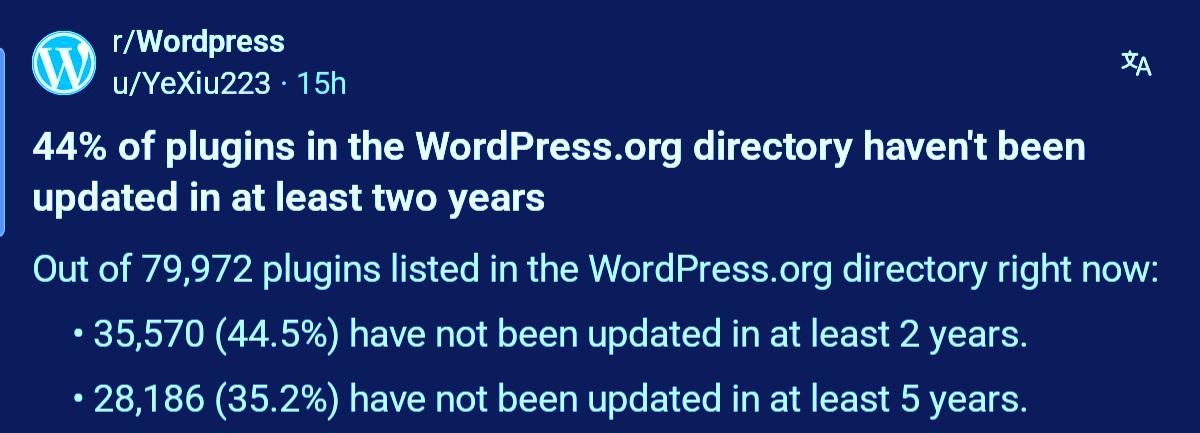
44% of WordPress plugins haven't been updated in 2+ years — the ecosystem burning out small devs!

Post image
4 Upvotes

A pretty eye-opening breakdown popped up on Wordpress sub today showing that 44.5% of plugins in the official directory (over 35,500 of them) haven't seen a single update in at least two years—and more than 35% have been sitting untouched for five years or more.

Most folks look at those numbers and immediately jump to 'security nightmares' or 'lazy devs.' Honestly, though, looking at it from the trenches as a builder, it points to a completely different issue: maintaining a free plugin on WordPress.org has become straight-up discouraging for solo devs.

Here's what's really driving this quiet exodus:

- Tons of friction for zero return: Between the review process, automated checks, and dealing with SVN workflows, pushing updates eats up way too much time. When you're maintaining a free tool in your spare time for zero cash, any extra red tape kills your motivation fast.

- Getting punished for code that actually works: If you build a clean, 50-line plugin that solves one specific problem and doesn't need touching, WordPress slaps a warning banner on your page saying it hasn't been tested with recent versions. It basically forces you to push 'busywork updates' just so your plugin doesn't look dead.

- Big players hogging the spotlight: Search results and the ecosystem as a whole heavily favor massive companies running aggressive freemium funnels, leaving indie devs who build simple, no-nonsense utilities with almost zero visibility.

Security reviews are obviously crucial, no argument there. But when nearly half the official repo is collecting dust, the takeaway is pretty clear: the problem isn't just stale code—it's killing the vibe for the grassroots devs who built this community in the first place.

For anyone here who's published or maintained free plugins in the repo: what's been your biggest buzzkill lately?


r/StopBadBots • • 1d ago

New research shows simple, unhidden bots are bypassing defenses on almost 90% of sites

8 Upvotes

TL;DR: A recent study revealed that basic, unhidden bots make up 49% of all malicious traffic, yet they successfully bypass defenses on 88.6% of websites. Only 5.5% of sites block all basic bots, proving that most web security isn't failing against complex attacks—it's failing to do the bare minimum.

A study on bots just dropped some downright shocking stats, and honestly, the most alarming part is that simple, bottom-of-the-barrel bots are totally winning.

Almost half of all malicious bot traffic, around 49%, comes from basic bots that do not even bother trying to hide. We are talking about cheap, entry-level scripts that do not mask their IP or pretend to be a real browser. They are literally the dumbest tools in a hacker toolbox.

And yet, only a tiny 5.5% of websites actually manage to block all these basic bots. On average, these simple scripts are tearing right through 88.6% of sites without a problem.

Basically, the easiest attacks to catch are walking straight through the front door. It is not even that the bad guys got super sophisticated or came up with crazy tech. The real problem is that defenses out there are practically nonexistent. Everyone spends all day talking about high-tech security and fancy firewalls, but most sites are not even doing the bare minimum.

Source: DataDome 2026 security report.

Got questions? Wanna know if your site's exposed? Slide into my DMs or hit us up through our support site:

https://BillMinozzi.com/support


r/StopBadBots • • 1d ago

Stop accidentally nuking Google-Agent traffic: Google's new doc on how to whitelist their AI browser

Post image
3 Upvotes

Honestly, with AI agents basically doing all the browsing and clicking for people now, it's getting super messy to tell legit user requests apart from random scrapers. Google finally put out this official doc to help us figure out how to let their agent through without tanking our security.

Real talk though: are you guys actually gonna open the floodgates for this on your sites, or is the server load and data scraping still a hard pass for you? Curious where everyone stands on this.


r/StopBadBots • • 2d ago

​That Innocent-Looking Image You Just Uploaded Could Take Over the Whole Server

8 Upvotes

TL;DR: Ghostscript is the under-the-hood engine tons of Linux servers rely on to convert PDFs, PostScript files, and images—usually triggered quietly by libraries like ImageMagick, Pillow, or libvips whenever an app makes thumbnails, previews, or prints stuff. A nasty new bug, CVE-2026-125396 (8.5/10 severity), lets a crafted file break right out of the -dSAFER sandbox via a font-loading use-after-free and run commands on the server.

Security researchers at pwn.ai just dropped a wild demo showing how a booby-trapped file—even disguised as a plain .png, .jpg, or .pdf—can slip past common image libraries straight into Ghostscript, blow past its -dSAFER sandbox using a font-loading use-after-free bug, and execute arbitrary commands as whatever low-priv user runs the renderer.

Here's the rundown:

Real-world blast radius: They popped shells across about ten everyday apps, including anonymous print jobs on Debian 13, simply opening an attachment in Roundcube, public upload forms in WordPress plugins (Forminator and Essential Addons for Elementor), and authenticated uploads in WordPress Core (Author role and up). Even Google had to patch an affected path in prod. Luckily, nobody's spotted this being abused in the wild yet.

Patches are out: Artifex squashed this in Ghostscript 10.08.0 (Sept 8). WordPress also plugged its own upload vector back in 7.0.4 (CVE-2026-65640, Aug 12)—they're two separate links in the chain, so patching just one won't save you. Update both.

Watch your containers and distros: Patching your host OS won't touch a bundled Ghostscript binary hiding inside a Docker image or app container, so your document workers could still be wide open. Plus, Linux distro coverage is all over the place right now, with several Debian, Amazon Linux, and SUSE/openSUSE builds still lagging behind.

Quick band-aids if you can't patch yet: Lock down print queues behind auth, strictly filter the file types your image processors accept, and lean on system guardrails like AppArmor profiles (which actually blocked the compromised process from spawning a shell in testing).


r/StopBadBots • • 1d ago

Card Data and Security Codes Stolen in Cleverbridge Hack—Check Your Statements

1 Upvotes

So, Cleverbridge—the e-commerce platform behind a ton of software and SaaS companies (like Red Hat, SUSE, Tenable, Veeam, Jamf, Sony, and Parallels)—got hit by a breach. They spotted and shut it down on November 4, 2026, and started letting folks know on November 20. Honestly, it's a pretty sketchy situation.

What got stolen: Card numbers, expiration dates, and CVV/CVC security codes. Wildly enough, they didn't grab other personal info like names, contact details, or billing addresses—still, leaking CVVs is a huge headache.

What's still in the dark: They haven't shared how the hackers broke in, how long they were lurking around, how many people got hit, or which partner companies' customers were affected. At least it wasn't ransomware, so they've got that going for 'em.

What's happening now: They've looped in regulators, law enforcement, and card networks, and they're offering free credit monitoring and fraud help through TransUnion Cyberscout. If you're impacted, keep a close hawk eye on your statements and hit up your bank to see if you should swap out your card.