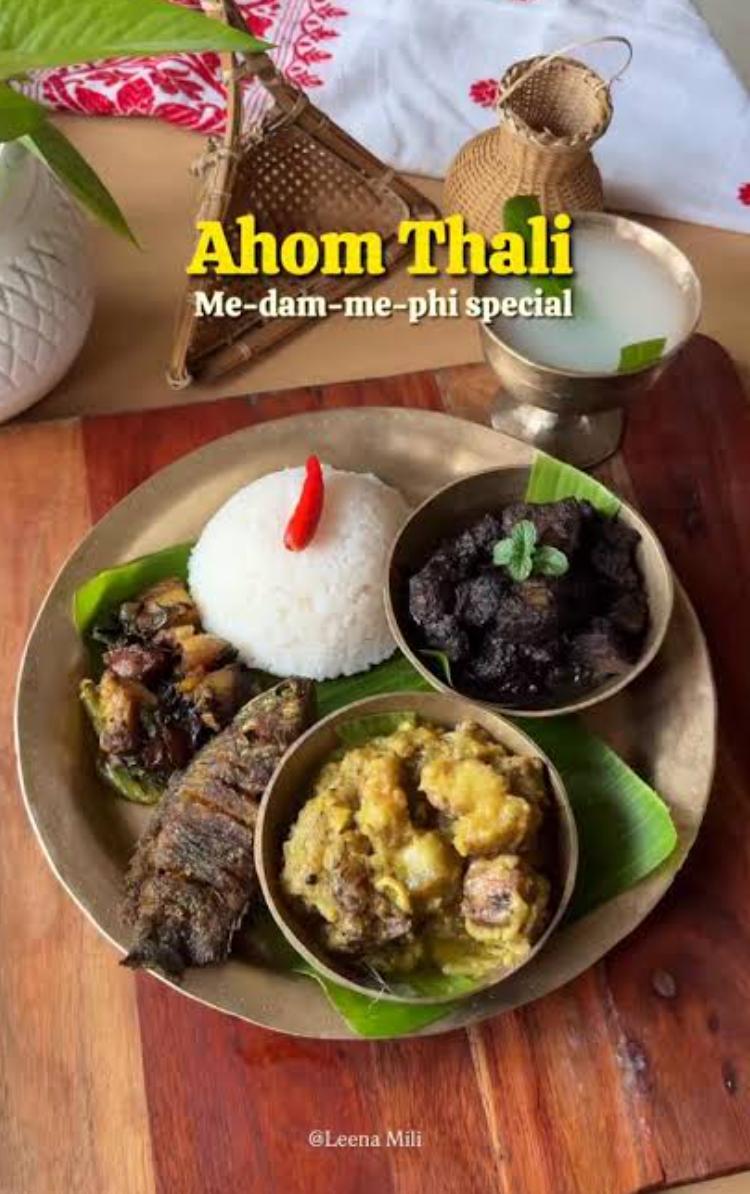
(Image source: @LeenaMili, Instagram)
The Ahom language makes an interesting distinction between paddy grains, husked and uncooked rice, and cooked rice ready for consumption. These distinctions are reflected in its vocabulary through the use of different words and combinations.
The word for paddy grains, rice and food in general is '𑜁𑜈𑜫' (Khāw). When combined with the Tai word '𑜏𑜃𑜫' (Sān), which has an Austroasiatic origin and is derived from the earlier form 'Sāl' which is the Austroaseatic root meaning 'to peel', it gives us '𑜁𑜈𑜫 𑜏𑜃𑜫' (Khāw Sān), meaning husked and uncooked rice grains.
Next, pairing the Tai word '𑜏𑜤𑜀𑜫' (Suk), meaning 'cooked', with '𑜁𑜈𑜫' (Khāw) gives us '𑜁𑜈𑜫 𑜏𑜤𑜀𑜫' (Khāw Suk), meaning cooked rice. The word 'Suk' has clear cognates in other Tai languages like Thai and Lao, where it carries the meaning of 'cooked' or 'ripe'.
Another word used for rice in general is '𑜍𑜪' (Rām). However, it has other meanings as well, including a sedan or palanquin and a load carried by two persons. Therefore, 'Khāw' is more preferable when referring specifically to rice.
Now, an important grammatical observation, if you're wondering why the adjectives appear after the nouns, it is because Ahom generally follows a Noun-Adjective order. In other words, the adjective or qualifying word comes after the noun it modifies, unlike in English, where adjectives generally precede the nouns they describe.
This is a characteristic feature of Ahom grammar and is also documented in linguistic studies of the language.