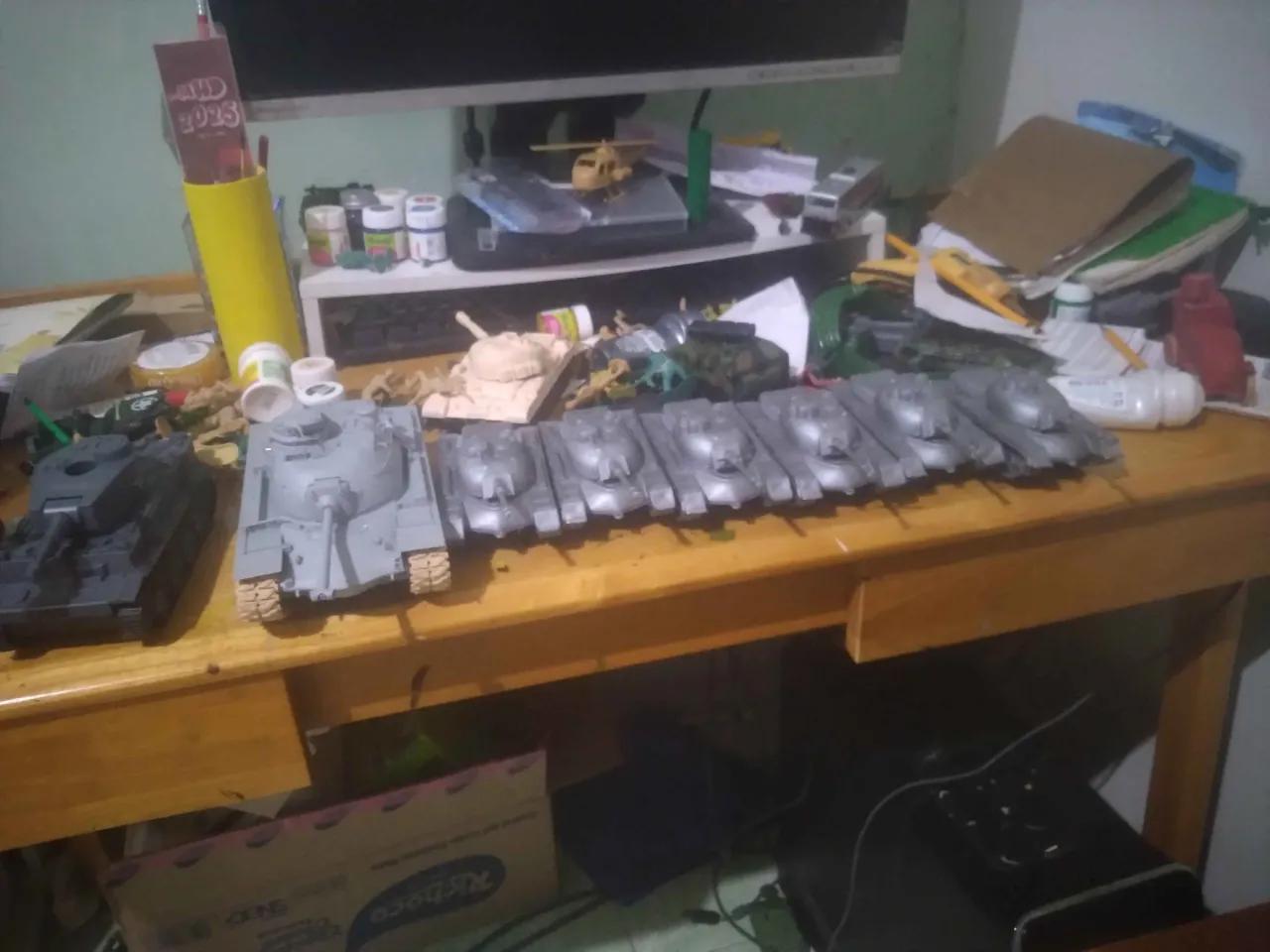
Weight: 119 tonnes
Length: 9.5m
Width: 4.2m
Height: 2.75m
Horsepower: 2742hp
Power to weight ratio: 26.37 hp/ton
Ground pressure: 6.5 kPA
Gun MM: 155 MM smoothbore cannon
Barrel length: 8 M
Frontal Armor: 2631 mm (LOS effective thickness)
Turret cheeks: 2200 mm (LOS effective thickness)
Sides: 90mm (45mm amour, 200mm empty space, 45mm amour)
Sides: 120mm of effective thickness.
Cost: 17 Million per tank.
Ammo: APFSHEDS (Amour Penetrating Fin stabilised High Explosive Discarding Sabot) ,HE
Other: Has 25 smoke grenades, has a roof mounted 30mm automatic machine gun(works agaisnt light vehicles, infantry, and missles and drones), has 7 Radars, strong computing systems, a 12.5 mm roof mounted machine guns, has a 12.5 mm coaxial machine guns, the most modern sensors and optics, has 5 crew, a huge autoloader with 5 second reload, Enlarged trophy APS, laser dizzying, laser detection, roof mount Lazer APS.
Additional Arms:
2 x 12.5 mm
1 x 30 mm
1x 45mm light flamethrower
Weight calculation:
Leopard 2A7 with no frontal or turret amour weighs 55 tonnes
Leopard dimensions = 8m long, 3m high, 3.75 wide
Lion dimensions = 9m long, 2.75 m tall, 4m wide
8 x 3 x 3.75 = 90
9 x 2.75 x 4 = 99
(55/90) x 99 = 60.5
Add 25% due to the lion filling out more of its dimensions (more space per profile)
60.5 x 1.25 = 75.625
Add 3 tonnes due to the lions significantly heavier engine (uses different materials and uses high strength UD material)
75.625 + 3 = 78.625
Add 1 tonne due to increased barrel thickness (along with recoil mechanisms)
78.625 + 1 = 79.625
(Uses Dorchester Composite Amour)
Frontal armor weight:
Frontal armor dimensions = 4m wide, 1.8 m long, 0.1 m thick (1000mm)
Density = 8 tonnes per m^3
4 x 1.8 x 0.1 = 0.72
0.72 x 8 = 5.76 tonnes
Lower Glacias:
Dimensions = 2m wide, 0.8 m long , 0.09 m thick (900 mm)
2 x 0.8 x 0.09 = 0.144
0.144 x 8 = 1.152 tonnes
Turret cheeks:
Dimensions = 3.35 m wide, 1.2 m long, 0.11 m thick (1100 mm)
3.35 x 1.2 x 0.11= 0.4422
0.4422 x 8 = 3.5376 tonnes
(Extra) Side amour:
Side amour was already included in the general weight calculation for the leopard chassis size up, but I am adding additional.
Dimensions: 9m wide, 1.2 m tall, 0.004 thick (40mm)
9 x 1.2 x 0.004 = 0.0432
0.0432 x 8 = 0.3456 tonnes
Structural reinforcements:
(Partially included due to previous calculations) Due to its increased mass and engine stress, along with absorbing more impacts before dying, it will have increased structural elements (ie shock absorbers, internal bar cage, etc)
Leopard structural element weight = 12 tonnes
Extra mass added to current reinforcements = 5 tonnes
(this provides it with more ability to survive repeated impacts, blunt force, high kinetic energy-low pen weapons)
Engine mass:
The leopards engine weighs 2 tonnes, (4 with powerpack included)
(This will be an overestimate as the mass of the engine in previous calculations is included and multiplied by the lions size, and this will not be, so expect this to be 15-25% overestimate on the weight added)
Engine: (Modified) TI 272 (2742hp)
Dimensions: Length: 1.8 m Width: 3.m Height: 1m
Mass: 4 tonnes (including cooling powerpack, gears, transmission)
The base engine is smaller than the dimensions it has been given, and lighter too. The extra mass and Space has been used to add larger shock/vibration absorbers, acoustic materials (reducing sound greatly), greater cooling ability, larger air filters, more numerous air ducts and other such modifications.
To compensate for other smaller additions and the gun system, and extra 5 tonnes will be added to be safe. Bear in mind this mass number is likely an overestimation.
79.625 + 5.76 + 1.152 + 3.5376 + 0.3456 + 5 + 4 +5 +15 = 104.4202 tonnes
Defensive Systems:
Active Protection Systems (APS):
The Lion II uses many Trophy style Active Protection Systems.
These are distributed around the vehicle to provide extensive coverage against incoming threats.
The tank uses multiple APS units rather than relying on a single system.
The objective is to provide overlapping coverage, reducing the possibility of an incoming threat exploiting a gap in the vehicle's active protection.
Coverage calculation:
Let:
N = Number of APS units
C = Individual APS coverage area
Total nominal coverage:
N x C = Total nominal coverage
(Note: Actual coverage will be lower where coverage areas overlap.)
Laser Defence System:
The Lion II uses a high powered laser defence system, primarily designed for intercepting drones and missiles.
Laser output power: 100 KW.
Estimated electrical input: 333 KW.
Laser efficiency: 30%.
Power calculation:
Engine power: 2742 HP
1 HP = 745.7 Watts
2742 x 745.7 = 2,044,169 Watts
Total engine output = 2.044 MW.
Assuming a laser efficiency of 30%:
100 / 0.30 = 333.33 KW
Therefore, the laser requires approximately 333 KW of electrical power to produce 100 KW of laser output.
Engine power allocation:
333 / 2044 x 100 = 16.29%
The laser's electrical input is equivalent to approximately 16.3% of the engine's total mechanical output, before generator losses.
The laser system also has its own radar and IR equipment.
Radar and Detection Systems:
The Lion II uses several different radar systems, alongside infrared and LIDAR equipment.
These include:
- Long range search radar.
- Short range search radar.
- Tracking radar.
- Infrared (IR) detection systems.
- LIDAR systems.
The different systems provide multiple methods of detecting and tracking objects.
The use of seperate long range and short range search radars allows the vehicle to have different detection systems for different operating distances.
The tracking radars provide additional tracking capabilities.
Infrared and LIDAR provide additional sensor information alongside radar.
Independent Weapon Detection Systems:
The roof mounted 30mm automatic cannon and laser defence system each have their own radar and infrared equipment.
This means that these systems have dedicated detection equipment rather than depending entirely on the main vehicle sensor suite.
The 30mm turret has its own radar and IR equipment.
The laser system also has its own radar and IR equipment.
This provides additional sensor redundancy and allows the individual systems to operate with their own detection equipment.
Computing Systems:
The Lion II has complex onboard computing systems.
These systems process information from the vehicle's various radar, infrared and LIDAR equipment.
The computing systems integrate information from the different sensors and support the operation of the vehicle's defensive systems.
Data Link:
The Lion II has a data link connecting it to other friendly vehicles and droens.
This allows it to exchange information with other units rather than operating entirely independently.
The vehicle can recieve and share battlefield information through its data link.
This forms part of the Lion II's wider networked sensor architecture.
Overall Sensor suite:
The Lion II uses a combination of:
- Long range radar.
- Short range radar.
- Tracking radar.
- Infrared sensors.
- LIDAR senors
- Independent 30mm turret radar and IR.
- Independent laser radar and IR.
- Complex onboard computing
- Vehicle to vehicle data links
- Drone data links
The vehicle therefore has both a central sensor architecture and independant detection equipment for its secondary defensive systems.
Mobility
Horsepower
Full engine = 2742 HP
Engine = Modified TI 272
The Lion II uses a heavily modified engine producing 2742 horsepower
Power calculation:
1 HP = 745.7 Watts
2742 x 745.7 = 2,044,169 Watts
Total engine output = 2.044 MW
Power to weight ratio
Weight = 119 tonnes
Horsepower = 2742 HP
Power to weight ratio:
2742 / 119 = 23.04 HP per tonne
This provides approximately 23 HP per tonne which is a very high power to weight ratio for a vehicle of this mass
Maximum speed
Estimated maximum road speed = 65 KM/H
Estimated maximum cross country speed = 50 KM/H
Estimated reverse speed = 20 KM/H
These speeds are based on the assumption that the Lion II has an exceptionally powerful engine and a specially designed transmission and suspension system
The 50 KM/H cross country speed assumes relatively firm terrain such as open fields dry ground and moderately uneven surfaces
On particularly rough terrain soft ground or steep slopes the speed would be reduced
The vehicle uses a specially designed suspension system and reinforced tracks to maintain stability at higher speeds
The transmission is also assumed to have sufficient gearing to transfer the engine output efficiently without excessive mechanical stress
Track area
Track width = 1 metre
Track length in contact with ground = 8 metres
Number of tracks = 2
Track area:
(1 x 8) x 2 = 16 m²
Total track contact area = 16 m²
Ground pressure
Weight = 119 tonnes
Mass = 119,000 KG
Gravity = 9.81 m/s²
Weight force:
119,000 x 9.81 = 1,167,390 N
Ground pressure:
1,167,390 / 16 = 72,961.9 Pa
72,961.9 / 1000 = 72.96 KPa
Calculated ground pressure = approximately 73 KPa
This assumes the entire track area is in contact with the ground and that weight is distributed evenly
Transmission
Due to the Lion II enormous weight and high horsepower the transmission is one of the most important components of the vehicle
A conventional transmission would experience extremely high mechanical stresses when transferring 2742 HP through the drivetrain
To compensate for this the Lion II uses an extensively reinforced transmission constructed using highly specialised materials
These include:
- High strength forged alloy steel gears
- Advanced nickel based alloys for components exposed to high temperatures
- Specialised high strength steel transmission shafts
- Advanced surface hardening treatments to reduce wear
- High performance bearings
- Reinforced torque converters and clutch assemblies
- Specialised heat resistant materials and coatings
The gears are designed to withstand extremely high torque and repeated mechanical loading
The transmission housing is also reinforced to prevent deformation under heavy loads
Special attention is given to fatigue resistance as the transmission must withstand repeated acceleration braking turning and changes of terrain
The transmission is assumed to be designed for sustained high power operation rather than simply handling short bursts of maximum engine output
Engine and Cooling
The Lion II uses a modified TI 272 engine producing 2742 HP
Due to the enormous power output the engine requires an extensive cooling system
The engine includes:
- Increased cooling capacity
- Larger air filters
- Additional air ducts
- Larger cooling components
- Reinforced engine mounts
- Increased vibration absorption
- Improved lubrication systems
The transmission also has its own dedicated cooling and lubrication systems
These are necessary because the transmission will generate substantial heat when transferring such large amounts of power
The cooling systems are assumed to be capable of maintaining operating temperatures during prolonged high speed cross country movement
Specialised Materials and Structural Reinforcement
An extreme emphasis is placed on using very high strength specialised materials throughout the drivetrain and mobility systems
The objective is to prevent the enormous forces generated by the vehicle weight and engine from causing premature component failure
Transmission:
Uses high strength forged alloy steels and specialised heat treatments to withstand high torque and repeated loading
Drive sprockets:
Use reinforced high strength steel with hardened contact surfaces to resist wear from the tracks
Track pins and links:
Use specialised high strength wear resistant steel alloys to withstand the enormous tensile and bending forces experienced during movement
Suspension:
Uses reinforced suspension arms high strength steel components and specialised shock absor