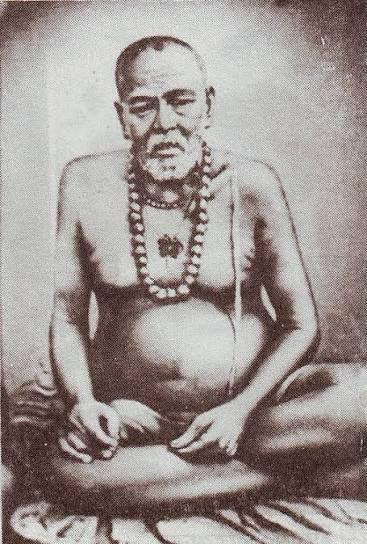
At present, many claims about Sri Shyama Khyapa have spread across the internet. He is repeatedly introduced as the “youngest disciple of Sri Bāmākṣepa,” while the lineage is presented simply as Sri Bāmākṣepa → Sri Shyama Khyapa → Porbeen Chor. Sri Bāmākṣepa is consequently described by Porbeen as his “Param Guru — the Guru of my Guru.” The current Jai Khyapa Parampara website itself presents exactly this three-person structure.
This post is not intended to deny Sri Shyama Khyapa’s relationship with Bāmdev. It is intended to understand that relationship from Shyama Khyapa’s own words, preserved in videos from his own YouTube channel and translated on the very same Jai Khyapa Parampara website.
The historical chronology is simple. Sri Bāmākṣepa left his body in 1911. Sri Shyama Khyapa himself states that he was born on 16 August 1947, thirty-six years later. Therefore Shyama Khyapa could not have been Bāmākṣepa’s physical disciple during Bāmākṣepa’s lifetime. This by itself does not invalidate a posthumous Guru relationship, and Shyama Khyapa never needs us to pretend otherwise.
In fact, Shyama Khyapa explains his early Guru relationship very clearly. He says:
“I eventually took initiation (Diksha) from Ramnath Bhattacharya of Bhatpara. He was our family guru.”
When he later began Tantra sādhana, he informed Ramnath Bhattacharya. His Guru told him that Tantra was not really his field, but encouraged him and offered whatever help he could.
Shyama then describes going to Tārāpīṭha and beginning his sādhana. There he was advised that before approaching Mā Tārā he should undertake Bāmdev sādhana and seek Bāmdev, who might even initiate him. This begins a completely different relationship from ordinary physical Guru-disciple succession.
Shyama Khyapa himself removes all ambiguity when he says:
“I found my Guru, Bama Khyapa, long after he passed away.”
He unquestionably calls Bāmākṣepa his Guru. That should be respected exactly as he says it. But he equally clearly describes finding his Guru after Bāmākṣepa had already left the body
This distinction matters because Shyama Khyapa also speaks very clearly about the historical Guru current associated with Bāmākṣepa.
Speaking about Sri Durgāprasanna Paramahaṁsa, he says:
“We speak of three great generations in this lineage: Sadhak Bamakhepa, Nigamananda Paramhansa Dev, and then Durgaprasanna Paramhansa Dev. Nigamananda was Durgaprasanna’s guru, and Bamakhepa was Nigamananda’s guru.”
In another discourse he repeats the same structure after explaining that Bāmākṣepa initiated Nigamānanda and that Durgāprasanna later took initiation from Nigamānanda:
“So we say Three Generations: Bama Baba, Nigamananda, and Durga Prasanna Paramhansa.”
Shyama Khyapa therefore does not erase Nigamānanda and Durgāprasanna from the history between Bāmdev and his own period.
He also speaks about himself with considerable restraint. When explaining why he is called a Gupta Sādhaka, he says that he remained hidden in his sādhana for approximately 22½ years. He explains that his disciple Joy Chakraborty encouraged him to share his knowledge on YouTube, and that he eventually did so because it was Mā’s order. In that same conversation he says Bāmākṣepa was his first predecessor, Nigamānanda the second, another Guru the third.
This is noticeably different from the current story that Shyama Khyapa remained hidden specifically under Bāmākṣepa’s command until a foretold person arrived to reveal him.
Porbeen’s own account says Shyama was the youngest disciple of Bāmākṣepa, remained hidden by his Guru’s command, and knew that someone would eventually come who would reveal his identity.
Yet when Shyama Khyapa himself explains why he became public, he speaks about Joy Chakraborty encouraging him to share his knowledge and about Mā instructing him to do so.
So is Sri Shyama Khyapa a disciple of Sri Bāmākṣepa?
According to Shyama Khyapa himself, yes.
He calls Bāmdev his Guru, describes years of sādhana directed toward him, and says that he eventually found Bāmdev long after Bāmdev had passed away.
But is that the same thing as saying that a man born thirty-six years after Bāmākṣepa’s death was historically his “youngest disciple,” and then compressing the Guru-paramparā into:
Bāmākṣepa → Shyama Khyapa → Porbeen Chor?
Shyama Khyapa’s own words give us a much more complete picture.
There was his living dīkṣā from Sri Ramnath Bhattacharya.
There was his later search for Bāmdev through sādhana.
There was his posthumous spiritual relationship with Bāmākṣepa, whom he genuinely accepted as Guru.
And there was the historical current he himself repeatedly preserved:
Sri Bāmākṣepa → Sri Nigamānanda Paramahaṁsa → Sri Durgāprasanna Paramahaṁsa.
None of this diminishes Shyama Khyapa.
On the contrary, it allows his own story to remain exactly as he told it.
Before repeating what the internet now says about a saint, listen first to what the saint himself said.