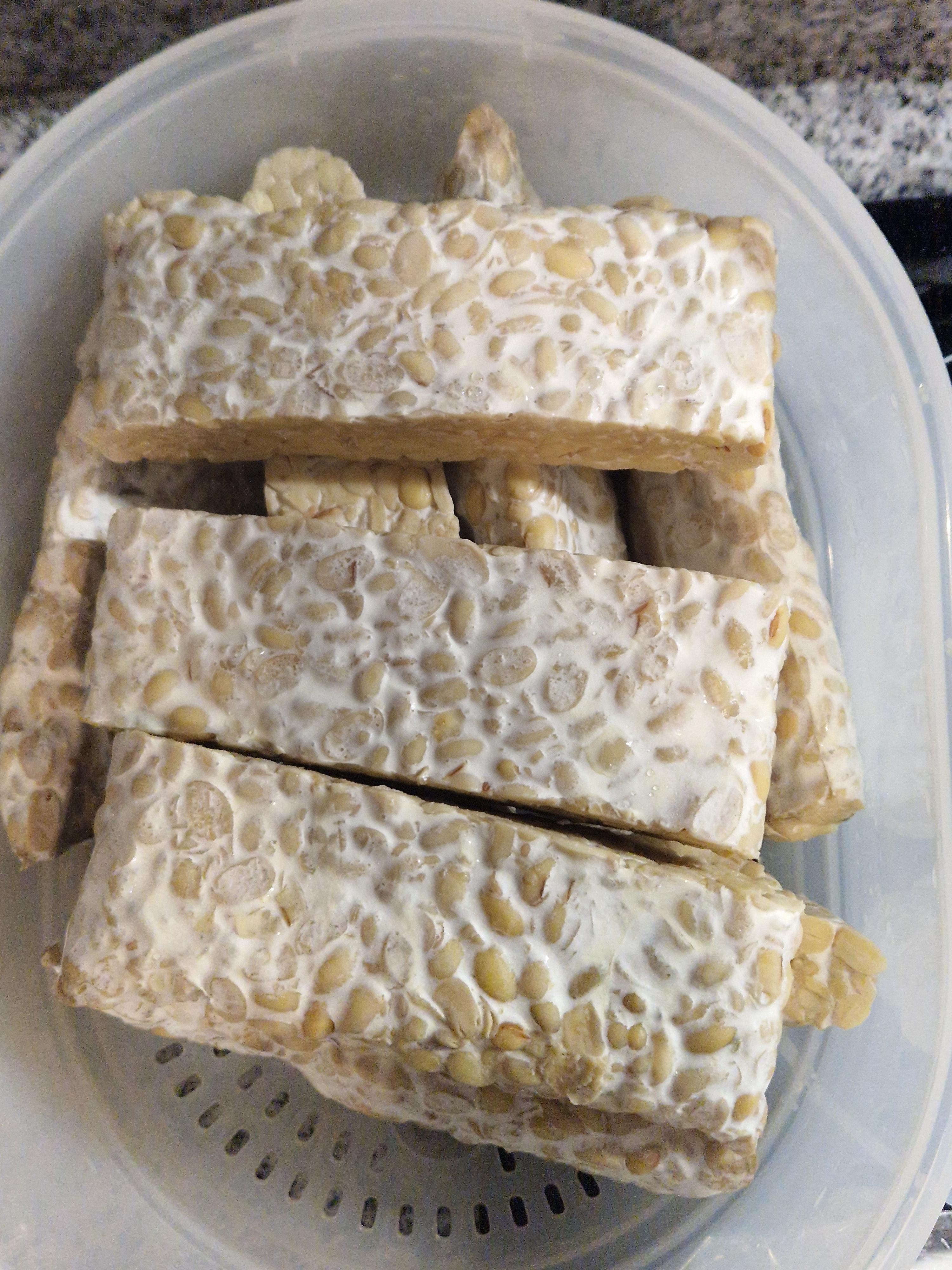
Well, the question says all: do you wait 24 hours before cooking your tempeh? I always do, but tomorrow I don't have anything in mind to cook and I have a double batch of tempeh that should be ready in 3 hours or so. So I could put it in the refrigerator overnight and cook it for lunch.ñ, in total 14-16 hours of rest. What do you think?
Some experiment! Soak soya chunks in hot water with any acid and squeeze out the excess water and toast dry and sprinkle some tempeh fungus and put in banana leaf or plastic bag etc
have i done it right tempeh smells good . it is fluffy with black color when surface is scratched. but when i break some piece yellow color is there inside some beans is it safe.
Hey y'all, the last post I've seen mention this was 4y ago so wanted to gather another consensus on the KitchenAid Grain Mill, and sorry if it's repetitive.
I see it specifically says do NOT mill soybeans, however I'm inferring that means don't fine mill them into a flour, not just split the beans [on the KitchenAid setting #8-9]
I can't find a reliable source for already split beans, beans are around $2.50/lb but the cheapest split beans I see are admittedly not much more at $3.60/lb from MakeTempeh.com
However buying a mill would basically raise the money I'm spending on tempeh making to $3.60/lb for x amount of blocks so should I just buy the split beans and suck it up?
poor ventilation- i am making tempeh in oven .the problem i think was tempeh was not getting enough air exchange after it starts generating heat. i installed the fan to act like exhaust so i think that worked.earlier the fan face was toward the oven the air kept circulating inside it. no air exchange was there with fresh air from outside.
2)over-fermentation- i think i was over fermenting it.I woke up at night as soon as tempeh hit 31 C i switch off light.earlier the light kept switching on and off making tempeh over-ferment as i was asleep.
please suggest what can i do better - would i get more good result if i keep ambient and internal temperature close to 5-6 C. the tempeh temperature was at 31.5 and the ambient temperature was at 23 c.
Thank you everyone who earlier commented on my post. this was my 4th attempt i am happy.
Here I am again. I recently made black bean tempeh and would love some advice from more experienced tempeh makers.
I fermented it for about 30–36 hours at 30-31°C (inside the oven, light on). The mycelium grew very well, and the tempeh became firm and compact after just 24 hours, but needed a few more hours to fill the package. It smells pleasantly yeasty and slightly nutty, with no noticeable ammonia or rotten smell. It's also neither wet nor slimy when I touch it.
However, I noticed some tiny yellowish/beige spots around the ventilation holes and some grey/black fuzzy patches, especially along the edges of the cake (see photos). Could these simply be Rhizopus sporulation due to higher oxygen exposure, or should I be worried about mold contamination?
For context, I soaked 300 g of dried black beans for about 7 hours at room temperature, cooked and dried them in the oven (100 °C), then added 2 tablespoons of apple cider vinegar before inoculation. I didn't acidify the soaking water.
I am not new to vegan cooking but I am new to tempeh. I decided to try a tempeh sheet pan recipe from a vegan cookbook I own. I bought an 8oz package of tempeh at my local grocery store. The recipe called for marinating the cubed tempeh for an hour to overnight, depending on your time available. Mine sat for six hours in the fridge. The recipe called for pretty low amounts of ingredients in the marinade. For 16 oz of cubes there was maybe a total of five tablespoons ingredients like oil and soy sauce. It seemed low but I was using half the amount tempeh.
The baked cubes were crumbly and I didn’t like the texture. Also I thought the tempeh would absorb more flavor but the fermented aspect of the flavor profile threw me a bit.
I have made my own fermented pickles, carrots and other things before but having that flavor in a protein source kinda threw me.
What ways have you made tempeh that you do on repeat? Do you have any suggestions for how I can use tempeh successfully?
This is a sunflower+green lentils tempeh for reference. I let it ferment for 48 h within the range of 28-32 degrees (which was a bit of a struggle cause it always heated up so fast when I wasn't actively cooling it down). As you can see in the pics it didn't grow fully unanimously and I didn't wanna risk it over fermenting. Do anyone else have experience with this stage in the fermentation, would you let it sit for another night (8 h)?
Also, any tips for cooling down the tempeh? I was thinking doing 2 smaller batches or cooking the lentils more al dente to prevent the over heating
Hello everyone. I have been trying to make tempeh but it doesnt turn out good. It has been three times that I had tried . But the tempeh turned out to crumbly , sticky and smells like ammonia . There has been lot of condensation throughout the process. Below are the steps that I followed. 1) soak beans for 12 hours .
2) boil them for 30-40 minutes.
3) dehulling about 90% of beans
4) dry them using kitchen towels and air drying machine for hour
5) inoculate them with apple cider vinegar and starter(alla posh) 5 grams for 500 g soybeans
6) put them in ziplock bag with holes in it with skewer 1 inch apart
setup - ambient temperature is 27.5 it turns off after tempeh generates its own heat and tempeh internal temperature is around 31-32 C. i am using 12 v fan for air circulation and temperature control .fan turns on and off if temperature increases above 32 C.
But the problem is there is lot of condensation on bags after 18 hours and it doesnt go away. so help me what i am doing wrong. thank you. below are pictures of tempeh and my setup.
made this tempe last month, had no expectations but succeed!!! then when I tried to make another batch with high expectations, its all just went downhill 😹 I don't want to jinx it anymore, but been craving homemade tempe so bad cause the store bought just doesn't taste the same.
how do you dry your soybeans after boiling them before adding starter so it doesn't go damp or sticky afterwards? do you just let it cool down on the clean cloth/paper towel until its dry or do you also use fan to make it faster? because my boiled soybeans changed color after and doesn't ferment properly (the center was spoiled) and I believe this was my reason for failing. please share your tips!!! thank you so much in advance.
Hello, tempeh rookie here! This is my tempeh after 44 hours. 24 first hours inside a bread proofer with the temperature setting on, and the rest still inside there but turned off. During the process it gets quite humid inside the ziplog bag (you can perfectly see a bunch of water droplets), however the final result is not slimy nor particularly moist at all. I guess there really is never enough holes in the bag, I'll try to make them a bit bigger next time to help with condensation. I am assuming the black parts are just the mature spores and that it is perfectly edible, it doesn't smell bad.
Also, it would be really helpful to know how you all store your tempeh. I used a paper towel to take any possible excess of moisture and put it inside a tupperware in the fridge (for how long would it last in there??), I will probably freeze some of it like I did with my first batch. :)
Hello! 👋🏼 I'm interested in making my own tempeh. I'll probably be repurposing my dehydrator and adding a thermostatic heat mat in the bottom. Has anyone done this, to make an incubator? (To clarify, I won't turn on my dehydrator- it is too hot.)
Also, I'd like to make tempeh molds - most probably by drilling small holes in tuppaware containers. Has anyone here done this? If so, should I make holes on all the surfaces of the box? Or only the top? Does anyone have any interesting ideas for tempeh molds that are reusable and perhaps not made of plastic?
I really don't like the tempeh available at grocery stores, so I decided to make my own. Black beans are my favorite, so I thought I'd start there. This is after 28 hours. I think maybe the inside of the bags got a little too wet, and that there may not have been enough room or time for the rhizopus to keep growing. The outside of the left one seems more grey (could be the black beans) and bit more damp, but it's not too bad. And it's edible... right?
Edit: I definitely think I should let it grow more next time. I'm steaming the one I already cut, and I've put the other one back in ventilated container to see if it will indeed grow some more
Anyone in here ever made red lentil tempeh? I ask because I would very much like to try, but red lentils kinda disintegrate upon cooking so I was wondering if anyone here has done it and if so, what the technique was. My first thoughts are just soaking and not cooking it prior to fermenting or a very quick cook after a presoak just to get them barely cooked before they disintegrate. Any ideas would be welcome.
I'm about to try making tempeh for the first time. Was going to use a proofing box I made that I use for sourdough, yogurt, and kefir. Should I be worried about the tempeh spores colonizing the box and possibly contaminating other ferments in the future? Should I just make a second proofer instead?
Kitchen is dark so I used a headlamp, hence the odd lighting. Red beans, 24hrs in the oven with the light on for heat, 18 hrs on counter in the bag. Are the darker patches fine or is it gone?
So this was completely on a whim. I'd never made tempeh before, and when I raided the pantry, all I had was red kidney beans. No soybeans. Fine — red kidney bean tempeh it is.
Soaked them, boiled them, mixed in the starter. Then the hard part: waiting. 24 hours later, white mycelium had wrapped every single bean into one beautiful solid block.
First try, first success. The sense of accomplishment is unreal. ❤️