r/TheIndianRepublic • u/GanjiBaniyan999 • 7h ago
News 📰 Devotees are arrested
17
Upvotes
r/TheIndianRepublic • u/Enough-Zombie8216 • 5h ago
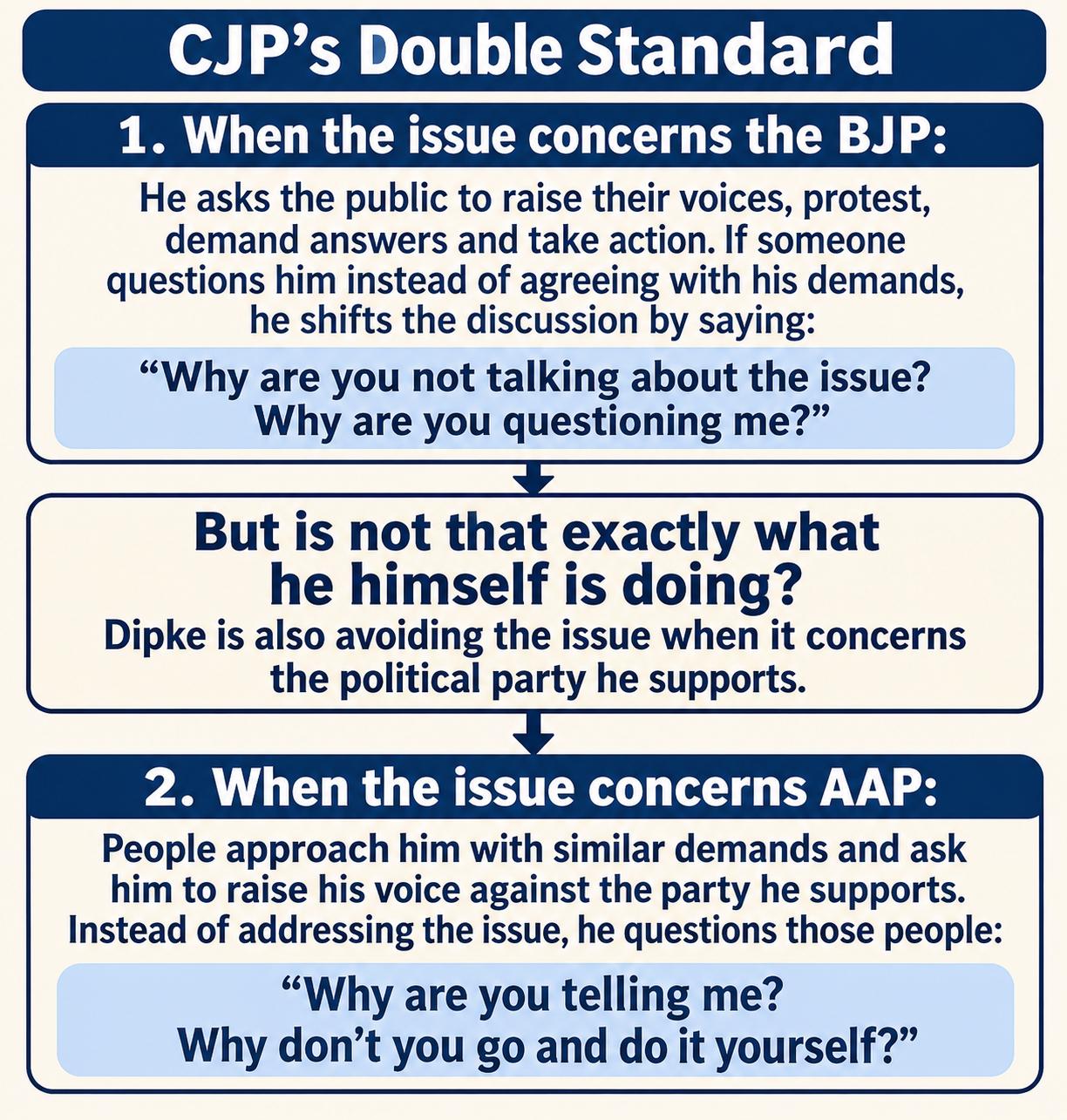
CJP is trying to influence public opinion against a particular political party by mobilising people along political lines. The public is not obligated to become a tool for anyone's political agenda. If Dipke can tell people to go and deal with an issue themselves instead of appealing to CJP, simply because he does not want to speak against a particular political party, that is his personal choice. But he cannot expect the public to follow his political opinions or label them as party supporters simply because they disagree with him or refuse to act according to his instructions. Just as he chooses to distance himself from issues that the public brings to him, the public can also choose to distance itself from his political opinions and influence when he reaches out to people online.
If he can use his political affiliation to defend his preferred political party and despite the public raising genuine issues, Dipke can turn around and ask the public, "Why are you coming to me with these issues? Why don't you go and deal with them yourself?", then the public has every right to question him in the same way. If he chooses to stand by his preferred political party instead of standing with the public's concerns, and questions people for raising issues with him, he should also be prepared to face the same questions from the public. When he makes videos telling people what they should do about certain public issues or asking them to take action, the public can also question him by asking, "Why are you telling us what to do?" If Dipke wants people to respect his political preferences and his decision aboit not to speak against his own party, he must also respect the public's political preferences and its right to question him.
If he has the right to distance himself from public issues and refuse to listen to people, the public has the same right to distance itself from him and his political influence. And just as he chooses to distance himself from people who question his preferred political party, people have every right to distance themselves from him when he tries to mobilise them against the BJP.
This is the reason why CJP cannot be considered a genuine citizens' movement. It is a campaign to mobilise one section of the public against another based on political affiliations.
r/TheIndianRepublic • u/TreacleDry9367 • 4h ago
r/TheIndianRepublic • u/hrisch • 5h ago
r/TheIndianRepublic • u/One_Citizen_ • 8h ago
The Real Picture of Visiting a Government Hospital in India
Disclaimer: This post reflects personal observations and common everyday experiences in public healthcare. It does not name or target any specific hospital, department, doctor, or staff member, and it is not medical advice or a reason to avoid seeking care. Many government doctors and workers do honest, exhausting work under heavy pressure. This is simply an open conversation about system gaps and everyday behaviour that ordinary patients face far too often.
If you have never had to get a full diagnosis or surgery done at a government hospital, it is hard to explain how draining it gets. Half the time, running from counter to counter wears you down faster than the illness itself.
The Never-Ending Lines
A few hospitals now offer online OPD ticket booking so you can skip the first counter. That sounds good on paper, except most people who actually visit government hospitals do not know how to use online portals. Some end up paying extra or getting tricked by outsiders hanging around the gate who offer to book tickets for them.
For everyone else, the morning starts in a huge line for an OPD slip. After that comes another line for ticket entry, and then a third line outside the doctor's room. Inside, there is barely any privacy because several patients and family members are packed into the room together. The doctor sees you for a few minutes, writes temporary medicines and a list of tests, and asks you to come back with the reports. Because everything happens in such a rush, older patients often walk out without even clearly understanding when or how to take their medicines.
Go to the hospital pharmacy and you hit another long queue, only to hear that many of the prescribed medicines are out of stock and have to be bought from outside anyway. Then you head to the test counter for slips, where you often find out tests cannot be done the same day.
So you show up early the next morning and wait two to three hours on an empty stomach for fasting blood work. Another day goes into after-food tests. Different days for scans or other checks. Then more lines just to collect reports. For daily-wage earners and working families, every single extra trip means losing a day's income.
Once the reports are ready, the whole OPD line starts all over again. If admission or approval from another department is needed, you repeat the same routine with a new doctor, finish another medicine course, and lose more weeks. If surgery is advised, you enter the Pre-Anaesthetic Checkup (PAC) process, which brings its own long queues for file submission and entry. One missing check or extra requirement pushes everything back by weeks again.
Small administrative slip-ups make it worse. Old rubber stamps fade or the print comes out too light on the slip, so staff simply stamp it again and ask you to redo the same tests. If there is a holiday in between or the sample collector is unavailable, you are casually told to try another government hospital. In a few situations, patients are even told to buy a specific tube from a local medical shop, get blood drawn outside, and bring the sample back. And if you need reports urgently, you have no choice but to pay private labs outside.
When PAC finally clears you for the Operation Theatre, you stand in the OPD line one last time. The doctor notes down your name and phone number and says the hospital will call with a date. For non-emergency surgeries, that wait can easily stretch to months.
How Patients Are Treated
Given India's population, anyone can accept long queues. What really breaks people is losing basic human respect when they are already sick and worried.
Proper signboards and working help desks are hard to find, so confused patients naturally ask nearby staff for directions. Ask an idle worker a simple question and some snap back with the attitude of someone who owns the entire hospital. Rudeness, shouting, ego, demeaning comments, and occasionally even abusive language happen right in the open. When a crowd builds up, maybe two out of five staff members actually try to handle it while the others walk around or pass sarcastic remarks.
Patients and their families are not always innocent either. People cut queues, lose patience fast, argue with attitude, and bring four or five attendants for one patient, blocking narrow corridors.
Even keeping that in mind, being treated like a servant by certain staff members, from security guards and cleaners to clerical staff, hurts deeply when you need help the most. Some shout at children, teenagers, adults, and senior citizens alike. Weak and elderly patients stand for hours because seating, clean drinking water, and wheelchairs are rarely enough.
Typing mistakes on slips or reports bring out some of the worst behaviour. When an error happens on their end, some staff act as though printing the paper at all was a huge favour. Request them several times and they might casually cross it out with a pen. Ask for an official stamp, a signature, or a fresh copy so your file does not get rejected later, and some turn aggressive and rude. Until you either fold your hands and plead or stand your ground and speak up firmly, they refuse to correct their own mistake officially.
Rushed Checkups and the Admin Wall
Many government doctors are stretched way beyond their limits and still do honest work. Still, there are a few who treat checkups like they are just going through the motions. They browse their phones, chat among themselves, barely listen to the patient, and write the same routine prescription they always give. Seeing that casual attitude makes any patient genuinely worried about getting misguided or given improper treatment.
Try meeting hospital management with a concern and the wall gets even harder to cross. Security guards and clerks outside administrative offices are often the hardest to deal with, making you wait hours outside. Even when you get inside, some officials talk over you and push you out within a minute without actually hearing what you came to say.
Tell them honestly that the pain at home has become unbearable, and the common reply is to keep taking medicines and come to Emergency if things get worse. It leaves you feeling like nobody really steps in until a patient reaches a critical stage.
Stay Away From Brokers and Scammers
Around hospital gates, counters, and corridors, you will run into middlemen promising faster dates, quick reports, online bookings, or easy admission in exchange for cash. Never hand them money. Many turn out to be touts or scammers, and dealing with them only drags you into bigger trouble while you are already fighting a health problem.
Cleanliness and Toilets
Cleanliness has always been a mess in many government hospitals, and honestly, both sides are to blame. Visitors spit pan masala and throw trash everywhere, and shockingly, some hospital staff litter too. Cleaners often work half-heartedly, as if showing up for attendance is enough.
In many hospitals, the toilets inside the premises are in terrible shape. Foul smells, broken latches, clogged drains, and no water make them almost unusable for sick people and pregnant women. Here again, the fault sits on both ends: poor hospital upkeep mixed with visitors who leave taps running, throw wrappers inside, and never flush.
Inside the Emergency Ward
People rush to Emergency when they are scared and going through real pain. Yet some security and front-desk staff treat them as if they made a mistake by showing up. Plenty of young doctors in Emergency are genuinely kind, sharp, and helpful. Others sit with a cold, casual attitude and barely hear the patient out before giving the fixed line: "We have written the medicines, take them and come to the OPD tomorrow." Extreme life-or-death cases do get attended to, though acute bed shortages cause long holds. Ordinary patients end up feeling sidelined, with the common impression that things move faster only when someone has influential contacts.
Not every government hospital works like this. Some are run well, and thousands of dedicated doctors and nurses keep a heavily overloaded system standing every single day. Sadly, a few places are even worse than what I described. Talking about this is not meant to insult public healthcare. Millions of Indians have no other option, and staying quiet about the delays, carelessness, and humiliation will never fix anything.
#GovernmentHospital #IndianHealthcare #PublicHealthcare #HealthcareReality #PatientRights #GroundReality #CivicIssues #HealthcareReform #India #CommonManVoice