r/ThirdTempleMovement • u/Common_Time5350 • 2d ago
Video The Bricks are being built in the Occupied West Bank for the Third Temple

4
Upvotes
r/ThirdTempleMovement • u/Common_Time5350 • 2d ago
r/ThirdTempleMovement • u/Lilflipflopper • 2d ago
I am not a Jew, and thus my understanding of Judaism is quite limited despite years of Bible study, but lately I have been thinking about the controversy of Josephus's claims of over a quarter million Jews making pilgrimage to the 2nd temple for Passover and how it cannot be accepted as established historical fact.
For any who may be unfamiliar, his report that the priests counted 256,500 Passover lambs in AD 70 during the Roman siege of Jerusalem would have resulted in over 35 lambs being slaughtered per second, which would have been thousands per minute and hundreds of thousands per hour, given the 2 hour window they were said to be working in. These numbers only factor the slaughter itself, not the other operational procedures such as collecting and handling blood, processing carcasses, and maintaining all the rituals precisely as mandated by scripture.
Then there is the claim that 2.7 million made pilgrimage. Would the city have been able to accommodate so many, and provide enough drinking water, food, waste management, etc.?
All of this leads to my real question... If the third temple was actually rebuilt according to the exact parameters outlined in the Tanakh, and all of the Jews alive today were to make Aliyah from the diaspora and join the current population of Jews in Israel, and families continued multiplying exponentially, could the land and the temple actually accommodate the population and still meet every single biblical requirement for sacrifices (during Passover, specifically)? What if the resurrection happened too, and every single Jew who ever lived also made up the population? Is it even remotely possible? I think I already know the answer... but, is this discussed in Judaism? Is it all supposed to be supernatural? Clearly, the dead resurrecting would be, but is it generally believed that everything else will function in the realm of reality??
Sorry if this is a dumb question. I'm just genuinely curious what is taught regarding this apparent impossibility.
r/ThirdTempleMovement • u/Common_Time5350 • 2d ago

r/ThirdTempleMovement • u/dustydancers • 2d ago
Hey, I am looking for a audio podcast on the topic of Third Temple Movement / Red Heifer Sacrifice, maybe even connecting it to techno accelerationism.
All I can find is christian nutjobs, “theologians” and “scholars” and Tucker Carlson.
r/ThirdTempleMovement • u/alertthedirt • 2d ago
r/ThirdTempleMovement • u/alertthedirt • 3d ago

4 May 2026 08:02 BST
Israeli police said they arrested 21 people suspected of attempting to bring a sacrificial goat to the Al-Aqsa Mosque in Jerusalem's Old City on Friday, Times of Israel reported.
The incident marked the second such incident in two months involving efforts to carry out a ritual sacrifice at the site, where such practices are prohibited.
The report said the group that took a goat to the mount on Friday was attempting to perform the sacrifice in honour of Pesach Sheni, or Second Passover.
Israeli national security minister Itamar Ben Gvir has advocated changes to restrictions on prayer there.
r/ThirdTempleMovement • u/alertthedirt • 3d ago

LONDON: About 115 Israeli settlers stormed the Al-Aqsa Mosque compound in the walled city of occupied East Jerusalem on Wednesday, according to the Palestine News Agency.
The Jerusalem Governorate reported that groups of settlers toured the site, accompanied by Israeli police. They entered the compound in groups through the Mughrabi Gate, conducting provocative tours and performing Jewish rituals in its courtyards, it added.
Israeli forces usually impose strict entry measures on visitors and worshippers of the mosque, and scrutinize their personal identities while settlers are on the site.
Al-Aqsa compound, Islam’s third-holiest site, also known as Al-Haram Al-Sharif, has been the site of frequent conflicts — including raids by Israeli settlers and restrictions on Muslim worshippers — since East Jerusalem was occupied in June 1967.
Settlers, who refer to the area as the Temple Mount, seek to establish a presence in the compound to pray at certain times. Several far-right ministers and Knesset members have publicly endorsed these plans.
r/ThirdTempleMovement • u/alertthedirt • 3d ago
r/ThirdTempleMovement • u/alertthedirt • 3d ago
r/ThirdTempleMovement • u/alertthedirt • 3d ago
r/ThirdTempleMovement • u/alertthedirt • 3d ago

Journal of Political Ideologies Volume 31, 2026 - Issue 1
ABSTRACT
For decades now, Jerusalem has been the point of collision between Israeli and Palestinian narratives, leading to perpetual rounds of violence. This research is concerned with the spiritual origins of this violence. Therefore, its purpose is to explore the evolution of Jewish and Muslim narratives regarding the Temple Mount. Inquiring into the various layers of these narratives, particularly their religious components, one finds how some were gradually and intentionally constructed, sometimes with no particular relation to actual events. We started with a review of scholarly literature that examines narrative and, more importantly, differentiates between history and narrative. We then reviewed the historical chronology of Jerusalem. In a third phase, we gathered narratives relating to Jerusalem’s holy places from numerous sources from the long history of the two communities. In each narrative, we focused on the gap between facts and fiction – between historical events and national beliefs. Grasping how this gap was constructed on both sides of the conflict and being aware of the manipulative nature of these narratives will enable a better comprehension of events in the Middle East.
r/ThirdTempleMovement • u/alertthedirt • 3d ago

r/ThirdTempleMovement • u/alertthedirt • 4d ago
r/ThirdTempleMovement • u/alertthedirt • 5d ago
r/ThirdTempleMovement • u/alertthedirt • 4d ago

@templeinstitute HAFTARAH FOR SHABBAT PARASHAT VAYEITZEI
Hosea 11:7 - 12:14
"And My people waver whether to return to Me, and to the matter concerning which they call them, together they do not uphold it. How shall give you, Ephraim? How deliver you, Israel? How shall make you as Admah, make you as Tzevoyim? My heart is turned within Me, together My remorse has been kindled. will not execute the kindling of My anger, will not return to destroy Ephraim, for am God and nota man. In your midst is the Holy One, and I will not enter a city. They shall follow HaShem, He shall roar like a lion; for He shall roar, and the children shall hasten from the west. They shall hasten like a bird from Egypt and like a dove from the land of Assyria; and will place them in their houses, says HaShem."
"Ephraim has surrounded me with lies, and the house of Israel with deceit, but Yehudah still rules with G-d, and with the Holy One he is faithful. Ephraim joins the wind and chases the east wind; all day he increases deceit and plunder, and they make a treaty with Assyria, and oil is brought to Egypt. Now HaShem has a contention with Yehudah, and to visit upon Yaakov according to his ways; according to his deeds He shall recompense him. In the womb, he seized his brother's heel, and with his strength he strove with an angel. He strove with an angel and prevailed; he wept and beseeched him; In Bethel he shall find Him, and there He shall speak with us. And HaShem is the Grd of the hosts; HaShem is His Name. And you shall return by your Gd: keep loving-kindness and justice, and hope to your G-d always. A trafficker who has deceitful scales in his hand; he loves to oppress. And Ephraim said: Surely I have become rich; have found power for myself; all my toils shall not suffice for my iniquity which is sin. And am HaShem your G-d from the land of Egypt; will yet make you dwell in tents as in the days of the early times. And I spoke to the prophets, and increased their visions; and to the prophets assumed likenesses.."
r/ThirdTempleMovement • u/alertthedirt • 5d ago

r/ThirdTempleMovement • u/alertthedirt • 4d ago

r/ThirdTempleMovement • u/alertthedirt • 4d ago
r/ThirdTempleMovement • u/alertthedirt • 14d ago
r/ThirdTempleMovement • u/Common_Time5350 • 18d ago

r/ThirdTempleMovement • u/alertthedirt • 20d ago

As the Oct. 27 election in Israel draws closer, it has become increasingly common for a new scandal or crisis to emerge, often fueled by the government’s coalition partners.
After Israeli Prime Minister Benjamin Netanyahu apparently realized that he would emerge from the election defeated, stoking the so-called Turkish threat was seemingly not enough to consolidate right-wing, conservative and nationalist support. He has now been joined by far-right National Security Minister Itamar Ben-Gvir, whose actions and rhetoric appear aimed at altering the status quo at Al-Aqsa Mosque.
In fact, Ben-Gvir’s aim at altering the status of Al-Aqsa is not a new phenomenon. Indeed, shortly after becoming the national security minister in the Netanyahu government, he signaled potential developments in the new era by staging a raid on Al-Aqsa alongside his associates. As if it were not enough that he has repeatedly raided Al-Aqsa using his ministerial authority, in 2024, he overstepped his bounds by stating that “they will eventually build a synagogue in the area where Al-Aqsa stands.” Thereby, he paved the way for the rhetoric, now widely circulated, regarding the demolition of Al-Aqsa and the construction of the third Jewish temple in its place.
However, as the election campaign has begun, it has become clear that the race will be extremely challenging. Since right-wing and conservative voters will determine the outcome, rhetoric calling for the construction of a new temple in place of Al-Aqsa has become mainstream. The fact that these narratives, which until just yesterday were considered marginal and could not be openly expressed in public, can now be used with ease is grave. It reflects the even higher shift toward conservatism in Israeli politics and society.
So who are these groups, referred to as “temple movements," that frequently speak about changing the status of the Al-Aqsa Mosque or demolishing it to build a Jewish temple in its place? What are they doing to achieve their goals? Are these claims merely aimed at the election, or are they part of a long-term plan? Perhaps most importantly, how is the Islamic world responding to this challenge?
According to Jewish historical accounts, the First Temple, also known as the Temple of Solomon, was built by King Solomon in 957 B.C. to house the Ark of the Covenant, the sacred relic of the Jewish people. Considered by Jews to be God’s dwelling place on Earth and a center of worship, this temple was destroyed by the Babylonians in 586 B.C.
The Second Temple, built after the destruction of the First Temple, was destroyed by the Romans in A.D. 70. Since that time, Jews have had no temple, and as a result, certain religious rituals cannot be performed. However, certain conditions must be met before a third temple can be built, and prominent Jewish religious leaders consider the construction of a temple before these conditions are met to be a sin.
Some Jewish groups that identify as messianic or Temple-centered movements, including Elad (Ir David), Ateret Cohanim, Beyadanu, the Temple Mount Heritage Foundation, the Western Wall Heritage Foundation and the Temple Mount and Land of Israel Faithful Movement, claim that the Second Temple is located on the site where the Al-Aqsa Mosque stands today.
These extremist groups, which have had their sights set on the Al-Aqsa almost since the occupation of East Jerusalem in 1967, have tried many methods to achieve their goals. The most striking of these, without a doubt, are the so-called archaeological excavations aimed at hollowing out the foundations of the Al-Aqsa and causing it to collapse on its own. However, despite all their efforts, these Temple-centered movements have failed to succeed.
At the same time, they are attempting to sever Muslims’ sense of belonging by using their political influence to block their access to Al-Aqsa, thereby leaving the site ownerless.
Another tactic employed by extremist groups in recent times has been to escalate the “flag march,” which has been held since 1968 to demonstrate Israel’s sovereignty over occupied East Jerusalem, into actions aimed at damaging the Al-Aqsa compound. In fact, as you may recall, a few years ago, these groups gathered at the Buraq Wall and threw torches into the Al-Aqsa compound, causing trees to catch fire. During this fire, they chanted slogans suggesting that the Al-Aqsa Mosque itself would be burned in the same way.
Throughout all these incidents, Israeli soldiers have also provided support to extremist groups. In fact, despite instructions from religious and political authorities prohibiting Jews from entering Al-Aqsa, they have turned a blind eye to extremist groups storming the compound and conducting so-called Jewish rituals there. Israeli soldiers have even gone so far as to arrest the volunteers protecting the Al-Aqsa Mosque and impose entry bans on them. They have also begun detaining the imams of the Al-Aqsa Mosque on flimsy pretexts and imposing penalties that prevent them from performing their duties for extended periods. However, despite all these obstructive measures, Israel has failed to sever the bond between Muslims and the Al-Aqsa Mosque, nor has it been able to break the Palestinians’ resistance.
These recent developments remind us of past events.
Jews were banned from entering the Al-Aqsa Mosque in 1967 by Moshe Dayan, then minister of defense, and control of the Al-Aqsa Mosque was transferred to Jordan under the 1994 Wadi Peace Agreement.
However, former Prime Minister of Israel Ariel Sharon raided Al-Aqsa in 2000, causing the Second Intifada to start. Today, the raids on Al-Aqsa by Ben-Gvir, and his statements during these raids, such as “Jews must also be allowed to worship at Al-Aqsa” or “a Jewish temple will be built here,” are interpreted as moves aimed at the same target.
These efforts are not driven solely by the temple-centered movements mentioned above. As one might expect, these movements also enjoy significant political and economic backing. After all, it would be impossible for these movements to act so boldly or continue their activities without political and economic support.
Along with Ben-Gvir, it is known that Moshe Feiglin, a former Likud Knesset member who later founded the Zehut party and continued his political career as an independent, and Rabbi Yehuda Glick, also a former Likud Knesset member, have supported these Temple movements. Another notable figure in this regard is Gershon Salomon, who, despite having once been a staunch secularist, became radicalized after being wounded in a 1958 clash in the Golan Heights and dedicated himself to the construction of the Third Temple. Although Salomon passed away in 2022, the Temple Mount Faithful Foundation, which he founded in 1967, remains active in the region.
As can be seen, the rhetoric is not merely a matter related to the election process. In other words, even if the election passes and Netanyahu and the far-right parties supporting him are ousted from power, the expectations and efforts toward rebuilding the Holy Temple among a certain segment of Israeli society will continue.
Al-Aqsa Mosque is the first qibla of Muslims and one of the three holy mosques. It is also believed that Prophet Muhammad ascended to heaven from the Dome of the Rock, located in the courtyard of the mosque, which is why it is considered sacred. Therefore, it is unthinkable that the Al-Aqsa Mosque, which is considered so important to Muslims, should be left at the mercy of Israel. Moreover, the Organization of Islamic Cooperation (OIC) was established in 1969 in response to an attempt to burn down the Al-Aqsa Mosque and has made significant contributions to its protection to this day.
However, due to Israel’s recent moves aimed at driving a wedge between Palestinians and other Arabs, there has not been a sufficient response to Israel’s attempts. In particular, the fact that some regional countries have entered into a normalization process with Israel through the Abraham Accords, thereby sidelining the Palestinians, has emboldened Israel and the aforementioned extremist movements, leading them to intensify their efforts.
However, Israel’s genocide in Gaza following Oct. 7, 2023, and its expansion of the occupation by attacking other neighboring countries have led Arab nations to recognize the truth. It can also be said that Türkiye’s resolute stance against any change in the status of the Al-Aqsa Mosque has played a role in this process. Consequently, the Islamic world is more sensitive today to the issue of the Al-Aqsa Mosque than it was yesterday. While this stance has not yet stopped Israel, it has prevented it from acting as freely as it once did.
In direct proportion to the transformations taking place in Israeli society and the trend toward the far-right, attempts to alter the status of the Al-Aqsa Mosque are unacceptable to all Muslim countries, particularly Türkiye. Al-Aqsa Mosque is the honor of the entire Islamic world, and its protection cannot be left solely to the oppressed Palestinians. Muslim countries must act in unison on this issue and prevent Israel from taking any steps in this direction. Otherwise, there will be no Al-Aqsa Mosque left to protect.
https://www.dailysabah.com/opinion/op-ed/israels-dream-of-third-temple-threatens-al-aqsa
r/ThirdTempleMovement • u/alertthedirt • 20d ago

The Israeli right is marching under a new flag
Once confined to the margins, a movement seeking Jewish sovereignty over Al-Aqsa and an openly theocratic regime is going mainstream.
By Menachem Klein June 15, 2026
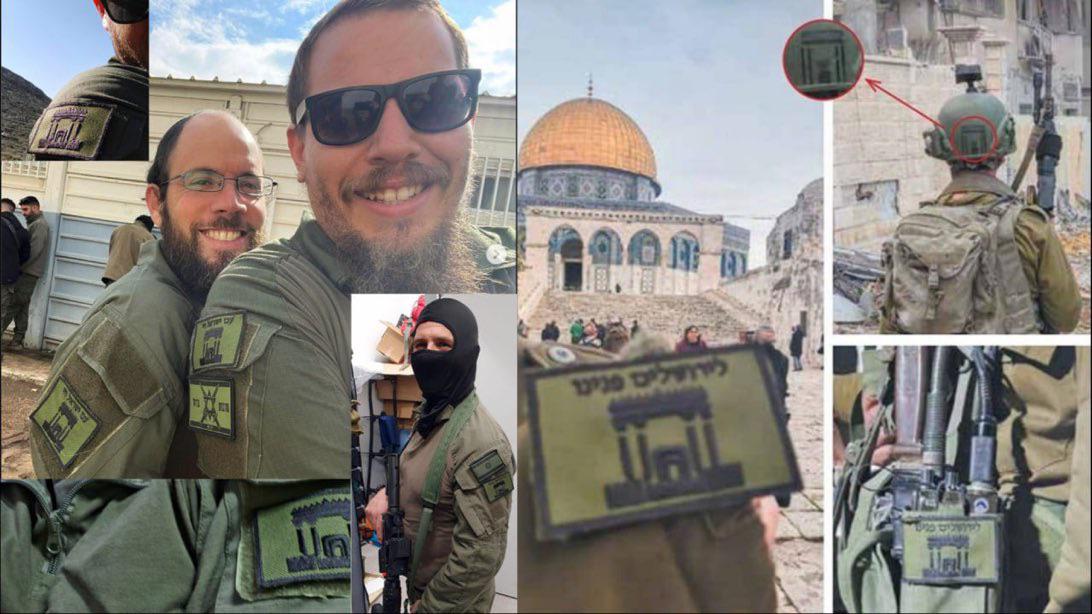
Among the familiar sea of Israeli flags at the Jerusalem Day Flag March last month, another symbol caught my eye: a light-blue banner bearing the image of the Temple Mount, known to Muslims as the Al-Aqsa Mosque compound or Al-Haram Al-Sharif. It appeared again and again among the roughly 70,000 young religious-nationalist men and women who took part in the annual procession celebrating Israel’s conquest of the city in 1967.
For Jerusalemites like myself, that symbol is nothing new. It is plastered throughout the city — on cars, signposts, and bus stops — often accompanied by the slogan: “We face the Temple.” A few months ago, I even came across a photograph of the same icon on a mock road sign along a major West Bank highway directing travelers toward Jerusalem, one of dozens placed by Temple activists across the country.
Yet the proliferation of the symbol at this year’s march reflects the growing mainstreaming of the Temple Mount movement within Israel’s religious-nationalist camp. To understand this convergence, it is worth recalling how the Flag March came to stand at the center of the national-religious experience of an entire generation of Israelis.
Although the first procession took place in 1968, soon after Israel’s illegal occupation of the West Bank, Gaza Strip, Golan Heights, and East Jerusalem began, for decades it remained a relatively peripheral event within the religious-Zionist sector. In the early 2000s, however, a new dimension of the march became central to public discourse around it: violent attacks on Palestinians and their property in Jerusalem’s Old City.
That violence, which has only grown over time, unfolded within a broader political context. The Camp David summit of July 2000 collapsed in part over disputes around sovereignty in Jerusalem and the future of the Temple Mount — namely Israeli demands for a Jewish prayer area at the site and continued Israeli sovereignty over parts of East Jerusalem.
The summit’s failure, followed by Ariel Sharon’s highly provocative visit to the compound in September 2000, helped trigger the outbreak of the Second Intifada. Sharon became prime minister in January 2001 and went on to lead the military campaign that, by 2002, had dismantled much of the Palestinian Authority’s governing and security infrastructure.
Since the collapse of the peace process, the Israeli right in general — and the national-religious camp in particular — has increasingly placed the Temple Mount at the center of its political project. The goal has been to alter the status quo established in June 1967, one of whose central principles is the prohibition on Jewish prayer at the site, and ultimately to divide the compound into separate Muslim and Jewish areas of worship, following the model Israel imposes at Hebron’s Cave of the Patriarchs/Ibrahimi Mosque.
On the Temple Mount, partition would mean overturning an arrangement that has endured for roughly 1,300 years, in which the compound has functioned as an exclusively Muslim place of worship. For Palestinians, the fear is that such a move would become a step toward erasing Al-Aqsa Mosque as a Muslim place of worship and replacing it with a Third Temple.
The growing prominence of the Flag March, then, and the rising violence against Palestinians that accompanies it, cannot be separated from the political ascent of Israel’s religious-nationalist right, the growing influence of the Temple Mount movement, and the intensification of the struggle over sovereignty in Jerusalem.
Marching in uniform
Over the past two decades, in which the Flag March became what it is today, a significant sociological shift has taken place within the Israeli army. Growing numbers of conservative and national-religious youths have passed through pre-military academies and yeshivot that combine military preparation with intensive ideological education. Many arrive in elite combat units with an explicit sense of mission, encouraged by rabbis, educators, and ideological institutions to reshape the army from within and place religious-nationalist values at the center of Israeli state power.
Today, many of those who take part in the Flag March each year go on to become combat soldiers. Indeed, the genocidal war the Israeli military is waging in the Gaza Strip has been carried out in part by soldiers who, only a few years earlier, had been participants in the march. The chant “May your village burn,” for years a favorite among the marchers, is now also commonly heard among soldiers in Gaza, while its message is regularly put into practice in the West Bank.
Nor has this shift been limited to the army’s lower ranks. While the religious-nationalist sector now constitutes the dominant social force in Israel’s ground forces, its influence is increasingly evident in the air force, navy, intelligence services, and security establishment as a whole.
It has also reached the ranks of commanders and senior officers — including major generals, the second-highest rank in the Israeli army. David Zini, appointed head of the Shin Bet in 2025, is one such figure: His formative years were shaped by institutions associated with Rabbi Zvi Yisrael Thau, the spiritual leader of the far-right, anti-LGBTQ Noam party, before he went on to study at Yeshivat Shavei Hebron in the Kiryat Arba settlement, an institution that places strong emphasis on assuming leadership roles in the army.
The Temple Mount movement, too, is no longer confined to activist organizations and religious institutions. Recent reporting from Haaretz showed that Israel Police has begun actively recruiting religious-nationalist Temple activists to serve in the Temple Mount Unit, the force responsible for policing the Al-Aqsa Mosque compound. One unit commander circulated recruitment messages in right-wing and settler social media and WhatsApp groups advertising favorable employment conditions, inviting applicants to participate in what he described as “implementing sovereignty” on the Mount.
This is not just the work of activists entering state institutions from below. Another recent report revealed that Netanyahu has empowered National Security Minister Itamar Ben Gvir to oversee arrangements at the Temple Mount — a sign that the ongoing erosion of the status quo is sanctioned from the highest levels of government.
This institutional shift is accompanied by a broader ideological one. Across the media, politics, and the military, biblical language has been repeatedly deployed to justify the dehumanization, killing, and displacement of Palestinians. Soldiers on the ground, meanwhile, have openly described the rebuilding of the Temple as a motivation behind their actions.
The violence that has become emblematic of the Flag March — fueled in part by Temple-centered ideology — has thus expanded far beyond the streets of Jerusalem. It now extends into Gaza, the West Bank, and southern Lebanon; through Israeli air power, it reaches Beirut and Iran as well.
A flag for a new political order
None of this is coincidental. The war that began on October 7 is not merely an enraged response to Hamas’ war crimes; it reflects deeper political dynamics whose effects are visible on multiple fronts.
The escalating violence against Palestinians in the West Bank, and the forced displacement of rural communities, are not the crimes of a marginal extremist fringe, as right-wing politicians often claim. They are state-backed policies of directed expulsion, carried out by agents of the state. Among those implementing them are religious nationalists whose Temple flag flies at outposts alongside — and increasingly in place of — the national flag.
That flag has come to signify something that extends far beyond the Temple Mount itself. It has become a shared symbol for a broad political camp, stretching from committed Orthodox activists to national-religious communities, conservative traditionalists, and many secular or non-observant members of the Israeli right. Its growing visibility at the Flag March, on cars, along roadsides, and at settlement outposts reflects the emergence of a common political language that cuts across older religious and social boundaries.
Anyone following Jewish-Israeli activity on the Temple Mount — including Ben Gvir’s highly publicized visits — can see the breadth of this coalition. Those ascending the compound increasingly include ultra-Orthodox Jews praying alongside religious nationalists, despite opposition from their own rabbinic authorities. The trend also encompasses Chabad Hasidim, whose yellow Messiah-and-crown flag has become a popular patch on the uniforms of soldiers with no direct connection to the movement itself.
In the broader Jewish-Israeli public sphere, the practice of wearing four long tzitzit visibly outside one’s trousers has undergone a similar transformation: from a signal of religious observance into an identity marker associated with a wider political and cultural camp — the camp represented by the Flag March and the Temple icon.
Yet the Temple flag does not carry the same meaning for everyone who waves it. For many, it expresses a vague attachment to Jewish sovereignty, religious identity, and national revival. For a more radical current, however, it signals the belief that the State of Israel, in its current form, has exhausted its historical mission. This current emerged with particular force after the 2005 disengagement from Gaza, when many religious-nationalist activists concluded that the state had betrayed its sacred purpose.
In their view, Israel can no longer be redeemed from within; it must be replaced by a different political order. Their ambition extends beyond securing Jewish prayer rights on the Temple Mount. It envisions a comprehensive transformation of the state itself: the construction of the Third Temple and the emergence of a Jewish theocratic order centered around it.
This is why the Temple icon cannot be understood merely as an expression of religious devotion. It is a declaration of political intent — a statement about the future that significant sectors of Israeli society now imagine and seek to build.
Over the years, the Flag March has served as a barometer of a broader radicalization whose assumptions have moved steadily into the mainstream. The growing prominence of the Temple flag marks another stage in this dangerous process.
https://www.972mag.com/israeli-right-flag-march-temple-mount-movement/
r/ThirdTempleMovement • u/Common_Time5350 • 20d ago

Filmed in the Old City of Jerusalem, this ground-breaking documentary investigates the research of renowned Biblical archaeologists, Bob Cornuke, David Sielaff and Earnest L. Martin who claim that Solomon and Herod's Temples never stood on the Haram al Sharif, also known as the Temple Mount. If they are right, then there is nothing to stop the Jewish people building their long awaited for Third Jewish Temple in the actual site where the Temples once stood. But is tradition too strong? We'll see.
r/ThirdTempleMovement • u/alertthedirt • 20d ago