r/TigersofIndia • u/Plenty_Chemistry8610 • 3h ago
Video Sanjay Dubri: Trishul making the most of a sunny day.
166
Upvotes
Credits: ishu_sanjay_dubri
r/TigersofIndia • u/StripedAssassiN- • Aug 20 '26
I’m making this to put to bed the constant, never ending skirmishes in this sub about tiger size. Are there other charts floating around? Yes. Do they have a higher average? Yes. Are they reliable? Maybe-maybe not, that’s up to you to decide.
This is not gonna be a long post because quite frankly I cannot be bothered getting into another toxic debate regarding big cat (particularly Lion and Tiger) sizes. It is common knowledge that the average Bengal Tiger weighs around 200kg, give or take. Averages are not set values, depending on new weights added, they will either go up or go down.
TLDR; Bengal Tigers do not average 20-30kg more than Lions. Data compiled by GauteGojira through written, peer reviewed scientific sources put male Bengals at 196-210kg or so, depending on the sample size.
I will also show why Gaute’s data is not simply biased to favor larger individuals below. He removes data he deems unreliable, even if it will consequently lower the average, so simply put he is not a biased individual.
January 2022
His sample size of 31 male Bengals weighed by scientists in the Indian subcontinent, confirmed and published found 214kg. See below:

However, his much larger dataset, puts male Bengals at a 201kg average from 182 individuals:

Also, notice he has 34 male Amur tigers weighing at 200kg (this likely involves weights that were not completely verified) however his most recent dataset as of December 2025, has them weighing 190kg. Again, if information on a weight is not deemed reliable, he removes it.
April 2022
Upon more finds of weights that have been confirmed and published, he calculated a 199.7kg including Sundarbans, from a sample size of 198 tigers. Without the Sundarban tigers, the average was found to be 202.1kg from 192 tigers. This is his most recent dataset on Bengal Tigers. See below:

I have already explained by Gaute’s data does not rely on personal communication, but only published and verified weights of Tigers in my post “Body size of the Amur Tiger” on r/TigersoftheWorld.
All in all, it’s generally accepted that male Bengal Tigers average around 200kg and females average around 130kg.
r/TigersofIndia • u/StripedAssassiN- • Jun 09 '26
Recently I’ve come across certain users online making posts and comments, claiming that Terai (North Indian and Nepalese) Tigers predominantly take livestock and thus are “fat”, with their weights being “inflated”. As expected, they do not have any sources or scientific data to back up their claims and when asked for this, they tuck tails and run. Well, I’m here again to put an end to the blatant misinformation they love to spread.
We’ll be going over all the available scientific studies I’ve gathered that not only says otherwise, but I’ve yet to come across a study on Terai tigers where THE MAJORITY of their diet came from livestock. There was NOT A SINGLE study I found in the Terai Arc that pointed to this. This won’t be as long a post like the one I made showing the importance of large ungulates in their diet, but it’ll still be lengthy. For users who aren’t into reading much, I apologize.
Starting off with study 1:
A comparative study of the diets of tiger (Panthera tigris tigris Linnaeus, 1758) and leopard (Panthera pardus fusca Linnaeus, 1758) in relation to human- wildlife conflicts in and around Chitwan National Park, Nepal.
Source: https://media.rufford.org/media/project_reports/20823-1%20Masters%20Thesis.pdf
This study was conducted from January-May 2017, in both the core, buffer and forest corridor zones. Results showed that Tigers preyed predominantly on wild ungulates (97.04%), with the main prey species being Sambar deer (22.96%), Chital (37.04%) and Wild Boar (17.04%). Livestock contributed an insignificant amount (2.96%). As evidenced here, livestock made up a higher amount in Leopard diet (13.21%) than the Tigers. However, you won’t see these very people claiming that Leopard weights are “inflated” or that they’re “fat”, no. They won’t go around saying that Leopard weights should be “10-20kg less” because of this. Funny how this ONLY applies to Tigers right? The hypocrisy never ends.

On another note, this study further cements the Tiger’s macro predatory nature. Despite the Chital population density being insanely high (88 individuals/km2), only Sambar deer was preferred. This is not surprising as Sambar deer can be equal or up-to twice a Tiger’s size. Gaur were also preferred however the sample size is very small because Gaur do not have an established, healthy population in Chitwan.
Here are some quotes taken from the study:
“Our statistical analysis suggests that Tigers PREFER MEDIUM-LARGE SIZED PREY such as Wild Boar, Sambar deer and Gaur.”
“Sambar is preferred by Tigers only in the corridor area, whereas Wild Boar and Gaur are preferred by Tigers in the core area.”
“The results of this study suggests that the main bulk of Tiger diet consists of Chital (36.50%) and Sambar (22.63%). However, out of these 2 prey species, only Sambar is preferred.”
Moving on to study 2:
Inferring patterns of sympatry among large carnivores in Manas National Park – a prey‐rich habitat influenced by anthropogenic disturbances.
Again, this study found NO livestock in their diet, with Tigers feeding ONLY on wild ungulates. Over 60% of their diet consisted of large sized prey items. These being Sambar deer (34.75%), Gaur (11.86%), Wild Water Buffalo (6.78%) and Swamp Deer (5.93%). This is the first study I’ve come across that documents Wild Water Buffalo in Tiger diet. I hope there can be studies conducted on Kaziranga Tigers soon, as it would be interesting to see their dietary biology there.

Interestingly, despite these giant bovines making up almost 20% of Tiger diet, the big cats opted for the giant cervids instead. It seems like North Indian Tigers are cervid specialists as opposed to being bovine specialists, like their Central-South Indian and Indo-Chinese counterparts.
Study 3:
What drives prey selection? Assessment of Tiger (Panthera tigris) food habits across the Terai-Arc Landscape, India.
Source: https://academic.oup.com/jmammal/article/104/6/1302/7241439
510 scat samples were collected in this study. While here Tigers took livestock more often than other areas (an average of 9.54% over both landscapes), they still preyed predominantly on WILD ungulates (91.46%).
Again, medium-large wild ungulates dominated. Chital made up 36.33%, Sambar deer 23.67%, Nilgai 13.25% and Wild Boar 10.07%.

Study 4:
Food habit of Tiger (Panthera tigris) in Tropical Moist Deciduous Forest of Dudhwa National Park, Uttar Pradesh, India.
In Dudhwa, again wild prey made up the majority of Tiger diet. Livestock only contributed 7.97% in winter, 11.29% in summer and 15.63% in the monsoon. It seems like Terai tigers are medium-large cervid specialists, with the medium sized Chital and the roughly large Wildebeest sized Swamp Deer (140-280kg) making up the majority of their diets. Swamp deer was taken more often in winter (27.54%) compared to Chital (26.90%). In Summer, Chital made up 44.65% compared to the Swamp Deer’s 15.58%.

Study 5:
An Insight Into the Diet and Prey Preference of Tigers in Bardia National Park, Nepal
Source: https://journals.sagepub.com/doi/epub/10.1177/1940082918799476
Livestock was only found one time, in which a male Tiger was seen taking down a domestic buffalo. Tigers as usual took mainly wild prey.
Study 6:
Establishing an empirical benchmark of livestock loss for managing human–tiger coexistence.
Source: https://www.sciencedirect.com/science/article/pii/S0006320726001540
Last but not least, this paper went over every single scat based dietary study from 2000-2025 (a total of 43 studies across 8 countries). They found an average biomass contribution from livestock to be 7.4%, again an insignificant amount.
Of the 43 studies, only 2 found livestock making up the majority of their diet: Buxa and Bhutan. That’s it.
All in all, no evidence suggests that Tigers in Northern India-Nepal are larger because they "predominantly take livestock". In fact livestock, represents a minimal part of their diet. It seems much more logical that the vast, almost untouched land in the Terai Arc provides refuge to healthy populations of medium-large ungulates, especially cervids which the Tigers there exploit.
r/TigersofIndia • u/Plenty_Chemistry8610 • 3h ago
Credits: ishu_sanjay_dubri
r/TigersofIndia • u/AdWarm2498 • 2h ago

Credit to Tublu Chatterjee. Thanks to my friend Ke'Arvy Strong for finding these images.
1-8: Banka, he was the ruler of Tala zone from 1984 till 1990 before Charger showed up. He fathered the first 2 litters of Sita
9-11: Young and aggressive Charger in his prime. He ruled Tala from 1990 till early 2000. He sired 4 litters of Sita and had at least 7 more mates.
12, 13: Takdir, he was a son of Charger from Sita's 3rd litter (first litter of Sita sired by charger)
14, 15: Young male named Bhagoda, he fought Charger in 1996 and injured Charger's eye. Unfortunately Bhagoda was never seen after this fight
16, 17: Balram, he was a son of Banka from Sita's 2nd litter.
18: Dau, the brother of Balram
19, 20: Legendary Sita. She was born on Sita Mandap to Daddy and old Sita Mandap female in 1982. She had 6 litters over the course of 10 years from 1986 till 1996. She was poached in 1999, her skin was recovered. However, today all tigers in Bandhavgarh are descended from her.
r/TigersofIndia • u/tan-doori • 5h ago
r/TigersofIndia • u/Unusual-Citron-7963 • 6h ago

He was the father of KZT 022, KZT 023, and KZT 024 males. KZT 023 had a legendary son called KZT 085 whose lineage still remains strong today.
r/TigersofIndia • u/StripedAssassiN- • 15h ago

Credit: Rahul Priyadarshi
r/TigersofIndia
•
u/StripedAssassiN-
•
1d ago
r/TigersofIndia • u/Plenty_Chemistry8610 • 1d ago

Credits: rashisharma.wildlife
r/TigersofIndia • u/AdWarm2498 • 1d ago

Credit to Mainak Roy, Sai Shankar, Treks and Trails on FB, Prasanna Subramanian, Abhishek Godbole, RYK on FB, Krishna Kumar Tekam, Shilpa Samith, Vijayrajan Muthu and few I can't remember names of unfortunately (I'm sorry, I wrote only the names I could recall. Please DM for credit)
2 years after Old Thinstripe male migrated to Mukki, a new Thinstripe-like tiger was seen in Kanha zone. He was tagged KTR-T3 and named Thinstripe-2. He always wanted to become the king of Kanha, but that never happened. He first appeared during the reign of Munna and mated with his alleged daughter Parsatola female, though all the cubs died. After Munna's capture, Red Eye male took over. But soon enough Red eye was pushed away by Bajrang. Bajrang didn't tolerate Thinstripe and fought and injured him badly in 2017 (pic 3-7 of him resting after the fight) and likely too banished him from Kanha. It is said that he most certainly didn't stay in Kanha after T36 Bamhani Dadar male arrived.
It should be worth noting that both times a tiger from Pench came to conquer Kanha, he was soon humbled by a descendant of Limping male.
For Old Thinstripe, he was humbled by the 4 year old Umarpani male, son of Munna and grandson of Limping male. He was also humbled again by Kankata, alleged son of Limping male, and his own mate Choti mada who teamed up with Kankata, Choti mada herself was a daughter of Chain male and Badi mada and hence paternal granddaughter of Limping male and maternal granddaughter of Gaur Singh.
For Thinstripe-2, he was humbled by Bajrang, son of Kankata and grandson of Limping male.
r/TigersofIndia • u/AdWarm2498 • 1d ago

Credit to Amit Kher
Sita was born in 1982 to old Sita Mandap female and Daddy male. She allegedly had a lookalike sister who migrated to Bhadrashila area and later drowned in a flood. Over the course of exactly 10 years from 1986 to 1996, she had 6 litters from Banka and Charger. Today, every single tiger in Bandhavgarh is a descendant of her.
r/TigersofIndia • u/StripedAssassiN- • 1d ago
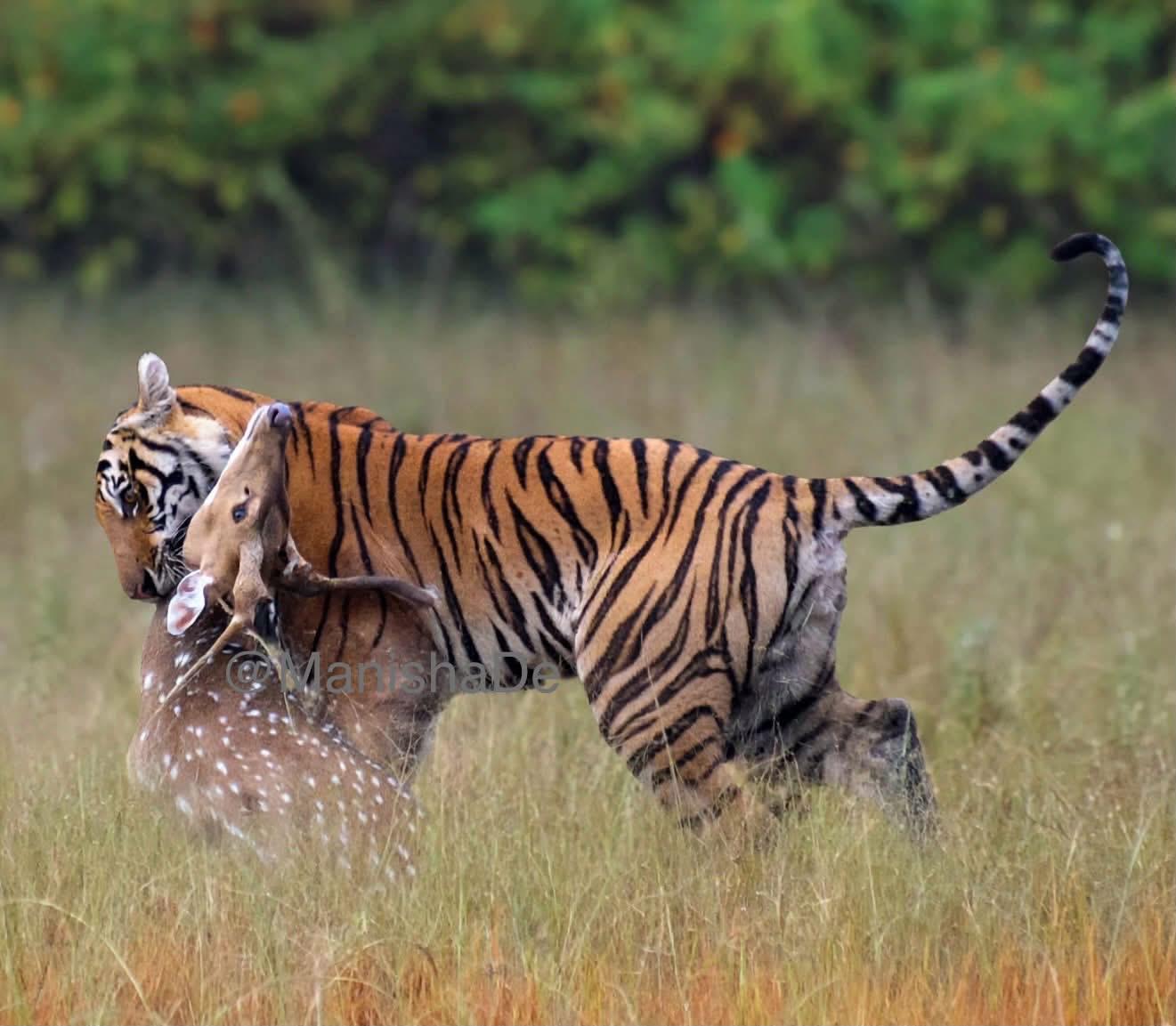
Credit: Manisha De
r/TigersofIndia • u/StripedAssassiN- • 2d ago
Credit: Kaku Saikia
r/TigersofIndia • u/AdWarm2498 • 2d ago

Credits to Guddu Khan, Sahil AK, Indrajit Latey, Richardwells photography, Vinod Ayam, few I forgot (I am sorry I am forgetting some original photographer's names, please DM for photo credit).
Old Thinstripe male or Thinstripe 1 was a large male from Kanha. He had migrated into the Mukki zone in 2010 and was called Pench male or Thinstripe for his Pench Charger line-like or Un-kanha-like thin stripes. He was allegedly camera trapped as a cub in Pench, which confirmed this. After coming in he soon killed Chain male, the dominant male of Mukki at that time, and ruled Mukki zone for 4 years. He was believed to be a descendant of T1 Charger of Pench. In Mukki he mated with the Mahavir female (Thinstripe with Mahavir female in pic 16) fathering Umarjhola female aka Tedi Poonch and Zila line aka District line female. He also mated with Choti Mada (Chain male's daughter) and was the father of T34 Chimta female and legendary T27 Dhawajhandi female. As photographer Sahil AK said, he terrorized and mocked the "kanha breed" for 4 years and showed the power of the Pench T1 Charger line until September 2014 when Umarpani male showed him the power of the Kanha Limping male line (chain male and munna were said to be brothers born to old indri female and Limping male, Munna father of Uma). Later at Babathenga lake (pic 9, 10, 11) Thinstripe's mate Choti mada betrayed him and helped Kankata, yet another alleged son of Limping male, defeat Thinstripe and forever banish him from Kanha National Park.
r/TigersofIndia
•
u/grumpydogfather
•
2d ago
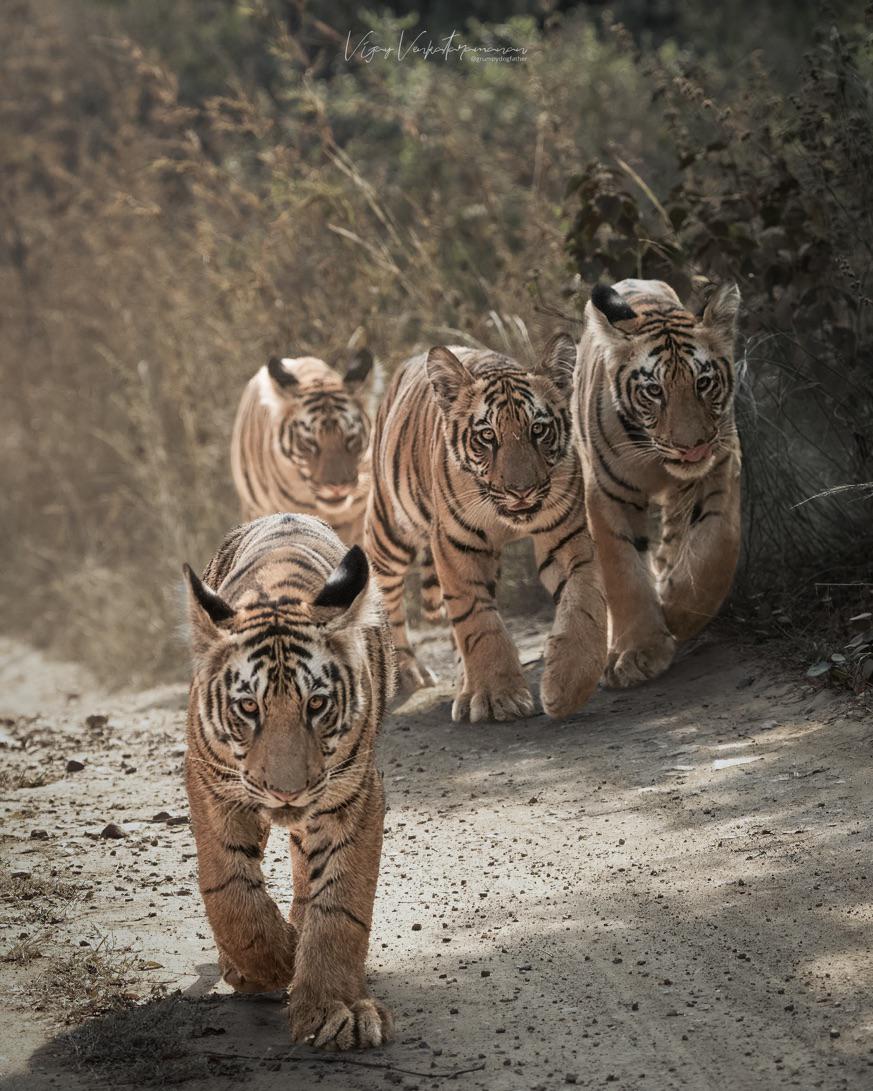
I’m placing my bets on the one leading this little procession. There’s something about the way this cub carries itself that makes me think we’ll be hearing a lot more about it.
These are F2’s four cubs, and they have some pretty big pugmarks to fill. Their mother, daughter of Fairy and believed to be fathered by Surya, has already successfully raised a litter of five cubs to adulthood. I had the opportunity to witness the final chapter of that journey when I saw her disperse the last of them.
Gothangaon has proved to be an important breeding ground for tigers. Its mix of dry deciduous forests, undulating terrain, water bodies and a healthy prey base makes it a wonderful habitat for raising cubs. F2 is a fine example of just how productive this landscape can be.
Four cubs, four personalities, and a whole forest waiting to be explored. For now, they’re growing up under the watchful eye of a rather accomplished mother.
Let’s see if my prediction about the little leader comes true!
Date Photographed: Nov 17, 2026
Gear: Sony A7III with 200-600mm f5.6-6.3 GOSS
EXIF: ISO 400 | 200mm | -1ev | f8 | 1/1000s
r/TigersofIndia • u/StripedAssassiN- • 2d ago

Credit: Dia Mmirani
r/TigersofIndia • u/StripedAssassiN- • 3d ago
Credit: Durgesh Sonwane
r/TigersofIndia • u/StripedAssassiN- • 3d ago

Credit: studiofelidaehub @ Instagram.
r/TigersofIndia • u/AdWarm2498 • 3d ago

Credit to Rajarshi Banerji, Ravi Naidu, Sandeep (something, sorry I forgot surname), Raghunadhan Kulkarni and a few people whose names I forgot unfortunately (please dm for credit).
Banda sr was first spotted in the Kanha meadows in 2002. Back then, Bhura sr was the dominant male of Kanha. Banda soon pushed out Bhura and likely killed his son Bhura jr (Link 9 male). He ruled the Kanha meadows for 6 years. He was radio collared by Dr. Y.V Jhala for his research, where he allegedly weighed 288 kg. Banda had at least 8 cubs, namely:
From Sonapani female: Umarpani female, Umarpani female's unnamed sister, 3 cubs from Sonapani female's next litter
From Chuhri female: Chuhri male (siblings unknown)
From Old Link 7 female: Jr Banda 1 (collared) and Jr Banda 2
Banda went missing in 2008 after being defeated by Munna, but he still remains known as Umarpani male's maternal grandfather. His blood still runs in the park in his great granddaughter, Sharmili.
NOTE: I WILL NOT ENTERTAIN ANY COMMENT WHICH DOES NOT BELIEVE THE 288 KG FIGURE. KEEP YOUR OPINIONS TO YOURSELF.
r/TigersofIndia • u/grumpydogfather • 3d ago

We were barely 45 minutes into the jungle on this morning when news came in that F2 and her cubs had been spotted outside the Gothangaon gate, crossing the main road. And here I was looking for them inside the reserve. By the time I managed to run out there, most of the family had crossed. One little cub was still waiting, hesitant to make the crossing. This is the moment it finally decided to take the plunge.
I’m happy to see all four cubs looking healthy and doing well. But this photograph also leaves me with a rather uncomfortable feeling.
It’s a reminder of just how dangerously close our worlds are getting. A tigress confidently taking her cubs across a busy public road. People standing remarkably close to photograph them. Both sides seemingly becoming increasingly accustomed to the other’s presence.
Fear, or perhaps more appropriately, a healthy respect and distance between humans and tigers, is essential for the safety of both. When that disappears, the consequences can be tragic.
India has made remarkable progress in bringing its tiger populations back. But protecting tigers isn’t just about increasing their numbers. It is equally about protecting and expanding the forests they need to survive. As habitats shrink and become fragmented, encounters like this will only become more frequent.
It’s wonderful to see these little ones growing up. I just hope we don’t wait for a tragedy to realise that sharing a landscape requires responsibility from both sides.
r/TigersofIndia • u/Good-Consequence8891 • 3d ago
Enjoy this 15 second reel
r/TigersofIndia • u/AdWarm2498 • 3d ago
Credit to Shariq Hasan
Indri female or Indri-2 was believed to have been a daughter of Limping male and Old Indri female. She was a mate of Konda and had 3 cubs from that litter, 1 female and 2 males. One of those cubs eventually went on to become Indri-3 and later T2 of Panna. Hence Indri-2 was the grandmother to many such as P213 and great grandmother to the Pannalal male.
r/TigersofIndia • u/Plenty_Chemistry8610 • 4d ago
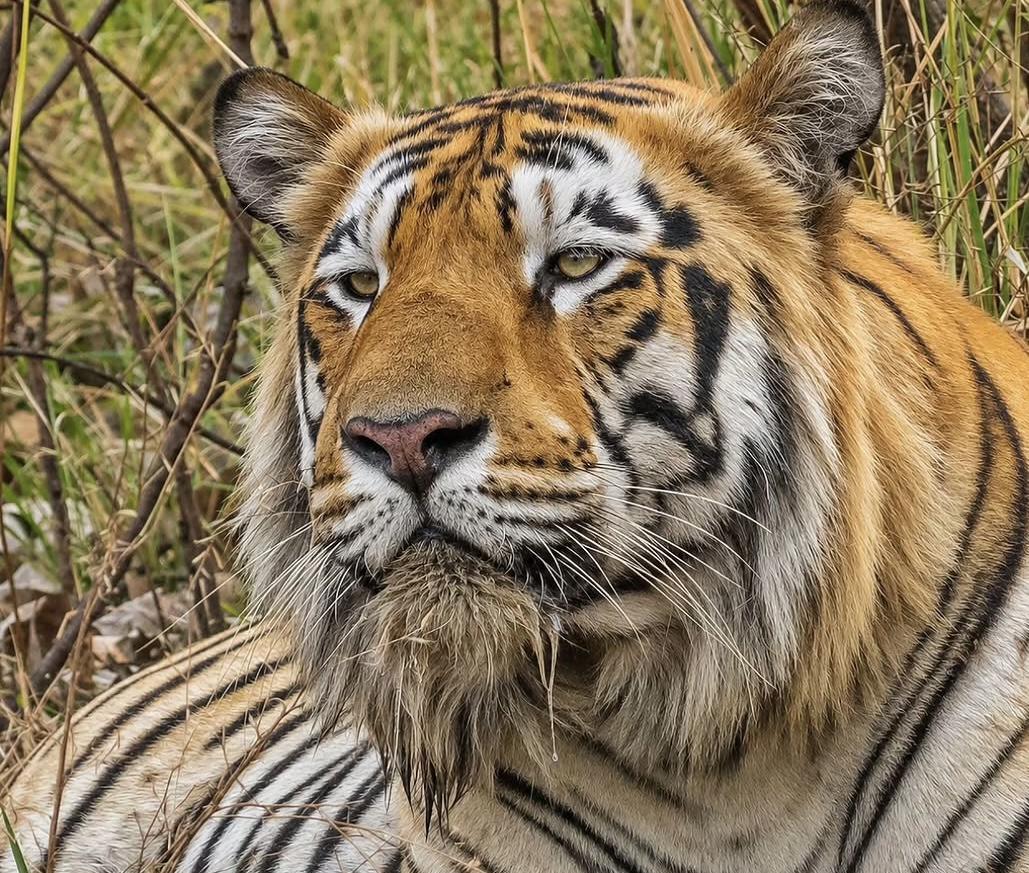
Credits: gcb6819