r/Trotskyism • • 1h ago

WSWS discrepancy in demands on Army's release of a lead dust cloud in Iowa.

1 Upvotes

The two recent WSWS articles about the US Army’s plans to explode a cloud of lead dust across Iowa were excellent. They offered two sets of demands.

Demands from the first article:

"Plant workers and residents in Iowa and Illinois should organize and fight for the following demands:

* Stop the detonation until everything is made public and reviewed independently: the EPA permit, the Army’s assessment, all of its modeling, and why the 2025 neutralization plan was dropped.

* An independent investigation, controlled by workers and residents with scientists they trust, into how the stockpile was left to decay.

* The safest method of disposal, whatever it costs, with full capture of the lead.

* Full pay for plant workers during shutdowns, the right to refuse unsafe work, and safety committees elected by the workers themselves."

Demands from the second article:

"Working people in Iowa, Illinois and Missouri can place no confidence in the Army, the EPA, the courts or either party. They must demand the release of every document on the stockpile and the decision to blow it up, independent monitoring of the air, soil and water, free blood lead testing for every child and pregnant woman in the plume’s path, and cleanup at public expense. That fight cannot be separated from the fight against the wars that produced this poison and the profit system that drives them."

The explosion is not scheduled to happen until two days after the second article was published. The explosion had already been delayed because of public pressure, so it seems to me that the second articles transition to post explosion demands was premature.

I asked Socialism AI about it and got this response:

“That is not a neutral choice of emphasis. It is a political position, whether or not the author intended it as one. It accepts the state's timetable as the horizon of the struggle. The courts ruled, the legal avenues closed, and the article's demands quietly adjust to that fact — as if the working class's power to stop the blast were a function of the legal calendar, which expires when the appeals court rules.

But the first article had already answered this. "These demands will not be won by appeals to the Army, the EPA or either party. They require rank-and-file committees of plant workers and residents." The power to stop the detonation was never located in the courts. It is located in the workers at the plant, who are the ones who would carry it out. The courts ruling does not extinguish that power. It only means the state has exhausted its own procedures and is now prepared to impose the blast by force. That is precisely the moment when the demand to stop it — tied to full disclosure and independent review, to be won through independent organization — is most necessary, not least.

The second article's demands read as if the author has accepted the blast as a done deal and shifted to damage control. That is a retreat from the first article's perspective — a retreat that mirrors, in miniature, the very capitulation the article condemns in the governors and the Democrats, who "asked only that the blast be delayed" rather than opposed.”

Is Socialism AI being too harsh? Did something happen in the editing room where the post explosion demands were posted prematurely?

What do people think?


r/Trotskyism • • 11h ago

History Max Shachtman's 1939 break with Trotskyism and the origins of the DSA

Thumbnail
youtube.com
4 Upvotes

"Every political party has a history. The DSA, and it may come as a revelation for many of you, has its origins in the Trotskyist movement." Watch David North's full lecture, After the Midterms: Results & Prospects, only on the World Socialist Web Site


r/Trotskyism • • 13h ago

The Huang affair, the AI bubble and the divisions within the American ruling class

Thumbnail
wsws.org
10 Upvotes

The reinstatement of Jensen Huang as chief executive of Nvidia on Monday, 11 days after the company’s board forced him out, has exposed both the bitter divisions within the American ruling class and the extraordinary fragility of an economy that rests on the AI bubble.

Nvidia’s shares closed up 31.5 percent on the announcement of Huang’s return to the head of the company, adding some $950 billion to its market value, the largest one-day gain for any company in stock market history. The Nasdaq rose 6.5 percent, its best day since April 2025. The previous week, after the board ruled out his return, the Nasdaq had fallen 10 percent, its worst week since the March 2020 crash at the start of the COVID-19 pandemic. Swings of this magnitude, in both directions and within days, are the mark of a financial system without any stable foundation.

The affair became publicly known on October 29, on the eve of the midterm elections, when the New York Times, relaying classified surveillance through unnamed officials, reported that Huang had been the target of a Chinese intelligence operation through his two-year-long affair with Alice Huang (no relation), who had formerly run Megaspeed, a Singapore data center firm. The Times published some 30 articles in less than a month, supplying most of the “breaking” developments. Huang stepped down on November 12, and on November 17 the board’s new chair declared that it “does not intend to reinstate” him. Record quarterly revenue of $115.8 billion, reported the same day, failed to halt the slide in Nvidia’s shares.

The reversal came after the direct intervention of the White House. The day after returning from his summit with Xi Jinping and Vladimir Putin in Shenzhen, Trump used his November 20 press conference to declare that Huang should “make a big apology and go back.” On Sunday, according to news website Semafor, he dialed into the board’s meeting to argue for Huang’s return. Trump told CNBC on Monday, “I spoke to them and I convinced them,” adding, “it was a lot easier to convince them yesterday than it was a week and a half ago.” What had changed in the interval was the collapse of the market.

Nvidia is a company of strategic importance for the ruling class. In a column published November 20, the day of the market collapse, the Financial Times**’s Gillian Tett called it “the quasi-central bank of AI.” By her count it has provided some $100 billion in equity investments and more than $530 billion in off-balance-sheet guarantees and lease backstops to its own customers, which in turn buy its chips.**

Tett compared Nvidia to AIG (American International Group), which became the hub of a web of interlocking, circular and half-hidden trades leading up to the 2008 Wall Street crash. Citing the Bank for International Settlements, she asked what happens to the rest of the industry if Nvidia stops playing this role. With tech investment accounting for two-thirds of US economic growth this year, according to Apollo figures she cites, the removal of the man whose word underwrote this web of circular deals threatened to bring it all down.

...

The Democrats owe their congressional majorities to a wave of opposition to the war against Iran, the rising cost of living and social inequality. Their response has been to pledge collaboration with Trump, while attacking him for “appeasing” both China and Russia. Leading Democrats have ruled out using the December 11 government funding deadline to stop the war against Iran and ensured that the impeachment of War Secretary Pete Hegseth was buried. When the Democrats take their majorities on January 3, their central priority will be the escalation of the drive to secure American global dominance.

Much of this conflict is taking place behind closed doors and can only be inferred from the course of events. But the affair has laid bare a deep rift in a ruling class whose industrial, technological and financial interests pull in different directions, and which is unable to resolve its own deepening crisis. Every initiative it takes comes at a heavy price.

The working class has no stake in which one of these reactionary factions prevails. But the divisions themselves are of immense significance. In The Collapse of the Second International, written in 1915 amid the slaughter of the First World War, Lenin identified as a mark of a revolutionary situation “a crisis, in one form or another, among the ‘upper classes,’” which opens “a fissure through which the discontent and indignation of the oppressed classes burst forth.” A ruling class that cannot agree on how to wage war against China, and whose markets tremble at the fate of one executive, is preparing to impose the costs of war and economic crisis on the working class.

Yet the technology at the center of this speculative frenzy holds immense revolutionary potential. AI systems are now contributing to mathematical and scientific breakthroughs almost every week, resolving problems that had defied human effort for decades.

Under capitalism, these powers are subordinated to the enrichment of the financial oligarchy and the preparation of war. But the same crisis that has fractured the ruling class is setting the working class in motion. Workers and youth are entering into struggle across Europe in mass protests and nationwide strikes, and a process of political radicalization is underway in the United States.

The objective logic of this movement brings it into direct conflict with the financial oligarchy and both of its parties. It places before workers the task of taking the productive forces, including the technology monopolies, out of the hands of the oligarchy and placing them under public ownership and workers’ control, as the Socialist Equality Party’s resolution “AI and the fight for socialism” explains. And it unites workers across national borders, including in China, in a common struggle against imperialist war and for socialism.


r/Trotskyism • • 13h ago

Their Debs and ours: A review of <em>American Socialist: The Life and Legacy of Eugene V. Debs<em>

Thumbnail
wsws.org
6 Upvotes

Shawn Gude. American Socialist: The Life and Legacy of Eugene V. Debs. New York: Simon & Schuster, 2026. ISBN 978-1-6680-5673-8** 

At the conclusion of his new biography of Eugene Debs, Shawn Gude, former senior editor of Jacobin, attempts to link the founding figure of American socialism to Vermont Senator Bernie Sanders, the Democratic Socialists of America (DSA), New York City mayor Zohran Mamdani, and even to Shawn Fain, the corporatist bureaucrat who presides over the United Auto Workers. 

Gude writes,

"The two presidential campaigns of Bernie Sanders… revitalized [Debs’] tradition, spurring the rebirth of the Democratic Socialists of America (DSA), the institutional descendant of Debs’s Socialist Party. When Zohran Mamdani won the mayorship of the nation’s largest city in November 2025, he began his victory speech by quoting Debs: “I can see the dawn of a better day for humanity.” A Socialist mayor of a city of 8 million people! … As I write, more than two hundred democratic socialists hold public office across the US… United Auto Workers president Shawn Fain is a fiery blue-collar worker from Indiana and a democratic socialist in all but name…"

Debs would be horrified. 

In Gude’s telling, the legacy of this great revolutionary figure amounts to a pipeline of candidates and officeholders working within the Democratic Party and the union apparatus. Gude, in other words, “honors” Debs by enlisting him in the service of the very institutions he spent his life trying to tear down. It would be akin to a biographer of Lincoln locating his legacy among the Jim Crow Democrats who overthrew Reconstruction. 

The life of the real Eugene Victor Debs (1855-1926) does not support Gude’s project. From the time of his jailing after the great Pullman Strike of 1894 by Democratic President Grover Cleveland until his imprisonment at the hands of another Democratic president, Woodrow Wilson, in 1919 for opposing World War I, Debs repeatedly staked out his position in terms that Sanders, Mamdani and Fain should prefer not to recall. 

Debs opposed imperialist war and any attempt by socialists to accommodate it in the name of “national defense,” saying he would prefer “to be shot for treason” than to vote for war funding. He opposed the “aristocracy of labor” and the “labor lieutenants of capital” that controlled the unions. He demanded that workers “sever all relations with the capitalist parties.” He opposed reformist socialism as “the mask of fraud” authored by “‘reformers’ of chicken hearts” who were “for everybody, especially themselves, and against nobody.”  He was a revolutionist, stating that he “would destroy all enslaving and degrading capitalist institutions and re-create them as free and humanizing institutions.” One could go on. 

Debs’ own words are available, including in Writings and Speeches of Eugene V. Debs (1948) and the three-volume Letters of Eugene V. Debs (1990). Much of this material is freely accessible online. Haymarket Books is also publishing The Selected Works of Eugene V. Debs, edited by Tim Davenport and David Walters, of which four of a planned six volumes have so far appeared 

...

Gude’s book arrives as the DSA, an organization of the affluent upper middle class, surveys a world of mounting opposition to the capitalist order and finds that its own “success” is the source of its predicament. Every city hall it wins binds it to the administration of capitalism. Every paid union post it secures binds it to the apparatus that polices workers. These ties set it on a collision course with the working class. Fearing where that opposition may lead, the DSA reaches for borrowed authority: the legacy of America’s most famous socialist.

To be sure, Gude does not, or cannot, fully conceal the political development of his subject. The main episodes of Debs’ life—the railroad brotherhoods, Pullman, the two imprisonments, the presidential campaigns—are recounted. The problem is what Gude tries to make of it all. 

To yoke Debs to a strategy of realignment within the Democratic Party and the official unions, Gude must tame him. He reduces the struggle over the class character and revolutionary purpose of the Socialist Party to a matter of personality, tone and “tactical dexterity,” avoiding the question of what social forces were involved. The emerging working class found a revolutionary tribune and agitator in Debs. But the vast American middle class found their representatives in the reformists who dominated the party, Berger and Hillquit above all. Gude obscures this antagonism, transforming Debs from a revolutionary fighter into a paragon of moral virtue who suffered for lofty convictions that could never be realized. Gude’s is a Debs that well-to-do liberals can admire, and they have. The book has been warmly received in the New Republic, the New Yorker and the New York Times Book Review. 

His distortions allow Gude to claim in his epilogue that the DSA is the “institutional descendant” of Debs’ Socialist Party. This is a lie. The DSA descends politically not from Debs but from his reformist rivals, along a rightward path that runs unbroken to the present. It is a lineage that runs through the Socialist Party’s reformist remnant to Max Shachtman, who broke with Trotskyism in 1940, ended up supporting the Bay of Pigs invasion and the Vietnam War, and placed his followers in the anticommunist apparatus of the AFL-CIO. It then runs to his protégé Michael Harrington, who founded the DSA’s predecessor on the program of “realignment,” working inside the Democratic Party as “the left wing of the possible.” Debs’ fight for the political independence of the working class was repudiated at every stage.

To test Gude’s claim that the DSA represents Debs’ political estate, and to answer the question it raises—who are his real heirs?—one must set his actual life against the biographer’s account of it, beginning with the world that made him.

...

To Gude, Debs was too strident, too hostile to the AFL leadership, too ready to treat compromise as betrayal, and too unwilling to court “would-be allies.” This is precisely the case Berger and Hillquit made against Debs in their own day. In other words, in the central conflict of Debs’ political life, his biographer takes the side of his opponents. That is the precondition for Gude’s epilogue, because only a Debs duly corrected by Berger and Hillquit can be handed down to the DSA.

Of course, Gude’s “tactical dexterity” is hardly in short supply at Jacobin, where the art of distinguishing a compromise from a sellout has been refined to the point of abolishing the distinction altogether! As, for example, when it gave DSA leader Ocasio-Cortez a platform to defend her vote in Congress to impose a contract and block the 2022 nationwide railroad strike as a “difference in strategy.” Gude was then still listed as a Jacobin “senior editor.”

What Gude treats as “rhetorical deftness,” Debs recognized as a danger to the class character of the socialist movement. As the Socialist Party’s vote grew, so did his fear that winning office would become an end in itself. Such a party would court middle-class respectability and the trade union bureaucracy, and once in power would end up administering capitalism rather than fighting it, as it was in Berger’s Milwaukee—and as it is now in Mamdani’s New York.

After Berger’s election to Congress in November 1910 and a wave of Socialist municipal victories, Debs sounded the alarm in “Danger Ahead,” published in the International Socialist Review in January 1911. The party, he warned, was “apt to attract elements which it cannot assimilate,” and might “become permeated and corrupted with the spirit of bourgeois reform to an extent that will practically destroy its virility and efficiency as a revolutionary organization.” 

“To my mind,” he went on, “the working class character and the revolutionary integrity of the Socialist party are of first importance. All the votes of the people would do us no good if our party ceased to be a revolutionary party.” Votes without organization were hollow. “Voting for socialism is not socialism any more than a menu is a meal,” Debs wrote. “Socialism must be organized, drilled, equipped and the place to begin is in the industries where the workers are employed.” Without that organization, “the fruit of any political victories the workers may achieve will turn to ashes on their lips.”

...

In his last years he could not reconcile himself to either side of the split that had seemed to shatter his Socialist Party. He was repelled by the purge carried out in his absence and remained a defender of the Russian Revolution. Yet he could not bring himself to join the communist movement that had grown out of the very left wing he had inspired. 

The early American Communists did little to win him over. Underground and beset by the ultra-leftism Lenin called an “infantile disorder,” they boycotted the 1920 election rather than support Debs’ campaign from Atlanta Federal Penitentiary. By 1924 William Z. Foster, the seminal figure of American Stalinism, was dismissing the old revolutionary as a “sentimentalist.” But Debs never joined the anti-Bolshevik campaign that had become common among surviving leaders of the Second International.

In his declining years, he enjoyed the companionship of writers including Carl Sandburg and Sinclair Lewis. Sandburg, who had carried Lenin’s “Letter to American Workers” from Scandinavia in 1918, became a close friend, visiting Debs at the sanitarium and welcoming him into his home. Debs had withdrawn from political life, though in 1924 the Socialist Party made him its national chairman, an honorific post that lent the diminished organization the prestige of his name, much as Gude’s epilogue now seeks to lend it to the DSA. He died on October 20, 1926, at a sanitarium outside Chicago, still the most famous member of the party that had expelled its revolutionary wing.

To millions, Debs was the Socialist Party. His name was synonymous with it, and his campaigns gave it whatever mass following it had. Yet he could never be fully equated with it, not in its better days and certainly not after its turn to the right. His authority came not from the party machinery, which was always in other hands, but from the workers who saw in Eugene Debs their own cause. Cannon was right when he said that “Debs was in and of the party, but at the same time he was bigger than the party—bigger and better.” 

Above all, Debs stood with the workers, not with the reformists he condemned as “the representatives of middle class interests,” whose influence “the shrewd old politicians of the capitalist parties are not slow to perceive and take advantage of.” The words fit the DSA as well as they did Berger and Hillquit. The organization now claiming Debs descends from the men who fought him for two decades and purged his followers while he sat in prison, and it serves the party of Cleveland and Wilson, which jailed him twice, and from which he urged workers to sever all relations. 

Debs belongs to the workers still.

“I have remained in the ranks with the workers, side by side with them,” Debs told lumber workers in Everett, Washington, in 1912, “and there is where I belong and I am going to remain.”


r/Trotskyism • • 1d ago

WATCH: Socialist Equality Party holds final public meeting ahead of Victorian election

Thumbnail
wsws.org
12 Upvotes

r/Trotskyism • • 1d ago

News Reject the US Steel contract! Build rank-and-file committees to organize a common fight by steelworkers!

Thumbnail
wsws.org
9 Upvotes

Are you a US Steel or Cleveland Cliffs worker? Fill out the form at the end of this article for information on building a rank-and-file committee to oppose the USW sellout contract.

The United Steelworkers bureaucracy announced a tentative agreement with US Steel last week for a four-year contract covering 11,200 workers at 13 facilities across six states. Workers should reject the deal and organize rank-and-file committees at every mill, coke plant and mine to take the contract struggle out of the hands of the union bureaucracy.

Steelworkers should unite with their brothers and sisters at Cleveland-Cliffs, who face a virtually identical contract, and fight for collective strike action with National Steel Car workers in Canada and locked-out BP refinery workers in Whiting, Indiana, and Marathon workers in Martinez, California.

Workers have every reason to be angry. For decades, the steel corporations, with the collaboration of the USW apparatus, have imposed wage concessions, job destruction, forced overtime and speedup. Five workers have died at US Steel and Cleveland-Cliffs facilities in little more than a year, while the corporations rake in hundreds of millions of dollars and their executives accumulate vast personal fortunes.

The agreement comes nearly three months after the previous contract expired on September 1. Throughout this period, the USW kept workers on the job, refusing to mobilize approximately 21,000 steelmaking workers at the two corporations and an additional 3,000 iron ore miners at Cleveland-Cliffs. Separate agreements covering the miners have now been ratified, dividing steelworkers from the miners who supply their mills.

As at Cleveland-Cliffs, the USW is preparing to push through the agreement by mailing workers glossy contract summaries along with their ballots rather than distributing the complete agreement. Workers must go to their local union offices to see the actual text. After months of secret negotiations, the bureaucracy wants workers to entrust their livelihoods, health and safety for the next four years to the very officials who have overseen the destruction of their jobs and living standards.

...

The USW touts the preservation of premium-free healthcare as a major victory. But annual deductibles will rise to $300 for individuals and $600 for families, and emergency room copays to $125. Premium-free coverage does not prevent the company from shifting medical costs onto workers and their families. The union has not published a comprehensive comparison of existing and proposed provisions, including prescription drug costs, coinsurance and out-of-pocket maximums.

Steelworkers spend decades exposed to extreme heat, deafening noise, toxic chemicals and industrial dust. They need comprehensive healthcare throughout their working lives and retirement, not higher medical expenses. The union’s announcement, meanwhile, says nothing about increasing pensions for retirees, whose purchasing power has been steadily eroded by inflation.

The most damning aspect of the agreement is its failure to address deadly working conditions. In little more than a year, these workers were killed at US Steel and Cleveland-Cliffs facilities:

- August 11, 2025: Steven Menefee, 52, and Timothy Quinn, 51, killed in an explosion at US Steel’s Clairton Coke Works outside Pittsburgh. Five other workers were injured.

- July 11, 2026: Mitcheal Nelson, 62, electrocuted while working on a malfunctioning transformer at Granite City Works in Illinois.

- August 13, 2026: Jonathan Stepp, 28, a father of six, killed while operating a slag pot hauler at Cleveland-Cliffs’ Burns Harbor Works in Indiana.

- September 27, 2026: Jeffrey Smith, 53, crushed between two coke oven door machines at Cleveland-Cliffs’ Monessen Coke Plant in Pennsylvania.

The USW’s bargaining updates have largely ignored these deaths. Its announcement of the agreement mentions recent fatalities only in passing, without naming a single worker. More than 15 months after the Clairton explosion, all seven US Chemical Safety Board recommendations remain open. As the World Socialist Web Site reported in August, management’s refusal to halt production to carry out a safer procedure for purging coke oven gas lines exemplified the subordination of safety to production.

The safety improvements the USW touts, including better training for electricians and a process for identifying hazardous locations, are basic precautions that should already be in place. Nothing in the published highlights establishes minimum staffing requirements, limits compulsory overtime or gives workers independent authority to shut down unsafe operations without fear of victimization.

The five deaths are only a fraction of the human cost of steel production. Studies of Pittsburgh-area coke oven workers found extraordinarily high rates of lung cancer. Steelworkers cannot entrust their lives to joint union-management safety programs. They must establish independent rank-and-file safety committees with the authority to halt unsafe production, investigate deaths and injuries, and enforce safe conditions.

...

Steelworkers share the same fundamental interests as workers in China, Japan, Canada, Mexico and throughout the world. To advance their fight for wages, jobs and safety, they must establish their independence from the corporations, the union bureaucracy and both capitalist parties by building rank-and-file committees at every US Steel and Cleveland-Cliffs facility, democratically controlled and answerable to the membership.

These committees will fight for the immediate distribution of the complete agreements, adequate time for discussion and a democratic vote free of USW interference. They will fight for substantial wage increases, full cost-of-living protection, comprehensive healthcare for active and retired workers, pension increases, an end to forced overtime and the protection of every job. Safety committees will fight for unrestricted access to company safety and exposure records, independent investigations of deaths and injuries, and lifetime medical care and income protection for workers with occupational illnesses.

The committees will unite steelworkers and miners across both corporations, including the 2,100 machinists at Cleveland-Cliffs’ Middletown Works and 1,000 UAW members at its Dearborn Works, overcoming the divisions imposed by the bureaucracies. They will prepare coordinated action up to a common strike and mobilize support for National Steel Car workers and locked-out refinery workers. National Steel Car workers have formed their own rank-and-file committee and appealed for a joint struggle with Stelco and US steelworkers. Through the International Workers Alliance of Rank-and-File Committees, steelworkers can establish direct contact with workers around the world.

The productive capacity built by generations of steelworkers must be used to meet the needs of the working class, not to enrich executives or provide the industrial foundation for another imperialist world war. We urge steelworkers at US Steel and Cleveland-Cliffs to contact the World Socialist Web Site to discuss organizing rank-and-file committees and taking up this fight.


r/Trotskyism • • 1d ago

News Michigan autoworkers face wave of layoffs as UAW bureaucracy enforces corporate restructuring

Thumbnail
wsws.org
10 Upvotes

A late-year spike in layoffs and plant closures in auto parts across the state of Michigan and beyond is an expression of a global economic crisis that anticipates a wave of job cuts throughout the automotive industry, and manufacturing more broadly, in the new year. Layoffs and plant closures will hit salaried and hourly workers, union and non-union, from smaller suppliers to major automakers in urban, suburban and rural communities.

The auto-related layoffs announced thus far in Michigan are one expression of a major restructuring taking place in the global automotive industry.

Last week Nexteer Automotive announced hundreds of permanent layoffs at its Saginaw, Michigan complex. The layoffs follow within months of the UAW imposing a sellout contract that workers had previously rejected on three occasions the first by 96.2 percent — and voted 86 percent to authorize a strike, which the UAW refused to call. Laid off workers will be offered a chance to apply for part time positions at $27 an hour, with no vacation or benefits, creating in effect a new low wage tier of workers with few if any rights.

These cuts were preceeded by the announcement by Dakkota Integrated Systems LLC announced of the closing of two of its Michigan assembly and sequencing plants by year’s end, eliminating nearly 470 jobs. The Detroit facility will cut 397 jobs, with an additional 67 jobs cut in Lansing.

Other recent layoff announcements include:

- Inalfa Roof Systems Inc., a manufacturer of vehicle sunroofs, will eliminate 142 jobs by December 14, 2026, with the closure of its North American headquarters and a nearby manufacturing plant, both in Auburn Hills, suburban Detroit. This follows the previous layoff of 127 workers at facilities in the state of Georgia in July.

The layoffs may be related to pressure from the federal government on automakers to eliminate ties with suppliers connected to Chinese state-backed companies. Formerly Dutch-owned, Inalfa was purchased by a subsidiary of Beijing Automotive Group in 2011.

- ADAC Automotive is a Tier 1 supplier of interior and exterior door handles and associated components, founded in 1975. It is owned and operated by the Teets family, and claims to be “woman-owned” since 2012. ADAC is eliminating 98 jobs with the closure of its 90,000-square-foot manufacturing facility in Saranac, a rural community outside Grand Rapids, between December 18, 2026, and June 30, 2027.

- Detroit Chassis, LLC, producer of motorhome chassis, commercial step vans, and complex sub-assemblies, announced 175 “temporary” layoffs beginning December 31.

- Woodbridge Group, a global supplier specializing in polyurethane and foam for automotive seating and other interior and exterior trim and components, announced a “temporary” layoff of 100 workers in the state capital, Lansing, beginning December 18, 2026, due to the loss of a contract relating to retooling at nearby General Motors facilities.

- J.G. Kern Enterprise, Inc., a decades-long supplier of precision CNC machined components to Ford and other automotive and industrial manufacturers, will shutter its nearly 200,000-square-foot facility in Sterling Heights, a northern suburb of Detroit. The permanent shutdown will eliminate 156 jobs, due primarily to the loss of a production contract with Ford. UAW Local 228 officials have remained silent.

- Lear Corporation, a major seating and interiors supplier based in suburban Detroit, announced the closure of a Sterling Heights facility impacting 67 jobs on November 9, 2026. Rather than fully closing the site, however, it will serve as a “blueprint” for the automation of its manufacturing process. CEO Raymond Scott told investors on an October 30, 2026 earnings call, “We expect automation to reduce the conversion cost requirements by 10 percent to 15 percent — the more important story is what this represents strategically.”

In other automotive layoffs:

- General Motors will lay off 350 workers beginning January 14, 2027, across at least two Lansing-area assembly and stamping plants.

- Rugged Liner, a producer of aftermarket truck bed liners, announced the closure of two sites in Owosso, eliminating 90 jobs in the rural community between Lansing and Flint.

The above companies all issued Worker Adjustment and Retraining (WARN) notices to state officials, but Nexteer seeks to artificially decrease its layoff numbers with a scheme to “voluntarily” turn its employees into part-time gig workers with no healthcare or job protections.

...

The mass layoffs now beginning in Michigan are symptomatic of a broader crisis that is spreading throughout the global industry. Schaeffler, the German supplier, announced on November 3 that it would eliminate a net 3,460 jobs across Europe and close five manufacturing sites. Volkswagen and other European automakers and parts suppliers have already announced tens of thousands of redundancies.

The restructuring of the global auto industry is subject in part to the uncertainty surrounding the redivision of the global economy and the metastatic spread of imperialist war that is underway. The electric vehicle (EV) transition is proceeding slower than originally envisioned by automakers. Upheavals stemming from the expansion of AI data centers and imperialist war, both in Europe and the Persian Gulf region, continue to rock energy markets.

Trade war and national protectionism restrict the flow of goods in a transnational production and supply chain. The chief source of instability continues to be the decades-long collapse of the global position of the US and the unsustainable debt that floods its balance sheet.

The layoffs are not a response to “market conditions” but a deliberate transfer of the costs of the global crisis onto the working class, while the corporations retain the socially produced wealth.

For workers to stop the escalating assault on jobs, they must organize independently in rank-and-file committees across local, state, national, and international lines, to assert their independent interest as the only progressive force in modern society. Such a fight cannot be organized by the corrupt union apparatus or the political parties of the ruling class. Workers must fight for a socialist program that organizes production democratically to meet the needs of all.

The ruling class is prepared to upend the entire global economy to retain the socially produced wealth it privately controls. Major shocks are inevitable, but the outcome is not predetermined. The fight to defend jobs must be built as the fight to build the International Workers Alliance of Rank-and-File Committees.


r/Trotskyism • • 1d ago

Italy's general strike: "The workers are the only ones who can stop this" – Voices from Rome

Thumbnail
youtu.be
16 Upvotes

r/Trotskyism • • 1d ago

"Against Trans Vulgar Materialism, For Trans Peoples’ Democratic Rights"

Thumbnail counterattackjournal.org
2 Upvotes

"Amos says capitalism 'emerged from patriarchal class societies'. Since Athena emerged from the head of Zeus, does that mean she is still inside his head? Capitalism emerged from the feudal mode of production, but precisely in so doing it eradicated feudal relations of production, a process that has also been uneven. Marx and Engels put the process plainly in the Manifesto; 'the bourgeoisie, wherever it has got the upper hand, has put an end to all… patriarchal …relations.'"


r/Trotskyism • • 2d ago

History Bernie Sanders falsifies the political legacy of Rosa Luxemburg

Post image
86 Upvotes

In a statement that combines ignorance with historical falsification, US Senator Bernie Sanders on Thursday sought to misconstrue the legacy of Rosa Luxemburg, the revolutionary murdered by the social democratic forebears of Sanders’ “democratic socialism.”

https://www.wsws.org/en/articles/2026/11/21/tsdi-n21.html


r/Trotskyism • • 2d ago

RCP, SWP and the fight against the far right

Thumbnail
workerspower.uk
0 Upvotes

Masked fascists recently tried to storm an SWP meeting in Glasgow. The far right is getting bolder, and the left is arguing about how to respond.

Andy Yorke replies to the RCP’s attack on Stand Up To Racism. Class arguments matter, he says, but they can’t replace an open defence of migrants. He makes the case for local anti-fascist coalitions based in the unions and the community, with their own elected organisers and proper self-defence.


r/Trotskyism • • 3d ago

Retired New York City transit worker speaks on Mamdani, the TWU bureaucracy and the fight for the political independence of the working class

Thumbnail
wsws.org
10 Upvotes

WSWS: You worked closely with Ed Winn. Who was he, and what role did he play in Local 100 and the socialist movement?

AC: Ed Winn was a veteran bus mechanic in Surface Maintenance at the East New York depot and a leader of the Workers League—an extraordinary cadre and perhaps the most politically advanced worker in the country. Elected to the Local 100 Executive Board, Ed opposed the 1980 strike sellout and voted against the settlement.

In Surface Maintenance, workers admired Ed because he was fearless, uncorrupted and never treated grievances as mere technical disputes. I remember sitting with him in a restaurant near the East New York depot when an agitated worker came in after being written up for lateness. Ed told him directly: “You have to be a good worker, show up on time, and deny management any easy pretext to victimize you—and you have to fight for a political alternative, for socialism.” He always connected shop floor defense to breaking with the capitalist parties. Even workers who didn’t fully agree with his politics respected him deeply, and several attended Workers League meetings.

Ed ran as the Workers League candidate for US President in 1984 and 1988, campaigning among transit workers, autoworkers and miners to demonstrate what independent working-class politics looked like. He passed away in 1995.

WSWS: You also ran for union office early in your career. What was your platform, and how did workers respond?

AC: Before completing my first year—while still on probation and most vulnerable to firing—I ran as an independent socialist candidate for the Local 100 Executive Board in Rapid Transit Operations (RTO). Collecting enough signatures to get on the ballot against entrenched bureaucratic slates was difficult, but I campaigned openly on breaking from the Democrats and Republicans to build a Labor Party pledged to socialist policies.

I won roughly 25 percent of the vote among conductors and later won about a quarter of the vote running as an independent train operator for chairman of the motormen’s division. Workers didn’t necessarily agree with our entire program, but they backed someone who stood up to management and the bureaucracy.

From 1982 through the late 1990s, I also sold our party newspaper, The Bulletin (later the International Workers Bulletin), inside transit crew rooms—not just to train crews, but to underpaid car cleaners. Management was furious and posted notices banning literature sales on TA property; someone scrawled “Alan Cherry and Edwin Soto” right beneath the order. Edwin Soto joined the Trotskyist movement as a teenager, became a transit worker in the 1980s and worked in the New York City subway system for more than three decades before retiring in 2020.

After we launched the World Socialist Web Site in 1998, we distributed leaflets on broad political and cultural topics, including dozens of copies of David Walsh’s review of Titanic, which workers read eagerly. It showed them that socialism fought for the cultural and intellectual elevation of the entire working class.


r/Trotskyism • • 3d ago

Thoughts on adding flairs?

11 Upvotes

I've seen this sub grow from just shy of 300 subscribers to just over 2000, and I'd love a customizable option/ ICFI flair especially.

Also, to all the newcomers - welcome! It is an honor to have you with us. It is not easy choosing this path, and I am honored to call you all my comrades. I'm bias but, you don't make it past all the propaganda that "Trotsky = bad" without educating yourselves, fighting opposition from everyone else along the way. Cheers to each and every one of you. You all make for some truly esteemed company.

I can also see the argument against it, more potential camps = more division so I'm curious what everyone else thinks.

All the best!


r/Trotskyism • • 3d ago

Eugene Debs called on workers to break with the Democrats

Thumbnail
youtu.be
19 Upvotes

r/Trotskyism • • 3d ago

General strike in Italy must become International - Katja Rippert in Rome

Thumbnail
youtube.com
22 Upvotes

r/Trotskyism • • 4d ago

Some Questions I Want To Ask About Trotskyism (From An Anarchist Perspective)

10 Upvotes

1.) What measures must be taken to prevent the so-called revolutionary vanguard from simply becoming a new ruling class that dominates the workers?
2.) Wouldn’t Permanent Revolution rely too much on the hope of socialist uprisings not only occurring in multiple places at once, but even succeeding?
3.) Even if there was a successful world revolution, what’s to say that the global workers’ state, instead of voluntarily stepping down and giving up power to the working class, instead keeps making up excuses for why this hasn’t happened yet (stuff like “There are still class distinctions” or “The productive forces need to be developed more”). After all, doesn’t the state usually try to perpetuate its existence?


r/Trotskyism • • 4d ago

North: Bernie Sanders on Rosa Luxemburg

Post image
64 Upvotes

r/Trotskyism • • 4d ago

Theory Do Trotskyism support the idea of personal learning of self defense tactics ?

6 Upvotes

Hi everyone so before reaching the core of my question I have to give a bit of context

I recently came out as a Trans girl. I am a person of color ( family comes from the Middle East ) and I used to be an anarchist before becoming a Trotskyist

As I see the world becoming more and more bigoted toward minorities and with the uprise of fascism
I really began feeling truly scared. I know that I shouldn’t let emotions like fear clouds my judgement but it become increasingly harder

I do not live in the US and my country strictly limit gun ownership.

I know that one of main priorities of Trotskyism is to stay connected with the working class. Because only the working class can overthrow capitalism.

Correct me if I’m wrong but I suppose Trotskyism is opposed to small guerrilla group and is more focused on arming the whole population during the revolution with workers militia

Even with this principle in mind can I just learn self defence tactics and guerilla tactics in case of the emergence of an insurrection or a revolution.

I will also admit that I just do not want to an easy target for transphobe and bigot who want my death

Thanks for reading


r/Trotskyism • • 4d ago

History "In the 1930s, millions of workers struck and seized factories." - David North

Thumbnail
youtube.com
19 Upvotes

Watch the full lecture "After the Midterms: Results and Prospects" by David North, only on the World Socialist Web Site, wsws.org


r/Trotskyism • • 4d ago

News French Youth in Revolt: School Protests Brave Massive Repression

Thumbnail
internationalist.org
1 Upvotes

r/Trotskyism • • 5d ago

Seminário “O marxismo de Leon Trotsky” | 1/4 – Trotsky na tradição marxista [LEGENDADO]

Thumbnail
youtube.com
5 Upvotes

r/Trotskyism • • 5d ago

News General strike in Italy: The struggle against Meloni’s war and austerity policies requires a socialist perspective

Thumbnail
wsws.org
19 Upvotes

On Friday, November 20, a nationwide general strike will take place in Italy against the anti-working-class and militarist policies of the government of fascist Prime Minister Giorgia Meloni. Workers in industry, public services, healthcare and education have been called upon to stop work. Demonstrations are planned in numerous cities.

The fact that the largest Italian trade union confederation, the CGIL, is calling for a strike alongside the base (independent) unions is an expression of the enormous social and political opposition to the government. Millions of workers and young people are no longer prepared to accept the destruction of their living conditions, rearmament and support for imperialist wars.

The strike is part of a growing movement. In September and October 2025, workers walked off the job in protest against the Israeli genocide in Gaza, while dockworkers refused to load weapons. On October 4, more than a million people demonstrated in Rome. Further strikes and mass protests followed. As recently as October 30, according to the organizing base unions, around 1 million workers and young people participated in actions in 70 cities.

The decisive question is how this opposition can be developed into an independent political movement capable of overthrowing Meloni and ending the underlying capitalist policies.

Part of a Europe-wide movement

The general strike is part of an international radicalization of the working class and youth. On Tuesday, November 17, according to trade union figures, 500,000 people participated in a nationwide day of strikes and protests in France. On November 11, a general strike and protests against rising living and housing costs took place in Spain, involving more than 3 million people, according to the organizers. Another nationwide public-sector strike has been announced in Greece for November 25.

On Friday, coordinated youth protests against war, conscription and austerity will also take place for the first time in more than 20 countries. In Germany, more than 120,000 young people had already participated in protests in over 30 cities on October 31.

Everywhere, billions are being allocated to war and rearmament while wages and pensions come under attack, public services are starved of funding and democratic rights are dismantled. Whether governments are openly fascist, as in Italy, conservative-social democratic, as in Germany, or describe themselves as “left-wing,” as in Spain, they all enforce the interests of finance capital. This objective international expansion of the class struggle requires workers to consciously unite across national borders.

...

For a European general strike and a socialist perspective!

To achieve this, the growing readiness of the Italian working class to fight must be guided by a conscious socialist and internationalist perspective. Workers must build independent rank-and-file action committees in factories, ports, logistics centers, hospitals, schools and universities, democratically controlled by the workers themselves and acting independently of the trade union bureaucracies and capitalist parties.

They must unite the struggle against falling real wages, layoffs and social cuts with resistance to war and fascism, and organize across national borders within the International Workers Alliance of Rank-and-File Committees (IWA-RFC).

Workers in Italy confront the same banks, corporations and European institutions as their counterparts in France, Spain, Greece and Germany. The general strike must become the starting point for coordinating these struggles internationally and preparing a European general strike that raises the question of political power: Who decides how society’s resources are used and what the future of Europe will be—the financial oligarchy or the working class?

Reporters from the World Socialist Web Site and members of the International Youth and Students for Social Equality (IYSSE) will intervene in the protests in Italy on Friday. In their call for the Europe-wide youth protests, the IYSSE explain that the movement against war and austerity must be organized independently of the capitalist parties and trade union bureaucracies and armed with a socialist program.

This requires the building of a new revolutionary leadership: sections of the International Committee of the Fourth International in Italy and throughout Europe. The struggle against war, fascism and social cuts must be united with the struggle to overthrow capitalism and establish the United Socialist States of Europe.


r/Trotskyism • • 6d ago

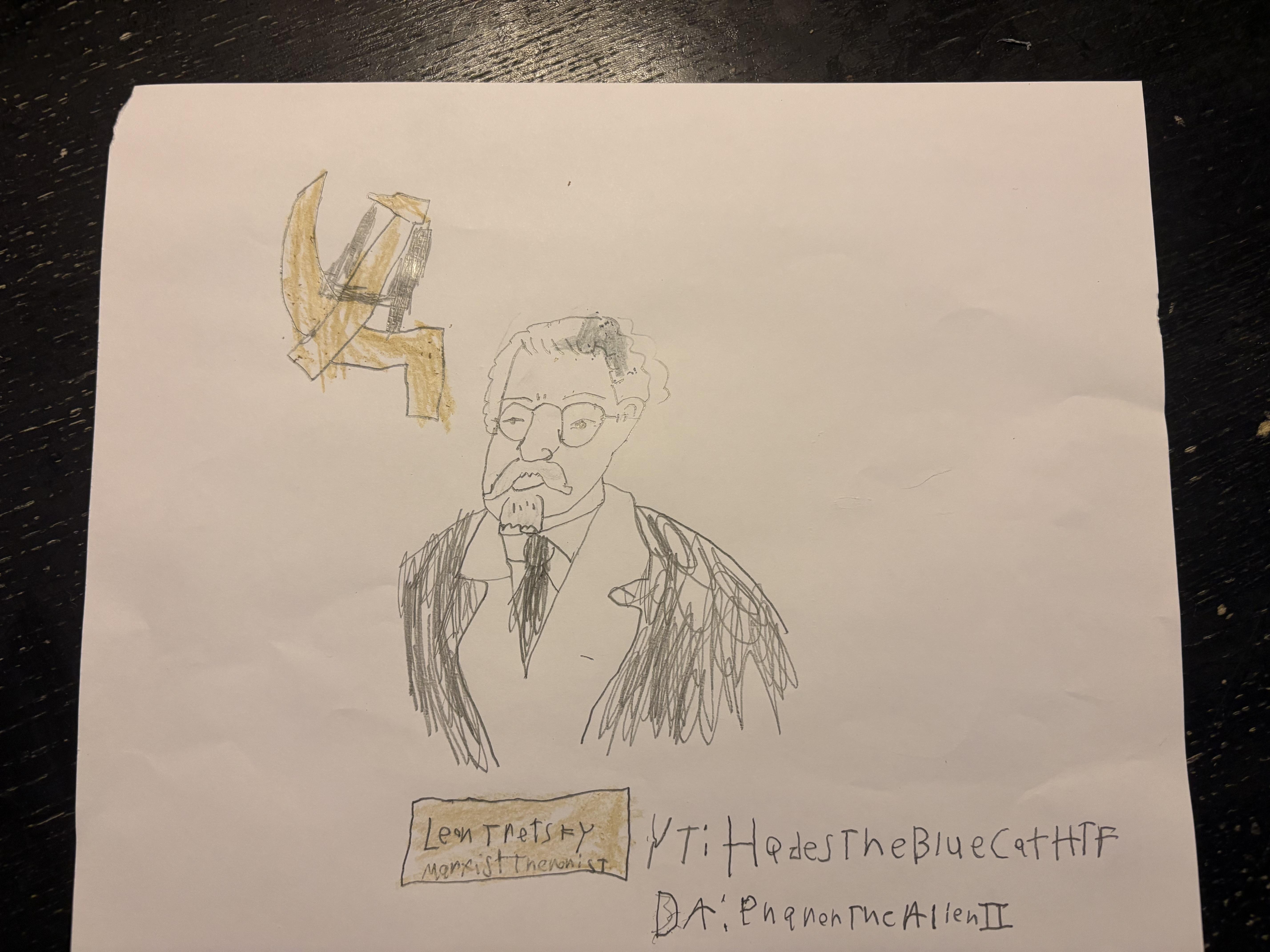
Art Leon Trotsky drawing I made

Post image
31 Upvotes

I tried my best to draw him, and this is my attempt.


r/Trotskyism • • 6d ago

James P. Cannon: The Builder of American Trotskyism (Marxist Theory)

Thumbnail
youtube.com
20 Upvotes

Transcript: James P. Cannon: The Builder of American Trotskyism

In 1928, James P. Cannon was a founding leader of the Communist Party of the United States. He spent a decade building the Communist movement, organizing the vanguard of the American working class. That year, he traveled to Moscow for the Sixth Congress of the Communist International. There, by accident, he came into possession of a suppressed document authored by Leon Trotsky.

The document was The Draft Program of the Communist International: A Criticism of Fundamentals. It delivered an exact analysis of the Stalinist bureaucracy, exposing how its nationalist doctrine of socialism in one country was destroying the world revolution. Cannon read the manuscript overnight. The text laid out the theoretical explanation for the recent catastrophic defeats of the international working class in Britain and China, tracing these failures directly to the policies of the Stalinist apparatus.

Convinced by this materialist analysis, Cannon smuggled the document out of the Soviet Union and brought it back to America to organize around its principles. The Stalinist bureaucracy answered with expulsions. The party Cannon built threw him and his comrades out, plastering their press with slanders, denouncing the revolutionaries as traitors. The Communist Party had abandoned the working class to serve a counterrevolutionary bureaucracy. By defending Trotsky's program against this degeneration, Cannon initiated the founding act of American Trotskyism.

The expulsion forced a sudden reorganization. Cannon, Max Shachtman, and Martin Abern immediately established the Communist League of America as the American section of the International Left Opposition. They were a tiny fraction of revolutionaries. The labor bureaucracy barred them from the trade unions while the official Communist Party subjected them to physical violence and endless vilification.

Against the apparatus of the Stalinist state, the Left Opposition possessed one decisive advantage: the genuine Marxist program of the world revolution. They printed this program and distributed it directly to the working class through their newspaper, The Militant. Cannon fought ruthlessly against any tendency to isolate the movement from mass struggles. He insisted that the Opposition enter the class struggle and fight for leadership in the factories and on the picket lines. The Communist League of America functioned as the living continuation of the Communist movement. Built as a direct instrument for revolution, Trotskyism emerged as the genuine Marxism of the American working class.

The definitive test of this political perspective arrived in 1934. The theoretical program of American Trotskyism met the material force of the class struggle in the streets of Minneapolis. The Trotskyists had systematically penetrated the local Teamsters Union under the leadership of Farrell Dobbs and the Dunne brothers. They organized the rank and file of the trucking industry into a disciplined fighting force.

What began in May as a strike in the coal yards escalated completely by July and August into a massive confrontation. The trucking terminals went quiet, and the workers completely shut down the commercial life of the city. Under Cannon's political direction, the strikers deployed highly organized militant tactics. They formed mass pickets and mobilized flying squads to intercept scab deliveries, physically confronting the police and the employer's deputies.

Throughout this massive collision between labor and capital, the Communist Party, which continually denounced the Trotskyists as enemies of the workers, failed to organize a single significant action. The Teamsters won total victory, breaking the back of the open-shop employers in the Midwest. The revolutionaries who led the battle codified these strategies for future generations, preserving the record in texts like Dobbs' Teamster Rebellion. The victory in the streets vindicated Cannon's strategy. The Minneapolis strikes proved that the revolutionary party can lead the American working class.

The American ruling class answered this victory with legal terror. In 1941, the federal government indicted twenty-nine leaders of the Trotskyist movement and the Teamsters Union under the Smith Act. The formal charge was sedition, but the true motive was political retaliation. The state designed the Smith Act specifically to criminalize the revolutionary politics that had just demonstrated their material power in Minneapolis.

Cannon refused to retreat. He turned the bourgeois courtroom into a political platform, openly defending the necessity of workers' power and socialism. Eighteen leaders were convicted and sent to federal prison. Cannon served his sentence alongside his comrades, and none of them compromised the revolutionary program to appease the state.

The Smith Act trial failed to crush the vanguard. The state's aggressive prosecution demonstrated its recognition of the lessons of Minneapolis. A revolutionary party capable of organizing mass strikes poses a direct material threat to capitalist property relations.

The political authority earned on the picket lines and in the courtroom culminated in the formal establishment of the Socialist Workers Party in 1938. As the national secretary of the SWP, Cannon guided its political work and recorded the history of its formation in theoretical works like The History of American Trotskyism and The Struggle for a Proletarian Party.

The history contains a sharp divergence. In the decades following his death in 1974, the SWP degenerated. It abandoned the revolutionary program, expelled the genuine Marxists, and became a petty-bourgeois sect. Cannon built the party that later betrayed the program he helped build. The degeneration of the Socialist Workers Party represents a total betrayal of Cannon's political life. The historical record demonstrates that the party must be rooted within the working class, and an organization that abandons the class requires a decisive break. The continuity of American Trotskyism passed directly to the [International Committee of the] Fourth International and its sections, leaving behind the party that betrayed the program.

The American working class remains the most powerful social force on earth. In endless mass strikes and demonstrations, it has repeatedly shown its capacity and willingness to fight capital. The ruling class has spent a century attempting to bury the history of American Trotskyism to convince workers that socialist revolution in the United States is impossible. The contradictions of capitalism compel the working class toward revolution. The party must be built again on the firm foundation of Cannon's struggle. Studying his life arms the working class for the coming battles.

Links to Selected Readings:

  1. The History of American Trotskyism — James P. Cannon (1944). Cannon's own account of the founding and development of the American Trotskyist movement. https://www.marxists.org/archive/cannon/works/1945/history/01a-1stcomm.html
  2. The Struggle for a Proletarian Party — James P. Cannon (1943). Cannon's defense of the revolutionary party against the petty-bourgeois degeneration of the movement. https://www.marxists.org/archive/cannon/works/1940/party/index.htm
  3. Teamster Rebellion — Farrell Dobbs (1972). The first-hand account of the 1934 Minneapolis strikes, led by the Trotskyists. https://archive.org/details/teamsterrebellio00farr

*Edits: Fixed the links; removed redundant text.


r/Trotskyism • • 6d ago

News Harvard student speaks out as strike enters fourth week: “It’s just really remarkable how poorly treated workers are at this university”

Thumbnail
wsws.org
10 Upvotes

As the strike by more than 4,000 Harvard graduate student workers enters its fourth week and the first-ever walkout by non-tenure-track faculty and researchers completes its first week, the World Socialist Web Site spoke with a Harvard master’s student, who has spent the strike talking with workers across campus about their conditions.

“If you just sit down and have that really simple conversation, you ask, ‘What are your working hours? How much do you take home? How much is your rent?’” she said. “It’s just really remarkable how poorly treated workers are at this university. You look around us, and we’re in the midst of such wealth. Sometimes I just walk through these buildings and I wonder, how much did that chair cost? Why is Harvard investing in these things and not in the quality of life of its workers, which are really the basis of critical inquiry here?”

Record endowment, frozen wages

The contrast she describes is a matter of record. Harvard’s endowment grew by $11.1 billion in the last fiscal year to $68 billion, while the university cut $104 million from salaries and wages. Harvard’s graduate workers have gone without a raise since their contract expired in June 2025, and the university withheld the raise non-tenure-track faculty and researchers were due last July.

Over the past year, Boston-area prices rose 3.8 percent, and energy prices 21.7 percent. Harvard’s latest offers are 6.1 percent on ratification and 3 percent a year after that for graduate workers, and 3.5 percent upfront and 15.75 percent over six years for HAW (Harvard Academic Workers) members. Both unions say these offers will not keep up with the cost of living. One graduate student told the WSWS last week that she takes home about $2,600 a month—and pays $1,300 for rent.

Harvard’s endowment windfall came from speculation. The 27.1 percent return, its highest since 2021, was driven by venture capital and, above all, by a $2.2 billion stake in SpaceX, which went public in June in the largest IPO in history, helping make Elon Musk the first trillionaire. One analysis estimated that SpaceX alone added 7.8 percentage points to the return.

Those who manage the money are lavishly rewarded. The six highest-paid executives at Harvard Management Company (HMC), which invests the endowment, took home $26.2 million in 2024, led by CEO N.P. Narvekar, a former JPMorgan derivatives executive, at $6.4 million. HMC’s 113 employees received $89 million in fiscal 2024, an average of about $800,000 each. The pay of those six executives alone equals a quarter of the $104 million Harvard cut from wages. Yet the university has frozen next year’s endowment payout, citing the new federal endowment tax, and tells its workers to accept 3 percent.

...

The student who spoke to the WSWS belongs to the Harvard Undergraduate Workers Union, which still has no first contract. She agreed with the WSWS that if the strike remains confined to two bargaining units, Harvard, “with its deep pockets,” will try to wear workers down.

“I absolutely agree,” she said. “There are multiple unions on campus that have been striking at different times. It would be great if there was more cooperation between the academic workers unions and the more traditional worker unions here on campus, because that’s what we really need actually, I think, to bring this place to a halt—for all of these units of people who make the university function to really just say, we stand in this together and we are going to shut things down.”

The potential for exactly such a movement exists. Nearly 900 Harvard University Dining Services workers, members of UNITE HERE Local 26, voted 89 percent in favor of authorizing a strike on October 20 and have been without a contract since June. At nearby MIT (Massachusetts Institute of Technology), more than 3,000 graduate workers voted 93 percent to strike on November 12, and nurses at Brigham and Women’s Hospital were set to walk out the same day.

Instead, the MIT and Brigham strikes were called off after last-minute tentative agreements, while the dining workers remain on the job with no strike date announced. Each struggle has been kept on its own separate timetable.

The student described how this division is built into the structure of employment at Harvard. “The structure is extremely splintered,” she said. “You see this even within the graduate student union. Research assistants and TFs make different rates. So it’s very difficult, because of the way that funding works at this university, to actually get people to act collectively. This has been a strategy by the university, and it’s sad to see that it’s been so effective.”

...

Harvard can outlast a strike confined to Harvard

The struggle at Harvard is part of a growing international movement of the working class, from the mass demonstrations and general strikes by workers and youth in France, Spain and Italy against austerity and war spending to mounting protests across Latin America.

The great danger is that the strike at Harvard remains isolated. With its massive resources, Harvard can outlast a strike confined to Harvard. It cannot outlast a movement of the working class as a whole.

To build that movement, workers must take the conduct of the strike into their own hands. Graduate and academic workers should form a rank-and-file strike committee and demand an immediate mass membership meeting, with an open microphone and no restrictions on discussion, at which the UAW must answer: What is your strategy to win? How are you mobilizing your 380,000 members? Which workers in Boston and nationally are you calling on? And why does a strike fund holding nearly $1 billion pay strikers only $550 a week?

Strikers should demand full strike pay from day one, the publication of all proposals and tentative agreements, the restoration of the academic freedom demand, and a full membership vote on a written agreement before any strike ends.

Above all, the strike must turn outward: to Harvard’s dining workers, to undergraduate student workers, to clerical staff and nurses, to workers across Boston and to UAW members in auto and other industries.

Harvard graduate and academic workers who want to take up this fight should contact the WSWS today.