The late 1880s saw three classic British unresolved mysteries triggered in less than a year.
What is usually agreed to be Jack the Ripper's last murder, of Mary Jane Kelly, was committed by him on 9 November 1888; Florence Maybrick was reprieved on 31 August 1889, four days before she was due to be executed for the murder of her husband ... and a third oddly neglected but controversial death took place on 15 July 1889 - that of Edwin Robert Rose.
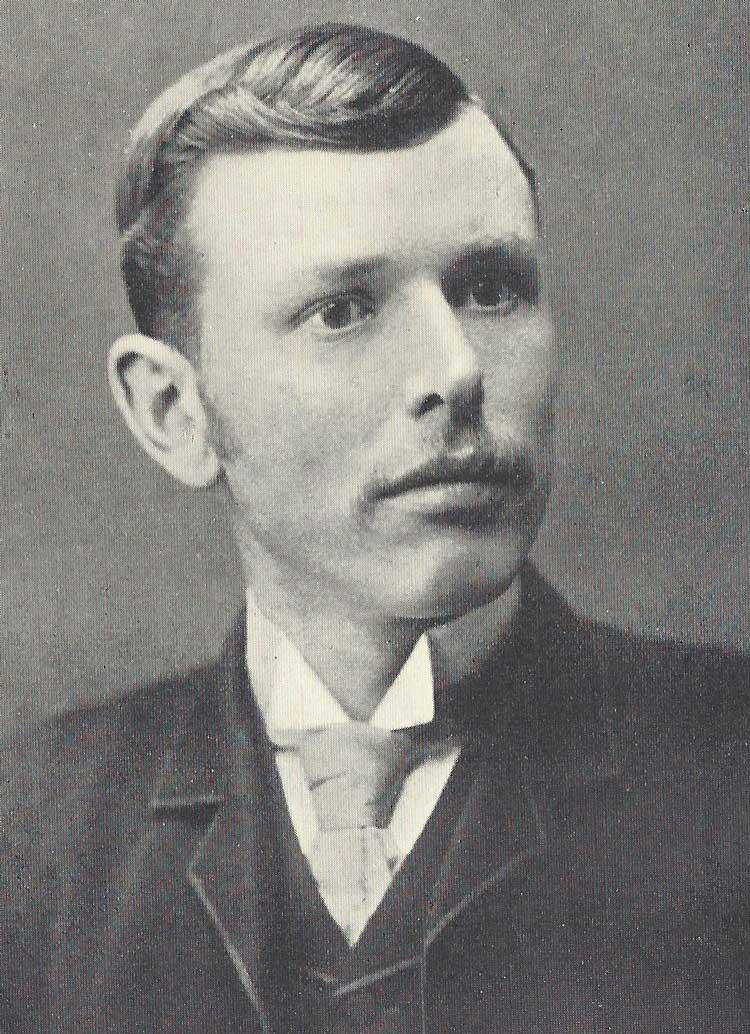
Edwin was born in Tooting, South London and worked as a clerk for a builder named James Goodman in nearby Brixton. He was 32, described as "athletic" and of "agreeable manners", "frank and open" and "prone to take up with strangers", and had decided to take a two-week holiday in Scotland starting on Friday 12 July.
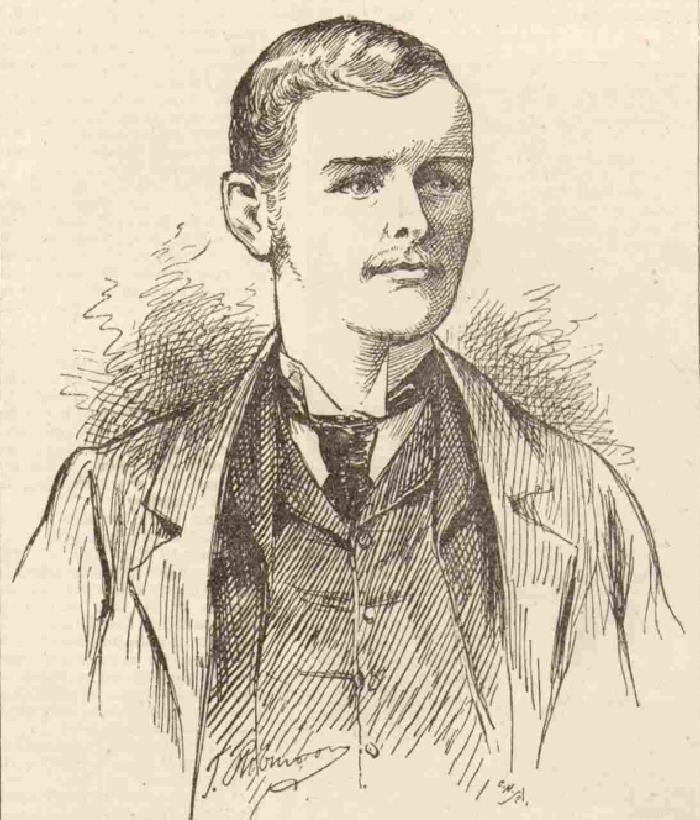
He likely travelled to Helensburgh, thirty miles West of Glasgow, by train then took the paddle steamer Ivanhoe to the island of Arran. On that boat he met John Watson Laurie, who was 25 and born in Coatbridge, about eight miles East of Glasgow. For some reason Watson Laurie introduced himself as "John Annandale". He worked for a company called Sharp & Stewart as a pattern-maker (making moulds for metal parts) in Atlas Works, in the centre of Glasgow. He had a criminal record; in March 1889 he was convicted of stealing jewellery worth £18 [£2,100 now] from his landlady. Unfortunately, given future events, his relatives made good the loss and he was only admonished.
After Edwin and Watson Laurie disembarked they found lodgings in the hamlet of Invercloy with a Mrs. Walker. Their bedroom was in a lean-to (wooden shed abutting her house), so they could come and go without being noticed.
On Saturday Edwin introduced "Annandale" to two friends whom he had got to know during a previous year's holiday. One of them was distinctly unimpressed by Watson Laurie.
Next day Edwin and Watson Laurie walked about the island and decided that they would climb Goat Fell, a splendid conical mountain of almost 3,000 feet with its summit the highest point in Arran, on Monday. One source suggests that the friend who disliked Watson Laurie strongly urged Edwin not to make that climb, to no avail.
That day they were seen by five witnesses on or near the summit at about 1815, but another witness saw only Watson Laurie going down the mountain, and only Watson Laurie bought a drink in the Corrie Hotel in Brodick, about two and a half miles South of the summit, at about 2200 by which time it was dark (sunset 2054). He vacated Mrs. Walker's lean-to early next day without paying their bill of 17 shillings [£100], but left a mixture of his and Edwin's personal effects.
Edwin was not seen alive after the encounters on the summit, and the alarm was eventually raised on the 22nd after he failed to return to work.
A search began on the 28th with two hundred participants. It was hampered by bad weather, to the extent that visibility was sometimes a few feet, and the inhospitable terrain which is full of rocks and boulders with the vegetation being mostly ferns, heather and moss. Eventually, on 4 August when the weather finally cleared, a searcher smelled something odd, went across for a closer look and found Edwin dead. He was lying on his front in a gully under the overhang of a massive boulder, covered with turf, plants and 42 smaller stones. After the tail of his jacket, which had been flipped up to cover his head, was pulled back his face and the top front of his head were seen to be crawling with maggots and "fearfully and terribly smashed" to the extent that bone fragments remained on the ground when he was lifted, and one shoulder was broken, but he had no other injuries. It was estimated later that he had fallen between 19 and 32 feet. A number of his personal items were found further up the mountain: a walking stick, a waterproof split in two, a knife, a pencil, a button and a cap weighed down by a stone.
Clearly there had been someone else involved in his death as Edwin's head was so badly damaged he could not have fallen, crawled or slid under the boulder and covered himself before dying. So a hue and cry went up.
Before and after Invercloy and Goat Fell Watson Laurie had stayed at different lodgings, in Port Bannantyne about fifteen miles North on the neighbouring island of Bute, giving a false home address. He vacated them on the 19th and followed the pattern - he didn't pay his bill of £3 3s 8d [£370] but left Edwin's yachting cap and tennis shoes. The first trapped him, as a holidaymaker named Aitken crossed paths with Watson Laurie both before and after Edwin's disappearance and had also seen him with Edwin. He had observed both of them wearing the yachting cap at different times, read the newspapers, reached the right conclusion and, when he came across Watson Laurie by chance in Glasgow on the 31st, engaged in brief conversation and drew a response of "Surely you don't think I'm a ..." with the distinct impression that something like "murderer" would have been said next. On that Aitken went to the police.
Although Edwin had not yet been found Watson Laurie was spooked, resigned his job on the spot, sold his tools for 25 shillings [£145] and embarked on an unwanted grand tour of the United Kingdom. He sent frankly rather unhinged letters protesting his innocence from Liverpool and Aberdeen to newspapers, with some of Edwin's shirts found in a box by a landlady of a boarding house he had lodged in in the first, was seen at a distance in Coatbridge a few times, then was finally spotted at close quarters on 4 September on a platform at Ferniegair (now Chatelherault) railway station, about five miles South of Coatbridge. A group of coal miners chased him into a nearby wood, cornered him then called the police, who arrested him and charged him with Edwin's murder. He survived trying to cut his throat on the spot with an open razor, which left a superficial wound: Roughead, who was clearly convinced that Watson Laurie was guilty of murder, rather cattily remarked that Watson Laurie's hand was "less sure" then than during the presumed crime.
The committal hearing was in Greenock and the trial of John Watson Laurie for the murder of Edwin Rose took place at the High Court of the Justiciary in Edinburgh on 8 and 9 November, Friday and Saturday. It was rushed, with the judge continually trying to hurry it up, as was noted even at the time. A great deal of effort was spent on what amounted to discussions of prototype forensic science, with attempts to "prove" how Edwin's injuries had been incurred. The prosecution made the error of initially arguing that Watson Laurie had beaten Edwin to death with a stone, which was easily disproved by the defence; the injuries were far too severe. So it changed the proposed method of murder to a push, causing Edwin to fall. That could not be disproved and the fact that no blood was found on Watson Laurie's clothes indirectly strengthened the argument as it suggested he was not physically close to Edwin at the instant of his fatal injury, although it was simultaneously weakened by it being practically impossible to differentiate between a fall and a push, which the prosecution tried to obscure by introducing large quantities of what would nowadays be (inadmissible) bad character evidence. At the time the accused was not allowed to speak in their own defence.
The prosecution made protracted but unconvincing and, really, pointless attempts to come up with a motive. Many famous crimes, successfully prosecuted, have never had an accepted motive.
Both sides agreed that, however Edwin died, Watson Laurie stole some of his personal effects.
From the transcript, ignoring the prosecution errors and obfuscations, the medical witnesses called by the defence (three of only seven defence witnesses; there were 86 prosecution witnesses) probably did impart reasonable doubt, with the help of some rather gruesome experiments on animals, but the main thrust of the defence's argument was weak - rather than argue that Watson Laurie saw Edwin fall, panicked because he was the only witness and hid Edwin's body, they argued that he left Edwin alive at the top of Goat Fell and never saw him again. Strangely, Watson Laurie described the superior argument in a letter sent from prison after he was sentenced; it is believed that he insisted on the inferior argument being presented at trial. Why will never be known, particularly as it contradicted the agreed fact that Watson Laurie robbed Edwin of possessions, although it was stated in the first letter Watson Laurie sent to the press when he was on the run.
So there were errors and misjudgments in both the prosecution and defence cases. The judge's summing up was generally seen as favourable to Watson Laurie: the jury's verdict came at 2225, after retiring for 45 minutes, and it was eight for Guilty, seven for Not Proven and none for Not Guilty. As in Scotland a simple majority was sufficient until 2026, the judge sentenced Watson Laurie to death, specifically "being hanged by the neck between the hours of eight and ten in the fore noon of 30th November". Watson Laurie responded with "Ladies and Gentlemen, I am innocent of this charge"; interestingly, he was not silenced while saying that, only after doing so.
The verdict sparked tumult, not just from the several thousand people who had waited patiently for hours outside the court. The demand for newspapers was so great one had a print run of almost 200,000 in short order. There were no formal appeals in criminal cases until the early 1900s: several petitions for clemency were raised, ultimately collecting almost 140,000 signatures, but probably the most effective intervention was from a Glasgow surgeon, Dr. Campbell Black, who published a twopenny pamphlet [Roughead (1932), Appendix 3, page 233] attacking many aspects of the medical evidence from both sides and asking whether there was even any proof that a crime had been committed. 140 years later, if his rather florid means of expression is ignored, the arguments made come across as being very much to the point.
Those strenuous efforts got through to the authorities. Although there was no formal mechanism for reprieve the Secretary of Scotland convened an ad hoc panel of psychologists (or "alienists", as they were called then) who made a recommendation for mercy and Watson Laurie's death sentence was commuted to life imprisonment only two days before he was due to be hanged. That was to the great relief of the authorities in Greenock, who were instrumental in raising petitions and only very reluctantly prepared for the execution which, if it had gone ahead, would have been the first there in fifty-five years.
Watson Laurie spent forty-one years in confinement after that commutation of sentence: twenty years in prison, including a failed escape attempt in 1893, and twenty-one years in a mental hospital to which he had been taken suffering from "generalised dementia". He died in 1930, aged 66.
Roughead comments that Watson Laurie was probably reprieved because of the knife-edge verdict, with one juror making the difference between death and freedom after thirteen hours of argument and debate on the second day.
However, there is no doubt that Watson Laurie was punished severely in lieu of execution.
So: did Edwin fall or was he pushed? Accident or murder? (There is no evidence of suicide).
As a finale to this tragedy Edwin's grave in Sannox Old Churchyard has a large boulder taken from Goat Fell as his tombstone.
References
Press and Journal article (2022). One of the very few modern references to the case, and a good summary.
Murderpedia article (nd). Another good summary.
Twelve Scots Trials by William Roughead (1913). Although almost forgotten now, Roughead is the first modern true crime writer in my opinion. He is brilliant, and the last chapter is an outstanding write-up of this case.
Notable British Trials: John Watson Laurie (1932). One of a lengthy series which, sadly, died out in the 1950s; it has an updated version of the write-up by Roughead to set the scene, then a full trial transcript with commentary followed by particularly interesting incidental documents. (Curiously, this volume was due to be published in 1905 then was pulled at the last minute; the publisher was likely scared of a libel action, given that Watson Laurie was alive then).
Note
Very little background information is available about either Edwin or Watson Laurie: almost nothing is known about their upbringing, parents, siblings, wives or children if any, education or previous jobs.