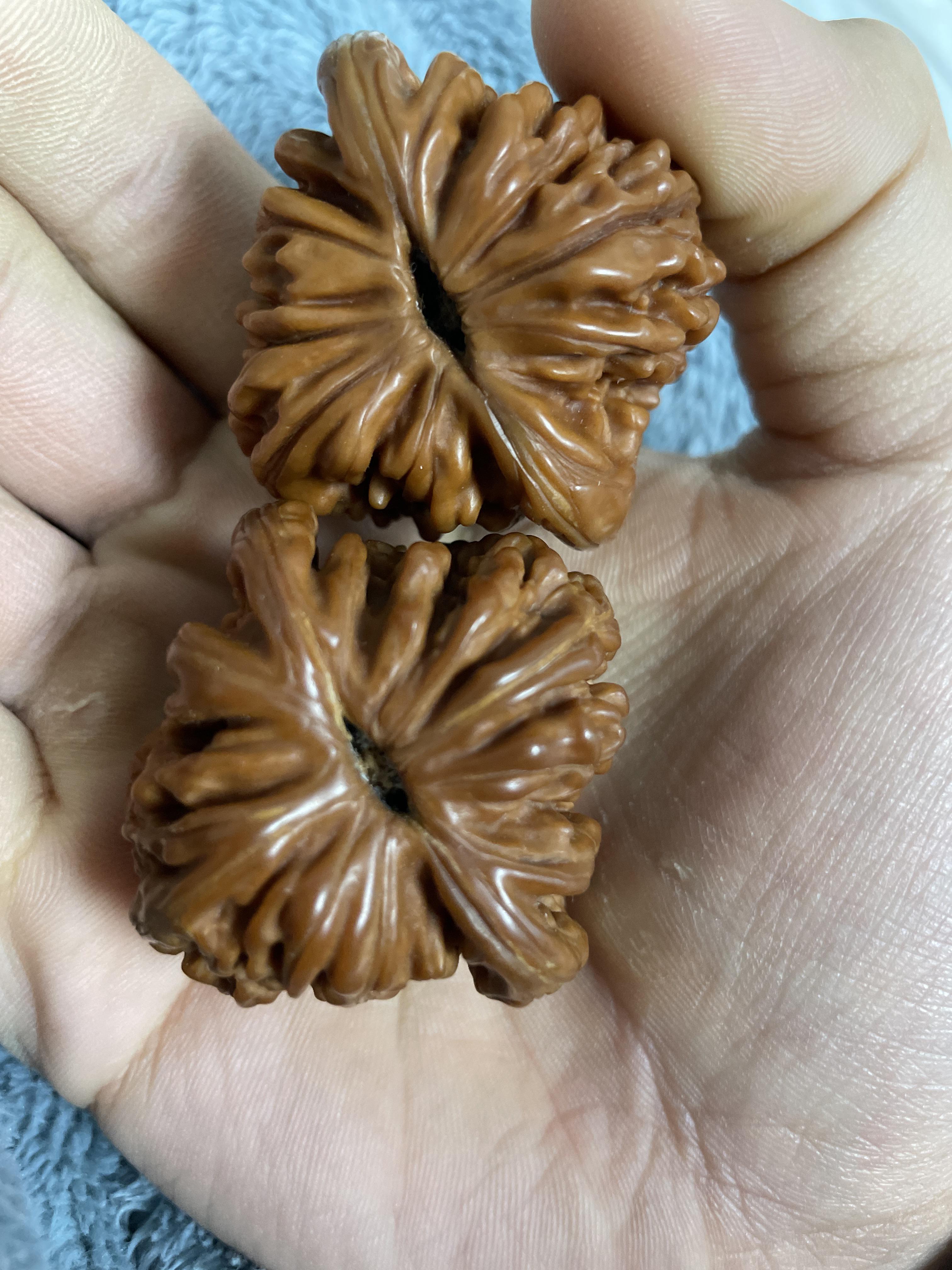
Previous post explained how to identify genuine Nanjiang Shi and select a good pair.
The "Nanjiang Shi" : How to Identify and Select the Perfect Pair
However, recognizing the variety’s typical traits should not lead us to believe that all Nanjiang Shi walnuts are supposed to look the same.
As this collage of walnuts from the original tree (as shown in the picture), even walnuts from the same tree can differ noticeably in overall shape, tips, shoulders, bases, outer edges, and the depth and flow of their ridges. Some closely match the familiar “textbook” examples, while others fall outside what newer collectors might expect from Nanjiang Shi.
No single top-tier pair or reference photo can represent the entire variety. A better way to understand it is this: a shared set of varietal traits, expressed through remarkable individual variation. “A thousand pairs, a thousand faces” is the result of both growth and pairing.
1. Why Is There So Much Variation?
The diversity of Nanjiang Shi cannot be attributed to a single cause. Nor is it accurate to explain this diversity simply by saying that every shell has a different genetic makeup.
The original tree’s genetic makeup is relatively stable, but this does not mean that every walnut develops under identical conditions.
Genetics and Tree Condition
The variety’s genetic background establishes its general range of forms; it does not prescribe an exact size, shape, or ridge pattern for every walnut.
Branches on the same tree vary in vigor. Walnuts also grow in different positions, while the tree’s crop load and internal nutrient distribution change from year to year. A walnut growing on a strong fruiting branch does not experience the same conditions as one growing on a weak or heavily laden branch.
Pruning, fertilization, pest and disease management, and harvest timing can further influence the walnut’s final size, fullness, and overall condition. The variety provides the shared foundation, while the condition of the tree influences how that foundation is expressed.
Geography, Geology, and Growing Conditions
Soil depth, texture, drainage, and fertility, together with factors such as slope and elevation, affect root growth and the tree’s access to water and nutrients. These conditions ultimately influence tree vigor and nut development.
When the variety is propagated or grown in a different location, its walnuts may develop differently as a result. But this does not mean that one type of soil automatically produces one type of ridge pattern, or that a particular location can only produce one shape.
There is no simple one-to-one relationship between a particular growing condition and a particular walnut trait.
Rainfall and Water Availability
What matters is not only the annual rainfall total, but also when the rain falls, how long wet or dry periods last, and how these conditions coincide with key stages of nut development.
Insufficient water can weaken the tree and limit nut growth, while excessive rainfall or prolonged waterlogging can disrupt normal root activity. Rainfall distribution varies from year to year, and irrigation and drainage further affect the amount of water actually available to the tree.
Consequently, the same tree may produce walnuts in different years that vary in size, fullness, and overall development. Water is one of the factors involved, not a universal explanation for every difference in appearance.
Weather and the Microclimate Within the Canopy
Light, temperature, humidity, spring cold spells, summer heat and drought, and prolonged rain near maturity can all influence tree growth and nut development during a given season.
Even on the same tree and in the same year, individual walnuts do not experience exactly the same microclimate. Different parts of the canopy—outer versus inner, upper versus lower, and different exposures—receive different amounts of light and can vary in temperature and humidity. A walnut growing in full sun on the outside of the canopy does not develop under the same conditions as one shaded deep inside the tree.
The variety provides the foundation; site conditions and water influence tree vigor; weather leaves its mark on each season; and branch position and tree management further shape individual walnuts. Pairing then brings these differences together in new combinations, giving us a thousand pairs with a thousand different faces.
2. What Makes the Original Tree Special?
If we display only a few beautifully matched, top-tier pairs from the original tree, our understanding of Nanjiang Shi becomes unnecessarily narrow. The original tree can also produce walnuts that are irregular, less typical, difficult to pair, or unusual in appearance. These walnuts do not diminish the tree’s value; they are part of its authentic record.
The purpose of this collage is therefore not merely to show that the original tree can produce outstanding walnuts. It is to present a fuller picture of the variety’s natural variation.
Beyond its importance as the genetic source of the variety, the original tree also holds particular significance in terms of walnut quality.
In the experience of many collectors, walnuts from the original tree generally have an advantage in both skin quality and shell density (often referred to as “bone” quality in the walnut-collecting community). Their skin texture, surface character, and overall feel are often highly regarded, while their shells are valued for their density, hardness, and substantial feel.
These qualities are part of what makes walnuts from the original tree especially sought after. Its value is therefore not limited to provenance or genetic authenticity; it also serves as an important quality benchmark for evaluating Nanjiang Shi walnuts.
However, this should be understood as an overall tendency rather than an absolute rule. Not every walnut from the original tree is necessarily superior to every walnut from a grafted tree. Rootstock, growing conditions, tree management, and the individual development of each walnut all contribute to the final result.
Nevertheless, when discussing the variety's origins and quality characteristics, walnuts from the original tree deserve special attention—not only because they represent the original genetic source, but also because they provide an important reference for the skin and bone qualities that collectors value in Nanjiang Shi.
The wok-shaped base, diamond-shaped navel, sloping shoulders, and dense texture discussed in my previous post should be understood as typical identifying clues—not as a rigid checklist that every walnut from the original tree must satisfy in every respect.
The original tree does not offer a single definitive template. It is a living archive that helps us understand the variety.
3. What Does “First-Generation Grafting” Mean?
In the context of wenwan walnuts, first-generation grafting usually means taking scionwood or buds directly from the original tree and grafting them onto another plant, known as the rootstock. The resulting grafted tree is commonly called a first-generation grafted tree.
The key point is that the scion comes directly from the original tree.
A tree grown from one of the original tree’s seeds is a seed-grown tree, not a first-generation grafted tree. “First-generation” describes the source of the scion and the propagation relationship; it does not simply refer to the tree’s age or the first year in which it bears nuts.
Provided that the scion source is authentic and properly documented, first-generation grafting has three main advantages:
First, it preserves and propagates the original tree’s genetic line.
Because grafting is a form of vegetative propagation, it avoids the genetic reshuffling that occurs during seed reproduction. This allows the original scion’s genetic line to be maintained and propagated more widely.
Second, it has a direct, traceable connection to the original tree.
Because the scion comes directly from the original tree, the propagation chain is relatively short. This also makes it easier to compare walnuts from the grafted tree with those from the original tree.
Third, it allows the variety to be cultivated more widely.
First-generation grafting increases the number of bearing trees and gives us an opportunity to observe how the same scion source performs under different growing conditions, rootstocks, and management practices.
However, walnuts from a first-generation grafted tree are not exact copies of those from the original tree. The scion provides the varietal genetics, but the rootstock, soil, climate, and subsequent management still affect tree vigor and nut development.
Final Thoughts: Diversity Does Not Mean the Absence of Standards
The standard for Nanjiang Shi should not be a single fixed template. It should be a set of shared traits that can still be recognized across a range of individual variation.
These shared traits allow the walnuts to be identified as Nanjiang Shi, while environmental, seasonal, and developmental differences give each one its own appearance.
The original tree shows us the source and full range of variation within the variety. First-generation grafting allows that source to be propagated. Soil, rainfall, weather, and the condition of the tree shape each crop and each walnut differently.
Pairing is not about finding two perfectly identical walnuts. It is about finding harmony in size, shape, texture, and overall character between two unique individuals.
A thousand pairs, a thousand faces. This diversity does not mean that Nanjiang Shi lacks standards; it is a central part of the natural beauty that makes the variety worth a closer look.