r/WorldHistory • u/GreenStrength5876 • 3h ago
Image Battle at Sea. My oil painting on hardboard

1
Upvotes
r/WorldHistory • u/GreenStrength5876 • 3h ago
r/WorldHistory • u/sajiasanka • 13h ago
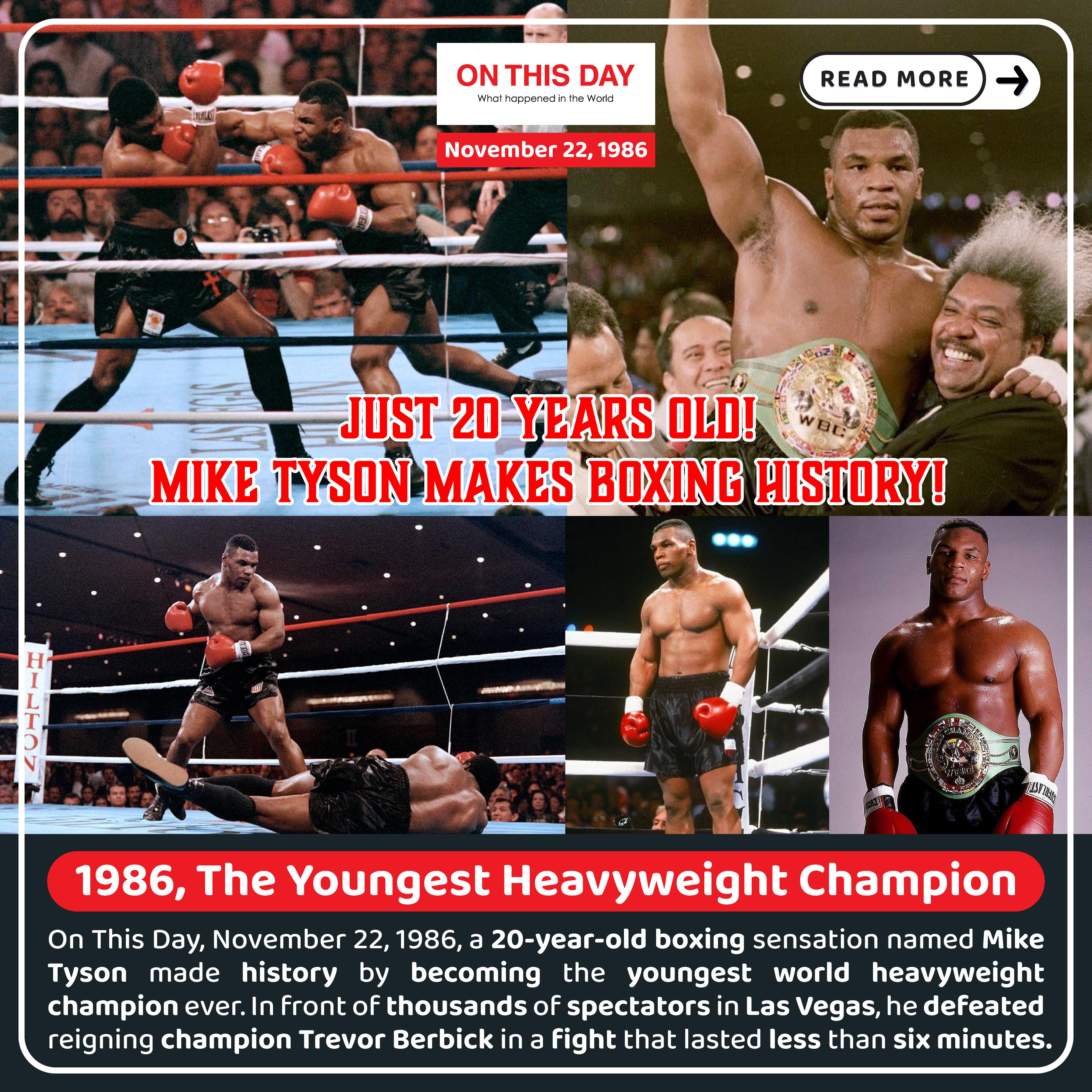
On This Day, November 22, 1986, a 20-year-old boxing sensation named Mike Tyson made history by becoming the youngest world heavyweight champion ever. In front of thousands of spectators in Las Vegas, he defeated reigning champion Trevor Berbick in a fight that lasted less than six minutes.
Known as "Iron Mike," Tyson had already built a terrifying reputation in professional boxing. His extraordinary punching power, lightning-fast combinations, and aggressive fighting style had made him one of the most feared young fighters in the sport.
But there was one major challenge standing between him and boxing history: Trevor Berbick, the reigning World Boxing Council (WBC) heavyweight champion.
Berbick was an experienced fighter who had won the championship earlier that year. At 32 years old, he was considerably older than Tyson and entered the contest determined to defend his title.
The highly anticipated fight took place at the Las Vegas Hilton in Nevada, USA.
From the opening bell, Tyson attacked with explosive combinations, speed, and relentless pressure. Berbick struggled to cope with the younger challenger's power.
The decisive action came in the second round.
Tyson knocked Berbick down with a powerful combination. Although the champion managed to get back to his feet, he was visibly unsteady.
Tyson attacked again, landing another devastating combination that sent Berbick crashing to the canvas.
The champion attempted to stand, but his legs repeatedly gave way. Referee Mills Lane decided that he could not safely continue and stopped the fight.
At exactly 2 minutes and 35 seconds of the second round, the contest was over.
Mike Tyson had done it!
At just 20 years, 4 months and 22 days old, Tyson became the youngest boxer ever to win a world heavyweight championship, breaking the previous record held by Floyd Patterson, who had won the title at 21.
Tyson's victory was especially emotional because his legendary trainer and mentor, Cus D'Amato, had died the previous year and never lived to see him achieve the dream they had worked towards together.
Tyson would later unify the major heavyweight titles, becoming the first boxer to hold the WBA, WBC, and IBF heavyweight championships simultaneously.
His victory over Berbick marked the beginning of an extraordinary era in heavyweight boxing.
A young fighter entered the ring chasing a dream. Less than six minutes later, he had become a legend.
r/WorldHistory • u/Aware-Designer2505 • 16h ago
This video provides a rough depiction of the geography of Jewish survival 1000-2026. The lights in this animation represent the estimated distribution and relative presence of Jewish communities over time. The map should be understood as a historically informed visualization, not a precise demographic reconstruction, particularly for earlier periods and regions with fragmentary records.
r/WorldHistory • u/tazrian77 • 21h ago

r/WorldHistory • u/No_Office_7730 • 1d ago

r/WorldHistory • u/definegov • 1d ago
https://youtu.be/jcsPa0AdAlI
He conquered the known world by thirty. He studied under Aristotle. He wept at the tomb of Achilles. He asked a homeless philosopher what he wanted — and never forgot the answer. This is the complete philosophical worldview of Alexander the Great: his beliefs on glory, death, ambition, unity, and what it means to be fully alive.
What drove a man to march past every edge of the known world? What did he actually believe? And what can his philosophy teach us today?
In this video we explore:
— The three years Alexander spent studying under Aristotle, and what he truly inherited
— The concept of pothos — the Greek word for a longing that conquest cannot satisfy
— His obsession with Achilles and the philosophy of choosing glory over a long life
— Why Alexander broke with Aristotle's teaching on the division of humanity
— His vision of homonoia — the unity of all peoples — and whether he truly believed it
— The contradictions, the grief, the violence, and what they reveal about the man
— What his legacy actually changed about the world — and why we still talk about him
This is not a military history. This is the mind behind the empire.
r/WorldHistory • u/History-Chronicler • 1d ago

r/WorldHistory • u/sajiasanka • 1d ago

On This Day, November 21, 1974, two devastating bombs exploded inside crowded pubs in the heart of Birmingham, England. The attacks killed 21 innocent people and injured more than 180 others, becoming one of the deadliest terrorist atrocities in British history.
It was a Thursday evening. People were enjoying a night out, meeting friends, and relaxing after work in two popular city-center pubs: The Mulberry Bush, beneath the famous Rotunda building, and The Tavern in the Town, an underground bar nearby.
At approximately 8:11 p.m., a warning telephone call was received by the Birmingham newspaper offices. The caller claimed that bombs had been planted in the city center.
But there was not enough time to locate and evacuate the buildings.
At approximately 8:17 p.m., the first bomb exploded inside The Mulberry Bush. Just three minutes later, at around 8:20 p.m., a second explosion ripped through The Tavern in the Town.
The explosions devastated both buildings. Walls collapsed, glass and debris filled the streets, and people were trapped beneath the wreckage. Emergency services rushed to the scene as firefighters, police officers, and medical teams desperately worked to rescue survivors.
The scale of the destruction was horrific.
Twenty-one people lost their lives, and 182 were injured. Many of the victims were young people who had simply gone out to enjoy an ordinary evening. Some victims died days or even weeks after the explosions from their injuries.
The attacks were attributed to the Provisional Irish Republican Army (IRA) during the violent period known as the Troubles in Northern Ireland.
But the tragedy did not end with the explosions.
Later that night, six Irishmen were arrested. They became known as the Birmingham Six: Hugh Callaghan, Patrick Hill, Gerard Hunter, Richard McIlkenny, William Power, and John Walker.
In August 1975, all six were convicted of the murders and sentenced to life imprisonment.
However, serious questions emerged about the police investigation, the confessions, and the forensic evidence used against them. The men maintained their innocence, and their convictions became one of the most notorious miscarriages of justice in British legal history.
After spending approximately 16 years in prison, the Birmingham Six were released on March 27, 1991, when the Court of Appeal quashed their convictions.
Despite decades of investigations and campaigning by victims' families, nobody has been convicted of carrying out the Birmingham Pub Bombings.
In April 2019, a fresh inquest concluded that the 21 victims had been unlawfully killed. The jury also found that an inadequate bomb warning had contributed to the deaths.
Today, the tragedy remains a painful reminder of the innocent lives destroyed by terrorism and the devastating consequences of a failed justice system.
21 people went out for an ordinary evening. They never came home. Their families have spent decades waiting for justice.
r/WorldHistory • u/TonightAble3243 • 2d ago
I want to know information. During which frame of time did these four icons exist? Any interesting facts about them? It was said that during the 1830s to 1870s these existed? Was it specifically that time frame?
r/WorldHistory • u/nAPPoTrails • 2d ago

r/WorldHistory • u/sajiasanka • 2d ago

On This Day, November 20, 1947, Princess Elizabeth, the future Queen Elizabeth II, married Lieutenant Philip Mountbatten at Westminster Abbey in London. It was one of the most celebrated royal weddings of the 20th century, bringing a moment of joy and hope to a Britain still recovering from the devastation of the Second World War.
The couple's story had begun years earlier. They first met as children at a royal family wedding in 1934, but their relationship developed when they met again in 1939 at the Royal Naval College in Dartmouth. Elizabeth was just 13, while Philip was 18.
Their friendship grew over the following years, including during the war, when Philip served with the Royal Navy overseas. Their engagement was officially announced on July 9, 1947, and the wedding was arranged for just four months later.
But Britain in 1947 was still struggling with shortages and post-war austerity. Clothing rationing remained in force, even for the King's daughter.
Princess Elizabeth was granted 200 additional clothing coupons to obtain the materials for her wedding dress. Designed by celebrated British fashion designer Norman Hartnell, the magnificent ivory duchesse satin gown was decorated with pearls, crystals, and intricate floral embroidery. Its spectacular train stretched approximately 13 feet behind her.
On the morning of November 20, thousands of people gathered along the streets of London to witness the royal procession. Around 2,000 invited guests filled Westminster Abbey, while millions around the world listened to the ceremony broadcast on BBC radio.
Princess Elizabeth arrived with her father, King George VI, and walked down the aisle accompanied by eight bridesmaids. Philip, dressed in his Royal Navy uniform, waited at the altar.
The ceremony was officiated by the Archbishop of Canterbury, Geoffrey Fisher, and the couple exchanged their wedding vows before the congregation.
Following the ceremony, the newlyweds appeared on the balcony of Buckingham Palace, greeted by enormous crowds celebrating the occasion.
Their honeymoon took them to Broadlands in Hampshire and Birkhall on the Balmoral estate in Scotland.
What began as a royal wedding became the beginning of a remarkable partnership that lasted more than 73 years. Together, they had four children: Charles, Anne, Andrew, and Edward.
On February 6, 1952, Elizabeth became Queen following the death of her father. Philip would stand beside her throughout her historic reign, supporting her through decades of royal duties and national events.
Their marriage endured until Prince Philip's death on April 9, 2021. Queen Elizabeth II died on September 8, 2022.
A wedding born in the difficult years after the war became the beginning of one of the longest and most remarkable marriages in modern royal history.
r/WorldHistory • u/RelativeMusician4224 • 2d ago
I made a short animated film about Shivaji's escape from Agra, told from his point of view: https://youtu.be/9uNT9sRbxw0 . Here's the written version, mostly from Jadunath Sarkar's "Shivaji and His Times" (ch. 6), which collects the Persian chronicles and Rajasthani letters.
The basket details come from later chronicles, so I've kept the date and route hedged. Original cartoon animation; AI tools are part of how it's made, including the narration voice. Happy to be corrected on anything.
r/WorldHistory • u/dellings • 2d ago
Gettysburg Address. Operation Uranus Stalingrad. Pele 1000
r/WorldHistory • u/sajiasanka • 2d ago

On This Day, November 20, 1974, the aviation world was shocked when a Boeing 747 passenger aircraft crashed shortly after taking off from Nairobi, Kenya. The disaster became the first fatal accident involving the legendary Boeing 747, the aircraft popularly known as the "Jumbo Jet."
Lufthansa Flight 540 was operating a scheduled international service from Frankfurt, Germany, to Johannesburg, South Africa, with a stop in Nairobi. The aircraft involved was a Boeing 747-130 named "Hessen," registered D-ABYB. There were 157 people on board, including 140 passengers and 17 crew members.
At approximately 7:54 a.m. local time, the aircraft began its takeoff from Nairobi's airport.
Initially, everything appeared normal. The enormous aircraft accelerated along the runway and lifted into the air. But within seconds, something went terribly wrong.
The aircraft struggled to climb. It reached only around 100 feet above the ground before beginning to descend. Despite the crew's attempts to control the situation, the aircraft struck the ground, continued moving across the terrain, and hit an elevated access road.
The impact destroyed much of the aircraft, and a massive fire quickly engulfed the wreckage.
Rescue efforts began immediately. Survivors escaped through emergency exits and evacuation slides, while firefighters and emergency personnel rushed to the scene.
The tragedy claimed 59 lives—55 passengers and four crew members. The remaining 98 people survived, although many suffered injuries.
But what had caused such a devastating accident?
The official investigation discovered that the aircraft had taken off with its leading-edge flaps retracted. These important devices help an aircraft generate the lift needed to take off safely at lower speeds.
The pneumatic system responsible for extending them had not been activated correctly. As a result, the aircraft became airborne in a dangerous, partially stalled condition and was unable to climb normally.
The investigation also identified weaknesses in cockpit procedures and warning systems that failed to adequately alert the crew to the dangerous configuration.
The accident exposed serious weaknesses in aircraft safety procedures and highlighted the importance of effective warning systems, checklist discipline, and cockpit cross-checking.
Although the Boeing 747 would go on to become one of the most successful and recognizable passenger aircraft in aviation history, its first fatal accident became a painful reminder that even the most advanced aircraft depend on safety systems and procedures working correctly.
r/WorldHistory • u/acasiaconnel • 2d ago
Adolf Hitler wollte die Olympischen Sommerspiele 1936 in Berlin als große Propagandashow nutzen, um die vermeintliche „arische Überlegenheit“ zu demonstrieren. Stattdessen wurde der afroamerikanische Leichtathlet Jesse Owens mit vier Goldmedaillen (100 m, 200 m, Weitsprung und 4x100 m Staffel) zum gefeierten Star der Spiele direkt vor den Augen des NS Regimes.
Quellen aus deutschen Archiven:
• Bundesarchiv Themenbeitrag zum Olympiajahr 1936
• Deutsches Historisches Museum (LeMO) Die XI. Olympischen Sommerspiele in Berlin 1936
r/WorldHistory • u/sajiasanka • 3d ago
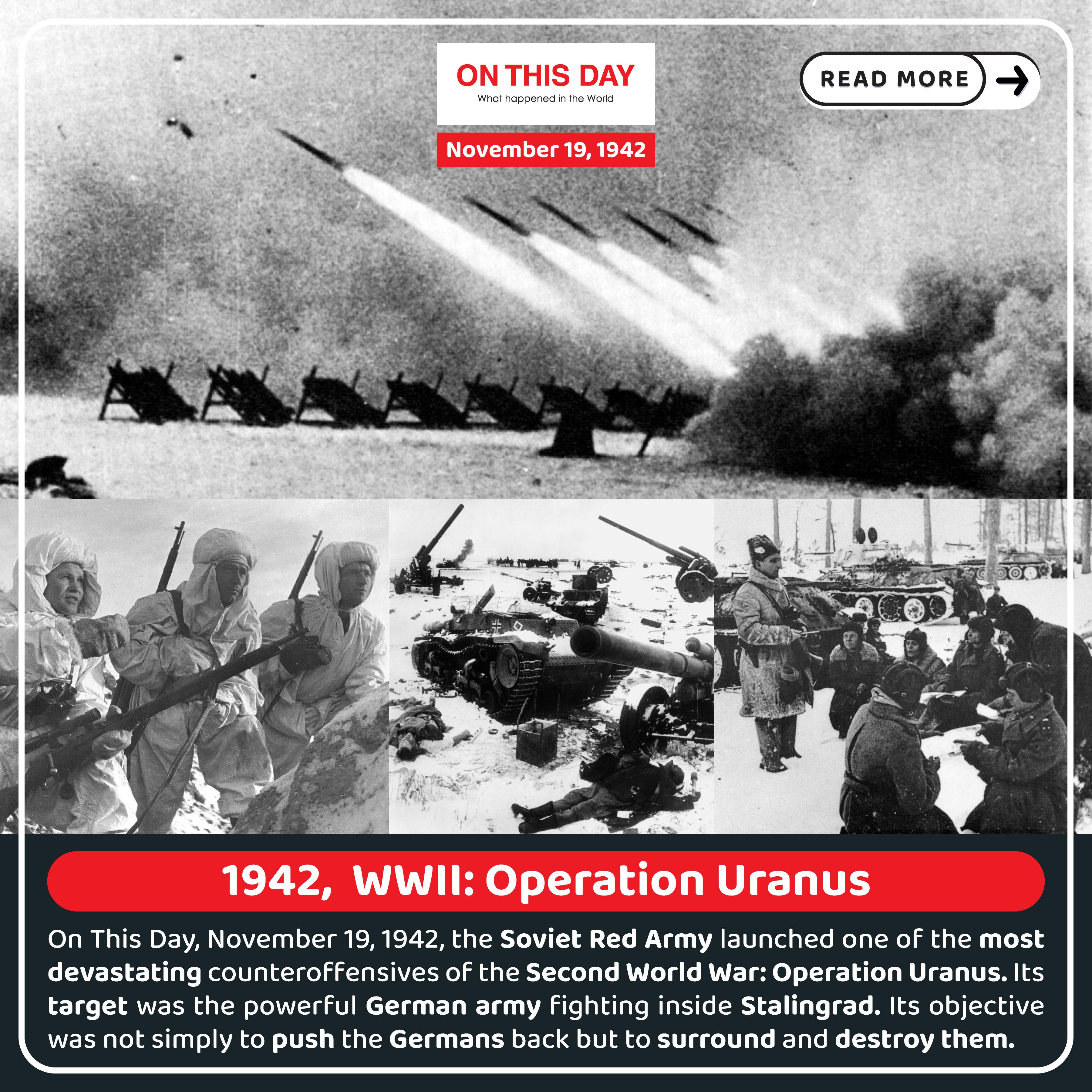
On This Day, November 19, 1942, the Soviet Red Army launched one of the most devastating counteroffensives of the Second World War: Operation Uranus. Its target was the powerful German army fighting inside Stalingrad. Its objective was not simply to push the Germans back but to surround and destroy them.
For months, German forces under General Friedrich Paulus had been fighting to capture Stalingrad, a strategically important industrial city on the banks of the Volga River. The battle had become a nightmare of brutal street fighting, with soldiers battling for individual buildings, factories, and streets. Adolf Hitler was determined to capture the city, while Soviet defenders refused to surrender.
But behind the German advance, a dangerous weakness had developed.
The German army's northern and southern flanks were largely protected by Romanian forces. These positions were stretched across vast distances and lacked the strength and equipment needed to withstand a major Soviet assault.
The Soviet high command recognized this weakness and secretly prepared a massive counterattack.
On the morning of November 19, 1942, Soviet artillery unleashed a devastating bombardment against Romanian positions northwest of Stalingrad. Soviet infantry and armoured forces then broke through the defensive lines, advancing deep behind the Axis forces.
The following day, November 20, another Soviet offensive struck from the south. The two Soviet forces advanced towards each other in a gigantic pincer movement, threatening to cut off the German troops fighting inside Stalingrad.
On November 23, Soviet forces met near Kalach-on-Don, closing the encirclement.
The trap had been completed.
Hundreds of thousands of German and allied Axis troops were now trapped inside the Stalingrad pocket, cut off from their supply routes and surrounded by Soviet forces. German commanders hoped they could supply the trapped army by air and eventually break through the Soviet ring, but those hopes would ultimately fail.
Hitler refused to authorize a full withdrawal.
As winter tightened its grip, the trapped German soldiers faced starvation, freezing temperatures, disease, and relentless Soviet attacks. The German Sixth Army eventually surrendered in February 1943.
Operation Uranus had transformed the Battle of Stalingrad and dealt Nazi Germany one of its most catastrophic military defeats. The momentum on the Eastern Front had shifted, and the Red Army would increasingly take the initiative in the war against Nazi Germany.
A battle that began with a German advance ended with an entire army surrounded.
r/WorldHistory • u/Augustus_Ceaser-Rome • 3d ago
r/WorldHistory • u/ImportedSatanist • 3d ago
r/WorldHistory • u/persequetur • 4d ago

r/WorldHistory • u/History-Chronicler • 4d ago

r/WorldHistory • u/sajiasanka • 4d ago

On This Day, November 18, 1916, one of the bloodiest and most devastating battles of the First World War came to an end as British Commander-in-Chief General Sir Douglas Haig called off the Somme offensive in northern France.
For 141 days, British, French, and German soldiers had fought across a landscape transformed into a nightmare of trenches, artillery craters, mud, and shattered villages.
The battle had begun on July 1, 1916, when British and French forces launched a massive offensive against German positions along the River Somme.
The British Army had spent days bombarding German defenses with artillery, believing that the bombardment would destroy enemy positions and allow infantry to advance.
But when the soldiers climbed out of their trenches and moved across No Man's Land, they encountered devastating machine-gun and artillery fire.
The first day became the bloodiest in British military history.
Approximately 57,470 British soldiers became casualties on July 1 alone, including around 19,240 killed. Thousands more were wounded or missing.
Yet the battle continued.
Throughout the summer and autumn, wave after wave of attacks and counterattacks took place around villages, woods, and heavily fortified German positions.
Places such as Delville Wood, High Wood, and Pozières became scenes of extraordinary suffering.
In September, another remarkable moment in military history occurred when British forces used tanks in battle for the first time during the attack near Flers-Courcelette. Although the new machines were unreliable, they signaled the beginning of a new era in warfare.
As autumn turned into winter, the battlefield became almost impossible to cross. Heavy rain transformed the ground into thick mud, while freezing temperatures, exhaustion, and disease added to the soldiers' suffering.
Finally, on November 18, General Douglas Haig ordered the offensive to end.
The human cost was staggering.
By the end of the campaign, estimates placed British Empire casualties at approximately 420,000, French casualties at around 200,000, and German casualties at least 450,000.
That meant more than one million casualties across the opposing armies.
Despite this enormous sacrifice, Allied forces had advanced only about six to seven miles (10–12 kilometers) in the main battle area. The hoped-for decisive breakthrough had not been achieved.
The Battle of the Somme remains one of the most haunting reminders of the terrible human cost of trench warfare.
Behind every casualty statistic was a soldier, a family, and a life forever changed by the horrors of war.
r/WorldHistory • u/EverythingExplained1 • 4d ago


